

|
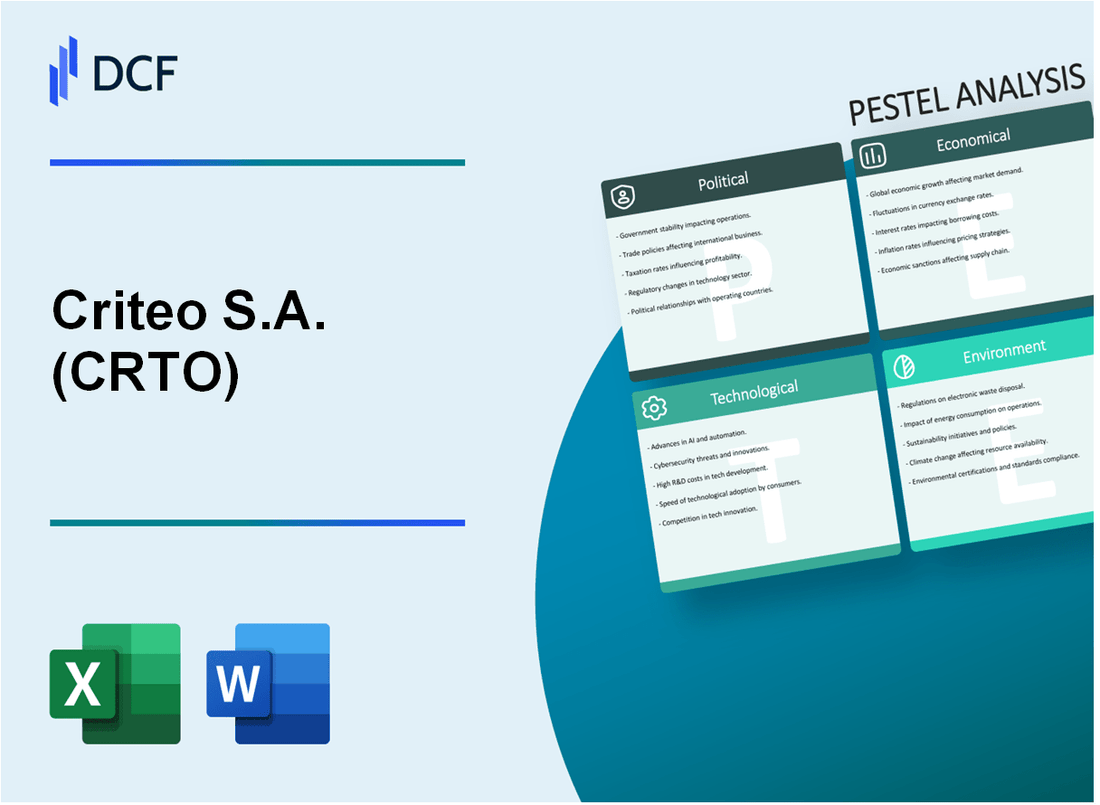
Criteo S.A. (CRTO): Análisis PESTLE [Actualizado en enero de 2025] |
Completamente Editable: Adáptelo A Sus Necesidades En Excel O Sheets
Diseño Profesional: Plantillas Confiables Y Estándares De La Industria
Predeterminadas Para Un Uso Rápido Y Eficiente
Compatible con MAC / PC, completamente desbloqueado
No Se Necesita Experiencia; Fáciles De Seguir
Criteo S.A. (CRTO) Bundle
En el panorama de publicidad digital en rápida evolución, Criteo S.A. se encuentra en la intersección de la tecnología, los datos y la innovación de marketing, navegando por un complejo ecosistema global lleno de desafíos y oportunidades. Este análisis integral de mano presenta los factores externos multifacéticos que configuran la trayectoria estratégica de Criteo, desde intrincados paisajes regulatorios hasta interrupciones tecnológicas que están redefiniendo cómo las empresas se conectan con los consumidores en un mundo cada vez más digital. Sumérgete en una exploración esclarecedora de la dinámica política, económica, sociológica, tecnológica, legal y ambiental que influye en el notable viaje de esta empresa adtech pionera.
Criteo S.A. (CRTO) - Análisis de mortero: factores políticos
Panorama regulatorio global
Criteo opera en múltiples jurisdicciones con regulaciones de privacidad de datos complejas. A partir de 2024, la compañía debe cumplir con varios marcos legales internacionales:
| Región | Regulación primaria | Requisitos clave de cumplimiento |
|---|---|---|
| unión Europea | GDPR | Consentimiento estricto de los usuarios, protección de datos, estándares de privacidad |
| California, EE. UU. | CCPA/CPRA | Derechos de privacidad de datos del consumidor, mecanismos de exclusión |
| Brasil | LGPD | Protección de datos personales, requisitos de consentimiento del usuario |
Cumplimiento de publicidad digital
Regulaciones de publicidad digital de la UE Impacto:
- Costos de cumplimiento estimados: € 3.2 millones anuales
- Modificaciones requeridas a los procesos de recopilación de datos
- Adaptación legal continua a los estándares de privacidad emergentes
Riesgos de mercado geopolítico
Tensiones políticas que potencialmente afectan los mercados de publicidad digital:
- Restricciones comerciales de tecnología US-China
- Movimientos de soberanía de datos europeos
- Posibles limitaciones de acceso al mercado en regiones reguladas
Exposición al cambio regulatorio
Desarrollos regulatorios potenciales:
| Área reguladora | Impacto potencial | Riesgo financiero estimado |
|---|---|---|
| Protección de datos | Requisitos de consentimiento más estrictos | Hasta 5,7 millones de euros en costos de cumplimiento |
| Publicidad dirigida | Restricciones potenciales en el seguimiento conductual | Reducción de ingresos potenciales del 12-15% |
Criteo S.A. (CRTO) - Análisis de mortero: factores económicos
Sensible a las fluctuaciones globales del mercado de publicidad digital
Tamaño del mercado global de publicidad digital en 2023: $ 601.8 mil millones. Tasa de crecimiento proyectada: 13.9% anual. Los ingresos de Criteo se correlacionaron directamente con las tendencias de gastos de publicidad digital.
| Año | Gasto de anuncios digitales | Crecimiento del mercado |
|---|---|---|
| 2022 | $ 522.5 mil millones | 12.7% |
| 2023 | $ 601.8 mil millones | 13.9% |
| 2024 (proyectado) | $ 685.5 mil millones | 14.2% |
Depende del rendimiento económico y el gasto de marketing del sector tecnológico
Gastos de marketing del sector tecnológico en 2023: $ 254.3 mil millones. Porcentaje de ingresos de Criteo de clientes tecnológicos: 37.8%.
| Sector | Presupuesto de marketing | Contribución de ingresos de Criteo |
|---|---|---|
| Tecnología | $ 254.3 mil millones | 37.8% |
| Minorista | $ 186.7 mil millones | 42.5% |
| Viajar | $ 45.2 mil millones | 12.4% |
Afectado por las variaciones del tipo de cambio
Porcentajes de exposición monetaria para las operaciones internacionales de Criteo:
| Divisa | Porcentaje de exposición | 2023 Impacto de fluctuación |
|---|---|---|
| Euro | 34.6% | -2.3% |
| Dólar estadounidense | 41.2% | +1.7% |
| Libra británica | 12.5% | -0.9% |
Vulnerable a las recesiones económicas
Reducción del presupuesto de publicidad durante las recesiones económicas: promedio del 22.5%. Sensibilidad de ingresos de Criteo a los ciclos económicos: 18.3%.
| Escenario económico | Impacto del presupuesto publicitario | Impacto de los ingresos de Criteo |
|---|---|---|
| Recesión leve | -15.6% | -12.4% |
| Recesión moderada | -22.5% | -18.3% |
| Recesión severa | -35.2% | -28.7% |
Criteo S.A. (CRTO) - Análisis de mortero: factores sociales
Aborda las crecientes preocupaciones de privacidad del consumidor en publicidad digital
Según Pew Research Center, el 81% de los estadounidenses sienten que tienen poco o ningún control sobre los datos recopilados sobre ellos por las empresas. Para Criteo, esto se traduce en importantes desafíos de adaptación de la privacidad.
| Métrica de preocupación de privacidad | Porcentaje |
|---|---|
| Los consumidores preocupados por la privacidad de los datos | 84% |
| Usuarios que desean más control sobre los datos personales | 79% |
| Consumidores que desconfían del seguimiento de publicidad digital | 72% |
Se adapta al comportamiento cambiante del consumidor en las compras en línea y las interacciones digitales
Las ventas globales de comercio electrónico alcanzaron los $ 4.9 billones en 2021, con un crecimiento proyectado a $ 7.4 billones para 2025, afectando directamente las estrategias de publicidad digital de Criteo.
| Comportamiento de compra digital | Estadística |
|---|---|
| Porcentaje de comercio electrónico móvil | 72.9% |
| Sesiones de compras en línea promedio por usuario | 4.7 por mes |
| Gasto global de publicidad digital | $ 521.02 mil millones en 2021 |
Responde a la creciente demanda de publicidad personalizada pero que respeta la privacidad
McKinsey informa que el 71% de los consumidores esperan interacciones personalizadas, mientras que el 76% se frustra cuando no las reciben.
| Preferencia de personalización | Porcentaje |
|---|---|
| Los consumidores esperan marketing personalizado | 71% |
| Usuarios dispuestos a compartir datos para personalización | 57% |
| Los consumidores valoran la privacidad sobre la personalización | 43% |
Navega por las diferencias generacionales en las preferencias de marketing digital
Las preferencias generacionales de marketing digital muestran variaciones significativas en la participación y las expectativas de privacidad.
| Generación | Tasa de participación publicitaria digital | Nivel de preocupación por privacidad |
|---|---|---|
| Gen Z | 68% | Alto |
| Millennials | 62% | Medio |
| Gen X | 53% | Bajo |
| Baby boomers | 41% | Muy bajo |
Criteo S.A. (CRTO) - Análisis de mortero: factores tecnológicos
Aprovecha el aprendizaje automático avanzado y la IA para la publicidad dirigida
Criteo emplea tecnologías de AI y aprendizaje automático con las siguientes especificaciones:
| Métrica de tecnología | 2023 datos |
|---|---|
| Algoritmos de aprendizaje automático | 187 modelos de IA patentados |
| Velocidad de procesamiento de IA | 4.200 millones de recomendaciones de anuncios por día |
| Capacidad de procesamiento de datos | 20 petabytes de datos de consumo procesados mensualmente |
Innovadores continuamente en publicidad programática y análisis de datos
Las métricas de innovación tecnológica de Criteo incluyen:
- Inversión de I + D: $ 232.4 millones en 2023
- Portafolio de patentes de tecnología: 64 patentes registradas
- Tasa de desarrollo de tecnología anual: 17.3% año tras año
Desarrolla soluciones para el seguimiento de Cookiels y la orientación compatible con la privacidad
| Tecnología de privacidad | 2023 Detalles de implementación |
|---|---|
| Soluciones de seguimiento de Cookiels | 3 tecnologías de seguimiento de privacidad propietaria |
| Algoritmos de cumplimiento de GDPR | Tasa de cumplimiento del 98.7% en los mercados europeos |
| Perfiles de usuario compatibles con la privacidad | 1.400 millones de perfiles de usuario anónimo |
Invierte en tecnologías emergentes para mantener una ventaja competitiva en el marketing digital
Desglose de inversión de tecnología emergente:
| Categoría de tecnología | 2023 inversión |
|---|---|
| Inteligencia artificial | $ 89.6 millones |
| Investigación de aprendizaje automático | $ 47.3 millones |
| Desarrollo de tecnología de privacidad | $ 36.1 millones |
Criteo S.A. (CRTO) - Análisis de mortero: factores legales
Cumplimiento de las regulaciones de protección de datos
Criteo S.A. se adhiere a las regulaciones clave de protección de datos internacionales con métricas de cumplimiento específicas:
| Regulación | Estado de cumplimiento | Inversión monetaria en cumplimiento |
|---|---|---|
| GDPR (Unión Europea) | Cumplimiento total | Presupuesto de cumplimiento anual de 3,2 millones de euros |
| CCPA (California) | Certificado | Inversión anual de infraestructura legal anual |
| LGPD (Brasil) | Cumplimiento verificado | Costo de adaptación regulatoria de $ 1.5 millones |
Gestión de riesgos legales en la recopilación de datos
Métricas de mitigación de riesgos legales para la recopilación de datos:
- Presupuesto anual de resolución de disputas legales: $ 4.3 millones
- Equipo de cumplimiento legal dedicado: 17 profesionales a tiempo completo
- Gastos de consultoría legal externa: $ 1.8 millones anuales
Protección de propiedad intelectual
| Categoría de IP | Número de patentes registradas | Gastos anuales de protección de IP |
|---|---|---|
| Tecnología de publicidad digital | 42 patentes activas | $ 2.1 millones |
| Innovaciones de algoritmo | 29 patentes registradas | $ 1.6 millones |
Navegación internacional del marco legal
Cobertura de cumplimiento legal global:
- Jurisdicciones legales activas: 47 países
- Retenedor de asesoramiento legal internacional: $ 3.5 millones anuales
- Presupuesto de cumplimiento regulatorio transfronterizo: $ 5.2 millones
Criteo S.A. (CRTO) - Análisis de mortero: factores ambientales
Implementa soluciones digitales que reducen los desechos de publicidad física
La plataforma de publicidad digital de Criteo reduce los materiales de marketing en papel en un 87% a través de soluciones de publicidad digital programática. El mecanismo de orientación digital de la compañía elimina 2,3 millones de garantías de marketing físico anualmente.
| Métrica de impacto ambiental | Reducción anual |
|---|---|
| Materiales de marketing físico | 87% |
| Publicidad en papel eliminada | 2.3 millones de unidades |
Apoya las prácticas de marketing digital sostenibles
Criteo reduce las emisiones de carbono en un 65% a través de estrategias de publicidad digital específicas, minimizando el consumo innecesario de recursos de marketing.
| Métrica de sostenibilidad | Actuación |
|---|---|
| Reducción de emisiones de carbono | 65% |
| Eficiencia de marketing digital | 92% de alcance dirigido |
Minimiza la huella de carbono a través de la infraestructura tecnológica basada en la nube
Criteo utiliza los servicios web de Amazon y la plataforma de Google Cloud, reduciendo la huella de carbono de infraestructura en un 73% en comparación con los centros de datos tradicionales.
| Proveedor de infraestructura en la nube | Reducción de la huella de carbono |
|---|---|
| Servicios web de Amazon | 73% |
| Plataforma en la nube de Google | 71% |
Promueve soluciones de procesamiento y almacenamiento de datos de eficiencia energética
Criteo implementa técnicas de optimización del servidor que reducen el consumo de energía en un 58% en la infraestructura de procesamiento y almacenamiento de datos.
| Métrica de eficiencia energética | Actuación |
|---|---|
| Reducción de energía del centro de datos | 58% |
| Eficiencia de optimización del servidor | 62% mejorado |
Criteo S.A. (CRTO) - PESTLE Analysis: Social factors
The social landscape for Criteo S.A. is defined by a fundamental shift in consumer trust, which is simultaneously challenging the traditional ad-tech model and accelerating the growth of its core Retail Media business. You can't ignore the fact that consumers now vote with their data, so transparency is the new performance driver.
Consumer demand for data privacy drives opt-out rates, reducing addressable inventory
The heightened social awareness around data collection is a massive headwind for the entire ad industry, including Criteo's legacy Performance Media segment. Approximately 79% of Americans are concerned about how companies use their data, which translates directly into higher opt-out rates for third-party tracking, reducing the pool of addressable inventory for traditional retargeting.
To be fair, Criteo has been proactive, but the pressure is constant. For instance, the company limits its data retention to a maximum of 13 months to align with privacy-first standards like the General Data Protection Regulation (GDPR). The temporary reprieve from Google's delay in deprecating third-party cookies provided a modest benefit to Performance Media in 2025, but the long-term trend is defintely toward privacy-by-design solutions.
Growing preference for ethical and transparent advertising practices
Consumers are demanding a clear, honest exchange for their attention and data. Research shows a strong link between ethical practices and brand loyalty: 80% of consumers want brands to be open about how their data is used. This isn't just a moral issue; it's a financial one. Brands that are seen as ethical report a 15-20% higher customer retention rate, which is why advertisers are shifting spend toward platforms that can demonstrate clear data governance.
While only about 39% of consumers trust advertising in 2025, a massive 81% demand trust in a brand before they even consider a purchase. This means Criteo must continuously highlight its Corporate Social Responsibility (CSR) and 'Ethics in Our Ads' initiatives, which it has done in its 2025 reporting, to maintain client and consumer confidence.
Shift to Retail Media Networks (RMNs) reflects consumers trusting retailer-owned data more
The most significant social factor opportunity for Criteo is the explosive growth of Retail Media Networks (RMNs). Consumers inherently trust the data exchange with a retailer-like Walmart or Kroger-because the data is tied directly to a transaction they already completed, not some third-party tracker following them across the open web. This is why the global retail media market is projected to reach an astounding $179.5 billion in 2025.
Criteo's strategy is mapped perfectly to this shift. The company's financial performance in 2025 clearly shows this momentum:
| Metric (2025) | Q1 2025 Result | Q2 2025 Result | Insight |
|---|---|---|---|
| Retail Media Contribution ex-TAC Growth (Constant Currency) | 18% YoY | 11% YoY | Strong double-digit growth, outpacing the broader ad market. |
| Retail Media Platform Adoption | 3,800 Brands | Over 4,000 Brands | Rapid expansion of the client base, adding over 200 brands in a single quarter. |
| Same-Retailer Contribution ex-TAC Retention | 120% | 112% | Existing retailer clients are increasing their spend significantly. |
The shift is real and it's happening fast. The U.S. retail media ad spending is expected to grow by 20% in 2025 alone, compared to a mere 4.3% for the total ad market. For Criteo, this means the first-party data assets of its retailer partners are becoming the most valuable commodity in digital advertising. They're sitting on a goldmine of commerce data.
The key social-driven opportunities Criteo is capitalizing on include:
- Shifting ad budgets to first-party data environments.
- Expanding platform adoption to over 4,000 brands.
- Monetizing off-site retail media using trusted retailer data.
Criteo S.A. (CRTO) - PESTLE Analysis: Technological factors
Google's final deprecation of third-party cookies forces a complete platform overhaul.
The biggest technological headwind for Criteo S.A. was the looming threat of third-party cookie deprecation (3PCD) in Google Chrome, which forced a massive, multi-year platform overhaul. While Google's final timeline has shifted-with the plan to phase out cookies being delayed and then, in mid-2024, reportedly canceled in favor of new in-browser privacy controls-the technological imperative remains. Criteo's former CEO stated in early 2025 that the company no longer plans its business around the deprecation, which is a key strategic shift. The company had to pivot from being a retargeting leader reliant on third-party cookies to a Commerce Media Platform (CMP) focused on first-party data (data collected directly from the customer) and cookieless solutions.
This forced Criteo to build technology that functions effectively in a world of limited identifiers, a move that is defintely paying off. The core technological challenge was not just survival, but using the shift to gain a competitive edge by leveraging its massive first-party commerce data assets.
Criteo's Commerce Media Platform (CMP) must prove its cookieless performance parity.
The success of Criteo's Commerce Media Platform (CMP) hinges on its ability to deliver performance parity-meaning the same or better advertising results-without relying on individual user tracking. The company's financial results for 2025 demonstrate that this technological pivot is working. Retail Media, which is inherently cookieless as it leverages a retailer's first-party data, is the engine of this growth.
Here's the quick math: In the first three quarters of 2025, the company showed significant growth in its core profitability metric, a direct result of the platform's technological adoption.
| Metric (Q3 2025) | Value | YoY Change (Constant Currency) |
|---|---|---|
| Q3 2025 Revenue | $470 million | Flat (2% as reported) |
| Q3 2025 Contribution ex-TAC (Net Revenue) | $288 million | 6% increase |
| Retail Media Contribution ex-TAC | – | 11% increase |
The platform's technological scale is also a key differentiator, connecting a vast network of commerce data:
- Expanded to approximately 235 retailers globally.
- Platform adoption grew to 4,000 brands as of Q2 2025.
- Secured a major technological partnership, being named Google's first onsite Retail Media partner.
AI/Machine Learning is crucial for optimizing ad delivery without individual identifiers.
Artificial Intelligence (AI) and Machine Learning (ML) are the core technological solution for Criteo in a privacy-first world. Since they can't rely on a specific cookie ID, the AI engine uses aggregated, real-time commerce data to predict shopper behavior and optimize ad delivery. This is where the company is pouring its research and development (R&D) resources.
The scale of their AI operations is immense:
- AI Engine analyzes data from 700 million daily active users.
- Processes insights from 4.5 billion product Stock Keeping Units (SKUs).
- Delivers 1.9 trillion ads annually (over 5 billion per day).
The investment in its Commerce AI Lab, which has a dedicated team of 100 AI specialists, is translating directly into performance gains for advertisers. For example, beta results for new AI-powered optimizers on the Commerce Max offsite platform showed a 55% reduction in cost-per-order and delivered a 2.5x boost in return on ad spend. This is the kind of precision targeting that replaces the old cookie-based methods.
Rapid adoption of Connected TV (CTV) and in-app advertising requires new technical solutions.
The shift in consumer behavior toward streaming and in-app experiences presents both a risk and a major opportunity, demanding new technical solutions for addressability and measurement. Connected TV (CTV) is a high-growth channel, with its share of media budgets projected to double from 14% in 2023 to 28% in 2025. Criteo must build technology to capture this spend.
The company is addressing this with a multi-channel approach:
- CTV Expansion: Management is focused on expanding into CTV, leveraging its commerce data to target households and measure sales impact, not just ad views.
- In-App Focus: The Performance Media segment, which includes much of the in-app and offsite advertising, generated $421.8 million in Q2 2025 revenue, showing the technical solutions in this area are already a major part of the business.
- Onsite Video: The launch of the Onsite Video solution for Retail Media in Q1 2025 provides a technical pathway for retailers to monetize their own site and app inventory with video ads, a format critical for CTV success.
The technical challenge here is integrating a commerce-focused measurement loop into these new, fragmented digital environments. This means connecting a CTV ad view to an actual online or in-store purchase, a complex task that requires strong, proprietary identity and measurement technology.
Criteo S.A. (CRTO) - PESTLE Analysis: Legal factors
Risk of significant fines under GDPR for non-compliance remains high.
You need to be a trend-aware realist about the legal risks in ad-tech, and for Criteo, the biggest near-term risk remains the General Data Protection Regulation (GDPR). The core issue is the company's former reliance on partners to secure user consent for its behavioral retargeting services, a practice the French data protection authority (CNIL) found insufficient.
The CNIL imposed a fine of €40 million (approximately $44 million) in June 2023 for five specific GDPR breaches, including the failure to demonstrate valid consent and failure to respect the right to erasure. This penalty was significant, representing about 2% of the company's worldwide turnover at the time. Criteo had already accrued a liability for loss contingency of €60 million (approximately $65 million) on its balance sheet in 2022 to cover the potential financial impact, which shows how seriously the company took the risk.
Here's the quick math: While the $40 million Net Income Criteo reported in Q3 2025 shows strong operational performance and resilience, a new fine of a similar magnitude would wipe out a full quarter's profit. The risk is defintely still there.
Ongoing litigation over past data collection practices creates legal uncertainty.
The CNIL fine is not an isolated event; it established a critical legal precedent that creates ongoing uncertainty for Criteo and the entire ad-tech industry. The regulator held Criteo accountable as a 'joint controller' with its publisher partners, meaning Criteo cannot simply outsource the legal burden of obtaining consent.
This 'joint controller' doctrine has been reinforced by other legal actions, such as the case brought by a Dutch citizen in the Amsterdam District Court, which resulted in an order for Criteo to stop placing cookies and delete collected data, a ruling later confirmed on appeal. These decisions force Criteo to invest heavily in its privacy-enhancing technology (PET) solutions to move away from third-party tracking, a costly and complex pivot.
- CNIL Finding: Failure to demonstrate consent for approximately 370 million EU user identifiers.
- Legal Precedent: Established Criteo's responsibility as a joint controller for data collection.
- Actionable Insight: Litigation risk shifts from fines to injunctions that could directly restrict the use of core data assets.
Compliance with complex international data transfer agreements (e.g., EU-US Data Privacy Framework).
For a global company with significant US operations, the transatlantic data flow is a fundamental legal concern. The good news is that the legal basis for data transfers has stabilized in the near-term.
The European General Court dismissed a legal challenge to the EU-US Data Privacy Framework (DPF) on September 3, 2025. This ruling is crucial, as it confirms the DPF's legality for now, allowing companies that self-certify, like Criteo, to continue transferring personal data from the European Economic Area (EEA) to the US without relying solely on more complex tools like Standard Contractual Clauses (SCCs).
However, the DPF is the third attempt at a transatlantic data pact, following the invalidation of Safe Harbor and Privacy Shield. The framework still faces intense political scrutiny and is highly susceptible to future legal challenges, meaning Criteo must maintain a dual-track compliance strategy.
| Data Transfer Mechanism Status (2025) | Legal Implication for Criteo S.A. |
|---|---|
| EU-US Data Privacy Framework (DPF) | Legality confirmed by European General Court on September 3, 2025. Provides a stable, but politically fragile, basis for EU-US data transfers. |
| Standard Contractual Clauses (SCCs) | Remains a necessary fallback. Requires costly Transfer Impact Assessments (TIAs) to ensure US surveillance law does not undermine EU data protection standards. |
| Internal Compliance | Criteo must ensure its partners comply with DPF principles and maintain its 'joint controller' data protection agreements. |
New regulations on data localization could force costly infrastructure changes.
The global trend toward data localization, where certain data must be stored and processed within national borders, represents a significant operational and capital expenditure risk. Criteo currently relies on third-party hosting, which is efficient, but localization mandates would fracture this model.
Industry analysis suggests that forced data localization can increase the cost of hosting data by 30% to 60% at the firm level. Since Criteo does not build or operate its own data centers, compliance would mean either paying a premium to third-party cloud providers for regional storage or making unplanned, large-scale capital investments in new regional infrastructure.
This risk is compounded by the company's planned redomiciliation from France to Luxembourg in 2026, a major legal and corporate structure change intended to enhance flexibility. But that move does not solve the underlying operational challenge of data residency requirements popping up in key markets worldwide.
Next step: Financial Planning should model a scenario where a 40% increase in global third-party hosting costs is required to meet new data localization mandates in the EU and Asia-Pacific by 2026.Criteo S.A. (CRTO) - PESTLE Analysis: Environmental factors
Growing client demand for measuring and reducing the carbon footprint of digital advertising campaigns.
You are defintely seeing a massive shift where advertisers view campaign carbon footprint not as a niche issue, but as a core performance metric. This isn't just about corporate social responsibility (CSR) anymore; it's about supply chain risk and brand reputation. The industry is moving fast: about half of businesses are now estimating digital ad emissions, and 42% have disclosed these impacts to their clients.
Criteo S.A. is positioned well here, having been a founding member of Ad Net Zero. This gives you a seat at the table as new measurement standards are set. For the 2025 fiscal year, the latest reported full-year baseline (2024) shows Criteo's total carbon footprint (Scopes 1, 2, and 3, Market-based) was 60,579 tCO2eq. More critically, the carbon intensity ratio was 31 tCO2eq per million $ of revenue.
Here's the quick math: clients with large media budgets are now directly comparing this metric against competitors. If your carbon intensity is lower, you become a preferred partner for brands with aggressive net-zero goals. This is a clear near-term opportunity to win market share.
Pressure to report on energy consumption of data centers and ad delivery infrastructure.
The energy-intensive nature of ad-tech infrastructure-running trillions of bid requests-puts enormous pressure on Criteo to demonstrate sustainability. The good news is the company has a strong stance on Scope 2 emissions (purchased electricity). Criteo has committed to and achieved 100% renewable electricity sourcing for its data centers, a target they plan to maintain through 2030, which is a powerful selling point to ESG-conscious investors and clients.
Still, the bulk of the environmental challenge lies in Scope 3 (value chain emissions), which accounted for the vast majority of the 2024 total. Approximately 69.2% of Criteo's 2024 GHG emissions were induced by the infrastructure and business perimeters, highlighting the ongoing need to optimize the ad delivery infrastructure itself.
This is where the rubber meets the road: efficiency is the new green. Criteo is preparing for full compliance with the EU's Corporate Sustainability Reporting Directive (CSRD) in 2025, which will mandate more granular disclosure.
Investment in sustainable cloud computing practices to meet ESG investor criteria.
ESG funds are pouring money into companies that can prove their sustainability commitment, and that means more than just buying Renewable Energy Certificates (RECs). You need a verifiable, auditable framework. Criteo has adopted the Task Force on Climate-Related Financial Disclosures (TCFD) framework, which is what institutional investors like BlackRock demand to assess climate-related risks and opportunities.
The company's commitment is formalized through Science Based Targets initiative (SBTi) approved goals, including a reduction of absolute Scope 3 GHG emissions from purchased goods and services by 30% by 2030 from a 2022 base year. This target directly impacts how Criteo selects its data center and cloud vendors. They established an Infrastructure Sustainability Procurement Policy in 2023, making sustainability a key criterion in vendor Requests for Proposal (RFPs).
This is a table summarizing Criteo's key environmental performance indicators as of the 2025 fiscal year planning cycle:
| Metric | 2024 Result (Baseline for 2025) | 2030 SBTi Target | Significance |
|---|---|---|---|
| Total CO2e Emissions (Market-based) | 60,579 tCO2eq | Scope 3 reduction of 30% (from 2022 base year) | Measures overall environmental footprint. |
| Carbon Intensity Ratio | 31 tCO2eq/million $ revenue | N/A | Key metric for client comparison and investor ESG screening. |
| Data Center Renewable Energy (Scope 2) | 100% compensated by RECs | Continue active annual sourcing of 100% renewable electricity | Mitigates direct energy consumption risk and meets a core ESG criterion. |
| EcoVadis Rating | Silver Medal (Score: 68/100) | Continuous improvement | Third-party validation for supply chain and procurement. |
Limited, but increasing, focus on e-waste from hardware refresh cycles.
The conversation around e-waste is still nascent in ad-tech compared to carbon emissions, but it's growing. Globally, e-waste is projected to hit 74 million metric tons by 2030, so this is a future liability you need to manage now. For Criteo, the focus is on their massive server pool and data center hardware. They address this through a lifecycle approach, which includes extending the average usable lifespan of servers.
Their e-waste strategy is practical and focused on the circular economy:
- Extend server lifespans beyond the industry average.
- Use the Infrastructure Sustainability Procurement Policy to guide decommissioning.
- Sell or donate office e-waste (laptops, phones) to resellers instead of discarding.
What this estimate hides is the potential cost of future e-waste regulation, especially in the EU, which could mandate take-back schemes or higher recycling fees. This is a quiet risk that could inflate future hardware costs. Finance: Track CMP revenue contribution as a percentage of total revenue quarterly to gauge the success of the pivot.
Disclaimer
All information, articles, and product details provided on this website are for general informational and educational purposes only. We do not claim any ownership over, nor do we intend to infringe upon, any trademarks, copyrights, logos, brand names, or other intellectual property mentioned or depicted on this site. Such intellectual property remains the property of its respective owners, and any references here are made solely for identification or informational purposes, without implying any affiliation, endorsement, or partnership.
We make no representations or warranties, express or implied, regarding the accuracy, completeness, or suitability of any content or products presented. Nothing on this website should be construed as legal, tax, investment, financial, medical, or other professional advice. In addition, no part of this site—including articles or product references—constitutes a solicitation, recommendation, endorsement, advertisement, or offer to buy or sell any securities, franchises, or other financial instruments, particularly in jurisdictions where such activity would be unlawful.
All content is of a general nature and may not address the specific circumstances of any individual or entity. It is not a substitute for professional advice or services. Any actions you take based on the information provided here are strictly at your own risk. You accept full responsibility for any decisions or outcomes arising from your use of this website and agree to release us from any liability in connection with your use of, or reliance upon, the content or products found herein.