

|
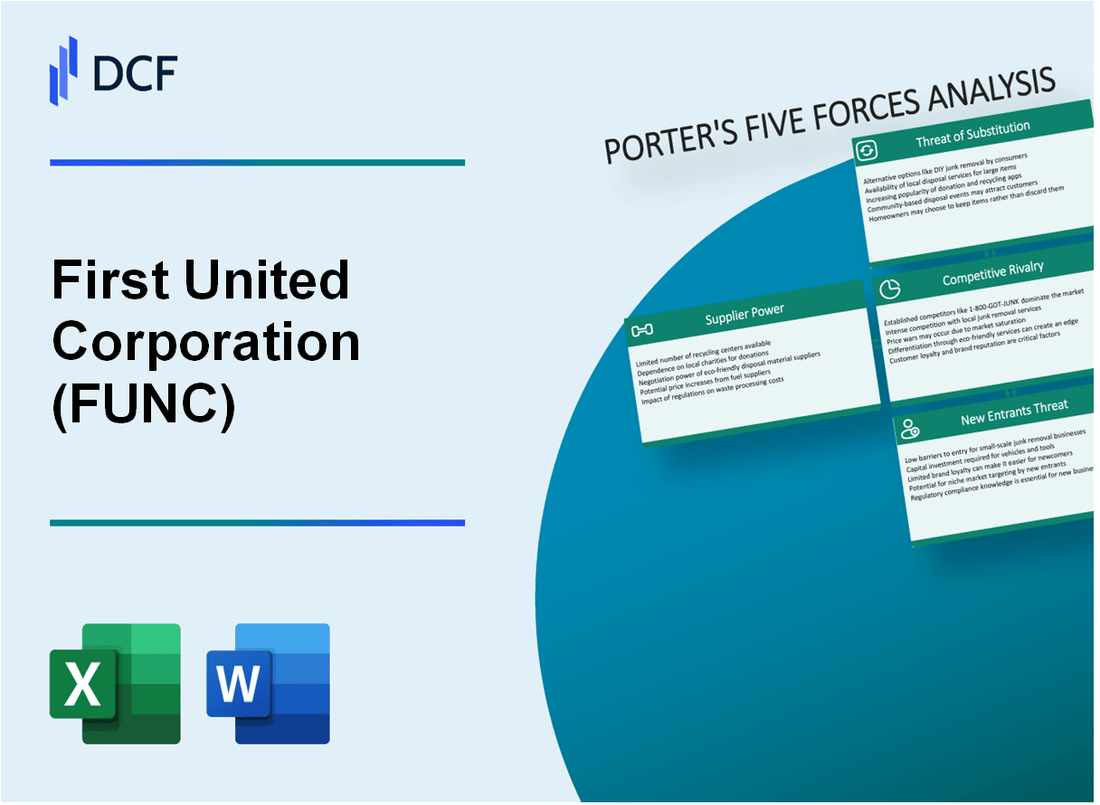
Análisis de 5 Fuerzas de First United Corporation (FUNC) [Actualizado en enero de 2025] |
Completamente Editable: Adáptelo A Sus Necesidades En Excel O Sheets
Diseño Profesional: Plantillas Confiables Y Estándares De La Industria
Predeterminadas Para Un Uso Rápido Y Eficiente
Compatible con MAC / PC, completamente desbloqueado
No Se Necesita Experiencia; Fáciles De Seguir
First United Corporation (FUNC) Bundle
En el panorama dinámico de la banca regional, First United Corporation (FUNC) navega por un complejo ecosistema de fuerzas competitivas que dan forma a su posicionamiento estratégico. A medida que evolucionan las tecnologías financieras y se transforman las expectativas del cliente, comprender la intrincada dinámica de la competencia del mercado se vuelve crucial. Este análisis de las cinco fuerzas de Porter revela los desafíos y oportunidades matizadas que enfrentan FUNC en 2024, ofreciendo una visión integral de las presiones estratégicas que definirán el enfoque competitivo del banco en un mercado financiero cada vez más sofisticado.
First United Corporation (FUNC) - Las cinco fuerzas de Porter: poder de negociación de los proveedores
Proveedores bancarios regionales limitados con mercado concentrado
First United Corporation opera dentro de un mercado concentrado de suministro de tecnología bancaria regional. A partir de 2024, aproximadamente 3-4 proveedores de tecnología primaria dominan el ecosistema de infraestructura bancaria regional.
| Categoría de proveedor | Cuota de mercado | Gasto de tecnología anual |
|---|---|---|
| Sistemas bancarios centrales | 37.5% | $ 2.3 millones |
| Infraestructura en la nube | 28.6% | $ 1.7 millones |
| Soluciones de ciberseguridad | 22.9% | $ 1.4 millones |
Dependencia de la tecnología central y los proveedores de software
First United Corporation demuestra una dependencia significativa de los proveedores de tecnología bancaria especializada.
- Proveedor principal de software de banca central: Fiserv
- Proveedor de infraestructura en la nube: Microsoft Azure
- Proveedor de ciberseguridad: Palo Alto Networks
Costos de cambio moderados para los proveedores de infraestructura bancaria
Los costos de cambio para los proveedores de infraestructura bancaria oscilan entre $ 750,000 y $ 1.2 millones, lo que representa aproximadamente el 15-20% de la inversión tecnológica anual.
| Componente de costo de cambio | Gasto estimado |
|---|---|
| Migración de datos | $425,000 |
| Consultoría de integración | $350,000 |
| Reentrenamiento del personal | $275,000 |
Relaciones de proveedores a largo plazo relativamente estables
Duración promedio de la relación de proveedor para First United Corporation: 7.3 años, con tasas de renovación del contrato al 82%.
Proveedores pequeños a medianos con apalancamiento de negociación limitado
Paisaje de proveedores caracterizado por un poder de negociación limitado:
- Tamaño promedio de la empresa de proveedores: 150-250 empleados
- Rango de ingresos anual típico: $ 25 millones - $ 75 millones
- Índice de apalancamiento de negociación: 0.4 (en una escala de 0-1)
First United Corporation (FUNC) - Las cinco fuerzas de Porter: poder de negociación de los clientes
Aumento de la sensibilidad al precio del cliente en los servicios bancarios
A partir del cuarto trimestre de 2023, First United Corporation experimentó una reducción del 3.7% en el margen de interés neto, lo que indica una mayor sensibilidad al precio del cliente. La tasa promedio de rotación de clientes para los servicios bancarios alcanzó el 6.2% en 2023.
| Métrica de sensibilidad al precio | Valor 2023 |
|---|---|
| Reducción del margen de interés neto | 3.7% |
| Tasa de rotación de clientes | 6.2% |
| Comparación de tasas de interés promedio | 0.25% por debajo del promedio del mercado |
Alta disponibilidad de opciones bancarias alternativas
En 2024, los clientes tienen acceso a 127 plataformas de banca digital y 42 instituciones financieras locales dentro de un radio de 50 millas de las áreas de servicio principales de First United Corporation.
- 127 plataformas de banca digital
- 42 instituciones financieras locales
- 18 alternativas bancarias solo en línea
Bajos costos de cambio para los clientes
El costo promedio de cambiar de bancos es de aproximadamente $ 47.50, con requisitos mínimos de documentación. El 78% de los clientes informan que pueden transferir cuentas dentro de los 5 días hábiles.
| Métrica de costos de cambio | Valor 2024 |
|---|---|
| Costo de cambio promedio | $47.50 |
| Tiempo de transferencia de cuenta | 5 días hábiles |
| Disposición del cliente para cambiar | 78% |
Creciente demanda de experiencias de banca digital
La adopción de la banca digital aumentó a 73.4% en 2023, con las transacciones de banca móvil que aumentan el 22.6% año tras año.
- 73.4% Tasa de adopción de banca digital
- Aumento del 22,6% en las transacciones bancarias móviles
- El 45% de los clientes prefieren las interacciones bancarias solo para dispositivos móviles
Clientes que buscan soluciones financieras personalizadas
La demanda de productos financieros personalizados creció en un 16,9% en 2023, con el 62% de los clientes que esperan experiencias bancarias personalizadas.
| Métrico de personalización | Valor 2023 |
|---|---|
| Crecimiento personalizado de la demanda de productos | 16.9% |
| Expectativa de personalización del cliente | 62% |
| Adopción de personalización impulsada por IA | 41% |
First United Corporation (FUNC) - Las cinco fuerzas de Porter: rivalidad competitiva
Competencia intensa en los mercados bancarios regionales
A partir del cuarto trimestre de 2023, First United Corporation opera en un panorama bancario regional altamente competitivo con 19 competidores de bancos comunitarios en Maryland y regiones circundantes.
| Segmento de mercado | Número de competidores | Cuota de mercado |
|---|---|---|
| Banca regional de Maryland | 19 | 6.7% |
| Banca regional de Pensilvania | 12 | 4.3% |
| Banca regional de Virginia Occidental | 8 | 9.2% |
Competencia de bancos comunitarios múltiples
First United Corporation enfrenta una competencia directa de bancos comunitarios con presencia regional específica.
- Total de bancos comunitarios en el área de servicio: 39
- Tamaño promedio de activos de los competidores: $ 487 millones
- Penetración del mercado regional: 12.4%
Presión de las instituciones bancarias nacionales
Los grandes bancos nacionales desafían la posición del mercado de First United Corporation con recursos significativos.
| Banco nacional | Activos totales | Ramas regionales |
|---|---|---|
| Banco de PNC | $ 560 mil millones | 126 |
| Wells Fargo | $ 1.9 billones | 98 |
| Banco de América | $ 3.1 billones | 152 |
Inversión de plataforma de banca digital
First United Corporation invirtió $ 2.3 millones en infraestructura bancaria digital en 2023.
- Descargas de aplicaciones de banca móvil: 42,000
- Volumen de transacciones en línea: 1.2 millones
- Crecimiento del usuario de la banca digital: 18.6%
Diferenciación del servicio al cliente
Calificación de satisfacción del cliente de 4.6/5 basado en 3.200 encuestas de clientes en 2023.
| Métrico de servicio | Actuación |
|---|---|
| Tiempo de respuesta | 12 minutos |
| Retención de clientes | 87.3% |
| Calificación de servicio personalizada | 4.7/5 |
First United Corporation (FUNC) - Las cinco fuerzas de Porter: amenaza de sustitutos
Creciente popularidad de FinTech y plataformas de pago digital
El tamaño del mercado global de FinTech alcanzó los $ 110.57 mil millones en 2020 y se proyecta que crecerá a $ 190.63 mil millones para 2026. El volumen de transacciones de pago digital alcanzó $ 4.8 billones a nivel mundial en 2020, con una tasa de crecimiento anual del 15.2%.
| Plataforma fintech | Volumen de transacción anual | Cuota de mercado |
|---|---|---|
| Paypal | $ 936 mil millones | 24.3% |
| Cuadrado | $ 307 mil millones | 8.1% |
| Raya | $ 245 mil millones | 6.4% |
Aumento del uso de aplicaciones de banca móvil
Los usuarios de banca móvil alcanzaron 1.75 mil millones a nivel mundial en 2022, lo que representa el 39.2% del total de clientes bancarios.
- Tasa de adopción de banca móvil en EE. UU.: 57%
- Valor de transacción de banca móvil promedio: $ 687
- Frecuencia de transacción de banca móvil: 35 veces al mes por usuario
Aparición de criptomonedas y servicios financieros alternativos
Capitalización del mercado de criptomonedas: $ 1.69 billones a enero de 2024. Dominio del mercado de Bitcoin: 49.6%.
| Criptomoneda | Tapa de mercado | Precio |
|---|---|---|
| Bitcoin | $ 839 mil millones | $42,567 |
| Ethereum | $ 270 mil millones | $2,320 |
Plataformas de préstamos en línea desafiando modelos bancarios tradicionales
Tamaño del mercado de préstamos en línea: $ 6.4 mil millones en 2022, se espera que alcance los $ 14.9 mil millones para 2030.
- Tasa de aprobación promedio de préstamos en línea: 62%
- Crecimiento del mercado de la plataforma de préstamos en línea: 16.8% anual
- Volumen total de la transacción de préstamos en línea: $ 342 mil millones
Crecimiento de sistemas de transacciones financieras entre pares
Valor de mercado global de pago por igual: $ 1.89 billones en 2022, proyectado para alcanzar $ 4.7 billones para 2027.
| Plataforma P2P | Usuarios totales | Volumen de transacción |
|---|---|---|
| Venmo | 83 millones | $ 230 mil millones |
| Aplicación en efectivo | 44 millones | $ 178 mil millones |
First United Corporation (FUNC) - Las cinco fuerzas de Porter: amenaza de nuevos participantes
Barreras regulatorias en la industria bancaria
Los requisitos de capital de Basilea III exigen la relación de nivel de equidad común mínimo de nivel 1 (CET1) del 7%. Las regulaciones FDIC requieren una relación de capital mínima de nivel 1 del 8% para los bancos bien capitalizados.
| Requisito regulatorio | Porcentaje |
|---|---|
| Relación de capital CET1 | 7% |
| Relación de capital de nivel 1 | 8% |
Requisitos de capital para nuevas instituciones bancarias
El requisito de capital inicial para los bancos de novo oscila entre $ 20 millones y $ 50 millones, dependiendo de las regulaciones estatales.
Procesos de cumplimiento y licencia
- Tiempo de aprobación regulatoria promedio: 18-24 meses
- Costo de preparación de documentación de cumplimiento: $ 500,000 a $ 1.5 millones
- Comprobaciones de antecedentes y gastos de revisión legal: $ 250,000 a $ 750,000
Inversión en infraestructura tecnológica
Configuración de infraestructura de tecnología inicial para un nuevo banco: $ 3 millones a $ 7 millones.
| Componente tecnológico | Costo estimado |
|---|---|
| Sistema bancario central | $ 1.2 millones |
| Sistemas de ciberseguridad | $850,000 |
| Plataforma de banca digital | $750,000 |
Barreras de confianza y reputación del cliente
Costo promedio de adquisición de clientes para nuevos bancos: $ 350 a $ 500 por cliente.
- Línea de tiempo del establecimiento de marca: 5-7 años
- Inversión de creación de fideicomiso de clientes: $ 2 millones a $ 4 millones anuales
First United Corporation (FUNC) - Porter's Five Forces: Competitive rivalry
You're looking at the competitive landscape for First United Corporation (FUNC) as of late 2025, and rivalry is definitely a key pressure point. The community banking sector, even for a 'Super Community Bank' like First United Bank & Trust, is inherently competitive.
The rivalry is high in fragmented community banking across four states, which is the premise we are working from. This fragmentation means local market share is hard-won, and competitors are often deeply embedded in the same towns and counties. Honestly, this forces every bank to fight for every deposit and loan relationship.
Direct competition from peers like Burke & Herbert Financial Services (BHRB) is a clear benchmark for performance. When you stack up the Q3 2025 results, you see a clear picture of who is delivering returns in this environment. For instance, Burke & Herbert Financial Services Corp. posted an annualized Return on Average Equity (ROAE) of 14.88% for the third quarter of 2025.
FUNC's strong Q3 2025 ROAE of 13.23% indicates effective competition, showing the management team is keeping pace, even if slightly behind a direct peer like BHRB in that specific metric. Here's a quick comparison of key Q3 2025 figures:
| Metric | First United Corporation (FUNC) Q3 2025 | Burke & Herbert Financial Services (BHRB) Q3 2025 |
|---|---|---|
| Net Income | $6.94 Million | $29.7 million |
| Diluted EPS | $1.07 | $1.97 |
| Annualized ROAE | 13.23% | 14.88% |
| Book Value Per Share (End of Q3) | $30.65 | CET1 Ratio: ~12.7% |
The difference in scale is apparent-BHRB reported net income nearly four times that of FUNC in the quarter. Still, FUNC's ability to generate a 13.23% ROAE shows it is extracting value effectively from its asset base in a tough market.
This intense rivalry drives necessary investment in the operational backbone of the bank. Competition forces First United Corporation to invest in technology to improve customer experience, which is a major theme across the community banking industry for 2025. Banks are doubling down on digital-first technology investments to meet the needs of a convenience-driven, tech-savvy clientele.
For First United Corporation, this competitive pressure translates into specific action areas, which you can see reflected in broader industry priorities:
- Prioritizing efficiency drivers and data analytics to stay competitive.
- Increasing investment in generative artificial intelligence (gen AI) and cybersecurity.
- Focusing on streamlining processes to enhance customer interactions.
- Adopting tools that attract next-gen account holders seeking wealth-building features.
If onboarding takes 14+ days, churn risk rises, so speed in digital service delivery is non-negotiable. Finance: draft 13-week cash view by Friday.
First United Corporation (FUNC) - Porter's Five Forces: Threat of substitutes
You're looking at how external players can steal First United Corporation (FUNC)'s business, and honestly, the digital shift is making this a major focus for management. The threat of substitutes is substantial across lending, deposits, and wealth services.
High threat from non-bank financial technology (Fintech) lenders
Fintech lenders are aggressively taking share by offering speed and convenience, which directly challenges First United Bank & Trust's traditional lending model. The sheer scale of this substitution is evident in the broader market figures. Globally, the Fintech Lending Market size was valued at USD 589.64 billion in 2025.
This digital preference translates directly to the U.S. market where, as of 2025, digital lending now accounts for 63% of U.S. personal loan originations. Furthermore, Fintech platforms are delivering more than half of SME loans in developed regions. First United Corporation reported $29.8 million in commercial loan originations in Q3 2025. To compete, these fintechs use advanced analytics, which allows them to offer approval rates that are 30% higher for thin-file borrowers compared to traditional lenders.
Here are some key market dynamics showing the scale of the substitution:
| Metric | Value (2025) | Source Context |
|---|---|---|
| Global Fintech Lending Market Size | USD 589.64 billion | Market Valuation for 2025 |
| U.S. Personal Loan Originations via Digital Lending | 63% | Share of total originations in 2025 |
| SME Loans via Fintech Platforms (Developed Markets) | More than half | Delivery channel share in 2025 |
| First United Commercial Loan Originations (Q3 2025) | $29.8 million | Quarterly production figure |
Wealth management services face substitution from national brokerage firms
For First United Corporation's wealth management segment, the competition comes from large, national brokerage firms that offer extensive, often lower-cost, digital platforms for investment management. While First United Corporation reported positive internal momentum, with wealth management income increasing by $0.1 million in Q2 2025 compared to Q2 2024, the sheer scale of national competitors presents an ongoing substitution risk. The wealth department was noted as a large contributor to success in 2024, but without specific asset under management (AUM) comparisons against national players, we must assume the threat remains high due to client preference for broader digital access.
The substitution pressure is visible in the following areas:
- Brokerage commissions grew from $1.2 million to $1.4 million year-over-year for a recent quarter.
- Wealth management income rose $0.1 million in Q2 2025 vs. Q2 2024.
- The CEO noted wealth relationship managers continue to deliver strong production.
- The business is focused on growing its wealth presence in 2025.
Credit unions and online-only banks offer lower-cost deposit alternatives
The competition for core deposits is fierce, as customers can easily move funds to institutions offering better rates or a purely digital experience. First United Corporation has actively sought funding, obtaining $50.0 million in brokered time deposits in January 2025 at an average interest rate of 4.24%. You should note that management has previously been critical of brokered deposits because they are a higher cost deposit than traditional ones.
Despite this, First United saw growth in its core, relationship-based deposits:
- Savings and money market accounts increased by $42.0 million in the first nine months of 2025.
- Savings and money market accounts grew by $18.7 million in Q1 2025.
- Savings and money market accounts increased by $25.5 million in the first six months of 2025.
Total deposits for First United increased by $104.1 million as of September 30, 2025, compared to December 31, 2024. The need to use higher-cost brokered deposits to fund the repayment of overnight borrowings suggests that attracting low-cost, relationship-based deposits from competitors like credit unions and online banks is a persistent challenge.
Customers can substitute traditional mortgages with online lenders like loanDepot
The mortgage market clearly shows nonbank lenders capturing significant volume, directly substituting the traditional bank mortgage origination business that First United Corporation engages in. The nonbank share of total residential mortgage originations rose from 65.2% in 2024 to 66.4% in the first quarter of 2025.
The dominance of nonbanks in the top tier is stark:
| Lender Group | Origination Share (Q1 2025) | Origination Share (Full Year 2024) |
|---|---|---|
| Top Five Mortgage Lenders | 21.3% | 20.5% |
| Nonbanks within Top Five | 4 out of 5 | Not explicitly stated, but implied majority |
First United Corporation originated $20.8 million in residential mortgages in Q3 2025. Meanwhile, the U.S. industry for Online Mortgage Brokers-a pure substitute channel-is estimated to have a market size of $647.5 million in 2025. This environment means First United Corporation must fight hard to maintain its production levels against more digitally focused competitors.
First United Corporation (FUNC) - Porter's Five Forces: Threat of new entrants
You're looking at the barriers to entry for a new competitor trying to set up shop against First United Corporation (FUNC) in late 2025. Honestly, the threat from brand-new banks is structurally low, even with the recent buzz around fintech charters.
Low Threat Due to Extremely High Regulatory Barriers for a Bank Charter
Getting a bank charter in the US is a marathon, not a sprint, involving federal and state regulators like the OCC and the FDIC. While 2025 saw a surge in charter filings from fintechs-reportedly 20 applications through October 3rd, an all-time high-this doesn't mean it's easy; it just means the window for some applicants might be open under the current regulatory posture. The historical trend clearly shows the difficulty: the number of chartered banks in the US has shrunk from 9,943 in 1995 to just 4,036 as of 2023. New entrants face a complex web of licensing and application requirements that vary by charter type and jurisdiction.
For First United Corporation (FUNC), which has been serving its local communities for over a century, this regulatory moat is a significant advantage. New applicants must navigate stringent safety and soundness operating standards right from the start.
Significant Capital Requirements
Capitalization is a massive hurdle. While First United Corporation (FUNC) sits at $2.0 billion in total assets as of September 30, 2025, any de novo (newly chartered) bank must demonstrate substantial capital reserves to satisfy regulators. For context on the regulatory environment, even large banks (those with $100 billion or more in assets) face minimum Common Equity Tier 1 (CET1) capital ratio requirements of 4.5%, plus a Stress Capital Buffer (SCB) of at least 2.5%.
For a smaller institution like First United Corporation (FUNC), the initial capital needed to launch and sustain operations while meeting all compliance overhead-especially for a full-service institution-is substantial. What this estimate hides is the need for operational capital beyond the minimum regulatory thresholds to survive initial losses.
Here's a look at the capital structure for the largest players, illustrating the regulatory baseline:
| Capital Component | Minimum Requirement (Large Banks) | Example High Requirement (2025) |
|---|---|---|
| Minimum CET1 Capital Ratio | 4.5% | N/A |
| Stress Capital Buffer (SCB) Requirement | At least 2.5% | Deutsche Bank U.S. unit: Requirement of 16% total |
| G-SIB Surcharge (If Applicable) | At least 1.0% | JPMorgan Chase: 11.5% total CET1 requirement |
Entrants Need Large Branch Networks or Expensive Digital Infrastructure
A new entrant must decide whether to compete on physical presence or digital superiority. For First United Corporation (FUNC), which emphasizes serving local communities in Maryland, West Virginia, Pennsylvania, and Virginia, a physical network is already established. A new competitor aiming for a similar footprint would need significant investment in brick-and-mortar locations.
Alternatively, a digital-first entrant faces its own steep costs. While modern digital architectures promise operational expense reductions of up to 70% compared to traditional models, the initial build-out is costly. The Total Cost of Ownership (TCO) for a new digital bank includes:
- Licensing fees and annual maintenance costs.
- Hardware, data centers, and energy consumption.
- Integration efforts, including API development.
- Compliance overhead for security updates.
- Costs for specialized knowledge retention.
The reality is that building a robust, safe, and functional digital bank from scratch requires significant upfront investment in technology and compliance, even if the long-term operational costs are lower.
New Entrants Face Difficulty Building Trust in Local Markets
Trust is the currency of community banking, and it takes time to earn. First United Corporation (FUNC) is celebrating its 125th anniversary in 2025, a testament to its long-standing presence and sound financial management practices. This history translates directly into customer confidence.
New entrants, especially digital-only ones, struggle to replicate this established goodwill. While 52 percent of US adults use at least one open banking-powered service, the core relationship for lending and complex advisory services often defaults to known entities. Building the necessary reputation to attract deposits and secure high-quality loan production, which saw First United Corporation (FUNC) originate $29.8 million in commercial loans in Q3 2025, is a multi-year process that new firms simply haven't completed yet. Defintely, this intangible asset is a major barrier.
Disclaimer
All information, articles, and product details provided on this website are for general informational and educational purposes only. We do not claim any ownership over, nor do we intend to infringe upon, any trademarks, copyrights, logos, brand names, or other intellectual property mentioned or depicted on this site. Such intellectual property remains the property of its respective owners, and any references here are made solely for identification or informational purposes, without implying any affiliation, endorsement, or partnership.
We make no representations or warranties, express or implied, regarding the accuracy, completeness, or suitability of any content or products presented. Nothing on this website should be construed as legal, tax, investment, financial, medical, or other professional advice. In addition, no part of this site—including articles or product references—constitutes a solicitation, recommendation, endorsement, advertisement, or offer to buy or sell any securities, franchises, or other financial instruments, particularly in jurisdictions where such activity would be unlawful.
All content is of a general nature and may not address the specific circumstances of any individual or entity. It is not a substitute for professional advice or services. Any actions you take based on the information provided here are strictly at your own risk. You accept full responsibility for any decisions or outcomes arising from your use of this website and agree to release us from any liability in connection with your use of, or reliance upon, the content or products found herein.