

|
First United Corporation (FUNC): 5 Forces Analysis [Jan-2025 Mise à jour] |
Entièrement Modifiable: Adapté À Vos Besoins Dans Excel Ou Sheets
Conception Professionnelle: Modèles Fiables Et Conformes Aux Normes Du Secteur
Pré-Construits Pour Une Utilisation Rapide Et Efficace
Compatible MAC/PC, entièrement débloqué
Aucune Expertise N'Est Requise; Facile À Suivre
First United Corporation (FUNC) Bundle
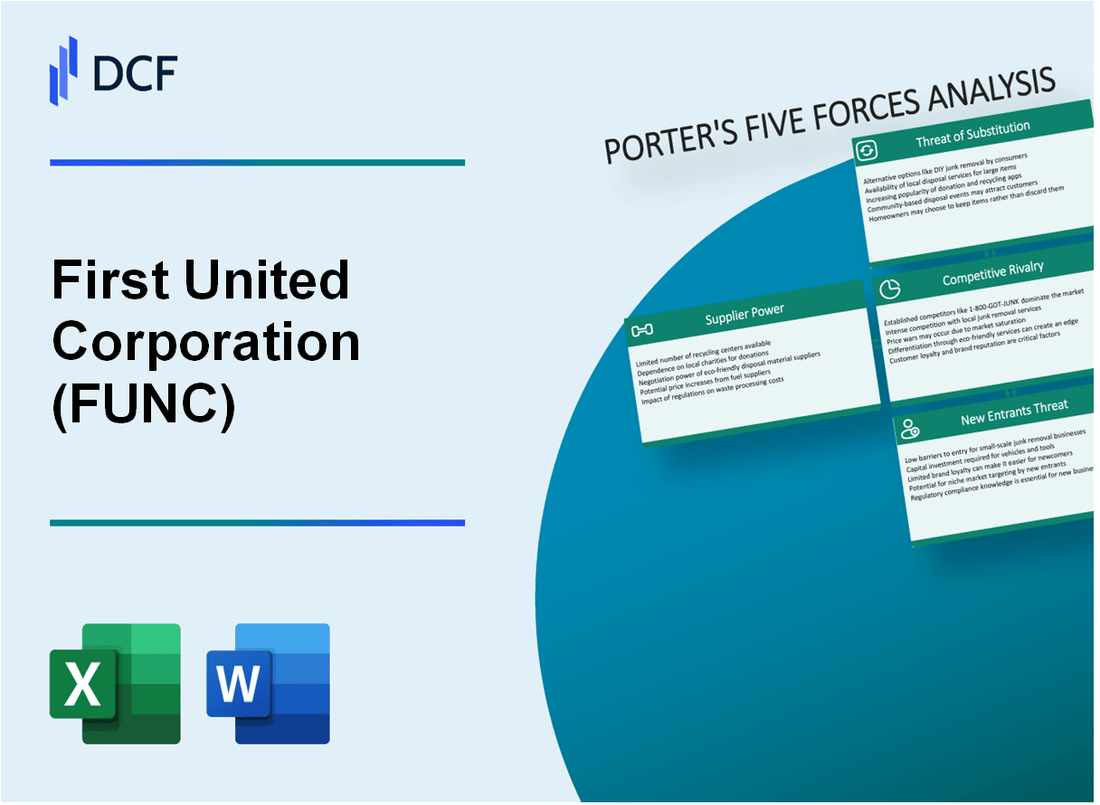
Dans le paysage dynamique de la banque régionale, First United Corporation (FUNC) navigue dans un écosystème complexe de forces compétitives qui façonnent son positionnement stratégique. À mesure que les technologies financières évoluent et que les attentes des clients se transforment, la compréhension de la dynamique complexe de la concurrence du marché devient cruciale. Cette analyse des cinq forces de Porter révèle les défis et les opportunités nuancées auxquelles sont confrontés Func en 2024, offrant un aperçu complet des pressions stratégiques qui définiront l'approche compétitive de la banque dans un marché financier de plus en plus sophistiqué.
First United Corporation (FUNC) - Porter's Five Forces: Bangaining Power of Fournissers
Des fournisseurs bancaires régionaux limités avec un marché concentré
First United Corporation opère dans un marché concentré sur l'approvisionnement en technologie bancaire régionale. En 2024, environ 3-4 fournisseurs de technologies primaires dominent l'écosystème régional de l'infrastructure bancaire.
| Catégorie des fournisseurs | Part de marché | Dépenses technologiques annuelles |
|---|---|---|
| Systèmes bancaires de base | 37.5% | 2,3 millions de dollars |
| Infrastructure cloud | 28.6% | 1,7 million de dollars |
| Solutions de cybersécurité | 22.9% | 1,4 million de dollars |
Dépendance à l'égard de la technologie de base et des fournisseurs de logiciels
First United Corporation démontre une dépendance significative à l'égard des fournisseurs de technologies bancaires spécialisées.
- Primary Core Banking Software Provider: Fiserv
- Fournisseur d'infrastructure cloud: Microsoft Azure
- Vendeur de cybersécurité: réseaux Palo Alto
Coûts de commutation modérés pour les fournisseurs d'infrastructures bancaires
Les coûts de commutation pour les fournisseurs d'infrastructures bancaires se situent entre 750 000 $ et 1,2 million de dollars, ce qui représente environ 15 à 20% de l'investissement technologique annuel.
| Composant de coût de commutation | Dépenses estimées |
|---|---|
| Migration des données | $425,000 |
| Conseil d'intégration | $350,000 |
| Recyclage du personnel | $275,000 |
Relations de fournisseurs à long terme relativement stables
Durée moyenne des relations avec les fournisseurs pour First United Corporation: 7,3 ans, avec des taux de renouvellement des contrats à 82%.
Petits fournisseurs avec un effet de levier de négociation limité
Paysage des fournisseurs caractérisée par un pouvoir de négociation limité:
- Taille moyenne des entreprises de fournisseur: 150-250 employés
- Gamme de revenus annuelle typique: 25 millions de dollars - 75 millions de dollars
- Indice de levier de négociation: 0,4 (sur une échelle de 0-1)
First United Corporation (FUNC) - Porter's Five Forces: Bargaining Power of Clients
Augmentation de la sensibilité au prix du client dans les services bancaires
Au quatrième trimestre 2023, First United Corporation a connu une réduction de 3,7% de la marge nette des intérêts, indiquant une sensibilité accrue au prix du client. Le taux de désabonnement moyen moyen des services bancaires a atteint 6,2% en 2023.
| Métrique de sensibilité des prix | Valeur 2023 |
|---|---|
| Réduction de la marge d'intérêt net | 3.7% |
| Taux de désabonnement du client | 6.2% |
| Comparaison moyenne des taux d'intérêt | 0,25% inférieur à la moyenne du marché |
Haute disponibilité des options bancaires alternatives
En 2024, les clients ont accès à 127 plateformes bancaires numériques et 42 institutions financières locales dans un rayon de 50 miles des principaux domaines de service de First Corporation.
- 127 plateformes bancaires numériques
- 42 institutions financières locales
- 18 alternatives bancaires en ligne uniquement
Coûts de commutation faibles pour les clients
Le coût moyen des banques de commutation est d'environ 47,50 $, avec des exigences de documentation minimales. 78% des clients signalent qu'ils peuvent transférer des comptes dans les 5 jours ouvrables.
| Métrique des coûts de commutation | Valeur 2024 |
|---|---|
| Coût de commutation moyen | $47.50 |
| Heure de transfert de compte | 5 jours ouvrables |
| Volonté du client de changer | 78% |
Demande croissante d'expériences bancaires numériques
L'adoption des services bancaires numériques est passé à 73,4% en 2023, les transactions bancaires mobiles augmentant de 22,6% en glissement annuel.
- 73,4% Taux d'adoption des banques numériques
- Augmentation de 22,6% des transactions bancaires mobiles
- 45% des clients préfèrent les interactions bancaires mobiles
Clients à la recherche de solutions financières personnalisées
La demande de produits financiers personnalisés a augmenté de 16,9% en 2023, avec 62% des clients s'attendant à des expériences bancaires personnalisées.
| Métrique de personnalisation | Valeur 2023 |
|---|---|
| Croissance de la demande de produits personnalisés | 16.9% |
| Attente des clients de la personnalisation | 62% |
| Adoption de personnalisation dirigée par l'IA | 41% |
First United Corporation (FUNC) - Five Forces de Porter: Rivalité compétitive
Concurrence intense sur les marchés bancaires régionaux
Au quatrième trimestre 2023, First United Corporation opère dans un paysage bancaire régional hautement compétitif avec 19 concurrents de la banque communautaire dans le Maryland et les régions environnantes.
| Segment de marché | Nombre de concurrents | Part de marché |
|---|---|---|
| Banque régional du Maryland | 19 | 6.7% |
| Banque régionale de Pennsylvanie | 12 | 4.3% |
| Banque régionale de Virginie-Occidentale | 8 | 9.2% |
Concours de banques communautaires multiples
First United Corporation fait face à la concurrence directe des banques communautaires avec une présence régionale spécifique.
- Total des banques communautaires dans la zone de service: 39
- Taille moyenne des concurrents: 487 millions de dollars
- Pénétration régionale du marché: 12,4%
Pression des institutions bancaires nationales
Les grandes banques nationales défient la position du marché de la première Corporation avec des ressources importantes.
| Banque nationale | Actif total | Branches régionales |
|---|---|---|
| Banque PNC | 560 milliards de dollars | 126 |
| Wells Fargo | 1,9 billion de dollars | 98 |
| Banque d'Amérique | 3,1 billions de dollars | 152 |
Investissement de la plate-forme bancaire numérique
First United Corporation a investi 2,3 millions de dollars dans les infrastructures bancaires numériques en 2023.
- Téléchargements d'applications bancaires mobiles: 42 000
- Volume de transaction en ligne: 1,2 million
- Croissance des utilisateurs bancaires numériques: 18,6%
Différenciation du service client
Évaluation de satisfaction du client de 4,6 / 5 sur la base de 3 200 enquêtes clients en 2023.
| Métrique de service | Performance |
|---|---|
| Temps de réponse | 12 minutes |
| Fidélisation | 87.3% |
| Note de service personnalisée | 4.7/5 |
First United Corporation (FUNC) - Five Forces de Porter: Menace de substituts
Rising Popularité des plates-formes de paiement fintech et numériques
La taille mondiale du marché fintech a atteint 110,57 milliards de dollars en 2020 et devrait atteindre 190,63 milliards de dollars d'ici 2026. Le volume des transactions de paiement numérique a atteint 4,8 billions de dollars dans le monde en 2020, avec un taux de croissance annuel de 15,2%.
| Plate-forme fintech | Volume de transaction annuel | Part de marché |
|---|---|---|
| Paypal | 936 milliards de dollars | 24.3% |
| Carré | 307 milliards de dollars | 8.1% |
| Bande | 245 milliards de dollars | 6.4% |
Utilisation croissante des applications bancaires mobiles
Les utilisateurs des services bancaires mobiles ont atteint 1,75 milliard dans le monde en 2022, ce qui représente 39,2% du total des clients bancaires.
- Taux d'adoption des banques mobiles aux États-Unis: 57%
- Valeur de transaction bancaire mobile moyenne: 687 $
- Fréquence des transactions bancaires mobiles: 35 fois par mois par utilisateur
Émergence de crypto-monnaie et de services financiers alternatifs
Capitalisation boursière de la crypto-monnaie: 1,69 billion de dollars en janvier 2024. Dominance du marché du bitcoin: 49,6%.
| Crypto-monnaie | Capitalisation boursière | Prix |
|---|---|---|
| Bitcoin | 839 milliards de dollars | $42,567 |
| Ethereum | 270 milliards de dollars | $2,320 |
Plateformes de prêt en ligne contestant les modèles bancaires traditionnels
Taille du marché des prêts en ligne: 6,4 milliards de dollars en 2022, devrait atteindre 14,9 milliards de dollars d'ici 2030.
- Taux d'approbation de prêt en ligne moyen: 62%
- Croissance du marché des plateformes de prêt en ligne: 16,8% par an
- Volume total de transactions de prêt en ligne: 342 milliards de dollars
Croissance des systèmes de transaction financière entre pairs
Valeur marchande mondiale de paiement entre pairs: 1,89 billion de dollars en 2022, prévoyant à atteindre 4,7 billions de dollars d'ici 2027.
| Plate-forme P2P | Total utilisateurs | Volume de transaction |
|---|---|---|
| Venmo | 83 millions | 230 milliards de dollars |
| Application en espèces | 44 millions | 178 milliards de dollars |
First United Corporation (FUNC) - Five Forces de Porter: Menace des nouveaux entrants
Barrières réglementaires dans le secteur bancaire
Bâle III Exigences en matière de capital exigent le ratio minimum de niveau de capitaux propres communs (CET1) de 7%. Les réglementations de la FDIC nécessitent un ratio de capital minimum de niveau 1 de 8% pour les banques bien capitalisées.
| Exigence réglementaire | Pourcentage |
|---|---|
| Ratio de capital CET1 | 7% |
| Ratio de capital de niveau 1 | 8% |
Exigences en matière de capital pour les nouvelles institutions bancaires
L'obligation de capital initial pour les banques de novo varie entre 20 et 50 millions de dollars selon les réglementations de l'État.
Processus de conformité et de licence
- Temps d'approbation réglementaire moyen: 18-24 mois
- Documentation de conformité Coût de préparation: 500 000 $ à 1,5 million de dollars
- Vérification des antécédents et dépenses d'examen juridique: 250 000 $ à 750 000 $
Investissement en infrastructure technologique
Configuration des infrastructures technologiques initiales pour la nouvelle banque: 3 à 7 millions de dollars.
| Composant technologique | Coût estimé |
|---|---|
| Système bancaire de base | 1,2 million de dollars |
| Systèmes de cybersécurité | $850,000 |
| Plate-forme bancaire numérique | $750,000 |
Bornières de confiance des clients et de réputation
Coût moyen d'acquisition du client pour les nouvelles banques: 350 $ à 500 $ par client.
- Chronologie de l'établissement de la marque: 5-7 ans
- Investissement de construction de fiducie client: 2 à 4 millions de dollars par an
First United Corporation (FUNC) - Porter's Five Forces: Competitive rivalry
You're looking at the competitive landscape for First United Corporation (FUNC) as of late 2025, and rivalry is definitely a key pressure point. The community banking sector, even for a 'Super Community Bank' like First United Bank & Trust, is inherently competitive.
The rivalry is high in fragmented community banking across four states, which is the premise we are working from. This fragmentation means local market share is hard-won, and competitors are often deeply embedded in the same towns and counties. Honestly, this forces every bank to fight for every deposit and loan relationship.
Direct competition from peers like Burke & Herbert Financial Services (BHRB) is a clear benchmark for performance. When you stack up the Q3 2025 results, you see a clear picture of who is delivering returns in this environment. For instance, Burke & Herbert Financial Services Corp. posted an annualized Return on Average Equity (ROAE) of 14.88% for the third quarter of 2025.
FUNC's strong Q3 2025 ROAE of 13.23% indicates effective competition, showing the management team is keeping pace, even if slightly behind a direct peer like BHRB in that specific metric. Here's a quick comparison of key Q3 2025 figures:
| Metric | First United Corporation (FUNC) Q3 2025 | Burke & Herbert Financial Services (BHRB) Q3 2025 |
|---|---|---|
| Net Income | $6.94 Million | $29.7 million |
| Diluted EPS | $1.07 | $1.97 |
| Annualized ROAE | 13.23% | 14.88% |
| Book Value Per Share (End of Q3) | $30.65 | CET1 Ratio: ~12.7% |
The difference in scale is apparent-BHRB reported net income nearly four times that of FUNC in the quarter. Still, FUNC's ability to generate a 13.23% ROAE shows it is extracting value effectively from its asset base in a tough market.
This intense rivalry drives necessary investment in the operational backbone of the bank. Competition forces First United Corporation to invest in technology to improve customer experience, which is a major theme across the community banking industry for 2025. Banks are doubling down on digital-first technology investments to meet the needs of a convenience-driven, tech-savvy clientele.
For First United Corporation, this competitive pressure translates into specific action areas, which you can see reflected in broader industry priorities:
- Prioritizing efficiency drivers and data analytics to stay competitive.
- Increasing investment in generative artificial intelligence (gen AI) and cybersecurity.
- Focusing on streamlining processes to enhance customer interactions.
- Adopting tools that attract next-gen account holders seeking wealth-building features.
If onboarding takes 14+ days, churn risk rises, so speed in digital service delivery is non-negotiable. Finance: draft 13-week cash view by Friday.
First United Corporation (FUNC) - Porter's Five Forces: Threat of substitutes
You're looking at how external players can steal First United Corporation (FUNC)'s business, and honestly, the digital shift is making this a major focus for management. The threat of substitutes is substantial across lending, deposits, and wealth services.
High threat from non-bank financial technology (Fintech) lenders
Fintech lenders are aggressively taking share by offering speed and convenience, which directly challenges First United Bank & Trust's traditional lending model. The sheer scale of this substitution is evident in the broader market figures. Globally, the Fintech Lending Market size was valued at USD 589.64 billion in 2025.
This digital preference translates directly to the U.S. market where, as of 2025, digital lending now accounts for 63% of U.S. personal loan originations. Furthermore, Fintech platforms are delivering more than half of SME loans in developed regions. First United Corporation reported $29.8 million in commercial loan originations in Q3 2025. To compete, these fintechs use advanced analytics, which allows them to offer approval rates that are 30% higher for thin-file borrowers compared to traditional lenders.
Here are some key market dynamics showing the scale of the substitution:
| Metric | Value (2025) | Source Context |
|---|---|---|
| Global Fintech Lending Market Size | USD 589.64 billion | Market Valuation for 2025 |
| U.S. Personal Loan Originations via Digital Lending | 63% | Share of total originations in 2025 |
| SME Loans via Fintech Platforms (Developed Markets) | More than half | Delivery channel share in 2025 |
| First United Commercial Loan Originations (Q3 2025) | $29.8 million | Quarterly production figure |
Wealth management services face substitution from national brokerage firms
For First United Corporation's wealth management segment, the competition comes from large, national brokerage firms that offer extensive, often lower-cost, digital platforms for investment management. While First United Corporation reported positive internal momentum, with wealth management income increasing by $0.1 million in Q2 2025 compared to Q2 2024, the sheer scale of national competitors presents an ongoing substitution risk. The wealth department was noted as a large contributor to success in 2024, but without specific asset under management (AUM) comparisons against national players, we must assume the threat remains high due to client preference for broader digital access.
The substitution pressure is visible in the following areas:
- Brokerage commissions grew from $1.2 million to $1.4 million year-over-year for a recent quarter.
- Wealth management income rose $0.1 million in Q2 2025 vs. Q2 2024.
- The CEO noted wealth relationship managers continue to deliver strong production.
- The business is focused on growing its wealth presence in 2025.
Credit unions and online-only banks offer lower-cost deposit alternatives
The competition for core deposits is fierce, as customers can easily move funds to institutions offering better rates or a purely digital experience. First United Corporation has actively sought funding, obtaining $50.0 million in brokered time deposits in January 2025 at an average interest rate of 4.24%. You should note that management has previously been critical of brokered deposits because they are a higher cost deposit than traditional ones.
Despite this, First United saw growth in its core, relationship-based deposits:
- Savings and money market accounts increased by $42.0 million in the first nine months of 2025.
- Savings and money market accounts grew by $18.7 million in Q1 2025.
- Savings and money market accounts increased by $25.5 million in the first six months of 2025.
Total deposits for First United increased by $104.1 million as of September 30, 2025, compared to December 31, 2024. The need to use higher-cost brokered deposits to fund the repayment of overnight borrowings suggests that attracting low-cost, relationship-based deposits from competitors like credit unions and online banks is a persistent challenge.
Customers can substitute traditional mortgages with online lenders like loanDepot
The mortgage market clearly shows nonbank lenders capturing significant volume, directly substituting the traditional bank mortgage origination business that First United Corporation engages in. The nonbank share of total residential mortgage originations rose from 65.2% in 2024 to 66.4% in the first quarter of 2025.
The dominance of nonbanks in the top tier is stark:
| Lender Group | Origination Share (Q1 2025) | Origination Share (Full Year 2024) |
|---|---|---|
| Top Five Mortgage Lenders | 21.3% | 20.5% |
| Nonbanks within Top Five | 4 out of 5 | Not explicitly stated, but implied majority |
First United Corporation originated $20.8 million in residential mortgages in Q3 2025. Meanwhile, the U.S. industry for Online Mortgage Brokers-a pure substitute channel-is estimated to have a market size of $647.5 million in 2025. This environment means First United Corporation must fight hard to maintain its production levels against more digitally focused competitors.
First United Corporation (FUNC) - Porter's Five Forces: Threat of new entrants
You're looking at the barriers to entry for a new competitor trying to set up shop against First United Corporation (FUNC) in late 2025. Honestly, the threat from brand-new banks is structurally low, even with the recent buzz around fintech charters.
Low Threat Due to Extremely High Regulatory Barriers for a Bank Charter
Getting a bank charter in the US is a marathon, not a sprint, involving federal and state regulators like the OCC and the FDIC. While 2025 saw a surge in charter filings from fintechs-reportedly 20 applications through October 3rd, an all-time high-this doesn't mean it's easy; it just means the window for some applicants might be open under the current regulatory posture. The historical trend clearly shows the difficulty: the number of chartered banks in the US has shrunk from 9,943 in 1995 to just 4,036 as of 2023. New entrants face a complex web of licensing and application requirements that vary by charter type and jurisdiction.
For First United Corporation (FUNC), which has been serving its local communities for over a century, this regulatory moat is a significant advantage. New applicants must navigate stringent safety and soundness operating standards right from the start.
Significant Capital Requirements
Capitalization is a massive hurdle. While First United Corporation (FUNC) sits at $2.0 billion in total assets as of September 30, 2025, any de novo (newly chartered) bank must demonstrate substantial capital reserves to satisfy regulators. For context on the regulatory environment, even large banks (those with $100 billion or more in assets) face minimum Common Equity Tier 1 (CET1) capital ratio requirements of 4.5%, plus a Stress Capital Buffer (SCB) of at least 2.5%.
For a smaller institution like First United Corporation (FUNC), the initial capital needed to launch and sustain operations while meeting all compliance overhead-especially for a full-service institution-is substantial. What this estimate hides is the need for operational capital beyond the minimum regulatory thresholds to survive initial losses.
Here's a look at the capital structure for the largest players, illustrating the regulatory baseline:
| Capital Component | Minimum Requirement (Large Banks) | Example High Requirement (2025) |
|---|---|---|
| Minimum CET1 Capital Ratio | 4.5% | N/A |
| Stress Capital Buffer (SCB) Requirement | At least 2.5% | Deutsche Bank U.S. unit: Requirement of 16% total |
| G-SIB Surcharge (If Applicable) | At least 1.0% | JPMorgan Chase: 11.5% total CET1 requirement |
Entrants Need Large Branch Networks or Expensive Digital Infrastructure
A new entrant must decide whether to compete on physical presence or digital superiority. For First United Corporation (FUNC), which emphasizes serving local communities in Maryland, West Virginia, Pennsylvania, and Virginia, a physical network is already established. A new competitor aiming for a similar footprint would need significant investment in brick-and-mortar locations.
Alternatively, a digital-first entrant faces its own steep costs. While modern digital architectures promise operational expense reductions of up to 70% compared to traditional models, the initial build-out is costly. The Total Cost of Ownership (TCO) for a new digital bank includes:
- Licensing fees and annual maintenance costs.
- Hardware, data centers, and energy consumption.
- Integration efforts, including API development.
- Compliance overhead for security updates.
- Costs for specialized knowledge retention.
The reality is that building a robust, safe, and functional digital bank from scratch requires significant upfront investment in technology and compliance, even if the long-term operational costs are lower.
New Entrants Face Difficulty Building Trust in Local Markets
Trust is the currency of community banking, and it takes time to earn. First United Corporation (FUNC) is celebrating its 125th anniversary in 2025, a testament to its long-standing presence and sound financial management practices. This history translates directly into customer confidence.
New entrants, especially digital-only ones, struggle to replicate this established goodwill. While 52 percent of US adults use at least one open banking-powered service, the core relationship for lending and complex advisory services often defaults to known entities. Building the necessary reputation to attract deposits and secure high-quality loan production, which saw First United Corporation (FUNC) originate $29.8 million in commercial loans in Q3 2025, is a multi-year process that new firms simply haven't completed yet. Defintely, this intangible asset is a major barrier.
Disclaimer
All information, articles, and product details provided on this website are for general informational and educational purposes only. We do not claim any ownership over, nor do we intend to infringe upon, any trademarks, copyrights, logos, brand names, or other intellectual property mentioned or depicted on this site. Such intellectual property remains the property of its respective owners, and any references here are made solely for identification or informational purposes, without implying any affiliation, endorsement, or partnership.
We make no representations or warranties, express or implied, regarding the accuracy, completeness, or suitability of any content or products presented. Nothing on this website should be construed as legal, tax, investment, financial, medical, or other professional advice. In addition, no part of this site—including articles or product references—constitutes a solicitation, recommendation, endorsement, advertisement, or offer to buy or sell any securities, franchises, or other financial instruments, particularly in jurisdictions where such activity would be unlawful.
All content is of a general nature and may not address the specific circumstances of any individual or entity. It is not a substitute for professional advice or services. Any actions you take based on the information provided here are strictly at your own risk. You accept full responsibility for any decisions or outcomes arising from your use of this website and agree to release us from any liability in connection with your use of, or reliance upon, the content or products found herein.