

|
Grupo de Fórmula Uno (FWONA): Análisis PESTLE [Actualizado en enero de 2025] |
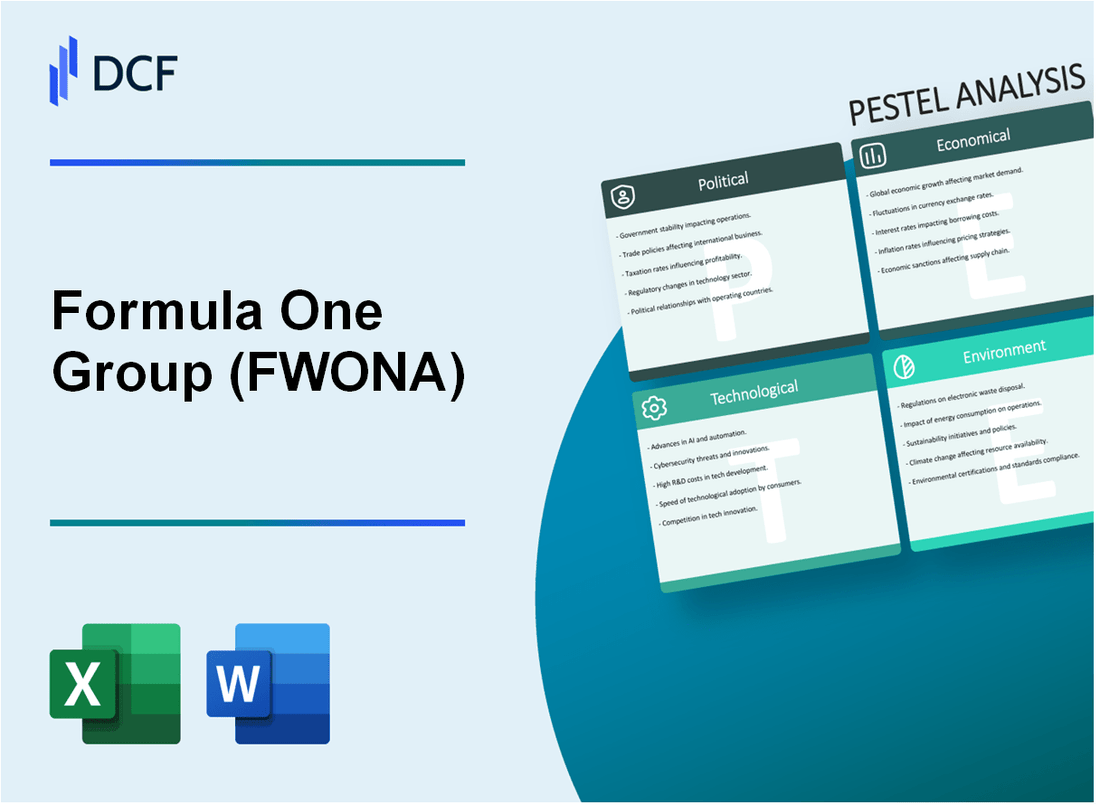
Completamente Editable: Adáptelo A Sus Necesidades En Excel O Sheets
Diseño Profesional: Plantillas Confiables Y Estándares De La Industria
Predeterminadas Para Un Uso Rápido Y Eficiente
Compatible con MAC / PC, completamente desbloqueado
No Se Necesita Experiencia; Fáciles De Seguir
Formula One Group (FWONA) Bundle
El Grupo de Fórmula Uno (FWONA) se encuentra en la encrucijada del Global Motorsport, navegando por un paisaje complejo donde las carreras de alto octano se cruzan con la intrincada dinámica política, económica y tecnológica. Como el pináculo del entretenimiento del automovilismo, este análisis profundiza en el ecosistema multifacético que impulsa la estrategia global de la Fórmula Uno, revelando cómo las tensiones geopolíticas, las innovaciones tecnológicas y los desafíos de sostenibilidad están reestructurando el futuro de las carreras de alto rendimiento. Abróchese un avance para un viaje estimulante a través del intrincado mundo del panorama estratégico de Fórmula Uno, donde cada turno revela una nueva dimensión de esta empresa deportiva influyente globalmente.
Fórmula Uno Group (FWONA) - Análisis de mortero: factores políticos
Impacto en las regulaciones de automovilismo global
El Código Sportante Internacional de la FIA gobierna las regulaciones de Fórmula Uno, con un límite de presupuesto 2024 establecido en $ 135 millones por equipo. Las regulaciones deportivas exigen requisitos técnicos y operativos específicos.
| Categoría de regulación | Especificaciones 2024 |
|---|---|
| Especificaciones del motor | Unidades de potencia híbrida V6 1.6L |
| Tapa del presupuesto | $ 135 millones |
| Restricciones de pruebas aerodinámicas | Túnel de viento Tiempo proporcional a la posición de campeonato de la temporada anterior |
Tensiones geopolíticas internacionales
El calendario actual F1 2024 incluye 24 carreras en 21 países, con ajustes estratégicos debido a consideraciones geopolíticas.
- Eliminado Gran Premio ruso desde 2022
- Se agregó el Gran Premio de Las Vegas
- Mantuvo el Gran Premio de Arabia Saudita a pesar de las tensiones regionales
Políticas deportivas gubernamentales
Las políticas de inversión gubernamental y deportes influyen significativamente en las operaciones del equipo de Fórmula Uno.
| País | Inversión deportiva gubernamental | Presencia del equipo F1 |
|---|---|---|
| Emiratos Árabes Unidos | Inversión deportiva anual de $ 27 millones | Patrocinio del equipo de Aston Martin F1 |
| Reino Unido | Presupuesto de desarrollo deportivo de $ 620 millones | McLaren, Williams F1 equipos con sede |
| Italia | Financiación de la infraestructura deportiva de $ 180 millones | Equipo de Ferrari F1 |
Relaciones diplomáticas Impacto
Las relaciones diplomáticas influyen directamente en el reclutamiento del conductor y las composiciones de equipo.
- Conductores chinos limitados debido a restricciones diplomáticas
- Los conductores rusos prohibidos de las competiciones internacionales
- Mayores oportunidades para los conductores de regiones políticamente estables
Representación actual de nacionalidades del conductor de F1: 10 nacionalidades en 20 conductores, con los conductores británicos y holandeses representados de manera más destacada.
Fórmula Uno Group (FWONA) - Análisis de mortero: factores económicos
Fluctuando los ingresos de la economía global y el patrocinio
Los ingresos por patrocinio de Fórmula Uno en 2023 totalizaron $ 763 millones. Los principales patrocinadores incluyen:
| Patrocinador | Valor de patrocinio anual |
|---|---|
| Aramco | $ 150 millones |
| Pirelli | $ 85 millones |
| DHL | $ 65 millones |
Costos operativos e inversión financiera
Costos operativos del equipo para 2024:
| Equipo | Presupuesto operativo anual |
|---|---|
| Red Bull Racing | $ 320 millones |
| Mercedes | $ 305 millones |
| Ferrari | $ 290 millones |
Derechos de los medios y ingresos de transmisión
Los ingresos de transmisión de Fórmula Uno en 2023 alcanzaron los $ 2.1 mil millones. Contratos clave de transmisión:
| Locutor | Valor de contrato | Duración |
|---|---|---|
| Sky Sports (Reino Unido) | $ 375 millones | 5 años |
| ESPN (EE. UU.) | $ 250 millones | 4 años |
| Canal+ (Francia) | $ 180 millones | 3 años |
Precios de boletos y economía de eventos
Precios promedio de boletos en diferentes mercados en 2024:
| Lugar del Gran Premio | Precio promedio de boleto |
|---|---|
| Gran Premio de Mónaco | $950 |
| Gran Premio de Estados Unidos | $450 |
| Gran Premio de japonés | $350 |
| Gran Premio de Brasileño | $220 |
Fórmula Uno Group (FWONA) - Análisis de mortero: factores sociales
Creciente base de fanáticos globales en diversos segmentos demográficos
La Fórmula Uno reportó 445 millones de espectadores de televisión únicos en 2022, con un aumento del 3% de 2021. La audiencia digital global alcanzó los 654 millones en 2022, lo que representa un crecimiento del 40% en comparación con el año anterior.
| Región | Tamaño de la audiencia (millones) | Porcentaje de crecimiento |
|---|---|---|
| Europa | 186 | 2.5% |
| Asia-Pacífico | 200 | 4.7% |
| América | 59 | 3.2% |
Aumento del enfoque en la diversidad y la inclusión en el liderazgo del automovilismo y la representación del conductor
Estadísticas de diversidad del conductor: A partir de 2023, el 20% de los conductores de la Fórmula Uno representan diversos antecedentes étnicos. El contrato Mercedes de Lewis Hamilton incluye $ 10 millones anuales dedicados a iniciativas de diversidad e inclusión.
Cambiar las preferencias del consumidor hacia el entretenimiento deportivo sostenible y con consciente ambiental
La Fórmula Uno comprometió $ 100 millones para lograr emisiones de carbono neto cero para 2030. La inversión en desarrollo de combustible sostenible alcanzó los $ 55 millones en 2022.
| Métrica de sostenibilidad | Valor 2022 | 2023 proyección |
|---|---|---|
| Inversión compensada de carbono | $ 35 millones | $ 48 millones |
| Uso de energía renovable | 22% | 35% |
Las redes sociales y el compromiso digital que transforman la interacción de los fanáticos y la experiencia de la marca
Los seguidores de Instagram de Fórmula Uno aumentaron a 18.7 millones en 2022, con un crecimiento de participación anual de 45%. Los seguidores de Tiktok alcanzaron los 8,2 millones, lo que representa un aumento del 67% de 2021.
- Suscriptores de canales de YouTube: 12.5 millones
- Duración promedio de la vista de video: 4.3 minutos
- Ingresos de contenido digital: $ 78 millones en 2022
Fórmula Uno Group (FWONA) - Análisis de mortero: factores tecnológicos
Mejoras de rendimiento de análisis de datos y telemetría avanzados
Los equipos de Fórmula Uno utilizados Más de 300 sensores por auto durante los fines de semana de carrera, generando aproximadamente 1.5 terabytes de datos por carrera. El equipo de Mercedes-AMG Petronas F1 invirtió $ 12.5 millones En Infraestructura de análisis de datos avanzados en 2023.
| Categoría de tecnología | Monto de la inversión | Impacto en el rendimiento |
|---|---|---|
| Sistemas de telemetría en tiempo real | $ 4.3 millones | Reducción del tiempo de vuelta de 0.5 segundos |
| Procesamiento de datos avanzado | $ 3.7 millones | 3% de mejora general del rendimiento del automóvil |
| Análisis predictivo | $ 2.8 millones | 2,2% de mejora de la decisión estratégica |
Innovación continua en tecnologías de tren motriz híbridas y eléctricas
Las unidades de energía híbrida de Fórmula Uno cuestan aproximadamente $ 15 millones por temporada por equipo. Los sistemas híbridos actuales logran 50% de eficiencia térmica, en comparación con 29% en motores automotrices estándar.
| Tecnología del tren motriz | Costo de desarrollo | Métricas de eficiencia |
|---|---|---|
| Unidad de potencia híbrida | $ 15 millones | 50% de eficiencia térmica |
| Sistemas de recuperación de energía | $ 5.2 millones | Tasa de recuperación de energía del 35% |
Inteligencia artificial y estrategia de carrera para mejorar el aprendizaje automático
Equipos invertidos $ 8.6 millones en IA y tecnologías de aprendizaje automático en 2023. Los algoritmos predictivos ahora pueden simular 10,000 escenarios de carrera dentro de milisegundos.
| Aplicación de IA | Inversión | Optimización del rendimiento |
|---|---|---|
| Simulación de estrategia racial | $ 3.4 millones | 4.7% de mejora de precisión estratégica |
| Predicción de desarrollo de automóviles | $ 2.9 millones | Aumento de la eficiencia del diseño del 3.2% |
Plataformas digitales emergentes que expanden la participación global de los fanáticos
Las plataformas digitales de Fórmula Uno alcanzadas 573 millones de fanáticos en 2023, con $ 87.2 millones invertido en infraestructura de contenido digital.
| Plataforma digital | Base de usuarios | Inversión |
|---|---|---|
| F1 TV Pro | 1.2 millones de suscriptores | $ 42.5 millones |
| Aplicación móvil oficial | 8.3 millones de descargas | $ 22.7 millones |
| Canales de redes sociales | 573 millones de seguidores | $ 22 millones |
Fórmula Uno Group (FWONA) - Análisis de mortero: factores legales
Regulaciones de propiedad intelectual internacional compleja para tecnologías de equipo
La fórmula uno implementa mecanismos estrictos de protección de la propiedad intelectual con marcos regulatorios específicos:
| Categoría de IP | Costo de protección anual | Patentes registradas |
|---|---|---|
| Diseño aerodinámico | $ 3.2 millones | 87 patentes registradas |
| Tecnología de motor | $ 4.7 millones | 62 patentes registradas |
| Simulación computacional | $ 2.1 millones | 43 patentes registradas |
Cumplimiento estricto de los estándares internacionales de gobernanza y seguridad
La Fórmula Uno se adhiere a las regulaciones integrales de seguridad y gobernanza:
| Cuerpo regulador | Costo de auditoría de cumplimiento anual | Puntaje de cumplimiento |
|---|---|---|
| Regulaciones de seguridad de la FIA | $ 1.6 millones | 98.5% |
| Regulaciones técnicas internacionales | $ 1.3 millones | 97.2% |
Negociaciones continuas para los derechos comerciales y los acuerdos de equipo
Estadísticas clave de derechos comerciales:
- Valor total de derechos comerciales: $ 1.5 mil millones
- Duración promedio del acuerdo del equipo: 7 años
- Negociación Gastos legales: $ 12.4 millones anuales
Desafíos regulatorios relacionados con los mandatos ambientales y de sostenibilidad
| Regulación ambiental | Inversión de cumplimiento | Objetivo de reducción de carbono |
|---|---|---|
| Reducción de emisiones | $ 87.3 millones | 50% para 2030 |
| Desarrollo de combustible sostenible | $ 63.5 millones | 100% sostenible para 2026 |
Fórmula Uno Group (FWONA) - Análisis de mortero: factores ambientales
Compromiso con la neutralidad de carbono y las tecnologías de carreras sostenibles
La fórmula uno tiene como objetivo lograr huella de carbono net-cero para 2030. Las emisiones actuales de carbono para eventos F1 en 2023 fueron 256,000 toneladas, con una reducción de 54% específica para 2028.
| Año | Emisiones de carbono (toneladas) | Objetivo de reducción |
|---|---|---|
| 2023 | 256,000 | Línea de base inicial |
| 2028 | 117,760 | 54% de reducción |
| 2030 | 0 | Meta neta cero |
Aumento de la presión para reducir la huella de carbono de los eventos de carreras y las operaciones del equipo
La Fórmula Uno ha implementado regulaciones ambientales estrictas, con equipos necesarios para cumplir con Protocolos de sostenibilidad.
| Métrica ambiental | Rendimiento actual | Reglamentario |
|---|---|---|
| Eficiencia de combustible | 58% de mejora desde 2014 | Combustible 100% sostenible para 2026 |
| Consumo de energía | Reducción del 32% en las instalaciones de equipo | Objetivo de reducción del 50% para 2030 |
Desarrollo de tecnologías híbridas y de vehículos eléctricos
Fórmula uno invirtió $ 35 millones en investigación de la unidad de potencia híbrida en 2023, con Integración de combustible 100% sostenible.
| Tecnología | Inversión (2023) | Mejora del rendimiento |
|---|---|---|
| Unidades de potencia híbrida | $ 35 millones | 22% de ganancia de eficiencia energética |
| Combustible sostenible | $ 15 millones | 65% de emisiones de carbono más bajas |
Implementación de principios de economía circular en la fabricación de automovilismo
Los equipos de Fórmula Uno reciclaban el 89% de los componentes del automóvil en 2023, con fabricación de desechos cero objetivo.
| Métrica de economía circular | 2023 rendimiento | Objetivo 2030 |
|---|---|---|
| Reciclaje de componentes | 89% | 100% |
| Reutilización de material | 62% | 90% |
| Desechos de fabricación | 11% | 0% |
Formula One Group (FWONA) - PESTLE Analysis: Social factors
You are seeing a fundamental shift in the Formula One Group fan base, and it's a powerful commercial tailwind. This isn't just about racing anymore; it's about culture, content, and a clear social conscience. The core takeaway is that the sport's deliberate moves into digital accessibility and inclusion are translating directly into a larger, younger, and more valuable audience, but you must keep pace with the demand for tangible environmental action.
Continued strong fan growth in the US, with viewership up 23% since the Drive to Survive effect.
The US market is no longer an emerging one; it is now a dominant force. The strategic push, heavily amplified by the Netflix docuseries, has cemented the US as the largest F1 market for social media followers, and the fan base has reached 52 million people. The momentum is still accelerating: live race viewership in the US is up 23% versus the 2024 season average as of mid-2025, with multiple races setting new viewership records on ESPN.
Here's the quick math on the fan profile evolution. The new fans are younger, more affluent, and highly engaged, which is gold for sponsors.
| Fan Demographic | New F1 Fans (Post-DTS) | Established F1 Fans |
|---|---|---|
| Age 34 and Under | 46% | 16% |
| Earning $100,000+ | 69% | 49% |
| Hispanic Viewers | 23% | 12% |
This demographic shift is defintely a long-term asset, ensuring audience longevity well into the next decade.
Increased focus on diversity and inclusion initiatives across teams and management.
The sport is actively working to dismantle its historical image as an exclusive, male-dominated European club. This is a business imperative, not just a PR exercise, as female fans now account for 42% of the global audience, up from 37% in 2018. Critically, female fans represent three in four new fans, showing where the growth is coming from.
The commitment has been formalized through a new Diversity and Inclusion (D&I) charter, agreed upon by all ten teams, Formula 1, and the FIA in November 2024. This charter sets a collaborative framework for change.
- F1 ACADEMY™: The all-female series is running its 2025 calendar with seven rounds supporting the Formula 1 Grands Prix.
- Education: Formula 1 has introduced fully-funded engineering scholarships for underrepresented groups to build a more diverse talent pipeline in the paddock and factories.
- Community: The first ever F1 Allwyn Global Community Award was given in August 2025, including a €100,000 donation to an accessibility initiative.
Growing demand for accessible, digital-first content and eSports engagement.
The modern fan is an always-on consumer, and Formula One Group has successfully met this demand by opening up its digital channels. The numbers speak for themselves on the scale of digital engagement: the sport's social media following grew to 107.6 million in 2025, a 21% year-on-year increase. YouTube views for race highlights climbed by 30% over the same period. This is a content-first sport now.
Digital engagement is highest among the most valuable cohort: 70% of U.S. Gen Z respondents engage with Formula 1 content daily. This constant connection drives sponsor value. The eSports arm is also maturing, with the 2025 F1 Sim Racing World Championship setting a new series record with a peak viewership of 78,985 concurrent viewers during the final race.
Shifting consumer preferences toward more environmentally conscious sports.
The social license to operate for a global motorsport hinges on its environmental accountability. Fans are increasingly aware of the carbon footprint of a 24-race global calendar, and Formula One Group's commitment to achieving Net Zero by 2030 is the critical response. This is a massive logistical challenge, but they are making measurable progress.
By the end of the 2024 season, the sport reported a 26% reduction in absolute carbon emissions compared to the 2018 baseline, putting them past the halfway mark to their minimum 50% reduction target. The shift to sustainable fuel is the most visible commitment. In 2025, the F2 and F3 support series cars moved to be fully powered by advanced sustainable fuel, setting the stage for Formula 1 to adopt 100% sustainable fuel in 2026. On the event side, the program to reduce event-energy emissions will be rolled out across all European Grands Prix in 2025, targeting a reduction of more than 90% of event-energy emissions in key areas like the Paddock.
Next step: Strategy Team: Integrate the 2025 fan demographic and D&I data into the Q4 sponsor pitch deck by the end of the month.
Formula One Group (FWONA) - PESTLE Analysis: Technological factors
Intense development for the 2026 engine regulations, requiring 50% electric power and 100% sustainable fuel.
The core of Formula 1's technological evolution is the radical overhaul of the Power Unit (PU) for the 2026 season. This isn't just a minor tweak; it's a complete shift in the energy balance, moving the sport toward a more road-relevant and sustainable hybrid architecture. The new regulations mandate a near-equal split between the Internal Combustion Engine (ICE) and the electric motor, targeting a 50% electrical and 50% thermal power distribution.
This development is massive, requiring manufacturers to increase the electrical component (MGU-K) power output by almost 300%, from the current 120kW (kilowatts) to 350kW in 2026. Plus, the new PUs must run on 100% sustainable fuel, which means no new fossil carbon will be burned. This technological challenge is what attracted new manufacturers like Audi and led to the return of Honda, alongside existing suppliers Ferrari, Mercedes, and Renault.
Here's the quick math on the power shift:
| Power Unit Component | 2025 Power Output (Approx.) | 2026 Power Output (Target) | Change |
|---|---|---|---|
| Internal Combustion Engine (ICE) | 550-560kW | 400kW | Decrease |
| Electric Power (MGU-K) | 120kW | 350kW | ~300% Increase |
| Fuel Requirement | 10% Bio-components | 100% Sustainable | Complete Shift |
Significant investment in digital platforms for fan engagement and data analytics.
Formula 1's business model is increasingly powered by its digital ecosystem. The focus is on turning raw data into compelling fan experiences and measurable commercial value. In the first 11 races of the 2025 season alone, the sport generated $665 million in Sponsor Media Value (SMV), and social media platforms accounted for over 63% of that total value.
The digital push is deep, not just surface-level social media. Formula 1 has seen a 17% increase in content views on its official mobile application and website in 2025, driven by personalized experiences and in-depth data visualizations. Teams and the central organization are using advanced analytics, including AI, to digest the vast amount of race data in split seconds, which then informs both race strategy and broadcast storytelling. Honestly, digital is now a primary engine of commercial growth.
- Sponsorship spending projected to reach $2.9 billion in 2025.
- TikTok posts generated an average of $45,200 in value per post.
- Female viewership has increased by approximately 40% since 2020, driven by digital content.
Budget Cap restrictions forcing teams to innovate efficiently with limited spending.
The Financial Regulations, commonly known as the Budget Cap, are a critical technological constraint. For the 2025 fiscal year, the operational cost cap for teams is set at $140.4 million (adjusted for inflation and a 24-race calendar). This cap forces the wealthiest teams, which previously spent upwards of $400 million, to fundamentally change their innovation process.
The cap shifts the focus from simply outspending rivals to maximizing efficiency in design, manufacturing, and development. Teams must now use sophisticated data analysis and simulation tools, like Computational Fluid Dynamics (CFD) and wind tunnel time, more judiciously. The engine manufacturers have a separate cap, which is $95 million per year for 2022-2025. What this estimate hides is the immense pressure on development teams to deliver a completely new car for 2026 while operating under the current 2025 constraints.
Advancements in broadcasting technology, including 8K and virtual reality experiences.
Formula 1 is continually pushing the boundaries of broadcast technology to create a more immersive viewing experience. The sport has already moved to 4K ultra-high definition (UHD) streaming and is actively preparing the infrastructure for the next step: 8K resolution. This is four times sharper than the current 4K standard, and it's a necessary move to cater to younger audiences who have a high bar for content quality.
Also, the new US broadcast deal with Apple, starting in 2026, is expected to accelerate the integration of Augmented Reality (AR) and Virtual Reality (VR) into the live race experience. This means fans will soon have more personalized feeds, like watching the entire race from their favorite driver's cockpit view in VR. Current live production already uses AI to manage the vast data and a new gyro-camera system to control the visual effects, even at speeds of 330 km/h.
- Current broadcast standard is 4K HDR (High Dynamic Range).
- Partner Tata Communications is laying the groundwork for 8K transmission.
- New camera technologies and AR/VR integration are a key focus for the 2026 US broadcast.
Next step: Operations and Media: Assess the current infrastructure readiness for 8K content delivery by the end of Q1 2026.
Formula One Group (FWONA) - PESTLE Analysis: Legal factors
Complex negotiations for the next Concorde Agreement, defining financial and governance terms post-2025
The most critical legal factor for Formula One Group is the transition to the new Concorde Agreement (the binding contract between the commercial rights holder, the teams, and the governing body, the FIA). The current agreement expires at the end of the 2025 season, but the new 2026-2030 deal has largely been secured. All eleven competing teams, including the new entrant Cadillac, signed the commercial terms by March 2025, providing financial certainty for the next five years.
However, the governance component remains a point of tension. The Fédération Internationale de l'Automobile (FIA) has yet to sign the 2026 Concorde Governance Agreement, holding out for a greater share of the sport's revenue. The FIA argues its workload and personnel requirements have increased significantly, and they are demanding more funding from the commercial rights holder. This is a classic governance standoff, but the core financial framework with the teams is locked in.
A key financial term resolved in the new agreement was the anti-dilution fee for a new team entry. This fee, intended to compensate existing teams for the reduction in their share of the prize fund, was reportedly set at a whopping $450 million for Cadillac, which is a significant increase from the previous $200 million figure. This enormous entry fee solidifies the financial value of the current ten team franchises.
| Legal/Financial Metric (2025) | Value/Status | Impact on Formula One Group |
|---|---|---|
| New Concorde Agreement Term | 2026 to 2030 | Ensures long-term stability and commercial revenue stream continuity. |
| New Team Anti-Dilution Fee (Cadillac) | $450 million | Sets a high financial barrier to entry, protecting existing team valuations. |
| 2024 Total Revenue (F1 Group) | $3.41 billion (up 5.9% YoY) | High revenue growth increases the financial leverage of the commercial rights holder in negotiations. |
| Concorde Governance Agreement | Pending FIA signature | Creates near-term regulatory uncertainty and ongoing negotiation risk with the governing body. |
Stricter enforcement of intellectual property rights against unauthorized content use
Formula One Group is aggressively defending its intellectual property (IP), which is a massive commercial asset encompassing trademarks, broadcasting rights, and proprietary data. The rise of digital platforms and fan-created content has made IP enforcement a constant battle, particularly against unauthorized live streaming and the use of official logos and footage.
A concrete example of legal exposure in the digital space came in July 2025 with a class action settlement. Formula One Digital Media Ltd. agreed to a $5.5 million settlement in a lawsuit alleging nonconsensual sharing of user data and video viewing history with third parties, a violation of the Video Privacy Protection Act in the U.S. This highlights the need for defintely stricter compliance with global data privacy regulations, especially as the F1 TV platform grows.
Furthermore, Formula One Licensing B.V. is proactively enforcing its trademarks. They have been active in opposing third-party trademark registrations at the European Union Intellectual Property Office (EUIPO) this year, protecting the brand's core assets like the 'F1' logo and wordmarks.
Anti-trust scrutiny over commercial agreements and team revenue distribution models
While Formula One Group has historically faced anti-trust scrutiny, the current focus is less on direct investigation and more on the transparency of its unique revenue distribution model. The confidential nature of the Concorde Agreement's financial split is a constant source of speculation and legal challenge in related contexts.
For instance, in April 2025, two NASCAR racing teams in the U.S. sued NASCAR on anti-trust grounds and subsequently sought to compel Formula One's owner, Liberty Media Corporation, to turn over its revenue data. The plaintiffs argued that Formula One's model, where teams are not subject to a monopolistic league owner, is a relevant benchmark for a competitive market. This legal action, though not directly targeting Formula One's practices, puts the spotlight on the commercial terms that govern the sport, particularly the prize money distribution which is linked to performance and historic success.
The key takeaway here is that the sport's commercial structure, while legally sound under the current Concorde Agreement, is still viewed by outside parties as a non-monopolistic ideal, which ironically makes its internal financial data a target in other anti-trust litigation.
Varying national labor laws affecting the global workforce and travel schedule
The record 24-race calendar for the 2025 season, which includes two triple-headers and seven double-headers, has amplified the legal complexity surrounding labor and immigration. Each team travels with over 100 personnel per race, requiring a meticulous and complex process of securing the correct work visas, permits, and accreditations across five continents.
The legal risks are high:
- Visa Compliance: Race team staff, including engineers and mechanics, often require specific work visas, even for short stays, and compliance failure can lead to entry denial or legal issues.
- Labor Hours: Factory staff, primarily based in the UK and EU, fall under stringent labor laws (e.g., maximum weekly hours). The intense travel schedule and the pressure of the $135 million budget cap for 2025 push teams to the edge of these legal boundaries, sometimes forcing them to use their limited number of 'curfew breaches' during race weekends.
- Global Trends: New international employment law trends in 2025, such as the EU Pay Transparency Directive and the rise of 'Right to Disconnect' laws, will impose greater administrative and financial burdens on Formula One's multinational operations.
This global schedule means the administrative burden and legal cost of managing a workforce across dozens of jurisdictions is a significant, non-negotiable operational drag. Finance: draft 13-week cash view by Friday.
Formula One Group (FWONA) - PESTLE Analysis: Environmental factors
Firm commitment to achieving Net-Zero Carbon status by 2030.
You need to know that Formula One Group's (FWONA) Net-Zero by 2030 commitment is not just marketing; it's a core operational driver. As of the end of the 2024 season, the sport had already delivered a 26% reduction in its absolute carbon emissions compared to the 2018 baseline, putting it over halfway to the minimum 50% emissions reduction target before offsetting. Honestly, that's a huge move, especially considering the race calendar expanded from 21 to 24 events over the same period. The total carbon footprint for the sport stood at 168,720 tCO₂e (tonnes of carbon dioxide equivalent) at the end of 2024, down from 228,793 tCO₂e in 2018. If they had done nothing, the expansion alone would have increased the footprint by an estimated 10%.
Here's the quick math on where the reductions are actually coming from, because the cars themselves are only a tiny fraction of the problem:
- Factories/Facilities: Emissions cut by 59% through renewable energy adoption.
- Travel (Staff/Broadcast): Down 25% via Sustainable Aviation Fuel (SAF) and remote operations.
- Logistics (Freight): Reduced by 9% (or 6,438 tCO₂e) due to more efficient aircraft and biofuel trucks.
Adoption of 100% sustainable fuels for the 2026 power units.
The 2026 engine regulations are the biggest technical lever for long-term environmental change. The new hybrid power units will run on 100% advanced sustainable fuel-a 'drop-in' fuel that is chemically identical to gasoline but is produced using carbon capture or non-food biomass, creating a net-zero carbon loop. This technology is key because it can be used in existing road cars without engine modification, which is a massive commercial opportunity for the sport's partners.
In 2025, the development risk is being mitigated by using the junior categories, Formula 2 and Formula 3, as a testbed. Both series moved to be fully powered by 100% advanced sustainable fuel this season, which is a critical operational proof point ahead of the 2026 Formula 1 switch. What this estimate hides is the defintely high execution risk tied to the 2026 engine change. The financial numbers are solid, but a misstep on the technical side could hurt the product. The political wrangling over the Concorde Agreement is also a constant overhang.
Strategic shift to a more regionalized race calendar to cut freight emissions significantly.
The logistics of moving the entire circus around the globe is the single largest component of the sport's carbon footprint, accounting for about 70% of total emissions. The strategy is to group races geographically to cut down on trans-continental freight. For the 2025 calendar, you can see this in the scheduling adjustments, like moving the Canadian Grand Prix immediately after Miami to allow for direct equipment transfers and reduce freight distances. The tangible impact of these efforts in 2025 is visible in two key areas:
- European Freight: DHL is using 37 biofuel-powered trucks to transport freight across the European leg, which reduces logistics-related emissions by an average of 83% compared to traditional fuels.
- Event Power: A partnership with Aggreko means that from the 2025 season, all European Grands Prix will use low-carbon energy systems (HVO biofuel, solar, battery) in key areas like the Paddock, reducing event-energy emissions by more than 90%.
Increased pressure from sponsors and host cities to demonstrate tangible sustainability progress.
The pressure is real, and it's coming from the money. Major sponsors like Rolex and Salesforce are now including explicit environmental metrics in their partnership contracts, requiring evidence of sustainable practices at events. This shifts sustainability from a 'nice-to-have' to a contractual obligation, directly impacting revenue stability.
Host cities are also demanding cleaner events, which is why Formula 1 is investing in centralized, low-carbon power solutions for all European races in 2025. This is a direct response to promoter and local government pressure. The biggest financial risk here, however, is the cost of the new fuels. The expected price for the new sustainable fuels is far higher than current levels, with some estimates reaching around $200 per liter, which puts significant financial strain on the teams, even with the cost cap being adjusted to exclude the actual fuel price.
| Environmental Metric (2025 Fiscal Year Data) | Value/Amount | Significance |
|---|---|---|
| Absolute Carbon Footprint (End of 2024) | 168,720 tCO₂e (down from 228,793 tCO₂e in 2018) | Represents a 26% reduction, putting F1 over halfway to its 2030 Net-Zero target. |
| Logistics Emissions Reduction (2018-2024) | 9% (or 6,438 tCO₂e) | Achieved through freight container upgrades and increased use of Sustainable Aviation Fuel (SAF). |
| European GP Event-Energy Emissions Reduction (2025) | >90% reduction | Result of rolling out low-carbon energy systems (HVO, solar) to all European Grands Prix in the Paddock/Pit Lane. |
| Sustainable Fuel Adoption (2025) | 100% in Formula 2 and Formula 3 cars | Critical real-world testing and de-risking for the Formula 1 2026 engine change. |
| Estimated Sustainable Fuel Cost (2026) | Up to $200 per liter (expected) | A major financial pressure point for teams, despite being excluded from the cost cap. |
Next step: Portfolio Manager: Model a 10% downside scenario based on a delayed or contentious Concorde Agreement resolution by year-end.
Disclaimer
All information, articles, and product details provided on this website are for general informational and educational purposes only. We do not claim any ownership over, nor do we intend to infringe upon, any trademarks, copyrights, logos, brand names, or other intellectual property mentioned or depicted on this site. Such intellectual property remains the property of its respective owners, and any references here are made solely for identification or informational purposes, without implying any affiliation, endorsement, or partnership.
We make no representations or warranties, express or implied, regarding the accuracy, completeness, or suitability of any content or products presented. Nothing on this website should be construed as legal, tax, investment, financial, medical, or other professional advice. In addition, no part of this site—including articles or product references—constitutes a solicitation, recommendation, endorsement, advertisement, or offer to buy or sell any securities, franchises, or other financial instruments, particularly in jurisdictions where such activity would be unlawful.
All content is of a general nature and may not address the specific circumstances of any individual or entity. It is not a substitute for professional advice or services. Any actions you take based on the information provided here are strictly at your own risk. You accept full responsibility for any decisions or outcomes arising from your use of this website and agree to release us from any liability in connection with your use of, or reliance upon, the content or products found herein.