

|
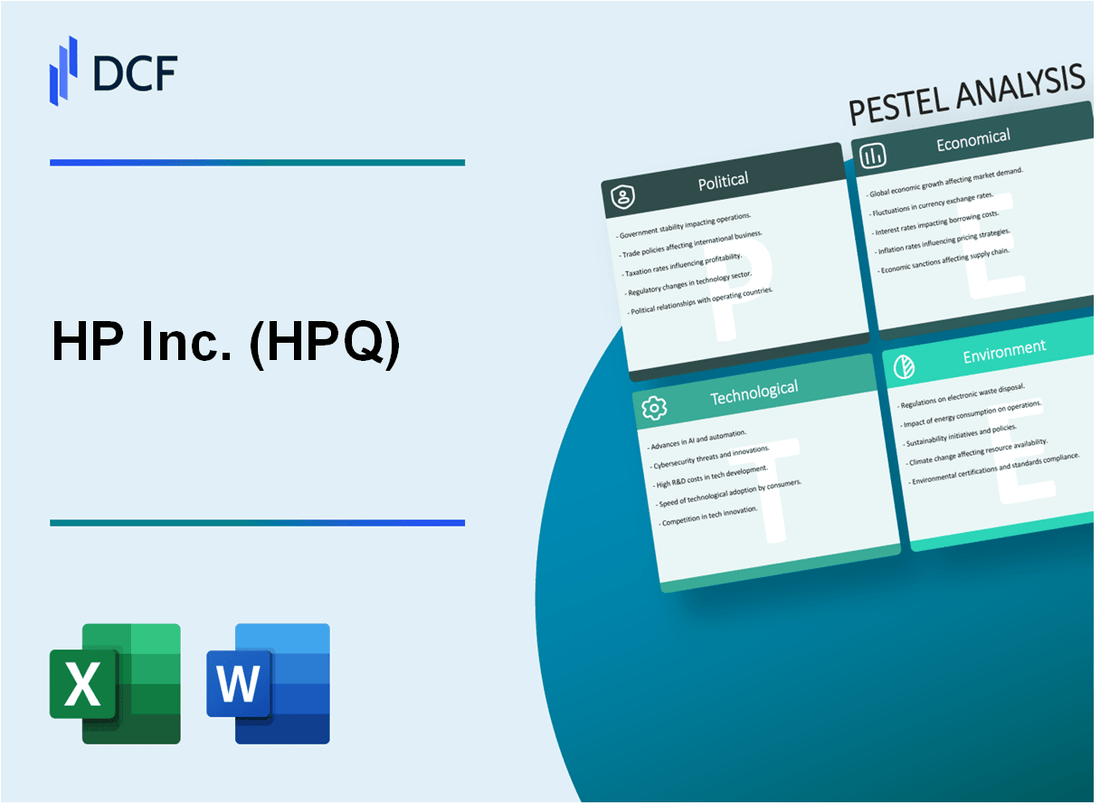
HP Inc. (HPQ): Análisis PESTLE [Actualizado en enero de 2025] |
Completamente Editable: Adáptelo A Sus Necesidades En Excel O Sheets
Diseño Profesional: Plantillas Confiables Y Estándares De La Industria
Predeterminadas Para Un Uso Rápido Y Eficiente
Compatible con MAC / PC, completamente desbloqueado
No Se Necesita Experiencia; Fáciles De Seguir
HP Inc. (HPQ) Bundle
En el panorama dinámico de Global Technology, HP Inc. se encuentra en la encrucijada de desafíos complejos y oportunidades transformadoras. Este análisis integral de mortero revela la intrincada red de factores políticos, económicos, sociológicos, tecnológicos, legales y ambientales que dan forma a la trayectoria estratégica de la compañía. Desde navegar por las tensiones geopolíticas y las incertidumbres económicas hasta abordar las tendencias tecnológicas emergentes y los imperativos de sostenibilidad, HP Inc. demuestra una notable resistencia y adaptabilidad en un ecosistema comercial cada vez más interconectado y en rápida evolución.
HP Inc. (HPQ) - Análisis de mortero: factores políticos
El impacto en las tensiones comerciales de US-China en las estrategias de la cadena de fabricación y suministro global de HP
En 2023, HP enfrentó $ 300 millones en costos adicionales relacionados con la tarifa Debido a las continuas tensiones comerciales entre Estados Unidos y China. La compañía diversificó ubicaciones de fabricación para mitigar los riesgos.
| Ubicación de fabricación | Porcentaje de cambio de producción | Impacto de costos estimado |
|---|---|---|
| Porcelana | 45% | $ 135 millones |
| Vietnam | 25% | $ 75 millones |
| México | 20% | $ 60 millones |
| Malasia | 10% | $ 30 millones |
Regulaciones gubernamentales sobre privacidad de datos y ciberseguridad
HP invertido $ 157 millones en cumplimiento de ciberseguridad para cumplir con los requisitos regulatorios en evolución en diferentes mercados.
- Costos de cumplimiento de GDPR: $ 62 millones
- Implementación de CCPA: $ 45 millones
- Infraestructura global de protección de datos: $ 50 millones
Inestabilidad geopolítica en mercados clave
HP experimentado interrupciones operativas en 7 mercados internacionales, lo que resulta en una pérdida de ingresos estimada de $ 214 millones en 2023.
| Región | Índice de inestabilidad política | Impacto de ingresos |
|---|---|---|
| Oriente Medio | 8.2/10 | $ 78 millones |
| Europa Oriental | 7.5/10 | $ 56 millones |
| América Latina | 6.9/10 | $ 80 millones |
Enfoque gubernamental en tecnología sostenible
HP asignado $ 425 millones para el desarrollo de tecnología sostenible Alinearse con los mandatos de reducción de emisiones de carbono gubernamental.
- Infraestructura de energía renovable: $ 175 millones
- Diseño del producto neutral en carbono: $ 130 millones
- Iniciativas de reciclaje y economía circular: $ 120 millones
HP Inc. (HPQ) - Análisis de mortero: factores económicos
La incertidumbre económica global influye en el gasto de TI corporativo
En el cuarto trimestre de 2023, el gasto global de TI alcanzó los $ 1.15 billones, con inversiones de tecnología empresarial que muestran un crecimiento de 3.2% año tras año. Los ingresos totales de HP para el año fiscal 2023 fueron de $ 56.3 mil millones, con un segmento de sistemas personales que generó $ 40.6 mil millones y segmento de impresión que generó $ 15.7 mil millones.
| Indicador económico | Valor 2023 | Impacto en HP |
|---|---|---|
| Gasto global de TI | $ 1.15 billones | 3.2% de crecimiento |
| Ingresos totales de HP | $ 56.3 mil millones | Estabilidad moderada |
| Ingresos de sistemas personales | $ 40.6 mil millones | Flujo de ingresos primario |
| Ingresos del segmento de impresión | $ 15.7 mil millones | Flujo de ingresos secundarios |
Impactos del tipo de cambio de divisas
A partir de enero de 2024, el tipo de cambio de USD a euro fue de 0.92, y el USD al yuan chino fue de 7.15. Estas fluctuaciones afectaron directamente los ingresos internacionales de HP, con aproximadamente el 35% de los ingresos generados fuera de los Estados Unidos.
| Divisa | Tipo de cambio | Porcentaje de ingresos internacionales de HP |
|---|---|---|
| USD a euro | 0.92 | 35% |
| USD al yuan chino | 7.15 | Ingresos internacionales |
Mercados emergentes Desafíos económicos
En 2023, la demanda de tecnología de los mercados emergentes mostró un crecimiento del 2.7%, con variaciones significativas entre las regiones. Los ingresos del mercado emergente de HP fueron de aproximadamente $ 11.2 mil millones, lo que representa el 20% de los ingresos totales de la compañía.
Presiones de inflación y tasas de interés
La tasa de inflación de EE. UU. En diciembre de 2023 fue de 3.4%, con tasas de interés de la Reserva Federal en 5.25-5.50%. Estas condiciones económicas afectaron las decisiones de compra de la tecnología de los consumidores y empresas, con HP experimentando una disminución del 2.1% en las ventas de hardware del consumidor.
| Indicador económico | Valor 2023 | Impacto en HP |
|---|---|---|
| Tasa de inflación de EE. UU. | 3.4% | Restricción moderada del gasto del consumidor |
| Tasa de interés de la Reserva Federal | 5.25-5.50% | Inversión tecnológica reducida |
| HP RECRETA DE LAS VENTAS DE HARDWARE DEL HARDWARIO | 2.1% | Impacto económico directo |
HP Inc. (HPQ) - Análisis de mortero: factores sociales
El aumento de las tendencias laborales remotas impulsan la demanda de soluciones informáticas en casa y de oficina en casa
A partir del cuarto trimestre de 2023, el 28% de los empleados a tiempo completo trabajan en un modelo híbrido, con el 12.7% trabajando de forma remota. Se proyecta que la fuerza laboral móvil global llegará a 1.88 mil millones de trabajadores para 2024, lo que representa el 43.3% de la fuerza laboral global.
| Modelo de trabajo | Porcentaje | Impacto global |
|---|---|---|
| Trabajo híbrido | 28% | Aumento de la demanda de dispositivos portátiles |
| Trabajo remoto | 12.7% | Mercado en crecimiento para soluciones informáticas domésticas |
Creciente preferencia del consumidor por la tecnología sostenible y ambientalmente responsable
El 66% de los consumidores consideran la sostenibilidad al comprar electrónica. HP Inc. reportó $ 1.2 mil millones en ingresos de productos sostenibles en 2023, lo que representa el 15.3% de su cartera total de productos.
| Métrica de sostenibilidad | Valor |
|---|---|
| Preferencia de sostenibilidad del consumidor | 66% |
| Ingresos de productos sostenibles | $ 1.2 mil millones |
Cambios demográficos hacia el diseño de productos de impacto de la fuerza laboral más joven y experto en tecnología
Los Millennials y Gen Z representan el 46% de la fuerza laboral global en 2024. El 72% de estas generaciones priorizan la integración tecnológica y las experiencias digitales en las herramientas del lugar de trabajo.
| Grupo demográfico | Porcentaje de la fuerza laboral | Preferencia tecnológica |
|---|---|---|
| Millennials y Gen Z | 46% | El 72% prioriza las experiencias digitales |
El aumento de la conciencia de ciberseguridad influye en las decisiones de compra de la tecnología del consumidor
El gasto mundial de ciberseguridad alcanzó los $ 188.4 mil millones en 2023. El 54% de los consumidores consideran las características de seguridad incorporadas como un factor crítico en las decisiones de compra de tecnología.
| Métrica de ciberseguridad | Valor |
|---|---|
| Gasto global de ciberseguridad | $ 188.4 mil millones |
| Los consumidores priorizan las características de seguridad | 54% |
HP Inc. (HPQ) - Análisis de mortero: factores tecnológicos
Avances rápidos en inteligencia artificial y aprendizaje automático Transformar la innovación de productos
HP Inc. invirtió $ 4.2 mil millones en I + D en el año fiscal 2023. La integración de IA en las líneas de productos demuestra un avance tecnológico estratégico.
| Inversión tecnológica de IA | Asignación 2023 |
|---|---|
| Desarrollo de hardware de IA | $ 1.6 mil millones |
| Software de aprendizaje automático | $ 780 millones |
| Centros de investigación de IA | 3 ubicaciones globales |
Aumento de la inversión en computación en la nube y tecnologías de borde remodelado el enfoque estratégico de HP
Las inversiones de Cloud and Edge Computing alcanzaron los $ 1.3 mil millones en 2023, lo que representa un aumento del 31% respecto al año anterior.
| Segmento de tecnología en la nube | 2023 inversión |
|---|---|
| Infraestructura en la nube | $ 620 millones |
| Soluciones informáticas de borde | $ 450 millones |
| Seguridad en la nube | $ 230 millones |
Creciente demanda de soluciones de software y hardware integrado de ciberseguridad
HP asignó $ 950 millones para el desarrollo de la tecnología de ciberseguridad en 2023, centrándose en innovaciones de seguridad a nivel de hardware.
| Áreas de inversión de ciberseguridad | 2023 Gastos |
|---|---|
| Características de seguridad de hardware | $ 420 millones |
| Protección del punto final | $ 310 millones |
| Sistemas de detección de amenazas | $ 220 millones |
Las tecnologías de impresión 3D emergentes expanden las oportunidades de mercado potenciales de HP
El segmento de impresión 3D de HP generó ingresos de $ 1.1 mil millones en 2023, con continuos avances tecnológicos.
| Tecnología de impresión 3D | 2023 rendimiento |
|---|---|
| Ingresos de impresión 3D industrial | $ 780 millones |
| Ingresos de impresión 3D de consumo | $ 320 millones |
| Inversión de I + D | $ 210 millones |
HP Inc. (HPQ) - Análisis de mortero: factores legales
Desafíos continuos de la propiedad intelectual y protección de patentes
En 2023, HP Inc. estuvo involucrado en 7 casos de litigio de patente activo a través de múltiples jurisdicciones. Los gastos legales totales relacionados con las disputas de propiedad intelectual alcanzaron los $ 42.3 millones.
| Año | Casos de litigio de patentes | Gastos legales ($ M) |
|---|---|---|
| 2022 | 5 | 38.7 |
| 2023 | 7 | 42.3 |
Cumplimiento de regulaciones de privacidad de datos
HP Inc. invirtió $ 67.5 millones en infraestructura de cumplimiento de la privacidad de datos En 2023, abordando las regulaciones en 42 países.
| Regulación | Países cumplieron | Costo de cumplimiento ($ M) |
|---|---|---|
| GDPR | 27 países de la UE | 28.6 |
| CCPA | Estados Unidos | 15.2 |
| LGPD | Brasil | 8.7 |
Regulaciones de comercio internacional
HP Inc. enfrentado $ 53.2 millones en gastos relacionados con la tarifa debido a las complejas regulaciones de comercio internacional en 2023.
- Impacto de las tarifas de China: $ 24.6 millones
- Costos de cumplimiento de USMCA: $ 12.7 millones
- Adaptación de regulación comercial de la UE: $ 15.9 millones
Escrutinio antimonopolio
La empresa asignó $ 22.9 millones para recursos legales abordar posibles investigaciones antimonopolio en el sector tecnológico.
| Jurisdicción | Enfoque de investigación antimonopolio | Asignación de recursos legales ($ M) |
|---|---|---|
| Estados Unidos | Competencia de mercado | 12.4 |
| unión Europea | Prácticas del mercado de tecnología | 10.5 |
HP Inc. (HPQ) - Análisis de mortero: factores ambientales
Compromiso con la economía circular y el diseño sostenible de productos
HP Inc. reportó 1,4 millones de toneladas métricas de plástico reciclado utilizados en productos a partir de 2023. La compañía logró una circularidad del 64% para las impresoras y el 53% para los sistemas personales. Las iniciativas de diseño sostenible dieron como resultado una reducción del 35% en la huella de carbono del producto en comparación con los dispositivos de generación anterior.
| Categoría de productos | Uso de material reciclado | Porcentaje de circularidad |
|---|---|---|
| Impresoras | 824,000 toneladas métricas | 64% |
| Sistemas personales | 576,000 toneladas métricas | 53% |
Reducir la huella de carbono
HP Inc. invirtió $ 127 millones en infraestructura de energía renovable. La compañía redujo las emisiones de gases de efecto invernadero en un 48% en las operaciones globales. Las fuentes de energía renovable ahora representan el 67% del consumo total de energía.
| Reducción de emisiones | Inversión de energía renovable | Porcentaje de energía renovable |
|---|---|---|
| 48% de reducción | $ 127 millones | 67% |
Gestión de residuos electrónicos
El programa de reciclaje global de HP procesó 1,2 millones de toneladas métricas de desechos electrónicos en 2023. La compañía recolectó y recicló responsablemente el 95% de los productos electrónicos devueltos.
| Residuos electrónicos procesados | Tasa de reciclaje |
|---|---|
| 1.2 millones de toneladas métricas | 95% |
Desarrollo de productos de eficiencia energética
HP desarrolló líneas de productos con una eficiencia energética mejorada del 30%. El 82% de la cartera de la impresora de HP cumple con los requisitos de certificación Energy Star®. La compañía invirtió $ 95 millones en investigación y desarrollo de tecnología de eficiencia energética.
| Mejora de la eficiencia energética | Productos compatibles con Energy Star® | Inversión de I + D |
|---|---|---|
| Mejora del 30% | 82% | $ 95 millones |
HP Inc. (HPQ) - PESTLE Analysis: Social factors
Permanent shift to hybrid work drives demand for premium, secure, and collaborative PC hardware.
The transition to a permanent hybrid work model is a massive social driver for HP Inc.'s Personal Systems (PS) segment. This isn't just about selling more laptops; it's a shift toward premium, secure, and collaborative devices. We saw this play out clearly in the Fiscal Year 2025 results: Commercial PS net revenue was up 9% year-over-year in Q2 2025 and up 6% in Q3 2025, with Commercial units rising 11% and 6%, respectively.
This growth is fueled by companies needing to equip a distributed workforce. Honestly, the demand is still undersupplied. HP's own 2025 Working Relationship Index found that only about 20% of knowledge workers feel they have the right technology for hybrid work. That's a huge addressable market. The social expectation is clear: by 2025, an estimated 44% of the workforce is set to be remote, and 67% of businesses expect to lose talent if they don't offer flexible work options. This forces IT departments to buy devices with embedded security like Wolf Pro Security and advanced collaboration tools, like AI-based noise reduction, which HP is building directly into its EliteBook and Z-series lines.
Growing consumer preference for subscription services (e.g., Instant Ink) over one-time purchases.
Consumers and small businesses are increasingly valuing convenience and predictable costs, pushing them toward subscription models. This is a critical social trend for HP, as it transforms the volatile printing supplies revenue into a stable, high-margin annuity stream. HP's Instant Ink service is the prime example, moving the customer relationship from transactional to contractual. As of early 2024, the service had more than 13 million subscribers.
The company is aggressively pursuing this model, stating its intent to increase the total subscribers across Instant Ink and all-in plans by 25% in Fiscal Year 2026. This push is also a margin-protection strategy, as the high-margin printing supplies business remains profitable, as noted in the Fiscal 2025 third-quarter results. To be fair, this model isn't without risk; HP planned to raise Instant Ink subscription rates again in April 2025, which could test customer loyalty.
Increased focus on digital equity and accessibility in technology design and marketing.
The societal pressure to address the global digital divide-estimated to be a $1 trillion-plus problem-is now a core business consideration, not just a philanthropic one. HP is responding by integrating digital equity and accessibility into its corporate social responsibility (CSR) strategy, which in turn strengthens its brand and appeal to socially-conscious enterprises and consumers.
A concrete example of this commitment in 2025 is the Digital Equity Accelerator, a joint initiative with the HP Foundation. The 2025 cohort selected 8 nonprofit organizations across four countries, each receiving a $100,000 grant and HP technology valued at approximately $100,000. This initiative, which has already helped 27 alumni organizations expand their reach by over 9 million people, demonstrates a clear, measurable commitment to social impact that resonates with stakeholders.
Talent wars in cybersecurity and AI engineering raise R&D and labor costs.
The race to embed Artificial Intelligence (AI) into every PC and printer means the competition for specialized talent-AI engineers, machine learning experts, and top-tier cybersecurity architects-is fierce. This 'talent war' is a significant cost pressure point. Here's the quick math: HP is making major investments to lead the new AI PC market, which involves expensive talent acquisition.
A key strategic move in 2025 was the acquisition of Humane's AI platform, Cosmos, and its portfolio of over 300 patents for $116 million. This investment, which included bringing Humane's engineering team into the newly formed HP IQ lab, directly reflects the high cost of acquiring ready-made AI capability and talent. The goal is to boost AI PC sales from 15% of Q2 2025 revenue to 25% by 2026, but the initial outlay for this talent is substantial and non-recurring.
The need for specialized talent is driving up the structural costs of innovation, which is a defintely long-term headwind. This is a risk that must be managed through the company's Future Ready plan, which aims for $1.9 billion in structural cost savings by the end of Fiscal Year 2025.
| Social Trend / Factor | HP Inc. (HPQ) FY2025 Impact and Metrics | Strategic Implication (Actionable Insight) |
|---|---|---|
| Hybrid Work Shift | Commercial Personal Systems (PS) revenue up 9% (Q2 FY2025) and 6% (Q3 FY2025) year-over-year. 44% of the workforce is set to be remote by 2025. |
Focus R&D on premium, secure, and collaborative devices (AI PCs) to capture the high-margin commercial market. |
| Subscription Preference | Over 13 million Instant Ink subscribers (early 2024). Target to increase total subscribers by 25% in FY2026. Planned price increases for Instant Ink in April 2025. |
Accelerate the shift of the printing business model from transactional hardware to recurring, high-margin services. |
| Digital Equity | 2025 Digital Equity Accelerator provides $100,000 grants and ~$100,000 in tech to 8 nonprofits. | Enhance brand reputation and market access by demonstrating measurable social impact and inclusive design. |
| AI/Cyber Talent War | Acquired Humane's AI platform for $116 million in 2025 to secure talent and patents. Aim to increase AI PC sales from 15% (Q2 FY2025) to 25% by 2026. |
Expect elevated R&D and acquisition costs to secure specialized AI/security talent needed to drive future product innovation. |
HP Inc. (HPQ) - PESTLE Analysis: Technological factors
The 'AI PC' cycle begins, requiring faster processors (NPU) and driving a refresh opportunity in late 2025
The biggest near-term technological opportunity for HP Inc. is the emerging Artificial Intelligence PC (AI PC) cycle, which is finally driving a much-needed commercial refresh. This is not just a marketing term; it requires a fundamental hardware shift, specifically the integration of a Neural Processing Unit (NPU) to handle local AI tasks like real-time translation and enhanced collaboration features. HP is positioning aggressively, launching new devices like the OmniBook Ultra Flip with an NPU performance of up to 55 TOPS (Trillion Operations Per Second) and the EliteBook Ultra G1i with up to 48 TOPS.
This new hardware is essential for the coming wave of Windows 11 and Microsoft Copilot+ features, which is forcing a massive upgrade cycle as Windows 10 reaches end-of-life. HP's Personal Systems segment is already seeing the benefit, with revenue up 6% year-over-year to $9.9 billion in fiscal Q3 2025. The company expects AI PCs to account for 25% of its total PC sales by the end of 2025. That's a clear market signal.
Here's the quick math: if the Personal Systems segment continues its mid-single-digit growth into Q4 2025, the AI PC is the primary catalyst for that momentum. This is a defintely a high-value refresh cycle.
3D Printing segment faces slower-than-expected industrial adoption, requiring strategic re-evaluation
HP's 3D Printing business, while technologically advanced with its Multi Jet Fusion (MJF) and Metal Jet platforms, still faces the challenge of scaling industrial adoption from prototyping to true mass production. The strategic re-evaluation in 2025 focuses intensely on lowering the total cost of ownership (TCO) to make the business case undeniable for manufacturers. HP is working to reduce the cost per part by up to 20% through software like the HP 3D Build Optimizer, which is slated for launch in 2025.
The company is also tackling material costs and sustainability, introducing new polymers like HP 3D HR PA 11 Gen2, which offers up to 80% powder reusability and up to 40% lower variable part costs. This push, combined with the launch of the HP Additive Manufacturing Network (AMN) Program to connect demand with its partner network, is a direct response to the slower pace of industrial integration. They are trying to solve the ecosystem problem.
| 3D Printing Cost/Efficiency Metric (2025 Focus) | Target Improvement/Metric | HP Technology |
|---|---|---|
| Cost Per Part Reduction | Up to 20% | HP 3D Build Optimizer |
| Powder Reusability (PA 11 Gen2) | Up to 80% | Multi Jet Fusion (MJF) Platform |
| Variable Part Cost Reduction (PA 11 Gen2) | Up to 40% | New Material Innovation |
Cybersecurity threats (firmware, supply chain) necessitate continuous, costly security feature integration
The increasing sophistication of cyberattacks, particularly those targeting the supply chain and device firmware, forces HP to continuously integrate costly, advanced security features. This is a non-negotiable cost of doing business in 2025. HP's own research shows that device security failures cost organizations a staggering $10.9 billion annually worldwide, with 68% of organizations reporting financial or operational harm from such breaches.
The threat is existential for commercial clients. A vast majority, 91%, of IT decision-makers believe nation-state threat actors will target physical supply chains to insert malicious hardware or firmware into PCs and printers. In response, HP is embedding security deeper than ever, from the silicon up, and is even launching products like the HP LaserJet Enterprise 8000 Series Printers with protection against quantum computer attacks. This requires significant and ongoing R&D investment to maintain the Wolf Security platform's leadership position in endpoint security.
Key areas of focus for costly security integration include:
- Firmware Integrity: Protecting the non-volatile memory from tampering.
- Supply Chain Verification: Ensuring components haven't been compromised during transit.
- Quantum-Resistant Encryption: Future-proofing high-end enterprise devices.
Printer business models are disrupted by lower-cost, high-yield ink tank systems
The traditional, highly profitable razor-and-blade model in the printer business-selling hardware cheaply and making profit on expensive, low-yield ink cartridges-is being fundamentally disrupted by high-yield ink tank systems (like HP Smart Tanks) and third-party alternatives. This shift is evident in the fiscal Q3 2025 results, where the Printing division's net revenues fell 4% to $4 billion.
The revenue contraction impacted printing supplies directly. However, hardware sales within the Printing category actually rose 1% year-over-year, specifically driven by strong demand for those very same Big Tank models. Customers are shifting their spending from frequent, small purchases of cartridges to a larger upfront hardware cost with much lower long-term ink expenses. HP is navigating this by pushing its own high-yield models and its subscription service, Instant Ink, to maintain a recurring revenue stream, but the structural decline in the overall print market is expected to fall by low single digits in both 2025 and 2026.
The business is transitioning from a high-margin supplies model to a more balanced, services-led approach.
HP Inc. (HPQ) - PESTLE Analysis: Legal factors
EU's Digital Markets Act (DMA) and Digital Services Act (DSA) impose new compliance burdens on online services and data handling.
The European Union's Digital Markets Act (DMA) and Digital Services Act (DSA) represent a significant, non-negotiable legal headwind for a global enterprise like HP Inc. While HP Inc. may not be designated a 'gatekeeper' like the largest platforms, its extensive digital service offerings, particularly in print subscriptions and software, fall under the broad scope of these regulations.
Compliance with the DMA and DSA forces a fundamental re-engineering of how HP Inc. handles user data, ensures platform transparency, and manages its online marketplaces. For a large U.S. technology company, the average annual compliance cost for all EU digital regulations is estimated to be around $430 million in 2025. This is a massive, ongoing expense. Specifically, the DMA alone is estimated to cost an average large U.S. tech company about $200 million per year, with the DSA adding another $150 million annually for compliance, reflecting the scale of the required operational changes.
The real risk isn't just the compliance cost, but the potential fines. The DMA allows for penalties up to 10% of a company's total worldwide annual turnover for non-compliance. That is defintely an existential threat for a business with a global footprint.
- DMA: Requires interoperability and fair access for business users.
- DSA: Mandates greater transparency on algorithms and content moderation.
- Financial Risk: Fines can reach 10% of worldwide annual turnover.
Ongoing intellectual property (IP) disputes related to printer cartridge technology and third-party supplies.
HP Inc.'s business model heavily relies on the high-margin revenue from proprietary ink and toner cartridges, making intellectual property (IP) enforcement a continuous, high-stakes legal battleground. In the first half of 2025, the company aggressively pursued and resolved multiple patent infringement cases globally, securing both financial compensation and market protection.
A key win came in July 2025 when the long-running dispute with LAMA France before the Unified Patent Court (UPC) was settled, leading to the withdrawal of appeals. Also in 2025, HP Inc. reached settlements with third-party suppliers like Promo Rigenera in Italy and Pacific Color in Chile, where the infringers agreed to cease sales, withdraw imitation cartridges from the market, and pay financial compensation to HP Inc.
This IP protection strategy is critical, and HP Inc.'s proactive measures are quantifiable. For example, in the first half of 2025 alone, HP Inc. collaborated with major online marketplaces like Amazon and eBay to remove approximately 120,000 lookalike listings globally, directly protecting its brand and sales channel integrity.
| Legal Action Type | Region/Entity | Outcome (2025) |
|---|---|---|
| Patent Infringement Settlement | LAMA France (UPC) | Settlement reached, appeals withdrawn (July 2025). |
| Patent Infringement Settlement | Promo Rigenera (Italy) | Agreed to cease sales and pay financial compensation to HP Inc. |
| Patent Infringement Settlement | Pacific Color (Chile) | Settlement included withdrawal of cartridges and financial compensation to HP Inc. |
| Counterfeit Listing Removal | Global Marketplaces (e.g., Amazon, eBay) | Approximately 120,000 lookalike listings removed (H1 2025). |
Stricter global data privacy laws (e.g., CCPA, GDPR) increase compliance costs for customer data management.
Managing customer data across dozens of jurisdictions exposes HP Inc. to substantial compliance costs and fine risk under laws like the European Union's General Data Protection Regulation (GDPR) and the California Consumer Privacy Act (CCPA). These regulations demand continuous investment in IT infrastructure, legal counsel, and Data Subject Access Request (DSAR) fulfillment.
Non-compliance is expensive. The average cost of a GDPR fine in 2024 was approximately €2.8 million, a 30% increase from the prior year, showing the rising enforcement trend. In the U.S., CCPA violations carry a penalty of up to $7,500 per incident, with no cap on the total penalty, making a large-scale data breach catastrophic.
HP Inc. must also manage the legal fallout from its own data practices. A class action settlement approved in March 2025 over its printer ink cartridges required the company to be more transparent, specifically mandating that HP Inc. inform customers about data collection practices and provide an opportunity to decline printer updates. This settlement shows the direct link between product design, data collection, and legal risk.
Antitrust scrutiny over market dominance in specific PC and print segments remains a latent risk.
The practice of using firmware updates to block non-HP Inc. ink cartridges-often called 'Dynamic Security'-is the primary source of antitrust scrutiny for the company. This strategy, aimed at protecting the profitable supplies business, has repeatedly triggered legal action alleging anticompetitive behavior and market dominance abuse.
In March 2025, a proposed class action lawsuit was filed in U.S. federal court, asserting claims under consumer protection and antitrust laws. The suit alleges that HP Inc. used firmware updates to effectively create a monopoly in the aftermarket for replacement ink cartridges, forcing consumers to buy higher-priced HP-branded supplies. This is a clear, ongoing antitrust risk in the print supplies segment, which accounts for a significant portion of the company's operating profit.
The core of the legal challenge is the claim that HP Inc. is restraining consumers' ability to purchase cheaper third-party ink, which, absent the firmware, would work in their printers. This legal pressure forces the company to balance its high-margin supplies strategy against the increasing risk of major antitrust damages and injunctions.
HP Inc. (HPQ) - PESTLE Analysis: Environmental factors
Commitment to 100% renewable electricity in global operations by 2035 drives capital expenditure.
HP Inc.'s aggressive push toward decarbonization is a major factor shaping its capital expenditure (CapEx) strategy. While the company is working toward achieving carbon neutrality in its operations by the end of 2025, the long-term goal is to reach 100% renewable electricity usage across its global operations by 2035. This is a huge undertaking.
To fund these and other sustainability initiatives, HP Inc. is allocating a significant annual investment, estimated to be between $1 billion and $1.2 billion, toward green technologies and ESG (Environmental, Social, and Governance) programs. This CapEx is not just a cost; it's a strategic investment that reduces long-term operational risk from energy price volatility and positions the company favorably with institutional investors.
Here's the quick math on their electricity progress:
- Renewable electricity used in global operations (2023): 85%.
- Target for global operations: 100% by 2035.
- Goal for Scope 1 and 2 GHG emissions reduction: 65% by 2025 (compared to 2015).
Increased regulatory pressure for product circularity and using recycled content in all hardware.
The industry is seeing tightening regulations, particularly in the European Union, demanding greater product circularity (the practice of keeping resources in use for as long as possible) and extended producer responsibility (EPR). HP Inc. is preempting this pressure with some of the most ambitious circularity goals in the sector, which is defintely a smart move to maintain market access.
The core of the strategy is designing products for easy disassembly, repair, and recycling, plus dramatically increasing the use of recycled materials. This requires deep collaboration with the supply chain and significant R&D investment in material science.
The progress on materials use as of 2024 shows the scale of the transition:
| Metric | 2024 Performance | Long-Term Goal |
| Circularity for products and packaging (by weight) | 43% | 75% by 2030 |
| Total materials used in products and packaging | 839,800 tonnes | N/A |
| Recycled content plastic in HP products (postconsumer) | 48,840 tonnes (2024) | 30% postconsumer recycled content plastic across personal systems and print portfolios |
| Ocean-bound plastic prevented (since 2016) | Over 110 million bottles (as of March 2024) | N/A |
HP aims for net-zero value chain greenhouse gas emissions by 2040, a massive operational challenge.
The commitment to achieve net-zero greenhouse gas (GHG) emissions across the entire value chain (Scope 1, 2, and 3) by 2040 is the company's biggest environmental challenge. Given that the value chain, especially the supply chain and product use, accounts for the vast majority of emissions, this goal necessitates transforming global logistics, supplier energy use, and product design.
The total carbon footprint for the twelve months ending October 31, 2023, was 19,764,400 tonnes of CO2-equivalent. The 2040 net-zero target is supported by a critical near-term goal: a 50% absolute reduction in the value chain GHG emissions by 2030, compared to 2019 levels. This is an absolute reduction, so growth cannot mask a lack of progress.
The company is focused on five strategic drivers to decouple growth from carbon emissions:
- Print and Compute-as-a-Service models.
- Sustainable materials use.
- Supply chain decarbonization.
- Energy efficiency in product design.
- Forest investments (Forest Positive Framework).
Water stewardship goals are critical in manufacturing regions facing water scarcity.
Water scarcity is a major physical risk, especially in key manufacturing regions across Asia. HP Inc.'s water stewardship goals are focused on reducing potable water withdrawal in its operations, particularly at sites located in water-stressed areas.
The company's goal is to reduce potable water withdrawal in global operations by 35% by 2025, compared to a 2015 baseline. This is a metric that directly impacts operational continuity in places like Singapore, Malaysia, and China.
One concrete example of this investment is the plan to install a new water storage tank and associated infrastructure at its Penang, Malaysia site, with an estimated cost of approximately US$1.97 million. This action helps mitigate the risk of operational disruption due to regional water shortages. The company has demonstrated consistent leadership here, having received a triple A rating across CDP's Climate, Forests, and Water lists for multiple consecutive years.
Disclaimer
All information, articles, and product details provided on this website are for general informational and educational purposes only. We do not claim any ownership over, nor do we intend to infringe upon, any trademarks, copyrights, logos, brand names, or other intellectual property mentioned or depicted on this site. Such intellectual property remains the property of its respective owners, and any references here are made solely for identification or informational purposes, without implying any affiliation, endorsement, or partnership.
We make no representations or warranties, express or implied, regarding the accuracy, completeness, or suitability of any content or products presented. Nothing on this website should be construed as legal, tax, investment, financial, medical, or other professional advice. In addition, no part of this site—including articles or product references—constitutes a solicitation, recommendation, endorsement, advertisement, or offer to buy or sell any securities, franchises, or other financial instruments, particularly in jurisdictions where such activity would be unlawful.
All content is of a general nature and may not address the specific circumstances of any individual or entity. It is not a substitute for professional advice or services. Any actions you take based on the information provided here are strictly at your own risk. You accept full responsibility for any decisions or outcomes arising from your use of this website and agree to release us from any liability in connection with your use of, or reliance upon, the content or products found herein.