

|
HP Inc. (HPQ): PESTLE Analysis [Nov-2025 Updated] |
Fully Editable: Tailor To Your Needs In Excel Or Sheets
Professional Design: Trusted, Industry-Standard Templates
Investor-Approved Valuation Models
MAC/PC Compatible, Fully Unlocked
No Expertise Is Needed; Easy To Follow
HP Inc. (HPQ) Bundle
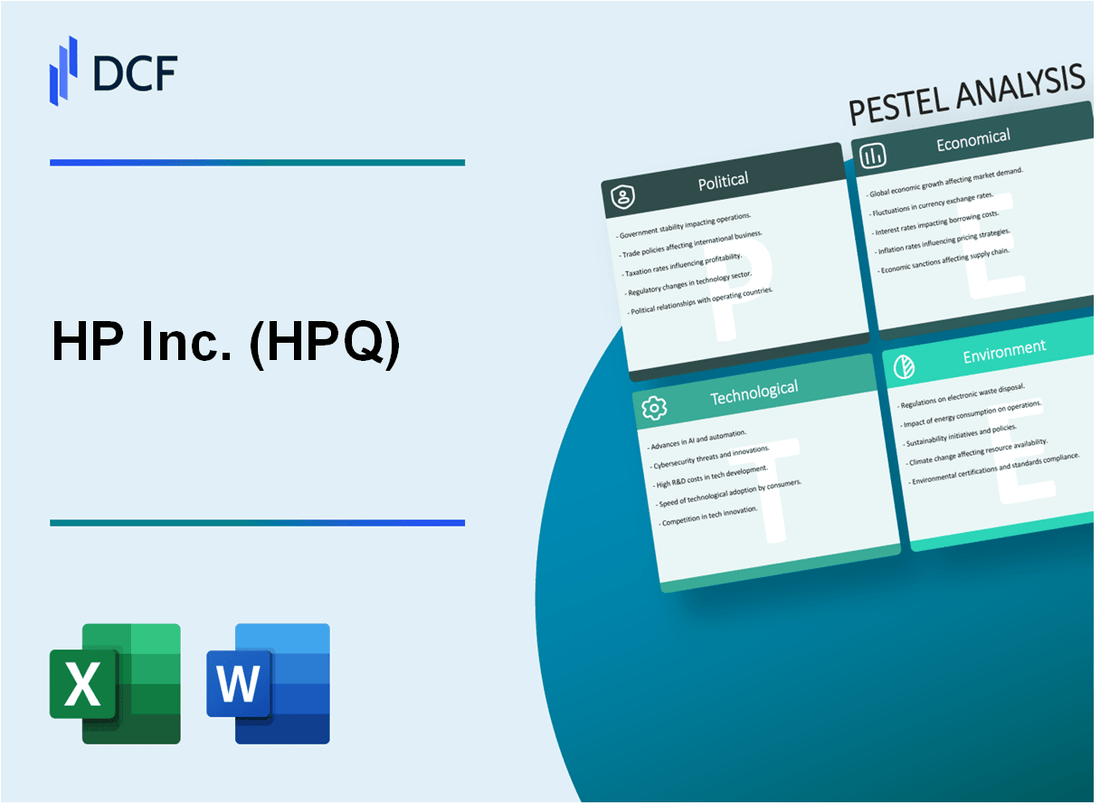
You want to know the real forces determining HP Inc.'s value in 2025, and honestly, it's a tug-of-war between the AI PC opportunity and global friction. The good news: the PC market is stabilizing, with expected 2025 revenue around $53.8 billion, driven by the need for faster, AI-enabled hardware. The challenge: US-China trade tensions are raising supply chain costs, high interest rates are slowing consumer print sales, and new laws like the EU's Digital Markets Act (DMA) are adding compliance burdens. Below is the precise PESTLE analysis showing you where to focus your strategy.
HP Inc. (HPQ) - PESTLE Analysis: Political factors
The political landscape in 2025 is forcing HP Inc. to make costly, structural changes to its global operations, shifting from a cost-optimization model to a risk-mitigation model. The core challenge is navigating US-China trade tensions and new global tax regimes, which directly impact supply chain costs and effective tax rates.
US-China trade tensions continue to drive supply chain diversification costs.
The ongoing trade disputes and the threat of new tariffs have accelerated HP's supply chain de-risking strategy. The company is aggressively moving production out of China to reduce exposure to US tariffs, which were higher than expected in early 2025.
By the end of fiscal year 2025 (October), HP expects more than 90% of its products sold in North America will be built outside of China. This is a massive, defintely expensive pivot.
To manage this transition and mitigate tariff impacts, HP is executing its 'Future Ready' plan. Here's the quick math on the near-term financial impact:
| Metric (FY 2025) | Value | Impact |
|---|---|---|
| Target Annualized Structural Savings | $1.9 billion | Long-term cost reduction goal from restructuring. |
| Estimated Restructuring Charges | Approximately $1.2 billion | One-time cost for layoffs and relocation. |
| Inventory Stockpiling (Q3 FY25) | $8.4 billion | Buffer against tariff hikes and supply shocks. |
The immediate cost is clear: $1.2 billion in restructuring charges is a significant outlay, but management views this as essential to securing long-term supply chain resilience. This is a trade-off of short-term pain for geopolitical stability.
Global tax reforms (Pillar Two) affect HP's effective tax rate and profit repatriation.
The OECD's Pillar Two initiative, which establishes a global minimum effective corporate tax rate of 15% for large multinational enterprises (MNEs) with consolidated revenues over €750 million, is a critical factor for HP in 2025.
The core issue for a US-based MNE like HP is the disparity between Pillar Two and the US Global Intangible Low-Taxed Income (GILTI) regime. The US GILTI rate for 2025 is only 10.5%, which is below the 15% global minimum.
This difference means that profits HP earns in low-tax jurisdictions could be subject to an extra 'top-up tax' in other countries where Pillar Two rules (like the Income Inclusion Rule or Undertaxed Profits Rule) are now effective in 2025. This increases the effective tax rate (ETR) and adds significant compliance complexity.
What this estimate hides is the complexity of jurisdictional blending. Because HP's US GAAP financial reporting excludes certain tax adjustments from non-GAAP earnings per share (EPS) guidance, the exact dollar impact of the Pillar Two top-up tax for FY2025 is not explicitly quantified in public guidance. Still, expect a material increase in cash tax payments in jurisdictions where the ETR falls below the 15% floor.
Increased government scrutiny on printer cartridge recycling and e-waste disposal.
Governments, particularly at the US state and municipal level, are stepping up enforcement and introducing new legislation to address electronic waste (e-waste) and single-use plastics, directly impacting HP's Printing segment.
- New York Senate Bill 2025-S1464 is moving forward, requiring companies to submit a packaging reduction and recycling plan.
- Pennsylvania Senate Bill 856, introduced in June 2025, aims to hold manufacturers directly accountable for e-waste, mandating the setup of collection sites and imposing potential fines of up to $10,000 for non-compliance.
- The Los Angeles City Council is considering an ordinance (May 2025) to ban the sale of single-use printer cartridges, forcing a shift to remanufactured or original equipment manufacturer (OEM) cartridges.
HP's proactive goal to recycle 1.2 million metric tons of hardware and supplies by 2025 is a necessary defense against this regulatory wave, but compliance costs are rising fast.
US federal procurement policies favor vendors with strong cybersecurity and domestic production.
The US government remains a crucial, high-margin customer, but new federal policies are raising the compliance bar for IT vendors.
The Department of Defense (DoD) requires vendors to meet stringent cybersecurity standards, formalized by the Cybersecurity Maturity Model Certification (CMMC) Procurement Rule, which became effective on November 10, 2025. Compliance is now a non-negotiable cost of doing business with the federal sector.
HP's ability to win lucrative contracts shows their current compliance strength. For instance, HP secured a $931 million cloud services contract from a DoD support agency in November 2025. The push for domestic production is also a factor, driven by Buy American provisions and supply chain security concerns. HP is expanding its US manufacturing footprint, primarily for federal customers, a move that is a small but strategically vital part of its overall production network.
Next step: Cybersecurity Team: Finalize CMMC Level 3 compliance audit by December 31, 2025.
HP Inc. (HPQ) - PESTLE Analysis: Economic factors
Global inflation pressures keep enterprise IT budget growth modest, defintely below 2021 levels.
You might see headlines touting massive budget increases, but the reality is that global inflation is eating up most of that growth. Gartner forecasts worldwide IT spending will total $5.61 trillion in 2025, a nominal increase of 9.8% over 2024. However, with global inflation averaging around 5.9%, a significant portion of that budget hike is simply offsetting higher prices, not funding new projects. This means the real, discretionary spending growth for enterprise hardware is modest, keeping pressure on HP Inc.'s commercial Personal Systems (PS) margins.
HP is directly feeling this cost pressure. In its fiscal Q2 2025, the company's non-GAAP operating profit was impacted by roughly 100 basis points due to unmitigated tariff and related costs-a clear sign of cost-side inflation. To counter this, HP is aggressively pursuing internal cost efficiencies, raising its 'Future Ready' structural cost savings target to $1.9 billion by the end of fiscal year 2025. It's a classic fight: nominal growth versus real-world cost increases.
PC market is stabilizing after a 2024 dip, with 2025 revenue expected to be around $53.8 billion.
The PC market is finally moving past the post-pandemic slump, driven by the Windows 11 migration cycle and the push for new AI PCs (Personal Computers). Global PC shipments grew 4.4% year-over-year in the second quarter of 2025, according to Gartner data. This stabilization is a tailwind for HP Inc., whose Personal Systems segment is the revenue engine. The total PC market revenue for 2025 is expected to be around $53.8 billion, reflecting this renewed commercial and AI-driven demand. HP's Personal Systems segment revenue in Q3 FY25 was $9.9 billion, marking a 6% year-over-year increase, showing they are capturing this rebound.
The key driver here is the commercial sector, which is adopting AI-enabled devices for future-proofing their workflows. This is a crucial distinction, as the consumer side is still lagging. The commercial segment is where the higher-margin sales are happening, which is a good thing for HP's bottom line.
High interest rates slow consumer spending on discretionary items like new printers.
The Federal Reserve's sustained high interest rate environment is a direct headwind for HP's consumer-facing segments. Higher borrowing costs translate into tighter household budgets, forcing consumers to defer discretionary purchases like new PCs and, critically, printers. We saw this clearly in the volatility of the first half of fiscal 2025:
- Consumer Personal Systems revenue was down 7% year-over-year in Q1 FY25.
- Consumer Printing revenue was down 3% year-over-year in Q2 FY25.
- Overall demand was moderated, leading HP to adjust its full-year outlook in May 2025.
The consumer is simply holding onto their older devices longer. This is why the Printing segment, which relies on hardware sales and the high-margin supplies business, remains structurally challenged, even as the commercial side recovers. The Printing segment's net revenue declined 4% in Q3 FY25.
Strong US Dollar (USD) against other major currencies creates foreign exchange headwinds, impacting reported earnings.
A strong US Dollar (USD) is a persistent problem for any multinational company like HP Inc. that generates a large portion of its revenue overseas but reports earnings in USD. When foreign sales in Euros or Yen are converted back to a strong Dollar, the reported revenue shrinks-this is your foreign exchange (FX) headwind.
The impact is real and measurable. In Q2 FY25, HP's net revenue growth was 3.3% in nominal terms, but it was 4.5% in constant currency (meaning without the currency effect). Here's the quick math: that 1.2 percentage point difference is money that vanished in the conversion process. This FX pressure also hits gross margin, compounding the effects of inflation and tariffs. For a company with a significant global footprint, currency movements are a constant, unwelcome tax on reported earnings.
| Economic Factor | FY2025 Data Point | Impact on HP Inc. (HPQ) |
|---|---|---|
| Worldwide IT Spending Growth (Nominal) | 9.8% (to $5.61 trillion) | Real growth is lower due to inflation; strong commercial demand for AI PCs. |
| Global Inflation Rate (Approximate) | Around 5.9% | Mutes real IT budget growth; contributed to 100 basis points of margin pressure in Q2 FY25. |
| PC Market Revenue (Expected) | Around $53.8 billion | Stabilization and rebound driven by commercial AI PC refresh cycle. |
| Consumer Personal Systems (Q1 FY25 YoY) | Down 7% | High interest rates and economic uncertainty slow discretionary consumer spending. |
| Foreign Exchange Headwind (Q2 FY25) | 1.2 percentage point difference (Nominal vs. Constant Currency) | Reduces reported revenue and pressures gross margin due to strong USD. |
HP Inc. (HPQ) - PESTLE Analysis: Social factors
Permanent shift to hybrid work drives demand for premium, secure, and collaborative PC hardware.
The transition to a permanent hybrid work model is a massive social driver for HP Inc.'s Personal Systems (PS) segment. This isn't just about selling more laptops; it's a shift toward premium, secure, and collaborative devices. We saw this play out clearly in the Fiscal Year 2025 results: Commercial PS net revenue was up 9% year-over-year in Q2 2025 and up 6% in Q3 2025, with Commercial units rising 11% and 6%, respectively.
This growth is fueled by companies needing to equip a distributed workforce. Honestly, the demand is still undersupplied. HP's own 2025 Working Relationship Index found that only about 20% of knowledge workers feel they have the right technology for hybrid work. That's a huge addressable market. The social expectation is clear: by 2025, an estimated 44% of the workforce is set to be remote, and 67% of businesses expect to lose talent if they don't offer flexible work options. This forces IT departments to buy devices with embedded security like Wolf Pro Security and advanced collaboration tools, like AI-based noise reduction, which HP is building directly into its EliteBook and Z-series lines.
Growing consumer preference for subscription services (e.g., Instant Ink) over one-time purchases.
Consumers and small businesses are increasingly valuing convenience and predictable costs, pushing them toward subscription models. This is a critical social trend for HP, as it transforms the volatile printing supplies revenue into a stable, high-margin annuity stream. HP's Instant Ink service is the prime example, moving the customer relationship from transactional to contractual. As of early 2024, the service had more than 13 million subscribers.
The company is aggressively pursuing this model, stating its intent to increase the total subscribers across Instant Ink and all-in plans by 25% in Fiscal Year 2026. This push is also a margin-protection strategy, as the high-margin printing supplies business remains profitable, as noted in the Fiscal 2025 third-quarter results. To be fair, this model isn't without risk; HP planned to raise Instant Ink subscription rates again in April 2025, which could test customer loyalty.
Increased focus on digital equity and accessibility in technology design and marketing.
The societal pressure to address the global digital divide-estimated to be a $1 trillion-plus problem-is now a core business consideration, not just a philanthropic one. HP is responding by integrating digital equity and accessibility into its corporate social responsibility (CSR) strategy, which in turn strengthens its brand and appeal to socially-conscious enterprises and consumers.
A concrete example of this commitment in 2025 is the Digital Equity Accelerator, a joint initiative with the HP Foundation. The 2025 cohort selected 8 nonprofit organizations across four countries, each receiving a $100,000 grant and HP technology valued at approximately $100,000. This initiative, which has already helped 27 alumni organizations expand their reach by over 9 million people, demonstrates a clear, measurable commitment to social impact that resonates with stakeholders.
Talent wars in cybersecurity and AI engineering raise R&D and labor costs.
The race to embed Artificial Intelligence (AI) into every PC and printer means the competition for specialized talent-AI engineers, machine learning experts, and top-tier cybersecurity architects-is fierce. This 'talent war' is a significant cost pressure point. Here's the quick math: HP is making major investments to lead the new AI PC market, which involves expensive talent acquisition.
A key strategic move in 2025 was the acquisition of Humane's AI platform, Cosmos, and its portfolio of over 300 patents for $116 million. This investment, which included bringing Humane's engineering team into the newly formed HP IQ lab, directly reflects the high cost of acquiring ready-made AI capability and talent. The goal is to boost AI PC sales from 15% of Q2 2025 revenue to 25% by 2026, but the initial outlay for this talent is substantial and non-recurring.
The need for specialized talent is driving up the structural costs of innovation, which is a defintely long-term headwind. This is a risk that must be managed through the company's Future Ready plan, which aims for $1.9 billion in structural cost savings by the end of Fiscal Year 2025.
| Social Trend / Factor | HP Inc. (HPQ) FY2025 Impact and Metrics | Strategic Implication (Actionable Insight) |
|---|---|---|
| Hybrid Work Shift | Commercial Personal Systems (PS) revenue up 9% (Q2 FY2025) and 6% (Q3 FY2025) year-over-year. 44% of the workforce is set to be remote by 2025. |
Focus R&D on premium, secure, and collaborative devices (AI PCs) to capture the high-margin commercial market. |
| Subscription Preference | Over 13 million Instant Ink subscribers (early 2024). Target to increase total subscribers by 25% in FY2026. Planned price increases for Instant Ink in April 2025. |
Accelerate the shift of the printing business model from transactional hardware to recurring, high-margin services. |
| Digital Equity | 2025 Digital Equity Accelerator provides $100,000 grants and ~$100,000 in tech to 8 nonprofits. | Enhance brand reputation and market access by demonstrating measurable social impact and inclusive design. |
| AI/Cyber Talent War | Acquired Humane's AI platform for $116 million in 2025 to secure talent and patents. Aim to increase AI PC sales from 15% (Q2 FY2025) to 25% by 2026. |
Expect elevated R&D and acquisition costs to secure specialized AI/security talent needed to drive future product innovation. |
HP Inc. (HPQ) - PESTLE Analysis: Technological factors
The 'AI PC' cycle begins, requiring faster processors (NPU) and driving a refresh opportunity in late 2025
The biggest near-term technological opportunity for HP Inc. is the emerging Artificial Intelligence PC (AI PC) cycle, which is finally driving a much-needed commercial refresh. This is not just a marketing term; it requires a fundamental hardware shift, specifically the integration of a Neural Processing Unit (NPU) to handle local AI tasks like real-time translation and enhanced collaboration features. HP is positioning aggressively, launching new devices like the OmniBook Ultra Flip with an NPU performance of up to 55 TOPS (Trillion Operations Per Second) and the EliteBook Ultra G1i with up to 48 TOPS.
This new hardware is essential for the coming wave of Windows 11 and Microsoft Copilot+ features, which is forcing a massive upgrade cycle as Windows 10 reaches end-of-life. HP's Personal Systems segment is already seeing the benefit, with revenue up 6% year-over-year to $9.9 billion in fiscal Q3 2025. The company expects AI PCs to account for 25% of its total PC sales by the end of 2025. That's a clear market signal.
Here's the quick math: if the Personal Systems segment continues its mid-single-digit growth into Q4 2025, the AI PC is the primary catalyst for that momentum. This is a defintely a high-value refresh cycle.
3D Printing segment faces slower-than-expected industrial adoption, requiring strategic re-evaluation
HP's 3D Printing business, while technologically advanced with its Multi Jet Fusion (MJF) and Metal Jet platforms, still faces the challenge of scaling industrial adoption from prototyping to true mass production. The strategic re-evaluation in 2025 focuses intensely on lowering the total cost of ownership (TCO) to make the business case undeniable for manufacturers. HP is working to reduce the cost per part by up to 20% through software like the HP 3D Build Optimizer, which is slated for launch in 2025.
The company is also tackling material costs and sustainability, introducing new polymers like HP 3D HR PA 11 Gen2, which offers up to 80% powder reusability and up to 40% lower variable part costs. This push, combined with the launch of the HP Additive Manufacturing Network (AMN) Program to connect demand with its partner network, is a direct response to the slower pace of industrial integration. They are trying to solve the ecosystem problem.
| 3D Printing Cost/Efficiency Metric (2025 Focus) | Target Improvement/Metric | HP Technology |
|---|---|---|
| Cost Per Part Reduction | Up to 20% | HP 3D Build Optimizer |
| Powder Reusability (PA 11 Gen2) | Up to 80% | Multi Jet Fusion (MJF) Platform |
| Variable Part Cost Reduction (PA 11 Gen2) | Up to 40% | New Material Innovation |
Cybersecurity threats (firmware, supply chain) necessitate continuous, costly security feature integration
The increasing sophistication of cyberattacks, particularly those targeting the supply chain and device firmware, forces HP to continuously integrate costly, advanced security features. This is a non-negotiable cost of doing business in 2025. HP's own research shows that device security failures cost organizations a staggering $10.9 billion annually worldwide, with 68% of organizations reporting financial or operational harm from such breaches.
The threat is existential for commercial clients. A vast majority, 91%, of IT decision-makers believe nation-state threat actors will target physical supply chains to insert malicious hardware or firmware into PCs and printers. In response, HP is embedding security deeper than ever, from the silicon up, and is even launching products like the HP LaserJet Enterprise 8000 Series Printers with protection against quantum computer attacks. This requires significant and ongoing R&D investment to maintain the Wolf Security platform's leadership position in endpoint security.
Key areas of focus for costly security integration include:
- Firmware Integrity: Protecting the non-volatile memory from tampering.
- Supply Chain Verification: Ensuring components haven't been compromised during transit.
- Quantum-Resistant Encryption: Future-proofing high-end enterprise devices.
Printer business models are disrupted by lower-cost, high-yield ink tank systems
The traditional, highly profitable razor-and-blade model in the printer business-selling hardware cheaply and making profit on expensive, low-yield ink cartridges-is being fundamentally disrupted by high-yield ink tank systems (like HP Smart Tanks) and third-party alternatives. This shift is evident in the fiscal Q3 2025 results, where the Printing division's net revenues fell 4% to $4 billion.
The revenue contraction impacted printing supplies directly. However, hardware sales within the Printing category actually rose 1% year-over-year, specifically driven by strong demand for those very same Big Tank models. Customers are shifting their spending from frequent, small purchases of cartridges to a larger upfront hardware cost with much lower long-term ink expenses. HP is navigating this by pushing its own high-yield models and its subscription service, Instant Ink, to maintain a recurring revenue stream, but the structural decline in the overall print market is expected to fall by low single digits in both 2025 and 2026.
The business is transitioning from a high-margin supplies model to a more balanced, services-led approach.
HP Inc. (HPQ) - PESTLE Analysis: Legal factors
EU's Digital Markets Act (DMA) and Digital Services Act (DSA) impose new compliance burdens on online services and data handling.
The European Union's Digital Markets Act (DMA) and Digital Services Act (DSA) represent a significant, non-negotiable legal headwind for a global enterprise like HP Inc. While HP Inc. may not be designated a 'gatekeeper' like the largest platforms, its extensive digital service offerings, particularly in print subscriptions and software, fall under the broad scope of these regulations.
Compliance with the DMA and DSA forces a fundamental re-engineering of how HP Inc. handles user data, ensures platform transparency, and manages its online marketplaces. For a large U.S. technology company, the average annual compliance cost for all EU digital regulations is estimated to be around $430 million in 2025. This is a massive, ongoing expense. Specifically, the DMA alone is estimated to cost an average large U.S. tech company about $200 million per year, with the DSA adding another $150 million annually for compliance, reflecting the scale of the required operational changes.
The real risk isn't just the compliance cost, but the potential fines. The DMA allows for penalties up to 10% of a company's total worldwide annual turnover for non-compliance. That is defintely an existential threat for a business with a global footprint.
- DMA: Requires interoperability and fair access for business users.
- DSA: Mandates greater transparency on algorithms and content moderation.
- Financial Risk: Fines can reach 10% of worldwide annual turnover.
Ongoing intellectual property (IP) disputes related to printer cartridge technology and third-party supplies.
HP Inc.'s business model heavily relies on the high-margin revenue from proprietary ink and toner cartridges, making intellectual property (IP) enforcement a continuous, high-stakes legal battleground. In the first half of 2025, the company aggressively pursued and resolved multiple patent infringement cases globally, securing both financial compensation and market protection.
A key win came in July 2025 when the long-running dispute with LAMA France before the Unified Patent Court (UPC) was settled, leading to the withdrawal of appeals. Also in 2025, HP Inc. reached settlements with third-party suppliers like Promo Rigenera in Italy and Pacific Color in Chile, where the infringers agreed to cease sales, withdraw imitation cartridges from the market, and pay financial compensation to HP Inc.
This IP protection strategy is critical, and HP Inc.'s proactive measures are quantifiable. For example, in the first half of 2025 alone, HP Inc. collaborated with major online marketplaces like Amazon and eBay to remove approximately 120,000 lookalike listings globally, directly protecting its brand and sales channel integrity.
| Legal Action Type | Region/Entity | Outcome (2025) |
|---|---|---|
| Patent Infringement Settlement | LAMA France (UPC) | Settlement reached, appeals withdrawn (July 2025). |
| Patent Infringement Settlement | Promo Rigenera (Italy) | Agreed to cease sales and pay financial compensation to HP Inc. |
| Patent Infringement Settlement | Pacific Color (Chile) | Settlement included withdrawal of cartridges and financial compensation to HP Inc. |
| Counterfeit Listing Removal | Global Marketplaces (e.g., Amazon, eBay) | Approximately 120,000 lookalike listings removed (H1 2025). |
Stricter global data privacy laws (e.g., CCPA, GDPR) increase compliance costs for customer data management.
Managing customer data across dozens of jurisdictions exposes HP Inc. to substantial compliance costs and fine risk under laws like the European Union's General Data Protection Regulation (GDPR) and the California Consumer Privacy Act (CCPA). These regulations demand continuous investment in IT infrastructure, legal counsel, and Data Subject Access Request (DSAR) fulfillment.
Non-compliance is expensive. The average cost of a GDPR fine in 2024 was approximately €2.8 million, a 30% increase from the prior year, showing the rising enforcement trend. In the U.S., CCPA violations carry a penalty of up to $7,500 per incident, with no cap on the total penalty, making a large-scale data breach catastrophic.
HP Inc. must also manage the legal fallout from its own data practices. A class action settlement approved in March 2025 over its printer ink cartridges required the company to be more transparent, specifically mandating that HP Inc. inform customers about data collection practices and provide an opportunity to decline printer updates. This settlement shows the direct link between product design, data collection, and legal risk.
Antitrust scrutiny over market dominance in specific PC and print segments remains a latent risk.
The practice of using firmware updates to block non-HP Inc. ink cartridges-often called 'Dynamic Security'-is the primary source of antitrust scrutiny for the company. This strategy, aimed at protecting the profitable supplies business, has repeatedly triggered legal action alleging anticompetitive behavior and market dominance abuse.
In March 2025, a proposed class action lawsuit was filed in U.S. federal court, asserting claims under consumer protection and antitrust laws. The suit alleges that HP Inc. used firmware updates to effectively create a monopoly in the aftermarket for replacement ink cartridges, forcing consumers to buy higher-priced HP-branded supplies. This is a clear, ongoing antitrust risk in the print supplies segment, which accounts for a significant portion of the company's operating profit.
The core of the legal challenge is the claim that HP Inc. is restraining consumers' ability to purchase cheaper third-party ink, which, absent the firmware, would work in their printers. This legal pressure forces the company to balance its high-margin supplies strategy against the increasing risk of major antitrust damages and injunctions.
HP Inc. (HPQ) - PESTLE Analysis: Environmental factors
Commitment to 100% renewable electricity in global operations by 2035 drives capital expenditure.
HP Inc.'s aggressive push toward decarbonization is a major factor shaping its capital expenditure (CapEx) strategy. While the company is working toward achieving carbon neutrality in its operations by the end of 2025, the long-term goal is to reach 100% renewable electricity usage across its global operations by 2035. This is a huge undertaking.
To fund these and other sustainability initiatives, HP Inc. is allocating a significant annual investment, estimated to be between $1 billion and $1.2 billion, toward green technologies and ESG (Environmental, Social, and Governance) programs. This CapEx is not just a cost; it's a strategic investment that reduces long-term operational risk from energy price volatility and positions the company favorably with institutional investors.
Here's the quick math on their electricity progress:
- Renewable electricity used in global operations (2023): 85%.
- Target for global operations: 100% by 2035.
- Goal for Scope 1 and 2 GHG emissions reduction: 65% by 2025 (compared to 2015).
Increased regulatory pressure for product circularity and using recycled content in all hardware.
The industry is seeing tightening regulations, particularly in the European Union, demanding greater product circularity (the practice of keeping resources in use for as long as possible) and extended producer responsibility (EPR). HP Inc. is preempting this pressure with some of the most ambitious circularity goals in the sector, which is defintely a smart move to maintain market access.
The core of the strategy is designing products for easy disassembly, repair, and recycling, plus dramatically increasing the use of recycled materials. This requires deep collaboration with the supply chain and significant R&D investment in material science.
The progress on materials use as of 2024 shows the scale of the transition:
| Metric | 2024 Performance | Long-Term Goal |
| Circularity for products and packaging (by weight) | 43% | 75% by 2030 |
| Total materials used in products and packaging | 839,800 tonnes | N/A |
| Recycled content plastic in HP products (postconsumer) | 48,840 tonnes (2024) | 30% postconsumer recycled content plastic across personal systems and print portfolios |
| Ocean-bound plastic prevented (since 2016) | Over 110 million bottles (as of March 2024) | N/A |
HP aims for net-zero value chain greenhouse gas emissions by 2040, a massive operational challenge.
The commitment to achieve net-zero greenhouse gas (GHG) emissions across the entire value chain (Scope 1, 2, and 3) by 2040 is the company's biggest environmental challenge. Given that the value chain, especially the supply chain and product use, accounts for the vast majority of emissions, this goal necessitates transforming global logistics, supplier energy use, and product design.
The total carbon footprint for the twelve months ending October 31, 2023, was 19,764,400 tonnes of CO2-equivalent. The 2040 net-zero target is supported by a critical near-term goal: a 50% absolute reduction in the value chain GHG emissions by 2030, compared to 2019 levels. This is an absolute reduction, so growth cannot mask a lack of progress.
The company is focused on five strategic drivers to decouple growth from carbon emissions:
- Print and Compute-as-a-Service models.
- Sustainable materials use.
- Supply chain decarbonization.
- Energy efficiency in product design.
- Forest investments (Forest Positive Framework).
Water stewardship goals are critical in manufacturing regions facing water scarcity.
Water scarcity is a major physical risk, especially in key manufacturing regions across Asia. HP Inc.'s water stewardship goals are focused on reducing potable water withdrawal in its operations, particularly at sites located in water-stressed areas.
The company's goal is to reduce potable water withdrawal in global operations by 35% by 2025, compared to a 2015 baseline. This is a metric that directly impacts operational continuity in places like Singapore, Malaysia, and China.
One concrete example of this investment is the plan to install a new water storage tank and associated infrastructure at its Penang, Malaysia site, with an estimated cost of approximately US$1.97 million. This action helps mitigate the risk of operational disruption due to regional water shortages. The company has demonstrated consistent leadership here, having received a triple A rating across CDP's Climate, Forests, and Water lists for multiple consecutive years.
Disclaimer
All information, articles, and product details provided on this website are for general informational and educational purposes only. We do not claim any ownership over, nor do we intend to infringe upon, any trademarks, copyrights, logos, brand names, or other intellectual property mentioned or depicted on this site. Such intellectual property remains the property of its respective owners, and any references here are made solely for identification or informational purposes, without implying any affiliation, endorsement, or partnership.
We make no representations or warranties, express or implied, regarding the accuracy, completeness, or suitability of any content or products presented. Nothing on this website should be construed as legal, tax, investment, financial, medical, or other professional advice. In addition, no part of this site—including articles or product references—constitutes a solicitation, recommendation, endorsement, advertisement, or offer to buy or sell any securities, franchises, or other financial instruments, particularly in jurisdictions where such activity would be unlawful.
All content is of a general nature and may not address the specific circumstances of any individual or entity. It is not a substitute for professional advice or services. Any actions you take based on the information provided here are strictly at your own risk. You accept full responsibility for any decisions or outcomes arising from your use of this website and agree to release us from any liability in connection with your use of, or reliance upon, the content or products found herein.