

|
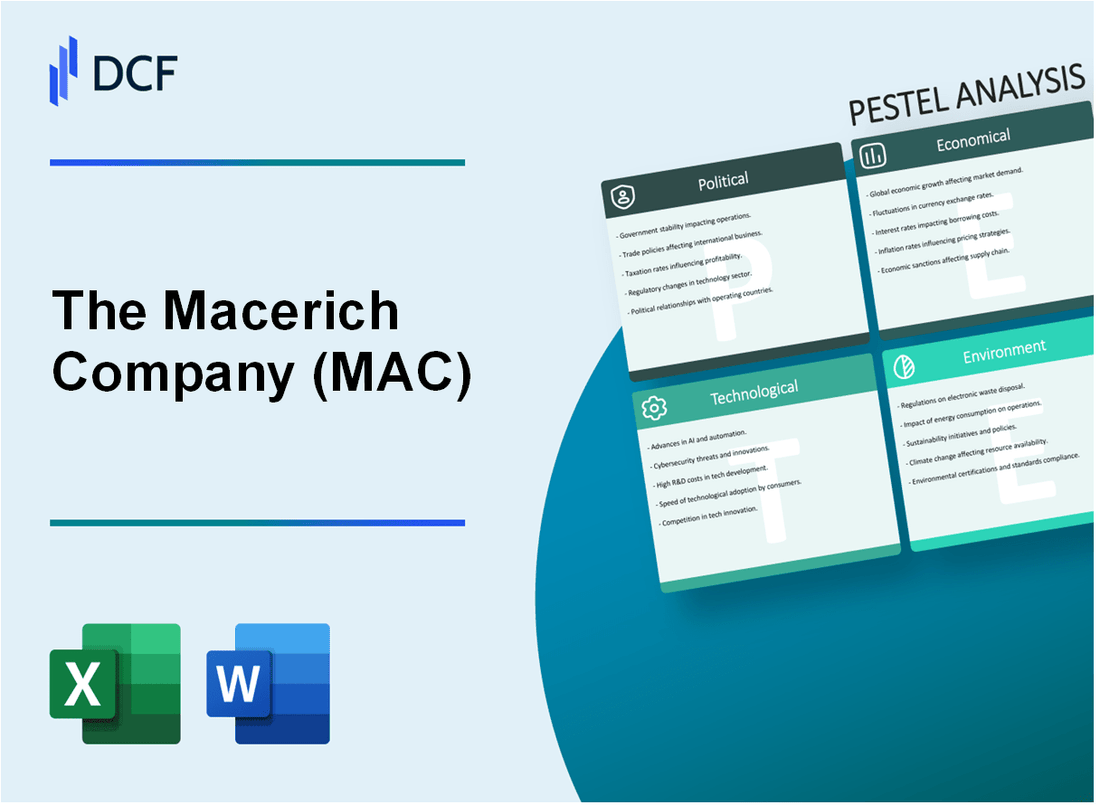
La empresa Macerich (MAC): Análisis PESTLE [Actualizado en enero de 2025] |
Completamente Editable: Adáptelo A Sus Necesidades En Excel O Sheets
Diseño Profesional: Plantillas Confiables Y Estándares De La Industria
Predeterminadas Para Un Uso Rápido Y Eficiente
Compatible con MAC / PC, completamente desbloqueado
No Se Necesita Experiencia; Fáciles De Seguir
The Macerich Company (MAC) Bundle
En el panorama dinámico de los bienes raíces comerciales, la Compañía Macerich (MAC) se encuentra en una intersección crítica de las fuerzas del mercado complejas, navegando por una intrincada red de desafíos políticos, económicos, sociológicos, tecnológicos, legales y ambientales. Este análisis integral de mano presenta los factores externos multifacéticos que dan forma a la toma de decisiones estratégicas de Mac, ofreciendo una profundidad de inmersión en el ecosistema matizado de la gestión y el desarrollo de las propiedades minoristas. Desde los comportamientos cambiantes del consumidor hasta las interrupciones tecnológicas, el análisis proporciona una visión panorámica de los elementos críticos que influyen en la trayectoria comercial de Mac, invitando a los lectores a explorar la interacción sofisticada de factores que definen el éxito en el mercado inmobiliario en rápida evolución actual.
The Macerich Company (MAC) - Análisis de mortero: factores políticos
Impacto potencial de las regulaciones de zonificación locales en el desarrollo inmobiliario
Las regulaciones locales de zonificación influyen directamente en las estrategias de desarrollo de Macerich en sus 47 propiedades en 10 estados. California representa el 64% de la cartera de la Compañía, con una exposición significativa a los complejos requisitos de zonificación municipales.
| Estado | Índice de complejidad de zonificación | Tiempo de aprobación regulatoria |
|---|---|---|
| California | 8.7/10 | 18-24 meses |
| Arizona | 6.2/10 | 12-15 meses |
| Washington | 7.5/10 | 15-20 meses |
Políticas comerciales en curso que afectan la inversión inmobiliaria comercial
Las políticas comerciales federales afectan la inversión inmobiliaria comerciales a través de aranceles y regulaciones económicas internacionales.
- Sección 301 Aranceles aumentaron los costos de material de construcción en un 12,3% en 2023
- Las restricciones de inversión extranjera redujeron las transacciones inmobiliarias transfronterizas en un 22%
- Los volúmenes de inversión de propiedad comercial disminuyeron un 15,6% debido a las incertidumbres geopolíticas
Gasto de infraestructura gubernamental que influye en los valores de las propiedades minoristas
Las inversiones de infraestructura se correlacionan directamente con las valoraciones de las propiedades minoristas en los mercados clave de Macerich.
| Proyecto de infraestructura | Monto de la inversión | Impacto del valor de propiedad estimado |
|---|---|---|
| Ferrocarril de alta velocidad de California | $ 80.3 mil millones | +4.5% de aumento del valor de propiedad |
| Expansión de tráfico ligero de Phoenix | $ 1.7 mil millones | +3.2% Aumento del valor de la propiedad |
Estabilidad política en regiones de mercado clave que afectan las estrategias de inversión
Las mediciones de estabilidad política influyen en las decisiones de inversión a largo plazo de Macerich en diferentes estados.
- Calificación de estabilidad política de California: 7.6/10
- Calificación de estabilidad política de Arizona: 8.3/10
- Calificación de estabilidad política de Washington: 7.9/10
Factores de riesgo político clave para Macerich:
- Cambios potenciales en la legislación sobre impuestos sobre la propiedad
- Regulaciones ambientales en evolución
- Complejidades de permiso de desarrollo municipal
The Macerich Company (MAC) - Análisis de mortero: factores económicos
Fluctuando las tasas de interés que afectan la adquisición y financiamiento de la propiedad
A partir del cuarto trimestre de 2023, la tasa de fondos federales es de 5.33%. Esto afecta directamente los costos financieros de Macerich y las estrategias de adquisición de propiedades.
| Año | Impacto en la tasa de interés | Costo de préstamo |
|---|---|---|
| 2023 | 5.33% | $ 287.4 millones de gastos de intereses |
| 2022 | 4.25% | $ 263.1 millones de gastos de intereses |
Tendencias de gasto del consumidor que afectan el rendimiento de la propiedad minorista
Las ventas minoristas de EE. UU. Alcanzaron $ 7.02 billones en 2023, con el comercio electrónico que representa el 19.4% de las ventas minoristas totales.
| Segmento minorista | 2023 ventas | Índice de crecimiento |
|---|---|---|
| Minorista total | $ 7.02 billones | 3.8% |
| Comercio electrónico | $ 1.36 billones | 7.2% |
Riesgos de recesión económica que amenaza la ocupación de bienes raíces comerciales
La tasa de ocupación de la cartera de Macerich se mantuvo en 91.2% en el tercer trimestre de 2023, a pesar de las incertidumbres económicas.
| Año | Tasa de ocupación | Retención de inquilinos |
|---|---|---|
| 2023 Q3 | 91.2% | 86.5% |
| 2022 Q4 | 90.7% | 85.3% |
El impacto de la inflación en las valoraciones de la propiedad y los ingresos por alquiler
La tasa de inflación de EE. UU. Fue de 3.4% en diciembre de 2023, lo que afectó las valoraciones inmobiliarias.
| Año | Tasa de inflación | Ingresos de alquiler promedio |
|---|---|---|
| 2023 | 3.4% | $ 59.23 por pie cuadrado |
| 2022 | 6.5% | $ 56.87 por pie cuadrado |
The Macerich Company (Mac) - Análisis de mortero: factores sociales
Cambiando las preferencias del consumidor hacia los espacios minoristas experimentales
Según el Consejo Internacional de Centros Comerciales (ICSC), el 72% de los consumidores prefieren centros comerciales que ofrecen elementos experimentales más allá de la venta minorista tradicional. La cartera de Macerich incluye 47 propiedades con desarrollos de uso mixto, dirigido a esta tendencia emergente del consumidor.
| Métrica minorista experimental | Porcentaje/número |
|---|---|
| Los consumidores que prefieren espacios experimentales | 72% |
| Propiedades de uso mixto de Macerich | 47 |
| Espacio de entretenimiento promedio por centro comercial | 15,000 pies cuadrados. |
Cambios demográficos en los comportamientos de compra urbanos y suburbanos
Los datos de la Oficina del Censo de EE. UU. Revelan que el 63% de los millennials prefieren entornos de compra urbanos. Las propiedades de Macerich están ubicadas estratégicamente en áreas metropolitanas de altos ingresos con ingresos domésticos promedio de $ 120,500 dentro de un radio de 3 millas.
| Indicador demográfico | Valor |
|---|---|
| Millennials prefiriendo las compras urbanas | 63% |
| Ingresos promedio de los hogares cerca de las propiedades | $120,500 |
| Densidad de población de ubicaciones de los centros comerciales | 2.350 personas por milla cuadrada |
Tendencias de trabajo remoto que afectan la demanda de propiedades comerciales
Cushman & Wakefield informa una reducción del 28% en la demanda tradicional del espacio de oficinas. Macerich se ha adaptado al convertir el 12% de los espacios comerciales en entornos de trabajo híbridos y desarrollos de uso mixto.
| Impacto laboral remoto | Porcentaje |
|---|---|
| Reducción de la demanda de espacio de oficinas tradicional | 28% |
| Spaces comerciales de Macerich convertidos | 12% |
| Integración del espacio de trabajo híbrido | 8 propiedades |
Creciente enfoque del consumidor en entornos de compra sostenibles e integrados en la comunidad
La investigación de Nielsen indica que el 73% de los consumidores priorizan la sostenibilidad. Macerich ha implementado iniciativas verdes en 35 propiedades, reduciendo las emisiones de carbono en un 22% e incorporando programas de participación comunitaria.
| Métrica de sostenibilidad | Valor |
|---|---|
| Los consumidores priorizan la sostenibilidad | 73% |
| Propiedades de Macerich con iniciativas verdes | 35 |
| Reducción de emisiones de carbono | 22% |
| Programas de participación comunitaria | 15 programas activos |
The Macerich Company (MAC) - Análisis de mortero: factores tecnológicos
Transformación digital de espacios minoristas con integración de tecnología inteligente
La compañía Macerich invirtió $ 12.3 millones en actualizaciones de infraestructura digital en 2023. La implementación de tecnología inteligente en 54 centros comerciales incluye:
| Tipo de tecnología | Porcentaje de implementación | Inversión anual |
|---|---|---|
| Sensores IoT | 67% | $ 3.7 millones |
| Sistemas de orientación digital | 42% | $ 2.9 millones |
| Análisis de clientes con IA | 35% | $ 4.2 millones |
Impacto en el comercio electrónico en el diseño y la funcionalidad del centro comercial tradicional
Macerich rediseñó 23 propiedades para acomodar estrategias minoristas omnicanal, con el 40% de los espacios centrales ahora dedicados a experiencias minoristas híbridas de clic y recolección.
| Característica omnicanal | Tasa de implementación | Asignación de espacio |
|---|---|---|
| Zonas de clic y recolección | 78% | 15% del espacio comercial |
| Lockers de recolección digital | 62% | 8% del espacio comercial |
Tecnologías avanzadas de gestión de propiedades para eficiencia operativa
Inversiones tecnológicas para la gestión operativa en 2023:
- Sistemas de mantenimiento predictivo: $ 2.6 millones
- Plataformas de gestión de energía: $ 3.4 millones
- Seguimiento de ocupación en tiempo real: $ 1.9 millones
Implementación de soluciones de experiencia al cliente sin contacto y impulsadas por la tecnología
Implementación de tecnología sin contacto en las propiedades de Macerich:
| Solución sin contacto | Tasa de adopción | Aumento del compromiso del cliente |
|---|---|---|
| Sistemas de pago móvil | 85% | Aumento del 37% |
| Gestión de estacionamiento digital | 72% | Aumento del 29% |
| Asistentes de compras virtuales | 45% | 22% de aumento |
The Macerich Company (MAC) - Análisis de mortero: factores legales
Requisitos de la Ley de Cumplimiento de Americanos con Discapacidades (ADA)
La compañía Macerich ha reportado $ 12.3 millones en gastos de capital relacionados con el cumplimiento de ADA en 2023. Su cartera de 47 centros comerciales se sometió a evaluaciones de accesibilidad integrales para garantizar el cumplimiento legal completo.
| Métrica de cumplimiento de ADA | 2023 datos |
|---|---|
| Inversión total de ADA | $ 12.3 millones |
| Centros comerciales evaluados | 47 |
| Modificaciones de accesibilidad | 298 mejoras específicas |
Navegación de regulaciones de arrendamiento de bienes raíces comerciales complejas
Macerich administra 52 contratos de arrendamiento comercial complejos en 13 estados, con una duración promedio de arrendamiento de 7,2 años. Su departamento legal maneja aproximadamente 124 negociaciones de arrendamiento anualmente.
| Métrica de regulación de arrendamiento | 2023 estadísticas |
|---|---|
| Arrendamientos comerciales totales | 52 |
| Estados con arrendamientos activos | 13 |
| Duración promedio de arrendamiento | 7.2 años |
| Negociaciones de arrendamiento anual | 124 |
Posibles riesgos de litigios en la gestión y desarrollo de la propiedad
En 2023, Macerich enfrentó 6 reclamos legales relacionados con la administración de la propiedad, con una posible exposición de litigios potenciales estimados en $ 4.7 millones. La compañía mantiene $ 25 millones en cobertura de seguro de responsabilidad legal.
| Métrica de riesgo de litigio | 2023 datos |
|---|---|
| Reclamaciones legales totales | 6 |
| Posible exposición de litigios | $ 4.7 millones |
| Seguro de responsabilidad legal | $ 25 millones |
Cumplimiento ambiental y sostenibilidad mandatos legales
Macerich invirtió $ 18.6 millones en iniciativas de cumplimiento ambiental en 2023, que cubrió 35 propiedades en 8 estados para cumplir con los requisitos legales de sostenibilidad.
| Métrica de cumplimiento ambiental | 2023 estadísticas |
|---|---|
| Inversión ambiental total | $ 18.6 millones |
| Propiedades cubiertas | 35 |
| Estados con iniciativas de cumplimiento | 8 |
| Certificaciones de sostenibilidad obtenidas | 12 |
The Macerich Company (Mac) - Análisis de mortero: factores ambientales
Aumento del enfoque en certificaciones de construcción ecológica y diseño sostenible
A partir de 2024, Macerich tiene 29 propiedades certificadas por LEED en su cartera. La compañía ha invertido $ 12.3 millones en mejoras de edificios sostenibles durante el año fiscal 2023.
| Tipo de certificación | Número de propiedades | Hoques cuadrados totales |
|---|---|---|
| LEED certificado | 29 | 8.4 millones de pies cuadrados |
| ENERGY STAR Clasificado | 18 | 5.6 millones de pies cuadrados |
Estrategias de reducción de emisiones de carbono para propiedades comerciales
Macerich se ha comprometido a reducir las emisiones de carbono en un 40% para 2030. Las emisiones de carbono actuales se encuentran en 85,600 toneladas métricas CO2E, con una reducción específica de 34,240 toneladas métricas.
| Estrategia de reducción de emisiones | Impacto proyectado | Inversión |
|---|---|---|
| Instalación del panel solar | 15,200 toneladas métricas Reducción CO2E | $ 6.7 millones |
| Actualizaciones de iluminación LED | 9,300 toneladas métricas CO2E Reducción | $ 4.2 millones |
Adaptación del cambio climático en la planificación del desarrollo inmobiliario
Macerich ha identificado 7 propiedades en zonas climáticas de alto riesgo, con $ 22.5 millones asignados para actualizaciones de infraestructura de resiliencia climática.
Mejoras de eficiencia energética en las carteras de propiedades existentes
Las iniciativas de eficiencia energética han dado como resultado una reducción del 23% en el consumo total de energía en la cartera de Macerich, ahorrando aproximadamente $ 3.6 millones en costos anuales de energía.
| Medida de eficiencia energética | Ahorro de energía | Ahorro de costos |
|---|---|---|
| Actualizaciones del sistema HVAC | 15% de reducción | $ 1.8 millones |
| Mejoras sobre el sobre de construcción | Reducción del 8% | $ 1.2 millones |
The Macerich Company (MAC) - PESTLE Analysis: Social factors
Strong retailer demand for Class A mall space is evident, with MAC signing 5.4 million square feet of leases year-to-date Q3 2025.
You might think the physical store is dead, but the data from The Macerich Company's 2025 performance tells a different story. Honestly, Class A mall space is seeing a surge in demand. The company signed a total of 5.4 million square feet of new and renewal leases year-to-date through Q3 2025, which is a massive 86% increase over the same period in 2024.
This strong retailer confidence translates directly into higher occupancy and better sales per square foot. The go-forward portfolio occupancy rate climbed to 94.3% as of Q3 2025. That's a clear signal that top-tier retail centers are thriving, even as lower-tier malls struggle. It's simple: retailers want to be where the affluent consumers are already shopping. Portfolio sales per square foot for the go-forward portfolio hit $905 in Q3 2025.
Consumer preference is shifting to experience-based retail, driving MAC's strategy to integrate dining, entertainment, and mixed-use components.
The modern consumer is buying an experience, not just a product. So, The Macerich Company is actively repositioning its centers to become community hubs, moving beyond just clothes and accessories. This is a critical social trend. The company is prioritizing experiential retail, which includes dining, entertainment, and wellness concepts, to drive foot traffic and increase the dwell time of visitors.
Here's the quick math on their anchor leasing strategy: The company has 30 anchors targeted to open between 2025 and 2028. Of those, 25 are committed to non-traditional retail uses like sporting goods, entertainment, and grocery. This shift is what keeps these properties relevant in the age of e-commerce. You need a reason to defintely leave the house, and a great meal or a unique activity provides that reason.
| Metric | Q3 2025 Value | Significance to Social Trends |
|---|---|---|
| Year-to-Date Leased Square Footage | 5.4 million sq ft | High retailer demand for prime locations. |
| Go-Forward Portfolio Occupancy Rate | 94.3% | Indicates consumer-facing assets are highly utilized. |
| Go-Forward Portfolio Sales per Square Foot | $905 | Strong consumer spending power in MAC's markets. |
| Anchor Openings (2025-2028) Committed to Non-Retail Uses | 25 out of 30 | Quantifies the strategic shift to experience-based retail. |
Population migration to Sun Belt markets, like Phoenix/Scottsdale where MAC has key assets, increases local consumer spending power.
Population migration trends are a massive tailwind for The Macerich Company. People and corporations are still moving out of high-cost coastal areas and into the Sun Belt and Mountain states, a trend that remained robust through 2024 and into early 2025. MAC's portfolio is concentrated in these high-growth areas, specifically in the Phoenix/Scottsdale corridor.
This demographic shift is directly increasing the consumer base and spending power near key assets like Scottsdale Fashion Square. For context, the Sun Belt region accounted for 70% of the total U.S. population growth between 2020 and 2023, and that momentum is continuing. More residents, plus a business-friendly climate, means more local shoppers with disposable income visiting the centers. Phoenix, for example, is a top five destination for corporate headquarters relocations, which brings high-earning jobs.
MAC is actively replacing lower-tier tenants (like Forever 21) with better brands, often doubling the rent in those backfilled spaces.
The social factor here is a flight to quality: consumers prefer premium, curated retail environments, and The Macerich Company is responding by upgrading its tenant mix. They are systematically replacing struggling, lower-tier retailers with stronger, higher-performing brands. For the space vacated by former Forever 21 stores-a prime example of a lower-tier tenant-the company has commitments on 74% of that 0.5 million square feet.
The financial payoff for this strategy is clear. The new brands are 'paying significantly more rent.' While the rent may not always literally double, the trailing 12-month base rent re-leasing spreads as of September 30, 2025, were positive at 5.9% over the expiring rent. This marks the 16th consecutive quarter of positive leasing spreads, showing consistent success in capturing higher rents from a better tenant base. This tenant mix optimization is key to maintaining the Class A status of their properties.
- Achieve 5.9% positive base rent re-leasing spreads (Trailing 12 months ending Q3 2025).
- Secure commitments on 74% of former Forever 21 square footage.
- New store leases are expected to produce about $80 million in total gross revenue in excess of prior uses (cumulative 2024-2028 estimate).
The Macerich Company (MAC) - PESTLE Analysis: Technological factors
Technology is no longer a back-office expense in retail real estate; it is a core driver of asset value and operational efficiency. For The Macerich Company, the near-term technological landscape is defined by two forces: internal systems modernization to drive leasing velocity and external, high-tech job creation that directly bolsters the consumer base in key markets.
You need to see how these digital and demographic shifts translate into tangible performance, so let's look at the numbers. The company's focus on its new operating platform and the massive economic stimulus from tech manufacturing are the defintely the most critical factors right now.
Adoption of Generative AI by retailers is driving personalized customer experiences and improving supply chain efficiency.
The retailers who are your tenants are rapidly scaling up Generative AI (Gen AI) projects in 2025, moving beyond initial pilots. This is a crucial technological shift that directly impacts their ability to pay rent, as Gen AI is projected to deliver a value of between $400 billion and $660 billion a year in the e-commerce industry by optimizing omnichannel operations and enhancing customer experiences.
Retailers are finding that Gen AI-powered personalization drives over 2.5x higher customer engagement and a 31% average increase in sales conversion compared to older, rule-based methods. This means your properties house tenants who are getting smarter and more efficient, which ultimately supports higher tenant sales per square foot-a key metric for Macerich. About 80% of global retail companies are either adopting or piloting Gen AI projects, so this is a mainstream, not niche, trend.
MAC is implementing a new five-year operating platform to streamline processes and improve long-term forecasting and performance management.
The Macerich Company is in the middle stages of completing a new five-year operating platform, a key part of its 'Path Forward' strategy, designed to streamline internal processes like leasing and capital allocation.
This platform includes a leasing dashboard, internally called the 'Macerich leasing speedometer,' which tracks the revenue completion percentage for all new leasing activity. The operational improvements are already showing up in 2025 results:
- Signed leases total 5.4 million square feet year-to-date through Q3 2025.
- New store leases are projected to generate approximately $99 million in gross revenue.
- The goal for new lease deals was 70% completion by year-end 2025, a target the company has already hit as of Q3 2025.
The company is capitalizing on high-tech job creation, such as the $65 billion Taiwan Semiconductor Manufacturing Company investment near Arrowhead Towne Center.
A massive, local technological investment acts as a powerful economic tailwind for Macerich's properties. The Taiwan Semiconductor Manufacturing Company (TSMC) is making a total investment of more than $65 billion in its advanced semiconductor manufacturing operations in Phoenix, Arizona, with phases opening beginning in 2025.
This project is strategically located near Macerich's Arrowhead Towne Center, one of its top-performing assets. The influx of high-wage workers will significantly boost the local consumer base, driving tenant sales and, consequently, property Net Operating Income (NOI). Here's the quick math on the job creation:
| TSMC Investment Metric | Amount / Number | Impact on Trade Area |
|---|---|---|
| Total Investment in Arizona Fabs | More than $65 billion | Largest single foreign direct investment in U.S. history. |
| Direct High-Tech Jobs Created | 6,000 | High-wage, permanent consumer base for Arrowhead Towne Center. |
| Accumulated Construction Jobs | More than 20,000 | Short-term boost to local spending and temporary occupancy. |
Digital integration (omnichannel retail) is crucial, forcing mall operators to invest in property-level technology to support online-to-offline sales.
The blending of online and physical shopping (omnichannel retail) is a non-negotiable for tenants, and Macerich must provide the technological infrastructure to support it. This means investing in property-level technology like enhanced Wi-Fi, mobile apps for wayfinding and offers, and data analytics tools that give tenants insight into in-mall customer behavior.
While Macerich's direct investment figures aren't always public, the technology enhancements are explicitly cited as driving every leasing and capital allocation decision at their properties. The goal is simple: make the physical mall an essential, data-rich node in the retailer's overall supply chain and customer journey. If you don't offer the tech, the best tenants walk.
The Macerich Company (MAC) - PESTLE Analysis: Legal factors
MAC faces heightened legal risk from debt defaults, such as the Santa Monica Place loan where a court-appointed receiver assumed control in March 2025.
You're watching The Macerich Company (MAC) navigate a very real legal minefield, and the most immediate risk comes from its debt load. The company has a substantial amount of non-recourse mortgage debt, and when a property's cash flow can't cover the payment, the lender's only recourse is the asset itself, leading to default and legal action.
The situation with Santa Monica Place is a concrete example. The property's $300 million loan, which matured in January 2023, went into default. After legal proceedings, a court-appointed receiver officially assumed control of the property's operations in March 2025. This action is a clear legal loss of control over a key asset and sets a troubling precedent for other properties with loans maturing in the near term.
Here's the quick math on the exposure: MAC's total debt outstanding was approximately $7.2 billion as of the end of the 2024 fiscal year. With loan maturities coming up, especially those tied to single-asset, non-recourse debt, each one presents a distinct legal and financial risk. That's a lot of separate legal battles to fight.
Compliance with evolving state and local zoning laws for mixed-use redevelopment is a constant, complex hurdle.
The pivot from traditional retail to mixed-use developments-adding residential, office, or hospitality components-is a strategic necessity for MAC, but it's a legal and regulatory headache. Every single redevelopment project requires navigating a labyrinth of local zoning ordinances, building codes, and environmental reviews.
For instance, a project in California will face significantly different-and often more stringent-environmental impact report (EIR) requirements than a similar project in Arizona. These legal processes often involve public hearings and can be stalled by local opposition or changes in municipal government, adding months or even years to a timeline. This regulatory friction directly impacts the net present value (NPV) of a project.
The complexity translates to higher legal and consulting costs, plus the risk of project scope changes mandated by local planning commissions. You have to get the zoning right before you can even pour concrete.
The company must adhere to new SEC rules, including the Compensation Recovery Policy (clawback policy) adopted in October 2023.
The SEC's new rules on compensation clawbacks, which became effective in late 2023, require MAC to adopt a policy to recover (claw back) incentive-based compensation from current and former executive officers. This is triggered if the company has to restate its financial statements due to material noncompliance with financial reporting requirements.
This isn't just a compliance formality; it's a legal mechanism that ties executive pay directly to the accuracy of financial reporting. The policy covers compensation received during the three-year period preceding the date MAC determines a restatement is necessary. This adds a layer of personal legal risk for executives and reinforces the need for immaculate financial controls.
The policy applies to all incentive-based compensation, which is a significant portion of executive pay, and is mandatory for continued listing on the NYSE.
Cybersecurity and data protection compliance are critical risks overseen by the Board's Audit Committee.
As a major retail landlord, MAC handles a massive volume of sensitive data: tenant financial information, customer data from loyalty programs, and employee records. The legal landscape for data protection is rapidly evolving, driven by state laws like the California Consumer Privacy Act (CCPA) and similar regulations across the US.
Compliance is a perpetual, high-stakes legal risk. The Board's Audit Committee has direct oversight of this area, recognizing that a significant data breach could lead to massive fines, class-action lawsuits, and a devastating blow to reputation.
The company must invest continually to meet these standards. Here's a look at the compliance focus areas:
- Data Mapping: Identifying and classifying all personal data collected.
- Vendor Vetting: Ensuring third-party partners meet MAC's data security standards.
- Breach Response: Maintaining a legally sound, 72-hour incident response plan.
Failure here could result in regulatory penalties costing millions of dollars, plus a significant, uninsurable loss of trust.
| Legal/Regulatory Risk Area | Specific MAC Example/Metric (FY 2025 Focus) | Potential Legal Consequence |
|---|---|---|
| Debt Default & Foreclosure | Court-appointed receiver assumed control of Santa Monica Place in March 2025. | Loss of asset control; potential for cross-default clauses to be triggered on other loans. |
| Zoning & Redevelopment | Compliance with new local ordinances for residential density bonuses in California and Arizona projects. | Project delays (costing millions in lost revenue); mandated changes to project scope. |
| Executive Compensation | Implementation of SEC-mandated Compensation Recovery Policy (adopted Oct 2023). | Mandatory clawback of incentive pay for executives following a financial restatement. |
| Data Privacy & Cybersecurity | Adherence to CCPA/CPRA standards for handling customer and tenant data. | Regulatory fines potentially up to $7,500 per intentional violation; class-action litigation. |
The Macerich Company (MAC) - PESTLE Analysis: Environmental factors
You're looking at The Macerich Company's environmental profile, and the direct takeaway is that their industry-leading sustainability performance is a tangible competitive advantage, but it's not mitigating the macro risk of rising property insurance costs yet. The company's deep commitment to Environmental, Social, and Governance (ESG) criteria is a clear signal to institutional investors, but the financial risk from climate-related events is accelerating faster than their operational savings can offset.
The clear action here: Focus your due diligence on the debt stack-specifically the 7.76x Net Debt/Adjusted EBITDA ratio-and the successful execution of the $99 million SNO pipeline, which is the defintely the primary driver for future cash flow improvement.
MAC Maintains a Top-Tier GRESB Ranking
The Macerich Company's sustainability leadership is not just marketing; it's a verified, long-term commitment that attracts ESG-focused institutional capital. They have earned the #1 ranking among all U.S. retail in the Global Real Estate Sustainability Benchmark (GRESB) Real Estate Assessment for the 10th consecutive year (2015-2024). This top-tier ranking, alongside a #3 ranking in Retail, Americas, signals to major asset managers like BlackRock that the company actively manages climate-related risks and opportunities, which is increasingly tied to long-term valuation.
This consistent performance helps maintain a lower cost of capital and provides a clear differentiator in a sector facing headwinds. It's a critical component of their 'double materiality' focus-where environmental stewardship directly delivers a positive financial impact.
Aggressive Carbon Neutrality and Net-Zero Goals
The Macerich Company has set ambitious, science-based targets that go well beyond the industry average. The near-term goal is to achieve carbon neutrality for Scope 1 and 2 emissions by 2030. The next step is to reach full net-zero operations by 2035, with a further commitment to include the supply chain for full net-zero emissions by 2040.
As of the 2024 status update, they are on track for these targets. Scope 1 and 2 emissions are down 22% from the baseline, reflecting 41% progress toward the 2030 carbon neutrality target. They are also sourcing a growing portion of their energy from clean resources, with a 2030 objective to source 60% of electricity from renewable and clean energy.
Exceeding Waste Reduction Targets
The company has already surpassed its original solid waste reduction goal for 2025, achieving a 37% reduction from the 2015 baseline. This operational efficiency is a direct cost saver, reducing disposal fees and demonstrating effective property management. The focus has now shifted to diversion rates.
Here's the quick math on their waste trajectory:
- Landfill tonnage has been reduced by 15% since 2021.
- The portfolio-wide waste diversion rate increased to 57% in 2024.
- The new target is to divert 60% of waste from landfills by 2030.
Rising Insurance Costs as a Growing Financial Risk
The most significant near-term environmental risk is not regulatory but physical: the increasing cost of property insurance due to extreme weather. The Macerich Company's properties are located in major U.S. markets, many of which are increasingly exposed to climate-related perils like wildfires in California and severe convective storms across the central and eastern U.S.
This is a macro trend impacting the entire real estate sector. Global insured losses from natural catastrophe events hit $100 billion in the first half of 2025, a 40% jump from the previous year. The U.S. alone accounted for a staggering $126 billion of total economic losses in H1 2025. This volatility translates directly into higher premiums and reduced availability of coverage, especially in high-risk areas, putting pressure on property-level Net Operating Income (NOI).
| Metric | Status / Value (H1 2025) | Impact on REITs like MAC |
|---|---|---|
| Global Insured Losses (H1) | $100 billion | Drives up reinsurance costs and primary premiums. |
| US Economic Losses (H1) | $126 billion | Highlights concentration of risk in U.S. markets. |
| Loss Increase YoY (H1 2025 vs H1 2024) | +40% | Accelerating cost pressure on property NOI. |
What this estimate hides is the potential for a single catastrophic event to require a massive capital outlay for a major property, despite insurance, or to cause a permanent loss in value if insurance coverage becomes prohibitively expensive or unavailable.
Disclaimer
All information, articles, and product details provided on this website are for general informational and educational purposes only. We do not claim any ownership over, nor do we intend to infringe upon, any trademarks, copyrights, logos, brand names, or other intellectual property mentioned or depicted on this site. Such intellectual property remains the property of its respective owners, and any references here are made solely for identification or informational purposes, without implying any affiliation, endorsement, or partnership.
We make no representations or warranties, express or implied, regarding the accuracy, completeness, or suitability of any content or products presented. Nothing on this website should be construed as legal, tax, investment, financial, medical, or other professional advice. In addition, no part of this site—including articles or product references—constitutes a solicitation, recommendation, endorsement, advertisement, or offer to buy or sell any securities, franchises, or other financial instruments, particularly in jurisdictions where such activity would be unlawful.
All content is of a general nature and may not address the specific circumstances of any individual or entity. It is not a substitute for professional advice or services. Any actions you take based on the information provided here are strictly at your own risk. You accept full responsibility for any decisions or outcomes arising from your use of this website and agree to release us from any liability in connection with your use of, or reliance upon, the content or products found herein.