
|
Análisis FODA de Oramed Pharmaceuticals Inc. (ORMP) [Actualizado en enero de 2025] |
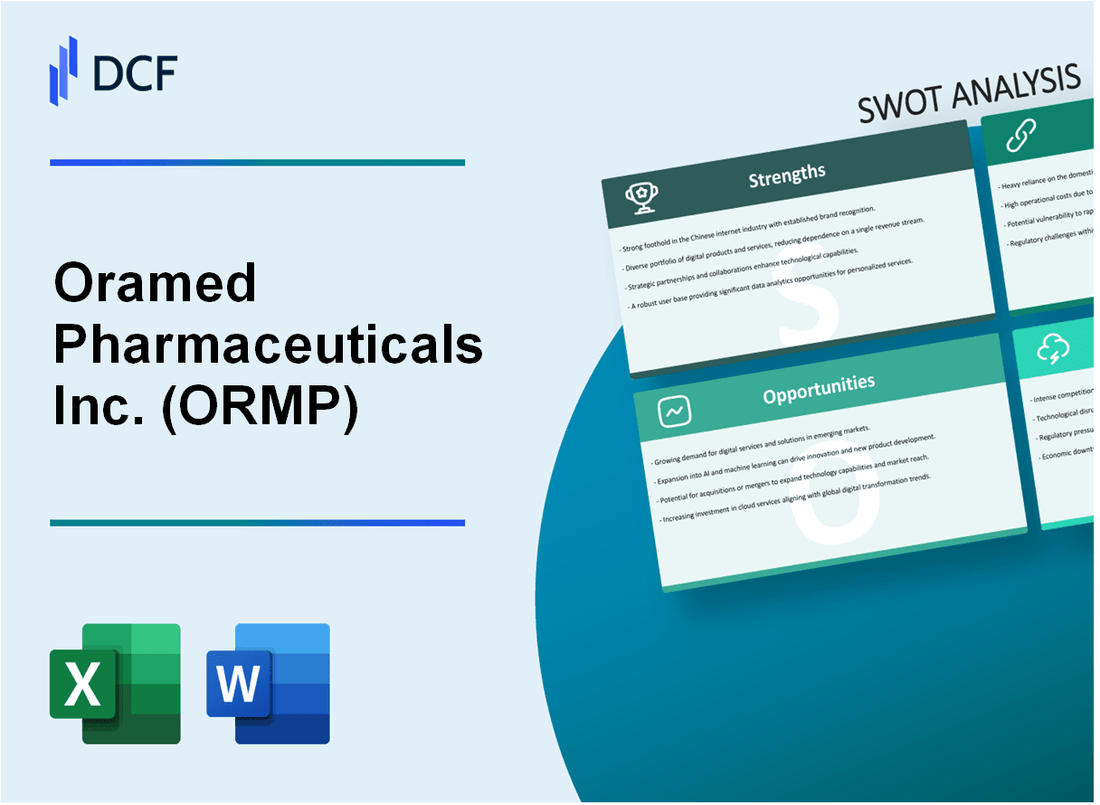
Completamente Editable: Adáptelo A Sus Necesidades En Excel O Sheets
Diseño Profesional: Plantillas Confiables Y Estándares De La Industria
Predeterminadas Para Un Uso Rápido Y Eficiente
Compatible con MAC / PC, completamente desbloqueado
No Se Necesita Experiencia; Fáciles De Seguir
Oramed Pharmaceuticals Inc. (ORMP) Bundle
En el mundo dinámico de la innovación farmacéutica, Oramed Pharmaceuticals Inc. (ORMP) se encuentra a la vanguardia del tratamiento transformador de la diabetes, pionera en la innovadora tecnología de insulina oral que podría revolucionar la forma en que millones manejan su condición. Este análisis FODA integral profundiza en el panorama estratégico de la compañía, explorando su investigación de vanguardia, oportunidades de mercado potenciales y los complejos desafíos que enfrentan este ambicioso innovador de biotecnología en 2024. Desde su plataforma única de entrega de proteínas orales hasta el intrincado mezcla de aprobaciones regulatorias y La competencia en el mercado, Oramed, representa un estudio de caso convincente de la ambición científica que cumple con el posicionamiento estratégico en el ámbito farmacéutico de alto riesgo.
Oramed Pharmaceuticals Inc. (ORMP) - Análisis FODA: Fortalezas
Plataforma de tecnología de insulina oral innovadora
Oramed ha desarrollado un propietario Tecnología de cápsula de insulina oral (ORMD-0801) con un mecanismo de entrega único. A partir de 2024, la tecnología representa un posible avance en el tratamiento con diabetes, abordando las limitaciones actuales de la insulina inyectable.
| Métrica de tecnología | Valor |
|---|---|
| Duración de protección de patentes | Hasta 2037 |
| Inversión de I + D (2023) | $ 22.4 millones |
| Oportunidad de mercado potencial | $ 48.5 mil millones Global Insulin Market |
Terapias únicas de proteínas orales y péptidos
Oramed se especializa en el desarrollo de proteínas orales y terapéutica de péptidos con un potencial médico significativo.
- GLP-1 oral para diabetes tipo 2
- PTH oral para la osteoporosis
- Plataforma innovadora de suministro de proteínas
Cartera de propiedades intelectuales
La compañía mantiene un Estrategia de propiedad intelectual robusta.
| Categoría de IP | Número de patentes |
|---|---|
| Patentes concedidas | 37 |
| Aplicaciones de patentes pendientes | 18 |
| Cobertura de patentes geográficas | Estados Unidos, Europa, Japón |
Equipo de gestión experimentado
Liderazgo con extensos antecedentes de investigación farmacéutica.
| Ejecutivo | Role | Años de experiencia |
|---|---|---|
| Nadav Kidron | CEO | Más de 20 años |
| Josh Hexter | Director de negocios | Más de 15 años |
Tubería clínica prometedora
Dirigido a necesidades médicas no satisfechas significativas con candidatos terapéuticos avanzados.
- Ensayos de fase 3 para insulina oral
- Ensayos de fase 2 para GLP-1 oral
- Indicaciones terapéuticas múltiples
| Programa clínico | Etapa actual | Tamaño potencial del mercado |
|---|---|---|
| Insulina oral (ORMD-0801) | Fase 3 | $ 20.3 mil millones |
| GLP-1 oral | Fase 2 | $ 15.7 mil millones |
Oramed Pharmaceuticals Inc. (ORMP) - Análisis FODA: debilidades
Recursos financieros limitados
A partir del cuarto trimestre de 2023, Oramed Pharmaceuticals reportó equivalentes en efectivo y efectivo de $ 98.3 millones, lo que es significativamente más bajo en comparación con las compañías farmacéuticas más grandes como Pfizer ($ 33.4 mil millones) o Merck ($ 14.5 mil millones).
Dependencia continua de la financiación externa
Los datos financieros revelan la continua dependencia de Oramed en fuentes de financiación externas:
| Fuente de financiación | Cantidad | Año |
|---|---|---|
| Financiamiento de capital | $ 45.2 millones | 2023 |
| Subvenciones de investigación | $ 12.7 millones | 2023 |
Falta de productos comercializados
Las flujos de ingresos actuales siguen siendo limitadas:
- No hay productos totalmente comercializados a partir de 2024
- Productos de tuberías que todavía están en etapas de ensayo clínico
- Ingresos potenciales principalmente de tecnologías de etapas de desarrollo
Costos de investigación y desarrollo
Los gastos de I + D para 2023 totalizaron $ 37.6 millones, representando un una carga financiera significativa con resultados regulatorios inciertos.
Desafíos de capitalización de mercado
| Métrica de capitalización de mercado | Valor | Estado comparativo |
|---|---|---|
| Capitalización de mercado actual | $ 456.2 millones | Segmento farmacéutico de pequeña capitalización |
| Volatilidad del precio de las acciones | ± 22.5% trimestral | Alto riesgo de inversión |
La pequeña capitalización de mercado de la compañía aumenta la incertidumbre de los inversores y los posibles riesgos de inversión.
Oramed Pharmaceuticals Inc. (ORMP) - Análisis FODA: Oportunidades
Mercado mundial de tratamiento de diabetes global
El mercado mundial de tratamiento de diabetes se valoró en $ 98.1 mil millones en 2022 y se proyecta que alcanzará los $ 159.6 mil millones para 2030, con una tasa compuesta anual de 6.2%.
| Segmento de mercado | Valor proyectado para 2030 | Índice de crecimiento |
|---|---|---|
| Mercado global de tratamiento de diabetes | $ 159.6 mil millones | 6.2% CAGR |
| Población de pacientes con diabetes | 537 millones de adultos | Aumento del 48% para 2045 |
Posible avance en la tecnología de entrega de insulina oral
Ventajas tecnológicas clave:
- Tecnología de cápsula de insulina oral patentada
- Potencial para reemplazar los tratamientos de insulina inyectables
- Plataforma avanzada de suministro de proteínas orales (ORMD-0801)
Expandir aplicaciones terapéuticas
Plataformas de investigación con posible expansión en:
- Manejo de diabetes tipo 1
- Tratamiento de diabetes tipo 2
- Aplicaciones potenciales en otros trastornos metabólicos
Potencial de asociación estratégica
| Categoría de asociación | Valor potencial | Impacto del mercado |
|---|---|---|
| Licencia farmacéutica | Hasta $ 300 millones | Desarrollo de tecnología acelerada |
| Colaboración de investigación | $ 50-100 millones | Capacidades de I + D mejoradas |
Interés de los inversores en tecnologías médicas innovadoras
La inversión de capital de riesgo en salud digital y tecnologías médicas alcanzó los $ 15.3 mil millones en 2022, lo que indica un fuerte potencial de mercado para soluciones farmacéuticas innovadoras.
| Categoría de inversión | 2022 total | Cambio año tras año |
|---|---|---|
| Inversiones en salud digital | $ 15.3 mil millones | -45% desde 2021 pico |
| Financiación de la tecnología médica | $ 8.7 mil millones | Trayectoria de crecimiento constante |
Oramed Pharmaceuticals Inc. (ORMP) - Análisis FODA: amenazas
Procesos de aprobación regulatoria farmacéutica complejos y largos
Las tasas de aprobación de la solicitud de medicamentos de la FDA muestran que solo el 12% de los medicamentos que ingresan a los ensayos clínicos alcanzan con éxito la aprobación del mercado. El proceso promedio de revisión regulatoria farmacéutica lleva aproximadamente 10-12 años con costos estimados que oscilan entre $ 1.3 mil millones y $ 2.6 mil millones por ciclo de desarrollo de fármacos.
| Métrico regulatorio | Valor estadístico |
|---|---|
| Tasa de éxito de aprobación de drogas | 12% |
| Duración promedio de revisión regulatoria | 10-12 años |
| Costo de desarrollo por fármaco | $ 1.3b - $ 2.6b |
Competencia intensa de fabricantes de tratamiento de diabetes establecidos
Mercado global de tratamiento de diabetes valorado en $ 204.6 mil millones en 2023, con los principales fabricantes que incluyen:
- Novo Nordisk (cuota de mercado: 28%)
- Eli Lilly (cuota de mercado: 22%)
- Sanofi (cuota de mercado: 18%)
Obsolescencia tecnológica potencial
La investigación de investigación y desarrollo médico alcanzó los $ 194 mil millones en todo el mundo en 2023, con el sector farmacéutico que experimentó tasas de rotación tecnológica de aproximadamente 15-18% anual.
| Inversión de investigación | Tasa de rotación tecnológica |
|---|---|
| Inversión global de I + D | $ 194 mil millones |
| Tasa anual de obsolescencia tecnológica | 15-18% |
Incertidumbres económicas que afectan las inversiones en salud
Las inversiones de capital de riesgo farmacéutico disminuyeron un 36% en 2023, totalizando aproximadamente $ 12.4 mil millones en comparación con $ 19.3 mil millones en 2022.
Desafíos potenciales para asegurar fondos adicionales
Financiación de biotecnología El panorama de los paisajes:
- Promedio de financiación de semillas: $ 2.1 millones
- Promedio de financiación de la Serie A: $ 15.7 millones
- Selectividad de inversiones de capital de riesgo: menos del 2% de las nuevas empresas farmacéuticas reciben fondos sustanciales
| Etapa de financiación | Inversión promedio |
|---|---|
| Financiación de semillas | $ 2.1 millones |
| Financiación de la Serie A | $ 15.7 millones |
| Tasa de éxito de financiación | Menos del 2% |
Oramed Pharmaceuticals Inc. (ORMP) - SWOT Analysis: Opportunities
Oral vaccine market penetration: A successful oral vaccine for a widespread disease like COVID-19 or flu could be a multi-billion-dollar market, simplifying logistics and patient compliance.
The biggest opportunity for Oramed Pharmaceuticals lies in its majority-owned subsidiary, Oravax Medical, and the development of an oral vaccine using the Protein Oral Delivery (POD™) technology. A successful oral vaccine for a major respiratory disease like COVID-19 or influenza would be a game-changer, not just for Oramed, but for global public health.
The global oral vaccines market is already substantial, projected to reach between $2.57 billion and $4.16 billion in 2025, but that figure is mostly for enteric diseases. The real prize is the injectable market it would disrupt. For instance, the global seasonal influenza vaccine market alone is valued between $8.91 billion and $10.2 billion for 2025. An oral, room-temperature stable vaccine eliminates the need for a cold chain, simplifies mass distribution, and removes the barrier of needle-phobia, which is defintely a factor in patient compliance.
Oravax's oral COVID-19 vaccine candidate is a triple-antigen Virus-Like Particle (VLP) vaccine, targeting three SARS-CoV-2 surface proteins, which could offer broader protection against emerging variants. Initial Phase I data was positive in late 2022, and advancing this program is a clear, high-reward action.
Platform licensing deals: Licensing the POD technology to other pharma companies for their own injectable drugs could create a non-dilutive revenue stream.
Oramed's core asset is the POD technology itself, a proprietary platform designed to orally deliver therapeutic proteins and peptides that would otherwise be destroyed by the digestive system. Licensing this technology to Big Pharma for their own injectable biologics offers a non-dilutive, high-margin revenue opportunity.
We already have concrete examples of this model in action for their oral insulin candidate, ORMD-0801, even before final regulatory approval in the US:
- China Deal: The joint venture with Hefei Tianhui Incubator of Technologies (HTIT) for Greater China includes $50 million in total payments, with $33 million already received, plus up to a 10% royalty on net sales.
- South Korea Deal: The distribution agreement with Medicox Co., Ltd. for South Korea includes $18 million in potential milestone payments, with $2 million received, plus up to a 15% royalty on gross sales.
Here's the quick math: If the POD technology can successfully deliver a blockbuster injectable drug-say, a monoclonal antibody-that generates $1 billion in annual sales, a 10% royalty would net Oramed $100 million per year from a single product, without the massive R&D costs of developing the drug itself. That's a powerful model.
Weight management/NASH pipeline: Developing ORMD-0801 for other indications, like Non-Alcoholic Steatohepatitis (NASH), using the existing safety data.
Following the mixed Phase III results for ORMD-0801 in Type 2 Diabetes (T2D), the focus must pivot to its other high-value indications, particularly Non-Alcoholic Steatohepatitis (NASH). The drug's mechanism of action, which targets the liver, makes it a strong candidate for NASH, a condition often linked to diabetes.
The NASH market is an enormous, underserved opportunity. The global NASH treatment market size is projected to be between $6.06 billion and $9.21 billion in 2025, and is expected to grow exponentially. North America currently holds the largest share of this market, at around 79% in 2024. ORMD-0801 is currently in a Phase II trial for NASH. Having already completed a Phase III program for T2D gives the NASH program a huge head start in terms of safety data and manufacturing scale-up, which reduces risk and time to market.
Government funding for vaccines: Potential for significant non-dilutive grants or contracts from US or international governments to accelerate oral vaccine development.
Governments and global health organizations are actively seeking solutions that improve vaccine access and logistics, especially after the COVID-19 pandemic exposed the fragility of the cold-chain distribution model. An oral, room-temperature stable vaccine is a strategic national asset.
While Oramed has not announced a specific large grant in 2025, the funding landscape is favorable for drug delivery innovation:
- The US Advanced Research Projects Agency for Health (ARPA-H) has a Fiscal Year 2025 President's Budget request of $1.5 billion to accelerate biomedical breakthroughs.
- The National Institute of Diabetes and Digestive and Kidney Diseases (NIDDK) has a FY2025 President's Budget of approximately $2.31 billion, which supports research relevant to ORMD-0801's target diseases like diabetes and NASH.
This focus on resilient systems and targeted delivery creates a clear path for non-dilutive funding, meaning Oramed can accelerate its oral vaccine program without issuing more stock, which is critical for shareholder value.
| Opportunity Area | 2025 Market Size (Estimated) | Oramed Product/Technology | Actionable Insight |
|---|---|---|---|
| Oral Vaccine Market Penetration | $8.91 Billion (Global Seasonal Flu Vaccine) | Oravax Oral VLP Vaccine (COVID-19, Flu) | A successful Phase II/III trial would position Oravax to capture a share of the injectable market by offering superior logistics and compliance. |
| Weight Management/NASH Pipeline | $6.06 Billion - $9.21 Billion (Global NASH Treatment) | ORMD-0801 (Phase II for NASH) | Pivot resources to the NASH program, leveraging existing Phase II data and the drug's liver-targeting mechanism. |
| Platform Licensing Deals | $50 Million in payments + 10% Royalty (China Deal Baseline) | POD™ Oral Delivery Technology | Aggressively market POD to large pharma for oral delivery of GLP-1s, antibodies, and other injectable biologics. |
| Government Funding | $1.5 Billion (ARPA-H FY2025 Budget Request for Innovation) | Oravax Oral Vaccine Development | Target non-dilutive grants from agencies like ARPA-H and BARDA, emphasizing the logistical and national security benefits of a shelf-stable oral vaccine. |
Oramed Pharmaceuticals Inc. (ORMP) - SWOT Analysis: Threats
You're looking at Oramed Pharmaceuticals Inc. (ORMP) and its pivot to a platform technology company, and while the balance sheet looks strong right now, the threats on the horizon are immediate and tied directly to the clinical pipeline. The biggest risk is the lack of clinical progress in the oral vaccine space, which is where the market expects the next big win.
Finance: Track the quarterly cash burn rate against the projected $85 million cash balance by Friday, and flag any quarter where the burn exceeds $15 million.
Clinical Trial Risk
The core threat is the slow, binary nature of drug development, especially with the Oravax oral vaccine candidates. While the technology (POD™ oral delivery) is innovative, the Oravax oral COVID-19 vaccine has not moved beyond Phase 1 in South Africa since the first participant was enrolled in December 2021. This lack of clear progress into a Phase 2 trial is a major red flag for investors.
If the Oravax candidate fails to meet its primary endpoints in a Phase 2 trial-meaning it doesn't show sufficient safety or immunogenicity-the financial impact would be severe. The company has already shifted focus after the Phase 3 failure of its oral insulin program, so another major pipeline failure would quickly deplete cash reserves earmarked for R&D. The nine-month R&D expense for the period ended September 30, 2025, was only $4.4 million, a 10% decrease year-over-year, which suggests a highly constrained or focused clinical program. A trial failure would necessitate a significant write-down and further stock price collapse.
Intense Vaccine Competition
Oramed is attempting to enter a market that is not only mature but is absolutely dominated by two behemoths, Pfizer and Moderna. These companies have established global manufacturing and distribution networks, plus a proven ability to rapidly update their products. The global mRNA vaccines and therapeutics market is estimated to be worth $63.74 billion in 2025, and Pfizer-BioNTech and Moderna hold the dominant share of this segment.
For the 2024-2025 season, both companies already have updated injectable mRNA vaccines (Comirnaty and Spikevax) targeting the currently circulating KP.2 Omicron strain, with full FDA approval for adults and Emergency Use Authorization (EUA) for children. They are also expanding their pipelines into combined flu/COVID-19 shots and other infectious diseases. The sheer scale of their R&D budgets and their existing regulatory relationships dwarf Oramed's resources, making it defintely an uphill battle for any new entrant, regardless of how convenient an oral pill is.
| Competitive Factor | Pfizer/Moderna (Injectable mRNA) | Oramed (Oravax Oral VLP) |
|---|---|---|
| 2025 Market Segment Value | Dominant share of the $63.74 billion mRNA market | Zero revenue; pre-commercial, Phase 1 stage |
| Product Status (2024-2025) | Updated, FDA-approved/EUA vaccines (KP.2 strain) | Stalled in Phase 1 since late 2021 |
| Regulatory Pathway | Established, streamlined process for updates | Novel oral delivery; faces complex, unproven path |
Regulatory Hurdles
Oral vaccines represent a novel drug delivery system (NDDS) for many infectious diseases, utilizing Oramed's proprietary Protein Oral Delivery (POD™) technology. This novelty is a major hurdle with the US Food and Drug Administration (FDA). The lack of a clear, established regulatory precedent for a new class of oral protein or virus-like particle (VLP) vaccine means the approval pathway will likely be longer and more complex than for a standard injectable.
The FDA is currently working to unveil a new framework for vaccine approvals to create a more predictable process. While predictability sounds good, new guidance often involves new, rigorous requirements, such as mandatory placebo testing for all new vaccines. These additional requirements can add years and millions of dollars to the clinical timeline, a burden a small-cap biotech like Oramed can ill afford.
Shareholder Dilution
Despite reporting a net income of $65.0 million for the nine months ended September 30, 2025, Oramed's operational cash flow tells a different story. This income is almost entirely non-operational, driven by gains from strategic investments like Scilex Holding Company and Alpha Tau Medical Ltd. The company's core operations are still burning cash.
Cash used in operating activities for the nine months ended September 30, 2025, was $8.7 million, representing a 33% increase in the underlying operational burn rate compared to the prior year. If the clinical trials for Oravax accelerate into Phase 2 or 3, or if the investment portfolio sees a downturn, the company will need to raise capital quickly. Given the 39,802,455 shares of common stock outstanding as of November 12, 2025, any future equity raise would significantly dilute existing shareholders, especially if the share price remains depressed due to clinical delays.
- Operational cash burn is increasing.
- Future capital raises will dilute equity.
- The non-operational income is a temporary cushion.
Disclaimer
All information, articles, and product details provided on this website are for general informational and educational purposes only. We do not claim any ownership over, nor do we intend to infringe upon, any trademarks, copyrights, logos, brand names, or other intellectual property mentioned or depicted on this site. Such intellectual property remains the property of its respective owners, and any references here are made solely for identification or informational purposes, without implying any affiliation, endorsement, or partnership.
We make no representations or warranties, express or implied, regarding the accuracy, completeness, or suitability of any content or products presented. Nothing on this website should be construed as legal, tax, investment, financial, medical, or other professional advice. In addition, no part of this site—including articles or product references—constitutes a solicitation, recommendation, endorsement, advertisement, or offer to buy or sell any securities, franchises, or other financial instruments, particularly in jurisdictions where such activity would be unlawful.
All content is of a general nature and may not address the specific circumstances of any individual or entity. It is not a substitute for professional advice or services. Any actions you take based on the information provided here are strictly at your own risk. You accept full responsibility for any decisions or outcomes arising from your use of this website and agree to release us from any liability in connection with your use of, or reliance upon, the content or products found herein.