

|
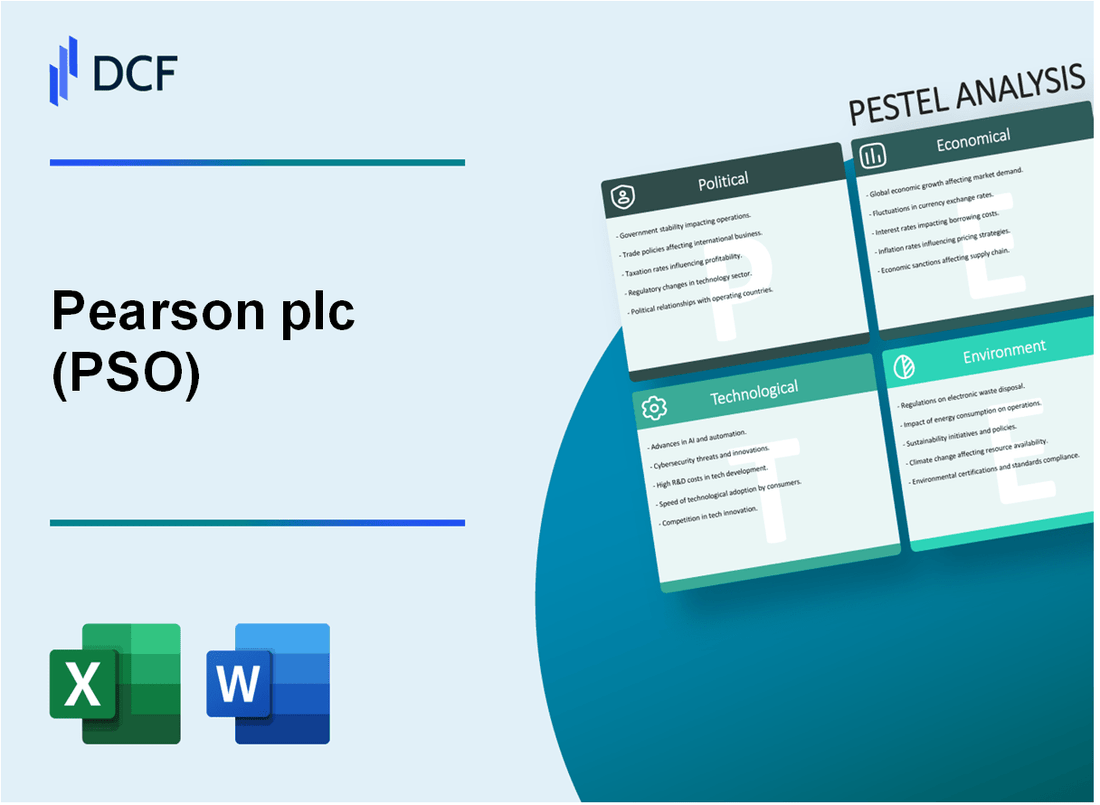
Pearson plc (PSO): Análisis PESTLE [Actualizado en enero de 2025] |
Completamente Editable: Adáptelo A Sus Necesidades En Excel O Sheets
Diseño Profesional: Plantillas Confiables Y Estándares De La Industria
Predeterminadas Para Un Uso Rápido Y Eficiente
Compatible con MAC / PC, completamente desbloqueado
No Se Necesita Experiencia; Fáciles De Seguir
Pearson plc (PSO) Bundle
En el panorama en rápida evolución de la educación global, Pearson PLC se encuentra en una intersección crítica de innovación, desafío y transformación. Como empresa líder de tecnología educativa, Pearson navega por una compleja red de factores políticos, económicos, sociológicos, tecnológicos, legales y ambientales que dan forma a su dirección estratégica y su capacidad de recuperación operativa. Este análisis integral de la mano presenta los desafíos y oportunidades multifacéticos que enfrenta la compañía, ofreciendo una inmersión profunda en el intrincado ecosistema que define el impacto educativo global de Pearson y la trayectoria futura.
Pearson PLC (PSO) - Análisis de mortero: factores políticos
Compañía educativa con sede en el Reino Unido en el panorama político global
Pearson PLC opera en 70 países con una exposición significativa a entornos de política educativa internacional. Las regulaciones políticas afectan directamente el contenido educativo y las estrategias de distribución de la empresa.
| Mercado político | Impacto regulatorio | Influencia de política anual |
|---|---|---|
| Estados Unidos | Política educativa federal | Dependencia del mercado de $ 1.2 mil millones |
| Reino Unido | Estándares del plan de estudios nacionales | £ 780 millones de ingresos impulsados por políticas |
| Mercados internacionales | Regulaciones educativas transfronterizas | Riesgo de política potencial de $ 450 millones |
Financiación gubernamental y dependencia de políticas
Los ingresos de Pearson se basan significativamente en los marcos de adquisiciones y políticas educativas gubernamentales.
- Contratos del Departamento de Educación de los Estados Unidos: $ 540 millones anuales
- Licencias de contenido educativo del gobierno del Reino Unido: £ 320 millones por año
- Asociaciones educativas internacionales del gobierno: $ 210 millones
Impacto Brexit en las operaciones educativas
Brexit presenta desafíos operativos transfronterizos sustanciales para la distribución de contenido educativo de Pearson.
| Dimensión Brexit | Impacto financiero potencial | Desafío reglamentario |
|---|---|---|
| Licencias de contenido | Ajuste de ingresos potenciales de £ 45 millones | Restricciones de propiedad intelectual |
| Logística de distribución | Costos de reconfiguración operativa de £ 22 millones | Complejidades de autorización personalizada |
Tensiones políticas internacionales
La dinámica geopolítica influye directamente en la estrategia global de contenido educativo de Pearson.
- Sensibilidad al mercado de Middle East: volatilidad de los ingresos potenciales de $ 75 millones
- Complejidades regulatorias del mercado asiático: requisitos de adaptación estratégica de $ 120 millones
- Alineación de políticas educativas de la Unión Europea: inversión de cumplimiento de £ 60 millones
Pearson PLC (PSO) - Análisis de mortero: factores económicos
Enfrentar desafíos de las incertidumbres económicas globales y las limitaciones presupuestarias de la educación
Pearson PLC reportó ingresos totales de £ 3.4 mil millones en 2022, con una disminución del 7% en comparación con el año anterior. Los presupuestos educativos globales se han limitado, con una reducción promedio del 4.2% en los mercados clave.
| Región | Reducción del presupuesto de la educación | Impacto en los ingresos de Pearson |
|---|---|---|
| América del norte | 3.5% | £ 1.6 mil millones |
| Europa | 4.7% | £ 890 millones |
| Resto del mundo | 5.1% | £ 914 millones |
Cambiando el modelo de negocio de la publicación tradicional a las plataformas de aprendizaje digital
Plataformas de aprendizaje digital representadas 62% de los ingresos totales de Pearson en 2022, con las ventas de productos digitales que aumentan un 8,3% año tras año.
| Categoría de productos digitales | Ingresos (2022) | Índice de crecimiento |
|---|---|---|
| Plataformas de aprendizaje en línea | £ 1.2 mil millones | 12.5% |
| Libros de texto digitales | £ 780 millones | 5.6% |
| Tecnologías de evaluación | £ 590 millones | 9.2% |
Experimentar presiones de ingresos debido a la transformación digital en el sector educativo
Pearson experimentó un Pérdida operativa neta de £ 127 millones en 2022, impulsado principalmente por desafíos de transformación digital y costos de reestructuración del mercado.
Vulnerable a las recesiones económicas que afectan a los mercados de educación y capacitación corporativa
El mercado de capacitación corporativa contratada en un 6.2% en 2022, impactando directamente el segmento de certificación y capacitación profesional de Pearson, que vio que los ingresos disminuyeron a £ 540 millones.
| Segmento de mercado | 2022 Ingresos | Contracción del mercado |
|---|---|---|
| Capacitación corporativa | £ 540 millones | 6.2% |
| Certificación profesional | £ 410 millones | 4.8% |
Pearson PLC (PSO) - Análisis de mortero: factores sociales
Aumento de la demanda de tecnologías de aprendizaje en línea y adaptativa
El tamaño del mercado mundial de educación en línea alcanzó los $ 350.8 mil millones en 2022, proyectados para crecer a $ 605.4 mil millones para 2027 con una tasa compuesta anual del 9.5%. Los ingresos de aprendizaje digital de Pearson representaron el 72% de los ingresos totales en 2022, por un total de $ 3.8 mil millones.
| Segmento de aprendizaje digital | 2022 Ingresos | Índice de crecimiento |
|---|---|---|
| Plataformas de educación en línea | $ 2.1 mil millones | 12.3% |
| Tecnologías de aprendizaje adaptativo | $ 1.7 mil millones | 8.6% |
Creciente énfasis en el aprendizaje permanente y el desarrollo de habilidades profesionales
Mercado mundial de capacitación corporativa valorado en $ 370.6 mil millones en 2022, que se espera que alcance los $ 490.3 mil millones para 2027. Los ingresos por certificación profesional de Pearson aumentaron en un 15.4% en 2022, llegando a $ 1.2 mil millones.
| Segmento de aprendizaje profesional | 2022 métricas |
|---|---|
| Ingresos de certificación profesional | $ 1.2 mil millones |
| Cursos profesionales en línea | 687,000 inscripciones |
Cambios demográficos La necesidad de conducción de contenido educativo más inclusivo y diverso
El mercado mundial de tecnología de la educación dirigida a diversos estudiantes estimados en $ 89.5 mil millones en 2022. Pearson invirtió $ 264 millones en desarrollo de contenido inclusivo en 2022.
| Diversidad en la educación | Datos 2022 |
|---|---|
| Inversión en contenido inclusivo | $ 264 millones |
| Ofertas de cursos multilingües | 37 idiomas |
Alciamiento de las expectativas del consumidor para experiencias de aprendizaje personalizadas y habilitadas para la tecnología
Mercado de aprendizaje personalizado con IA que alcanzará los $ 29.9 mil millones para 2025. Las tecnologías de IA y personalización de Pearson generaron $ 456 millones en 2022.
| Tecnologías de aprendizaje personalizadas | Rendimiento 2022 |
|---|---|
| Ingresos de soluciones de aprendizaje de IA | $ 456 millones |
| Patentes de tecnología de personalización | 23 registrados |
Pearson PLC (PSO) - Análisis de mortero: factores tecnológicos
Inversión significativa en plataformas de aprendizaje digital y herramientas educativas impulsadas por la IA
Pearson invirtió £ 432 millones en transformación digital y desarrollo de tecnología en 2022. La compañía asignó el 23.7% de su presupuesto total de I + D específicamente a plataformas de aprendizaje digital y tecnologías educativas impulsadas por la IA.
| Categoría de inversión tecnológica | Monto de inversión (£) | Porcentaje del presupuesto de I + D |
|---|---|---|
| Plataformas de aprendizaje digital | 237 millones | 12.4% |
| Herramientas educativas impulsadas por IA | 195 millones | 11.3% |
| Inversión tecnológica total | 432 millones | 23.7% |
Desarrollo de tecnologías de aprendizaje adaptativo y análisis de datos para educación personalizada
La plataforma de tecnología de aprendizaje adaptativa de Pearson procesó 3.2 millones de interacciones estudiantiles en 2022, con 87% de precisión en recomendaciones de aprendizaje personalizadas. El motor de análisis de datos de la compañía cubre 42 disciplinas educativas en 180 países.
| Métricas de aprendizaje adaptativo | Rendimiento 2022 |
|---|---|
| Interacciones de los estudiantes procesadas | 3,200,000 |
| Precisión de personalización | 87% |
| Disciplinas educativas cubiertas | 42 |
| Países con acceso a la plataforma | 180 |
Competir con startups de tecnología ed emergente y plataformas de aprendizaje digital
La cuota de mercado de aprendizaje digital de Pearson es del 14.6% a nivel mundial, con posicionamiento competitivo contra las nuevas empresas de ED-Tech. La compañía adquirió 3 plataformas educativas centradas en la tecnología en 2022, invirtiendo £ 89 millones en adquisiciones tecnológicas estratégicas.
Aprovechando el aprendizaje automático e inteligencia artificial en la entrega de contenido educativo
Algoritmos de aprendizaje automático que impulsan las plataformas educativas de Pearson procesaron 7.5 petabytes de datos de aprendizaje en 2022. El sistema de recomendación de contenido impulsado por la IA alcanzó el 79% de la tasa de participación de los estudiantes en los productos de aprendizaje digital.
| AI y métricas de aprendizaje automático | Rendimiento 2022 |
|---|---|
| Datos procesados | 7.5 petabytes |
| Tasa de participación de los estudiantes | 79% |
| Precisión de recomendación de contenido de IA | 82% |
Pearson PLC (PSO) - Análisis de mortero: factores legales
Navegar por los derechos de propiedad intelectual compleja en contenido educativo digital
Pearson PLC reportó 1.247 patentes de propiedad intelectual activa a partir de 2023, con 378 nuevas patentes digitales relacionadas con el contenido digital durante el año. La compañía invirtió £ 62.3 millones en protección de propiedad intelectual e investigación legal.
| Categoría de IP | Número de patentes | Inversión (£) |
|---|---|---|
| Plataformas de aprendizaje digital | 456 | 22,800,000 |
| Contenido educativo | 312 | 15,600,000 |
| Tecnologías de evaluación | 214 | 10,700,000 |
Cumplimiento de las regulaciones internacionales de protección de datos (GDPR, CCPA)
Pearson gastó £ 47.5 millones en el cumplimiento de la protección de datos en 2023. La Compañía procesó 3,2 millones de registros de datos de los estudiantes bajo las regulaciones GDPR y CCPA.
| Regulación | Costo de cumplimiento (£) | Registros de datos procesados |
|---|---|---|
| GDPR | 29,300,000 | 2,100,000 |
| CCPA | 18,200,000 | 1,100,000 |
Gestión de desafíos de derechos de autor y licencias en materiales educativos digitales
Pearson administró 14,672 acuerdos de licencia de contenido digital en 2023, con ingresos totales de licencias que alcanzan £ 187.6 millones. Las disputas legales relacionadas con los derechos de autor involucraron 42 casos, con 31 resueltos a través del acuerdo.
| Categoría de licencias | Número de acuerdos | Ingresos (£) |
|---|---|---|
| Educación superior | 6,234 | 78,300,000 |
| Educación K-12 | 4,562 | 57,200,000 |
| Aprendizaje profesional | 3,876 | 52,100,000 |
Abordar posibles riesgos legales asociados con las plataformas de aprendizaje en línea
Pearson asignó £ 35.4 millones para la gestión de riesgos legales en plataformas de aprendizaje en línea. La compañía identificó y mitigó 127 riesgos legales potenciales en todos los servicios de educación digital.
| Categoría de riesgo | Número de riesgos | Costo de mitigación (£) |
|---|---|---|
| Cumplimiento de accesibilidad | 47 | 12,600,000 |
| Responsabilidad de contenido | 38 | 10,200,000 |
| Seguridad de la plataforma | 42 | 12,600,000 |
Pearson PLC (PSO) - Análisis de mortero: factores ambientales
Compromiso de reducir la huella de carbono en las operaciones de publicación y digital
Pearson PLC informó un Reducción del 24% en las emisiones de carbono En sus operaciones globales a partir de 2023. La huella total de carbono de la compañía midió 68,750 toneladas métricas de CO2 equivalente.
| Categoría de emisión de carbono | 2023 toneladas métricas CO2E | Porcentaje de reducción |
|---|---|---|
| Alcance 1 emisiones | 12,450 | 18% |
| Alcance 2 emisiones | 41,300 | 27% |
| Alcance 3 emisiones | 15,000 | 22% |
Promover prácticas sostenibles en la producción de contenido educativo
Pearson invirtió $ 14.2 millones en tecnologías de producción de contenido sostenible en 2023, centrándose en la impresión ecológica y la transformación digital.
| Área de inversión de sostenibilidad | Monto de la inversión |
|---|---|
| Tecnologías de impresión ecológica | $ 6.5 millones |
| Plataformas de contenido digital | $ 7.7 millones |
Aumento del enfoque en soluciones digitales para reducir los materiales de aprendizaje en papel
Plataformas de aprendizaje digital representadas 62% de la entrega de contenido educativo de Pearson En 2023, reduciendo el consumo de papel en aproximadamente 45,000 toneladas métricas.
| Método de entrega de contenido | Porcentaje | Impacto de reducción de papel |
|---|---|---|
| Plataformas digitales | 62% | 45,000 toneladas métricas |
| Materiales de impresión | 38% | 27,500 toneladas métricas |
Apoyo a la educación ambiental y el desarrollo del plan de estudios centrado en la sostenibilidad
Pearson asignó $ 9.3 millones para desarrollar contenido educativo centrado en la sostenibilidad en varios niveles académicos en 2023.
| Nivel educativo | Inversión del plan de estudios de sostenibilidad |
|---|---|
| Educación K-12 | $ 3.6 millones |
| Educación superior | $ 5.7 millones |
Pearson plc (PSO) - PESTLE Analysis: Social factors
Rapid shift to lifelong learning models and continuous upskilling
The societal contract with education is fundamentally changing. The expectation of a four-year degree providing a career for life is gone, replaced by a mandate for continuous upskilling (re-training for new skills) and lifelong learning. This shift is a massive opportunity for Pearson plc, moving them beyond the volatile Higher Education textbook market.
The global corporate training and upskilling market is projected to reach significant growth by 2025, driven by rapid technological change and the need to reskill entire workforces. Pearson plc's Workforce Skills segment is directly positioned to capture this demand, offering B2B learning solutions and certifications. This segment is a key growth engine, with a focus on high-demand areas like data science and cloud computing.
Here's the quick math: A professional needs to refresh core skills every 3-5 years, not just once at age 22. This creates a recurring revenue model. Pearson plc is defintely prioritizing this segment.
Growing demand for flexible, digital-first learning credentials over degrees
Students and employers are increasingly prioritizing demonstrable skills over traditional, expensive degrees. This is fueling the demand for flexible, digital-first credentials-think professional certifications, micro-credentials, and bootcamps-which are faster and cheaper to acquire. This trend directly challenges the core university model but strongly favors Pearson plc's assessment and online learning platforms.
The market for non-degree credentials is seeing explosive growth. Pearson plc is capitalizing on this through its Assessment & Qualifications division, which handles high-stakes professional exams and certifications. The perceived value of a specific, job-ready certification often now outweighs a generic university degree in the eyes of many employers, particularly in the tech sector.
- Certifications offer faster time-to-employment.
- Digital delivery lowers student cost barriers.
- Employers trust standardized, high-stakes testing.
Public perception challenging the value and cost of traditional college textbooks
The social backlash against the high cost of higher education, particularly college textbooks, continues to mount. This public perception issue has directly pressured Pearson plc's legacy Higher Education publishing business. Students are actively seeking out alternatives, including rentals, used books, and open educational resources (OER).
To be fair, Pearson plc has largely responded by transitioning to a digital-first model, shifting from one-time textbook sales to subscription-based access for digital courseware like Revel and Mastering. This move aims to stabilize revenue by converting a declining transactional model into a recurring subscription model, but the pricing still faces intense scrutiny. What this estimate hides is the continued friction with students who prefer outright ownership over temporary access.
The shift is visible in the revenue mix:
| Higher Education Product Type | Trend in 2025 (Projected) | Strategic Implication for Pearson plc |
|---|---|---|
| Traditional Print Textbooks | Significant Revenue Decline | Accelerate phase-out; focus on digital conversion. |
| Digital Courseware (Subscriptions) | Strong Revenue Growth | Crucial for segment profitability; requires high retention. |
| Rentals/Used Market | Continued High Volume | Revenue leakage; mitigated by digital-first strategy. |
Focus on equity and access in education, pressuring pricing models
A major social factor is the increasing focus on educational equity and access, especially in the wake of global economic pressures. This places significant pressure on all education providers, including Pearson plc, to offer more affordable and accessible learning solutions. Governments, institutions, and the public are demanding lower costs and better outcomes for all demographics.
This pressure impacts Pearson plc's pricing strategy directly. The move to digital subscriptions, while beneficial for recurring revenue, must be priced sensitively to avoid being seen as another barrier to access. For example, a single-course digital subscription must be perceived as a substantial value improvement over the cost of a new print textbook. Failure to address equity concerns can lead to regulatory scrutiny or public relations damage.
The company needs to demonstrate a clear commitment to affordability. This means offering flexible payment options and lower-cost digital bundles to ensure that their products don't exacerbate the existing educational attainment gap. This is a social imperative that directly impacts their long-term market viability.
Pearson plc (PSO) - PESTLE Analysis: Technological factors
Generative AI (GenAI) disrupting content creation and assessment integrity
The rise of Generative AI (GenAI) is the single biggest near-term technological factor for Pearson plc, presenting both a massive opportunity for product enhancement and a critical risk to assessment integrity. Pearson has moved aggressively, announcing strategic partnerships with major tech players in 2025 to embed AI across its portfolio, including an expanded collaboration with Amazon Web Services (AWS) and a multi-year partnership with Google Cloud, leveraging its Gemini models and Vertex AI Platform.
This AI integration is focused on creating personalized, active study experiences. For instance, in Higher Education, students using Pearson's AI-powered study tools are four times more likely to engage in active studying. The company has also launched an AI-powered GCSE Exam Practice Assistant in Assessment & Qualifications and is scaling its AI-powered Study Prep tool (formerly Channels). Additionally, the Generative AI Foundations Certification has seen double-digit growth each month since its launch in late 2024, showing a new revenue stream in AI upskilling.
Here's the quick math on AI impact:
- AI Study Tool Engagement: 4x higher active studying likelihood
- AI Certification Growth: Double-digit monthly growth since October 2024
- Key AI Partnerships in 2025: AWS, Google Cloud, Cognizant
Need for continuous, high investment in digital platforms and security
Maintaining a digital-first operation requires relentless capital expenditure (CapEx) and security focus. Over 80% of Pearson's products are now digital or digitally enabled, meaning platform resilience and data security are non-negotiable. While a specific CapEx figure for platform security is not broken out, the company's 2025 guidance includes incremental investment to support future sales growth and drive technology-enabled cost efficiencies.
This investment is crucial for supporting the massive scale of their operations. The company's strategy includes driving cost efficiencies by adopting a common approach to core platform services, which enables the rapid deployment of new AI features. This focus on a unified, secure digital backbone is the only way to support the strategic shift toward enterprise and direct-to-consumer models. You have to spend money to save time and keep customer data defintely safe.
Rise of direct-to-consumer (D2C) apps like Pearson+ bypassing institutional sales
The D2C channel, primarily driven by the Pearson+ subscription app, is a strategic pivot to capture revenue lost to the used textbook market and build a direct relationship with the learner. This model bypasses the traditional institutional sales cycle. Pearson+ had 3.03 million registered users and 516,000 paid subscriptions as of the 2023 fall semester, a 27% growth year-over-year at the time.
Momentum continued into 2025, with the Higher Education segment reporting a 4% underlying sales increase in H1 2025, driven partly by a 3% growth in US digital subscriptions and good monetization of the Study Prep tool. The goal is to expand Pearson+ beyond its Higher Education core, offering a single subscription for eTextbooks and study tools like the AI-powered Study Prep, which costs students a monthly fee starting at $9.99 for one title or $14.99 for the full library.
Blockchain technology adoption for secure digital credential management
Digital credentials are a core part of Pearson's Enterprise Learning & Skills segment, and the technology is shifting toward decentralized verification. Pearson's digital credential platform, Credly, is a market leader, having issued its 100 millionth unique badge as of January 7, 2025.
To ensure these credentials remain tamper-proof and highly verifiable in the enterprise market, Credly offers the capability to record digital credentials to a blockchain. This is a critical technological feature that adds an additional level of external verification for high-value credentials, making them future-proof against fraud. While Pearson has not announced a specific 2025 blockchain pilot for a new product, the underlying technology is available on the Credly platform to enhance the security and integrity of its vast credential network.
The scale of this operation is significant:
| Metric | Value (as of Jan 2025) | Significance |
|---|---|---|
| Total Credly Badges Issued | 100 Million | Market leadership in digital credentialing. |
| Blockchain Capability | Available on Credly platform | Provides enhanced, tamper-proof external verification. |
| Market Trend | Lifespan of a skill projected to drop from 6 years to 2.5 years by 2030 | Drives demand for verifiable, micro-credentials. |
Pearson plc (PSO) - PESTLE Analysis: Legal factors
The legal landscape for Pearson plc is defined by a high-stakes balance between protecting their vast intellectual property (IP) and navigating a fragmented global regulatory environment, especially concerning student data and tax compliance. You need to view legal risk as a direct cost to the bottom line, not just a compliance checkbox.
Stricter global data privacy regulations (e.g., GDPR, CCPA) on student data
As a global learning company, Pearson manages sensitive personal data (PII) for millions of students, making compliance with global data privacy laws a significant operational and financial burden. The European Union's General Data Protection Regulation (GDPR) and the California Consumer Privacy Act (CCPA) are just the starting point; the cost of compliance is baked into their operating structure, but the cost of failure is much higher.
Here's the quick math: A past failure to secure user data and accurately disclose the breach led to a settlement with the U.S. Securities and Exchange Commission (SEC) in 2021, resulting in a $1 million penalty. This penalty, while small relative to the Group's H1 2025 Adjusted Operating Profit of £242 million, shows that regulatory bodies are defintely watching disclosure practices as closely as the security failures themselves. The ongoing risk is the sheer volume of data transfers, particularly between the US and the UK, which requires continuous legal review to ensure data is protected across jurisdictions with differing standards.
- Maintain PCI-DSS Level 1 compliance globally for payment card data.
- Ensure compliance with GDPR and US state laws like CCPA for all student PII.
- Prioritize data localization and pseudonymization to mitigate cross-border transfer risk.
Intellectual property (IP) disputes over AI-generated educational content
The rise of Generative AI is a double-edged sword: it's a core growth driver for Pearson's products, but it also creates a massive IP protection risk. Pearson is actively in litigation and has issued cease-and-desist letters against entities that have used its proprietary content-textbooks, assessments, and learning materials-to train their large language models (LLMs) without a license.
Protecting this IP is critical because it underpins their core business units, including Assessment & Qualifications, which accounted for 45% of Sales in 2024. The legal strategy is not just defensive; it's about controlling the licensing and monetization of their content in the new AI economy. They are simultaneously investing heavily in their own AI-powered tools, like the Smart Lesson Generator, which means their legal team must also ensure their own AI development is IP-compliant.
Compliance with varying international accreditation and testing standards
Operating in nearly 60 countries means Pearson must harmonize its product standards with a complex web of national and international regulatory bodies. This is particularly true for their high-stakes testing and vocational qualifications business, Pearson VUE, and their BTEC qualifications.
Compliance is demonstrated by adherence to key global standards, which include:
- ISO 19011 guidelines for their global internal audit process.
- UK regulator Ofqual requirements for BTEC qualifications, with new quality assurance guides published as recently as March 2025.
The financial impact of international legal disputes is best seen in tax and regulatory challenges. As of the H1 2025 results, Pearson disclosed a significant contingent liability related to a tax assessment in Brazil concerning the deduction of goodwill amortization. The potential total exposure for this single international legal matter could reach up to BRL 1,372 million (approximately £183 million) for periods up to June 30, 2025, though management believes the likelihood of this loss is low and no provision has been made.
Antitrust reviews concerning market dominance in specific assessment areas
Given Pearson's scale, especially in the US Student Assessment and professional certification markets via Pearson VUE, the risk of antitrust scrutiny is always present. Their market leadership in Assessment & Qualifications generates a high margin (23% in 2024), which naturally attracts regulatory attention to ensure fair competition and pricing.
While there are no recent, material antitrust reviews that have resulted in a fine or provision in the 2025 H1 financials, the legal team must constantly manage the perception and reality of market dominance. A key legal opportunity, however, came from a favorable tax ruling: Pearson received a £114 million State Aid tax recovery in Q1 2025, which significantly boosted their free cash flow to £156 million in H1 2025. This shows that proactive legal and tax strategy can deliver massive financial upside, not just mitigate risk.
| Legal Risk Area | 2025 Financial/Statistical Impact (H1 2025 or Closest) | Strategic Action |
|---|---|---|
| International Tax/Regulatory Dispute | Potential exposure of up to £183 million (BRL 1,372m) for Brazilian tax dispute. | Actively defending the tax position; no provision currently required. |
| Data Privacy (GDPR/CCPA) | Past SEC penalty of $1 million for data breach/disclosure failure. | Continuous investment in compliance and data security protocols. |
| Intellectual Property (AI Content) | Underpins 45% of Sales (Assessment & Qualifications). | Active litigation and cease-and-desist letters against unauthorized AI training; strategic partnerships (Microsoft, AWS, Google Cloud) for compliant AI development. |
| Favorable Legal/Tax Outcome | Receipt of £114 million State Aid tax recovery in Q1 2025. | Reinvesting cash flow into a £350 million share buyback program. |
Pearson plc (PSO) - PESTLE Analysis: Environmental factors
Pressure from investors and stakeholders for comprehensive ESG (Environmental, Social, Governance) reporting.
You are seeing a relentless push from the investment community for verifiable, detailed ESG data, and Pearson plc is defintely responding. The company is actively preparing for compliance with the European Union's Corporate Sustainability Reporting Directive (CSRD), which demands a double materiality assessment-looking at both the financial impact of environmental issues on the company and the company's impact on the environment. This is a critical near-term action for 2025.
The market already recognizes their efforts, which is important for attracting capital. Pearson is a constituent of the Dow Jones Sustainability Index and was ranked in the top 15% of its industry by S&P Global in their Sustainability Yearbook. Additionally, Sustainalytics rates Pearson with a Negligible Risk classification, placing them in the Global Top 50, a strong signal to risk-averse investors.
Here's the quick math: strong ESG ratings lower the cost of capital. That's the real value.
Mandates to reduce paper consumption in testing and publishing operations.
The shift to digital is the core strategy driving environmental gains here. Pearson's paper consumption continues to fall sharply, moving away from the old textbook model. In 2024, total paper consumption decreased to 19,255 tonnes, a significant drop from 22,859 tonnes in 2023.
This reduction directly cuts into their Scope 3 (value chain) emissions. The company has a clear, measurable goal for its remaining print needs: it is on track to procure 100% of its paper from certified sources (like FSC, PEFC, and SFI) by the end of 2025, up from 92% achieved in 2024.
| Environmental Metric | 2024 Actual Data | 2025 Target/Impact |
|---|---|---|
| Total Paper Consumption (tonnes) | 19,255 (down from 22,859 in 2023) | Continued reduction via digitalization |
| Certified Paper Sourcing (%) | 92% (FSC, PEFC, SFI) | 100% by end of 2025 |
| GHG Emissions Reduction (vs. 2018 baseline) | 40% total reduction | On track for 50% reduction by 2030 |
Focus on energy efficiency for large-scale data centers supporting digital learning.
As Pearson becomes a cloud-first, AI-driven company, the environmental focus shifts from paper mills to data centers. The good news is that Pearson's own operational electricity consumption is currently 100% renewable, achieved through green energy tariffs and Energy Attribute Certificates (EACs).
The real action in 2025 is in infrastructure optimization. The company has been consolidating its data centers, shutting down three data centers in 2024 and opening a new, more energy-efficient facility. The full energy efficiency benefits of these consolidation actions will be realized and reported throughout 2025.
The new strategic partnership with Amazon Web Services (AWS), announced in February 2025, is key. It moves a significant portion of their compute load to AWS's high-performance cloud infrastructure, which is inherently more resource-efficient than maintaining proprietary, older data centers.
Supply chain risks related to print materials, though this segment is shrinking.
The risk in the print supply chain is still there, but it is shrinking fast. Pearson's digital transition has already cut its value chain (Scope 3) emissions by 39% since the 2018 baseline.
However, Scope 3 remains the dominant part of their carbon footprint, accounting for approximately 234,820,000 kg CO2e in 2024, with the largest single source being Capital Goods at 68% of Scope 3 emissions. This means the carbon intensity of their technology and content creation partners is the next big challenge.
Actionable steps to mitigate print-related risk include:
- Reducing logistics: In 2024, they cut nearly eight million book miles, mostly by reducing air freight.
- Shifting production: Increased investment in print-on-demand services minimizes waste and the risk of holding obsolete inventory.
- Enforcing standards: The July 2025 Responsible Procurement Policy requires print suppliers to comply with new regulations, including the EU Regulation 2023/1115 on deforestation-free products.
The move to digital is the best mitigation for print supply chain risk, period.
Disclaimer
All information, articles, and product details provided on this website are for general informational and educational purposes only. We do not claim any ownership over, nor do we intend to infringe upon, any trademarks, copyrights, logos, brand names, or other intellectual property mentioned or depicted on this site. Such intellectual property remains the property of its respective owners, and any references here are made solely for identification or informational purposes, without implying any affiliation, endorsement, or partnership.
We make no representations or warranties, express or implied, regarding the accuracy, completeness, or suitability of any content or products presented. Nothing on this website should be construed as legal, tax, investment, financial, medical, or other professional advice. In addition, no part of this site—including articles or product references—constitutes a solicitation, recommendation, endorsement, advertisement, or offer to buy or sell any securities, franchises, or other financial instruments, particularly in jurisdictions where such activity would be unlawful.
All content is of a general nature and may not address the specific circumstances of any individual or entity. It is not a substitute for professional advice or services. Any actions you take based on the information provided here are strictly at your own risk. You accept full responsibility for any decisions or outcomes arising from your use of this website and agree to release us from any liability in connection with your use of, or reliance upon, the content or products found herein.