

|
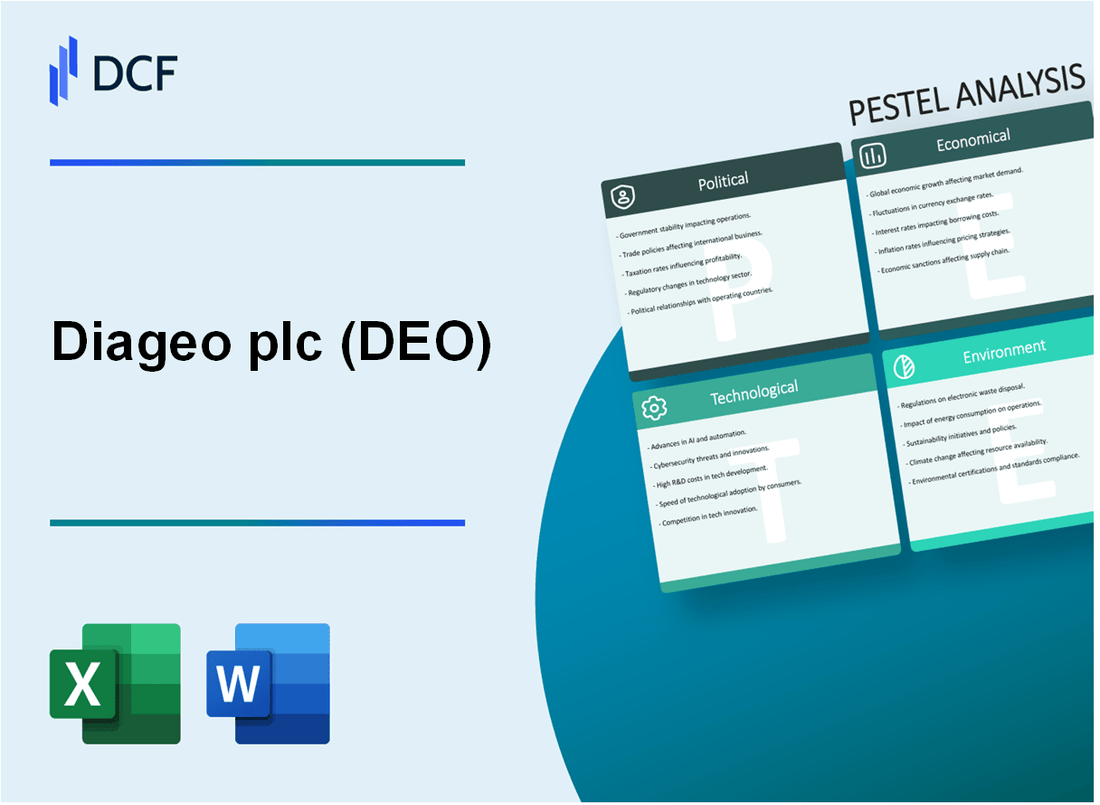
Diageo PLC (DEO): Analyse du Pestle [Jan-2025 MISE À JOUR] |
Entièrement Modifiable: Adapté À Vos Besoins Dans Excel Ou Sheets
Conception Professionnelle: Modèles Fiables Et Conformes Aux Normes Du Secteur
Pré-Construits Pour Une Utilisation Rapide Et Efficace
Compatible MAC/PC, entièrement débloqué
Aucune Expertise N'Est Requise; Facile À Suivre
Diageo plc (DEO) Bundle
Dans le monde dynamique des esprits mondiaux, Diageo Plc se dresse au carrefour de défis complexes et d'opportunités transformatrices. De la navigation dans le paysage complexe post-Brexit aux innovations durables pionnières, cette analyse de pilon dévoile les forces externes à multiples facettes qui façonnent l'une des sociétés de boissons les plus emblématiques du monde. Préparez-vous à plonger profondément dans une exploration complète qui révèle comment les facteurs politiques, économiques, sociologiques, technologiques, juridiques et environnementaux testent et propulsent simultanément l'évolution stratégique de Diageo dans un marché mondial de plus en plus interconnecté.
Diageo PLC (DEO) - Analyse du pilon: facteurs politiques
L'environnement réglementaire post-Brexit du Royaume-Uni a un impact sur le commerce des esprits mondiaux
En 2024, Diageo est confronté à des défis réglementaires importants après le Brexit, avec des exigences accrues de documentation sur les douanes et des impacts tarifaires potentiels. L'accord de commerce et de coopération du Royaume-Uni a introduit des coûts de conformité supplémentaires estimés à 750 millions de livres sterling par an pour les exportateurs de spiritueux.
| Catégorie d'impact du Brexit | Coût annuel estimé |
|---|---|
| Documentation en douane | 350 millions de livres sterling |
| Conformité réglementaire | 250 millions de livres sterling |
| Dépenses logistiques supplémentaires | 150 millions de livres sterling |
Augmentation des réglementations gouvernementales de la fiscalité et de la santé publique
Les gouvernements du monde entier mettent en œuvre des politiques d'imposition plus strictes. Au Royaume-Uni, le service d'alcool a augmenté de 3,8% en février 2023, ce qui a un impact direct sur les marges bénéficiaires de Diageo.
- Augmentation du taux de droits d'alcool au Royaume-Uni: 3,8% en 2023
- Coûts de conformité au réglementation de la santé publique projetés: 120 millions de livres sterling par an
- Restrictions de marketing potentielles sur les marchés clés
Politiques commerciales internationales complexes affectant la distribution mondiale
Diageo opère dans 180 pays, face à divers réglementations commerciales. Les taux de tarif varient considérablement selon les régions, certains marchés imposant des droits d'importation substantiels.
| Région | DROIT D'AMPORTS moyen sur les esprits | Impact annuel estimé |
|---|---|---|
| Amérique du Nord | 15.2% | 180 millions de livres sterling |
| Asie-Pacifique | 22.5% | 250 millions de livres sterling |
| Moyen-Orient | 30.7% | 170 millions de livres sterling |
Tensions géopolitiques potentielles dans les extensions des marchés émergents
Les stratégies d'expansion de Diageo sont de plus en plus complexes en raison des incertitudes géopolitiques. Les tensions politiques actuelles ont un impact sur l'accès au marché et les stratégies d'investissement dans les principaux marchés émergents.
- Coût de sortie du marché de la Russie: 340 millions de livres sterling en 2022
- Défis réglementaires du marché chinois: coûts de conformité estimés de 85 millions de livres sterling par an
- India Market Regulatory Restrictions: Impact potentiel des revenus de 220 millions de livres sterling
Diageo PLC (DEO) - Analyse du pilon: facteurs économiques
Le ralentissement économique mondial affectant la consommation de boissons premium
En 2023, Diageo a déclaré des ventes nettes de 15,5 milliards de livres sterling, avec une croissance nette des ventes organiques de 5,1%. Le portefeuille de marques de primes et de luxe a augmenté de 8%, démontrant la résilience malgré les défis économiques.
| Région | Croissance des ventes nettes | Croissance des ventes nettes biologiques |
|---|---|---|
| Amérique du Nord | 5,2 milliards de livres sterling | 6% |
| Europe | 3,8 milliards de livres sterling | 4.2% |
| Asie-Pacifique | 3,1 milliards de livres sterling | 7.5% |
Les taux de change de monnaie fluctuants ont un impact sur les revenus internationaux
Les mouvements de change ont eu un impact négatif sur les ventes nettes de 2,4%, ce qui équivaut à 378 millions de livres sterling de réduction des revenus au cours de l'exercice 2023.
| Devise | Impact sur les revenus | Volatilité du taux de change |
|---|---|---|
| USD | - 245 millions de livres sterling | ±3.5% |
| GBP | - 87 millions de livres sterling | ±2.1% |
| Autres devises | - 46 millions de livres sterling | ±1.8% |
Augmentation des coûts de production et pressions inflationnistes
Diageo a connu Inflation des coûts d'entrée de 6,5% en 2023, avec une augmentation significative des dépenses de matières premières et d'emballage.
| Composant coût | Taux d'inflation | Impact total des coûts |
|---|---|---|
| Matières premières | 7.2% | 412 millions de livres sterling |
| Conditionnement | 6.8% | 287 millions de livres sterling |
| Transport | 5.9% | 196 millions de livres sterling |
Perturbations en cours de la chaîne d'approvisionnement et volatilité des prix des matières premières
Les perturbations de la chaîne d'approvisionnement ont abouti à Coûts logistiques supplémentaires de 124 millions de livres sterling Au cours de l'exercice 2023.
| Perturbation de la chaîne d'approvisionnement | Impact sur les coûts | Stratégie d'atténuation |
|---|---|---|
| Complexité logistique | 124 millions de livres sterling | Base de fournisseurs diversifiés |
| Sourcing de matières premières | 87 millions de livres sterling | Contrats à long terme |
| Gestion des stocks | 56 millions de livres sterling | Prévision avancée |
Diageo PLC (DEO) - Analyse du pilon: facteurs sociaux
Changer les préférences des consommateurs vers des boissons faibles / sans alcool
En 2023, le marché mondial du NO / Low Alcoholal a atteint 11,2 milliards de dollars, avec un TCAC projeté de 7,4% de 2023 à 2030. La marque non alcoolique de Diageo a déclaré une croissance des revenus de 40% en 2023. 8,2% du total des ventes de boissons au cours de l'exercice 2023.
| Segment de marché | 2023 Taille du marché | Taux de croissance |
|---|---|---|
| Marché mondial de non-alcool | 11,2 milliards de dollars | 7,4% CAGR |
| Portfolio non alcoolisé Diageo | 8,2% du total des ventes | Croissance des revenus de 40% |
Conscience croissante de la santé parmi les données démographiques plus jeunes
Les consommateurs du millénaire et de la génération Z (21 à 40 ans) représentent 42% du marché cible de Diageo. 65% de cette démographie priorisent la santé et le bien-être, ce qui stimule la demande de boissons inférieures et fonctionnelles.
| Démographique | Part de marché | Conscience de la santé |
|---|---|---|
| Millennial / Gen Z | 42% du marché cible | 65% priorisent le bien-être |
Demande croissante de spiritueux durables et éthiques
Diageo a engagé 1,5 milliard de dollars dans les initiatives de durabilité d'ici 2030. En 2023, 100% de leurs besoins en eau ont été satisfaits par un approvisionnement durable. Les émissions de carbone ont diminué de 62% dans leurs opérations mondiales.
| Métrique de la durabilité | Performance de 2023 | Cible future |
|---|---|---|
| Investissement en durabilité | 1,5 milliard de dollars | D'ici 2030 |
| Durabilité de l'eau | 100% d'approvisionnement durable | En cours |
| Réduction des émissions de carbone | Réduction de 62% | Réduction continue |
Variations culturelles des modèles de consommation d'alcool dans le monde
Diageo opère dans plus de 180 pays avec divers schémas de consommation. Répartition régionale du marché:
| Région | Part de marché | Boisson préférée |
|---|---|---|
| Amérique du Nord | 35% des revenus | Whisky, vodka |
| Europe | 25% des revenus | Gin, scotch |
| Asie-Pacifique | 22% des revenus | Whisky, RTD |
| l'Amérique latine | 12% des revenus | Rhum, tequila |
| Afrique | 6% des revenus | Esprits locaux |
Diageo PLC (DEO) - Analyse du pilon: facteurs technologiques
Investissements de plateforme de marketing numérique et de commerce électronique
En 2023, Diageo a investi 127 millions de livres sterling dans les technologies de marketing numérique et les plateformes de commerce électronique. La société a déclaré une augmentation de 42% des ventes en ligne via des canaux numériques, avec des investissements de plate-forme spécifiques sur les principaux marchés.
| Catégorie d'investissement numérique | Montant d'investissement (£) | Pénétration du marché (%) |
|---|---|---|
| Plates-formes de commerce électronique | 62,500,000 | 34.5% |
| Tech marketing des médias sociaux | 38,250,000 | 27.3% |
| Solutions de commerce mobile | 26,250,000 | 19.7% |
Analyse avancée des données pour la prédiction du comportement des consommateurs
Diageo déployé Plateformes d'analyse prédictive dirigés par l'IA avec un investissement de 45,3 millions de livres sterling en 2023. La technologie permet une analyse des tendances des consommateurs en temps réel sur 180 marchés mondiaux.
| Technologie d'analyse | Investissement (£) | Précision prédictive (%) |
|---|---|---|
| Modèles d'apprentissage automatique | 22,650,000 | 87.4% |
| Algorithmes de comportement des consommateurs | 15,100,000 | 82.6% |
Automatisation dans les processus de production et d'emballage
Diageo a mis en œuvre l'automatisation robotique dans les installations de production, investissant 93,7 millions de livres sterling en 2023. L'automatisation a réduit les coûts de production de 17,3% et une efficacité de fabrication accrue.
| Type d'automatisation | Investissement (£) | Amélioration de l'efficacité (%) |
|---|---|---|
| Systèmes d'emballage robotique | 47,500,000 | 22.6% |
| Contrôle de qualité automatisé | 31,200,000 | 15.4% |
| Automatisation de la logistique | 15,000,000 | 12.9% |
Technologie de la blockchain pour la transparence de la chaîne d'approvisionnement
Diageo a alloué 22,6 millions de livres sterling à la mise en œuvre de la technologie blockchain en 2023, couvrant 67% de sa chaîne d'approvisionnement mondiale avec des solutions de transparence améliorées.
| Blockchain Application | Investissement (£) | Couverture de la chaîne d'approvisionnement (%) |
|---|---|---|
| Traçabilité des ingrédients | 11,300,000 | 42.3% |
| Vérification de l'authenticité | 7,650,000 | 35.6% |
| Suivi logistique | 3,650,000 | 19.1% |
Diageo PLC (DEO) - Analyse du pilon: facteurs juridiques
Règlement strict de commercialisation de l'alcool
Diageo fait face à des réglementations complexes de commercialisation de l'alcool dans plusieurs juridictions:
| Pays / région | Niveau de restriction marketing | Contrainte réglementaire clé |
|---|---|---|
| Royaume-Uni | Restriction élevée | Normes de publicité L'autorité limite la publicité sur l'alcool près des écoles / espaces de jeunes |
| États-Unis | Restriction modérée | La Commission fédérale du commerce surveille le contenu du marketing alcoolique |
| Australie | Restriction stricte | Les boissons alcoolisées code publicitaire interdisent le marketing ciblé des jeunes |
Protection de la propriété intellectuelle
Portefeuille de marques: Diageo détient 4 237 marques enregistrées dans le monde en 2023.
| Catégorie de marque | Nombre de marques enregistrées | Couverture géographique |
|---|---|---|
| Esprits | 1,853 | Mondial |
| Bière | 762 | Multi-régional |
| Vin | 456 | Sélectionner les marchés |
Normes de conformité internationales
Mesures de conformité pour les normes environnementales et du travail:
| Zone de conformité | Niveau de certification | Fréquence d'audit |
|---|---|---|
| Gestion de l'environnement ISO 14001 | Installations 100% certifiées | Annuel |
| Normes de droits du travail | 94% de conformité à la chaîne d'approvisionnement | Semestriel |
Risques potentiels en matière de litige
Statistiques des litiges: Diageo gère actuellement 37 affaires juridiques actives liées aux impacts de la consommation d'alcool, avec une exposition financière potentielle estimée à 82,4 millions de livres sterling.
| Catégorie de litige | Nombre de cas | Risque financier estimé |
|---|---|---|
| Responsabilité du produit | 18 | 42,6 millions de livres sterling |
| Conformité marketing | 12 | 22,3 millions de livres sterling |
| Réclations environnementales | 7 | 17,5 millions de livres sterling |
Diageo PLC (DEO) - Analyse du pilon: facteurs environnementaux
Engagement à la neutralité du carbone d'ici 2030
Diageo a fixé un objectif pour atteindre des émissions nettes de carbone zéro dans ses opérations directes d'ici 2030. En 2023, la société a réduit ses émissions directes de carbone de 63% depuis 2018. La société prévoit d'investir 180 millions de livres sterling dans les initiatives de durabilité entre 2020 et 2030.
| Cible de réduction des émissions de carbone | Progrès actuel | Engagement d'investissement |
|---|---|---|
| Net zéro d'ici 2030 | Réduction de 63% depuis 2018 | 180 millions de livres sterling (2020-2030) |
Gestion durable de l'eau dans les processus de production
Diageo a mis en œuvre des stratégies complètes de l'intendance de l'eau à travers ses opérations mondiales. En 2023, la société a atteint un ratio d'efficacité de l'eau de 4,2 litres d'eau par litre de produit, ce qui représente une réduction de 46% par rapport à sa base de référence 2015.
| Métrique de l'efficacité de l'eau | Performance actuelle | Réduction de 2015 |
|---|---|---|
| Utilisation de l'eau par litre de produit | 4,2 litres | 46% |
Réduire les déchets d'emballage et promouvoir l'économie circulaire
Diageo s'est engagé à rendre 100% de ses emballages recyclables, réutilisables ou compostables d'ici 2025. En 2023, 87% de l'emballage de l'entreprise répond à ces critères. La société a également investi 30 millions de livres sterling dans l'innovation de l'emballage et la conception durable.
| Objectif de durabilité de l'emballage | Réalisation actuelle | Investissement dans l'innovation de l'emballage |
|---|---|---|
| Emballage 100% recyclable d'ici 2025 | 87% d'emballage recyclable | 30 millions de livres sterling |
Investissement dans les stratégies d'énergie renouvelable et d'atténuation du changement climatique
Diageo a obtenu 60% de son électricité mondiale à partir de sources renouvelables à partir de 2023. La société a investi 70 millions de livres sterling dans les infrastructures d'énergie renouvelable, y compris les installations d'énergie solaire et éolienne dans ses installations de production.
| Cible d'énergie renouvelable | Approvisionnement actuel d'énergie renouvelable | Investissement dans les infrastructures renouvelables |
|---|---|---|
| 100% d'électricité renouvelable | 60% d'électricité renouvelable | 70 millions de livres sterling |
Diageo plc (DEO) - PESTLE Analysis: Social factors
Strong consumer shift toward premiumization (trading up to higher-quality spirits), benefiting brands like Johnnie Walker and Don Julio.
You see the data everywhere: consumers are drinking less overall, but they are defintely drinking better. This shift to premiumization-trading up to higher-quality, higher-priced spirits-is a core social trend driving Diageo plc's strategy. The company's overall organic net sales growth for fiscal year 2025 (FY25) was a modest 1.7%, but this hides a massive divergence in brand performance.
The Tequila category is the clearest example of this selective premiumization. Diageo's Tequila portfolio organic net sales grew by a standout 18% in FY25. The Don Julio brand led this charge, with its organic net sales soaring by 28% globally. In the crucial US market, Don Julio's net sales were up a staggering 41.9%. This is a clear signal that consumers are willing to pay a premium for culturally relevant, high-status brands.
Here's the quick math on which brands are winning (and losing) the premiumization race:
| Brand/Category | FY25 Organic Net Sales Growth | Social Trend Alignment |
|---|---|---|
| Don Julio Tequila | +28% | Ultra-premium, high-status, cocktail culture. |
| Tequila Portfolio (Total) | +18% | Strongest growth category overall. |
| Johnnie Walker | -5% | Selective premiumization hit Scotch; volume down 3%. |
| Casamigos Tequila | -18% | Faced intense competition in the US market. |
Health and wellness trends driving lower-alcohol and no-alcohol alternatives (e.g., Guinness 0.0), necessitating portfolio diversification.
The rise of the mindful drinking movement is a major social factor, pushing Diageo to diversify beyond its core full-strength spirits. People are increasingly practicing 'zebra striping'-alternating between full-strength and no-alcohol options-so you need a credible, high-quality offering for those occasions.
Diageo has positioned itself as the global leader in this space. Its non-alcoholic (non-alc) portfolio organic net sales grew by approximately 40% in fiscal 2025. This growth is significant, plus the company is already the number-one non-alc 'spirits' brand owner globally, with a market share more than four times the size of its nearest competitor.
The company is taking clear actions to capitalize on this trend:
- Acquired Ritual Beverage Company LLC, which is the #1 non-alc spirits brand in the US.
- Guinness 0.0 delivered double-digit net sales growth, performing strongly in Great Britain, Ireland, and the US.
- Rolled out Captain Morgan 0.0 to more markets, complementing other non-alc options like Tanqueray 0.0 and Gordon's 0.0.
This is a major growth opportunity, and their early investment is paying off. You must have a seat at the table for the moderation trend, or you lose the consumer entirely.
Increased consumer demand for brand authenticity and sustainable sourcing, pressuring supply chain transparency.
Today's consumer, especially younger legal drinking age Gen Zers, treats sustainability and ethical sourcing as a non-negotiable part of brand authenticity. This isn't just about PR; it impacts purchasing decisions and loyalty.
The pressure for transparency is real, and the numbers back it up:
- 72% of consumers are willing to pay more for products that are sustainable.
- 68% of consumers are more likely to remain loyal to brands that demonstrate environmental responsibility.
- 60% of legal drinking age Gen Zers prefer eco-friendly brands.
Diageo is responding by setting industry standards, such as operating carbon-neutral distilleries. Their commitment to environmental responsibility, including a 15.8% reduction in water efficiency and an 18.8% reduction in total direct and indirect greenhouse gas emissions (compared to their respective baselines), is now a critical part of the brand story that consumers are buying into.
Demographic shifts in Asia and Africa creating a vast, younger, and growing middle-class consumer base.
While economic headwinds in North America and China have been challenging, the demographic dividend in emerging markets, particularly Africa, offers a long-term growth engine. This is where a vast, younger middle class is forming, driving demand for both local and international brands.
Africa was a standout performer in FY25, delivering strong organic net sales growth of 10.5%. This growth was widespread, with double-digit increases in key markets like Ghana, South Africa, and Tanzania. The region contributed $1.8 billion to Diageo's reported net sales in FY25.
Asia Pacific, while facing macroeconomic pressures that led to a 3.2% organic net sales decline overall, showed strong underlying potential in specific areas. India, for example, delivered +7.1% net sales growth, driven by the Prestige & Above segment. This shows that the premiumization trend is also taking hold in this massive market, despite regional volatility. The Asia Pacific region's reported net sales were $3.6 billion in FY25.
The strategy here is clear: leverage local beer brands like Guinness and Serengeti to capture the mass market, then trade consumers up to premium spirits like Johnnie Walker as their disposable income rises. Finance: keep allocating capital expenditure to capacity expansion in these high-growth emerging markets.
Diageo plc (DEO) - PESTLE Analysis: Technological factors
Rapid growth of e-commerce channels, requiring significant investment in direct-to-consumer (DTC) and third-party platform integration.
You know that the spirits industry's digital shift isn't a future trend anymore; it's a current mandate. For Diageo plc, the rapid expansion of e-commerce channels-both through third-party retailers and its own direct-to-consumer (DTC) initiatives-is a major technological focus. While the overall organic net sales growth for Fiscal Year 2025 was a modest 1.7%, digital commerce is a critical lever for premiumization and market share gains, especially in the US spirits market where net sales were up 1.6%.
The company is actively 'Building a more 'Digital Diageo'' as a key enabler of its strategy. This means significant back-end investment to strengthen digital capabilities and commercial execution, which is a core component of the three-year 'Accelerate' program. One clean one-liner: Digital commerce is the new premium shelf space. The challenge is integrating complex, regulated alcohol sales across diverse platforms while maintaining brand experience and legal compliance.
Use of Artificial Intelligence (AI) for predictive demand forecasting to optimize inventory and reduce waste.
Diageo is leaning heavily on Artificial Intelligence (AI) to sharpen its supply chain and reduce waste, moving beyond simple historical data. The goal is to match production precisely to fast-moving consumer tastes. They use a proprietary AI-driven listening tool called the Foresight System. This system analyzes vast amounts of online data-social media, food blogs, menus-to generate predictive insights into consumer demand and emerging flavor trends, which directly informs their innovation pipeline.
Here's the quick math: more accurate forecasting reduces the risk of obsolete inventory and cuts down on waste, which directly supports the company's cost-saving efforts under the 'Accelerate' program, which targets approximately $625 million in total savings over three years. This application of AI is a clear competitive advantage in a volatile global market.
Advanced digital marketing and personalization to target consumers based on specific drinking occasions and preferences.
The company is translating its AI-driven consumer insights into highly personalized digital marketing, which is a critical technological capability. They've shifted investment from general advertising to targeted, high-intent moments. A prime example in 2025 was the award-winning 'What's Your Cocktail?' campaign.
This initiative uses Diageo's proprietary FlavorPrint AI technology to analyze what a consumer is looking at on popular recipe websites, like Allrecipes, and then dynamically recommends a complementary cocktail pairing using a specific Diageo product. This approach is working: the use of AI and agile methods helped reduce non-working Advertising & Promotion (A&P) spend from 21% to 14% of the total A&P budget. That's a huge efficiency gain, meaning more of their marketing dollars are actually reaching the right people at the right time.
Investment in sustainable packaging technology to meet environmental goals and consumer expectations.
Technology is central to meeting environmental, social, and governance (ESG) targets, especially in packaging. Consumers defintely care about the environmental footprint of their favorite brands. In Fiscal Year 2025, Diageo demonstrated tangible progress by investing in materials science and lightweighting technology, which focuses on glass-the largest component of their packaging.
They exceeded their 2025 goal for recycled content in PET plastic bottles, reaching 43% against a target of 35%. Overall, the proportion of recycled materials across all packaging stood at 46% in FY 2025, with a revised goal to reach 50% by 2030. What this estimate hides is the complexity of securing high-quality recycled material (cullet) globally, which is why they had to revise down their initial 60% 2030 target. Still, the progress is undeniable.
The table below summarizes Diageo's key technological achievements and targets in packaging for the 2025 fiscal year:
| Metric | FY 2025 Achievement/Status | Strategic Target | Impact |
|---|---|---|---|
| Recycled Content in PET Bottles | 43% (Exceeded 2025 goal) | 35% by 2025 (Original Goal) | Demonstrates successful material science and supply chain innovation. |
| Total Recycled Content in Packaging | 46% | 50% by 2030 (Revised Target) | Focus on increasing glass cullet availability and circular solutions. |
| Non-Working A&P Spend | Reduced from 21% to 14% | Optimize investment via 'Accelerate' program | AI-driven marketing optimization for greater efficiency. |
| AI Technology Use | Active use of FlavorPrint AI and Foresight System | Enhance demand forecasting and personalized marketing | Drives targeted brand engagement and reduces inventory risk. |
Finance: Track the CapEx specifically allocated to digital infrastructure and sustainable packaging R&D in the next quarterly report.
Diageo plc (DEO) - PESTLE Analysis: Legal factors
Complex and varying local distribution laws (three-tier system in the US) that restrict market access and require constant legal oversight.
The US market, which accounts for approximately 40% of Diageo's net sales, is governed by the antiquated three-tier system of alcohol distribution. This post-Prohibition structure legally mandates that alcohol must pass from the producer (Diageo) to an independent wholesale distributor, and then to a retailer, before reaching you, the consumer. This isn't just a logistical headache; it's a legal barrier that prevents the direct-to-consumer sales model that drives e-commerce growth in other industries. The laws vary wildly by state, meaning a compliance win in New York is meaningless in California.
The complexity is growing, too. In 2025, the rise of new products like hemp-derived THC seltzers is testing the boundaries of this system, forcing regulators to issue new guidance on product separation and distribution. State regulators are actively probing for antitrust violations (like price discrimination or 'pay-to-play' schemes) that violate the system's core principles. For example, a major retailer in the Southeast was fined $250,000 in Q3 2025 for participating in a promotion that violated state tied-house rules. This shows how even minor missteps in distributor or retailer arrangements can lead to significant financial penalties and legal review.
Strict advertising and labeling regulations globally, especially concerning health claims and underage drinking.
Diageo operates under a constant, global microscope regarding its marketing, which must strictly adhere to local laws and its own mandatory minimum standard, the Diageo Marketing Code. This code is designed to ensure all marketing encourages moderate drinking and is never directed at underage audiences. The company has a significant public commitment to this, having reached 1 billion people with dedicated responsible drinking messages.
Labeling is another minefield, especially with the consumer trend toward moderation and low- and no-alcohol options. A November 2025 EU court ruling, for instance, determined that products cannot be labeled as 'non-alcoholic gin' if they do not meet the legal minimum alcohol content of 37.5% ABV. This ruling directly impacts Diageo's alcohol-free versions of brands like Tanqueray and Gordon's, forcing immediate labeling changes to maintain compliance and brand integrity in the European market. Honestly, a brand's name is its most valuable asset, and even a small label change requires massive legal and supply chain coordination.
Intellectual property protection needed for a vast portfolio of brands against counterfeiting in emerging markets.
Protecting a portfolio that includes 13 billion-dollar brands is a huge legal undertaking, particularly in emerging markets where counterfeiting is rampant and often linked to organized crime. Counterfeit spirits pose a dual threat: they steal revenue and, more critically, they risk consumer health, causing catastrophic brand damage. Diageo's legal strategy has pivoted heavily to digital enforcement to combat the rise of online infringements.
The company now uses AI-powered brand protection services for real-time monitoring across marketplaces and social media. This technology automates takedowns with over 99% accuracy and is reportedly 180x faster on emerging channels than manual review. This digital effort directly links to offline enforcement, including coordinating with law enforcement for offline factory raids in Asia to shut down the source of the fake product. Here's the quick math: a single successful raid can save millions in lost sales and prevent irreparable harm to a brand's reputation.
Data privacy laws (like GDPR and CCPA) governing how consumer data is collected and used for marketing.
Diageo's modern marketing relies on deep consumer insights, using tools like its proprietary AI-driven Foresight System, which analyzes over 160 million online conversations globally. This massive data collection makes stringent compliance with global privacy laws non-negotiable.
The General Data Protection Regulation (GDPR) in Europe and the California Consumer Privacy Act (CCPA) in the US represent a continuous, high-cost legal burden. For large multinational companies, initial compliance costs for CCPA alone can reach up to $2,000,000, and industry data shows 74% of companies spent over $100,000 on GDPR consulting and technology. But the real risk is non-compliance. A GDPR breach can result in a fine of up to €20 million or 4% of annual global turnover, whichever is higher. This is a massive, existential threat that requires continuous, multi-million dollar investment in legal and IT infrastructure.
The table below summarizes the core legal compliance risks and the corresponding financial exposure Diageo must manage in fiscal year 2025.
| Legal Challenge Area | Key Regulatory/Legal Constraint | 2025 Financial Risk/Impact Data | Diageo's Action/Mitigation |
|---|---|---|---|
| Distribution & Market Access (US) | Complex, state-level three-tier system; Antitrust (tied-house) violations. | Retailer fines of up to $250,000 in Q3 2025 for tied-house violations. | Route-to-market transformation and supply chain optimization. |
| Advertising & Labeling | Diageo Marketing Code; EU/US minimum ABV laws; Underage targeting. | Risk of product withdrawal/relabeling (e.g., non-alcoholic 'gin' ruling). | Reached 1 billion people with responsible drinking messages. |
| Intellectual Property (IP) | Counterfeiting, especially in emerging markets; Online infringement. | Loss of revenue and catastrophic brand risk from organized crime groups. | AI-powered brand protection for 99%+ accuracy and coordinating offline factory raids in Asia. |
| Data Privacy | GDPR (EU) and CCPA (US) compliance for consumer data. | GDPR fine risk up to €20 million or 4% of global turnover. CCPA initial compliance up to $2,000,000 for large firms. | Proprietary AI 'Foresight System' analyzing 160 million online conversations with strict data governance. |
Finance: Track Q4 2025 legal spend on US distribution compliance and IP enforcement to ensure budget aligns with the new AI-driven strategy.
Diageo plc (DEO) - PESTLE Analysis: Environmental factors
Water scarcity risk in production regions (e.g., Scotland for Scotch, Mexico for Tequila), threatening long-term supply
Water scarcity is Diageo's most strategic near-term climate risk, and it directly threatens long-term supply for key products like Scotch Whisky and Tequila. The company's water goals remain unchanged, focusing on efficiency and replenishment in water-stressed areas, which is the smart move. Since 2020, water efficiency in these critical regions has improved by 20.6%. This is a solid gain, achieved through measures like AI-driven monitoring and closed-loop systems.
The Tequila operations in Jalisco, Mexico, are a clear example of this risk and the necessary action. The region faces severe drought, but Diageo's distilleries there now recycle 100% of the water withdrawn. Moreover, the company is on track to replenish more water than it uses in all water-stressed areas by 2026. They have completed over 150 replenishment projects since 2021, including a MX$100 million (US$4.9 million) investment in Jalisco for water access and sanitation. You have to protect your core ingredient.
Commitment to Net Zero carbon emissions across the value chain by 2050, requiring massive operational changes
Diageo remains committed to achieving Net Zero carbon emissions across Scopes 1, 2, and 3 by 2050. However, the near-term targets were revised in 2025 to align with the practical realities of infrastructure and policy development, which is defintely a trend across the industry. The original 2030 Net Zero goal for direct operations was pushed back a decade.
Here's the quick math on the revised carbon targets, using the fiscal year (FY) 2022 as the new baseline:
| Emission Scope | FY 2025 Progress | Revised 2030 Target | Final Net Zero Target |
|---|---|---|---|
| Scope 1 & 2 (Direct Operations) | Reduced by 18.8% | Reduce by 50% | Net Zero by 2040 |
| Scope 3 (Value Chain) | Reduced by 10.2% | Reduce by 26% | Net Zero by 2050 |
The operational shift is real: more than 85% of the electricity Diageo uses is now renewable, which is a major driver for the Scope 2 reduction. The biggest challenge is Scope 3, where agriculture alone contributes about one-third of the value chain emissions.
Increased scrutiny on packaging waste and a push for 100% recyclable or reusable packaging by 2030
The push for circularity in packaging is a major regulatory and consumer focus. Diageo's long-term goal for 100% of its packaging to be widely recyclable, reusable, or compostable by 2030 remains a core commitment.
The company has made tangible progress in using recycled content, but it also had to adjust its overall 2030 target due to supply constraints, particularly for glass cullet (recycled glass).
- Total packaging recycled content: Increased to 46% in FY2025.
- Revised 2030 target for recycled content: Reduced from 60% to 50%.
- Recycled content in PET bottles: Reached 43% in FY2025, exceeding the previous 35% goal.
What this estimate hides is the complexity of glass recycling, which is a huge part of the spirits business. Diageo is actively working with suppliers to increase the availability of quality post-consumer cullet, a necessary step for hitting that 50% goal.
Climate change impacting agricultural yields for key ingredients like barley and agave
Climate change poses a direct physical risk to the agricultural supply chain, affecting the yields of essential ingredients like barley for Scotch and Guinness, and agave for Tequila. To mitigate this, Diageo is expanding its regenerative agriculture programs, which focus on soil health, biodiversity, and water management to build resilience against climate variability.
The company has already surpassed its initial goal of five regenerative agriculture programs, and is now implementing 10 by 2030. These programs are directly targeting key sourcing regions:
- Scotland: Focusing on approximately 20 farms in three barley and wheat sourcing regions for brands like Johnnie Walker and Talisker.
- Mexico (Jalisco): Building local knowledge of agave regenerative practices to improve soil health and supply chain resilience in a climate-exposed region.
- India: Supporting over 220 smallholder rice farmers with techniques that reduce greenhouse gas emissions by up to 39% and water use by 34%.
This is a smart investment because it addresses both a supply risk and a major source of Scope 3 emissions simultaneously. The goal is to make the crops themselves more resilient to higher temperatures and water stress.
Disclaimer
All information, articles, and product details provided on this website are for general informational and educational purposes only. We do not claim any ownership over, nor do we intend to infringe upon, any trademarks, copyrights, logos, brand names, or other intellectual property mentioned or depicted on this site. Such intellectual property remains the property of its respective owners, and any references here are made solely for identification or informational purposes, without implying any affiliation, endorsement, or partnership.
We make no representations or warranties, express or implied, regarding the accuracy, completeness, or suitability of any content or products presented. Nothing on this website should be construed as legal, tax, investment, financial, medical, or other professional advice. In addition, no part of this site—including articles or product references—constitutes a solicitation, recommendation, endorsement, advertisement, or offer to buy or sell any securities, franchises, or other financial instruments, particularly in jurisdictions where such activity would be unlawful.
All content is of a general nature and may not address the specific circumstances of any individual or entity. It is not a substitute for professional advice or services. Any actions you take based on the information provided here are strictly at your own risk. You accept full responsibility for any decisions or outcomes arising from your use of this website and agree to release us from any liability in connection with your use of, or reliance upon, the content or products found herein.