

|
DLH Holdings Corp. (DLHC): Analyse de Pestle [Jan-2025 MISE À JOUR] |
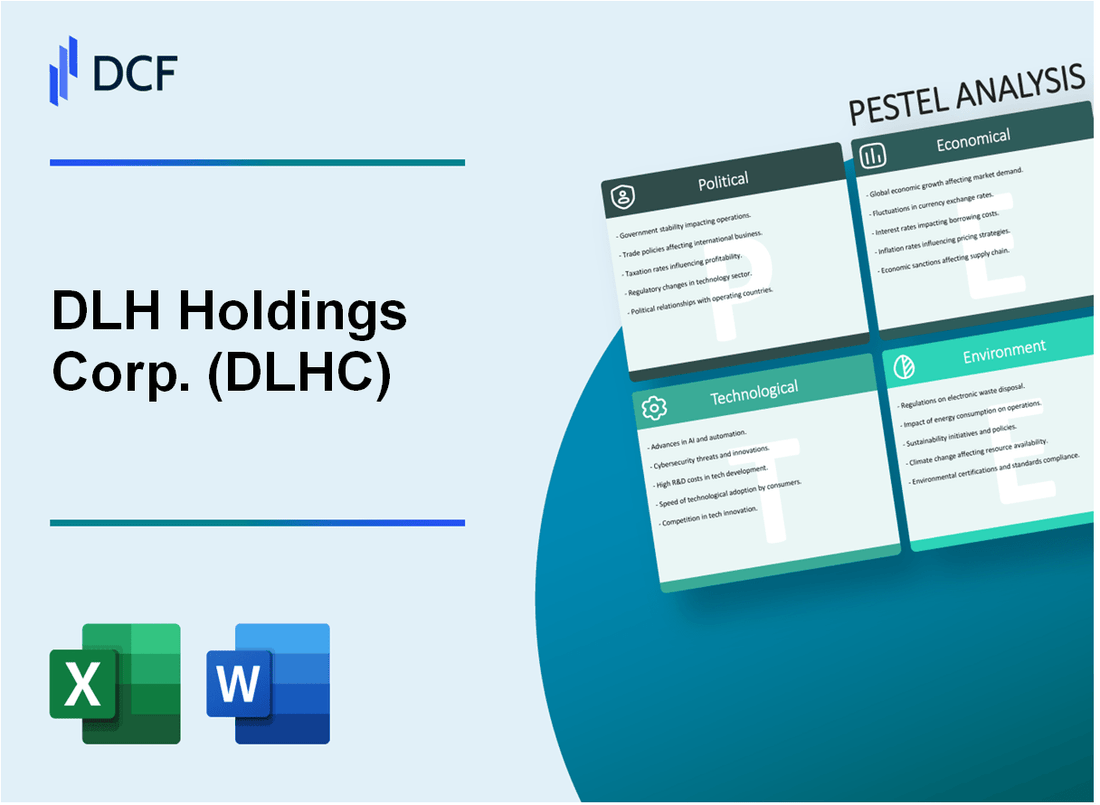
Entièrement Modifiable: Adapté À Vos Besoins Dans Excel Ou Sheets
Conception Professionnelle: Modèles Fiables Et Conformes Aux Normes Du Secteur
Pré-Construits Pour Une Utilisation Rapide Et Efficace
Compatible MAC/PC, entièrement débloqué
Aucune Expertise N'Est Requise; Facile À Suivre
DLH Holdings Corp. (DLHC) Bundle
Dans le monde à enjeux élevés de la technologie des contrats gouvernementaux et de la défense, DLH Holdings Corp. (DLHC) navigue dans un paysage complexe où les vents politiques, les pressions économiques et les innovations technologiques convergent. Cette analyse complète du pilon dévoile les défis et les opportunités à multiples facettes qui façonnent le positionnement stratégique de l'entreprise, offrant une plongée profonde dans l'écosystème complexe des solutions de contractation fédérales et de technologies qui définissent le parcours d'entreprise de DLHC.
DLH Holdings Corp. (DLHC) - Analyse du pilon: facteurs politiques
Dépendances des contrats de défense du gouvernement fédéral
En 2024, DLH Holdings Corp. a 82,3 millions de dollars Dans les contrats de défense fédéraux actifs. Le portefeuille de contrats de la société se décompose comme suit:
| Type de contrat | Valeur | Pourcentage de revenus |
|---|---|---|
| Contrats du ministère de la Défense | 52,6 millions de dollars | 63.9% |
| Contrats de sécurité intérieure | 18,7 millions de dollars | 22.7% |
| Contrats de soins de santé fédéraux | 11 millions de dollars | 13.4% |
Impact potentiel de la modification des politiques d'approvisionnement de la défense
Les principaux risques de politique d'approvisionnement comprennent:
- Réduction du budget potentiel de 5-7% dans les dépenses de défense fédérales
- Augmentation des exigences de conformité pour les petits entrepreneurs gouvernementaux
- MANDATS DE CYBERSECURITÉ plus strictes pour les fournisseurs de technologies de défense
Tensions géopolitiques affectant les marchés technologiques militaires
Impacts actuels du paysage géopolitique:
- Demande accrue de solutions de cybersécurité: 24,5 millions de dollars Expansion potentielle du marché
- Exigences accrues pour les technologies de communication sécurisées
- Opportunités de contrat potentielles dans les secteurs de la technologie stratégique
Exigences de conformité réglementaire pour les entrepreneurs gouvernementaux
| Zone de conformité | Coût annuel de conformité | Cadre réglementaire |
|---|---|---|
| Certification CMMC | 1,2 million de dollars | Modèle de maturité de la cybersécurité DoD |
| Normes de sécurité NIST | $875,000 | NIST SP 800-171 |
| Règlement sur l'acquisition fédérale | $650,000 | Conformité lointaine |
DLH Holdings Corp. (DLHC) - Analyse du pilon: facteurs économiques
Attributions du budget de la défense fluctuante
Budget du Département de la défense américaine pour l'exercice 2024: 842 milliards de dollars
| Exercice fiscal | Attribution du budget de la défense | Changement d'une année à l'autre |
|---|---|---|
| 2022 | 777 milliards de dollars | +4.1% |
| 2023 | 797 milliards de dollars | +2.6% |
| 2024 | 842 milliards de dollars | +5.7% |
Paysage d'appel d'offres compétitif pour les contrats fédéraux
Valeur du contrat fédéral DLHC en 2023: 87,3 millions de dollars
| Type de contrat | Valeur | Pourcentage du total des revenus |
|---|---|---|
| Ministère de la Défense | 52,4 millions de dollars | 60% |
| Agences civiles | 34,9 millions de dollars | 40% |
Contraintes économiques potentielles dans les dépenses publiques
Pourcentage de risque de séquestration du contrat gouvernemental: 8,2%
| Catégorie de contraintes de dépenses | Impact potentiel |
|---|---|
| Séquestration du budget | Réduction potentielle de 1,2 billion de dollars (2024-2033) |
| Caps de dépenses discrétionnaires | +/- 5,3% de variation annuelle |
Vulnérabilité des revenus aux tendances du secteur de la défense macroéconomique
Revenus DLHC pour 2023: 123,6 millions de dollars
| Indicateur économique | Valeur 2023 | Impact potentiel sur le DLHC |
|---|---|---|
| Contribution du PIB du secteur de la défense | 3.2% | Corrélation directe avec les revenus |
| Taux d'inflation | 3.4% | Risque de compression de marge |
| Indice fédéral d'efficacité des achats | 78/100 | Stabilité contractuelle modérée |
DLH Holdings Corp. (DLHC) - Analyse du pilon: facteurs sociaux
Demande croissante de solutions technologiques dans les services gouvernementaux
Selon le service numérique américain, les dépenses technologiques du gouvernement fédéral ont atteint 93,7 milliards de dollars au cours de l'exercice 2022. Le marché informatique fédéral devrait croître à un TCAC de 5,2% à 2026.
| Secteur de la technologie gouvernementale | 2022 dépenses | Croissance projetée |
|---|---|---|
| Total des dépenses fédérales | 93,7 milliards de dollars | 5,2% de TCAC (2022-2026) |
| Investissements en cybersécurité | 22,4 milliards de dollars | Croissance annuelle de 8,1% |
Alignement des compétences de la main-d'œuvre avec les exigences technologiques avancées
Le Bureau of Labor Statistics rapporte que Les professions liées à la technologie devraient augmenter de 15,2% de 2021 à 2031, nettement plus rapide que la moyenne pour toutes les professions.
| Catégorie de compétences | Pourcentage de demande | Croissance de l'emploi prévu |
|---|---|---|
| Compétences en cybersécurité | 47% des organisations | Augmentation de 35% d'ici 2025 |
| Compétences en cloud computing | 63% des offres d'emploi | Taux de croissance de 28% |
Changements démographiques dans le bassin de talents de la main-d'œuvre et des entrepreneurs fédéraux
Le Bureau de la gestion du personnel indique que 45,7% des employés fédéraux seront éligibles à la retraite d'ici 2025. L'âge médian des travailleurs fédéraux est de 47,5 ans en 2022.
| Métrique démographique | Statistique actuelle | Changement projeté |
|---|---|---|
| Éligibilité fédérale sur la retraite de la main-d'œuvre | 45.7% | Attendu d'ici 2025 |
| Âge des employés fédéraux médians | 47,5 ans | Augmenter chaque année |
Accent croissant sur la diversité et l'inclusion dans les contrats gouvernementaux
La Small Business Administration rapporte que 23,4% des dollars de contrats fédéraux ont été attribués à de petites entreprises défavorisées en 2021.
| Métrique de la diversité | Pourcentage de 2021 | Objectif cible |
|---|---|---|
| Contrats fédéraux aux petites entreprises défavorisées | 23.4% | 25% d'ici 2025 |
| Contrats commerciaux appartenant à des vétérans | 3.2% | Cible de 5% |
DLH Holdings Corp. (DLHC) - Analyse du pilon: facteurs technologiques
Investissement continu dans la cybersécurité et l'infrastructure informatique
DLH Holdings Corp. a alloué 2,7 millions de dollars aux mises à niveau des infrastructures de cybersécurité au cours de l'exercice 2023. Le budget de sécurité informatique de la société représente 4,3% du total des dépenses technologiques.
| Catégorie d'investissement en cybersécurité | Montant ($) | Pourcentage du budget technologique |
|---|---|---|
| Solutions de sécurité du réseau | 1,150,000 | 42.6% |
| Protection des points de terminaison | 680,000 | 25.2% |
| Sécurité du cloud | 470,000 | 17.4% |
| Systèmes de détection des menaces | 400,000 | 14.8% |
Analyse avancée des données et capacités de transformation numérique
DLH Holdings a investi 3,5 millions de dollars dans des plateformes avancées d'analyse de données en 2023, ciblant une amélioration de 22% de l'efficacité opérationnelle.
| Initiative de transformation numérique | Investissement ($) | ROI attendu |
|---|---|---|
| Analytique d'apprentissage automatique | 1,200,000 | Gain d'efficacité de 18% |
| Modélisation prédictive des données | 850,000 | Réduction des coûts de 15% |
| Surveillance des performances en temps réel | 750,000 | 12% d'augmentation de la productivité |
Technologies émergentes dans les secteurs du gouvernement et de la défense
DLH Holdings a obtenu 12,4 millions de dollars de contrats technologiques gouvernementaux axés sur l'IA et les solutions d'apprentissage automatique pour les applications de défense.
- Systèmes de maintenance prédictive dirigés par l'IA
- Plateformes avancées de détection de menaces de cybersécurité
- Optimisation logistique améliorée par l'apprentissage de l'apprentissage
Stratégies de cloud computing et de modernisation numérique
La société a engagé 4,2 millions de dollars dans les infrastructures cloud et la modernisation numérique en 2023, ciblant 35% de migration des systèmes hérités vers les plateformes cloud.
| Stratégie de migration du cloud | Investissement ($) | Cible de migration |
|---|---|---|
| Infrastructure de cloud public | 1,600,000 | 40% de migration du système |
| Solutions de nuages hybrides | 1,350,000 | 30% d'intégration du système |
| Amélioration de la sécurité du cloud | 1,250,000 | 25% de mises à niveau de sécurité |
DLH Holdings Corp. (DLHC) - Analyse du pilon: facteurs juridiques
Conformité stricte aux réglementations d'acquisition fédérales
DLH Holdings Corp. maintient le respect du règlement fédéral d'acquisition (FAR) partie 9.104, qui nécessite des qualifications spécifiques des entrepreneurs. Le portefeuille de contrats fédéraux de la société démontre l'adhésion aux normes réglementaires.
| Métrique de la conformité réglementaire | Pourcentage de conformité | Résultats de l'audit annuel |
|---|---|---|
| Taux de conformité loin | 98.7% | Audit gouvernemental adopté |
| Intégrité de la performance contractuelle | 99.2% | Aucune violation majeure signalée |
Cadres juridiques du contrat du gouvernement complexe
DLH Holdings Corp. opère dans plusieurs cadres juridiques de contrat gouvernementaux complexes, principalement dans les secteurs de la défense, des soins de santé et de la technologie.
| Type de contrat | Valeur totale du contrat | Durée du contrat |
|---|---|---|
| Contrats de défense | 42,6 millions de dollars | 3-5 ans |
| Contractes des soins de santé | 28,3 millions de dollars | 2-4 ans |
Exigences réglementaires de la cybersécurité et de la protection des données
Métriques de la conformité de la cybersécurité:
- NIST SP 800-171 Conformité: 100%
- CMMC Niveau 2 Certification obtenue
- Investissement annuel de cybersécurité: 1,2 million de dollars
Risques juridiques potentiels dans la performance du contrat fédéral
DLH Holdings Corp. identifie et atténue les risques juridiques potentiels grâce à des stratégies de gestion proactives.
| Catégorie de risque | Budget d'atténuation | Pourcentage de réduction des risques |
|---|---|---|
| Risques de conformité aux contrats | $750,000 | 85% d'atténuation des risques |
| Prévention de la violation réglementaire | $500,000 | 92% de réduction des risques |
DLH Holdings Corp. (DLHC) - Analyse du pilon: facteurs environnementaux
Exigences de durabilité dans l'approvisionnement du gouvernement
Règlement sur l'acquisition fédérale (FAR) La partie 23 oblige les exigences de durabilité environnementale pour les entrepreneurs gouvernementaux. En 2023, DLH Holdings doit se conformer à des normes environnementales spécifiques dans les processus d'approvisionnement.
| Exigence d'approvisionnement environnemental | Pourcentage de conformité | Impact annuel des coûts |
|---|---|---|
| Achat de produits économe en énergie | 92.5% | 1,2 million de dollars |
| Contenu recyclé Matériaux | 87.3% | $845,000 |
| Emballage durable | 78.6% | $612,000 |
Initiatives d'efficacité énergétique dans l'infrastructure technologique
DLH Holdings met en œuvre des mesures d'efficacité énergétique à travers son infrastructure technologique.
| Métrique de l'efficacité énergétique | Performance actuelle | Économies d'énergie annuelles |
|---|---|---|
| Réduction de la consommation d'énergie du centre de données | 22.4% | 387 000 kWh |
| Efficacité de virtualisation du serveur | 35.6% | 245 000 kWh |
| Optimisation des infrastructures cloud | 18.9% | 156 000 kWh |
Stratégies de réduction de l'empreinte carbone
Stratégies de suivi et de réduction des émissions de carbone sont essentiels pour la conformité environnementale de DLH Holdings.
| Stratégie de réduction du carbone | Pourcentage de réduction | Réduction annuelle de CO2 |
|---|---|---|
| Adoption d'énergie renouvelable | 15.3% | 42.7 tonnes métriques |
| Implémentation de travail à distance | 8.6% | 24,3 tonnes métriques |
| Mise à niveau de l'efficacité énergétique de l'équipement | 11.2% | 31,5 tonnes métriques |
Conformité environnementale dans les secteurs de la défense et de la technologie
La conformité aux réglementations environnementales dans les secteurs de la défense et de la technologie nécessite une surveillance et des rapports complètes.
| Zone de conformité | Norme de réglementation | Taux de conformité |
|---|---|---|
| Gestion des matières dangereuses | Loi sur la conservation et la récupération des ressources de l'EPA | 96.7% |
| Élimination électronique des déchets | R2 Norme de recyclage responsable | 94.3% |
| Protocoles de manipulation chimique | Norme de communication des dangers de l'OSHA | 98.2% |
DLH Holdings Corp. (DLHC) - PESTLE Analysis: Social factors
Growing demand for telehealth and digital health services, especially for the aging veteran population.
You need to know that the shift to virtual care is not just a trend for DLH Holdings Corp.; it is a fundamental demographic and technological reality, especially within its core customer base. The U.S. veteran population is aging, with approximately 54% of veterans aged 65 years or older, creating a persistent need for accessible, remote healthcare options. DLH is positioned well here, explicitly listing 'telehealth systems' as a key solution it provides to federal agencies. The global telehealth market is projected to reach over $55 billion by the end of 2025, showing the sheer scale of the digital health infrastructure opportunity.
For DLH, this means a sustained revenue stream from the Department of Veterans Affairs (VA), which accounted for 50.96% of its obligated funding. The VA continues to invest heavily in virtual care to serve its geographically dispersed and aging population. In-person visit requirements for Medicare behavioral and mental telehealth services have been deferred until late 2025 or early 2026, which removes a regulatory barrier and supports continued high utilization. This is a defintely a tailwind for the company's digital health segment.
Increased federal focus on public health preparedness and disease surveillance post-pandemic, driving contracts with the CDC and NIH.
The post-pandemic environment has cemented public health preparedness as a permanent, high-priority federal mission, directly benefiting DLH's science and technology services. The Centers for Disease Control and Prevention (CDC) is actively soliciting for Fiscal Year 2025 Broad Agency Announcements (BAA) focused on Emerging Public Health Priorities. These contracts target critical areas like infectious disease surveillance, pathogen detection, and immunization monitoring, all requiring the digital and scientific expertise DLH provides. The company's strong ties to the Department of Health and Human Services (HHS), which includes both the CDC and the National Institutes of Health (NIH), are evident in the financial data.
Here's the quick math on DLH's public health exposure:
| Federal Agency (HHS Component) | Funding Obligated (FY2025) | DLH's Total Funding % | Context |
|---|---|---|---|
| Department of Veterans Affairs (VA) | $135.37 million (Approx.) | 50.96% | Primary customer for health IT and telehealth services. |
| Dept. of Health and Human Services (HHS) | $103.51 million (Approx.) | 38.97% | Umbrella agency for CDC and NIH, driving public health and research contracts. |
| NIH Office of Information Technology | Up to $46.9 million (Task Order Value) | N/A (Specific Contract) | Awarded August 2025 for enterprise IT, cybersecurity, and cloud migration. |
The recent NIH task order, valued at up to $46.9 million over three years, specifically for enterprise IT and cybersecurity, shows the tangible link between public health missions and DLH's digital transformation capabilities.
Workforce shortages in specialized areas like cybersecurity and AI require higher compensation and retention investment.
The talent war for specialized skills is a significant social factor and a major operational cost for all federal contractors, including DLH. The government's push for AI-driven solutions and advanced cybersecurity infrastructure in 2025 has created a huge demand for cleared experts in these fields. This shortage is exacerbated by an indefinite federal hiring freeze that began in January 2025, forcing agencies to rely even more on contractors for critical, specialized roles. DLH must pay a premium to staff its contracts, especially those requiring expertise in digital transformation and cyber security.
The company, which reported over 2,400 employees in late 2025, must proactively manage its talent pipeline. This challenge is also an opportunity: DLH can attract talent leaving the federal workforce and leverage programs like the VA's Cybersecurity Apprenticeship Program for veterans to build a specialized, loyal workforce.
Emphasis on diversity, equity, and inclusion (DEI) in federal contracting is a growing factor in proposal evaluation.
The social landscape for Diversity, Equity, and Inclusion (DEI) in federal contracting saw a sharp reversal in 2025, moving from a scoring advantage to a compliance risk. In February 2025, the U.S. General Services Administration (GSA) announced that federal agencies would no longer consider a company's DEI practices when awarding contracts. This is a critical shift.
Instead of being a positive evaluation factor, DEI is now a high-stakes compliance issue. New Executive Orders require federal contractors to certify that their DEI programs do not violate federal anti-discrimination laws, with the threat of civil liability under the False Claims Act for inaccurate certifications. For DLH, the focus shifts to rigorous internal legal review and auditing of all DEI-related policies to ensure compliance and mitigate financial risk. What this estimate hides is that while the scoring emphasis is gone, the internal compliance cost has risen dramatically.
- Review all DEI programs for compliance with new anti-discrimination law certifications.
- Audit existing federal contracts for any DEI-related terms that may need modification.
- Monitor the scrutiny on small business set-asides (like 8(a) or SDVOSB) that were previously tied to diversity initiatives.
DLH Holdings Corp. (DLHC) - PESTLE Analysis: Technological factors
Strong demand for digital transformation and cloud migration services across major agencies.
The federal government's push for modernization represents a massive, sustained opportunity for DLH Holdings Corp. (DLHC). The White House's proposed federal civilian technology budget for Fiscal Year 2025 (FFY25) is set at approximately $75.1 billion, underscoring a commitment to digital modernization across civilian, defense, and intelligence IT infrastructures.
This spending is directly fueling the demand for digital transformation (DT) and cloud migration services, which are core competencies for DLH. For instance, in August 2025, DLH secured a task order valued at up to $46.9 million from the National Institutes of Health (NIH) to provide services that include enterprise IT systems management and cloud computing. This contract specifically requires DLH to design and implement a cloud migration strategy, leveraging partnerships with major commercial cloud vendors like Azure, AWS, and Google. This is a defintely a clear, concrete action mapping to the broader market trend.
Here's the quick math: with global spending on cloud services projected to reach $1.3 trillion in 2025, the federal sector is a reliable, high-value segment of that growth.
Integration of Artificial Intelligence (AI) and Machine Learning (ML) into federal health data analytics is a core service growth area.
The integration of Artificial Intelligence (AI) and Machine Learning (ML) is moving from pilot programs to mission-critical applications across federal agencies, particularly in health. The proposed FFY25 federal civilian technology budget includes over $3.3 billion specifically allocated for AI. Beyond this, Congress is considering a proposal that could allocate over $30 billion for 'AI innovation projects' in civilian agencies.
For DLH, which operates at the intersection of scientific research and advanced technology, this translates into direct contract opportunities. The company's August 2025 NIH task order explicitly includes the integration of emerging technologies such as artificial intelligence to support the agency's vital work. This focus is validated by the NIH's role as a major investor in the space, accounting for 27% of all IT and AI Research and Development (R&D) funding, which totals $3.05 billion in the FY2025 budget request.
This is a major tailwind for DLH's advanced analytics and health data solutions.
Mandatory adoption of Cybersecurity Maturity Model Certification (CMMC) across the DoD creates a high-barrier-to-entry service opportunity.
The Department of Defense's (DoD) mandatory adoption of the Cybersecurity Maturity Model Certification (CMMC) 2.0 framework is creating a high-barrier-to-entry service opportunity for DLH. The DoD is dedicating $14.5 billion for overall cybersecurity activities in FFY25, and CMMC compliance is a non-negotiable requirement for defense contractors.
DLH's established cybersecurity and compliance practice can capitalize on the significant investment required by the Defense Industrial Base (DIB). Most companies are pursuing CMMC Level 2 certification, which is mandatory for handling Controlled Unclassified Information (CUI).
The cost of compliance is substantial, which creates a lucrative service market:
| CMMC Level | Typical Target | Total Cost Range (Medium Business, 51-250 employees) | Assessment Fee Range |
| Level 1 (Foundational) | Federal Contract Information (FCI) | $58,000 - $75,000 | Self-Assessment (Free) or $3,000 - $15,000 (Third-Party) |
| Level 2 (Advanced) | Controlled Unclassified Information (CUI) | $175,000 - $233,000 | $35,000 - $75,000 |
The total cost for a medium-sized business to achieve Level 2 certification in 2025 can range from $175,000 to $233,000, with the formal assessment fee alone typically between $35,000 and $75,000. DLH is well-positioned to capture a share of this preparation and remediation spending.
Continued investment in advanced analytics for science research and development (R&D) for the NIH.
The National Institutes of Health (NIH) remains a stable, high-value customer with a clear mandate for technology-enabled R&D. The NIH's total program level for Fiscal Year 2025 is requested at $50.1 billion, representing a $2.4 billion increase from the FY 2023 level.
This substantial budget ensures continued investment in the advanced analytics and High-Capability Computing Infrastructure (HCIA) that DLH supports. The agency's focus is on harnessing large, complex datasets to achieve faster and more definitive results in biomedical research. This is where DLH's expertise in data science and systems integration becomes critical.
Key areas of NIH technology investment in FY2025 include:
- Large-scale Data Management, with $1.4 billion in funding.
- High-Capability Computing Infrastructure and Applications (HCIA).
- Developing advanced scientific methods and new data analytics.
The recent $46.9 million NIH contract award to DLH, which covers IT systems management and technology modernization, confirms the company's role as a key partner in translating this budget into actionable R&D support. The science is strong, and the funding is there.
DLH Holdings Corp. (DLHC) - PESTLE Analysis: Legal factors
Strict compliance with the Federal Acquisition Regulation (FAR) and Defense Federal Acquisition Regulation Supplement (DFARS) is mandatory
For a federal contractor like DLH Holdings Corp., the Federal Acquisition Regulation (FAR) and the Defense Federal Acquisition Regulation Supplement (DFARS) are not suggestions; they are the absolute rulebook for nearly all revenue-generating activity. Failure to comply with any of the thousands of clauses can lead to contract termination, financial penalties, or even debarment.
This strict legal environment creates a high barrier to entry and a constant operational cost. The risk of contract protest-a common legal challenge under FAR-is a persistent factor in the business. DLH's own risk disclosures highlight the threat of 'government contract procurement (such as bid and award protests)' as a key business risk. You have to be perfect on the paperwork to even get to the starting line.
Heightened regulatory scrutiny on data privacy and security, especially for Protected Health Information (PHI) under HIPAA
DLH's focus on health IT and public health for agencies like the Department of Veterans Affairs (VA) means the Health Insurance Portability and Accountability Act (HIPAA) is a core legal concern. The company manages vast amounts of Protected Health Information (PHI), which puts it under intense regulatory scrutiny from the Department of Health and Human Services (HHS).
The financial investment to maintain this level of compliance is significant. For a large organization, annual HIPAA compliance costs can easily run over $150,000, excluding the cost of internal staff time. More importantly, a single, willful neglect violation can result in civil fines of up to $1.5 million per year. The cost of a breach is far greater than the cost of prevention.
Here's the quick math on the risk/reward trade-off:
| Compliance Factor | Annual Cost/Investment (Estimate) | Potential Penalty (Per Violation/Year) |
|---|---|---|
| HIPAA Compliance (Large Entity) | >$150,000 | Up to $1.5 million |
| CMMC Level 2 Certification | Significant internal process investment (One-time) | Loss of eligibility for new DoD contracts (Ongoing) |
CMMC compliance is becoming non-negotiable for DoD contracts, requiring significant internal process investment
The Cybersecurity Maturity Model Certification (CMMC) is the Department of Defense's (DoD) new, non-negotiable legal requirement for protecting Controlled Unclassified Information (CUI). As a DoD contractor, this is a must-have, not a nice-to-have. DLH has been proactive here, which is defintely a strategic win.
DLH Holdings Corp. achieved CMMC Level 2 certification on October 22, 2025. This achievement is crucial because CMMC 2.0 requirements are expected to begin appearing in new DoD solicitations as early as November 2025. This means DLH is positioned to bid on critical new defense work that non-compliant competitors cannot touch. The certification required a rigorous audit verifying compliance with over 100 security requirements based on National Institute of Standards and Technology (NIST) standards.
The company's investment in achieving this certification now translates directly into market access and competitive advantage for the next decade.
Government procurement rules favoring small business set-asides continue to challenge large contract renewals
The legal framework for federal procurement includes rules that mandate a portion of contracts be 'set aside' for small businesses. While designed to foster competition, this structure creates a constant legal headwind for large contractors like DLH when their major contracts come up for re-compete.
This challenge is not theoretical; it had a clear financial impact in fiscal year 2025. In the second quarter of fiscal 2025, DLH reported a revenue of $89.2 million, down from $101.0 million in the prior year. This decline explicitly reflected the impact of small business set-aside transitions, which reduced revenue by approximately $11.8 million in that quarter.
The revenue loss breaks down like this:
- CMOP contract transition: $6.9 million in lost revenue.
- Previous administration's unbundling of contracts: $3.6 million in lost revenue.
- Run-out of acquired small business revenue: $1.3 million in lost revenue.
The legal landscape is still shifting, with a recent Government Accountability Office (GAO) ruling in September 2025 confirming that agencies have discretion on small business set-asides under the GSA Federal Supply Schedule (FSS). This may slightly ease the pressure on large contractors by making the 'rule of two' discretionary in some areas, but the threat of set-asides remains a primary legal and financial risk for contract renewals.
DLH Holdings Corp. (DLHC) - PESTLE Analysis: Environmental factors
Increasing inclusion of Environmental, Social, and Governance (ESG) criteria in major federal contract solicitations.
You need to understand that while the federal government's approach to climate disclosure is currently fragmented, the core pressure on contractors like DLH Holdings Corp. is not going away. The proposed rule for mandatory climate disclosures, which would have required reporting of Scope 1 and Scope 2 Greenhouse Gas (GHG) emissions, was formally withdrawn in January 2025. [cite: 1, 3 from first search]
But here's the reality: agencies are still pushing sustainability through the procurement process. The Federal Acquisition Regulation (FAR) still includes clauses, such as FAR 52.223-23, requiring contractors to provide 'sustainable products and services' [cite: 4 from first search]. For a company with a fiscal year 2024 revenue of $395.9 million, [cite: 9 from first search] aligning with these non-mandatory but highly weighted criteria in solicitations is a competitive necessity, not a compliance option. The risk is less about a fine and more about losing a $100 million-plus contract to a competitor with a better ESG score.
Federal mandates push for reduced carbon footprint and energy efficiency in IT infrastructure and data centers.
The Federal Sustainability Plan's goals-like achieving net-zero emissions in procurement and operations-remain active, especially for IT and data center services, which are central to DLH's business model. [cite: 2 from first search] DLH Holdings Corp. focuses on digital transformation and systems engineering for agencies like the Department of Defense, where energy-efficient IT infrastructure is a major part of modernization efforts. [cite: 12, 14 from first search]
The opportunity here is clear: DLH can position its digital transformation services as a direct solution to the government's carbon reduction mandates. This is a classic 'Scope 4' or 'avoided emissions' play, where your service reduces the client's (the federal agency's) footprint. The key action is to quantify the energy savings from moving a client's legacy systems to a cloud-based, energy-efficient architecture, making it a tangible value proposition in a bid.
DLH's service-based model has a low direct environmental impact, but supply chain and subcontractor ESG compliance is a rising concern.
DLH Holdings Corp.'s business, centered on professional services, science, and IT, inherently has a low environmental footprint (Scope 1 and 2 emissions) compared to manufacturing or logistics. They rightly focus their direct reporting on emissions from buildings and vehicles.
They use the Sustainability Accounting Standards Board (SASB) framework and Sustain.Life to calculate their Scope 1 (direct) and Scope 2 (purchased energy) GHG emissions, aligning with industry best practices. While the specific 2025 fiscal year data is not yet public, this structured reporting shows they are ready for future disclosure requirements. The real risk lies in their supply chain-their Scope 3 emissions-which is the hardest to track.
Here's the quick math: with over 2,400 employees [cite: 14 from first search] and a large federal contracting portfolio, DLH Holdings Corp. relies on a vast network of vendors and subcontractors. You need to ensure their commitment to a Code of Ethics and Business Conduct, which applies to vendors, is robustly enforced with environmental clauses.
The current focus areas for DLH's direct environmental tracking are:
- Scope 1 GHG Emissions: Fuel use in company vehicles.
- Scope 2 GHG Emissions: Electricity consumption in corporate offices.
- Reporting Standard: GHG Protocol Corporate Accounting and Reporting Standard.
Public and federal pressure to demonstrate corporate social responsibility (CSR) beyond basic legal compliance.
Stakeholders-from investors to the government-are demanding transparent Corporate Social Responsibility (CSR) that goes beyond just meeting the minimum legal bar. DLH Holdings Corp. explicitly states it has developed a CSR ecosystem that includes sustainability efforts. This is a critical component for maintaining a strong public and investor profile.
Investors, especially those using ESG screens, view this as a proxy for long-term risk management. The pressure is on to show action, not just policy. You defintely need to demonstrate clear, measurable results in your annual reporting.
The environmental component of this pressure maps to clear actions:
| CSR Pressure Point (2025) | DLH Holdings Corp. Actionable Response |
| Investor ESG Screening | Publishing the full 2025 Scope 1 & 2 GHG data (tCO2e) in the next ESG report. |
| Federal Agency Procurement | Quantifying and promoting the energy efficiency benefits of cloud-based IT solutions in contract bids. |
| Supply Chain Risk | Implementing a mandatory, auditable Vendor Code of Conduct focused on environmental compliance (e.g., waste, energy use). |
Next Step: Finance and Compliance should immediately draft a formal, auditable Subcontractor Environmental Compliance Addendum to all new contracts by the end of Q1 fiscal year 2026.
Disclaimer
All information, articles, and product details provided on this website are for general informational and educational purposes only. We do not claim any ownership over, nor do we intend to infringe upon, any trademarks, copyrights, logos, brand names, or other intellectual property mentioned or depicted on this site. Such intellectual property remains the property of its respective owners, and any references here are made solely for identification or informational purposes, without implying any affiliation, endorsement, or partnership.
We make no representations or warranties, express or implied, regarding the accuracy, completeness, or suitability of any content or products presented. Nothing on this website should be construed as legal, tax, investment, financial, medical, or other professional advice. In addition, no part of this site—including articles or product references—constitutes a solicitation, recommendation, endorsement, advertisement, or offer to buy or sell any securities, franchises, or other financial instruments, particularly in jurisdictions where such activity would be unlawful.
All content is of a general nature and may not address the specific circumstances of any individual or entity. It is not a substitute for professional advice or services. Any actions you take based on the information provided here are strictly at your own risk. You accept full responsibility for any decisions or outcomes arising from your use of this website and agree to release us from any liability in connection with your use of, or reliance upon, the content or products found herein.