

|
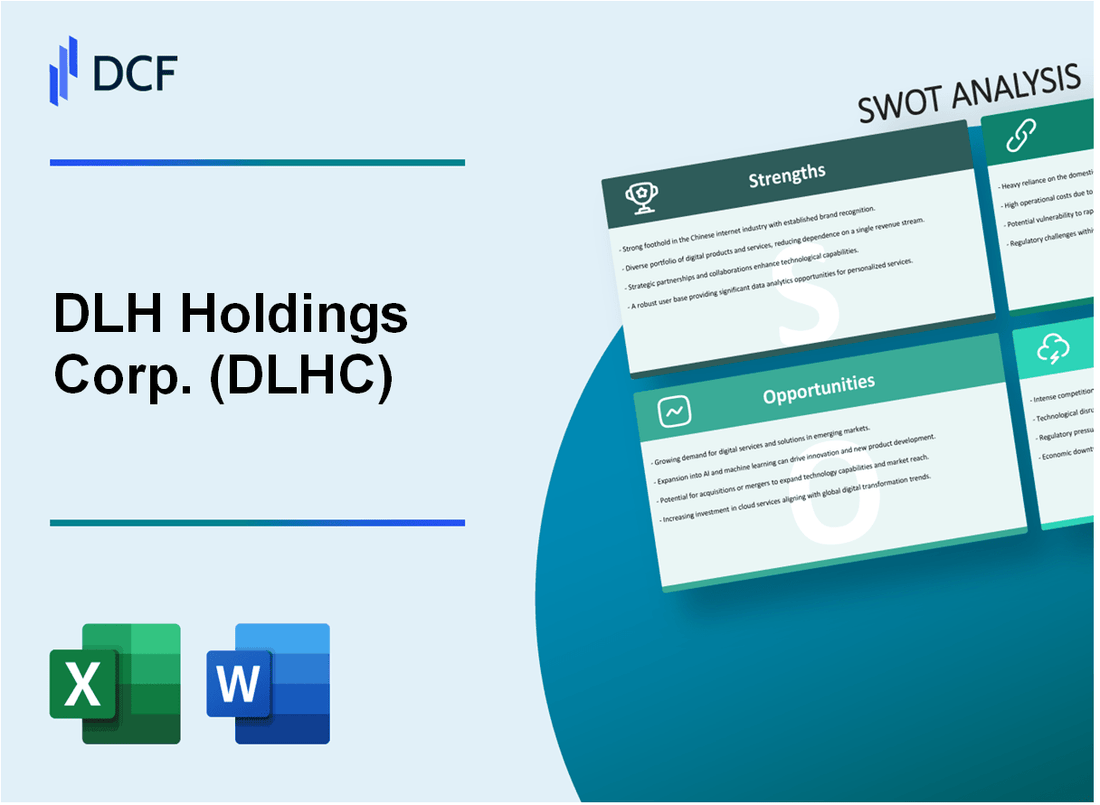
DLH Holdings Corp. (DLHC): Analyse SWOT [Jan-2025 Mise à jour] |
Entièrement Modifiable: Adapté À Vos Besoins Dans Excel Ou Sheets
Conception Professionnelle: Modèles Fiables Et Conformes Aux Normes Du Secteur
Pré-Construits Pour Une Utilisation Rapide Et Efficace
Compatible MAC/PC, entièrement débloqué
Aucune Expertise N'Est Requise; Facile À Suivre
DLH Holdings Corp. (DLHC) Bundle
Dans le paysage dynamique des services gouvernementaux, DLH Holdings Corp. (DLHC) est un joueur stratégique naviguant sur les défis et les opportunités complexes du marché fédéral. Cette analyse SWOT complète révèle comment ce fournisseur spécialisé de services gouvernementaux exploite ses forces, traite des faiblesses, capitalise sur les opportunités émergentes et atténue les menaces potentielles dans l'écosystème de la contractation fédérale en constante évolution. En disséquant le positionnement concurrentiel de DLHC, nous découvrons les facteurs critiques qui stimulent sa résilience, son potentiel de croissance et sa vision stratégique sur un marché hautement compétitif et réglementé.
DLH Holdings Corp. (DLHC) - Analyse SWOT: Forces
Fournisseur de services gouvernementaux spécialisés
DLH Holdings Corp. se concentre sur la prestation de services critiques aux agences gouvernementales fédérales dans trois secteurs primaires:
| Secteur | Focus du service |
|---|---|
| Défense | Support technique et solutions critiques de mission |
| Soins de santé | Services de soutien médical et administratif |
| Solutions techniques | Infrastructure informatique et services de cybersécurité |
Performance du contrat fédéral
Statistiques d'attribution du contrat:
- Valeur du contrat fédéral total en 2023: 87,4 millions de dollars
- Taux de victoire au contrat: 68,5%
- Durée du contrat moyen: 3-5 ans
Offres de services diversifiés
Le portefeuille de services dans tous les secteurs gouvernementaux comprend:
- Gestion de la logistique et de la chaîne d'approvisionnement
- Administration du programme de soins de santé
- Conseil de cybersécurité
- Analyse des données et support d'intelligence
Expertise en équipe de gestion
| Expérience exécutive | Années dans les contrats gouvernementaux |
|---|---|
| PDG | 22 ans |
| Directeur financier | 18 ans |
| Chef de la stratégie | 15 ans |
Compliance et gestion de la qualité
Certification et mesures de conformité:
- ISO 9001: 2015 certifié
- Évaluation de maturité de niveau 3 CMMI
- Zéro violations majeures de la conformité au cours des 5 dernières années
- Taux d'achèvement de la formation en conformité annuelle: 100%
DLH Holdings Corp. (DLHC) - Analyse SWOT: faiblesses
Une capitalisation boursière relativement petite limitant le potentiel de croissance
Au quatrième trimestre 2023, DLH Holdings Corp. a déclaré une capitalisation boursière de 43,2 millions de dollars. Cette taille limitée du marché limite la capacité de l'entreprise à rivaliser avec les plus grands fournisseurs de services gouvernementaux.
| Métrique financière | Valeur |
|---|---|
| Capitalisation boursière | 43,2 millions de dollars |
| Prix de l'action (décembre 2023) | $4.85 |
| Partage | 8,9 millions |
Dépendance des revenus concentrés sur les contrats gouvernementaux
Les revenus du contrat gouvernemental représentent 92,6% du total des revenus de l'entreprise Pour l'exercice 2023, créant des risques commerciaux importants.
- Contrats du ministère de la Défense: 58,4%
- Contrats d'agence civile fédérale: 34,2%
- Contrats du gouvernement national et local: 7,4%
Présence du marché international limité
DLH Holdings Corp. génère 98,7% de ses revenus au niveau national, avec un minimum d'opérations internationales.
| Distribution des revenus géographiques | Pourcentage |
|---|---|
| États-Unis | 98.7% |
| Marchés internationaux | 1.3% |
Vulnérabilité potentielle aux fluctuations du budget des dépenses fédérales
L'incertitude budgétaire fédérale a un impact direct sur la source de revenus de DLH. Les risques de séquestration et les interruptions potentielles de financement gouvernemental posent des défis importants.
Marges bénéficiaires minces typiques du secteur des services gouvernementaux
Pour l'exercice 2023, DLH Holdings a rapporté:
| Métrique de la rentabilité | Valeur |
|---|---|
| Marge brute | 16.3% |
| Marge bénéficiaire nette | 3.7% |
| Marge opérationnelle | 5.2% |
DLH Holdings Corp. (DLHC) - Analyse SWOT: Opportunités
Augmentation des dépenses fédérales de cybersécurité et de modernisation informatique
Le marché fédéral américain de la cybersécurité devrait atteindre 24,5 milliards de dollars en 2024. L'allocation budgétaire de la modernisation informatique du gouvernement pour l'exercice 2024 s'élève à 8,45 milliards de dollars, présentant des opportunités importantes pour DLH Holdings.
| Catégorie de dépenses de cybersécurité fédérale | 2024 Budget projeté |
|---|---|
| Cybersécurité d'agence civile | 6,7 milliards de dollars |
| Cybersécurité du secteur de la défense | 11,2 milliards de dollars |
| Cybersécurité de la sécurité intérieure | 3,8 milliards de dollars |
Expansion potentielle dans les domaines technologiques gouvernementaux émergents
Les domaines technologiques émergents avec des investissements gouvernementaux importants comprennent:
- Intelligence artificielle: 2,3 milliards de dollars alloués à la recherche et à la mise en œuvre de l'IA
- Informatique quantique: 845 millions de dollars en investissements fédéraux en technologie quantique
- Architecture de fiducie zéro: 1,1 milliard de dollars dédiés aux implémentations de cybersécurité zéro fiducie
Demande croissante de services de santé et de soutien technique
Le marché fédéral des services informatiques de la santé devrait atteindre 15,6 milliards de dollars en 2024, les services de soutien technique prévus par 7,3 milliards de dollars.
| Segment des services informatiques de la santé | 2024 Valeur marchande |
|---|---|
| Gestion des dossiers de santé électronique | 4,2 milliards de dollars |
| Infrastructure de télésanté | 3,1 milliards de dollars |
| Cybersécurité des soins de santé | 2,7 milliards de dollars |
Potentiel d'acquisitions stratégiques
Des possibilités d'acquisition stratégique existent dans des secteurs spécialisés des services gouvernementaux avec des évaluations cibles potentielles:
- Cirgins de cybersécurité: gamme d'évaluation de 25 à 50 millions de dollars
- Spécialistes informatiques de la santé: 15 à 35 millions de dollars potentiels d'acquisition
- Fournisseurs de services de migration en cloud: 20 à 45 millions de dollars
L'augmentation du gouvernement se concentre sur la diversité et les contrats de petites entreprises
Attribution fédérale des contrats de petite entreprise pour 2024:
| Catégorie de passation de marchés | 2024 allocation |
|---|---|
| Contrats totaux de petites entreprises | 178,3 milliards de dollars |
| Contrats commerciaux appartenant à des minorités | 42,6 milliards de dollars |
| Entreprises appartenant à des vétérans handicapées | 24,9 milliards de dollars |
DLH Holdings Corp. (DLHC) - Analyse SWOT: menaces
Concurrence intense sur le marché des services gouvernementaux fédéraux
Le marché des services du gouvernement fédéral démontre une pression concurrentielle importante avec plusieurs acteurs clés:
| Concurrent | Part de marché | Revenus annuels |
|---|---|---|
| Booz Allen Hamilton | 8.7% | 8,4 milliards de dollars |
| Saic | 5.3% | 6,9 milliards de dollars |
| CACI International | 4.2% | 5,7 milliards de dollars |
Séquestration du budget potentiel ou réduction des dépenses publiques
Les tendances des dépenses discrétionnaires fédérales indiquent des contraintes budgétaires potentielles:
- 2024 Budget discrétionnaire fédéral: 1,66 billion de dollars
- Impact potentiel de séquestration: réduction du budget de 5 à 10%
- Réduction des dépenses du gouvernement prévu: 80 à 120 milliards de dollars
Environnement réglementaire complexe et changeant
Les défis de la conformité réglementaire comprennent:
| Règlement | Coût de conformité | Plage de pénalité |
|---|---|---|
| CMMC 2.0 | $50,000-$500,000 | $5,000-$250,000 |
| NIST SP 800-171 | $100,000-$750,000 | $10,000-$500,000 |
Risques de cybersécurité et défis de conformité aux contrats
Paysage des menaces de cybersécurité:
- Coût moyen de la violation des données: 4,45 millions de dollars
- Risque potentiel de suspension du contrat: 25 à 40%
- Investissement en cybersécurité requis: 10 à 15% du budget informatique
Incertitudes économiques affectant les marchés publics
Stratégie d'approvisionnement Indicateurs de volatilité:
| Indicateur économique | 2024 projection | Impact potentiel |
|---|---|---|
| Budget d'achat fédéral | 630 milliards de dollars | ± 7% de variance |
| Incertitude d'attribution du contrat | 15-20% | Volatilité élevée |
DLH Holdings Corp. (DLHC) - SWOT Analysis: Opportunities
You're looking for where DLH Holdings Corp. (DLHC) can genuinely accelerate growth, especially given the revenue headwinds they faced in fiscal 2025 from small business contract conversions. The opportunities are defintely rooted in the federal government's massive shift toward digital health, AI, and defense modernization. DLH's existing contract vehicles and domain expertise position them perfectly to capture a significant share of the multi-billion-dollar spending surge coming in fiscal year (FY) 2026 and beyond. This is where they trade short-term pain for long-term, higher-margin work.
Expanding service offerings to adjacent federal agencies like Homeland Security or NIH.
DLH is successfully diversifying its customer base beyond its core Department of Veterans Affairs (VA) and Department of Defense (DoD) work, which is a smart move to mitigate concentration risk. The National Institutes of Health (NIH) is a clear, recent win that shows this strategy working. In August 2025, DLH was awarded a task order valued at up to $46.9 million from the NIH's Office of Information Technology (OIT) for a three-year period. This contract is all about enterprise IT systems, cybersecurity, and designing a cloud migration strategy, which are high-value services. The company is actively leveraging its expertise in public health and digital transformation to target other civilian agencies. For example, the Department of Homeland Security (DHS) is a prime target, with its civilian IT budget projected to increase by 9% in FY2025, reaching a total civilian IT budget of approximately $76.8 billion for the year. This expansion provides a critical new revenue stream to offset the revenue decline seen in the first three quarters of FY2025, where revenue dropped to $83.3 million in Q3 2025 from $100.7 million in Q3 2024.
Increased demand for digital modernization and AI integration within the VA and DoD.
The federal government is making unprecedented investments in digital transformation and Artificial Intelligence (AI), and DLH is already embedded in the programs driving this change. The Department of Defense (DoD) alone has requested an estimated $13.4 billion for AI and autonomy in its FY2026 budget, which is the largest single-year AI investment in defense history. DLH has secured a five-year task order up to $37.7 million (awarded in May 2025) with the US Army Medical Research & Development Command (MRDC) to deliver scientific R&D, AI/ML, and cloud-enabled big data analytic solutions. This is pure, high-tech work. For the VA, DLH is a prime awardee on the Accelerating VA Innovation and Learning (AVAIL) multiple-award contract, which has an aggregate ceiling of $650 million, allowing them to compete for task orders in areas like data transformation and digital care. This is a huge, long-term opportunity, even as the VA shifts its internal IT investments to focus on AI integration.
Here's the quick math on recent tech-focused contract wins:
| Agency | Contract/Task Order | Max Value (Up To) | Key Technology Focus |
|---|---|---|---|
| NIH (OIT) | Enterprise IT Services Task Order (Aug 2025) | $46.9 million | Cloud Migration, Cybersecurity, Software Development |
| DoD (MRDC/TATRC) | R&D and Advanced Technology Task Order (May 2025) | $37.7 million | AI/ML Modeling, Robotics, Cloud Analytics |
| VA | AVAIL MAC (Aggregate Ceiling) | $650 million | Digital Care, Data Transformation, Immersive Technology |
Potential to capture larger, multi-award contracts (MACs) in the upcoming 2026 budget cycle.
The shift away from small business set-asides, which hurt DLH's revenue in FY2025, is actually setting the stage for a rebound into larger, full-and-open Multi-Award Contracts (MACs) where they are a prime contractor. The company's contract backlog, which stood at $555.3 million as of June 30, 2025, provides a solid foundation, but the future growth will come from the new pipeline. DLH's new business pipeline is robust at $3.5 billion in opportunities across its market areas. The focus on cybersecurity, digital transformation, and public health initiatives is aligning the company with key FY2026 defense spending priorities. Securing a few major MACs in the next 18 months would immediately reverse the recent revenue trend.
Strategic acquisitions could broaden capabilities in specialized health IT and cloud services.
A calculated acquisition strategy is crucial for DLH to accelerate its capabilities in high-growth areas like specialized Health IT and cloud services. DLH has already established a strong presence in cloud migration, including partnerships with leading commercial cloud service providers (CSPs) like Azure, Amazon Web Services (AWS), and Google, as part of its NIH contract. A strategic acquisition could immediately give them a new, large contract vehicle or a proprietary software product that would be difficult to build internally. Given the company's focus on debt reduction-reducing total debt to $142.3 million by Q3 2025 from $154.6 million at the fiscal year start-they are improving their balance sheet, which is a key precursor to funding a strategic acquisition. They need to target firms that can provide:
- Immediate access to new, large-scale Multi-Award Contracts (MACs) in non-VA/DoD agencies.
- Proprietary AI/Machine Learning (ML) platforms for predictive health or logistics.
- Specialized cloud-native development teams with top-tier security clearances.
DLH's management has expressed optimism about future growth and bid activity for fiscal 2026, and a well-timed, accretive acquisition is the fastest way to deliver on that promise. One big deal can change the entire growth trajectory.
DLH Holdings Corp. (DLHC) - SWOT Analysis: Threats
You're looking at DLH Holdings Corp. and the picture is one of a company navigating a contracting market that is actively trying to cut costs and shift risk. The biggest threats aren't about technology; they're about Washington's budget process and the evolving contract structure. Your near-term action is defintely to monitor their cash flow and integration progress. Here's the quick math on the risks.
US government budget sequestration or delays in the FY 2026 appropriations process creates uncertainty.
The biggest immediate threat is the instability in federal funding. The government shutdown that began on October 1, 2025, and ended on November 12, 2025, with a Continuing Resolution (CR) is a perfect example of this. That CR only funds the government through January 30, 2026, meaning the threat of a lapse in appropriations-and delayed contract awards-is still very real. Delays like this freeze new program starts and slow down existing work, directly impacting DLH Holdings Corp.'s ability to transition its $463.0 million in unfunded backlog into revenue.
Also, the shift in priorities is clear: the market barometer for 2025 showed that civilian contracting, which is DLH Holdings Corp.'s core area (HHS, VA), was down 7.1% in contract value, while defense grew. This means the money pool DLH Holdings Corp. swims in is shrinking, making every contract re-compete a high-stakes battle.
Increased competitive pressure from larger, well-capitalized defense contractors.
DLH Holdings Corp. operates in a consolidating market where larger, well-capitalized firms and even smaller, aggressive niche players are fighting for every dollar. This pressure is already visible in the company's 2025 fiscal year results.
Here's how the competition is hitting the top line:
- Revenue Decline: Q3 2025 revenue was $83.3 million, a significant drop from $100.7 million in Q3 2024.
- Backlog Erosion: Total contract backlog fell from $690.3 million at the end of FY 2024 (September 30, 2024) to $555.3 million as of June 30, 2025.
- Contract Unbundling: The company specifically cited the impact of small business set-aside transitions and the unbundling of Department of Defense (DoD) contracts as reasons for lower revenue, indicating successful competitive bids against their incumbent work.
Government shift toward fixed-price contracts transfers more financial risk to DLH Holdings Corp.
The federal government is pushing to transfer financial risk away from its budget and onto contractors by favoring firm-fixed-price contracts over cost-reimbursable or time-and-materials contracts. DLH Holdings Corp. currently uses all three types, but the trend means more risk.
A firm-fixed-price contract means the contractor absorbs all cost overruns. For a company like DLH Holdings Corp., which is deeply involved in complex, technology-enabled services, this shift is a threat to profitability because it exposes their margins to unforeseen labor costs, supply chain issues, and inflation. You need to be incredibly disciplined on cost management to make this model work.
| Q3 FY 2025 Financial Metric | Q3 FY 2025 Value | Q3 FY 2024 Value | YoY Change (Risk Indicator) |
| Revenue | $83.3 million | $100.7 million | -17.28% |
| Net Income | $0.3 million | $1.1 million | -72.73% |
| EBITDA Margin | 9.7% | 10.0% | -0.3 percentage points |
Failure to smoothly integrate the Q3 2025 acquisition could negatively impact margins.
While the company did not announce a specific acquisition in Q3 2025, they consistently cite the 'risk that we will not realize the anticipated benefits of acquisitions' in their filings, which is an evergreen threat for any growth-by-acquisition strategy. The risk is magnified by the existing margin pressure.
The Q3 2025 results already show a sharp drop in profitability that an ill-managed acquisition would exacerbate. Net income fell to just $0.3 million in Q3 2025 from $1.1 million in the prior year period, and the EBITDA margin compressed from 10.0% to 9.7%. An integration hiccup-like losing key personnel from the acquired company or miscalculating technology migration costs-would put even more strain on a profitability metric that is already under pressure.
So, the near-term action is to monitor their cash flow and integration progress. Finance: draft a 13-week cash view focusing on debt service obligations by Friday.
Disclaimer
All information, articles, and product details provided on this website are for general informational and educational purposes only. We do not claim any ownership over, nor do we intend to infringe upon, any trademarks, copyrights, logos, brand names, or other intellectual property mentioned or depicted on this site. Such intellectual property remains the property of its respective owners, and any references here are made solely for identification or informational purposes, without implying any affiliation, endorsement, or partnership.
We make no representations or warranties, express or implied, regarding the accuracy, completeness, or suitability of any content or products presented. Nothing on this website should be construed as legal, tax, investment, financial, medical, or other professional advice. In addition, no part of this site—including articles or product references—constitutes a solicitation, recommendation, endorsement, advertisement, or offer to buy or sell any securities, franchises, or other financial instruments, particularly in jurisdictions where such activity would be unlawful.
All content is of a general nature and may not address the specific circumstances of any individual or entity. It is not a substitute for professional advice or services. Any actions you take based on the information provided here are strictly at your own risk. You accept full responsibility for any decisions or outcomes arising from your use of this website and agree to release us from any liability in connection with your use of, or reliance upon, the content or products found herein.