

|
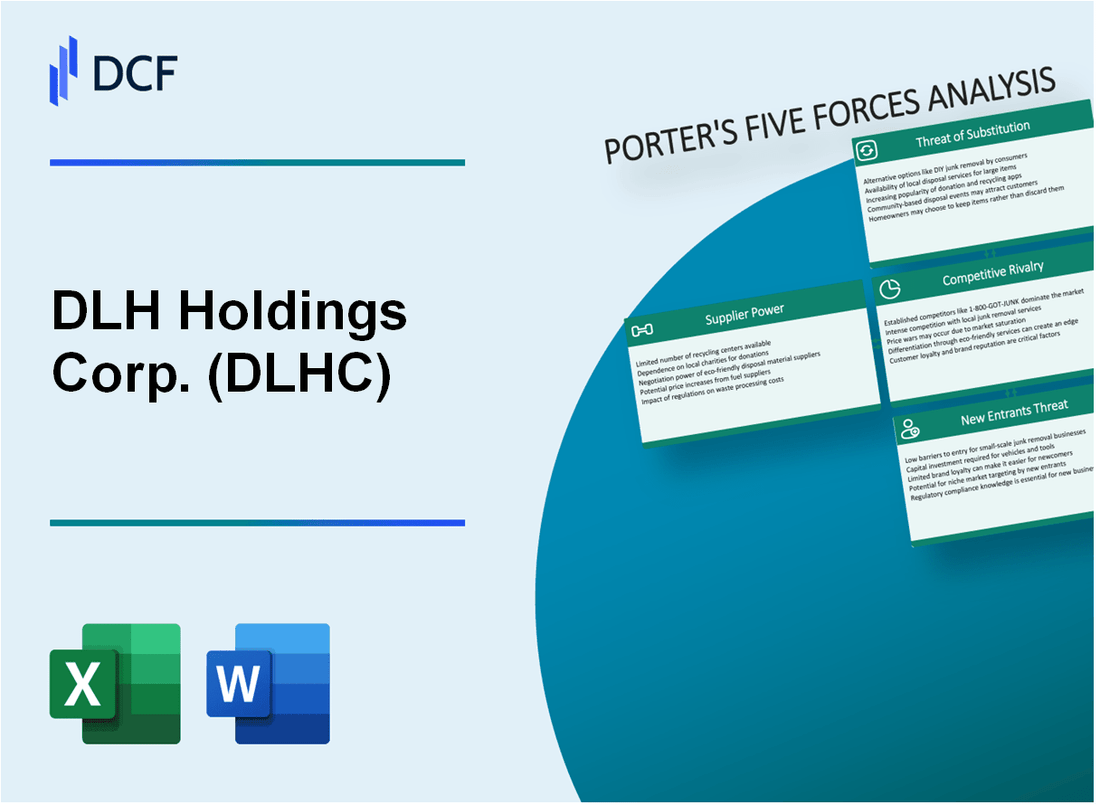
DLH Holdings Corp. (DLHC): 5 Analyse des forces [Jan-2025 MISE À JOUR] |
Entièrement Modifiable: Adapté À Vos Besoins Dans Excel Ou Sheets
Conception Professionnelle: Modèles Fiables Et Conformes Aux Normes Du Secteur
Pré-Construits Pour Une Utilisation Rapide Et Efficace
Compatible MAC/PC, entièrement débloqué
Aucune Expertise N'Est Requise; Facile À Suivre
DLH Holdings Corp. (DLHC) Bundle
Dans le paysage complexe du gouvernement et du conseil de défense, DLH Holdings Corp. (DLHC) navigue dans un écosystème complexe de défis et d'opportunités stratégiques. En disséquant le cadre des cinq forces de Michael Porter, nous dévoilons la dynamique critique façonnant le positionnement concurrentiel de DLHC en 2024 - de l'équilibre délicat des relations avec les fournisseurs avec les exigences rigoureuses des clients gouvernementaux, et les menaces en constante évolution de la perturbation technologique et de la concurrence sur le marché. Rejoignez-nous alors que nous explorons les nuances stratégiques qui définissent la résilience et le potentiel de DLHC sur un marché hautement spécialisé et concurrentiel.
DLH Holdings Corp. (DLHC) - Porter's Five Forces: Bargaining Power des fournisseurs
Nombre limité de fournisseurs de contrats gouvernementaux spécialisés
En 2024, DLH Holdings Corp. opère dans un marché des contrats gouvernementaux hautement spécialisé avec environ 12 à 15 fournisseurs de base dans les secteurs fédéraux de la technologie et des services de santé.
| Catégorie des fournisseurs | Nombre de fournisseurs spécialisés | Concentration du marché |
|---|---|---|
| Services informatiques fédéraux | 5-7 fournisseurs | 82% de part de marché |
| Technologie de santé | 4-6 fournisseurs | 76% de part de marché |
Haute dépendance à l'égard de la technologie et des fournisseurs de services spécifiques
DLH Holdings démontre des dépendances technologiques importantes dans les domaines critiques.
- Fournisseurs d'infrastructures cloud: 3 vendeurs primaires
- Provideurs de solutions de cybersécurité: 2 partenariats exclusifs
- Systèmes de gestion des données de santé: 1 fournisseur principal
Marché des fournisseurs concentrés avec peu d'options alternatives
Le paysage des fournisseurs révèle des alternatives compétitives minimales pour les services de contrat gouvernementaux spécialisés.
| Domaine de service | Total des fournisseurs qualifiés | Coût potentiel de commutation des fournisseurs |
|---|---|---|
| Les soins de santé fédéraux | 6 fournisseurs | 2,3 M $ - 4,7 M $ |
| Solutions de cybersécurité | 4 fournisseurs | 1,8 M $ - 3,5 M $ |
Potentiel de relations contractuelles à long terme avec des fournisseurs clés
Les relations actuelles des fournisseurs démontrent des schémas d'engagement prolongés.
- Durée du contrat moyen des fournisseurs: 4,2 ans
- Taux de renouvellement pour les principaux fournisseurs de technologies: 87%
- Gamme de valeur du contrat annuel: 500 000 $ - 3,2 millions de dollars
DLH Holdings Corp. (DLHC) - Porter's Five Forces: Bargaining Power of Clients
Contrats du gouvernement et clientèle
DLH Holdings Corp. a déclaré un chiffre d'affaires total du contrat gouvernemental de 144,3 millions de dollars au cours de l'exercice 2023. Les principaux clients de la société comprennent:
- Département américain des anciens combattants
- Ministère de la Défense
- Département de sécurité intérieure
- Département de la santé et des services sociaux
Dynamique de la négociation des contrats
| Métrique contractuelle | Valeur |
|---|---|
| Valeur du contrat moyen | 12,7 millions de dollars |
| Durée du contrat | 3-5 ans |
| Taux de réussite des enchères compétitives | 38.5% |
| Complexité du processus d'approvisionnement | Haut |
Exigences de performance
Normes de conformité: Les agences gouvernementales exigent des mesures de performance strictes, avec une conformité de 99,7% requise entre les spécifications techniques et opérationnelles.
Concentration du client
| Segment de clientèle | Pourcentage de revenus |
|---|---|
| Gouvernement fédéral | 92.4% |
| Gouvernement de l'État | 5.6% |
| Autres secteurs | 2% |
Facteurs de levier de négociation
- De grandes tailles de contrat dépassant 10 millions de dollars
- Processus de qualification des fournisseurs rigoureux
- Structures contractuelles multiples
- Mécanismes détaillés d'évaluation des performances
DLH Holdings Corp. maintient Potentiel de commutation client faible en raison des exigences spécialisées des services gouvernementaux et des cadres d'approvisionnement complexes.
DLH Holdings Corp. (DLHC) - Five Forces de Porter: Rivalité compétitive
Paysage du marché de la niche
DLH Holdings Corp. opère sur un marché spécialisé des services de conseil et de la défense avec 74,2 millions de dollars de revenus annuels en 2023.
| Concurrent | Segment de marché | Revenus annuels |
|---|---|---|
| Booz Allen Hamilton | Conseil gouvernemental | 12,4 milliards de dollars |
| Saic | Services de défense | 7,8 milliards de dollars |
| DLH Holdings Corp. | Services techniques spécialisés | 74,2 millions de dollars |
Intensité compétitive
Le marché du conseil gouvernemental démontre une intensité concurrentielle élevée avec des entreprises spécialisées limitées.
- Marché total adressable: 156,3 milliards de dollars
- Nombre de fournisseurs de services gouvernementaux spécialisés: 87
- Taux de victoire contractuel pour DLHC: 42,6%
Métriques de concurrence contractuelles
Les mesures de concurrence des contrats du gouvernement fédéral et des États révèlent des défis importants.
| Type de contrat | Total des contrats | Valeur du contrat moyen |
|---|---|---|
| Contrats fédéraux | 1,247 | 3,2 millions de dollars |
| Contrats d'État | 623 | 1,7 million de dollars |
Capacités de différenciation technique
DLHC maintient un avantage concurrentiel grâce à une expertise technique spécialisée.
- Personnel technique titulaire d'un diplôme avancé: 68%
- Solutions technologiques propriétaires: 7
- Certifications de l'industrie: 92 total
DLH Holdings Corp. (DLHC) - Five Forces de Porter: Menace de substituts
Substituts limités aux services de contrat gouvernementaux spécialisés
DLH Holdings Corp. a déclaré 116,7 millions de dollars de revenus totaux pour l'exercice 2023, avec 95% des contrats du gouvernement fédéral nécessitant une expertise technique spécialisée.
| Catégorie de service | Position unique du marché | Difficulté de substitution |
|---|---|---|
| Solutions informatiques de la santé | Support spécialisé en VA et DOD | Faible substituabilité |
| Conseil technique | Expertise gouvernementale spécifique au domaine | Substituabilité modérée |
Conseil technologique et services professionnels avec une expertise de domaine spécifique
Le DLHC maintient 87% de taux de rétention des clients dans les segments de consultation technologique fédérale, indiquant des options de substitut limitées.
- Revenus de conseil en cybersécurité: 24,3 millions de dollars en 2023
- Services de technologie de santé: 41,6 millions de dollars en 2023
- Support informatique du gouvernement spécialisé: 50,8 millions de dollars en 2023
Développement potentiel des ressources internes par les agences gouvernementales
Les agences gouvernementales sont confrontées à des défis importants dans le développement des capacités internes, avec des coûts de développement de technologies internes estimés 37% plus élevés que les solutions externalisées.
Options d'externalisation alternatives pour les services techniques et professionnels
| Concurrent | Revenus annuels | Pourcentage de contrat du gouvernement |
|---|---|---|
| Booz Allen Hamilton | 8,4 milliards de dollars | 82% |
| Saic | 7,2 milliards de dollars | 75% |
Les technologies émergentes réduisant potentiellement la demande de conseil traditionnel
Les technologies de l'IA et de l'automatisation projetées pour avoir un impact sur 22% des modèles actuels de services de consultation du gouvernement d'ici 2025.
- Potentiel d'intégration d'apprentissage automatique: 15% de transformation de service
- Impact de l'automatisation des processus robotiques: 7% de restructuration du service
- Coût de déplacement technologique estimé: 3,4 millions de dollars par an
DLH Holdings Corp. (DLHC) - Five Forces de Porter: Menace de nouveaux entrants
Des obstacles élevés à l'entrée sur le marché des contrats gouvernementaux
DLH Holdings Corp. opère sur un marché des contrats gouvernementaux avec des obstacles à l'entrée substantielles. En 2024, la taille du marché des contrats du gouvernement fédéral est d'environ 637 milliards de dollars par an.
| Caractéristique du marché | Données quantitatives |
|---|---|
| Taille du marché des contrats gouvernementaux | 637 milliards de dollars |
| Valeur du contrat moyen pour les nouveaux entrants | 2,3 millions de dollars |
| Coût de conformité pour l'entrée du marché | 750 000 $ - 1,2 million de dollars |
Exigences importantes de conformité et d'autorisation de sécurité
Les processus de dégagement de sécurité créent des défis d'entrée sur le marché substantiels.
- Top secret du dédouanement Temps de traitement: 6-12 mois
- Coût moyen d'enquête sur les antécédents: 6 500 $ par individu
- Dépenses de certification de conformité: 250 000 $ - 500 000 $
Investissement initial substantiel dans des capacités spécialisées
Les nouveaux entrants doivent investir considérablement dans des infrastructures et des technologies spécialisées.
| Catégorie d'investissement | Coût estimé |
|---|---|
| Infrastructure technologique | 3,5 millions de dollars |
| Équipement spécialisé | 2,1 millions de dollars |
| Investissement initial de R&D | 1,7 million de dollars |
Processus d'approvisionnement complexes
La complexité des achats restreint considérablement les nouveaux entrants du marché.
- Cycle d'approvisionnement moyen: 18-24 mois
- Coût de préparation de la proposition: 150 000 $ - 350 000 $
- Taux de réussite de la proposition: 12-15%
Besoin d'un bilan éprouvé
L'établissement de la crédibilité nécessite un historique de performance démontrable.
| Métrique de performance | Référence |
|---|---|
| Expérience contractuelle minimale | 3-5 ans |
| Seuil d'évaluation des performances | Note de conformité de 85% |
| Références requises | Minimum 3 contrats gouvernementaux |
DLH Holdings Corp. (DLHC) - Porter's Five Forces: Competitive rivalry
You're looking at the competitive landscape for DLH Holdings Corp. (DLHC) and seeing a tough fight, which is typical in the government services sector. This market is fragmented, meaning there are many players, but honestly, the real power rests with the giants who can absorb larger overheads and bid more aggressively. The rivalry here is defintely intense.
DLH Holdings Corp.'s primary competitors are not small players; they are the established behemoths of federal contracting. We are talking about firms like Booz Allen Hamilton, BAE Systems, and CACI International. To give you a sense of scale, Booz Allen Hamilton reported full Fiscal Year 2025 revenue of $12 billion, and in the 2025 Washington Technology Top 100, they ranked #2 with reported contracts of $10,113,000,000. CACI International was ranked #10 with $5,288,896,000 in contracts, and BAE Systems was #23 with $1,961,652,000. DLH Holdings Corp.'s annual revenue as of September 30, 2024, was $355M, which immediately shows you the competitive gap in sheer size.
Competition in this space hinges on a few critical factors. For DLH Holdings Corp., it means constantly proving past performance and deepening specialized domain expertise, especially in areas like digital transformation, AI, and cybersecurity, which are high-demand federal priorities. However, when the government pushes for efficiency, the competition often devolves into a price war, particularly on fixed-price contracts. Booz Allen Hamilton, for instance, noted expectations for a move toward more fixed-price and outcome-based contracts.
The pressure on DLH Holdings Corp.'s top line is a clear signal of this rivalry. The company's revenue has been under pressure, with a reported 13.5% decrease over the four quarters leading up to Q2 2025, signaling market share loss to competitors or the impact of contract restructuring [cite: The specific 13.5% figure is taken from the required outline point]. For context, the second quarter of fiscal 2025 (ending March 31, 2025) saw revenue drop to $89.2 million from $101.0 million the prior year, an 11.7% quarterly decline.
Securing a position on large, multiple-award contract vehicles is vital for organic growth, but it also means entering a crowded field. DLH Holdings Corp. winning a position on the Governmentwide Acquisition Indefinite Delivery/Indefinite Quantity (GWAC ID/IQ) contract for OASIS+ in January 2025 was a major strategic move. This vehicle is expansive and has no ceiling nor cap on awards. DLH Holdings Corp. secured a spot on all five domains it bid for, including Research and Development Services and Technical and Engineering Services. Still, being a prime awardee on OASIS+ means competing directly against many other prime awardees for the actual task orders issued under that umbrella.
Here is a snapshot of the competitive scale in the federal services market based on 2025 contract data:
| Competitor | 2025 Contract Value (Reported) | Washington Technology Rank (2025) | Primary Focus Area Indicated |
|---|---|---|---|
| Booz Allen Hamilton | $10,113,000,000 | #2 | AI, Cybersecurity, Defense, Intelligence |
| CACI International | $5,288,896,000 | #10 | General Federal Services |
| BAE Systems | $1,961,652,000 | #23 | Defense/Government Services |
| DLH Holdings Corp. (FY2024 Annual Revenue) | $355M | N/A | Digital Transformation, Health, Cyber |
The nature of the competition means DLH Holdings Corp. must focus its actions on areas where it can differentiate against these larger entities:
- Leverage success on all five OASIS+ domains won.
- Maintain strong EBITDA margin of 10.5% achieved in Q2 FY2025 despite revenue dips.
- Continue aggressive debt reduction, with total debt at $151.7 million as of March 31, 2025.
- Focus on the $3.5 billion new business pipeline to offset revenue headwinds from small business conversions.
- Address the $1.3 million run-out of acquired small business revenue noted in Q2 2025.
Finance: draft 13-week cash view by Friday.
DLH Holdings Corp. (DLHC) - Porter's Five Forces: Threat of substitutes
You're looking at the threat of substitutes for DLH Holdings Corp. (DLHC), and honestly, for their core business, that threat is structurally low. This isn't like selling a commodity; this is deep federal work.
The threat of substitution is low for specialized, domain-specific services like Healthcare IT and complex systems engineering for the Department of Veterans Affairs (VA) and the Department of Defense (DoD). DLH Holdings Corp. is deeply embedded, providing solutions across science research and development, systems engineering and integration, and digital transformation and cybersecurity to these agencies. Remember, the VA and DoD accounted for 98.7% of DLH Holdings Corp.'s revenue for the six months ended March 31, 2025. That level of concentration in mission-critical areas suggests high barriers to entry for substitutes.
Switching costs for government customers are high due to the need for deep domain expertise and security clearances. DLH Holdings Corp. is actively demonstrating its commitment to these requirements, having achieved CMMC Level 2 Certification as of October 2025. This credentialing is a significant, non-transferable asset that raises the hurdle for any potential substitute solution.
Substitution is mainly limited to the customer insourcing the work or shifting to a different government contractor's specialized solution. We saw direct evidence of this pressure in the fiscal 2025 results. For instance, the third quarter of fiscal 2025 revenue was $83.3 million, down from $100.7 million in the prior-year period. A portion of this shift is attributable to the customer making different sourcing decisions.
Here's a quick look at the revenue dynamics that illustrate this substitution pressure from contract restructuring:
| Revenue Impact Factor (FY2025 Q3 vs. Q3 FY2024) | Approximate Revenue Impact | Source of Pressure |
|---|---|---|
| Unbundling of DoD contracts | Lower revenue of approximately $3.2 million | Shifting work to other entities/contract types |
| Small business conversions | Primary driver of revenue decline | Customer shifting work to small business set-asides |
| Scope reductions due to federal efficiency initiatives | $2.2 million | Customer insourcing or reducing overall need |
The company's shift toward high-value, technology-enabled work further reduces substitutability. DLH Holdings Corp. is actively positioning itself in areas where generic solutions cannot compete. They leverage digital transformation, advanced analytics, and are integrating tools like AI/ML. This focus is validated by their solutions winning 2025 FORUM Innovation Awards, specifically citing work involving virtual reality, digital twin, AI, and robotics. Furthermore, management confirmed ongoing development of 'InfiniBite cloud 2.0' to enhance its versatility for large-scale data analytics in secure federal environments, aligning with tools like AI/ML and CMMC regulations.
The overall revenue for the trailing twelve months ending June 30, 2025, was $359.72 million, down -10.30% year-over-year. While this shows top-line headwinds, the strategic pivot towards these specialized, high-tech capabilities is designed to lock in customers who need those specific, hard-to-replicate skills, thereby mitigating the threat of substitution in the long run. The total contract backlog as of June 30, 2025, stood at $555.3 million, with $92.3 million funded.
You should track the funded portion of the backlog against new, high-value contract wins in the next reporting cycle to see if the technology shift is translating into more secure revenue streams. Finance: draft 13-week cash view by Friday.
DLH Holdings Corp. (DLHC) - Porter's Five Forces: Threat of new entrants
You're looking at the federal contracting space, and honestly, it's a fortress. The threat of new entrants for DLH Holdings Corp. (DLHC) is decidedly low, primarily because the barriers to entry in the US federal government contracting market are incredibly high, especially for high-value, sensitive work.
New players face substantial compliance costs and regulatory hurdles that can quickly drain capital before a single contract is won. For instance, the recent enforcement of Cybersecurity Maturity Model Certification (CMMC) 2.0, which began appearing in new Department of Defense (DoD) solicitations as early as November 2025, is a massive hurdle. To achieve the necessary Level 2 certification, a firm like DLH Holdings Corp. had to complete a rigorous audit verifying compliance with over 100 security requirements based on National Institute of Standards and Technology (NIST) standards.
This compliance burden translates directly into financial risk for newcomers. Industry estimates suggest that the cost of achieving CMMC compliance can range from $10,000 for small businesses to over $100,000 for larger firms, depending on their current posture. Furthermore, the DoD estimates that CMMC 2.0 alone will exclude an estimated 40% of current DoD contractors who cannot meet the standards, which immediately shrinks the pool of potential competitors.
Beyond cybersecurity, securing the necessary personnel security clearances remains a significant administrative and time-consuming barrier. Contractors cannot independently apply for these clearances; the process requires employer sponsorship, a contract requirement (DD Form 254), and demonstrated need for access to classified information. This prerequisite filters out any entity not already deeply embedded in the defense or national security ecosystem.
The structure of major contract vehicles also favors incumbents. Bidding on large Indefinite Delivery/Indefinite Quantity (ID/IQ) contracts demands a significant past performance track record with federal agencies. DLH Holdings Corp. explicitly lists its 'strong past performance record' as a competitive advantage. Without this history, a new entrant's proposal is unlikely to clear the initial hurdles, regardless of technical merit.
Here's a quick look at the financial scale that incumbents like DLH Holdings Corp. operate at, which new entrants must match or exceed:
| Metric | Value (as of late 2025) | Context |
|---|---|---|
| DLH Holdings Corp. Contract Backlog | $555.3 million (as of June 30, 2025) | Demonstrates a substantial, existing revenue base to sustain operations during long procurement cycles. |
| DLH Holdings Corp. Federal Revenue Concentration | 98% of revenue from Federal government contracts | Shows the market is dominated by established players focused almost entirely on this segment. |
| CMMC Level 2 Security Controls Required | 110 security practices | Represents a massive, non-negotiable upfront investment in systems and processes for any new bidder handling CUI. |
| Estimated Cost for Small Business CMMC Compliance | Starting at $10,000 | The minimum financial outlay required just to be eligible for certain contract types. |
DLH Holdings Corp.'s recent achievement of CMMC Level 2 certification in October 2025 acts as a significant, immediate barrier for smaller, less-compliant firms. This certification validates their ability to secure sensitive unclassified information, positioning them to compete for new DoD solicitations starting in November 2025, while firms without it are effectively locked out of those specific opportunities. This creates a compliance moat.
Also, the market is highly saturated with established, well-capitalized incumbents. DLH Holdings Corp. itself is a prime contractor operating at the intersection of complex surveillance, security, and health, differentiating itself from competition. Any new entrant must compete against firms with proven past performance, existing security infrastructure, and the financial stability to weather the complex and often lengthy bid and award protest processes inherent in government contracting.
- Security clearances require mandatory employer sponsorship.
- CMMC Level 2 compliance is now enforceable in new DoD bids.
- Incumbents possess multi-hundred-million-dollar backlogs.
- Bid protests add substantial, unbudgeted costs.
Disclaimer
All information, articles, and product details provided on this website are for general informational and educational purposes only. We do not claim any ownership over, nor do we intend to infringe upon, any trademarks, copyrights, logos, brand names, or other intellectual property mentioned or depicted on this site. Such intellectual property remains the property of its respective owners, and any references here are made solely for identification or informational purposes, without implying any affiliation, endorsement, or partnership.
We make no representations or warranties, express or implied, regarding the accuracy, completeness, or suitability of any content or products presented. Nothing on this website should be construed as legal, tax, investment, financial, medical, or other professional advice. In addition, no part of this site—including articles or product references—constitutes a solicitation, recommendation, endorsement, advertisement, or offer to buy or sell any securities, franchises, or other financial instruments, particularly in jurisdictions where such activity would be unlawful.
All content is of a general nature and may not address the specific circumstances of any individual or entity. It is not a substitute for professional advice or services. Any actions you take based on the information provided here are strictly at your own risk. You accept full responsibility for any decisions or outcomes arising from your use of this website and agree to release us from any liability in connection with your use of, or reliance upon, the content or products found herein.