

|
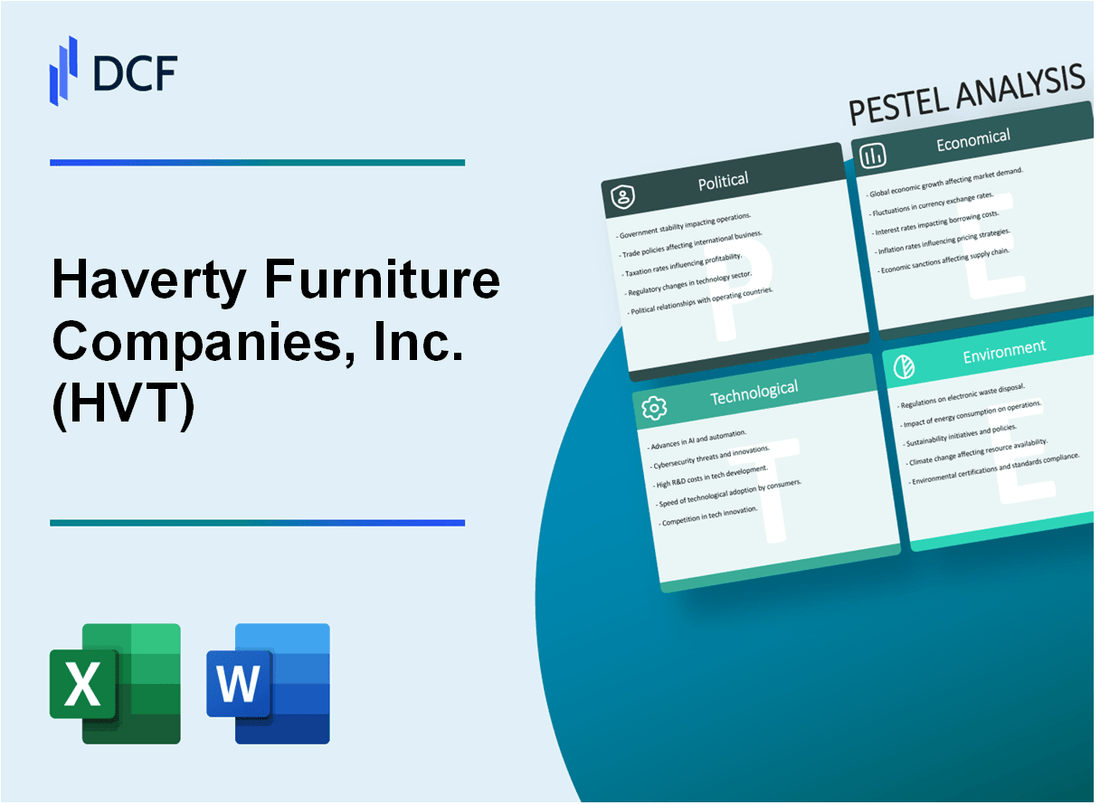
Haverty Furniture Companies, Inc. (HVT): Analyse de Pestle [Jan-2025 Mise à jour] |
Entièrement Modifiable: Adapté À Vos Besoins Dans Excel Ou Sheets
Conception Professionnelle: Modèles Fiables Et Conformes Aux Normes Du Secteur
Pré-Construits Pour Une Utilisation Rapide Et Efficace
Compatible MAC/PC, entièrement débloqué
Aucune Expertise N'Est Requise; Facile À Suivre
Haverty Furniture Companies, Inc. (HVT) Bundle
Dans le paysage dynamique de la vente au détail de meubles, Haverty Furniture Companies, Inc. (HVT) navigue dans un réseau complexe de forces externes qui façonnent sa trajectoire stratégique. De l'évolution des préférences des consommateurs aux perturbations technologiques et aux défis environnementaux, cette analyse du pilon dévoile l'écosystème multiforme influençant les opérations commerciales de HVT. Plongez dans une exploration complète des facteurs politiques, économiques, sociologiques, technologiques, juridiques et environnementaux qui redéfinissent le paysage concurrentiel de l'industrie du meuble, offrant un aperçu de la façon dont HVT s'adapte et prospère dans un marché de plus en plus interconnecté et en évolution rapide.
Haverty Furniture Companies, Inc. (HVT) - Analyse du pilon: facteurs politiques
Impact potentiel des politiques commerciales affectant les réglementations sur l'importation / exportation des meubles
En 2024, les tarifs d'importation des meubles américains restent importants, avec 25% de tarifs sur certains meubles en bois de Chine. Le paysage commercial actuel montre:
| Pays | Taux de tarif d'importation | Volume d'importation annuel |
|---|---|---|
| Chine | 25% | 8,2 milliards de dollars |
| Vietnam | 12-15% | 5,6 milliards de dollars |
| Mexique | 0% (USMCA) | 3,4 milliards de dollars |
Changement des incitations gouvernementales pour les secteurs de la vente au détail et de la fabrication
Les incitations actuelles au gouvernement comprennent:
- Crédit d'impôt sur l'investissement manufacturier de 6% pour la production intérieure
- Déduction de dépenses de petites entreprises à 1,29 million de dollars pour 2024
- Crédits d'impôt sur l'efficacité énergétique allant de 250 $ à 5 000 $ par investissement éligible
Changements possibles dans la législation fiscale impactant les entreprises de vente au détail de meubles
Considérations fiscales pour les meubles Haverty en 2024:
| Catégorie d'impôt | Taux actuel | Impact potentiel |
|---|---|---|
| Taux d'imposition des sociétés | 21% | Potentiel 1 à 2% de fluctuation |
| Variation de la taxe de vente | 5 à 10% dépendants de l'État | Harmonisation interétatique potentielle |
Politiques potentielles de développement économique régional influençant le marché des meubles
Initiatives régionales de développement économique ciblant le secteur des meubles:
- Offre de zone de fabrication du sud-est des États-Unis crédits d'impôt sur la paie jusqu'à 5,5%
- Incitations de l'État de Géorgie à fournir crédits de création d'emplois de 3 500 $ par nouveau poste de fabrication
- Programme de subvention de développement de l'industrie du mobilier de Caroline du Nord avec Attribution annuelle de 2 millions de dollars
Haverty Furniture Companies, Inc. (HVT) - Analyse du pilon: facteurs économiques
Tendances des dépenses de consommation en cours dans les meubles et décor
L'apparition de maisons américaines et les dépenses d'amélioration de la maison ont atteint 394 milliards de dollars en 2022, avec un taux de croissance annuel composé (TCAC) prévu de 4,3% de 2023 à 2028.
| Année | Dépenses totales de mobilier de la maison | Croissance d'une année à l'autre |
|---|---|---|
| 2022 | 394 milliards de dollars | 5.2% |
| 2023 | 414 milliards de dollars | 5.1% |
| 2024 (projeté) | 435 milliards de dollars | 5.0% |
Le marché du logement fluctuant influençant directement la demande de meubles
Les ventes de maisons existantes en 2023 ont totalisé 4,09 millions d'unités, ce qui représente une baisse de 19,4% par rapport à 2022. Le prix médian des maisons était de 387 600 $ en décembre 2023.
| Indicateur du marché du logement | 2022 | 2023 | Pourcentage de variation |
|---|---|---|---|
| Ventes de maisons totales | 5,03 millions | 4,09 millions | -19.4% |
| Prix médian des maisons | $378,400 | $387,600 | 2.4% |
Inflation et effets des taux d'intérêt sur le pouvoir d'achat des consommateurs
Le taux d'inflation américain en décembre 2023 était de 3,4%, contre 6,5% en décembre 2022. Les taux d'intérêt de la Réserve fédérale sont restés de 5,25% à 5,50% en janvier 2024.
| Indicateur économique | Décembre 2022 | Décembre 2023 |
|---|---|---|
| Taux d'inflation | 6.5% | 3.4% |
| Taux de fonds fédéraux | 4.25%-4.50% | 5.25%-5.50% |
Récupération économique et tendances des revenus disponibles post-pandemiques
Le revenu disponible personnel américain au troisième trimestre 2023 était de 16,5 billions de dollars, avec un taux d'épargne personnel de 3,8%.
| Métrique de revenu disponible | Q3 2022 | Q3 2023 | Pourcentage de variation |
|---|---|---|---|
| Revenu disponible personnel | 16,2 billions de dollars | 16,5 billions de dollars | 1.9% |
| Taux d'épargne personnelle | 3.6% | 3.8% | 5.6% |
Haverty Furniture Companies, Inc. (HVT) - Analyse du pilon: facteurs sociaux
Changer les préférences des consommateurs vers des expériences d'achat en ligne et hybrides
En 2023, les ventes de meubles en ligne ont atteint 27,9 milliards de dollars, ce qui représente 26,7% du total des ventes au détail de meubles aux États-Unis. Les ventes en ligne de Haverty Furniture ont augmenté de 18,3% par rapport à l'année précédente.
| Année | Pourcentage de vente en ligne | Valeur totale de ventes en ligne |
|---|---|---|
| 2022 | 22.4% | 23,6 milliards de dollars |
| 2023 | 26.7% | 27,9 milliards de dollars |
Changements démographiques dans les modèles de propriété et d'achat de meubles
Les milléniaux représentaient 43% des acheteurs de maisons en 2023, avec une dépense de meuble moyenne de 4 200 $ par ménage. Les propriétaires de 25 à 40 ans pour la première fois représentent 37% des achats du marché du mobilier.
| Groupe d'âge | Taux de propriété | Dépenses de meubles moyens |
|---|---|---|
| Milléniaux (25-40) | 43% | $4,200 |
| Gen Z (18-24) | 16% | $2,100 |
Accent croissant sur la conception de meubles durables et soucieuses de l'environnement
65% des consommateurs préfèrent les meubles respectueux de l'environnement en 2023. Le marché durable des meubles devrait atteindre 52,6 milliards de dollars d'ici 2025, avec un taux de croissance annuel composé de 7,2%.
| Métrique de la durabilité | Valeur 2023 | Valeur projetée 2025 |
|---|---|---|
| Préférence des consommateurs | 65% | 72% |
| Taille du marché | 45,3 milliards de dollars | 52,6 milliards de dollars |
Tendances de travail à distance ayant un impact sur les meubles de maison et les marchés de meubles de bureau
78% des entreprises soutiennent les modèles de travail hybrides en 2023. Les ventes de meubles du bureau à domicile ont augmenté de 32,4%, avec des dépenses moyennes de 1 850 $ par configuration du bureau à domicile.
| Modèle de travail | Taux d'adoption | Impact de la vente de meubles |
|---|---|---|
| Travail hybride | 78% | Augmentation de 32,4% |
| Dépenses de bureau à domicile | N / A | Moyenne de 1 850 $ |
Haverty Furniture Companies, Inc. (HVT) - Analyse du pilon: facteurs technologiques
Plateformes de commerce électronique avancées et expériences d'achat numériques
Au quatrième trimestre 2023, les revenus de commerce électronique de Haverty Furniture ont atteint 157,3 millions de dollars, ce qui représente 26,4% du total des ventes d'entreprises. La plate-forme numérique de l'entreprise a traité 412 000 transactions en ligne en 2023, avec une valeur de commande moyenne de 1 285 $.
| Métrique de la plate-forme numérique | Performance de 2023 |
|---|---|
| Revenus de vente en ligne | 157,3 millions de dollars |
| Total des transactions en ligne | 412,000 |
| Valeur de commande en ligne moyenne | $1,285 |
| Pourcentage des ventes totales | 26.4% |
Mise en œuvre de la réalité augmentée pour la visualisation des meubles virtuels
Haverty a investi 2,7 millions de dollars dans la technologie de réalité augmentée en 2023. La plate-forme AR permet aux clients de placer pratiquement les meubles dans leurs maisons, avec un taux d'engagement des utilisateurs de 38% et une augmentation du taux de conversion de 22%.
| Métrique de la technologie AR | 2023 données |
|---|---|
| Investissement technologique | 2,7 millions de dollars |
| Taux d'engagement des utilisateurs | 38% |
| Augmentation du taux de conversion | 22% |
Analyse des données pour les systèmes de recommandation des clients personnalisés
Haverty a déployé une plate-forme d'analyse de données de 1,9 million de dollars en 2023, traitant 2,3 millions de points de données d'interaction client. Le système de recommandation génère des suggestions personnalisées pour 67% des acheteurs en ligne, augmentant la valeur moyenne de la commande de 215 $.
| Métrique d'analyse des données | Performance de 2023 |
|---|---|
| Investissement de la plate-forme | 1,9 million de dollars |
| Points de données d'interaction client | 2,3 millions |
| Couverture de recommandation personnalisée | 67% |
| Augmentation de la valeur de commande moyenne | $215 |
Gestion des stocks grâce à des technologies avancées de suivi et d'IA
Haverty a mis en œuvre un système de gestion des stocks de 3,4 millions de dollars sur l'IA en 2023. La technologie a réduit les coûts de transport des stocks de 16% et amélioré la précision des actions à 97,5%. Le système traite les données en temps réel de 42 centres de distribution à travers les États-Unis.
| Métrique de gestion des stocks | 2023 données |
|---|---|
| Investissement technologique | 3,4 millions de dollars |
| Inventaire de réduction des coûts de transport | 16% |
| Précision | 97.5% |
| Centres de distribution | 42 |
Haverty Furniture Companies, Inc. (HVT) - Analyse du pilon: facteurs juridiques
Conformité aux réglementations sur la protection des consommateurs dans le secteur de la vente au détail
Haverty Furniture Companies, Inc. adhère à plusieurs réglementations fédérales de protection des consommateurs et des États, notamment:
| Règlement | Détails de la conformité | Range de pénalité potentielle |
|---|---|---|
| Acte de garantie de Magnuson-Moss | Documentation complète de garantie pour les produits de meuble | 43 280 $ par violation |
| Loi sur les rapports de crédit équitable | Protection stricte d'informations sur le crédit client | Jusqu'à 1 000 $ par violation individuelle |
| La vérité dans le prêt | Pratiques de divulgation de financement transparent | 5 000 $ de pénalité civile par violation |
Considérations de propriété intellectuelle pour la conception et la fabrication de meubles
Portfolio de propriété intellectuelle:
| Type IP | Nombre d'inscriptions | Durée de protection |
|---|---|---|
| Brevets de conception | 12 inscriptions actives | 15 ans à compter de la date de subvention |
| Inscriptions de la marque | 8 marques actives | 10 ans avec des périodes renouvelables |
Règlements sur l'emploi et le droit du travail affectant les opérations de l'entreprise
Mesures de conformité en droit de l'emploi clé:
- Total des employés: 1 789 en 2023
- Conformité aux réglementations EEOC
- Adhésion au salaire minimum: 7,25 $ Standard fédéral
| Catégorie de droit du travail | Métrique de conformité | Résultat de l'audit annuel |
|---|---|---|
| Normes de sécurité de l'OSHA | Compliance à 100% | Zéro violations majeures |
| Loi sur les normes de travail équitable | Compensation complète des heures supplémentaires | Pas de litiges en attente de salaire |
Exigences de conformité de sécurité et de qualité des produits
Métriques de la conformité de la sécurité et de la qualité:
| Standard | Niveau de conformité | Vérification des tiers |
|---|---|---|
| California TB 117-2013 Fire Standard | Compliance à 100% | Tests indépendants annuels |
| Normes de meubles internationaux ASTM | Pleine conformité | Audits de qualité trimestrielle |
| Commission de sécurité des produits de consommation | Zero Rementing Products en 2023 | Surveillance continue |
Haverty Furniture Companies, Inc. (HVT) - Analyse du pilon: facteurs environnementaux
Accent croissant sur l'approvisionnement durable des matériaux de meubles
Selon le rapport annuel de Haverty Furniture en 2022, la société a obtenu 37% des matériaux en bois provenant de sources forestières certifiées durables. La stratégie d'approvisionnement en bois de l'entreprise cible un objectif d'approvisionnement durable de 50% d'ici 2025.
| Source de matériau | Pourcentage de durabilité | Volume annuel |
|---|---|---|
| Bois certifié FSC | 22% | 1 245 tonnes métriques |
| Bois certifié PEFC | 15% | 845 tonnes métriques |
| Bois non certifié | 63% | 3 560 tonnes métriques |
Réduction de l'empreinte carbone des processus de fabrication et de logistique
Les meubles Haverty ont rapporté un 12,4% de réduction des émissions de carbone Des opérations de fabrication et de transport en 2022, avec des émissions totales mesurées à 42 675 tonnes métriques d'équivalent de CO2.
| Source d'émission | Émissions de carbone (tonnes métriques CO2E) | Pourcentage de réduction |
|---|---|---|
| Installations de fabrication | 24,350 | 8.2% |
| Transport et logistique | 18,325 | 16.7% |
Demande croissante des consommateurs de produits meubles respectueux de l'environnement et recyclables
La recherche sur les consommateurs indique que 42% de la clientèle de Haverty priorise désormais les options de meubles respectueuses de l'environnement. La société a introduit 18 nouvelles gammes de produits écologiques en 2022, ce qui représente 22% de leur catalogue de produits totaux.
| Catégorie de produits | Lignes de produit respectueuses de l'environnement | Pourcentage de catalogue |
|---|---|---|
| Meubles de salon | 7 lignes | 25% |
| Meubles de chambre à coucher | 6 lignes | 20% |
| Meubles à manger | 5 lignes | 17% |
Mise en œuvre des pratiques de fabrication et d'emballage vertes
Haverty Furniture a investi 3,2 millions de dollars dans les technologies de fabrication verte en 2022. La société a obtenu un 28% de réduction des déchets d'emballage Grâce à des stratégies innovantes de recyclage et d'optimisation des matériaux.
| Initiative verte | Montant d'investissement | Impact environnemental |
|---|---|---|
| Matériel d'emballage recyclé | 1,5 million de dollars | 65% de contenu recyclé |
| Équipement de fabrication économe en énergie | 1,7 million de dollars | 15% de réduction de la consommation d'énergie |
Haverty Furniture Companies, Inc. (HVT) - PESTLE Analysis: Social factors
Growing consumer demand for durable, high-quality, and sustainable home furnishings
You're seeing a clear shift in consumer psychology: people are moving away from fast furniture and treating their purchases as a long-term investment. This is a significant tailwind for a quality-focused retailer like Haverty Furniture Companies, Inc. (HVT). The market for sustainable furniture in the U.S. is a real growth engine, valued at $12.72 billion in 2025, and it's expanding faster than the broader sector. Consumers, especially Millennials and Gen Z, are driving this, with a reported 76% of them willing to pay a premium for eco-friendly pieces. That's a huge opportunity to capture higher-margin sales.
This isn't just about feeling good; it's about value. When household budgets are tight, a durable, high-quality sofa that lasts ten years is a smarter financial move than a cheaper one that needs replacing in three. We're seeing consumers prioritize pieces that justify a higher ticket price, which plays right into HVT's established brand image. The overall U.S. furniture market is projected to grow at a Compound Annual Growth Rate (CAGR) of 6.2% from 2025 to 2033, but the premium, durable segment is outpacing that.
Demographic shift to smaller households drives demand for versatile, multi-functional pieces
The escalating cost of housing is fundamentally changing how Americans furnish their homes. With the median sales price of houses sold in the U.S. hitting $416,900 in the first quarter of 2025, many buyers are settling for smaller spaces or renting for longer. This means the furniture you sell must work harder. It needs to be versatile.
The resulting demand for space-saving, multifunctional furniture is strong. The market for storage furniture alone is projected to rise at a CAGR of 7.3% from 2025 to 2033. Younger households are specifically channeling their budgets toward modular storage and sectional sofas that can optimize a smaller footprint. This trend requires HVT to defintely focus on designs that blend form and function, like extendable tables or storage-integrated beds.
Remote work trends sustain spending on home office and comfortable living spaces
The work-from-home revolution is no longer a temporary blip; it's a permanent fixture that continues to fuel home spending. The share of U.S. employees working from home reached 23% by mid-2024, a figure about 1.6 times higher than pre-pandemic levels. This has turned the home into a central hub for work, leisure, and family life, sustaining demand for comfortable, high-quality furniture beyond just the office.
The United States Work from Home Furniture Market, valued at $3.21 billion in 2024, is anticipated to grow to $5.60 billion by 2030 with a CAGR of 9.78%. This growth is driven by a focus on ergonomic designs for productivity. For HVT, this means a sustained opportunity not just in desks and chairs, but also in premium, durable living room furniture, as workers invest in comfortable, multi-use spaces.
- Demand for home office furniture is expected to rise over 15% annually through 2025.
- Consumers prioritize ergonomic and tech-integrated designs.
- The home is now a permanent co-working and living space.
Increased focus on 'buy now, pay later' (BNPL) financing options due to tighter consumer credit
Tighter consumer credit and persistent inflation mean many customers, even those buying premium items, are looking for flexible payment options to manage cash flow. This is why 'Buy Now, Pay Later' (BNPL) has become a critical social factor, especially in big-ticket retail like furniture. The number of American consumers using BNPL is expected to reach 91.5 million in 2025, a 5.78% year-over-year increase.
Here's the quick math: BNPL purchase volume in the U.S. is projected to total $122.3 billion in 2025, up 10.9% from the prior year. Home and furniture is the most popular spending category for BNPL users, with 42% making these purchases through installment plans. For a retailer like HVT, offering a seamless BNPL option is no longer a competitive edge-it's a requirement to convert a sale, especially since 36% of users rely on it for cash flow management. Honestly, if you don't offer it, you risk losing a significant portion of the younger, financially-conscious customer base.
| BNPL Adoption in U.S. (2025 Fiscal Year Data) | Amount/Percentage | Context |
|---|---|---|
| Projected U.S. BNPL Users | 91.5 million | Up 5.78% YoY in 2025. |
| Projected U.S. BNPL Purchase Volume | $122.3 billion | Up 10.9% YoY in 2025. |
| BNPL Use in Home & Furniture Category | 42% of users | Most popular spending category for BNPL. |
| Primary Reason for BNPL Use | 36% for cash flow management | Chief reason people turn to BNPL. |
Haverty Furniture Companies, Inc. (HVT) - PESTLE Analysis: Technological factors
E-commerce penetration must accelerate to compete with pure-play online retailers.
You're seeing the digital shift accelerate across all retail, and Haverty Furniture Companies, Inc. (HVT) is no exception. While the company maintains a strong physical footprint with 129 showrooms across 17 states, e-commerce penetration remains a key technological challenge and opportunity. In 2024, online sales accounted for approximately 3.0% of total sales [cite: 2 from step 2], which is low compared to pure-play online furniture competitors.
The good news is the digital segment is growing fast. Haverty Furniture's e-commerce sales grew by a strong 13.6% in Q3 2025 [cite: 6 from step 2], outpacing the overall sales growth of 10.6% for the quarter. This acceleration is crucial, but the company must defintely invest more to close the gap with digital-first rivals who capture a much larger share of the online furniture market.
Here's the quick math: to reach just 10% of the Q3 2025 net sales of $194.5 million from e-commerce alone, the company would need to generate nearly $19.5 million in online sales for that quarter, a significant jump from the current base.
Investment in augmented reality (AR) tools improves the virtual shopping experience.
The furniture industry is embracing Augmented Reality (AR) to overcome the biggest hurdle in online furniture shopping: visualization. Haverty Furniture is already making moves here, offering a 3-D room planner and upholstery customization tools on its website [cite: 2 from step 2]. This technology helps customers place virtual furniture in their actual living space, boosting confidence before purchase.
This is a smart investment because the industry data shows a clear return. For instance, similar visualization tools used by other major retailers have led to a 60% larger average basket size and a 25% reduction in returns in pilot programs [cite: 9 from step 2]. To keep pace, Haverty Furniture is allocating capital expenditures (CapEx) for technology, with approximately $2.6 million expected for Information Technology investments in 2025 [cite: 1 from step 1].
The goal is to merge the physical and digital retail experiences-what we call 'phygital'-to meet rising consumer expectations. Customers now expect to visualize items in their own space, and this technology is the bridge.
Supply chain visibility technology is crucial for managing lead times and inventory.
In a global furniture supply chain, visibility is everything. You cannot manage what you cannot see. Haverty Furniture has a long-standing foundation in advanced supply chain technology, leveraging a multi-party platform like Infor Nexus (a Supply Chain Network application) to orchestrate its complex global network of suppliers, carriers, and logistics providers.
This system provides end-to-end visibility, allowing the company to track goods from the overseas factory floor to the final warehouse delivery. This is critical for managing customer expectations and lead times, especially given the geopolitical and tariff uncertainties of 2025. The company's VP of Supply Chain, Abir Thakurta, emphasized at the NRF 2025 conference that the trick is to see supply chain uncertainty as an opportunity to outmaneuver the competition.
The continuous integration of this networked data, which was a key discussion point for Haverty Furniture at the Infor Nexus Connect 2025 event, ensures that logistics teams can use real-time Estimated Times of Arrival (ETAs) to schedule receiving at the warehouse, which in turn minimizes costly multiple delivery trips to customers.
Data analytics helps personalize marketing and optimize inventory across 120+ stores.
With 129 stores and a high average written ticket of $7,986 in Q3 2025 [cite: 3 from step 2], every customer interaction needs to be highly personalized. Data analytics is the engine for this. Haverty Furniture's strategic marketing investments, which contributed to an increase of $2.8 million in advertising and marketing costs in Q3 2025, are directly aimed at driving customer traffic and securing higher average tickets [cite: 4 from step 2].
The company is using data to optimize its omni-channel approach, focusing on two key areas:
- Personalized Marketing: Identifying customer segments most likely to purchase high-value items, like those who engage with the in-home design service (which accounted for 34.2% of written business in Q3 2025).
- Inventory Optimization: Using sales data and digital browsing patterns to ensure the right product mix is in the right regional distribution center, aiming for 'perfect inventory' to meet unpredictable consumer demand [cite: 4 from step 3].
This data-driven approach is essential for a retailer with a long purchase cycle, helping to predict the next purchase, like a customer buying a bedroom set after a dining room purchase, and then targeting them with a relevant campaign.
Haverty Furniture Companies, Inc. (HVT) - PESTLE Analysis: Legal factors
Compliance with complex state-level product safety and flammability standards (e.g., California).
The biggest legal shift for furniture retailers like Haverty Furniture Companies in recent years has been the federal adoption of what used to be a state-specific rule. The U.S. Consumer Product Safety Commission (CPSC) now mandates that all upholstered residential furniture manufactured or imported for sale in the U.S. must comply with the federal flammability standard, which is essentially the California Technical Bulletin 117-2013 (TB 117-2013) standard.
This national standard, effective since June 2021, requires upholstered furniture components-like cover fabrics and filling materials-to resist ignition from a smoldering cigarette. While this simplifies compliance by eliminating a patchwork of state rules, Haverty Furniture Companies still faces ongoing legal scrutiny and costs related to:
- Sourcing materials that meet the TB 117-2013 test methods.
- Ensuring all products bear the required permanent label stating, Complies with U.S. CPSC requirements for upholstered furniture flammability.
- Navigating California Proposition 65, which requires clear warnings for products containing certain listed chemicals, such as formaldehyde or specific flame retardants, common in furniture materials.
The compliance cost here is less about a new rule and more about consistent, rigorous supply chain vetting. It's defintely a non-negotiable cost of doing business.
Labor laws and wage mandates in key operating states increase payroll expenses.
Operating in 16 states means Haverty Furniture Companies must constantly adapt to a complex web of state and municipal labor laws, especially concerning minimum wage and overtime exemption thresholds. The trend is clear: state-level mandates are rising faster than the federal minimum wage of $7.25 per hour.
For example, in California, a key market, the state minimum wage increased to $16.50 per hour effective January 1, 2025. This increase also pushes the minimum annual salary for a full-time exempt employee (like a manager) to $68,640. Missouri, another state where Haverty Furniture Companies operates, saw its minimum wage rise to $13.75 per hour in 2025. This upward pressure on wages, even for non-minimum wage workers, directly impacts Selling, General, and Administrative (SG&A) expenses. The company reported an increase in administrative expenses of $3.4 million in Q2 2025, primarily driven by increased salaries and performance-based incentive compensation.
Data privacy regulations (like CCPA) require constant updates to customer data handling.
As a large retailer with significant online and in-store sales, Haverty Furniture Companies is subject to the California Consumer Privacy Act (CCPA), as amended by the California Privacy Rights Act (CPRA), because its annual revenue far exceeds the 2025 threshold of $26,625,000. The company's 2024 net sales were $722.9 million, so compliance is mandatory.
Compliance is a recurring operational expense. Large companies (over 500 employees) were initially estimated to face compliance costs of up to $2 million, and that's just the start. The real risk lies in penalties. Non-compliance can lead to fines of up to $7,988 per intentional violation, and the California Privacy Protection Agency (CPPA) is actively enforcing these rules, focusing on issues like Automated Decision-making Technology (ADMT) and mandatory Cybersecurity Audits in 2025. You need to treat customer data like the legal liability it is.
Lease agreements for their extensive retail footprint pose long-term contractual obligations.
The company's business model relies on a large retail footprint, operating 129 locations as of Q3 2025. The financial commitment for these stores and distribution centers is substantial, locked in through long-term operating lease agreements. This creates a massive long-term liability on the balance sheet.
To give you a sense of the scale, the total undiscounted future minimum lease payments for Haverty Furniture Companies were approximately $32.1 million for the year 2025 alone (based on the latest publicly available granular schedule). The total discounted operating lease liabilities on the balance sheet were over $230 million as of December 31, 2021. The legal risk here is twofold: the sheer size of the long-term contractual obligation and the rising cost of occupancy, which increased by $1.5 million in Q2 2025, largely due to costs related to new locations. Furthermore, new laws like California's SB 1103, effective January 1, 2025, introduce new tenant protections for 'qualifying commercial tenants,' which could slightly alter the landlord-tenant dynamic and notice requirements for rent increases in that key state.
| Legal Compliance Area | 2025 Key Legal Mandate/Threshold | Haverty Furniture Companies Impact/Metric |
|---|---|---|
| Product Safety (Flammability) | Federal adoption of California TB 117-2013 standard | Mandatory compliance for all upholstered goods sold in 129 locations |
| Labor & Wage Mandates | California Minimum Wage: $16.50/hour California Exempt Salary Threshold: $68,640/annually |
Contributed to $3.4 million increase in Q2 2025 administrative expenses (salaries/compensation) |
| Data Privacy (CCPA/CPRA) | Revenue Threshold: $26,625,000 Max Intentional Penalty: $7,988 per violation |
Applicable due to 2024 Net Sales of $722.9 million Requires ongoing operational compliance and risk assessment |
| Retail Lease Obligations | New commercial tenant protections (e.g., California SB 1103) | Estimated undiscounted minimum lease payments for 2025: $32.1 million Total operating lease liabilities (discounted) were over $230 million |
Haverty Furniture Companies, Inc. (HVT) - PESTLE Analysis: Environmental factors
Pressure to reduce the carbon footprint of global shipping and logistics operations.
The biggest environmental pressure point for Haverty Furniture Companies, Inc. is defintely its Scope 3 emissions-the indirect ones from its value chain, specifically global logistics. You see, a substantial portion of the company's wood products (case goods) and leather upholstery is imported from Asia, meaning long-haul ocean freight and subsequent road freight are major carbon drivers. While HVT does not publicly report its absolute 2025 Scope 3 emissions, the industry benchmark shows that international maritime shipping alone contributed 706 million metric tons of CO₂ in 2023, and road freight generates about 53% of CO₂ emissions within global trade-related transport.
This external pressure maps to a clear financial risk. As of Q3 2025, HVT reported consolidated sales of $194.5 million. Any future carbon taxes or fuel surcharges, driven by this global push for decarbonization, will hit the cost of goods sold (COGS) and directly erode the gross profit margin, which stood at a solid 60.3% in Q3 2025. The company has a good internal baseline, having achieved a 46% reduction in electric energy usage compared to its 2008 baseline by 2018 across its nearly 7 million square feet of facilities, but that only addresses a fraction of the total footprint.
Here's the quick math on the challenge:
- Air freight is roughly 2.57 lbs CO₂ per ton-mile.
- Truck freight is about 0.4 lbs CO₂ per ton-mile.
- Ocean freight is the most efficient at 0.13 lbs CO₂ per ton-mile, but the sheer volume of imports makes it the primary risk.
The company's planned $24.0 million in 2025 capital expenditures should include investments in logistics optimization software to consolidate shipments and reduce empty miles. That's a clear action item.
Increased consumer scrutiny on the sourcing of wood and other raw materials.
This is a critical, near-term risk that went from a voluntary best practice to a regulatory mandate in 2024/2025. The U.S. Lacey Act, which prohibits the trade of illegally sourced plants and plant products, was significantly expanded in June 2024 with Phase VII. This expansion now requires importers of wooden furniture-which is a core product for HVT-to provide a formal declaration that includes the genus, species, and country of origin of the wood.
What this means is that HVT's supply chain transparency must be absolute, especially since most of its wood products are imported from Asia. Failure to comply can result in fines, penalties, and seizure of goods, which is a direct hit to inventory and brand reputation. The market is increasingly demanding third-party verification, such as Forest Stewardship Council (FSC) certification, which provides a credible verification of legality and sustainable forest management.
The external pressure is high, and the internal disclosure is low.
| Raw Material Risk Factor | 2025 Regulatory Impact | Haverty Furniture Companies, Inc. Action Required |
|---|---|---|
| Illegal Logging/Sourcing | U.S. Lacey Act Phase VII (June 2024) mandates species and country of origin declaration for all wooden furniture imports. | Implement a granular, auditable supplier tracking system for all Asian imports to ensure full compliance and avoid forfeiture risk. |
| Deforestation/Biodiversity Loss | Increasing consumer demand for certified wood (FSC, SFI) as a standard for furniture. | Formalize a public wood sourcing policy and begin requiring a minimum percentage of FSC-Mix or FSC-Certified wood from suppliers. |
Need for better waste management and recycling programs for packaging and old furniture.
The furniture sector has a massive waste problem, primarily from bulky product packaging and old furniture disposal. The overall waste and recycling market is seeing strong growth, with a projected compound annual growth rate (CAGR) of 5.1% from 2024 to 2025, which shows the scale of the industry shift. HVT has a long history of internal recycling, having been recognized by environmental services company Avangard Innovative every year since 2014 for its efforts.
However, the focus is shifting from simply recycling cardboard in the warehouse to addressing the entire product lifecycle, including reverse logistics (handling returns and old furniture). The key opportunity here is a circular economy model. For instance, a major North American waste company diverted over 1.2 million tons of combined material from disposal in 2024.
HVT needs to move beyond internal facility recycling to a customer-facing 'take-back' program for old furniture, especially since the waste stream is a growing concern. What this estimate hides is the volume of Styrofoam and plastic wrap used in importing case goods; those are the real packaging targets.
Reporting requirements for Environmental, Social, and Governance (ESG) metrics are defintely increasing.
While HVT currently uses its 'Stewardship' tear sheet, the regulatory environment for large, publicly traded U.S. companies is moving toward mandatory, standardized ESG disclosure. The Sustainability Accounting Standards Board (SASB) standards, which HVT references, are now part of the International Sustainability Standards Board (ISSB), pushing for more comparable and decision-useful data.
The most significant increase in scrutiny is on Scope 3 emissions (the supply chain), which is a huge blind spot for furniture retailers. Investors and financial professionals are increasingly prioritizing this data. For you, the financially-literate decision-maker, the lack of a current, quantifiable GHG emissions table from HVT creates an information gap when assessing long-term climate risk and capital allocation. The market will soon penalize companies that cannot provide this data. The next step is clear: HVT needs to calculate and disclose its 2025 Scope 3 emissions, driven by its Asian import supply chain, to meet evolving investor expectations.
Disclaimer
All information, articles, and product details provided on this website are for general informational and educational purposes only. We do not claim any ownership over, nor do we intend to infringe upon, any trademarks, copyrights, logos, brand names, or other intellectual property mentioned or depicted on this site. Such intellectual property remains the property of its respective owners, and any references here are made solely for identification or informational purposes, without implying any affiliation, endorsement, or partnership.
We make no representations or warranties, express or implied, regarding the accuracy, completeness, or suitability of any content or products presented. Nothing on this website should be construed as legal, tax, investment, financial, medical, or other professional advice. In addition, no part of this site—including articles or product references—constitutes a solicitation, recommendation, endorsement, advertisement, or offer to buy or sell any securities, franchises, or other financial instruments, particularly in jurisdictions where such activity would be unlawful.
All content is of a general nature and may not address the specific circumstances of any individual or entity. It is not a substitute for professional advice or services. Any actions you take based on the information provided here are strictly at your own risk. You accept full responsibility for any decisions or outcomes arising from your use of this website and agree to release us from any liability in connection with your use of, or reliance upon, the content or products found herein.