

|
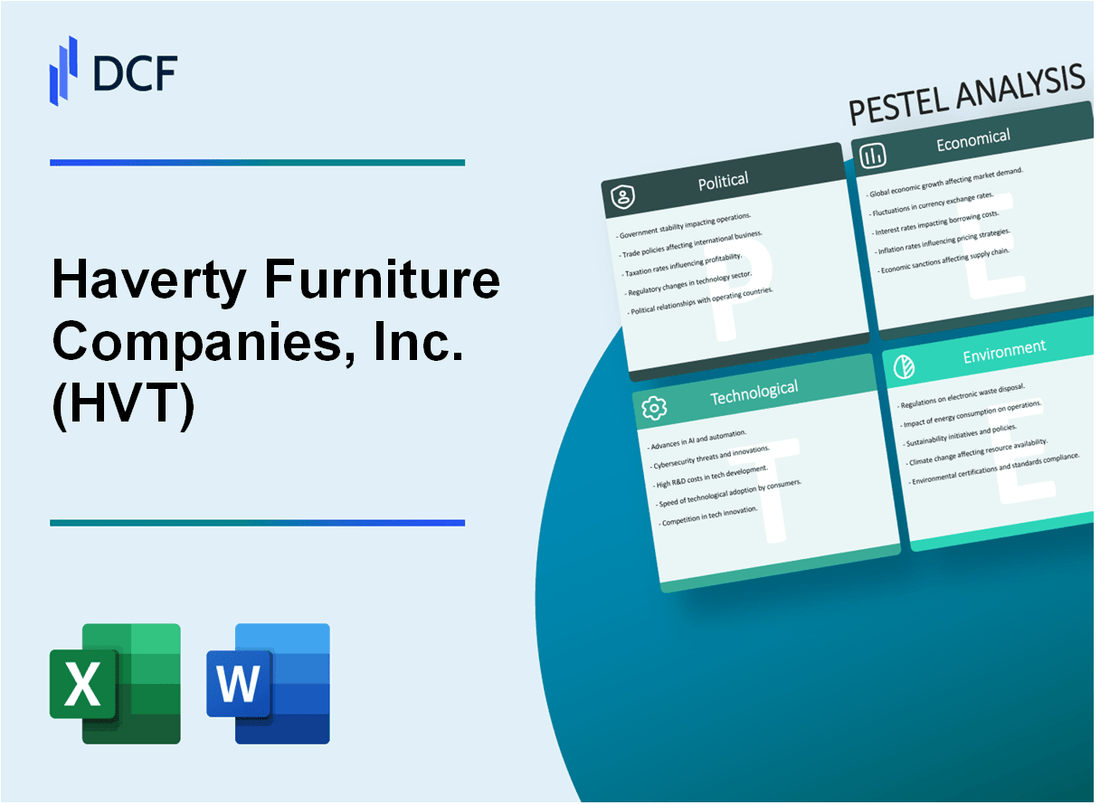
Haverty Furniture Companies, Inc. (HVT): Análise de Pestle [Jan-2025 Atualizado] |
Totalmente Editável: Adapte-Se Às Suas Necessidades No Excel Ou Planilhas
Design Profissional: Modelos Confiáveis E Padrão Da Indústria
Pré-Construídos Para Uso Rápido E Eficiente
Compatível com MAC/PC, totalmente desbloqueado
Não É Necessária Experiência; Fácil De Seguir
Haverty Furniture Companies, Inc. (HVT) Bundle
No cenário dinâmico do varejo de móveis, a Haverty Furniture Companies, Inc. (HVT) navega em uma complexa rede de forças externas que moldam sua trajetória estratégica. Desde as preferências em evolução do consumidor a interrupções tecnológicas e desafios ambientais, essa análise de pilões revela o ecossistema multifacetado que influencia as operações comerciais da HVT. Mergulhe em uma exploração abrangente dos fatores políticos, econômicos, sociológicos, tecnológicos, legais e ambientais que estão redefinindo o cenário competitivo da indústria de móveis, oferecendo informações sobre como a HVT se adapta e prospera em um mercado cada vez mais interconectado e em rápida mudança.
Haverty Furniture Companies, Inc. (HVT) - Análise de Pestle: Fatores políticos
Impacto potencial das políticas comerciais que afetam os regulamentos de importação/exportação de móveis
A partir de 2024, as tarifas de importação de móveis dos EUA permanecem significativas, com 25% de tarifas em determinados móveis de madeira da China. O cenário comercial atual mostra:
| País | Taxa tarifária de importação | Volume de importação anual |
|---|---|---|
| China | 25% | US $ 8,2 bilhões |
| Vietnã | 12-15% | US $ 5,6 bilhões |
| México | 0% (USMCA) | US $ 3,4 bilhões |
Mudanças nos incentivos do governo para setores de varejo e manufatura
Os incentivos atuais do governo incluem:
- Crédito tributário de investimento de fabricação de 6% para produção doméstica
- Dedução de pequenas empresas até US $ 1,29 milhão para 2024
- Créditos fiscais de eficiência energética que variam de US $ 250 a US $ 5.000 por investimento qualificado
Possíveis mudanças na legislação tributária que afeta os negócios de varejo de móveis
Considerações fiscais para Móveis Haverty em 2024:
| Categoria tributária | Taxa atual | Impacto potencial |
|---|---|---|
| Taxa de imposto corporativo | 21% | Flutuação potencial de 1-2% |
| Variação do imposto sobre vendas | 5-10% dependente do estado | Potencial harmonização interestadual |
Potenciais políticas de desenvolvimento econômico regional que influenciam o mercado de móveis
Iniciativas regionais de desenvolvimento econômico direcionadas ao setor de móveis:
- Oferta de manufatura do sudeste dos EUA Créditos fiscais de folha de pagamento até 5,5%
- Incentivos do Estado da Geórgia que fornecem Créditos de criação de empregos de US $ 3.500 por nova posição de fabricação
- Programa de concessão de desenvolvimento da indústria de móveis da Carolina do Norte com Alocação anual de US $ 2 milhões
Haverty Furniture Companies, Inc. (HVT) - Análise de Pestle: Fatores econômicos
Tendências de gastos com consumidores em andamento em móveis e decoração
Os móveis para casa dos EUA e os gastos com melhorias da casa atingiram US $ 394 bilhões em 2022, com uma taxa de crescimento anual composta prevista (CAGR) de 4,3% de 2023 a 2028.
| Ano | Gastos totais de mobiliário doméstico | Crescimento ano a ano |
|---|---|---|
| 2022 | US $ 394 bilhões | 5.2% |
| 2023 | US $ 414 bilhões | 5.1% |
| 2024 (projetado) | US $ 435 bilhões | 5.0% |
Mercado imobiliário flutuante influenciando diretamente a demanda de móveis
As vendas domésticas existentes em 2023 totalizaram 4,09 milhões de unidades, representando um declínio de 19,4% em relação a 2022. O preço médio da casa foi de US $ 387.600 em dezembro de 2023.
| Indicador do mercado imobiliário | 2022 | 2023 | Variação percentual |
|---|---|---|---|
| Vendas domésticas totais | 5,03 milhões | 4,09 milhões | -19.4% |
| Preço médio da casa | $378,400 | $387,600 | 2.4% |
Efeitos de inflação e taxa de juros no poder de compra do consumidor
A taxa de inflação dos EUA em dezembro de 2023 foi de 3,4%, abaixo dos 6,5% em dezembro de 2022. As taxas de juros do Federal Reserve permaneceram em 5,25% -5,50% em janeiro de 2024.
| Indicador econômico | Dezembro de 2022 | Dezembro de 2023 |
|---|---|---|
| Taxa de inflação | 6.5% | 3.4% |
| Taxa de fundos federais | 4.25%-4.50% | 5.25%-5.50% |
Recuperação econômica e tendências de renda descartável pós-pandêmica
A renda disponível pessoal dos EUA no terceiro trimestre de 2023 foi de US $ 16,5 trilhões, com uma taxa de poupança pessoal de 3,8%.
| Métrica de renda disponível | Q3 2022 | Q3 2023 | Variação percentual |
|---|---|---|---|
| Renda disponível pessoal | US $ 16,2 trilhões | US $ 16,5 trilhões | 1.9% |
| Taxa de poupança pessoal | 3.6% | 3.8% | 5.6% |
Haverty Furniture Companies, Inc. (HVT) - Análise de Pestle: Fatores sociais
Mudança de preferências do consumidor para experiências de compras online e híbridas
Em 2023, as vendas de móveis on -line atingiram US $ 27,9 bilhões, representando 26,7% do total de vendas de varejo de móveis nos Estados Unidos. As vendas on -line da Haverty Furniture aumentaram 18,3% em comparação com o ano anterior.
| Ano | Porcentagem de vendas on -line | Valor total de vendas on -line |
|---|---|---|
| 2022 | 22.4% | US $ 23,6 bilhões |
| 2023 | 26.7% | US $ 27,9 bilhões |
Mudanças demográficas na propriedade da casa e padrões de compra de móveis
A geração do milênio representou 43% dos compradores de imóveis em 2023, com um gasto médio de móveis de US $ 4.200 por família. Os proprietários iniciantes de 25 a 40 anos representam 37% das compras no mercado de móveis.
| Faixa etária | Taxa de propriedade da casa | Gastos médios de móveis |
|---|---|---|
| Millennials (25-40) | 43% | $4,200 |
| Gen Z (18-24) | 16% | $2,100 |
Ênfase crescente no design de móveis sustentável e ambientalmente consciente
65% dos consumidores preferem móveis ecológicos em 2023. O mercado de móveis sustentáveis espera -se que atinja US $ 52,6 bilhões até 2025, com uma taxa de crescimento anual composta de 7,2%.
| Métrica de sustentabilidade | 2023 valor | Valor projetado 2025 |
|---|---|---|
| Preferência do consumidor | 65% | 72% |
| Tamanho de mercado | US $ 45,3 bilhões | US $ 52,6 bilhões |
Tendências de trabalho remotas que afetam os móveis de casa e os mercados de móveis de escritório
78% das empresas apóiam modelos de trabalho híbrido em 2023. As vendas de móveis para escritório em casa aumentaram 32,4%, com gastos médios de US $ 1.850 por configuração do escritório em casa.
| Modelo de trabalho | Taxa de adoção | Impacto de vendas de móveis |
|---|---|---|
| Trabalho híbrido | 78% | Aumento de 32,4% |
| Gastos com escritório em casa | N / D | Média de US $ 1.850 |
Haverty Furniture Companies, Inc. (HVT) - Análise de Pestle: Fatores tecnológicos
Plataformas avançadas de comércio eletrônico e experiências de compras digitais
A partir do quarto trimestre de 2023, a receita de comércio eletrônico da Haverty Furniture atingiu US $ 157,3 milhões, representando 26,4% do total de vendas da empresa. A plataforma digital da empresa processou 412.000 transações on -line em 2023, com um valor médio de ordem de US $ 1.285.
| Métrica da plataforma digital | 2023 desempenho |
|---|---|
| Receita de vendas on -line | US $ 157,3 milhões |
| Total de transações online | 412,000 |
| Valor médio do pedido online | $1,285 |
| Porcentagem de vendas totais | 26.4% |
Implementação da realidade aumentada para visualização de móveis virtuais
A Haverty investiu US $ 2,7 milhões em tecnologia de realidade aumentada em 2023. A plataforma de AR permite que os clientes praticamente coloquem móveis em suas casas, com uma taxa de envolvimento do usuário de 38% e um aumento da taxa de conversão de 22%.
| Métrica de tecnologia AR | 2023 dados |
|---|---|
| Investimento em tecnologia | US $ 2,7 milhões |
| Taxa de envolvimento do usuário | 38% |
| Aumento da taxa de conversão | 22% |
Análise de dados para sistemas personalizados de recomendação de clientes
A Haverty implantou uma plataforma de análise de dados de US $ 1,9 milhão em 2023, processando 2,3 milhões de pontos de dados de interação do cliente. O sistema de recomendação gera sugestões personalizadas para 67% dos compradores on -line, aumentando o valor médio do pedido em US $ 215.
| Métrica de análise de dados | 2023 desempenho |
|---|---|
| Investimento da plataforma | US $ 1,9 milhão |
| Pontos de dados de interação do cliente | 2,3 milhões |
| Cobertura de recomendação personalizada | 67% |
| Aumento médio do valor da ordem | $215 |
Gerenciamento de inventário por meio de rastreamento avançado e tecnologias de IA
A Haverty implementou um sistema de gerenciamento de inventário de US $ 3,4 milhões em 2023. A tecnologia reduziu os custos de estoque em 16% e melhorou a precisão das ações para 97,5%. O sistema processa dados em tempo real de 42 centros de distribuição nos Estados Unidos.
| Métrica de Gerenciamento de Inventário | 2023 dados |
|---|---|
| Investimento em tecnologia | US $ 3,4 milhões |
| Redução de custos de transporte de estoque | 16% |
| Precisão do estoque | 97.5% |
| Centros de distribuição | 42 |
Haverty Furniture Companies, Inc. (HVT) - Análise de Pestle: Fatores Legais
Conformidade com os regulamentos de proteção do consumidor no setor de varejo
A Haverty Furniture Companies, Inc. adere a vários regulamentos federais e estaduais de proteção ao consumidor, incluindo:
| Regulamento | Detalhes da conformidade | Faixa de penalidade potencial |
|---|---|---|
| Lei de garantia de Magnuson-Moss | Documentação de garantia completa para produtos de móveis | US $ 43.280 por violação |
| Lei de Relatórios de Crédito Justo | Proteção estrita de informações de crédito ao cliente | Até US $ 1.000 por violação individual |
| Lei da verdade em empréstimos | Práticas de divulgação de financiamento transparentes | Pena civil de US $ 5.000 por violação |
Considerações de propriedade intelectual para design e fabricação de móveis
Portfólio de propriedade intelectual:
| Tipo IP | Número de registros | Duração da proteção |
|---|---|---|
| Patentes de design | 12 registros ativos | 15 anos a partir da data da concessão |
| Registros de marca registrada | 8 marcas comerciais ativas | 10 anos com períodos renováveis |
Regulamentos de direito e direito do trabalho que afetam as operações da empresa
Métricas principais de conformidade com as leis de trabalho:
- Total de funcionários: 1.789 a partir de 2023
- Conformidade com os regulamentos da EEOC
- Aderência salarial mínima: US $ 7,25 Federal Standard
| Categoria de lei trabalhista | Métrica de conformidade | Resultado da auditoria anual |
|---|---|---|
| Padrões de segurança da OSHA | 100% de conformidade | Zero grandes violações |
| Lei de padrões trabalhistas justos | Compensação completa de horas extras | Sem disputas salariais pendentes |
Requisitos de conformidade padrão de segurança e qualidade do produto
Métricas de segurança e conformidade de qualidade:
| Padrão | Nível de conformidade | Verificação de terceiros |
|---|---|---|
| California TB 117-2013 Padrão de incêndio | 100% de conformidade | Testes independentes anuais |
| Padrões de móveis internacionais da ASTM | Conformidade total | Auditorias trimestrais de qualidade |
| Comissão de Segurança de Produtos de Consumo | Zero Recorded Products em 2023 | Monitoramento contínuo |
Haverty Furniture Companies, Inc. (HVT) - Análise de Pestle: Fatores Ambientais
Foco crescente no fornecimento sustentável de materiais de móveis
De acordo com o relatório anual de 2022 da Haverty Furniture, a empresa adquiriu 37% dos materiais de madeira de fontes florestais sustentáveis certificadas. A estratégia de compras de madeira da empresa tem como alvo uma meta de fornecimento sustentável de 50% até 2025.
| Fonte de material | Porcentagem de sustentabilidade | Volume anual |
|---|---|---|
| Madeira certificada pelo FSC | 22% | 1.245 toneladas métricas |
| Madeira certificada pelo PEFC | 15% | 845 toneladas métricas |
| Madeira não certificada | 63% | 3.560 toneladas métricas |
Redução da pegada de carbono em processos de fabricação e logística
Haverty Furniture relatou um 12,4% de redução nas emissões de carbono Das operações de fabricação e transporte em 2022, com emissões totais medidas em 42.675 toneladas de CO2 equivalentes.
| Fonte de emissão | Emissões de carbono (toneladas métricas) | Porcentagem de redução |
|---|---|---|
| Instalações de fabricação | 24,350 | 8.2% |
| Transporte e logística | 18,325 | 16.7% |
Crescente demanda do consumidor por produtos de móveis ecológicos e recicláveis
A pesquisa do consumidor indica que 42% da base de clientes da Haverty agora prioriza as opções de móveis ecológicas. A empresa introduziu 18 novas linhas de produtos ecológicas em 2022, representando 22% do seu catálogo total de produtos.
| Categoria de produto | Linhas de produtos ecológicas | Porcentagem de catálogo |
|---|---|---|
| Móveis da sala de estar | 7 linhas | 25% |
| Móveis de quarto | 6 linhas | 20% |
| Móveis de jantar | 5 linhas | 17% |
Implementando práticas de fabricação e embalagem verdes
A Haverty Furniture investiu US $ 3,2 milhões em tecnologias de fabricação verde em 2022. A empresa alcançou um Redução de 28% no desperdício de embalagens por meio de estratégias inovadoras de reciclagem e otimização de materiais.
| Iniciativa verde | Valor do investimento | Impacto ambiental |
|---|---|---|
| Materiais de embalagem reciclados | US $ 1,5 milhão | 65% de conteúdo reciclado |
| Equipamento de fabricação com eficiência energética | US $ 1,7 milhão | 15% de redução do consumo de energia |
Haverty Furniture Companies, Inc. (HVT) - PESTLE Analysis: Social factors
Growing consumer demand for durable, high-quality, and sustainable home furnishings
You're seeing a clear shift in consumer psychology: people are moving away from fast furniture and treating their purchases as a long-term investment. This is a significant tailwind for a quality-focused retailer like Haverty Furniture Companies, Inc. (HVT). The market for sustainable furniture in the U.S. is a real growth engine, valued at $12.72 billion in 2025, and it's expanding faster than the broader sector. Consumers, especially Millennials and Gen Z, are driving this, with a reported 76% of them willing to pay a premium for eco-friendly pieces. That's a huge opportunity to capture higher-margin sales.
This isn't just about feeling good; it's about value. When household budgets are tight, a durable, high-quality sofa that lasts ten years is a smarter financial move than a cheaper one that needs replacing in three. We're seeing consumers prioritize pieces that justify a higher ticket price, which plays right into HVT's established brand image. The overall U.S. furniture market is projected to grow at a Compound Annual Growth Rate (CAGR) of 6.2% from 2025 to 2033, but the premium, durable segment is outpacing that.
Demographic shift to smaller households drives demand for versatile, multi-functional pieces
The escalating cost of housing is fundamentally changing how Americans furnish their homes. With the median sales price of houses sold in the U.S. hitting $416,900 in the first quarter of 2025, many buyers are settling for smaller spaces or renting for longer. This means the furniture you sell must work harder. It needs to be versatile.
The resulting demand for space-saving, multifunctional furniture is strong. The market for storage furniture alone is projected to rise at a CAGR of 7.3% from 2025 to 2033. Younger households are specifically channeling their budgets toward modular storage and sectional sofas that can optimize a smaller footprint. This trend requires HVT to defintely focus on designs that blend form and function, like extendable tables or storage-integrated beds.
Remote work trends sustain spending on home office and comfortable living spaces
The work-from-home revolution is no longer a temporary blip; it's a permanent fixture that continues to fuel home spending. The share of U.S. employees working from home reached 23% by mid-2024, a figure about 1.6 times higher than pre-pandemic levels. This has turned the home into a central hub for work, leisure, and family life, sustaining demand for comfortable, high-quality furniture beyond just the office.
The United States Work from Home Furniture Market, valued at $3.21 billion in 2024, is anticipated to grow to $5.60 billion by 2030 with a CAGR of 9.78%. This growth is driven by a focus on ergonomic designs for productivity. For HVT, this means a sustained opportunity not just in desks and chairs, but also in premium, durable living room furniture, as workers invest in comfortable, multi-use spaces.
- Demand for home office furniture is expected to rise over 15% annually through 2025.
- Consumers prioritize ergonomic and tech-integrated designs.
- The home is now a permanent co-working and living space.
Increased focus on 'buy now, pay later' (BNPL) financing options due to tighter consumer credit
Tighter consumer credit and persistent inflation mean many customers, even those buying premium items, are looking for flexible payment options to manage cash flow. This is why 'Buy Now, Pay Later' (BNPL) has become a critical social factor, especially in big-ticket retail like furniture. The number of American consumers using BNPL is expected to reach 91.5 million in 2025, a 5.78% year-over-year increase.
Here's the quick math: BNPL purchase volume in the U.S. is projected to total $122.3 billion in 2025, up 10.9% from the prior year. Home and furniture is the most popular spending category for BNPL users, with 42% making these purchases through installment plans. For a retailer like HVT, offering a seamless BNPL option is no longer a competitive edge-it's a requirement to convert a sale, especially since 36% of users rely on it for cash flow management. Honestly, if you don't offer it, you risk losing a significant portion of the younger, financially-conscious customer base.
| BNPL Adoption in U.S. (2025 Fiscal Year Data) | Amount/Percentage | Context |
|---|---|---|
| Projected U.S. BNPL Users | 91.5 million | Up 5.78% YoY in 2025. |
| Projected U.S. BNPL Purchase Volume | $122.3 billion | Up 10.9% YoY in 2025. |
| BNPL Use in Home & Furniture Category | 42% of users | Most popular spending category for BNPL. |
| Primary Reason for BNPL Use | 36% for cash flow management | Chief reason people turn to BNPL. |
Haverty Furniture Companies, Inc. (HVT) - PESTLE Analysis: Technological factors
E-commerce penetration must accelerate to compete with pure-play online retailers.
You're seeing the digital shift accelerate across all retail, and Haverty Furniture Companies, Inc. (HVT) is no exception. While the company maintains a strong physical footprint with 129 showrooms across 17 states, e-commerce penetration remains a key technological challenge and opportunity. In 2024, online sales accounted for approximately 3.0% of total sales [cite: 2 from step 2], which is low compared to pure-play online furniture competitors.
The good news is the digital segment is growing fast. Haverty Furniture's e-commerce sales grew by a strong 13.6% in Q3 2025 [cite: 6 from step 2], outpacing the overall sales growth of 10.6% for the quarter. This acceleration is crucial, but the company must defintely invest more to close the gap with digital-first rivals who capture a much larger share of the online furniture market.
Here's the quick math: to reach just 10% of the Q3 2025 net sales of $194.5 million from e-commerce alone, the company would need to generate nearly $19.5 million in online sales for that quarter, a significant jump from the current base.
Investment in augmented reality (AR) tools improves the virtual shopping experience.
The furniture industry is embracing Augmented Reality (AR) to overcome the biggest hurdle in online furniture shopping: visualization. Haverty Furniture is already making moves here, offering a 3-D room planner and upholstery customization tools on its website [cite: 2 from step 2]. This technology helps customers place virtual furniture in their actual living space, boosting confidence before purchase.
This is a smart investment because the industry data shows a clear return. For instance, similar visualization tools used by other major retailers have led to a 60% larger average basket size and a 25% reduction in returns in pilot programs [cite: 9 from step 2]. To keep pace, Haverty Furniture is allocating capital expenditures (CapEx) for technology, with approximately $2.6 million expected for Information Technology investments in 2025 [cite: 1 from step 1].
The goal is to merge the physical and digital retail experiences-what we call 'phygital'-to meet rising consumer expectations. Customers now expect to visualize items in their own space, and this technology is the bridge.
Supply chain visibility technology is crucial for managing lead times and inventory.
In a global furniture supply chain, visibility is everything. You cannot manage what you cannot see. Haverty Furniture has a long-standing foundation in advanced supply chain technology, leveraging a multi-party platform like Infor Nexus (a Supply Chain Network application) to orchestrate its complex global network of suppliers, carriers, and logistics providers.
This system provides end-to-end visibility, allowing the company to track goods from the overseas factory floor to the final warehouse delivery. This is critical for managing customer expectations and lead times, especially given the geopolitical and tariff uncertainties of 2025. The company's VP of Supply Chain, Abir Thakurta, emphasized at the NRF 2025 conference that the trick is to see supply chain uncertainty as an opportunity to outmaneuver the competition.
The continuous integration of this networked data, which was a key discussion point for Haverty Furniture at the Infor Nexus Connect 2025 event, ensures that logistics teams can use real-time Estimated Times of Arrival (ETAs) to schedule receiving at the warehouse, which in turn minimizes costly multiple delivery trips to customers.
Data analytics helps personalize marketing and optimize inventory across 120+ stores.
With 129 stores and a high average written ticket of $7,986 in Q3 2025 [cite: 3 from step 2], every customer interaction needs to be highly personalized. Data analytics is the engine for this. Haverty Furniture's strategic marketing investments, which contributed to an increase of $2.8 million in advertising and marketing costs in Q3 2025, are directly aimed at driving customer traffic and securing higher average tickets [cite: 4 from step 2].
The company is using data to optimize its omni-channel approach, focusing on two key areas:
- Personalized Marketing: Identifying customer segments most likely to purchase high-value items, like those who engage with the in-home design service (which accounted for 34.2% of written business in Q3 2025).
- Inventory Optimization: Using sales data and digital browsing patterns to ensure the right product mix is in the right regional distribution center, aiming for 'perfect inventory' to meet unpredictable consumer demand [cite: 4 from step 3].
This data-driven approach is essential for a retailer with a long purchase cycle, helping to predict the next purchase, like a customer buying a bedroom set after a dining room purchase, and then targeting them with a relevant campaign.
Haverty Furniture Companies, Inc. (HVT) - PESTLE Analysis: Legal factors
Compliance with complex state-level product safety and flammability standards (e.g., California).
The biggest legal shift for furniture retailers like Haverty Furniture Companies in recent years has been the federal adoption of what used to be a state-specific rule. The U.S. Consumer Product Safety Commission (CPSC) now mandates that all upholstered residential furniture manufactured or imported for sale in the U.S. must comply with the federal flammability standard, which is essentially the California Technical Bulletin 117-2013 (TB 117-2013) standard.
This national standard, effective since June 2021, requires upholstered furniture components-like cover fabrics and filling materials-to resist ignition from a smoldering cigarette. While this simplifies compliance by eliminating a patchwork of state rules, Haverty Furniture Companies still faces ongoing legal scrutiny and costs related to:
- Sourcing materials that meet the TB 117-2013 test methods.
- Ensuring all products bear the required permanent label stating, Complies with U.S. CPSC requirements for upholstered furniture flammability.
- Navigating California Proposition 65, which requires clear warnings for products containing certain listed chemicals, such as formaldehyde or specific flame retardants, common in furniture materials.
The compliance cost here is less about a new rule and more about consistent, rigorous supply chain vetting. It's defintely a non-negotiable cost of doing business.
Labor laws and wage mandates in key operating states increase payroll expenses.
Operating in 16 states means Haverty Furniture Companies must constantly adapt to a complex web of state and municipal labor laws, especially concerning minimum wage and overtime exemption thresholds. The trend is clear: state-level mandates are rising faster than the federal minimum wage of $7.25 per hour.
For example, in California, a key market, the state minimum wage increased to $16.50 per hour effective January 1, 2025. This increase also pushes the minimum annual salary for a full-time exempt employee (like a manager) to $68,640. Missouri, another state where Haverty Furniture Companies operates, saw its minimum wage rise to $13.75 per hour in 2025. This upward pressure on wages, even for non-minimum wage workers, directly impacts Selling, General, and Administrative (SG&A) expenses. The company reported an increase in administrative expenses of $3.4 million in Q2 2025, primarily driven by increased salaries and performance-based incentive compensation.
Data privacy regulations (like CCPA) require constant updates to customer data handling.
As a large retailer with significant online and in-store sales, Haverty Furniture Companies is subject to the California Consumer Privacy Act (CCPA), as amended by the California Privacy Rights Act (CPRA), because its annual revenue far exceeds the 2025 threshold of $26,625,000. The company's 2024 net sales were $722.9 million, so compliance is mandatory.
Compliance is a recurring operational expense. Large companies (over 500 employees) were initially estimated to face compliance costs of up to $2 million, and that's just the start. The real risk lies in penalties. Non-compliance can lead to fines of up to $7,988 per intentional violation, and the California Privacy Protection Agency (CPPA) is actively enforcing these rules, focusing on issues like Automated Decision-making Technology (ADMT) and mandatory Cybersecurity Audits in 2025. You need to treat customer data like the legal liability it is.
Lease agreements for their extensive retail footprint pose long-term contractual obligations.
The company's business model relies on a large retail footprint, operating 129 locations as of Q3 2025. The financial commitment for these stores and distribution centers is substantial, locked in through long-term operating lease agreements. This creates a massive long-term liability on the balance sheet.
To give you a sense of the scale, the total undiscounted future minimum lease payments for Haverty Furniture Companies were approximately $32.1 million for the year 2025 alone (based on the latest publicly available granular schedule). The total discounted operating lease liabilities on the balance sheet were over $230 million as of December 31, 2021. The legal risk here is twofold: the sheer size of the long-term contractual obligation and the rising cost of occupancy, which increased by $1.5 million in Q2 2025, largely due to costs related to new locations. Furthermore, new laws like California's SB 1103, effective January 1, 2025, introduce new tenant protections for 'qualifying commercial tenants,' which could slightly alter the landlord-tenant dynamic and notice requirements for rent increases in that key state.
| Legal Compliance Area | 2025 Key Legal Mandate/Threshold | Haverty Furniture Companies Impact/Metric |
|---|---|---|
| Product Safety (Flammability) | Federal adoption of California TB 117-2013 standard | Mandatory compliance for all upholstered goods sold in 129 locations |
| Labor & Wage Mandates | California Minimum Wage: $16.50/hour California Exempt Salary Threshold: $68,640/annually |
Contributed to $3.4 million increase in Q2 2025 administrative expenses (salaries/compensation) |
| Data Privacy (CCPA/CPRA) | Revenue Threshold: $26,625,000 Max Intentional Penalty: $7,988 per violation |
Applicable due to 2024 Net Sales of $722.9 million Requires ongoing operational compliance and risk assessment |
| Retail Lease Obligations | New commercial tenant protections (e.g., California SB 1103) | Estimated undiscounted minimum lease payments for 2025: $32.1 million Total operating lease liabilities (discounted) were over $230 million |
Haverty Furniture Companies, Inc. (HVT) - PESTLE Analysis: Environmental factors
Pressure to reduce the carbon footprint of global shipping and logistics operations.
The biggest environmental pressure point for Haverty Furniture Companies, Inc. is defintely its Scope 3 emissions-the indirect ones from its value chain, specifically global logistics. You see, a substantial portion of the company's wood products (case goods) and leather upholstery is imported from Asia, meaning long-haul ocean freight and subsequent road freight are major carbon drivers. While HVT does not publicly report its absolute 2025 Scope 3 emissions, the industry benchmark shows that international maritime shipping alone contributed 706 million metric tons of CO₂ in 2023, and road freight generates about 53% of CO₂ emissions within global trade-related transport.
This external pressure maps to a clear financial risk. As of Q3 2025, HVT reported consolidated sales of $194.5 million. Any future carbon taxes or fuel surcharges, driven by this global push for decarbonization, will hit the cost of goods sold (COGS) and directly erode the gross profit margin, which stood at a solid 60.3% in Q3 2025. The company has a good internal baseline, having achieved a 46% reduction in electric energy usage compared to its 2008 baseline by 2018 across its nearly 7 million square feet of facilities, but that only addresses a fraction of the total footprint.
Here's the quick math on the challenge:
- Air freight is roughly 2.57 lbs CO₂ per ton-mile.
- Truck freight is about 0.4 lbs CO₂ per ton-mile.
- Ocean freight is the most efficient at 0.13 lbs CO₂ per ton-mile, but the sheer volume of imports makes it the primary risk.
The company's planned $24.0 million in 2025 capital expenditures should include investments in logistics optimization software to consolidate shipments and reduce empty miles. That's a clear action item.
Increased consumer scrutiny on the sourcing of wood and other raw materials.
This is a critical, near-term risk that went from a voluntary best practice to a regulatory mandate in 2024/2025. The U.S. Lacey Act, which prohibits the trade of illegally sourced plants and plant products, was significantly expanded in June 2024 with Phase VII. This expansion now requires importers of wooden furniture-which is a core product for HVT-to provide a formal declaration that includes the genus, species, and country of origin of the wood.
What this means is that HVT's supply chain transparency must be absolute, especially since most of its wood products are imported from Asia. Failure to comply can result in fines, penalties, and seizure of goods, which is a direct hit to inventory and brand reputation. The market is increasingly demanding third-party verification, such as Forest Stewardship Council (FSC) certification, which provides a credible verification of legality and sustainable forest management.
The external pressure is high, and the internal disclosure is low.
| Raw Material Risk Factor | 2025 Regulatory Impact | Haverty Furniture Companies, Inc. Action Required |
|---|---|---|
| Illegal Logging/Sourcing | U.S. Lacey Act Phase VII (June 2024) mandates species and country of origin declaration for all wooden furniture imports. | Implement a granular, auditable supplier tracking system for all Asian imports to ensure full compliance and avoid forfeiture risk. |
| Deforestation/Biodiversity Loss | Increasing consumer demand for certified wood (FSC, SFI) as a standard for furniture. | Formalize a public wood sourcing policy and begin requiring a minimum percentage of FSC-Mix or FSC-Certified wood from suppliers. |
Need for better waste management and recycling programs for packaging and old furniture.
The furniture sector has a massive waste problem, primarily from bulky product packaging and old furniture disposal. The overall waste and recycling market is seeing strong growth, with a projected compound annual growth rate (CAGR) of 5.1% from 2024 to 2025, which shows the scale of the industry shift. HVT has a long history of internal recycling, having been recognized by environmental services company Avangard Innovative every year since 2014 for its efforts.
However, the focus is shifting from simply recycling cardboard in the warehouse to addressing the entire product lifecycle, including reverse logistics (handling returns and old furniture). The key opportunity here is a circular economy model. For instance, a major North American waste company diverted over 1.2 million tons of combined material from disposal in 2024.
HVT needs to move beyond internal facility recycling to a customer-facing 'take-back' program for old furniture, especially since the waste stream is a growing concern. What this estimate hides is the volume of Styrofoam and plastic wrap used in importing case goods; those are the real packaging targets.
Reporting requirements for Environmental, Social, and Governance (ESG) metrics are defintely increasing.
While HVT currently uses its 'Stewardship' tear sheet, the regulatory environment for large, publicly traded U.S. companies is moving toward mandatory, standardized ESG disclosure. The Sustainability Accounting Standards Board (SASB) standards, which HVT references, are now part of the International Sustainability Standards Board (ISSB), pushing for more comparable and decision-useful data.
The most significant increase in scrutiny is on Scope 3 emissions (the supply chain), which is a huge blind spot for furniture retailers. Investors and financial professionals are increasingly prioritizing this data. For you, the financially-literate decision-maker, the lack of a current, quantifiable GHG emissions table from HVT creates an information gap when assessing long-term climate risk and capital allocation. The market will soon penalize companies that cannot provide this data. The next step is clear: HVT needs to calculate and disclose its 2025 Scope 3 emissions, driven by its Asian import supply chain, to meet evolving investor expectations.
Disclaimer
All information, articles, and product details provided on this website are for general informational and educational purposes only. We do not claim any ownership over, nor do we intend to infringe upon, any trademarks, copyrights, logos, brand names, or other intellectual property mentioned or depicted on this site. Such intellectual property remains the property of its respective owners, and any references here are made solely for identification or informational purposes, without implying any affiliation, endorsement, or partnership.
We make no representations or warranties, express or implied, regarding the accuracy, completeness, or suitability of any content or products presented. Nothing on this website should be construed as legal, tax, investment, financial, medical, or other professional advice. In addition, no part of this site—including articles or product references—constitutes a solicitation, recommendation, endorsement, advertisement, or offer to buy or sell any securities, franchises, or other financial instruments, particularly in jurisdictions where such activity would be unlawful.
All content is of a general nature and may not address the specific circumstances of any individual or entity. It is not a substitute for professional advice or services. Any actions you take based on the information provided here are strictly at your own risk. You accept full responsibility for any decisions or outcomes arising from your use of this website and agree to release us from any liability in connection with your use of, or reliance upon, the content or products found herein.