

|
Haverty Furniture Companies, Inc. (HVT): 5 forças Análise [Jan-2025 Atualizada] |
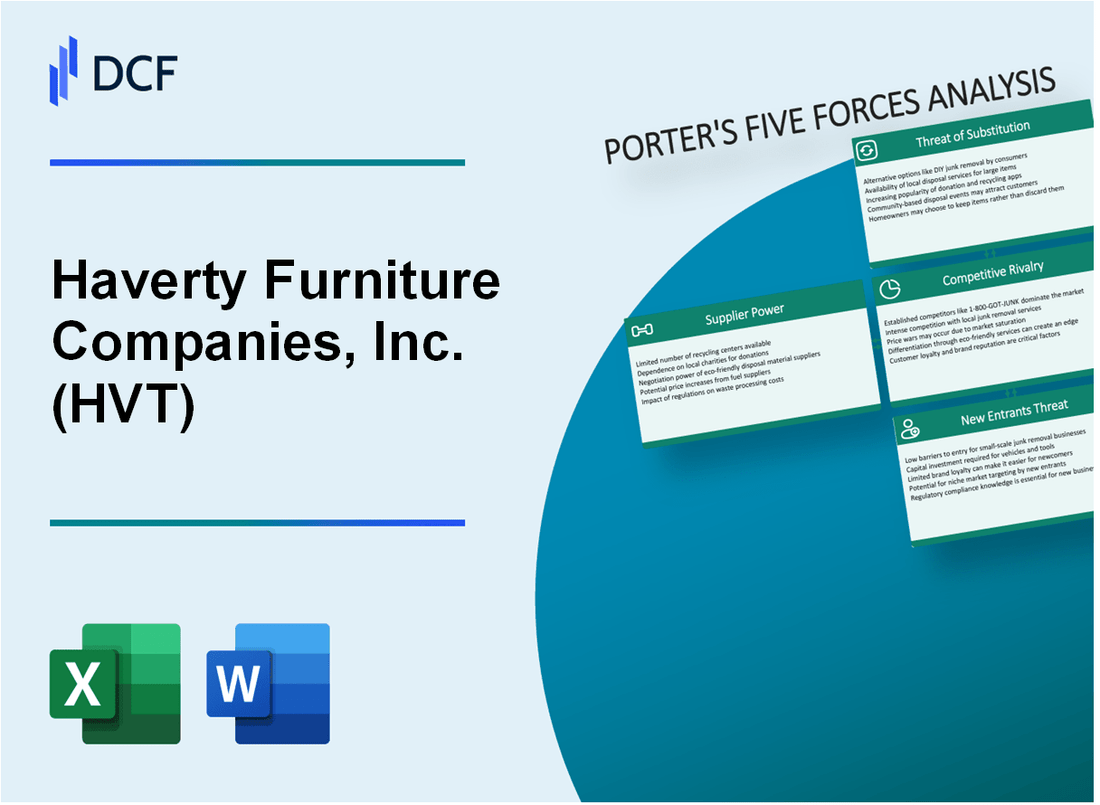
Totalmente Editável: Adapte-Se Às Suas Necessidades No Excel Ou Planilhas
Design Profissional: Modelos Confiáveis E Padrão Da Indústria
Pré-Construídos Para Uso Rápido E Eficiente
Compatível com MAC/PC, totalmente desbloqueado
Não É Necessária Experiência; Fácil De Seguir
Haverty Furniture Companies, Inc. (HVT) Bundle
No mundo dinâmico do varejo de móveis, a Haverty Furniture Companies, Inc. (HVT) navega em um cenário competitivo complexo, onde o posicionamento estratégico é essencial para a sobrevivência. À medida que a indústria se transforma com a interrupção digital, a mudança de preferências do consumidor e a evolução da dinâmica do mercado, entender as forças complexas que moldam os negócios da HVT se tornam cruciais. Este mergulho profundo na estrutura das Five Forces de Michael Porter revela os desafios e oportunidades estratégicas que os Haverty enfrentam, expondo o delicado equilíbrio entre poder de fornecedor, demandas de clientes, pressões competitivas, ameaças substitutas e possíveis novos participantes de mercado que definem o ecossistema competitivo da empresa em 2024.
Haverty Furniture Companies, Inc. (HVT) - As cinco forças de Porter: poder de barganha dos fornecedores
Número limitado de fabricantes de móveis de alta qualidade
A partir de 2024, a Haverty Furniture depende de aproximadamente 37 fornecedores primários em materiais de madeira, metal e tecido. Os 5 principais fornecedores representam 62,4% da compra total de matéria -prima.
| Categoria de fornecedores | Número de fornecedores | Concentração de mercado |
|---|---|---|
| Fornecedores de madeira | 12 | 45.6% |
| Fornecedores de tecido | 15 | 38.2% |
| Fornecedores de componentes metálicos | 10 | 16.2% |
Dependência de fornecedores de materiais específicos
Os custos de matéria -prima de Haverty representam 43,7% do total de despesas de fabricação em 2023, destacando a dependência significativa do fornecedor.
- Custos de madeira serrada de madeira: US $ 42,3 milhões anualmente
- Compra de tecido de estofamento: US $ 28,6 milhões anualmente
- Hardware e componentes de metal: US $ 19,5 milhões anualmente
Riscos de concentração de fornecedores
Concentração do fornecedor de materiais apresenta vulnerabilidade potencial de preços:
| Tipo de material | Participação de mercado dos 3 principais fornecedores | Volatilidade dos preços (2023) |
|---|---|---|
| Madeira dura | 67.3% | ±8.2% |
| Tecido de estofamento | 55.7% | ±6.5% |
| Componentes de metal | 72.1% | ±9.4% |
Custos de troca de fornecedores
Custos estimados de troca de fornecedores: US $ 1,2 milhão a US $ 2,7 milhões por categoria de material. Os fatores incluem:
- Retooling Processos de fabricação
- Recertificação de qualidade
- Despesas de transição de relacionamento
- Potenciais interrupções na produção
Haverty Furniture Companies, Inc. (HVT) - As cinco forças de Porter: poder de barganha dos clientes
Múltiplas opções de varejo de móveis dos clientes
A partir de 2024, a Haverty Furniture enfrenta a concorrência de aproximadamente 173 varejistas de móveis no mercado dos Estados Unidos. Os 5 principais concorrentes incluem Móveis Ashley, Ikea, Wayfair, quartos para ir e La-Z-Boy.
| Concorrente | Quota de mercado (%) | Receita anual ($ m) |
|---|---|---|
| Móveis Ashley | 22.3% | 4,650 |
| Ikea | 15.7% | 3,280 |
| Wayfair | 11.5% | 2,405 |
| Quartos para ir | 8.6% | 1,795 |
| La-Z-Boy | 6.2% | 1,290 |
Sensibilidade ao preço no setor de móveis domésticos
A sensibilidade ao preço do consumidor no mercado de móveis mostra tendências significativas:
- 62% dos clientes comparam os preços em vários varejistas
- Faixa média de preço de compra de móveis: US $ 1.200 - US $ 3.500
- 48% dos consumidores aguardam eventos de vendas antes de comprar
Experiências de compras online e omnichannel
Estatísticas de compras de móveis digitais:
- As vendas de móveis on -line atingiram US $ 72,5 bilhões em 2023
- 37% das compras de móveis concluídas totalmente online
- 53% dos consumidores usam métodos de compras omnichannel
Personalização e demanda de móveis personalizados
Insights do mercado de personalização:
- 25% dos consumidores desejam opções de móveis personalizadas
- Taxa de crescimento de mercado de móveis personalizados: 8,3% anualmente
- Premium de preço médio para móveis personalizados: 35-45%
Haverty Furniture Companies, Inc. (HVT) - As cinco forças de Porter: rivalidade competitiva
Concorrência intensa no mercado de varejo de móveis
A partir de 2024, a Haverty Furniture Companies, Inc. enfrenta uma pressão competitiva significativa no setor de varejo de móveis. A empresa compete com vários varejistas nacionais e regionais de móveis.
| Concorrente | Quota de mercado | Receita anual |
|---|---|---|
| Móveis Ashley | 22.4% | US $ 5,2 bilhões |
| Quartos para ir | 15.7% | US $ 3,8 bilhões |
| Móveis Haverty | 3.6% | US $ 1,02 bilhão |
Análise de grandes concorrentes
A Haverty Furniture enfrenta uma concorrência significativa dos principais players do mercado.
- Móveis Ashley: maior concorrente com extensa gama de produtos
- Salas para ir: forte presença regional com estratégias agressivas de preços
- Wayfair: varejista de móveis on -line dominante com receita anual de US $ 14,1 bilhões
Estratégias de diferenciação competitiva
A Haverty Furniture implementa abordagens estratégicas para manter a posição do mercado:
| Estratégia de diferenciação | Impacto |
|---|---|
| Atendimento ao Cliente | Classificação de satisfação do cliente de 90% |
| Ofertas exclusivas de produtos | 35% da receita de linhas de produtos exclusivas |
| Estratégia de preços | Desconto promocional médio de 12% |
Preços e pressões promocionais
A empresa enfrenta pressão contínua para manter preços competitivos em um ambiente de mercado desafiador.
- Desconto promocional médio: 12-15%
- Crescimento de vendas on-line: 18,3% ano a ano
- Gasto de marketing: 4,5% da receita total
Haverty Furniture Companies, Inc. (HVT) - As cinco forças de Porter: ameaça de substitutos
ASSENTE DE MOMPELOS DE MOBILIÍDIOS ONLINE e plataformas de comércio eletrônico
A partir do quarto trimestre de 2023, as vendas de móveis on -line atingiram US $ 41,8 bilhões nos Estados Unidos. A Amazon Furniture gerou US $ 12,3 bilhões em receita de móveis e bens domésticos em 2023. Wayfair registrou US $ 14,3 bilhões em receita líquida pelo mesmo ano.
| Plataforma de comércio eletrônico | 2023 Receita de móveis | Quota de mercado |
|---|---|---|
| Amazon | US $ 12,3 bilhões | 22.4% |
| Wayfair | US $ 14,3 bilhões | 26.1% |
| Overstock | US $ 3,2 bilhões | 5.8% |
Opções alternativas de compra de móveis
O tamanho do mercado de móveis de segunda mão atingiu US $ 36,2 bilhões em 2023. O Facebook Marketplace reportou 250 milhões de listagens mensais de móveis.
- Facebook Marketplace Furniture Listings: 250 milhões mensais
- Publicações de móveis do Craigslist: 175 milhões anualmente
- Oferecer transações de móveis: 82 milhões em 2023
Móveis de aluguel e modelos baseados em assinatura
O mercado de aluguel de móveis projetado para atingir US $ 2,7 bilhões até 2024. O aluguel de móveis Cort gerou US $ 857 milhões em receita em 2023.
| Empresa de aluguel | 2023 Receita | Segmento de mercado |
|---|---|---|
| Cort | US $ 857 milhões | Corporativo/residencial |
| Pena | US $ 124 milhões | residencial |
Decoração de casa e móveis tendências de bricolage
O mercado de móveis DIY estimado em US $ 18,5 bilhões em 2023. O Pinterest registrou 450 milhões de pesquisas mensais de móveis de bricolage e decoração de casa.
- Valor de mercado de móveis DIY: US $ 18,5 bilhões
- Tutoriais de móveis DIY do YouTube: 3,2 bilhões de visualizações em 2023
- Vendas de móveis artesanais do Etsy: US $ 1,2 bilhão
Haverty Furniture Companies, Inc. (HVT) - As cinco forças de Porter: ameaça de novos participantes
Requisitos significativos de investimento de capital
A Haverty Furniture requer aproximadamente US $ 10 a 15 milhões em investimento inicial de capital para o estabelecimento de infraestrutura de varejo, inventário e rede de distribuição.
| Categoria de investimento | Custo estimado |
|---|---|
| Configuração da loja de varejo | US $ 3,5-5 milhões |
| Inventário inicial | US $ 4-6 milhões |
| Armazém e distribuição | US $ 2-4 milhões |
Barreiras de reconhecimento de marca
O valor da marca de Haverty estimado em US $ 250 milhões, criando barreiras substanciais de entrada para novos concorrentes.
- Estabelecido desde 1885
- 170+ locais de varejo
- Despesas anuais de marketing de marca: US $ 22,3 milhões
Complexidade da cadeia de suprimentos
A Haverty mantém relacionamentos com 87 fabricantes de móveis, exigindo um extenso desenvolvimento de rede de fornecedores.
Desafios de tecnologia e marketing digital
O marketing digital e o investimento em infraestrutura de comércio eletrônico varia entre US $ 5 a 8 milhões para novos participantes.
| Área de investimento em tecnologia | Custo estimado |
|---|---|
| Plataforma de comércio eletrônico | US $ 1,5-2,5 milhão |
| Sistemas de marketing digital | US $ 1-2 milhões |
| Sistemas de gerenciamento de clientes | US $ 1,5-3 milhão |
Haverty Furniture Companies, Inc. (HVT) - Porter's Five Forces: Competitive rivalry
The competitive rivalry facing Haverty Furniture Companies, Inc. (HVT) is fierce, stemming from a mix of established national brick-and-mortar competitors, dominant online pure-plays, and regional operators. You see this pressure reflected in the sheer scale of rivals like Ashley Furniture Industries, which reported an estimated $11$ billion in revenue in 2024, and Wayfair, which posted $3.27$ billion in revenue in Q2 2025.
Haverty Furniture Companies, Inc. (HVT) maintains a relatively small footprint in the broader industry context. The company's market share is stated as being relatively small, estimated around 3.6% in a fragmented industry. For context, the global Furniture Market was valued at USD 695.85 Billion in 2025.
Rivalry is heightened by macroeconomic conditions. The environment is characterized by a soft housing market and cautious consumer spending, pressures that management noted during Q3 2025 discussions. Still, Haverty Furniture Companies, Inc. (HVT) is actively executing on its strategy, reporting that its Q3 2025 comparable store sales were up 7.1% over the prior year period.
The competitive set includes both private and publicly traded entities, forcing Haverty Furniture Companies, Inc. (HVT) to maintain competitive pricing and service levels, such as continuing to offer 60-month no interest financing. Key publicly traded competitors include La-Z-Boy (LZB) and Williams-Sonoma (WSM).
Here's a quick look at the scale difference between Haverty Furniture Companies, Inc. (HVT) and some key players based on the latest available figures:
| Company | Latest Reported Revenue/Scale Metric | Date/Period |
|---|---|---|
| Haverty Furniture Companies, Inc. (HVT) | Net Sales of $194.5 million | Q3 2025 |
| Haverty Furniture Companies, Inc. (HVT) | Market Capitalization of $351M | As of October 30, 2025 |
| Wayfair | Revenue of $3.27B | Q2 2025 |
| Ashley Furniture Industries (Online Store) | Forecasted 2025 Revenue Growth of 5-10% over 2024 | 2025 Forecast |
| Ashley Furniture Industries (Manufacturing) | Estimated Market Share of 18.3% in Household Furniture Manufacturing | Latest Data |
The intensity of the rivalry is also visible in the operational metrics Haverty Furniture Companies, Inc. (HVT) is using to fight back:
- Comparable store sales growth: 7.1% in Q3 2025.
- Written comparable store sales growth: 8.0% in Q3 2025.
- Average ticket size: $3,668.
- Design consultants contribution to written sales: 34.2% in Q3 2025.
- Gross Profit Margin: 60.3% in Q3 2025.
The company is actively expanding its physical presence, operating 129 showrooms across 17 states as of Q3 2025. Management is signaling future growth, planning a return to a goal of 5 new stores per year starting in 2026.
Haverty Furniture Companies, Inc. (HVT) - Porter's Five Forces: Threat of substitutes
The threat of substitution for Haverty Furniture Companies, Inc. (HVT) remains a significant factor, driven by macroeconomic conditions that influence consumer spending on big-ticket durable goods like furniture.
High interest rates and housing market slowdowns encourage consumers to defer big-ticket purchases. While the housing market showed signs of potential rebound, with National Association of Realtors forecasting a 9% increase in home sales for 2025, underlying weakness persisted in new construction. For instance, housing starts dropped 6% and building permits were down 11.1% as of August data, which directly impacts the need for new home furnishings. Furthermore, The Conference Board Consumer Confidence Index fell to 104.1 in January 2025, indicating weakening expectations for future business conditions. This environment caused consumers to prioritize spending elsewhere; for example, consumers continued to prioritize services such as dining out and streaming over big-ticket item purchases. Still, Haverty Furniture Companies, Inc. reported that its net sales grew 10.6% year-over-year in Q3 2025, reaching $194.5 million, and comparable store sales rose 7.1%, suggesting that their customer base, which management noted includes those with household incomes over $150,000, is still active, but the broader deferral risk is present.
Online-only retailers offer a lower-friction, often lower-cost substitute for traditional retail. While this channel presents a constant competitive pressure, Haverty Furniture Companies, Inc. is demonstrating traction in its own digital space. The company's e-commerce segment sales grew by 13.6% in Q3 2025, showing that consumers are engaging digitally with the brand. However, the overall SG&A expenses for the full year of 2025 are projected to be in the $296 million to $298 million range, an increase from previous guidance, partly due to increased advertising spending of $2.8 million in the quarter, which is necessary to compete for attention against digital-first substitutes.
Consumers may opt for home improvement/renovation over new furniture for a change of style. This substitution is often a choice between a large, single furniture purchase and smaller, phased renovation projects. To counter this, Haverty Furniture Companies, Inc. emphasizes its service model, which is a key differentiator from purely transactional online sellers. The company's focus on quality and full-service retail helps defend against low-cost, disposable furniture. This is evidenced by the company maintaining a strong gross profit margin of 60.3% in Q3 2025, slightly up from 60.2% the prior year, suggesting pricing power and effective merchandising mix. Furthermore, the in-home design services are deeply embedded in the sales process; design consultants accounted for 34.2% of written business in Q3 2025.
The company's focus on quality and full-service retail helps defend against low-cost, disposable furniture. The high gross margin supports the narrative of selling higher-quality, longer-lasting goods rather than disposable alternatives. You can see the financial commitment to this strategy in the margin performance versus the bottom line:
| Metric | Q3 2025 Value | Comparison/Context |
|---|---|---|
| Gross Profit Margin | 60.3% | Up 10 basis points from 60.2% YoY |
| Net Income | $4.7 million | Down from $4.9 million in Q3 2024 |
| Operating Margin | 3.3% | Down from 3.9% in Q3 2024 |
| Design Consultants Share of Written Business | 34.2% | Key service metric |
| Inventory Value (End of Q3 2025) | $92.4 million | Managed inventory level |
The pressure on the bottom line, with net income contracting to $4.7 million and the operating margin falling to 3.3% in Q3 2025, shows that while the quality focus helps maintain gross margins, the cost to deliver that service and compete is rising, as seen by the 11.3% increase in SG&A expenses to $112.3 million for the quarter.
The threat of substitutes is managed through several key levers:
- Maintain high gross profit margins, targeting 60.0% to 60.5% for 2025.
- Leverage the design business, which drove 34.2% of written sales.
- Continue growing digital sales, which were up 13.6% in Q3 2025.
- Capitalize on housing stabilization, with a forecast of 9% more home sales in 2025.
- Maintain a debt-free balance sheet and $130.5 million in cash and cash equivalents.
If onboarding takes 14+ days, churn risk rises.
Haverty Furniture Companies, Inc. (HVT) - Porter's Five Forces: Threat of new entrants
The threat of new entrants for Haverty Furniture Companies, Inc. (HVT) is generally considered low to moderate, primarily due to the substantial upfront investment and established infrastructure required to compete effectively in the furniture retail space.
Significant capital investment is required for a physical footprint. A new competitor cannot simply launch online; they must secure real estate and build out showrooms to match HVT's established presence. For context, Haverty Furniture Companies, Inc. planned capital expenditures (CapEx) for 2025 at $24 million, earmarked for stores and IT improvements. This level of planned investment signals the ongoing capital intensity of maintaining and growing a physical footprint. As of March 2025, HVT operates 130 showrooms across 17 states.
The scale of logistics presents another major hurdle. Need for a complex, large-scale distribution network is non-negotiable for timely delivery, a key service differentiator. Haverty Furniture Companies, Inc. supports its operations with multiple large facilities, including its Eastern Distribution Center in Braselton, Georgia, which is an 810,000-square-foot facility. HVT utilizes three distribution centers in total to manage inventory across its showroom network. Replicating this integrated, multi-site logistics backbone requires massive capital outlay and years of operational refinement.
Beyond physical assets, brand equity acts as a powerful, non-monetary barrier. Brand loyalty and a 140-year operating history create a high non-monetary barrier. Haverty Furniture Companies, Inc. was founded in 1885, giving it a legacy spanning 140 years of operation. This longevity, coupled with a stated focus on customer service, helps generate substantial, ingrained brand loyalty among its target demographic.
New entrants must also contend with the operational realities of the established players. New entrants must navigate the complex omnichannel retail landscape and high fixed costs. Haverty Furniture Companies, Inc.'s operational scale translates to significant fixed overhead. For the full year of 2025, HVT's Selling, General, and Administrative (SG&A) expenses are projected to fall between $296.0 million and $298.0 million. Absorbing these high fixed costs while simultaneously building market share against an incumbent is a steep challenge.
Finally, HVT's financial positioning acts as a deterrent to highly capitalized challengers. HVT's balance sheet strength, including no funded debt and $130.5 million cash (Q3 2025), deters new competition. As of the end of the third quarter of 2025, Haverty Furniture Companies, Inc. reported having no debt outstanding. Furthermore, the company maintained a strong liquidity position, reporting $130.5 million in cash and cash equivalents as of September 30, 2025.
The barriers to entry can be summarized by the scale of required resources:
- Planned 2025 CapEx: $24 million
- Distribution Center Size: Over 800,000 sq. ft.
- Operating History: Since 1885
- Estimated 2025 Fixed Costs (SG&A): $296.0 million to $298.0 million
- Funded Debt (Q3 2025): $0
The financial flexibility of Haverty Furniture Companies, Inc. allows it to aggressively defend market share or invest in counter-strategies, such as store remodels or IT upgrades, which further raises the bar for any potential new entrant.
| Barrier Component | HVT Metric/Data Point | Source of Barrier |
|---|---|---|
| Physical Footprint Cost | Planned 2025 CapEx: $24 million | High initial capital requirement for store build-out. |
| Logistics Scale | Largest DC size: Over 800,000 sq. ft. | Need for massive, complex, and costly distribution infrastructure. |
| Brand Equity | Founded: 1885 (140 years) | Established customer trust and loyalty over a long operating history. |
| Fixed Cost Structure | Projected 2025 SG&A: $296.0M - $298.0M | High operating leverage requires significant sales volume to cover costs. |
| Financial Strength | Cash (Q3 2025): $130.5 million | Strong cash reserves and no funded debt deter aggressive price competition from an incumbent. |
Disclaimer
All information, articles, and product details provided on this website are for general informational and educational purposes only. We do not claim any ownership over, nor do we intend to infringe upon, any trademarks, copyrights, logos, brand names, or other intellectual property mentioned or depicted on this site. Such intellectual property remains the property of its respective owners, and any references here are made solely for identification or informational purposes, without implying any affiliation, endorsement, or partnership.
We make no representations or warranties, express or implied, regarding the accuracy, completeness, or suitability of any content or products presented. Nothing on this website should be construed as legal, tax, investment, financial, medical, or other professional advice. In addition, no part of this site—including articles or product references—constitutes a solicitation, recommendation, endorsement, advertisement, or offer to buy or sell any securities, franchises, or other financial instruments, particularly in jurisdictions where such activity would be unlawful.
All content is of a general nature and may not address the specific circumstances of any individual or entity. It is not a substitute for professional advice or services. Any actions you take based on the information provided here are strictly at your own risk. You accept full responsibility for any decisions or outcomes arising from your use of this website and agree to release us from any liability in connection with your use of, or reliance upon, the content or products found herein.