

|
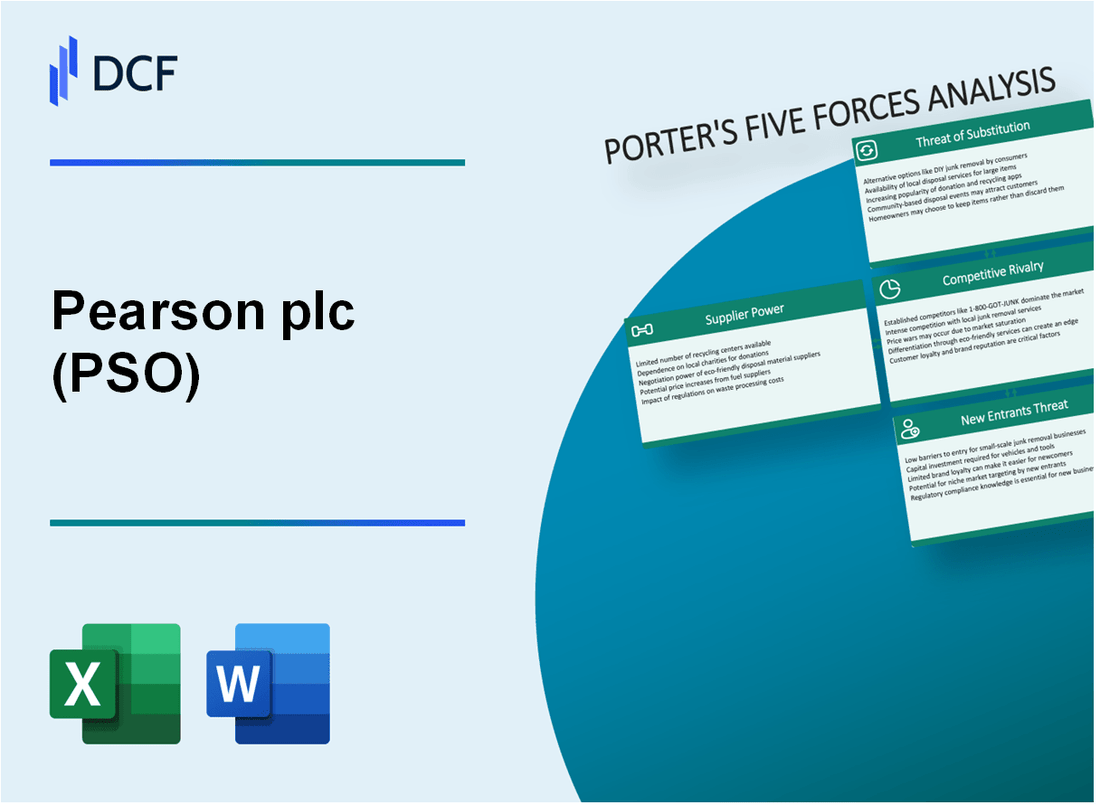
Pearson PLC (PSO): 5 Analyse des forces [Jan-2025 MISE À JOUR] |
Entièrement Modifiable: Adapté À Vos Besoins Dans Excel Ou Sheets
Conception Professionnelle: Modèles Fiables Et Conformes Aux Normes Du Secteur
Pré-Construits Pour Une Utilisation Rapide Et Efficace
Compatible MAC/PC, entièrement débloqué
Aucune Expertise N'Est Requise; Facile À Suivre
Pearson plc (PSO) Bundle
Dans le paysage dynamique de l'édition éducative, Pearson PLC (PSO) navigue dans un écosystème complexe de forces compétitives qui façonnent ses décisions stratégiques et son positionnement sur le marché. Alors que la transformation numérique révolutionne l'apprentissage, l'entreprise est confrontée à des défis et des opportunités sans précédent entre les relations avec les fournisseurs, les attentes des clients, les rivalités technologiques, les substituts émergents et les nouveaux entrants potentiels. Cette analyse complète des cinq forces de Porter révèle la dynamique complexe stimulant la stratégie concurrentielle de Pearson en 2024, offrant un aperçu de la façon dont le géant mondial de l'éducation maintient sa pertinence sur le marché au milieu des changements de paradigme technologiques et éducatifs rapides.
Pearson PLC (PSO) - Five Forces de Porter: Pouvoir de négociation des fournisseurs
Nombre limité de contenu éducatif et de fournisseurs de technologies
En 2024, Pearson Plc opère sur un marché avec environ 12 principaux fournisseurs de contenu éducatif mondial. Les 5 principaux fournisseurs contrôlent 68% du marché du contenu éducatif.
| Catégorie des fournisseurs | Part de marché | Nombre de fournisseurs |
|---|---|---|
| Plateformes d'apprentissage numérique | 42% | 5 |
| Créateurs de contenu académique | 26% | 7 |
Haute dépendance à l'égard des créateurs de contenu
Pearson s'appuie sur environ 3 500 chercheurs universitaires et 2 200 experts en matière dans le monde pour le développement de contenu.
- Valeur du contrat moyen avec les meilleurs chercheurs universitaires: 87 500 $ par an
- Nombre de partenariats exclusifs de création de contenu: 124
- Pourcentage de contenu de créateurs externes: 62%
Investissement dans du matériel éducatif
Pearson a investi 412 millions de dollars dans le développement de contenu et les infrastructures technologiques en 2023.
| Zone d'investissement | Dépense |
|---|---|
| Développement de contenu numérique | 243 millions de dollars |
| Infrastructure technologique | 169 millions de dollars |
Négociations de droits de propriété intellectuelle
En 2023, Pearson a géré 486 négociations de propriété intellectuelle actives avec des créateurs de contenu.
- Coût moyen de licence IP: 45 300 $ par contrat
- Dépenses totales de droits de propriété intellectuelle: 22,1 millions de dollars
- Taux de réussite de la négociation: 87%
Pearson PLC (PSO) - Five Forces de Porter: Pouvoir de négociation des clients
Grand pouvoir de négociation des acheteurs institutionnels
Le segment du marché éducatif de Pearson révèle un pouvoir de négociation des clients importants grâce à des achats institutionnels:
| Segment des acheteurs | Volume d'achat annuel | Effet de levier de négociation |
|---|---|---|
| K-12 districts scolaires | 4,2 milliards de dollars | Haut |
| Établissements d'enseignement supérieur | 3,7 milliards de dollars | Très haut |
| Formation en entreprise | 1,5 milliard de dollars | Moyen |
Sensibilité aux prix sur le marché de l'éducation
Indicateurs de sensibilité aux prix:
- Élasticité des prix moyenne: 2,3
- Demandes de réduction des coûts: 15-20% par an
- Pression de contrainte budgétaire: 78% des acheteurs institutionnels
Demande de solutions d'apprentissage numérique
Mesures de croissance du marché de l'apprentissage numérique:
| Segment de marché | 2024 Revenus projetés | Taux de croissance |
|---|---|---|
| Plateformes d'apprentissage en ligne | 325 milliards de dollars | 17.5% |
| Technologie d'apprentissage adaptative | 5,2 milliards de dollars | 22.3% |
Dynamique du marché concurrentiel
Indicateurs de paysage concurrentiel:
- Nombre de fournisseurs de contenu éducatif: 127
- Ratio de concentration du marché: 42%
- Coût de commutation du client: faible à moyen
Pearson PLC (PSO) - Five Forces de Porter: rivalité compétitive
Paysage concurrentiel du marché
En 2024, Pearson Plc fait face à une concurrence intense sur le marché de l'édition éducative avec les principaux concurrents suivants:
| Concurrent | Part de marché | Revenus annuels |
|---|---|---|
| McGraw-Hill Education | 18.5% | 1,7 milliard de dollars |
| Cengage Learning | 15.3% | 1,4 milliard de dollars |
| Pearson PLC | 22.7% | 4,2 milliards de dollars |
Facteurs d'intensité compétitive
La rivalité compétitive est caractérisée par les éléments clés suivants:
- Concours de plate-forme d'apprentissage numérique: 67% des éditeurs éducatifs investissent dans des technologies d'apprentissage en ligne
- Taux de consolidation du marché: 3-4 fusions stratégiques par an dans le secteur de l'édition éducative
- Investissement en R&D: 12-15% des revenus annuels alloués à l'innovation technologique
Métriques de la technologie et de l'innovation
| Métrique d'innovation | Valeur 2024 |
|---|---|
| Utilisateurs de la plate-forme d'apprentissage numérique | 42 millions |
| Contenu éducatif amélioré AI | 28% de pénétration du marché |
| Développement de cours en ligne | Investissement de 680 millions de dollars |
Dynamique du marché
Paysage concurrentiel montre:
- Fragmentation du marché: Les 4 meilleurs éditeurs contrôlent 62% du marché du contenu éducatif
- Marché mondial des technologies éducatives: Prévu pour atteindre 404 milliards de dollars d'ici 2025
- Taux d'adoption du contenu numérique: 53% des établissements d'enseignement en transition vers des plateformes numériques
Pearson PLC (PSO) - Five Forces de Porter: Menace de substituts
Concours de plates-formes d'apprentissage en ligne
Coursera a rapporté 77 millions d'utilisateurs enregistrés en 2023. EDX compte 35 millions d'apprenants dans le monde. Udemy a atteint 62 millions d'étudiants dans le monde en 2023.
| Plate-forme | Utilisateurs enregistrés (2023) | Revenus annuels |
|---|---|---|
| Parcours | 77 millions | 579,7 millions de dollars |
| EDX | 35 millions | 171 millions de dollars |
| Udemy | 62 millions | 518 millions de dollars |
Impact des ressources éducatives open source
OpenStax a produit 64 manuels numériques gratuits avec 2,2 millions d'utilisateurs annuels. MIT OpenCourseware propose 2 500 cours accessibles par 225 millions d'utilisateurs depuis 2002.
- Les manuels OpenStax ont téléchargé 12,5 millions de fois en 2022
- Khan Academy sert 18 millions d'utilisateurs actifs mensuels
- Wikipedia Education atteint 52 millions d'étudiants par an
Disponibilité du contenu numérique
Les canaux éducatifs YouTube ont accumulé 1,3 milliard de vues vidéo éducatives mensuellement. Les podcasts liés à l'éducation ont augmenté de 42% dans la base des auditeurs en 2022.
| Plate-forme numérique | Contenu éducatif mensuel Reach |
|---|---|
| Éducation YouTube | 1,3 milliard de vues |
| Podcasts éducatifs | Croissance de 42% en 2022 |
Marché d'apprentissage personnalisé
Le marché mondial de l'apprentissage personnalisé qui devrait atteindre 2,1 milliards de dollars d'ici 2024 avec un taux de croissance annuel de 35%.
- Les plateformes d'apprentissage personnalisées axées sur l'IA ont augmenté de 67% dans l'adoption des utilisateurs
- Marché de la technologie d'apprentissage adaptatif d'une valeur de 1,4 milliard de dollars en 2023
Pearson PLC (PSO) - Five Forces de Porter: Menace des nouveaux entrants
Exigences en matière de capital en développement de contenu éducatif
Le développement de contenu éducatif de Pearson nécessite un investissement financier important. En 2023, Pearson a investi 654 millions de dollars dans la recherche et le développement, créant des obstacles substantiels pour les participants au marché potentiels.
| Catégorie d'investissement | Montant (2023) |
|---|---|
| Dépenses de R&D | 654 millions de dollars |
| Coûts de développement du contenu | 412 millions de dollars |
| Infrastructure technologique | 243 millions de dollars |
Réputation de la marque et barrières d'entrée sur le marché
La position du marché de Pearson démontre des barrières d'entrée importantes:
- Part de marché mondial de l'éducation: 37,2%
- Présence établie dans 180 pays
- Plus de 40 ans d'expérience d'édition éducative continue
Complexité réglementaire
L'édition éducative implique des environnements réglementaires complexes dans plusieurs juridictions.
| Zones de conformité réglementaire | Niveau de complexité |
|---|---|
| Normes d'éducation internationale | Haut |
| Licence de contenu numérique | Moyen-élevé |
| Règlements sur la confidentialité des données | Haut |
Exigences du réseau de distribution
Les réseaux d'infrastructures technologiques et de distribution représentent des barrières à l'entrée critiques:
- Plateforme numérique Reach: 22 millions d'utilisateurs actifs
- Investissements de plate-forme d'apprentissage en ligne: 286 millions de dollars en 2023
- Canaux de distribution mondiaux: 150+ pays
Pearson plc (PSO) - Porter's Five Forces: Competitive rivalry
You're assessing the competitive landscape for Pearson plc right now, late in 2025, and honestly, the rivalry is fierce. The global education market Pearson operates in is anything but consolidated; it's fragmented, and that fragmentation fuels constant pressure on pricing and innovation.
The sheer number of players is staggering. Pearson is ranked 15th among its 231 active competitors in the space. That means there are over 230 other entities actively vying for the same customer spend, whether it's a school district, a university, or a professional looking to upskill. That level of competition definitely keeps management busy.
Competition isn't just coming from the established giants. Direct competitors are a mix of traditional publishing houses and nimble digital-first operations. While you see names like Cambridge University Press in the traditional sphere, the digital front is where things are heating up fast. We see companies like Stride, Inc. profiled in market analyses alongside Pearson in key segments like K-12. The battleground has decisively shifted to technology.
Competition is intensifying around AI-enhanced learning tools and digital platform features. Pearson is clearly trying to stay ahead, evidenced by its strategic cloud partnerships with Microsoft, AWS, and most recently, Google Cloud. They are embedding this tech, rolling out features like the "Go Deeper" AI-powered study tool and the AI GCSE Exam Practice Assistant. It's a race to see whose platform can deliver the most personalized, effective, and scalable digital experience.
To gauge the effect of this rivalry, look at the top-line results. Pearson's underlying sales growth for the first half of 2025 came in at 2%. Modest, right? That low single-digit number tells you that while the underlying business is moving forward, it's a tough slog for market share gains against so many rivals. It suggests aggressive price competition or slow adoption curves in certain areas, masking the growth in high-performing units like Higher Education, which saw 4% underlying growth in H1 2025. Here's the quick math on that H1 performance:
| Financial Metric (H1 2025) | Amount | Context/Comparison |
| Underlying Sales Growth | 2% | Modest growth indicating market share battles. |
| Total Sales | £1,722 million | Headline sales figure for the six months ended June 30, 2025. |
| Adjusted Operating Profit | £242 million | Up 2% on an underlying basis. |
| Free Cash Flow | £156 million | Surged by £129 million year-on-year. |
Still, Pearson isn't without its structural advantages, which act as a partial defense against aggressive rivals. These are the high exit barriers that keep the playing field somewhat stable, even if the day-to-day competition is brutal. You can't just spin up a global testing operation overnight.
These barriers are built on scale and intellectual property:
- Vast network of testing centers through Pearson VUE.
- High-quality, research-backed Clinical Assessment products.
- Globally recognized UK-curriculum-based qualifications (GCSEs, A levels).
- Extensive, proprietary digital learning platforms and content libraries.
The company's ability to deliver scaled testing services globally and its deep portfolio of established qualifications-recognized across 90 countries-create significant switching costs for institutional buyers. Finance: draft 13-week cash view by Friday.
Pearson plc (PSO) - Porter's Five Forces: Threat of substitutes
You're looking at the competitive landscape for Pearson plc, and the substitutes are not just knocking; they're already inside the building, especially where content creation and delivery are concerned. The threat here is substantial because the cost of switching from a Pearson textbook or digital courseware to an alternative is often near zero for the end-user.
Free and low-cost Massive Open Online Courses (MOOCs) and open-source content
Massive Open Online Courses (MOOCs) represent a direct, scalable alternative to traditional courseware. The global MOOC market size was valued at USD 26 billion in 2024 and is estimated to grow at a 39.3% CAGR from 2025 to 2034, reaching a projected USD 684.3 billion by 2034. For the year 2025, the market size is estimated at USD 25.39 billion. This growth is fueled by the demand for affordable education and the freemium model, which held 38.74% of the market share in 2024. To put this into perspective on adoption, as per a report published by Harvard Online in May 2024, 60% of all undergraduates enrolled in at least one online course. Furthermore, about 45% of large corporations now use MOOCs for employee training and development. Open-source content, while harder to quantify financially as a direct substitute, erodes the perceived value of proprietary content, especially in foundational subjects.
Generative AI tools like ChatGPT
Generative AI tools are rapidly threatening Pearson's core content creation model by offering instant, personalized study aids and lesson plans. The Generative AI in EdTech market size is projected to grow from $0.36 billion in 2024 to $0.53 billion in 2025, with a compound annual growth rate (CAGR) of 44.1%. The broader AI in Education Market is estimated at USD 6.90 billion in 2025. The adoption rate among users is staggering: 86% of students globally are using AI tools for their studies in 2025, and 88% of students have used generative AI for assessments, up from 53% in 2024. Honestly, when 58% of all university instructors use generative AI in their daily practice, it signals a fundamental shift in how content is consumed and created.
Here's a quick look at how the growth of these substitutes compares to Pearson's recent performance:
| Metric | Substitute Market Data Point | Pearson plc Data Point (H1 2025) |
|---|---|---|
| Market Growth Rate (CAGR) | MOOC Market: 39.3% (2025-2034) | Group Underlying Sales Growth: 2% (H1 2025) |
| Market Size (Base Year) | AI in Education Market: USD 6.90 billion (2025) | Group Sales: £1,722m (H1 2025) |
| High Growth Segment | Generative AI in EdTech: 44.1% CAGR (2024-2025) | Enterprise Learning & Skills Sales Growth (Guidance): High single digits (2025) |
Corporate in-house training programs
Pearson's Enterprise Learning & Skills segment faces substitution from companies building capabilities internally. While Pearson is seeing momentum, with its Enterprise Solutions expecting solid growth, the trend of internal development is a persistent threat. As noted, about 45% of large corporations use MOOCs for employee training, which is a form of outsourcing, but the alternative is building proprietary, in-house programs that bypass external providers entirely. The fact that the Corporate Training and Skill Development segment within the AI in Education market posts the fastest growth at a 44.80% CAGR suggests significant investment is flowing into these internal or dedicated corporate learning solutions, pulling spend away from generalist providers.
Certification and assessment substitutes
The assessment and certification space, where Pearson VUE operates, is seeing competition from vendor-specific and non-traditional credentials. Pearson VUE sales declined 3% on an underlying basis in H1 2025, driven partly by a contract pause and headwinds in PDRI due to US federal government spend reductions. This contrasts with the Clinical Assessment business, which grew, and the overall Assessment & Qualifications sales, which were up 2% underlying in H1 2025. The rise of stackable blockchain badges, which 95% of employers perceive as at least equal to traditional transcripts in some US pilots, directly challenges the value proposition of established certification bodies. Furthermore, the certificate & professional courses market within MOOCs is anticipated to grow at a 41.8% CAGR, indicating strong demand for focused, alternative credentials.
- Clinical Assessment sales showed growth in H1 2025.
- Pearson VUE sales declined 3% on an underlying basis in H1 2025.
- The professional courses segment of MOOCs is projected to grow at a 41.8% CAGR.
- The company is pursuing strategic collaborations, such as one with McGraw Hill in formative assessments.
Pearson plc (PSO) - Porter's Five Forces: Threat of new entrants
The threat of new entrants for Pearson plc is best characterized as moderate. While the digital nature of education technology allows for niche disruption, the core, high-stakes assessment and large-scale contract businesses remain protected by significant structural barriers.
The requirement to build and maintain a global testing network, particularly for Pearson VUE, and to secure large government assessment contracts demands substantial upfront capital and operational scale. Consider the sheer operational footprint Pearson plc manages: they secured a four-year contract from the UK Department for Education to manage national curriculum assessment tests starting in the 2025/26 academic year, servicing over 16,500+ primary schools across England. Building the logistics, scanning, and data delivery infrastructure for that volume represents a high barrier to entry. Furthermore, headwinds in the PDRI segment of Pearson VUE were explicitly linked to US federal government hiring and spend reductions in H1 2025, showing the dependency on, and the high barrier of entry into, these government procurement cycles.
Digital-first startups can certainly enter specific, less regulated niches with comparatively lower capital outlay. For instance, a company like CourseKey, which focuses on school management solutions including digital assessments, has raised a total of $20 million over 6 funding rounds as of late 2025, with its latest funding activity in January 2025. While this demonstrates venture capital interest in EdTech, the $20 million figure is dwarfed by the capital Pearson deploys strategically, such as the $225 million cash consideration paid for the acquisition of eDynamic Learning in 2025. These startups, while agile, still lack the established brand recognition and the deep accreditation required to challenge Pearson's market share in high-stakes testing, where brand trust is paramount.
Regulatory barriers in the K-12 and professional assessment spaces create a strong moat. In K-12, while there are no federal accreditation requirements, schools must meet specific state standards for performance. To gain the legitimacy needed for widespread adoption, especially for college admissions or state scholarship eligibility, regional accreditation is often necessary. This process requires adherence to external quality standards across governance, faculty qualifications, and student outcomes, demanding time and investment to align frameworks. For a new entrant, navigating this patchwork of state-level requirements is a major hurdle, especially when incumbents like Pearson plc have decades of established relationships and compliance history. The overall K-12 Testing and Assessment Market size was valued at $11.17 billion in 2025, indicating the value protected by these regulatory and trust barriers.
Pearson plc actively uses its financial strength to preemptively block entry into adjacent, growing segments. The acquisition of eDynamic Learning in H2 2025 is a clear example of this strategy. eDynamic Learning, which serves over 885,000 K-12 students and offers 325 digital courses across 40+ career pathways, was bought specifically to scale Pearson's position in the fast-growing Early Careers space. By spending $225 million to integrate a leader in Career and Technical Education, Pearson effectively acquires the necessary IP, customer base, and market momentum, raising the entry cost for any other startup aiming for that segment.
Here's a quick view of the scale of Pearson's established positions versus a digital challenger:
| Metric | Pearson plc (Scale/Investment) | CourseKey (Challenger Example) |
|---|---|---|
| H1 2025 Group Sales | £1,722 million | Not Publicly Disclosed (SaaS/Niche) |
| eDynamic Learning Acquisition Cost (2025) | $225 million | Total Funding Raised: $20 million |
| UK Govt. Assessment Contract Scope | Servicing 16,500+ primary schools | Serves over 9,000 K-12 schools/institutions (eDynamic) |
| Reported Digital Reach (eDynamic) | Serving over 885,000 K-12 students | Reported ~100,000 paying users (2019) |
The investment in strategic acquisitions, like the $225 million deal, demonstrates that Pearson is willing to pay a premium, at 13x adjusted EBITDA, to secure market share rather than allowing a new entrant to build it organically.
Disclaimer
All information, articles, and product details provided on this website are for general informational and educational purposes only. We do not claim any ownership over, nor do we intend to infringe upon, any trademarks, copyrights, logos, brand names, or other intellectual property mentioned or depicted on this site. Such intellectual property remains the property of its respective owners, and any references here are made solely for identification or informational purposes, without implying any affiliation, endorsement, or partnership.
We make no representations or warranties, express or implied, regarding the accuracy, completeness, or suitability of any content or products presented. Nothing on this website should be construed as legal, tax, investment, financial, medical, or other professional advice. In addition, no part of this site—including articles or product references—constitutes a solicitation, recommendation, endorsement, advertisement, or offer to buy or sell any securities, franchises, or other financial instruments, particularly in jurisdictions where such activity would be unlawful.
All content is of a general nature and may not address the specific circumstances of any individual or entity. It is not a substitute for professional advice or services. Any actions you take based on the information provided here are strictly at your own risk. You accept full responsibility for any decisions or outcomes arising from your use of this website and agree to release us from any liability in connection with your use of, or reliance upon, the content or products found herein.