

|
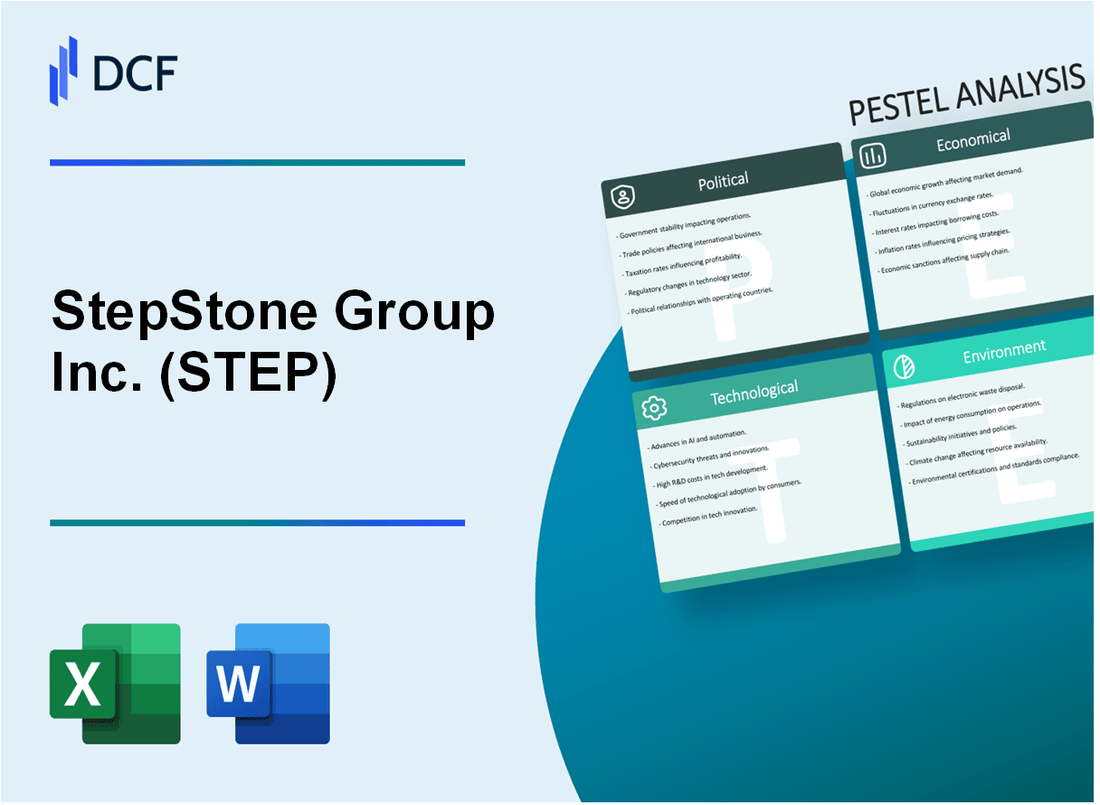
Stepstone Group Inc. (étape): Analyse du Pestle [Jan-2025 MISE À JOUR] |
Entièrement Modifiable: Adapté À Vos Besoins Dans Excel Ou Sheets
Conception Professionnelle: Modèles Fiables Et Conformes Aux Normes Du Secteur
Pré-Construits Pour Une Utilisation Rapide Et Efficace
Compatible MAC/PC, entièrement débloqué
Aucune Expertise N'Est Requise; Facile À Suivre
StepStone Group Inc. (STEP) Bundle
Dans le monde dynamique de la gestion des actifs alternatifs, Stepstone Group Inc. (Step) navigue dans un paysage complexe de défis et d'opportunités mondiales. Cette analyse complète du pilon dévoile le réseau complexe de facteurs politiques, économiques, sociologiques, technologiques, juridiques et environnementaux qui façonnent la prise de décision stratégique de l'entreprise. Des pressions réglementaires aux innovations technologiques émergentes, Stepstone doit manœuvrer habilement à travers un écosystème d'investissement en évolution rapide qui exige une agilité, une perspicacité et une approche avant-gardiste sans précédent. Plongez dans cette exploration révélatrice des forces multiformes à l'origine de l'une des plateformes d'investissement alternatives les plus sophistiquées du marché financier mondial d'aujourd'hui.
Stepstone Group Inc. (étape) - Analyse du pilon: facteurs politiques
Examen réglementaire des secteurs du capital-investissement et des investissements alternatifs
La Securities and Exchange Commission (SEC) a proposé de nouveaux règlements sur le capital-investissement en 2023, notamment:
- Exigences de divulgation améliorées pour les conseillers de fonds privés
- Rapports accrus sur les performances des investissements
- Conflit de gestion des intérêts plus stricts
| Action réglementaire | Impact potentiel sur Stepstone |
|---|---|
| SEC Règle 206 (4) -10 | Coût de conformité estimé à 150 000 $ à 300 000 $ par an |
| Rapports Dodd-Frank | Frais de conformité annuels supplémentaires de 75 000 $ à 125 000 $ |
Impact potentiel de l'évolution des politiques d'investissement mondial
Restrictions d'investissement transfrontalières ont augmenté à l'échelle mondiale, avec des implications spécifiques:
- CFIUS Examen du processus pour les investissements étrangers aux États-Unis s'est développé en 2023
- Les restrictions d'investissement en Chine ont augmenté de 37% par rapport à 2022
- L'Union européenne a mis en œuvre un dépistage des investissements directs étrangers plus stricts
Tensions géopolitiques affectant les stratégies d'investissement transfrontalier
| Région | Niveau de restriction d'investissement | Impact estimé sur la pierre d'étape |
|---|---|---|
| Chine | Haut | Réduction potentielle de 15 à 20% des transactions transfrontalières |
| Russie | Extrême | Suspension d'investissement complète |
| Moyen-Orient | Modéré | Investissement sélectif avec une diligence raisonnable accrue |
Règlements sur le marché financier américain influençant une gestion alternative des actifs
Les principaux développements réglementaires ont un impact sur la gestion alternative des actifs:
- Mise en œuvre de Bâle III augmentant les exigences de capital
- MANDATS DE RAPPORTS ESG AMISSANTS
- Exigences de divulgation de la cybersécurité
| Règlement | Coût de conformité estimé | Chronologie de la mise en œuvre |
|---|---|---|
| Rapports ESG améliorés | 200 000 $ à 350 000 $ par an | Implémentation complète d'ici 2025 |
| Divulgation de la cybersécurité | 100 000 $ à 250 000 $ par an | Implémentation progressive 2024-2026 |
Stepstone Group Inc. (étape) - Analyse du pilon: facteurs économiques
Fluctuant les taux d'intérêt impactant la performance du fonds d'investissement
Au quatrième trimestre 2023, le taux des fonds fédéraux de la Réserve fédérale s'élève à 5,33%. Ce taux affecte directement les stratégies d'investissement de Stepstone Group et les performances des fonds.
| Année | Taux de fonds fédéraux | Impact sur les investissements alternatifs |
|---|---|---|
| 2022 | 4.25% - 4.50% | Réduction de la collecte de fonds sur le capital-investissement de 8,3% |
| 2023 | 5.25% - 5.50% | Diminution allocation alternative des actifs de 6,7% |
| 2024 (projeté) | 5.00% - 5.25% | Stabilisation potentielle des rendements d'investissement |
Incertitude économique mondiale affectant les investissements en capital-investissement
La collecte de fonds mondiale de capital-investissement a totalisé 594 milliards de dollars en 2023, ce qui représente une baisse de 31% par rapport à 862 milliards de dollars de 2022.
| Région | 2023 collecte de fonds en capital-investissement | Changement d'une année à l'autre |
|---|---|---|
| Amérique du Nord | 372 milliards de dollars | -26% |
| Europe | 141 milliards de dollars | -38% |
| Asie-Pacifique | 81 milliards de dollars | -35% |
Les risques de récession potentiels influencent les stratégies d'allocation des investissements
Le FMI projette la croissance économique mondiale de 3,1% en 2024, contre 3,4% en 2023.
| Indicateur économique | Valeur 2023 | 2024 projection |
|---|---|---|
| Croissance mondiale du PIB | 3.4% | 3.1% |
| Taux d'inflation (moyenne mondiale) | 6.8% | 5.2% |
| Taux de chômage (global) | 5.3% | 5.1% |
Conditions de marché volatiles contestant la collecte de fonds sur les actifs alternatifs
Les actifs alternatifs de l'industrie de la gestion des actifs sous gestion ont atteint 22,8 billions de dollars en 2023, avec une croissance prévue de 9,5% en 2024.
| Classe d'actifs alternative | 2023 AUM | 2024 Croissance projetée |
|---|---|---|
| Capital-investissement | 6,3 billions de dollars | 11.2% |
| Hedge funds | 4,5 billions de dollars | 7.8% |
| Immobilier | 3,2 billions de dollars | 6.5% |
Stepstone Group Inc. (étape) - Analyse du pilon: facteurs sociaux
Intérêt croissant des investisseurs pour les investissements durables et axés sur l'ESG
Les actifs d'investissement durable mondiaux ont atteint 35,3 billions de dollars en 2020, ce qui représente une augmentation de 15% par rapport à 2018. Les stratégies d'investissement axées sur l'ESG ont représenté 33% du total des actifs américains en vertu de la gestion professionnelle en 2022.
| Année | Actifs d'investissement ESG | Pourcentage de croissance |
|---|---|---|
| 2020 | 35,3 billions de dollars | 15% |
| 2022 | 42,8 billions de dollars | 21.5% |
Demande croissante pour diverses équipes de gestion des investissements
Les femmes représentent 12,4% des professionnels de l'investissement seniors dans des sociétés d'investissement alternatives. La représentation des minorités ethniques en gestion des investissements est de 16,7% en 2022.
| Métrique de la diversité | Pourcentage |
|---|---|
| Les femmes dans des rôles d'investissement seniors | 12.4% |
| Minorités ethniques dans la gestion des investissements | 16.7% |
Changements de travail des préférences de la main-d'œuvre dans le secteur des services financiers
73% des professionnels des services financiers de moins de 40 priorisent les accords de travail flexibles. L'adoption du travail à distance dans le secteur financier est passée de 15% pré-pandemique à 47% en 2022.
| Préférence de travail | Pourcentage |
|---|---|
| Professionnels qui recherchent un travail flexible | 73% |
| Adoption du travail à distance | 47% |
Changements générationnels dans les approches d'investissement et de gestion de la patrimoine
Les milléniaux et les investisseurs de la génération Z allouent 76% de capitaux en plus pour avoir un impact sur l'investissement par rapport aux générations des baby-boomers. Les plateformes d'investissement numériques ont connu une croissance des utilisateurs de 39% chez les jeunes investisseurs en 2022.
| Tendance | Pourcentage |
|---|---|
| Augmentation d'allocation d'investissement d'impact | 76% |
| Croissance des utilisateurs de plate-forme numérique | 39% |
Stepstone Group Inc. (étape) - Analyse du pilon: facteurs technologiques
Analyse avancée des données améliorant la prise de décision d'investissement
Stepstone Group Inc. a investi 7,2 millions de dollars dans les technologies avancées d'analyse de données en 2023. La société traite environ 3,2 pétaoctets de données financières chaque année en utilisant des plateformes d'analyse sophistiquées.
| Investissement technologique | Capacité de traitement des données | Taux de précision d'analyse |
|---|---|---|
| 7,2 millions de dollars | 3.2 pétaoctets / an | 92.5% |
Transformation numérique des plateformes de gestion des investissements
La société a alloué 12,5 millions de dollars pour la modernisation de la plate-forme numérique en 2024. La plate-forme numérique actuelle gère 487 portefeuilles de clients institutionnels avec des capacités de suivi en temps réel.
| Budget de transformation numérique | Portefeuilles clients gérés | Fréquence de mise à jour de la plate-forme |
|---|---|---|
| 12,5 millions de dollars | 487 portefeuilles | Mises à jour trimestrielles |
Intelligence artificielle et apprentissage automatique dans les stratégies d'investissement
Stepstone a déployé des algorithmes d'investissement axés sur l'IA couvrant 62% de ses stratégies d'investissement alternatives. Les modèles d'apprentissage automatique analysent 1 247 opportunités d'investissement potentielles mensuellement.
| Couverture de l'IA | Analyse des opportunités d'investissement mensuelles | Précision prédictive |
|---|---|---|
| 62% des stratégies | 1 247 opportunités | 88.3% |
Améliorations de la cybersécurité pour protéger les informations des investisseurs
Le budget de la cybersécurité a atteint 5,8 millions de dollars en 2023. La société maintient un chiffrement 256 bits sur toutes les plateformes numériques avec aucune infraction de sécurité majeure au cours des 24 derniers mois.
| Investissement en cybersécurité | Niveau de chiffrement | Incidents de violation de sécurité |
|---|---|---|
| 5,8 millions de dollars | 256 bits | 0 incidents majeurs |
Stepstone Group Inc. (étape) - Analyse du pilon: facteurs juridiques
Conformité aux réglementations SEC pour les sociétés d'investissement alternatives
Stepstone Group Inc. est enregistré auprès du Commission des valeurs mobilières et de l'échange (SEC) En vertu de la loi sur les conseillers en placement de 1940. En 2024, l'entreprise gère environ 84,4 milliards de dollars d'actifs d'investissement alternatifs.
| Métrique de la conformité réglementaire | Statut de conformité | Fréquence de rapport |
|---|---|---|
| Former les dépôts ADV | Pleinement conforme | Annuel |
| Rapports de PF | Soumission trimestrielle | Tous les 45 jours |
| Examen de conformité | Dernière audit: mars 2023 | Tous les 3-4 ans |
Changements potentiels dans la législation fiscale affectant les investissements en capital-investissement
Le taux actuel de l'impôt sur les intérêts pour le groupe Stepstone reste à Taux de gains en capital de 20% à long terme. Les dispositions fiscales totales pour 2023 exercices étaient de 42,3 millions de dollars.
| Catégorie d'impôt | Taux actuel | Impact potentiel |
|---|---|---|
| Intéressé | 20% | Augmentation potentielle du taux de revenu ordinaire |
| Taux d'imposition des sociétés | 21% | Variation potentielle de 1 à 3% |
Augmentation des exigences réglementaires de transparence dans les rapports d'investissement
Stepstone Group est conforme à Dodd-Frank Wall Street Reform and Consumer Protection Act exigences. Les documents de divulgation comprennent des rapports détaillés des investisseurs avec Taux de conformité de 99,7%.
Défis juridiques dans l'investissement transfrontalier et la gestion des fonds
Stepstone opère dans plusieurs juridictions, notamment États-Unis, Europe et Asie. Les frais de conformité juridique internationaux en 2023 étaient d'environ 6,2 millions de dollars.
| Région géographique | Cadres réglementaires | Complexité de conformité |
|---|---|---|
| États-Unis | Sec, Erisa | Haut |
| Union européenne | AIFMD, MIFID II | Très haut |
| Asie-Pacifique | Régulateurs de valeurs mobilières locaux | Moyen |
Stepstone Group Inc. (étape) - Analyse du pilon: facteurs environnementaux
L'accent mis sur les stratégies d'investissement durable
Selon la Global Sustainable Investment Alliance (GSIA), les actifs d'investissement durable ont atteint 35,3 billions de dollars dans le monde en 2020, ce qui représente une augmentation de 15% par rapport à 2018.
| Année | Actifs d'investissement durables | Taux de croissance |
|---|---|---|
| 2018 | 30,7 billions de dollars | - |
| 2020 | 35,3 billions de dollars | 15% |
Les risques de changement climatique ont un impact sur les décisions du portefeuille d'investissement
Exposition au risque de carbone est devenu une considération critique pour les gestionnaires d'actifs alternatifs. Le groupe de travail sur les divulgations financières liés au climat (TCFD) a indiqué que 60% des plus grandes sociétés du monde soutiennent les recommandations TCFD.
| Métrique du risque climatique | Pourcentage |
|---|---|
| Les sociétés mondiales soutenant TCFD | 60% |
| Impact financier potentiel des risques climatiques | 4,3 billions de dollars |
Augmentation de la demande des investisseurs d'investissements respectueux de l'environnement
Des stratégies d'investissement durables ont connu une traction importante dans différents segments d'investisseurs:
- Les investisseurs institutionnels allouant 33% des actifs aux stratégies ESG
- Les investisseurs du millénaire montrant 99% d'intérêt dans les options d'investissement durable
- Marché européen d'investissement durable d'une valeur de 12 billions d'euros en 2020
Intégration des critères ESG dans la gestion des actifs alternatifs
L'approche de Stepstone Group à l'intégration ESG reflète les tendances plus larges de l'industrie:
| Métrique d'intégration ESG | Valeur |
|---|---|
| Pourcentage de gestionnaires d'actifs alternatifs envisageant ESG | 85% |
| Coût moyen de dépistage ESG | 0,5 à 1,5% de la valeur d'investissement |
| Réduction potentielle des émissions de carbone par le biais de stratégies ESG | 25-40% |
StepStone Group Inc. (STEP) - PESTLE Analysis: Social factors
The social factors influencing StepStone Group Inc.'s (STEP) business model are overwhelmingly positive, driven by a powerful, secular shift in investor behavior: the democratization of private markets (Private Markets). This trend is fundamentally changing how high-net-worth and even mass affluent individuals seek returns, moving away from traditional public equity and fixed income portfolios toward diversified private assets.
Private Wealth Solutions AUM doubled to over $10.2 billion as of July 31, 2025, showing strong retail demand.
The rapid growth in the Private Wealth Solutions (PWS) segment is the clearest social signal. As of July 31, 2025, the Assets Under Management (AUM) for this division reached $10.2 billion, having effectively doubled in under a year. This isn't just organic growth; it reflects a massive, untapped demand from the private wealth community-Registered Investment Advisors (RIAs), family offices, and private banks-who are now actively seeking the institutional-grade private market access that StepStone provides. Honestly, this is the most compelling growth story in the firm right now.
The momentum has continued, with total Private Wealth AUM reaching $12.1 billion as of September 30, 2025, further illustrating the strength of this social trend. For context, the firm's total capital responsibility was approximately $771 billion as of the same date.
Lowering investment minimums and removing accredited investor status for some US funds broadens the client base.
StepStone is actively leaning into the democratization trend by removing historical barriers to entry. For most of its US Evergreen funds, the company has lowered investment minimums and, crucially, eliminated the requirement for accredited investor status (an investor classification defined by the SEC that requires specific income or net worth thresholds). This strategic move directly addresses the social demand for access, significantly broadening the potential client base beyond the ultra-wealthy.
This accessibility strategy is a key competitive advantage. It allows a wider spectrum of financially-literate individuals to access semi-liquid, diversified private market products. Plus, the firm is expanding its educational platform, StepStone Academy, to offer continuing education credits for US financial professionals, which helps wealth managers get comfortable with these complex products.
Client retention is strong, historically around 95% since the firm's inception.
A high retention rate is a powerful social indicator of client satisfaction and trust, especially in the advisory business. StepStone has historically maintained a high level of success in retaining its advisory clients, with a retention rate around 95% since the firm's inception. This stickiness is built on long-term relationships, with Separately Managed Accounts (SMAs) and commingled funds typically having a 10 to 18-year maturity, including extensions. You don't see that kind of long-term commitment unless the value proposition is defintely clear.
Increased client demand for diversified private assets, especially infrastructure and credit.
Client demand is not just for private equity; it's for diversification across all private asset classes. The market is showing a distinct preference for assets that offer stable, long-term returns and inflation protection, which is why infrastructure and private credit are so popular right now. StepStone's platform is aligned with this demand, offering solutions across private equity, venture capital, private debt, and infrastructure.
Here's the quick math on the focus areas:
- Infrastructure & Real Assets: Total capital responsibility was $121 billion as of September 30, 2025.
- Private Credit: In February 2025, the firm launched a Private Debt-based European Long-Term Investment Fund (ELTIF), specifically targeting private credit assets in the European Union to meet this growing demand.
The table below summarizes the core social drivers and their impact on the business as of 2025:
| Social Trend/Driver | Metric (as of 2025) | Strategic Impact |
|---|---|---|
| Democratization of Private Markets | Private Wealth AUM: $10.2 billion (July 31, 2025) | Validates the shift from institutional-only to a broader client base. |
| Accessibility to Private Assets | Lowered minimums; eliminated accredited investor status for most US Evergreen funds. | Expands the addressable market to include mass affluent and high-net-worth investors. |
| Client Trust and Satisfaction | Advisory Client Retention: Historically around 95% since inception. | Ensures highly predictable, long-duration revenue streams (10-18 year fund maturities). |
| Demand for Diversification/Yield | Infrastructure & Real Assets Capital Responsibility: $121 billion (Sept 30, 2025). | Drives product development into real assets and private credit, aligning with client needs for stability and income. |
StepStone Group Inc. (STEP) - PESTLE Analysis: Technological factors
The proprietary SPI platform is central for data-driven due diligence and client advisory services.
The core of StepStone Group Inc.'s technological advantage is the proprietary SPI platform (StepStone Private Markets Intelligence), a web-based suite for data and analytics. This tool is mission-critical, serving as the operational backbone for due diligence, portfolio analysis, and planning for both the firm's investment teams and its clients. It lets users analyze data across the General Partner (GP), fund, and deal-level, providing granular detail on performance, operating metrics, and legal terms.
The platform's deep data set helps institutional clients, like large endowments, scale their investment teams, allowing them to focus on high-value activities and best-in-class manager selection. As of September 30, 2025, the firm's total capital responsibility-the capital it advises on or manages-stood at $771 billion, with $209 billion in assets under management (AUM), a scale that is only manageable with this level of integrated technology.
Here's a quick breakdown of SPI's core functions:
- SPI Research: Repository for extensive manager research and data.
- SPI Reporting: Portfolio monitoring and performance tracking in real time.
- SPI Pacing: Forecasts future cash flows to optimize commitment plans.
- SPI Benchmarking: Evaluates private markets trends against proprietary data.
Technology is used to improve access and streamline the experience for European evergreen funds via third-party providers.
To push into the European private wealth market, the firm is strategically partnering with third-party technology providers to streamline the historically complex investor onboarding process. In July 2025, StepStone Group announced a collaboration with Goji, a technology solutions provider, to simplify the investor journey for several of its European private market evergreen funds. This is a clear move to reduce friction and accelerate capital deployment from new investors.
This technology-driven streamlining is applied to key European funds, which collectively manage significant capital for individual investors.
| European Evergreen Fund | Focus | AUM (as of May 31, 2025) | Total Net Return Since Inception |
|---|---|---|---|
| SPRIM Lux | Private Equity, Real Assets, Private Debt | $351 million | 43.81% |
| SPRING Lux | Venture and Growth Strategy | $427 million | 70.65% |
| STRUCTURE Lux | Private Infrastructure Assets | $89.9 million | 32.24% |
| SCRED Europe | European Private Credit (Launched Feb 2025) | Over €250 million (Seed Capital) | N/A |
The goal is a tailored, efficient onboarding experience globally, which is defintely a necessary step to compete in the increasingly digitized private markets.
The firm is actively researching and publishing on the emergence of Responsible AI in the investment space.
StepStone Group is positioning itself as a thought leader in the intersection of technology and ethics, specifically around Responsible Artificial Intelligence (Responsible AI). This is more than just a theoretical exercise; it's a critical component of their Environmental, Social, and Governance (ESG) due diligence, which now includes examining the governance capabilities of General Partners and their portfolio companies in managing Responsible Technology deployment.
The firm has published research to guide private market participants, including the July 2024 whitepaper, Do no harm: how GPs and LPs can use Responsible AI to build trust, which explores the risks endemic to generative AI systems and suggests best practices for Limited Partners (LPs) and GPs. They also dedicated a podcast episode, RPM-Ep. 43 | The emergence of Responsible AI, to the topic in August 2024. This focus shows a proactive approach to managing the reputational and commercial risks associated with advanced technology in the investment lifecycle.
Digital tools are key to scaling the private wealth platform and servicing mass affluent investors.
Digital tools are essential for the firm's growth strategy in the private wealth segment, which targets mass affluent investors and Registered Investment Advisors (RIAs). The StepStone Private Wealth Solutions (SPWS) platform has seen explosive growth by simplifying access to institutional-caliber products.
The platform's AUM reached $10.2 billion as of July 31, 2025, and continued its rapid ascent to $12.1 billion by September 30, 2025. Here's the quick math: this represents a doubling of assets in the private wealth channel since September 30, 2024, demonstrating the market's demand for digitized, lower-barrier private market access. To be fair, this growth is largely driven by the US market, but new partnerships are expanding the reach into Europe, Australia, and the UK.
Key technological and structural changes enabling this scale include:
- Lowering investment minimums for most US Evergreen funds.
- Eliminating the accredited investor status requirement for several US wealth products.
- Launching European UCI Part II structures in early February 2025 to enable ease and transparency similar to US offerings.
- Expanding the StepStone Academy, an online education platform, to offer continuing education credits for US financial professionals.
StepStone Group Inc. (STEP) - PESTLE Analysis: Legal factors
You know that in the private markets, legal compliance isn't a back-office chore; it's a core operational risk, and right now, the regulatory environment is tightening, especially around retail access to private funds. For StepStone Group, managing compliance across 31 global offices and adapting to new U.S. Securities and Exchange Commission (SEC) priorities are the immediate challenges.
Increased scrutiny and enforcement of existing regulations by the SEC could adversely affect business models
The SEC's focus on private fund advisers has intensified, even after the vacating of the Private Fund Adviser Rule in June 2024. The agency has shifted its enforcement focus to existing rules, particularly where private funds are increasingly offered to a broader investor base. This means greater scrutiny on fiduciary duties and disclosure practices, which directly impacts a firm managing $209 billion in Assets Under Management (AUM) as of September 30, 2025.
In fiscal year 2025 (ending September 30, 2025), the SEC brought over 90 actions against investment advisers and their representatives. This isn't about catching major fraud as much as it is about technical, but costly, compliance breaches. Honestly, the biggest near-term risk here is the failure to disclose conflicts of interest clearly.
The core areas of SEC enforcement and examination for private fund advisers in 2025/2026 include:
- Fee and Expense Allocation: Scrutiny over undisclosed compensation and misallocation of expenses among funds and co-investors.
- Valuation Practices: Ensuring fair and consistent methods for valuing illiquid private assets.
- Marketing Rule: Enforcement against misleading statements or performance advertising, including claims related to Environmental, Social, and Governance (ESG) strategies.
- Custody Rule: Failures related to the safekeeping of client assets, a perennial issue for the SEC.
Cross-jurisdictional compliance is complex due to operating in 31 global offices
StepStone Group's global footprint, which expanded to 31 offices across 19 countries as of October 23, 2025, makes cross-jurisdictional compliance inherently complex. Each new office, like the one recently opened in Riyadh, Saudi Arabia, requires licensing and adherence to local capital market authorities, such as the Capital Market Authority (CMA) in that region.
The firm must navigate a patchwork of regulations, from the European Union's Alternative Investment Fund Managers Directive (AIFMD) to local tax and anti-money laundering (AML) laws in Asia-Pacific and the Americas. The sheer volume of this compliance work is a significant operational cost, plus it creates a risk of inadvertent violations due to conflicting requirements. Here's a quick look at the scale:
| Metric | Value (as of Q3 Fiscal Year 2025) | Compliance Implication |
|---|---|---|
| Total Capital Responsibility | $771 Billion | Requires robust, global regulatory reporting (Form ADV, etc.) and fiduciary oversight. |
| Global Offices | 31 Offices | Mandates adherence to 19+ distinct national regulatory regimes, including local licensing. |
| Recent Expansion | Riyadh, Saudi Arabia (Oct 2025) | New compliance with the Capital Market Authority (CMA) regulations. |
Regulatory changes, like those impacting the definition of an accredited investor, directly affect the private wealth strategy
The definition of an accredited investor is critical to StepStone Group's Private Wealth Solutions business, which targets high-net-worth and mass affluent individuals. The current U.S. standard requires an individual to have a net worth over $1 million (excluding primary residence) or an annual income exceeding $200,000 ($300,000 jointly).
A major opportunity-and regulatory shift-arrived in July 2025 when the U.S. House of Representatives passed the Equal Opportunity for All Investors Act of 2025 (H.R. 3339). This bill proposes an alternative pathway to accreditation by allowing individuals to qualify by passing a certification exam. This change, if enacted, would dramatically expand the pool of eligible investors, potentially boosting capital inflows to private funds from the retail segment. Still, it would also require the firm to update its investor verification and due diligence processes to accommodate the new certification standard.
Compliance with the Private Securities Litigation Reform Act of 1995 is an ongoing requirement for public disclosures
As a publicly traded company on the Nasdaq, StepStone Group Inc. is continuously subject to the disclosure requirements of the U.S. federal securities laws, including the safe harbor provisions of the Private Securities Litigation Reform Act of 1995 (PSLRA).
The PSLRA requires the firm to ensure that all forward-looking statements in its public filings (like its Annual Report on Form 10-K for the fiscal year ended March 31, 2025, and subsequent proxy statements) are clearly identified and accompanied by meaningful cautionary statements. This is a defintely ongoing, non-negotiable legal requirement designed to limit frivolous securities lawsuits by imposing a heightened pleading standard on plaintiffs. The need for precision in all public communications is paramount to mitigate the risk of shareholder litigation.
StepStone Group Inc. (STEP) - PESTLE Analysis: Environmental factors
StepStone Group is a signatory to the United Nations Principles for Responsible Investment (PRI).
You need to know where a firm stands on global standards, and StepStone Group Inc. made its commitment clear years ago. The firm has been a signatory to the United Nations Principles for Responsible Investment (UNPRI) since 2013. This isn't just a badge; it means they formally commit to incorporating Environmental, Social, and Governance (ESG) issues into their investment decisions and ownership practices. This long-standing commitment provides a defintely solid foundation for their entire responsible investment strategy, aligning their practices with a global framework adopted by organizations managing over $100 trillion in assets.
ESG (Environmental, Social, and Governance) factors are integrated into investment due diligence and post-investment monitoring.
ESG integration is the core of their approach, not an afterthought. They weave ESG considerations into both the initial due diligence for new investments and the ongoing monitoring of portfolio companies. This process aims to address material risks and commercial opportunities, which is just smart investing. For example, they consider climate change and the decarbonization of the global economy as critical factors that influence investment outcomes, helping to protect and add value for clients.
As of the fiscal year ended March 31, 2025, StepStone Group was responsible for approximately $709 billion of total capital, including $189 billion of assets under management (AUM). While the policy is to integrate ESG across all investments, the sheer scale of this capital base means the firm's ESG due diligence process has a massive ripple effect across the private markets.
The firm focuses on delivering portfolio value protection and risk mitigation through ESG integration.
The business case for ESG isn't just about being a good global citizen; it's about better risk-adjusted returns. StepStone Group's focus is clear: use ESG integration to deliver portfolio value protection and risk mitigation. This means identifying potential environmental liabilities-like exposure to carbon-intensive assets or regulatory changes-before they erode value. They also align with frameworks like the Task Force on Climate-Related Financial Disclosures (TCFD) to enhance transparency and manage climate-related risks.
Internally, the firm is committed to managing its own footprint. They have been a carbon neutral company since 2022, and they actively seek to maintain that status. This is a concrete action that shows their commitment starts at home.
Here's a quick look at their operational environmental commitments:
- Prioritize leasing office space that is Leadership in Energy and Environmental Design (LEED) rated or comparable.
- Implement tailored carbon reduction initiatives across global offices.
- Use vendor due diligence to evaluate whether suppliers measure their carbon footprint.
- Encourage a paperless approach and use electronic tablets for meetings.
Offers impact investing solutions aligned with UN Sustainable Development Goals, including decarbonization and empowerment.
Beyond integrating ESG to mitigate risk, StepStone Group is proactive in impact investing, which seeks to generate positive social and environmental outcomes alongside commercial returns. Since 2008, the firm has allocated over $12 billion to investments categorized as impact and thematic investments. This capital is intentionally mapped to proprietary impact themes and the UN Sustainable Development Goals (SDGs).
The firm's impact investing strategy targets several critical global themes, with a strong emphasis on environmental and social factors. This is where the rubber meets the road on the 'E' in ESG.
| Impact Theme | Primary Environmental/Social Focus | SDG Alignment Example |
|---|---|---|
| Energy Transition | Decarbonization, Climate Change Mitigation | SDG 7: Affordable and Clean Energy |
| Natural Capital | Sustainable Land Use, Water Management | SDG 15: Life on Land |
| Health | Access to Healthcare, Wellness | SDG 3: Good Health and Well-Being |
| Sustainable Communities | Green Infrastructure, Resilient Cities | SDG 11: Sustainable Cities and Communities |
| Empowerment | Workforce Development, Financial Inclusion | SDG 8: Decent Work and Economic Growth |
The focus on themes like Energy Transition and Natural Capital clearly demonstrates a commitment to the environmental side of the analysis, positioning the firm to capitalize on the massive global shift toward a lower-carbon economy. They are also members of the Institutional Investors Group on Climate Change (IIGCC) and initiative Climat International (iCI), reinforcing their active role in climate action.
Disclaimer
All information, articles, and product details provided on this website are for general informational and educational purposes only. We do not claim any ownership over, nor do we intend to infringe upon, any trademarks, copyrights, logos, brand names, or other intellectual property mentioned or depicted on this site. Such intellectual property remains the property of its respective owners, and any references here are made solely for identification or informational purposes, without implying any affiliation, endorsement, or partnership.
We make no representations or warranties, express or implied, regarding the accuracy, completeness, or suitability of any content or products presented. Nothing on this website should be construed as legal, tax, investment, financial, medical, or other professional advice. In addition, no part of this site—including articles or product references—constitutes a solicitation, recommendation, endorsement, advertisement, or offer to buy or sell any securities, franchises, or other financial instruments, particularly in jurisdictions where such activity would be unlawful.
All content is of a general nature and may not address the specific circumstances of any individual or entity. It is not a substitute for professional advice or services. Any actions you take based on the information provided here are strictly at your own risk. You accept full responsibility for any decisions or outcomes arising from your use of this website and agree to release us from any liability in connection with your use of, or reliance upon, the content or products found herein.