

|
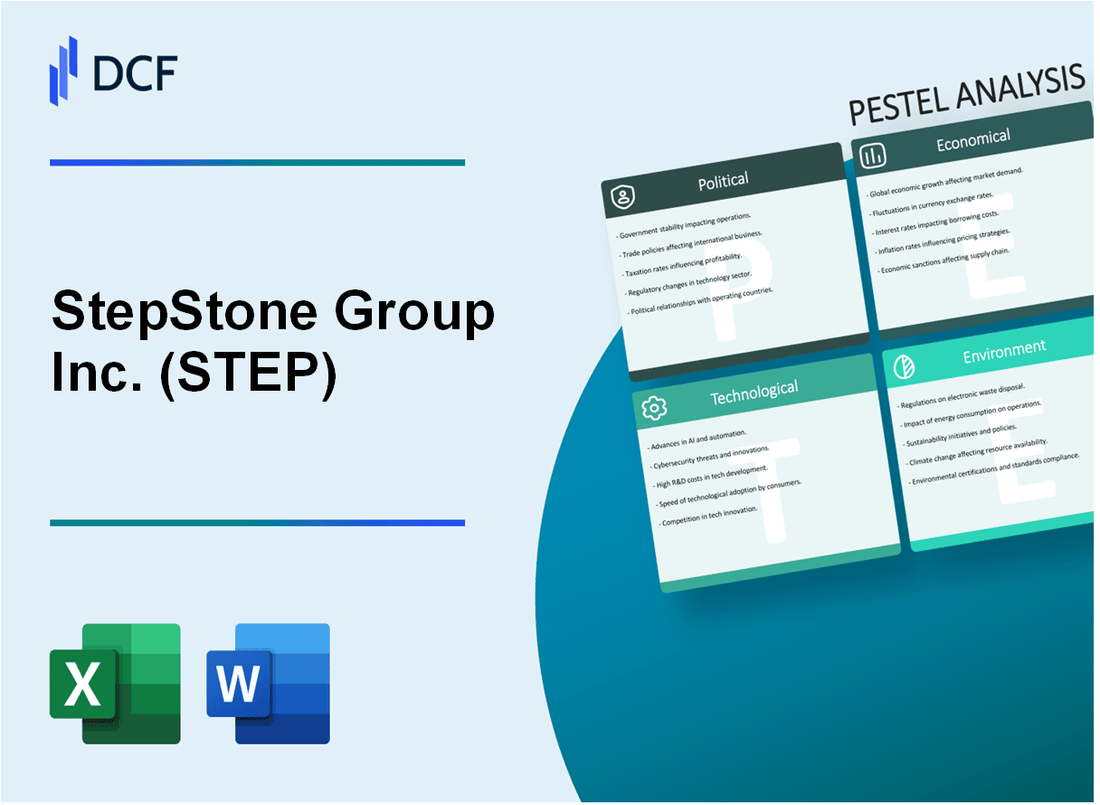
Stepstone Group Inc. (Etapa): Análise de Pestle [Jan-2025 Atualizado] |
Totalmente Editável: Adapte-Se Às Suas Necessidades No Excel Ou Planilhas
Design Profissional: Modelos Confiáveis E Padrão Da Indústria
Pré-Construídos Para Uso Rápido E Eficiente
Compatível com MAC/PC, totalmente desbloqueado
Não É Necessária Experiência; Fácil De Seguir
StepStone Group Inc. (STEP) Bundle
No mundo dinâmico do gerenciamento alternativo de ativos, o Stepstone Group Inc. (Etapa) navega em um cenário complexo de desafios e oportunidades globais. Essa análise abrangente de pestles revela a intrincada rede de fatores políticos, econômicos, sociológicos, tecnológicos, legais e ambientais que moldam a tomada de decisão estratégica da empresa. Das pressões regulatórias às inovações tecnológicas emergentes, a Stepstone deve manobrar de maneira adequada através de um ecossistema de investimento em rápida evolução que exige agilidade, insight e abordagem de visão de futuro sem precedentes. Mergulhe nessa exploração reveladora das forças multifacetadas que impulsionam uma das plataformas de investimento alternativas mais sofisticadas no mercado financeiro global de hoje.
Stepstone Group Inc. (Etapa) - Análise de Pestle: Fatores Políticos
Escrutínio regulatório de setores de private equity e investimentos alternativos
A Comissão de Valores Mobiliários (SEC) propôs novos regulamentos de private equity em 2023, incluindo:
- Requisitos de divulgação aprimorados para consultores de fundos privados
- Maior relatório sobre o desempenho do investimento
- Gerenciamento mais rigoroso de conflito de interesses
| Ação regulatória | Impacto potencial no Stepstone |
|---|---|
| Regra 206 (4) -10 | Custo de conformidade estimado em US $ 150.000 a US $ 300.000 anualmente |
| Relatórios Dodd-Frank | Despesas adicionais de conformidade anual de US $ 75.000 a US $ 125.000 |
Impacto potencial da mudança de políticas de investimento global
Restrições transfronteiriças de investimento aumentaram globalmente, com implicações específicas:
- Processo de revisão do CFIUS para investimentos estrangeiros nos EUA expandidos em 2023
- As restrições de investimento da China aumentaram 37% em comparação com 2022
- União Europeia implementou uma triagem mais rigorosa de investimento direto estrangeiro
Tensões geopolíticas que afetam estratégias de investimento transfronteiriço
| Região | Nível de restrição de investimento | Impacto estimado em Stepstone |
|---|---|---|
| China | Alto | Redução potencial de 15 a 20% nas transações transfronteiriças |
| Rússia | Extremo | Suspensão completa do investimento |
| Médio Oriente | Moderado | Investimento seletivo com due diligence aprimorada |
Regulamentos de mercado financeiro dos EUA que influenciam o gerenciamento alternativo de ativos
Principais desenvolvimentos regulatórios que afetam o gerenciamento alternativo de ativos:
- Implementação de Basileia III Crescente de requisitos de capital
- Mandatos de relatórios de ESG aprimorados
- Requisitos de divulgação de segurança cibernética
| Regulamento | Custo estimado de conformidade | Linha do tempo da implementação |
|---|---|---|
| Relatórios de ESG aprimorados | US $ 200.000 a US $ 350.000 anualmente | Implementação completa até 2025 |
| Divulgação de segurança cibernética | US $ 100.000 a US $ 250.000 anualmente | Implementação em fases 2024-2026 |
Stepstone Group Inc. (Etapa) - Análise de Pestle: Fatores Econômicos
Taxas de juros flutuantes que afetam o desempenho do fundo de investimento
A partir do quarto trimestre de 2023, a taxa de fundos federais do Federal Reserve é de 5,33%. Essa taxa afeta diretamente as estratégias de investimento do Stepstone Group e o desempenho do financiamento.
| Ano | Taxa de fundos federais | Impacto nos investimentos alternativos |
|---|---|---|
| 2022 | 4.25% - 4.50% | Redução de captação de recursos de private equity em 8,3% |
| 2023 | 5.25% - 5.50% | Diminuição da alocação de ativos alternativos em 6,7% |
| 2024 (projetado) | 5.00% - 5.25% | Estabilização potencial de retornos de investimento |
Incerteza econômica global que afeta investimentos em private equity
A captação de recursos globais de private equity totalizou US $ 594 bilhões em 2023, representando um declínio de 31% em relação a US $ 862 bilhões de 2022.
| Região | 2023 captação de recursos de private equity | Mudança de ano a ano |
|---|---|---|
| América do Norte | US $ 372 bilhões | -26% |
| Europa | US $ 141 bilhões | -38% |
| Ásia-Pacífico | US $ 81 bilhões | -35% |
Riscos potenciais de recessão influenciando estratégias de alocação de investimentos
O FMI projeta crescimento econômico global em 3,1% em 2024, abaixo dos 3,4% em 2023.
| Indicador econômico | 2023 valor | 2024 Projeção |
|---|---|---|
| Crescimento global do PIB | 3.4% | 3.1% |
| Taxa de inflação (média global) | 6.8% | 5.2% |
| Taxa de desemprego (global) | 5.3% | 5.1% |
Condições voláteis do mercado desafiando a captação de recursos de ativos alternativos
Os ativos alternativos do setor de gestão de ativos sob a administração atingiram US $ 22,8 trilhões em 2023, com um crescimento projetado de 9,5% em 2024.
| Classe de ativos alternativos | 2023 AUM | 2024 crescimento projetado |
|---|---|---|
| Private equity | US $ 6,3 trilhões | 11.2% |
| Fundos de hedge | US $ 4,5 trilhões | 7.8% |
| Imobiliária | US $ 3,2 trilhões | 6.5% |
Stepstone Group Inc. (Etapa) - Análise de Pestle: Fatores sociais
Crescente interesse do investidor em investimentos sustentáveis e focados em ESG
Os ativos globais de investimento sustentável atingiram US $ 35,3 trilhões em 2020, representando um aumento de 15% em relação a 2018.
| Ano | ESG ativos de investimento | Porcentagem de crescimento |
|---|---|---|
| 2020 | US $ 35,3 trilhões | 15% |
| 2022 | US $ 42,8 trilhões | 21.5% |
Crescente demanda por diversas equipes de gerenciamento de investimentos
As mulheres representam 12,4% dos profissionais de investimento seniores em empresas de investimento alternativas. A representação das minorias étnicas no gerenciamento de investimentos é de 16,7% a partir de 2022.
| Métrica de diversidade | Percentagem |
|---|---|
| Mulheres em funções de investimento seniores | 12.4% |
| Minorias étnicas em gestão de investimentos | 16.7% |
Mudança de preferências da força de trabalho no setor de serviços financeiros
73% dos profissionais de serviços financeiros abaixo de 40 priorizam acordos de trabalho flexíveis. A adoção do trabalho remoto no setor financeiro aumentou de 15% pré-pandemia para 47% em 2022.
| Preferência de trabalho | Percentagem |
|---|---|
| Profissionais que buscam trabalho flexível | 73% |
| Adoção remota do trabalho | 47% |
Mudanças geracionais nas abordagens de investimento e gerenciamento de patrimônio
Os investidores da geração do milênio e da geração Z alocam 76% mais capital para impactar o investimento em comparação com as gerações do Baby Boomer. As plataformas de investimento digital experimentaram 39% de crescimento do usuário entre investidores mais jovens em 2022.
| Tendência de investimento | Percentagem |
|---|---|
| Aumento da alocação de investimento de impacto | 76% |
| Crescimento do usuário da plataforma digital | 39% |
Stepstone Group Inc. (Etapa) - Análise de Pestle: Fatores tecnológicos
Análise de dados avançada Melhorando a tomada de decisão de investimento
O Stepstone Group Inc. investiu US $ 7,2 milhões em tecnologias avançadas de análise de dados em 2023. A Companhia processa aproximadamente 3,2 petabytes de dados financeiros anualmente usando plataformas sofisticadas de análise.
| Investimento em tecnologia | Capacidade de processamento de dados | Taxa de precisão da análise |
|---|---|---|
| US $ 7,2 milhões | 3.2 Petabytes/ano | 92.5% |
Transformação digital de plataformas de gerenciamento de investimentos
A empresa alocou US $ 12,5 milhões para modernização da plataforma digital em 2024. A plataforma digital atual lida com 487 portfólios de clientes institucionais com recursos de rastreamento em tempo real.
| Orçamento de transformação digital | Portfólios de clientes gerenciados | Frequência de atualização da plataforma |
|---|---|---|
| US $ 12,5 milhões | 487 portfólios | Atualizações trimestrais |
Inteligência artificial e aprendizado de máquina em estratégias de investimento
A Stepstone implantou algoritmos de investimento orientados por IA, cobrindo 62% de suas estratégias alternativas de investimento. Os modelos de aprendizado de máquina analisam 1.247 oportunidades de investimento em potencial mensalmente.
| Cobertura da IA | Análise mensal de oportunidade de investimento | Precisão preditiva |
|---|---|---|
| 62% das estratégias | 1.247 oportunidades | 88.3% |
Aprimoramentos de segurança cibernética para proteger as informações dos investidores
O orçamento de segurança cibernética atingiu US $ 5,8 milhões em 2023. A empresa mantém a criptografia de 256 bits em todas as plataformas digitais com zero grandes violações de segurança nos últimos 24 meses.
| Investimento de segurança cibernética | Nível de criptografia | Incidentes de violação de segurança |
|---|---|---|
| US $ 5,8 milhões | 256 bits | 0 Incidentes principais |
Stepstone Group Inc. (Etapa) - Análise de Pestle: Fatores Legais
Conformidade com os regulamentos da SEC para empresas de investimento alternativas
Stepstone Group Inc. está registrado com o Securities and Exchange Commission (SEC) De acordo com a Lei dos Consultores de Investimentos de 1940. Em 2024, a empresa gerencia aproximadamente US $ 84,4 bilhões em ativos de investimento alternativos.
| Métrica de conformidade regulatória | Status de conformidade | Frequência de relatório |
|---|---|---|
| Formulário de registros ADV | Totalmente compatível | Anual |
| Formulário PF Relatórios | Envio trimestral | A cada 45 dias |
| Exame de conformidade | Última auditoria: março de 2023 | A cada 3-4 anos |
Mudanças potenciais na legislação tributária que afetam os investimentos em private equity
A taxa atual de imposto de juros transportada para o grupo Stepstone permanece em 20% de taxa de ganhos de capital de longo prazo. As disposições fiscais totais para 2023 ano fiscal foram de US $ 42,3 milhões.
| Categoria tributária | Taxa atual | Impacto potencial |
|---|---|---|
| Carregava juros | 20% | Aumento potencial da taxa de renda comum |
| Taxa de imposto corporativo | 21% | Variação potencial de 1-3% |
Requisitos regulatórios aumentados para transparência em relatórios de investimento
Grupo Stepstone cumpre com Dodd-Frank Wall Street Reforma e Lei de Proteção ao Consumidor requisitos. Documentos de divulgação incluem relatórios detalhados de investidores com 99,7% da taxa de conformidade.
Desafios legais no investimento transfronteiriço e gerenciamento de fundos
Stepstone opera em várias jurisdições, incluindo Estados Unidos, Europa e Ásia. Os custos internacionais de conformidade jurídica em 2023 foram de aproximadamente US $ 6,2 milhões.
| Região geográfica | Estruturas regulatórias | Complexidade da conformidade |
|---|---|---|
| Estados Unidos | Sec, Erisa | Alto |
| União Europeia | AIFMD, MiFID II | Muito alto |
| Ásia-Pacífico | Reguladores de valores mobiliários locais | Médio |
Stepstone Group Inc. (Etapa) - Análise de Pestle: Fatores Ambientais
Ênfase crescente em estratégias de investimento sustentável
De acordo com a Global Sustainable Investment Alliance (GSIA), os ativos de investimento sustentável atingiram US $ 35,3 trilhões globalmente em 2020, representando um aumento de 15% em relação a 2018.
| Ano | Ativos de investimento sustentável | Taxa de crescimento |
|---|---|---|
| 2018 | US $ 30,7 trilhões | - |
| 2020 | US $ 35,3 trilhões | 15% |
Riscos de mudanças climáticas que afetam decisões de portfólio de investimentos
Exposição ao risco de carbono tornou -se uma consideração crítica para gerentes de ativos alternativos. A força-tarefa sobre divulgações financeiras relacionadas ao clima (TCFD) relatou que 60% das maiores corporações do mundo apóiam as recomendações do TCFD.
| Métrica de risco climático | Percentagem |
|---|---|
| Empresas globais que apoiam o TCFD | 60% |
| Impacto financeiro potencial dos riscos climáticos | US $ 4,3 trilhões |
Aumento da demanda dos investidores por investimentos ambientais responsáveis
Estratégias de investimento sustentável viram tração significativa em diferentes segmentos de investidores:
- Investidores institucionais que alocam 33% dos ativos às estratégias ESG
- Investidores milenares mostrando 99% de participação em opções de investimento sustentável
- Mercado europeu de investimento sustentável avaliado em € 12 trilhões em 2020
Integração dos critérios de ESG em gerenciamento de ativos alternativos
A abordagem do Grupo Stepstone para a integração ESG reflete tendências mais amplas da indústria:
| Métrica de integração ESG | Valor |
|---|---|
| Porcentagem de gerentes de ativos alternativos considerando ESG | 85% |
| Custo médio de triagem ESG | 0,5-1,5% do valor do investimento |
| Potencial redução de emissão de carbono através de estratégias de ESG | 25-40% |
StepStone Group Inc. (STEP) - PESTLE Analysis: Social factors
The social factors influencing StepStone Group Inc.'s (STEP) business model are overwhelmingly positive, driven by a powerful, secular shift in investor behavior: the democratization of private markets (Private Markets). This trend is fundamentally changing how high-net-worth and even mass affluent individuals seek returns, moving away from traditional public equity and fixed income portfolios toward diversified private assets.
Private Wealth Solutions AUM doubled to over $10.2 billion as of July 31, 2025, showing strong retail demand.
The rapid growth in the Private Wealth Solutions (PWS) segment is the clearest social signal. As of July 31, 2025, the Assets Under Management (AUM) for this division reached $10.2 billion, having effectively doubled in under a year. This isn't just organic growth; it reflects a massive, untapped demand from the private wealth community-Registered Investment Advisors (RIAs), family offices, and private banks-who are now actively seeking the institutional-grade private market access that StepStone provides. Honestly, this is the most compelling growth story in the firm right now.
The momentum has continued, with total Private Wealth AUM reaching $12.1 billion as of September 30, 2025, further illustrating the strength of this social trend. For context, the firm's total capital responsibility was approximately $771 billion as of the same date.
Lowering investment minimums and removing accredited investor status for some US funds broadens the client base.
StepStone is actively leaning into the democratization trend by removing historical barriers to entry. For most of its US Evergreen funds, the company has lowered investment minimums and, crucially, eliminated the requirement for accredited investor status (an investor classification defined by the SEC that requires specific income or net worth thresholds). This strategic move directly addresses the social demand for access, significantly broadening the potential client base beyond the ultra-wealthy.
This accessibility strategy is a key competitive advantage. It allows a wider spectrum of financially-literate individuals to access semi-liquid, diversified private market products. Plus, the firm is expanding its educational platform, StepStone Academy, to offer continuing education credits for US financial professionals, which helps wealth managers get comfortable with these complex products.
Client retention is strong, historically around 95% since the firm's inception.
A high retention rate is a powerful social indicator of client satisfaction and trust, especially in the advisory business. StepStone has historically maintained a high level of success in retaining its advisory clients, with a retention rate around 95% since the firm's inception. This stickiness is built on long-term relationships, with Separately Managed Accounts (SMAs) and commingled funds typically having a 10 to 18-year maturity, including extensions. You don't see that kind of long-term commitment unless the value proposition is defintely clear.
Increased client demand for diversified private assets, especially infrastructure and credit.
Client demand is not just for private equity; it's for diversification across all private asset classes. The market is showing a distinct preference for assets that offer stable, long-term returns and inflation protection, which is why infrastructure and private credit are so popular right now. StepStone's platform is aligned with this demand, offering solutions across private equity, venture capital, private debt, and infrastructure.
Here's the quick math on the focus areas:
- Infrastructure & Real Assets: Total capital responsibility was $121 billion as of September 30, 2025.
- Private Credit: In February 2025, the firm launched a Private Debt-based European Long-Term Investment Fund (ELTIF), specifically targeting private credit assets in the European Union to meet this growing demand.
The table below summarizes the core social drivers and their impact on the business as of 2025:
| Social Trend/Driver | Metric (as of 2025) | Strategic Impact |
|---|---|---|
| Democratization of Private Markets | Private Wealth AUM: $10.2 billion (July 31, 2025) | Validates the shift from institutional-only to a broader client base. |
| Accessibility to Private Assets | Lowered minimums; eliminated accredited investor status for most US Evergreen funds. | Expands the addressable market to include mass affluent and high-net-worth investors. |
| Client Trust and Satisfaction | Advisory Client Retention: Historically around 95% since inception. | Ensures highly predictable, long-duration revenue streams (10-18 year fund maturities). |
| Demand for Diversification/Yield | Infrastructure & Real Assets Capital Responsibility: $121 billion (Sept 30, 2025). | Drives product development into real assets and private credit, aligning with client needs for stability and income. |
StepStone Group Inc. (STEP) - PESTLE Analysis: Technological factors
The proprietary SPI platform is central for data-driven due diligence and client advisory services.
The core of StepStone Group Inc.'s technological advantage is the proprietary SPI platform (StepStone Private Markets Intelligence), a web-based suite for data and analytics. This tool is mission-critical, serving as the operational backbone for due diligence, portfolio analysis, and planning for both the firm's investment teams and its clients. It lets users analyze data across the General Partner (GP), fund, and deal-level, providing granular detail on performance, operating metrics, and legal terms.
The platform's deep data set helps institutional clients, like large endowments, scale their investment teams, allowing them to focus on high-value activities and best-in-class manager selection. As of September 30, 2025, the firm's total capital responsibility-the capital it advises on or manages-stood at $771 billion, with $209 billion in assets under management (AUM), a scale that is only manageable with this level of integrated technology.
Here's a quick breakdown of SPI's core functions:
- SPI Research: Repository for extensive manager research and data.
- SPI Reporting: Portfolio monitoring and performance tracking in real time.
- SPI Pacing: Forecasts future cash flows to optimize commitment plans.
- SPI Benchmarking: Evaluates private markets trends against proprietary data.
Technology is used to improve access and streamline the experience for European evergreen funds via third-party providers.
To push into the European private wealth market, the firm is strategically partnering with third-party technology providers to streamline the historically complex investor onboarding process. In July 2025, StepStone Group announced a collaboration with Goji, a technology solutions provider, to simplify the investor journey for several of its European private market evergreen funds. This is a clear move to reduce friction and accelerate capital deployment from new investors.
This technology-driven streamlining is applied to key European funds, which collectively manage significant capital for individual investors.
| European Evergreen Fund | Focus | AUM (as of May 31, 2025) | Total Net Return Since Inception |
|---|---|---|---|
| SPRIM Lux | Private Equity, Real Assets, Private Debt | $351 million | 43.81% |
| SPRING Lux | Venture and Growth Strategy | $427 million | 70.65% |
| STRUCTURE Lux | Private Infrastructure Assets | $89.9 million | 32.24% |
| SCRED Europe | European Private Credit (Launched Feb 2025) | Over €250 million (Seed Capital) | N/A |
The goal is a tailored, efficient onboarding experience globally, which is defintely a necessary step to compete in the increasingly digitized private markets.
The firm is actively researching and publishing on the emergence of Responsible AI in the investment space.
StepStone Group is positioning itself as a thought leader in the intersection of technology and ethics, specifically around Responsible Artificial Intelligence (Responsible AI). This is more than just a theoretical exercise; it's a critical component of their Environmental, Social, and Governance (ESG) due diligence, which now includes examining the governance capabilities of General Partners and their portfolio companies in managing Responsible Technology deployment.
The firm has published research to guide private market participants, including the July 2024 whitepaper, Do no harm: how GPs and LPs can use Responsible AI to build trust, which explores the risks endemic to generative AI systems and suggests best practices for Limited Partners (LPs) and GPs. They also dedicated a podcast episode, RPM-Ep. 43 | The emergence of Responsible AI, to the topic in August 2024. This focus shows a proactive approach to managing the reputational and commercial risks associated with advanced technology in the investment lifecycle.
Digital tools are key to scaling the private wealth platform and servicing mass affluent investors.
Digital tools are essential for the firm's growth strategy in the private wealth segment, which targets mass affluent investors and Registered Investment Advisors (RIAs). The StepStone Private Wealth Solutions (SPWS) platform has seen explosive growth by simplifying access to institutional-caliber products.
The platform's AUM reached $10.2 billion as of July 31, 2025, and continued its rapid ascent to $12.1 billion by September 30, 2025. Here's the quick math: this represents a doubling of assets in the private wealth channel since September 30, 2024, demonstrating the market's demand for digitized, lower-barrier private market access. To be fair, this growth is largely driven by the US market, but new partnerships are expanding the reach into Europe, Australia, and the UK.
Key technological and structural changes enabling this scale include:
- Lowering investment minimums for most US Evergreen funds.
- Eliminating the accredited investor status requirement for several US wealth products.
- Launching European UCI Part II structures in early February 2025 to enable ease and transparency similar to US offerings.
- Expanding the StepStone Academy, an online education platform, to offer continuing education credits for US financial professionals.
StepStone Group Inc. (STEP) - PESTLE Analysis: Legal factors
You know that in the private markets, legal compliance isn't a back-office chore; it's a core operational risk, and right now, the regulatory environment is tightening, especially around retail access to private funds. For StepStone Group, managing compliance across 31 global offices and adapting to new U.S. Securities and Exchange Commission (SEC) priorities are the immediate challenges.
Increased scrutiny and enforcement of existing regulations by the SEC could adversely affect business models
The SEC's focus on private fund advisers has intensified, even after the vacating of the Private Fund Adviser Rule in June 2024. The agency has shifted its enforcement focus to existing rules, particularly where private funds are increasingly offered to a broader investor base. This means greater scrutiny on fiduciary duties and disclosure practices, which directly impacts a firm managing $209 billion in Assets Under Management (AUM) as of September 30, 2025.
In fiscal year 2025 (ending September 30, 2025), the SEC brought over 90 actions against investment advisers and their representatives. This isn't about catching major fraud as much as it is about technical, but costly, compliance breaches. Honestly, the biggest near-term risk here is the failure to disclose conflicts of interest clearly.
The core areas of SEC enforcement and examination for private fund advisers in 2025/2026 include:
- Fee and Expense Allocation: Scrutiny over undisclosed compensation and misallocation of expenses among funds and co-investors.
- Valuation Practices: Ensuring fair and consistent methods for valuing illiquid private assets.
- Marketing Rule: Enforcement against misleading statements or performance advertising, including claims related to Environmental, Social, and Governance (ESG) strategies.
- Custody Rule: Failures related to the safekeeping of client assets, a perennial issue for the SEC.
Cross-jurisdictional compliance is complex due to operating in 31 global offices
StepStone Group's global footprint, which expanded to 31 offices across 19 countries as of October 23, 2025, makes cross-jurisdictional compliance inherently complex. Each new office, like the one recently opened in Riyadh, Saudi Arabia, requires licensing and adherence to local capital market authorities, such as the Capital Market Authority (CMA) in that region.
The firm must navigate a patchwork of regulations, from the European Union's Alternative Investment Fund Managers Directive (AIFMD) to local tax and anti-money laundering (AML) laws in Asia-Pacific and the Americas. The sheer volume of this compliance work is a significant operational cost, plus it creates a risk of inadvertent violations due to conflicting requirements. Here's a quick look at the scale:
| Metric | Value (as of Q3 Fiscal Year 2025) | Compliance Implication |
|---|---|---|
| Total Capital Responsibility | $771 Billion | Requires robust, global regulatory reporting (Form ADV, etc.) and fiduciary oversight. |
| Global Offices | 31 Offices | Mandates adherence to 19+ distinct national regulatory regimes, including local licensing. |
| Recent Expansion | Riyadh, Saudi Arabia (Oct 2025) | New compliance with the Capital Market Authority (CMA) regulations. |
Regulatory changes, like those impacting the definition of an accredited investor, directly affect the private wealth strategy
The definition of an accredited investor is critical to StepStone Group's Private Wealth Solutions business, which targets high-net-worth and mass affluent individuals. The current U.S. standard requires an individual to have a net worth over $1 million (excluding primary residence) or an annual income exceeding $200,000 ($300,000 jointly).
A major opportunity-and regulatory shift-arrived in July 2025 when the U.S. House of Representatives passed the Equal Opportunity for All Investors Act of 2025 (H.R. 3339). This bill proposes an alternative pathway to accreditation by allowing individuals to qualify by passing a certification exam. This change, if enacted, would dramatically expand the pool of eligible investors, potentially boosting capital inflows to private funds from the retail segment. Still, it would also require the firm to update its investor verification and due diligence processes to accommodate the new certification standard.
Compliance with the Private Securities Litigation Reform Act of 1995 is an ongoing requirement for public disclosures
As a publicly traded company on the Nasdaq, StepStone Group Inc. is continuously subject to the disclosure requirements of the U.S. federal securities laws, including the safe harbor provisions of the Private Securities Litigation Reform Act of 1995 (PSLRA).
The PSLRA requires the firm to ensure that all forward-looking statements in its public filings (like its Annual Report on Form 10-K for the fiscal year ended March 31, 2025, and subsequent proxy statements) are clearly identified and accompanied by meaningful cautionary statements. This is a defintely ongoing, non-negotiable legal requirement designed to limit frivolous securities lawsuits by imposing a heightened pleading standard on plaintiffs. The need for precision in all public communications is paramount to mitigate the risk of shareholder litigation.
StepStone Group Inc. (STEP) - PESTLE Analysis: Environmental factors
StepStone Group is a signatory to the United Nations Principles for Responsible Investment (PRI).
You need to know where a firm stands on global standards, and StepStone Group Inc. made its commitment clear years ago. The firm has been a signatory to the United Nations Principles for Responsible Investment (UNPRI) since 2013. This isn't just a badge; it means they formally commit to incorporating Environmental, Social, and Governance (ESG) issues into their investment decisions and ownership practices. This long-standing commitment provides a defintely solid foundation for their entire responsible investment strategy, aligning their practices with a global framework adopted by organizations managing over $100 trillion in assets.
ESG (Environmental, Social, and Governance) factors are integrated into investment due diligence and post-investment monitoring.
ESG integration is the core of their approach, not an afterthought. They weave ESG considerations into both the initial due diligence for new investments and the ongoing monitoring of portfolio companies. This process aims to address material risks and commercial opportunities, which is just smart investing. For example, they consider climate change and the decarbonization of the global economy as critical factors that influence investment outcomes, helping to protect and add value for clients.
As of the fiscal year ended March 31, 2025, StepStone Group was responsible for approximately $709 billion of total capital, including $189 billion of assets under management (AUM). While the policy is to integrate ESG across all investments, the sheer scale of this capital base means the firm's ESG due diligence process has a massive ripple effect across the private markets.
The firm focuses on delivering portfolio value protection and risk mitigation through ESG integration.
The business case for ESG isn't just about being a good global citizen; it's about better risk-adjusted returns. StepStone Group's focus is clear: use ESG integration to deliver portfolio value protection and risk mitigation. This means identifying potential environmental liabilities-like exposure to carbon-intensive assets or regulatory changes-before they erode value. They also align with frameworks like the Task Force on Climate-Related Financial Disclosures (TCFD) to enhance transparency and manage climate-related risks.
Internally, the firm is committed to managing its own footprint. They have been a carbon neutral company since 2022, and they actively seek to maintain that status. This is a concrete action that shows their commitment starts at home.
Here's a quick look at their operational environmental commitments:
- Prioritize leasing office space that is Leadership in Energy and Environmental Design (LEED) rated or comparable.
- Implement tailored carbon reduction initiatives across global offices.
- Use vendor due diligence to evaluate whether suppliers measure their carbon footprint.
- Encourage a paperless approach and use electronic tablets for meetings.
Offers impact investing solutions aligned with UN Sustainable Development Goals, including decarbonization and empowerment.
Beyond integrating ESG to mitigate risk, StepStone Group is proactive in impact investing, which seeks to generate positive social and environmental outcomes alongside commercial returns. Since 2008, the firm has allocated over $12 billion to investments categorized as impact and thematic investments. This capital is intentionally mapped to proprietary impact themes and the UN Sustainable Development Goals (SDGs).
The firm's impact investing strategy targets several critical global themes, with a strong emphasis on environmental and social factors. This is where the rubber meets the road on the 'E' in ESG.
| Impact Theme | Primary Environmental/Social Focus | SDG Alignment Example |
|---|---|---|
| Energy Transition | Decarbonization, Climate Change Mitigation | SDG 7: Affordable and Clean Energy |
| Natural Capital | Sustainable Land Use, Water Management | SDG 15: Life on Land |
| Health | Access to Healthcare, Wellness | SDG 3: Good Health and Well-Being |
| Sustainable Communities | Green Infrastructure, Resilient Cities | SDG 11: Sustainable Cities and Communities |
| Empowerment | Workforce Development, Financial Inclusion | SDG 8: Decent Work and Economic Growth |
The focus on themes like Energy Transition and Natural Capital clearly demonstrates a commitment to the environmental side of the analysis, positioning the firm to capitalize on the massive global shift toward a lower-carbon economy. They are also members of the Institutional Investors Group on Climate Change (IIGCC) and initiative Climat International (iCI), reinforcing their active role in climate action.
Disclaimer
All information, articles, and product details provided on this website are for general informational and educational purposes only. We do not claim any ownership over, nor do we intend to infringe upon, any trademarks, copyrights, logos, brand names, or other intellectual property mentioned or depicted on this site. Such intellectual property remains the property of its respective owners, and any references here are made solely for identification or informational purposes, without implying any affiliation, endorsement, or partnership.
We make no representations or warranties, express or implied, regarding the accuracy, completeness, or suitability of any content or products presented. Nothing on this website should be construed as legal, tax, investment, financial, medical, or other professional advice. In addition, no part of this site—including articles or product references—constitutes a solicitation, recommendation, endorsement, advertisement, or offer to buy or sell any securities, franchises, or other financial instruments, particularly in jurisdictions where such activity would be unlawful.
All content is of a general nature and may not address the specific circumstances of any individual or entity. It is not a substitute for professional advice or services. Any actions you take based on the information provided here are strictly at your own risk. You accept full responsibility for any decisions or outcomes arising from your use of this website and agree to release us from any liability in connection with your use of, or reliance upon, the content or products found herein.