

|
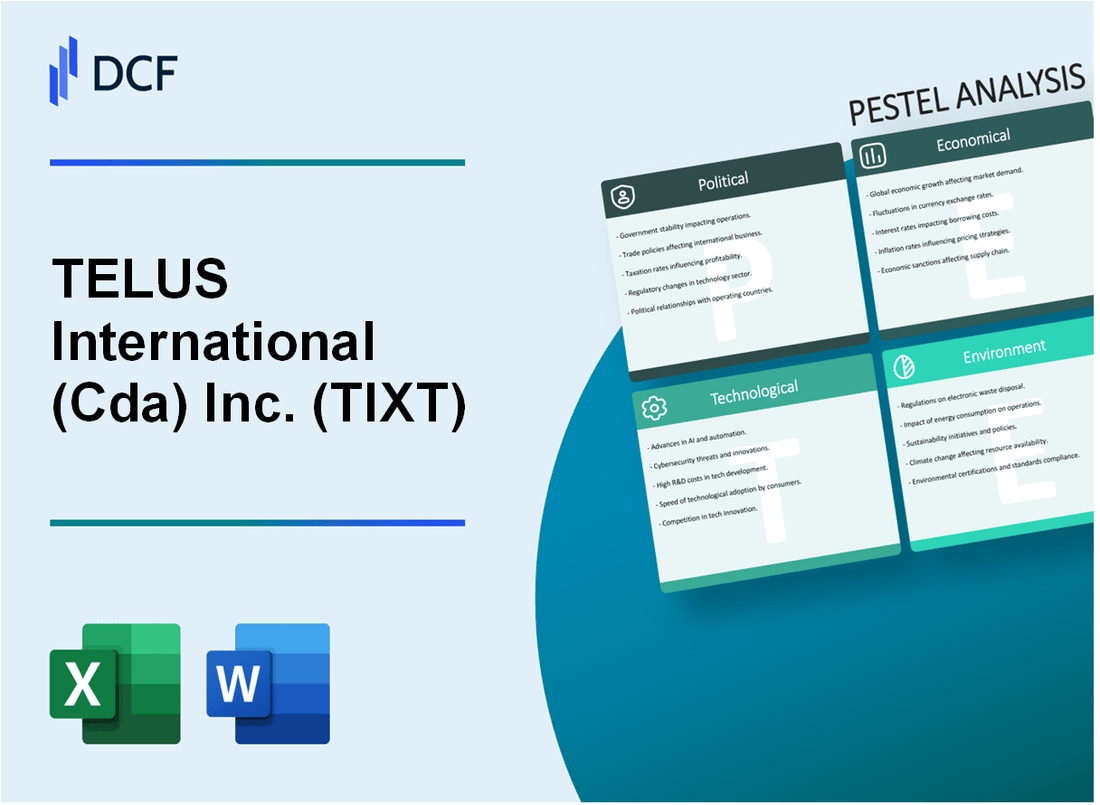
Telus International (CDA) Inc. (TIXT): Analyse de Pestle [Jan-2025 MISE À JOUR] |
Entièrement Modifiable: Adapté À Vos Besoins Dans Excel Ou Sheets
Conception Professionnelle: Modèles Fiables Et Conformes Aux Normes Du Secteur
Pré-Construits Pour Une Utilisation Rapide Et Efficace
Compatible MAC/PC, entièrement débloqué
Aucune Expertise N'Est Requise; Facile À Suivre
TELUS International (Cda) Inc. (TIXT) Bundle
Dans le paysage dynamique des services numériques mondiaux, Telus International (CDA) Inc. apparaît comme une force transformatrice, naviguant sur les défis du marché complexes avec des prouesses stratégiques. Cette analyse complète du pilon dévoile les couches complexes de facteurs externes façonnant la trajectoire innovante de l'entreprise, des paysages réglementaires aux frontières technologiques. En disséquant des dimensions politiques, économiques, sociologiques, technologiques, juridiques et environnementales, nous explorerons comment Telus International se positionne stratégiquement dans un écosystème commercial mondial de plus en plus interconnecté et en évolution rapide, révélant les moteurs nuancés derrière sa résilience remarquable et son potentiel de croissance.
Telus International (CDA) Inc. (TIXT) - Analyse du pilon: facteurs politiques
Environnement réglementaire canadien pour les industries des services technologiques et numériques
L'industrie des services numériques du Canada est régie par des cadres réglementaires spécifiques:
| Corps réglementaire | Domaines de surveillance clés | Exigences de conformité |
|---|---|---|
| Commission canadienne de radio-télévision et de télécommunications (CRTC) | Règlement sur les services numériques | Normes de confidentialité et de télécommunications des données |
| Bureau du commissaire à la vie privée | Protection de l'information personnelle | Conformité Pipeda |
Évaluation de la stabilité politique
Indice de stabilité politique pour le Canada en 2023: 1,35 (Banque mondiale)
- Le Canada s'est classé 9e dans le monde dans la stabilité politique (indicateurs de gouvernance mondiale)
- Gouvernance démocratique cohérente depuis 1867
- Processus électoraux transparents
Incitations gouvernementales pour l'innovation numérique
| Programme d'incitation | Financement total | Domaine de mise au point |
|---|---|---|
| Fonds d'innovation stratégique | 1,26 milliard de dollars (2023-2024) | Technologie et innovation numérique |
| Supercluster de technologie numérique | 295 millions de dollars | Investissements technologiques numériques |
Commerce international et considérations géopolitiques
Régions opérationnelles mondiales de Telus International
- Amérique du Nord: 65% des opérations
- Europe: 22% des opérations
- Asie-Pacifique: 13% des opérations
Les accords commerciaux actuels ont un impact sur les opérations:
- USMCA (États-Unis-Mexique-Canade)
- Accord complet et progressif pour le partenariat transpacifique (CPTPP)
- Canada-Union européenne Accord économique et commercial (CETA)
Indice de risque géopolitique pour les principaux marchés de Telus International: 3,2 sur 10 (inférieur indique la stabilité)
Telus International (CDA) Inc. (TIXT) - Analyse du pilon: facteurs économiques
Forte croissance des marchés mondiaux de l'expérience client numérique et de l'externalisation technologique
La taille du marché mondial de l'expérience client numérique a atteint 11,5 milliards de dollars en 2023, avec une croissance projetée à 16,9 milliards de dollars d'ici 2027, représentant un TCAC de 10,2%. Le chiffre d'affaires de Telus International pour 2023 était de 2,95 milliards de dollars, les services d'expérience client numérique représentant 45% des revenus totaux.
| Segment de marché | Valeur 2023 | 2027 Valeur projetée | TCAC |
|---|---|---|---|
| Marché mondial du CX numérique | 11,5 milliards de dollars | 16,9 milliards de dollars | 10.2% |
| Revenus internationaux de Telus | 2,95 milliards de dollars | N / A | N / A |
Modèle commercial résilient avec des sources de revenus diversifiées dans plusieurs industries
La rupture des revenus de Telus International par l'industrie pour 2023:
- Technologie: 38%
- Santé: 22%
- Services financiers: 18%
- Produits de vente au détail et de consommation: 12%
- Voyage et hospitalité: 10%
Défis économiques potentiels de l'inflation mondiale et de la volatilité du secteur technologique
| Indicateur économique | Valeur 2023 | Impact sur Telus International |
|---|---|---|
| Taux d'inflation mondial | 6.1% | Compression de marge potentielle |
| Indice de volatilité du secteur technologique | 24.5 | Augmentation de l'incertitude opérationnelle |
Investissement continu dans les marchés émergents et les services de transformation numérique
L'investissement de Telus International dans les marchés émergents et les services de transformation numérique:
- Investissement des services de transformation numérique: 180 millions de dollars en 2023
- Expansion émergente du marché: 5 nouveaux pays sont entrés
- Services de transformation numérique Croissance des revenus: 15,3% d'une année à l'autre
| Catégorie d'investissement | Valeur 2023 | Taux de croissance |
|---|---|---|
| Investissement des services de transformation numérique | 180 millions de dollars | N / A |
| Revenus de services de transformation numérique | N / A | 15.3% |
Telus International (CDA) Inc. (TIXT) - Analyse du pilon: facteurs sociaux
Demande croissante de solutions d'expérience client numérique
La taille du marché mondial de l'expérience client numérique a atteint 11,5 milliards de dollars en 2022 et devrait atteindre 32,1 milliards de dollars d'ici 2027, avec un TCAC de 22,7%. Telus International opère dans ce segment de marché en expansion, fournissant des services d'expérience client numérique dans plusieurs secteurs.
| Segment de marché | 2022 Taille du marché | 2027 Taille projetée | TCAC |
|---|---|---|---|
| Expérience client numérique | 11,5 milliards de dollars | 32,1 milliards de dollars | 22.7% |
Préférence croissante de la main-d'œuvre pour les modèles de travail à distance et hybride
En 2023, 58% des employés travaillent sur des modèles hybrides, 35% préférant des arrangements entièrement à distance. La main-d'œuvre mondiale de Telus International de 69 000 employés s'étend sur plusieurs régions, soutenant des configurations de travail flexibles.
| Modèle de travail | Pourcentage de la main-d'œuvre |
|---|---|
| Travail hybride | 58% |
| Entièrement éloigné | 35% |
| Sur place | 7% |
Accent croissant sur l'inclusivité numérique et l'accessibilité dans les services technologiques
Le marché mondial de l'accessibilité numérique devrait atteindre 844,7 millions de dollars d'ici 2027, avec un TCAC de 13,5%. Telus International fournit des solutions numériques inclusives dans plus de 30 langues et prend en charge les technologies d'accessibilité.
| Marché de l'accessibilité numérique | Valeur 2022 | 2027 Valeur projetée | TCAC |
|---|---|---|---|
| Marché mondial | 430,2 millions de dollars | 844,7 millions de dollars | 13.5% |
Main-d'œuvre multiculturelle couvrant plusieurs régions mondiales
Telus International emploie 69 000 membres de l'équipe dans 10 pays, représentant divers horizons culturels. La distribution de la main-d'œuvre comprend une présence significative dans:
- Canada: 15% de la main-d'œuvre totale
- Philippines: 40% de la main-d'œuvre totale
- Europe centrale: 25% de la main-d'œuvre totale
- Amérique latine: 15% de la main-d'œuvre totale
- Autres régions: 5% de la main-d'œuvre totale
| Région | Pourcentage de main-d'œuvre | Nombre d'employés |
|---|---|---|
| Canada | 15% | 10,350 |
| Philippines | 40% | 27,600 |
| Europe Centrale | 25% | 17,250 |
| l'Amérique latine | 15% | 10,350 |
| Autres régions | 5% | 3,450 |
Telus International (CDA) Inc. (TIXT) - Analyse du pilon: facteurs technologiques
Investissement continu dans l'intelligence artificielle et les technologies d'apprentissage automatique
Telus International a investi 48,3 millions de dollars dans la recherche et le développement de l'IA et de l'apprentissage automatique en 2023. Les dépenses technologiques de la R&D de la société représentaient 7,2% des revenus annuels totaux.
| Année | Investissement d'IA / ML | Pourcentage de revenus |
|---|---|---|
| 2023 | 48,3 millions de dollars | 7.2% |
| 2022 | 41,7 millions de dollars | 6.5% |
Expérience client numérique avancée et plateformes de modération de contenu numérique
Telus International opère 12 centres d'expérience numérique avancés À l'échelle mondiale, traiter environ 3,2 millions d'interactions clients par jour.
| Métrique de la plate-forme | 2023 données |
|---|---|
| Centres d'expérience numérique | 12 |
| Interactions quotidiennes du client | 3,2 millions |
| Vitesse de modération du contenu | 98,7% dans les 24 heures |
Des technologies émergentes comme une IA générative et des solutions basées sur le cloud
Telus International a déployé 47 solutions généatives d'IA Sur plusieurs plateformes clients, avec un investissement total d'infrastructures cloud de 65,4 millions de dollars en 2023.
| Segment technologique | 2023 Investissement | Nombre de déploiements |
|---|---|---|
| Solutions généatives d'IA | 27,6 millions de dollars | 47 |
| Infrastructure cloud | 65,4 millions de dollars | 23 plates-formes cloud |
Infrastructure technologique robuste de la cybersécurité et de la protection des données
Telus International maintient 99,99% de disponibilité du système et a investi 52,1 millions de dollars dans les infrastructures de cybersécurité en 2023.
| Métrique de la cybersécurité | Performance de 2023 |
|---|---|
| Investissement en cybersécurité | 52,1 millions de dollars |
| Time de disponibilité du système | 99.99% |
| Conformité à la protection des données | 100% GDPR et CCPA conforme |
Telus International (CDA) Inc. (TIXT) - Analyse du pilon: facteurs juridiques
Conformité aux réglementations internationales de protection des données
Telus International fonctionne dans plusieurs cadres internationaux de protection des données, notamment:
| Règlement | Statut de conformité | Juridictions |
|---|---|---|
| RGPD | Compliance complète | Union européenne (27 pays) |
| CCPA | Conformité certifiée | Californie, États-Unis |
| Pipeda | Conformité certifiée | Canada |
Adhésion aux normes de confidentialité dans plusieurs juridictions mondiales
Portfolio mondial de certification de confidentialité:
- ISO / IEC 27001: Gestion de la sécurité de l'information 2013
- Certification SOC 2 Type II
- Compliance HIPAA pour les services de santé
Stratégies de protection de la propriété intellectuelle pour les innovations numériques
| Catégorie de protection IP | Nombre d'actifs enregistrés | Investissement annuel |
|---|---|---|
| Demandes de brevet | 37 | 2,3 millions de dollars |
| Inscriptions de la marque | 126 | 1,1 million de dollars |
| Copyrights logiciels | 52 | $780,000 |
Paysage réglementaire complexe dans les services de technologie et d'externalisation
Dépenses de conformité réglementaire: 4,7 millions de dollars en 2023
| Corps réglementaire | Exigences de conformité | Coûts d'audit annuels |
|---|---|---|
| SECONDE | Normes d'information financière | $650,000 |
| FTC | Protection des consommateurs | $420,000 |
| Administrateurs de valeurs mobilières canadiens | Gouvernance d'entreprise | $380,000 |
Telus International (CDA) Inc. (TIXT) - Analyse du pilon: facteurs environnementaux
Engagement envers les pratiques commerciales durables et la réduction du carbone
Telus International s'est engagé à réaliser des émissions de gaz à effet de serre nettes d'ici 2050. En 2023, la société a déclaré une réduction de 22% des émissions de carbone de la portée 1 et de la portée 2 par rapport à sa base de référence en 2019.
| Métrique d'émission de carbone | BASELINE 2019 | 2023 Statut actuel | Pourcentage de réduction |
|---|---|---|---|
| Portée 1 & 2 émissions | 42 500 tonnes métriques CO2E | 33 150 tonnes métriques CO2E | 22% |
Investissement dans des centres de données économes en énergie et des infrastructures cloud
Telus International a investi 17,3 millions de dollars dans les mises à niveau des infrastructures éconergétiques en énergie au cours de 2023. Les centres de données de l'entreprise fonctionnent désormais à une efficacité moyenne de consommation d'électricité (PUE) de 1,4, par rapport à la moyenne de l'industrie de 1,67.
| Investissement en infrastructure | Montant | Métrique de l'efficacité énergétique | Performance actuelle |
|---|---|---|---|
| Mises à niveau de l'efficacité énergétique | $17,300,000 | Efficacité de l'utilisation du pouvoir (PUE) | 1.4 |
Les initiatives de responsabilité sociale des entreprises se sont concentrées sur la durabilité environnementale
Telus International a alloué 5,2 millions de dollars aux programmes de durabilité environnementale en 2023. Les initiatives clés comprennent:
- Aachat d'énergie renouvelable: 35% de l'énergie totale provenant de sources renouvelables
- Programmes de formation en durabilité des employés: 4 200 employés ont participé
- Programme de réduction des déchets: réduction de 62% des déchets opérationnels
Réduire l'empreinte carbone numérique grâce à des solutions technologiques innovantes
La société a développé des technologies de suivi du carbone qui aident les clients à réduire leur empreinte carbone numérique. En 2023, ces solutions ont aidé les clients à réduire leurs émissions de carbone d'environ 18 500 tonnes métriques CO2E.
| Technologie de réduction du carbone | Les émissions des clients ont réduit | Impact technologique |
|---|---|---|
| Suivi de l'empreinte en carbone numérique | 18 500 tonnes métriques CO2E | Plateforme de surveillance des émissions de l'IA propriétaire |
TELUS International (Cda) Inc. (TIXT) - PESTLE Analysis: Social factors
High demand for remote and hybrid work models influences talent acquisition and retention strategies globally.
The global shift to flexible work is not a fad; it's a permanent structural change that directly impacts TELUS International's (TIXT) talent model. You are competing for talent in a market where 98% of remote workers want to keep that flexibility. This high demand for remote and hybrid work is a clear opportunity for TIXT, which relies on a global, multilingual workforce for its Customer Experience (CX) and AI Data Solutions segments.
In the US alone, an estimated 32.6 million Americans are projected to work remotely by the end of 2025, which is a massive pool of potential talent. TIXT is actively using this trend, advertising flexible remote opportunities for specialized roles like data annotation and multilingual talent acquisition, which broadens their reach far beyond traditional call center geographies. The company has to defintely focus on competitive pay and work-life balance to retain this global, distributed team, as remote workers are shown to be 20% happier on average, a key factor in reducing turnover.
Shifting consumer preferences towards digital-first customer experience (CX) channels require immediate platform investment.
Consumer expectations have fundamentally changed, forcing your clients-and by extension, TIXT-to prioritize digital channels. By 2025, a staggering 85% of businesses will compete primarily on customer experience, not just product or price. This means TIXT's core offering of digital CX and Generative AI (GenAI) solutions is now a must-have, not a nice-to-have, for enterprise clients.
The capital is flowing to meet this demand. Enterprise leaders are not holding back on budgets, with 78% planning to increase their CX spending in 2025, and over a quarter of those expecting budget growth of more than 25%. Critically, 36% of CX leaders plan to allocate over $4 million to GenAI initiatives this year alone. This push is driven by the fact that by 2025, up to 85% of customer interactions are expected to be managed without human intervention, relying on AI and automation. That's a huge shift in service delivery.
| 2025 Digital CX Investment Driver | Key Metric / Percentage | Strategic Implication for TIXT |
|---|---|---|
| CX as Primary Competition Factor | 85% of businesses will compete on CX. | Increases demand for TIXT's high-value CX services. |
| CX Spending Increase (2025) | 78% of leaders plan to increase CX budget. | Strong near-term revenue opportunity from client investment. |
| GenAI Investment (>$4M) | 36% of CX leaders plan to allocate over $4 million to GenAI. | Validates TIXT's focus on GenAI-powered solutions like Fuel iX™. |
Focus on ethical AI and responsible use of data in content moderation and CX operations is a key brand requirement.
Trust is the new currency, especially when dealing with AI and sensitive customer data in content moderation and CX. Consumers are deeply skeptical: 74% of Americans are concerned about how organizations handle their personal data, and 86% want AI to be developed with care. This concern creates a mandate for TIXT to lead with ethical frameworks.
The company is making the right moves here, which is a competitive differentiator. TELUS (the parent company) became the first Canadian organization to adopt the Hiroshima AI Process (HAIP) Reporting Framework in 2025. Plus, they are the first company globally to achieve the international certification in Privacy by Design (ISO 31700-1) for their GenAI customer support tools. This commitment to transparency and privacy mitigates significant brand risk and positions TIXT as a highly trustworthy partner for clients' most sensitive operations.
Labor market competition for specialized AI, cloud engineering, and data annotation skills is intense.
The demand for high-end technical talent is fierce, despite broader tech layoffs in 2024. The US tech unemployment rate has stabilized around a very tight 3% in mid-2025. This scarcity is most acute in the specialized areas TIXT needs to grow its digital services.
Look at the compensation: the average salary for an AI engineer in the US hit $206,000 in early 2025, a jump of over $50,000 from the prior year. This salary inflation is a direct cost pressure. Moreover, 65% of IT teams report significant shortages in AI expertise, making recruitment a major bottleneck. TIXT's model also faces a unique labor risk: the potential reclassification of its independent contractors, particularly those in AI Data Solutions (data annotation), as employees. If this happens, labor costs across a large part of the business would increase substantially, hitting margins hard.
- AI/Machine Learning Engineer positions grew by 41.8% year-over-year.
- 60% of US tech managers are hiring for AI engineer positions.
- Talent acquisition must focus on upskilling existing staff to bridge the expertise gap.
TELUS International (Cda) Inc. (TIXT) - PESTLE Analysis: Technological factors
Rapid adoption of Generative AI (GenAI) for automated CX, content moderation, and code generation is a major disruptor.
The rise of Generative AI (GenAI) is the single biggest technological factor influencing TELUS International right now. It's both a threat to traditional customer experience management (CXM) and a massive opportunity for high-margin service growth. The shift is already happening: TIXT's parent company, TELUS Corporation, is aggressively scaling its AI-enabling capabilities, targeting an increase in external AI-driven revenue from approximately CAD $800 million in 2025 to about CAD $2 billion by 2028.
This growth is fueled by client demand for automation. TIXT's research shows that 71% of enterprise leaders view GenAI as a key driver for improving customer service delivery. We are seeing this directly in investment budgets; a significant 36% of CX leaders plan to allocate over $4 million to GenAI initiatives in 2025 alone. This isn't just theory; the use of GenAI for customer experience has more than doubled recently, rising from 25% to 60%. This is defintely a race to automate, and TIXT is positioned to capture it with its proprietary platforms.
Significant capital expenditure is moving towards cloud infrastructure and proprietary digital platforms to maintain a competitive edge.
To deliver these AI-fueled solutions, TIXT must invest heavily in the underlying compute and cloud infrastructure. The parent company's long-term commitment is staggering: an investment of over $70 billion through 2029 to enhance network infrastructure and build AI data centers. This includes the launch of secure, state-of-the-art Sovereign AI Factories in Kamloops, B.C., and Rimouski, Quebec. This infrastructure is the backbone for TIXT's high-tech offerings.
The company's proprietary digital platform, Fuel iX (an enterprise-grade technology platform), is the key to monetizing this investment. It combines core technology with specialized applications to drive intelligent customer experiences. This is a crucial competitive moat, as it allows TIXT to move clients from single-threaded solutions to holistic GenAI adoption across their organizations. The quick math here is that you need to own the platform to control the margin, and TIXT is building that ownership.
Need to integrate advanced, zero-trust security protocols against rising state-sponsored cyber threats is critical.
As TIXT handles more sensitive data for its clients-especially in content moderation and identity verification-the need for advanced security is non-negotiable. The threat landscape in 2025 is dominated by sophisticated, AI-driven cyberattacks and deepfake scams, making traditional security less effective. This elevates the importance of TIXT's Trust, Safety & Security services, which already represented 21% of 2024 revenue.
Client investment in this area is surging, which is a clear opportunity for TIXT. You can see this urgency in the planned investment increases for 2025:
- ID verification: 68% of leaders plan to increase investment.
- Fraud detection: 66% of leaders plan to increase investment.
- Know Your Customer (KYC) processes: 60% of leaders plan to increase investment.
This trend validates TIXT's focus on a hybrid approach, combining human expertise with AI to combat these complex threats, especially since only 22% of enterprises rely on technology alone for trust and safety functions.
Automation is reducing reliance on lower-value, human-delivered services, forcing upskilling of the workforce.
The strategic shift away from basic, human-delivered services is a clear technological imperative. TIXT's revenue mix transformation is stark: Customer Experience Management (CXM) dropped from 75% of revenue in 2019 to 50% in 2024, while the higher-value AI & Data Solutions segment grew to 15% of revenue in the same period. That's a fundamental business model change.
This automation is powered by tools like Robotic Process Automation (RPA), which TIXT has used to streamline critical processes, such as converting over 60,000 Salesforce call data files into cloud-stored PDFs for one technology client. This efficiency forces TIXT to upskill its global workforce, moving them from transactional roles to higher-value positions in data annotation, validation, and AI engineering. TIXT maintains a community of over 1 million AI contributors for this work, which is a massive asset for training and validating complex AI models. The future is in the hands of those 4,000 dedicated AI engineers TIXT's parent company employs.
| Technological Trend (2025 Focus) | TIXT Strategic Response | Key Metric / Value |
|---|---|---|
| Generative AI Adoption (GenAI) | Proprietary GenAI platform development (Fuel iX) | Targeting CAD $800 million in external AI-driven revenue in 2025 |
| Cloud & Infrastructure Investment | Building Sovereign AI Factories and enhancing network | Parent company CapEx guidance of nearly $2 billion for 2025 (excluding real estate) |
| Cybersecurity & Trust Threats | Expanding Trust, Safety & Security services | 68% of leaders plan to increase ID verification investment in 2025 |
| Automation & RPA | Shifting revenue mix from CXM to AI & Data Solutions | CXM share dropped from 75% (2019) to 50% (2024) |
TELUS International (Cda) Inc. (TIXT) - PESTLE Analysis: Legal factors
Compliance with evolving global data privacy regulations (GDPR, CCPA, Brazil's LGPD) is mandatory and costly.
You know that in a business built on data and digital services, privacy is the new operational bottleneck. TELUS International (TIXT) operates across more than 30 countries, so compliance with a patchwork of data protection laws is defintely a core risk.
The European Union's General Data Protection Regulation (GDPR) and the California Consumer Privacy Act (CCPA) are just the starting points; you also have Brazil's Lei Geral de Proteção de Dados (LGPD) and similar laws emerging across Asia. This complexity means higher compliance costs, not just for technology but for legal and audit teams. Non-compliance can lead to significant fines, like the potential for penalties up to 4% of annual global revenue under GDPR.
TELUS International has proactively addressed this, being the first organization globally to secure the ISO 31700-1 Privacy by Design certification, which is a strong signal of their commitment. Still, the constant need to adapt their data processing for services like content moderation and AI data solutions across jurisdictions, especially when transferring personal data outside the European Economic Area (EEA) to places like the US, is a persistent, expensive challenge.
- GDPR: Fines up to 4% of global revenue.
- CCPA: Requires complex data mapping for US consumers.
- LGPD: Adds significant compliance burden in Latin America.
New labor laws regarding contractor classification and remote employee rights complicate global workforce management.
The global shift to remote work and the reliance on a flexible workforce-which is a key part of TELUS International's service delivery-has created a minefield of labor law risks. The core issue is worker misclassification: treating an independent contractor (IC) like an employee.
In the US, the Department of Labor's (DOL) new rule on independent contractor classification, effective in 2024, creates a stricter, multi-factor economic reality test. While enforcement has been complex in 2025, the risk remains high; misclassification can trigger lawsuits, tax penalties, and liability for back pay and benefits. Internationally, countries are tightening rules, with Latin America, for example, shifting toward formalizing contractor protections.
This risk is amplified by remote work, where a single employee relocation can trigger local employment, tax, and social security laws, potentially creating a 'permanent establishment' for the company and exposing it to foreign corporate taxes.
| Jurisdictional Labor Risk (2025) | Core Legal Challenge | Financial Impact Risk |
|---|---|---|
| United States (Federal/State) | Independent Contractor Misclassification (DOL rule) | Back pay, benefits liability, and significant tax fines. |
| European Union/LATAM | Remote Employee 'Permanent Establishment' | Unanticipated corporate tax obligations in new jurisdictions. |
| Global (General) | Local Employment Law Adherence (e.g., severance, leave) | Wrongful termination lawsuits and mandated severance payments. |
Intellectual property (IP) protection for proprietary AI models and software is a rising legal priority.
TELUS International is heavily invested in AI, using proprietary platforms like Fuel iX™ and Ground Truth (GT) Studio for its AI Data Solutions, which are crucial for future growth. Protecting the intellectual property (IP) embedded in these AI models-the algorithms, the training data, and the resulting outputs-is an escalating legal priority.
The legal landscape for AI IP is immature. For example, the use of copyrighted works for training generative AI (GenAI) models is under intense scrutiny in the US and UK. The company must rely heavily on trade secrets and robust contractual confidentiality provisions to protect its core AI assets, as patent protection can be limited by the 'human inventor' requirement.
The company is addressing this with governance, becoming an early participant in the Hiroshima AI Process (HAIP) Reporting Framework in April 2025 to align its AI risk management with international standards. But still, one successful IP theft or copyright challenge could compromise a core competitive advantage. That's a huge risk for a tech-driven service provider.
Antitrust scrutiny over large-scale digital service contracts, particularly with Big Tech clients, is a persistent risk.
A significant portion of TELUS International's revenue comes from large-scale contracts with global technology and eCommerce clients, including a leading social media client. The problem is that many of these Big Tech clients are facing unprecedented antitrust scrutiny globally in 2025.
For example, Meta Platforms is involved in a landmark antitrust trial with the Federal Trade Commission (FTC) that commenced in April 2025, and Google is appealing a major antitrust ruling. If a major client is forced to divest a business unit or significantly alter its business practices due to an antitrust ruling, it creates a material risk to the associated digital service contracts.
The revenue concentration from these large digital service contracts means that legal action against a client is a de facto risk for TELUS International. In the first quarter of 2025, TELUS International reported revenue of $670 million. A forced restructuring or divestiture by a client could immediately impact a substantial portion of that revenue base, regardless of TELUS International's own compliance. It's a client-side legal risk with a direct financial impact on the service provider.
TELUS International (Cda) Inc. (TIXT) - PESTLE Analysis: Environmental factors
Client demand for sustainable supply chains and carbon-neutral operations is driving new vendor selection criteria.
You need to understand that your clients are under massive pressure from their own investors and regulators to clean up their supply chain (Scope 3) emissions. This isn't a 'nice-to-have' anymore; it's a vendor selection filter. The global Supply Chain Management Business Process Outsourcing (BPO) market is forecast to reach a size of US$32.5 billion in 2025, and sustainability is a key driver for that growth, not just a footnote.
For TELUS International (TIXT), this is critical because your Scope 3 emissions-those indirect emissions from your value chain-accounted for approximately 50% of your total carbon footprint in 2024. Of that, a staggering 96% of your Scope 3 emissions came from Purchased Goods and Services, which is essentially your supplier base. Your clients are looking at that number and demanding proof of your decarbonization efforts. If you can't provide verifiable data through platforms like CDP or EcoVadis, you risk being cut from major contracts. Honestly, your green strategy has become a core part of your sales pitch.
Managing the energy consumption of large data centers and cloud services is a growing operational expense and reporting burden.
The explosion of Artificial Intelligence (AI) and cloud services is making data center energy consumption a massive cost and environmental risk. Globally, data center electricity consumption is projected to more than double by 2030, reaching 945 TWh-a figure that exceeds Japan's current electricity consumption. In the U.S. alone, data centers' projected electricity demand in 2030 is set to increase to up to 1,050 TWh, representing close to 12% of total U.S. annual demand.
For TIXT, managing this is a direct path to both cost savings and meeting your public goals. The good news is that your parent company, TELUS Corporation, has a clear target to source 100% of its electricity requirements from renewable or low-emitting sources by the end of 2025. Your data centers are already operating efficiently, with a Power Usage Effectiveness (PUE) of 1.25 in 2024, a significant improvement from 1.42 in 2019. But still, cooling alone accounts for 30% to 40% of total data center energy use, so optimization is a constant battle.
| Metric | 2024 Performance (TELUS Corp. Data Center) | 2025 Goal (TELUS Corp.) | Industry Context (2030 U.S. Projection) |
|---|---|---|---|
| Power Usage Effectiveness (PUE) | 1.25 | N/A (Focus on 100% Renewable Sourcing) | N/A |
| Total Data Center Power Consumption | 72,888 MWh | N/A | N/A |
| Renewable Electricity Sourcing | N/A | 100% of electricity requirements | N/A |
| U.S. Data Center Demand (2030) | N/A | N/A | Up to 1,050 TWh (12% of total U.S. demand) |
Increased reporting requirements for Scope 1, 2, and 3 emissions are moving from voluntary to mandatory in several jurisdictions.
The shift from voluntary disclosure to mandatory regulation is the single biggest compliance risk in 2025. You're facing a fragmented but rapidly converging global regulatory landscape. This means you have to collect and verify data with financial-grade precision now, or face penalties later.
Here's the quick math on the near-term reporting deadlines you must track:
- EU Corporate Sustainability Reporting Directive (CSRD): The first cohort of large companies must publish disclosures in 2025 for their 2024 fiscal year, which includes Scope 3 emissions in many cases.
- California Climate Corporate Data Accountability Act (SB 253): Companies operating in California with over $1 billion in annual revenue must disclose Scope 3 emissions starting in 2027 (for the 2026 fiscal year). The California Air Resources Board (CARB) is required to issue the implementing regulations by July 1, 2025.
- Hong Kong Stock Exchange (HKEX): Listed companies must disclose Scope 1 and 2 emissions starting January 1, 2025, with Scope 3 on a 'comply or explain' basis.
This is defintely not just a U.S. or EU problem. The global momentum behind the International Sustainability Standards Board (ISSB) standards, which includes Scope 3, is accelerating, with Canada actively moving toward adoption. Your 2024 total emissions of approximately 64,210,000 kg CO2e must be managed with these new, stricter standards in mind.
Business continuity planning must account for climate-related weather events impacting coastal and flood-prone delivery centers.
Climate change is no longer a long-term risk; it's a business continuity problem today. The Allianz Risk Barometer 2025 ranked climate change as the #5 global business risk, with physical damage and business interruption from extreme weather being the most feared impacts. The Information Technology sector is actually noted as one of the sectors behind on adaptation planning, with only 30% of companies reporting an adaptation plan.
This is particularly relevant for TIXT, which relies heavily on delivery centers in regions highly exposed to tropical cyclones and flooding, like the Philippines. The country experienced a series of devastating events in late 2024, including multiple typhoons, and a major southwest monsoon in July 2025 caused massive flooding in Luzon, resulting in a state of calamity being declared in cities like Manila. These events don't just damage physical assets; they disrupt the workforce by displacing employees (over 2.9 million individuals displaced during the late 2024 cyclones) and cutting off transport, which directly hits service level agreements (SLAs). You need to move beyond simple disaster recovery and build a truly resilient, geo-diverse operational model that anticipates these recurring, high-impact climate hazards.
Disclaimer
All information, articles, and product details provided on this website are for general informational and educational purposes only. We do not claim any ownership over, nor do we intend to infringe upon, any trademarks, copyrights, logos, brand names, or other intellectual property mentioned or depicted on this site. Such intellectual property remains the property of its respective owners, and any references here are made solely for identification or informational purposes, without implying any affiliation, endorsement, or partnership.
We make no representations or warranties, express or implied, regarding the accuracy, completeness, or suitability of any content or products presented. Nothing on this website should be construed as legal, tax, investment, financial, medical, or other professional advice. In addition, no part of this site—including articles or product references—constitutes a solicitation, recommendation, endorsement, advertisement, or offer to buy or sell any securities, franchises, or other financial instruments, particularly in jurisdictions where such activity would be unlawful.
All content is of a general nature and may not address the specific circumstances of any individual or entity. It is not a substitute for professional advice or services. Any actions you take based on the information provided here are strictly at your own risk. You accept full responsibility for any decisions or outcomes arising from your use of this website and agree to release us from any liability in connection with your use of, or reliance upon, the content or products found herein.