

|
Viant Technology Inc. (DSP): PESTLE Analysis [Nov-2025 Updated] |
Fully Editable: Tailor To Your Needs In Excel Or Sheets
Professional Design: Trusted, Industry-Standard Templates
Investor-Approved Valuation Models
MAC/PC Compatible, Fully Unlocked
No Expertise Is Needed; Easy To Follow
Viant Technology Inc. (DSP) Bundle
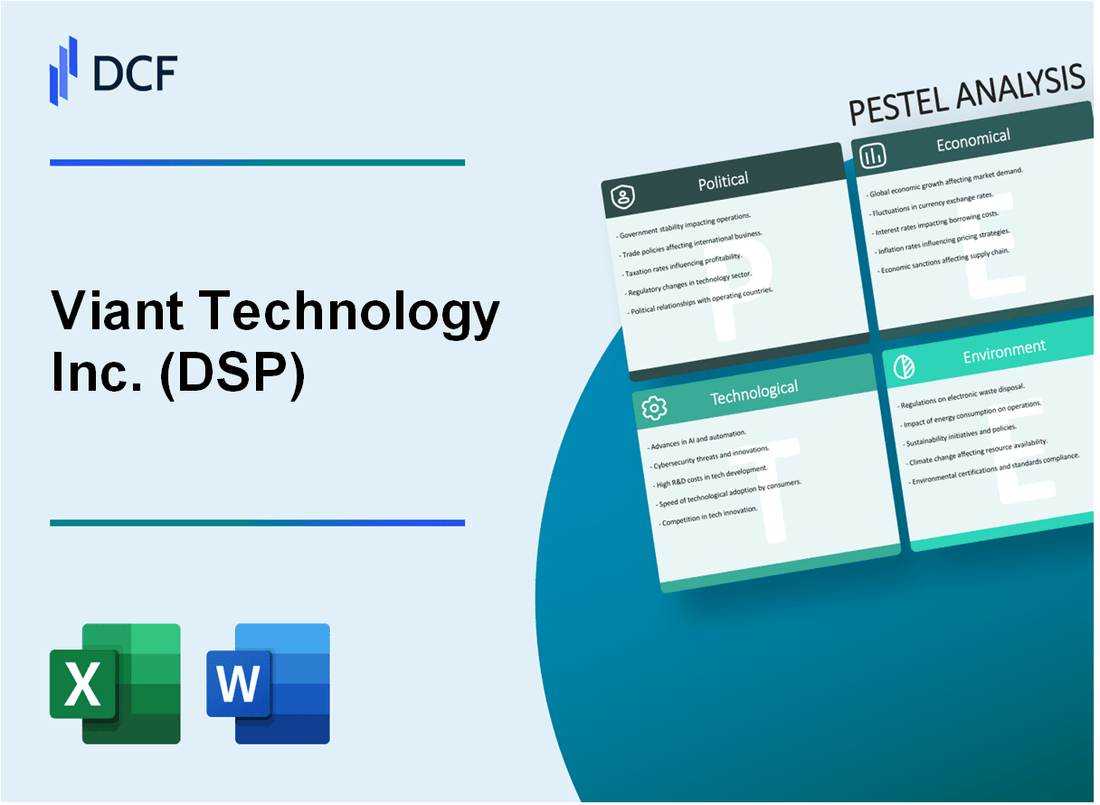
You're looking for a clear, actionable breakdown of the external forces shaping Viant Technology Inc. (a Demand-Side Platform, or DSP), and honestly, the picture is one of high regulatory risk balanced by a clear technological opportunity. The near-term focus must be on navigating the cookieless transition while capitalizing on the shift to Connected TV (CTV) advertising, which is defintely where the growth is.
Political Factors: Navigating Regulatory Scrutiny
The political landscape for Viant Technology Inc. is dominated by government oversight. Increased US federal scrutiny on ad-tech data practices and market concentration is a real headwind. You need to prepare for the potential of new federal data privacy legislation, like the American Data Privacy and Protection Act (ADPPA), by late 2025.
Plus, US state attorneys general are actively investigating the ad-tech industry for privacy violations, and global trade tensions still impact cross-border data flow agreements. This isn't just theory; it's a cost center. Compliance is the new moat.
Economic Factors: Efficiency Drives Spend
The economic outlook is favorable for digital ad spend, but tight for margins. US digital ad spend is projected to grow by around 12% in 2025, benefiting all DSPs, including Viant. This growth is your primary tailwind.
Still, high interest rates continue to pressure Viant's clients to demand measurable Return on Investment (ROI). Global economic uncertainty actually favors programmatic efficiency over traditional media buys, so Viant's core offering is well-positioned. Inflationary pressures are stabilizing, but still affecting advertiser budgets and margins, meaning Viant must keep its take-rate competitive.
Sociological Factors: The Privacy-First Consumer
The biggest sociological shift is the consumer demand for data privacy, which is at an all-time high and driving opt-out rates. This directly impacts the value of data Viant uses. The significant shift in viewing habits toward Connected TV (CTV) and streaming platforms is a massive opportunity; everyone is watching something different now.
Also, growing pressure from consumers and investors for companies to adopt ethical Artificial Intelligence (AI) in ad targeting is rising. Increased brand sensitivity to ad placement (brand safety) requires Viant to offer sophisticated filtering tools. Consumers are demanding better behavior, not just better ads.
Technological Factors: The Cookieless Imperative
Technologically, 2025 is the year of reckoning. The full deprecation of third-party cookies is expected to be completed, making Viant's cookieless solutions (like their Adelphic platform) absolutely critical. Viant's proprietary Household ID and direct publisher integrations are key assets against competitors who rely on older tracking methods.
AI and Machine Learning are essential for optimizing campaign performance and automated bidding. The rapid adoption of Retail Media Networks (RMNs) creates new integration requirements for DSPs, meaning Viant needs to keep building new connections fast. If you don't have a cookieless solution, you don't have a business.
Legal Factors: A Patchwork of Compliance
The legal environment is a compliance minefield. Enforcement of state laws like the California Consumer Privacy Act/California Privacy Rights Act (CCPA/CPRA) and the Virginia Consumer Data Protection Act (VCDPA) is creating a patchwork of compliance requirements across the US. European General Data Protection Regulation (GDPR) fines for ad-tech companies continue to rise, setting a global precedent for data misuse.
Ongoing antitrust investigations (e.g., Google's Ad-Tech practices) could force market restructuring, which actually creates opportunities for smaller DSPs like Viant to gain share. New regulations for political advertising transparency ahead of the 2026 election cycle also require platform updates. The cost of non-compliance far outweighs the cost of compliance.
Environmental Factors: Green Programmatic
Environmental, Social, and Governance (ESG) concerns are moving from a nice-to-have to a must-have. Growing client demand for 'green' programmatic advertising, which reduces the carbon footprint of ad delivery, is a new service requirement. This means Viant must focus on supply path optimization (SPO) not just for cost, but also to reduce unnecessary data transfers and energy waste.
There is increased scrutiny on the energy consumption of data centers and cloud infrastructure used by Viant. Plus, there's pressure to disclose ESG metrics in financial filings. Energy efficiency is the next competitive edge in ad-tech.
Here's the quick math: If Viant captures just 0.5% of the projected $300 billion US digital ad market in 2025, that's $1.5 billion in gross media spend flowing through their platform, which translates to their projected revenue of around $280 million. What this estimate hides is the immense pressure on their margins from the regulatory compliance costs. You need to know exactly how much they are spending on legal and engineering to stay ahead of the privacy curve.
So, your clear action is to have the Legal and Product teams draft a 2026 compliance roadmap by the end of this quarter. Finance: draft 13-week cash view by Friday, specifically modeling the cost of a 15% increase in compliance spending.
Viant Technology Inc. (DSP) - PESTLE Analysis: Political factors
You're operating Viant Technology Inc. (DSP) in an ad-tech political environment that is fundamentally reshaping itself, which is a massive opportunity but also a risk. The single biggest political factor is the US government's antitrust push against Google, which could fragment the market and hand you a competitive advantage. But, you also have to navigate a fragmented, aggressive state-level privacy enforcement landscape.
Increased US federal scrutiny on ad-tech data practices and market concentration
The Department of Justice (DOJ) case against Google is the main event here, and it's a clear political tailwind for independent demand-side platforms (DSPs) like Viant. U.S. District Court Judge Leonie Brinkema ruled in April 2025 that Google holds two illegal ad-tech monopolies, setting the stage for a remedy phase that concluded in November 2025. The DOJ is pushing for a structural remedy, specifically the forced divestiture (sale) of Google's ad exchange, AdX, to restore competition.
If the court orders this breakup, it would dramatically level the playing field, making Viant's buy-side-only model (Direct Access) a much more attractive, conflict-free option for advertisers. Viant's platform is already positioned as a strong alternative to the 'walled gardens,' which is why its Connected TV (CTV) ad spend hit approximately 45% of total ad spend in Q2 2025.
Global trade tensions impacting cross-border data flow agreements
Political actions on trade are now directly impacting your customers' ad budgets and the global data flow rules you rely on. The U.S. administration is explicitly using the threat of tariffs to pressure foreign governments to deregulate U.S. Big Tech firms and prevent 'foreign legal regimes' from limiting cross-border data flows. For example, the administration threatened a 50% tariff on imports from Brazil in July 2025, partly due to Brazil's attempts to regulate U.S. social media companies.
This political uncertainty translates directly to financial risk. Viant's Q2 2025 Contribution ex-TAC (excluding traffic acquisition costs) growth was impacted by a deceleration of around 400 basis points because some advertisers paused spending following a tariff announcement early in the quarter.
US state attorneys general actively investigating ad-tech industry for privacy violations
With federal legislation stalled, state attorneys general (AGs) have become the primary, aggressive enforcers of data privacy, creating a complex compliance patchwork. This is not just a theoretical risk; it involves large, concrete financial penalties that set precedents for the entire ad-tech industry. State AGs are now aggressively hiring technical experts to conduct deep technical audits, moving beyond simple policy reviews.
Here's the quick math on recent 2025 settlements that establish the new baseline for risk:
| State AG | Date | Company/Industry | Settlement Amount | Violation Focus |
|---|---|---|---|---|
| California (Bonta) | July 2025 | Healthline Media LLC | $1.55 million | Failing to honor CCPA opt-out requests (including Global Privacy Control) for personalized ads. |
| California (Bonta) | November 2025 | Jam City (Mobile App Gaming) | $1.4 million | Failure to offer CCPA-compliant opt-outs and sharing data of minors (ages 13-16) without affirmative consent. |
| Connecticut (Tong) | July 2025 | TicketNetwork, Inc. | $85,000 | Unreadable privacy notice and unusable rights mechanisms under the Connecticut Data Privacy Act (CTDPA). |
Potential for new federal data privacy legislation (e.g., ADPPA) by late 2025
The push for a single, preemptive federal data privacy law-like the American Data Privacy and Protection Act (ADPPA)-has effectively stalled in late 2025 due to disagreements over preemption (overriding state laws) and a private right of action (allowing individuals to sue). This legislative failure means the compliance burden for Viant is increasing, not simplifying.
The regulatory environment is fragmenting, forcing you to comply with a growing patchwork of state-level laws. In 2025 alone, eight new state privacy laws are taking effect, including those in Iowa, Delaware, Nebraska, New Hampshire, New Jersey, Tennessee, Minnesota, and Maryland. Delaware's law, for instance, is particularly strict, requiring opt-in consent for targeted advertising aimed at individuals under 18. This is a defintely complex operating environment.
- Iowa Consumer Data Protection Act (ICDPA) - effective January 1, 2025.
- Delaware Personal Data Privacy Act (DPDPA) - effective January 1, 2025.
- New Jersey Data Privacy Law (NJDPL) - effective January 15, 2025.
- Maryland Online Data Privacy Act (MODPA) - effective October 1, 2025.
Your action here is clear: Finance and Legal must draft a 13-week cash view by Friday, factoring in a 25% increase in compliance spending for the next fiscal year to manage this state-level complexity.
Viant Technology Inc. (DSP) - PESTLE Analysis: Economic factors
US Digital Ad Spend Growth is Still Robust
The core economic factor for Viant Technology Inc. (DSP) is the continued, albeit moderating, growth of the US digital advertising market. This expansion provides a strong tailwind for all Demand-Side Platforms (DSPs). The Interactive Advertising Bureau (IAB) recently revised its outlook, projecting US digital ad spending will reach $248 billion in 2025, representing a 10.3% increase from 2024. That's a massive pool of capital flowing directly into the channels Viant serves.
While some forecasts, like one projecting the market at $324.9 billion with 9.1% growth, are even more optimistic, the key takeaway is that digital remains the growth engine. This consistent double-digit growth, even in a cautious economy, confirms that digital advertising is no longer discretionary spending; it's a necessary investment for revenue generation.
Inflationary Pressures Stabilize but Caution Remains
Inflationary pressures are easing, which is good news for advertiser margins, but the effects are still deeply embedded in corporate planning. Overall media inflation is forecasted to slow to +2.5% in 2025, a noticeable drop from the +3.4% seen in 2024. This stabilization offers some breathing room for media buying costs.
Still, the psychological impact of the last few years is real. Survey data shows that 94% of U.S. advertisers remain concerned about the economic climate, and a significant 45% plan to reduce their overall budgets in response. This means every dollar is under intense scrutiny, and Viant's clients are prioritizing efficiency over brand-building 'fluff.'
High Interest Rates Drive Demand for Measurable ROI
The sustained high interest rate environment continues to pressure Viant's clients, especially those with high debt loads or reliance on venture capital funding. With the federal funds rate averaging around 3.9% in 2025, the cost of capital remains elevated. This forces Chief Financial Officers (CFOs) to demand immediate, measurable Return on Investment (ROI) from marketing budgets.
This shift is a direct benefit to Viant's platform, which is built on performance-based advertising. CFO scrutiny is high, with one CMO noting their CFO is their 'new boss' on spending. The industry benchmark for a good digital marketing ROI is a 5:1 return (or 500%), with exceptional performance hitting 10:1 or greater. Viant's ability to deliver on these metrics is now a critical sales point.
Programmatic Efficiency Outpaces Traditional Media
Global economic uncertainty is accelerating the shift toward programmatic advertising (automated ad buying), as its precision and efficiency are a perfect hedge against budget cuts. Programmatic is a bright spot in the ad market.
In the US, programmatic has accounted for more than 90% of digital display ad dollars since 2023. This trend is particularly strong in high-growth areas:
- Programmatic retail media display ad spending is projected to leap 29.3% in 2025.
- Programmatic video ad spending in the US will surpass $110 billion.
This data shows a clear preference for programmatic channels like Connected TV (CTV) and Retail Media Networks (RMNs) because they offer the data-driven targeting and closed-loop measurement that traditional media simply cannot match.
| US Digital Ad Market Metric (2025) | Forecast Value | Significance for Viant |
|---|---|---|
| Total US Digital Ad Spend | $248 billion | Represents the total addressable market size. |
| US Digital Ad Spend Growth Rate | 10.3% | Indicates strong underlying market growth. |
| Programmatic Retail Media Growth | +29.3% | Highlights high-growth sub-sector opportunity. |
| Media Inflation Forecast | +2.5% | Shows easing cost pressure for advertisers. |
| Target Digital Marketing ROI | 5:1 to 10:1 | Sets the high bar for performance Viant must meet. |
Viant Technology Inc. (DSP) - PESTLE Analysis: Social factors
Consumer demand for data privacy is at an all-time high, driving opt-out rates.
You and every other financial decision-maker must recognize that consumer trust is now a core financial asset in ad-tech. The public is defintely more aware of data collection, and they are acting on it. For Viant Technology Inc., whose core offering relies on addressability solutions like Household ID and IRIS_ID to navigate the cookieless future, this is a massive social factor.
The numbers are clear: 86% of the US general population sees data privacy as a growing concern. This translates directly to financial risk, as 75% of consumers say they will not purchase from organizations they do not trust with their personal data. Furthermore, a significant 71% of consumers report they would stop doing business with a company entirely if it mishandled their sensitive data. This pressure means Viant's privacy-centric solutions are no longer a feature, but a necessity for client retention and growth.
Significant shift in viewing habits toward Connected TV (CTV) and streaming platforms.
The shift from traditional linear television to Connected TV (CTV) is the most critical social trend driving Viant's near-term opportunity. This is where the money is moving. As of mid-2025, streaming officially claimed the top spot, accounting for 44.8% of total TV viewership, which surpassed the combined share of broadcast and cable at 44.2%. That's a permanent change in consumer behavior.
For Viant, this translates into a booming market where its programmatic demand-side platform (DSP) is highly relevant. The U.S. CTV advertising market is projected to reach approximately $33.48 billion in ad spend in 2025. Viant is capitalizing on this, reporting that CTV ad spend accounted for approximately 45% of its total ad spend on the platform in the second quarter of 2025. That's a huge concentration of revenue in the fastest-growing segment.
Growing pressure from consumers and investors for companies to adopt ethical AI in ad targeting.
The rapid adoption of Artificial Intelligence (AI) in ad targeting brings an ethical spotlight from consumers. As AI models become more complex, the risk of algorithmic bias (where the AI unfairly targets or excludes certain demographics) and lack of transparency increases. This is a real reputational hazard.
Consumers are skeptical: 70% have little to no trust in companies to make responsible decisions about how they use AI in their products. Moreover, 78% of consumers believe organizations have a responsibility to only use AI in an ethical manner. Viant's response, the launch of the third phase of its ViantAI product suite-AI Measurement and Analysis-is a direct action to address the need for transparency and on-demand insights, positioning them as a responsible player in this high-stakes environment.
Increased brand sensitivity to ad placement (brand safety) requiring sophisticated filtering.
Brand safety and suitability are non-negotiable for major advertisers, especially with automated programmatic platforms like Viant's. The risk of an ad appearing next to harmful content (like hate speech or misinformation) is a significant concern for clients.
Here's the quick math on why this matters: 68% of consumers say a brand loses their trust permanently if its ad appears next to offensive content. Consequently, 70% of advertisers consider brand safety a top priority when buying programmatic ads. This has driven a major investment trend, with 59% of digital advertisers actively investing in AI-powered brand safety tools to ensure contextually appropriate content, which 83% of brands now consider a key factor. Viant must continually prove its filtering technology is superior to maintain its pipeline of major U.S. advertisers.
| Social Factor (2025) | Key Metric | Value/Amount |
|---|---|---|
| Consumer Data Privacy Concern | US Population Concerned about Data Privacy | 86% |
| Consumer Data Privacy Impact | Consumers who would stop buying from a company over privacy concerns | 48% |
| Shift to Connected TV (CTV) | Projected U.S. CTV Ad Spend in 2025 | Up to $33.48 billion |
| Viant's CTV Exposure (Q2 2025) | CTV Ad Spend as % of Viant's Total Ad Spend | Approximately 45% |
| Ethical AI Pressure | Consumers who distrust companies' responsible use of AI | 70% |
| Brand Safety Sensitivity | Advertisers considering Brand Safety a Top Priority | 70% |
The social landscape demands a privacy-first, quality-obsessed, and CTV-focused platform. The market is moving fast, so Viant's ability to scale its Household ID and ViantAI solutions will be the true test of its social-factor resilience.
Viant Technology Inc. (DSP) - PESTLE Analysis: Technological factors
The technological landscape for Viant Technology Inc. is defined by two massive, converging forces: the death of the third-party cookie and the rise of Artificial Intelligence (AI). Your ability to execute campaigns hinges on Viant's proprietary solutions, which are now critical infrastructure, not just optional features.
The Full Deprecation of Third-Party Cookies
The final phase-out of third-party cookies in Google Chrome is expected in early 2025, marking a complete shift for the digital advertising industry. This is a massive risk for cookie-reliant Demand-Side Platforms (DSPs), but it's a clear opportunity for Viant, which has been preparing for this for over a decade. Viant's cookieless solution, branded as the World Without Cookies (WWC) update within the Adelphic advertising software, is now the core product.
This proprietary, people-based approach is proving its value in a measurable way. One client's cookieless campaign achieved 100% scale and 93% unique reach for activation, and some brands using WWC have seen over 200% average conversions compared to cookie-based campaigns. This isn't just a workaround; it's a competitive advantage that is now fully baked into the platform.
AI and Machine Learning for Optimization and Bidding
AI is no longer a buzzword; it's a non-negotiable tool for campaign profitability. Viant's investment in its Vion AI platform and the generative AI planning tool, ViantAI, is designed to automate the most time-consuming and complex parts of media buying.
Here's the quick math on how this translates to efficiency and savings:
- ViantAI Planning: Develops a complete media plan in 60 seconds, dramatically shortening the traditional agency process.
- AI Bidding: Automates the bidding process, saving customers an average of 40% on their ad spend by optimizing bid prices in real-time.
- Fraud Prevention: Machine learning algorithms analyze millions of impressions per second, helping clients save over 10% of their marketing budgets by identifying and preventing new forms of ad fraud.
The goal is autonomous advertising, and Viant is defintely pushing the boundary here.
Viant's Household ID and Direct Publisher Integrations
Viant's core technological assets are its patented Household ID and its Direct Access supply path. The Household ID is a persistent, device-agnostic identifier that translates over 1.5 billion identifiers into 115 million targetable homes. This is the backbone of their cookieless strategy, and its performance metrics are strong:
| Metric (as of 2025) | Performance | Significance |
|---|---|---|
| Household Recognition Rate | ~95% | High accuracy for cross-device targeting and frequency capping. |
| Inventory Coverage | ~80% | Ensures scale across a large portion of available ad inventory. |
| Targetable Homes Mapped | 115 million | Represents the total size of the addressable audience in the U.S.. |
The Direct Access model is a key differentiator against competitors like Google and Amazon. Viant operates as a buy-side-only platform, which means it has no conflict of interest in steering your budget toward its own inventory or supply paths. This objectivity, combined with superior household-level addressability, helped Viant secure a major multi-year partnership with Molson Coors Beverage Company, a win that was highly competitive.
Rapid Adoption of Retail Media Networks (RMNs)
The explosion of Retail Media Networks (RMNs) is creating a new technological mandate for DSPs. Global ad spend on RMNs is projected to exceed $100 billion in 2025, driven by the fact that RMNs offer the first-party purchase data that brands crave in a post-cookie world.
For Viant, this trend requires deeper technical integrations to connect its DSP to these new walled gardens. The key technological requirements are:
- First-Party Data Integration: DSPs must seamlessly ingest and activate the retailer's first-party data for targeting, which is more complex than traditional third-party data feeds.
- Omnichannel Measurement: The platform must unify online and in-store ad placements, allowing for closed-loop attribution-measuring an ad exposed on a Connected TV (CTV) against an in-store purchase.
- Identity Mapping: Viant must ensure its Household ID can interoperate with the various identity frameworks used by different RMNs (e.g., UID2, RampID) to maintain frequency capping and measurement consistency across fragmented networks.
Viant's focus on CTV, which accounted for 46% of its total ad spend in Q3 2025, and its mature Household ID solution position it well to solve the cross-channel measurement problem that RMNs create.
Viant Technology Inc. (DSP) - PESTLE Analysis: Legal factors
Enforcement of state laws like the CCPA/CPRA and VCDPA is creating a patchwork of compliance requirements.
You are operating in a fragmented legal environment, and the biggest near-term risk for Viant Technology Inc. is the escalating cost and complexity of US state privacy laws. The California Consumer Privacy Act (CCPA), as amended by the California Privacy Rights Act (CPRA), and the Virginia Consumer Data Protection Act (VCDPA) are not just paper requirements; they are actively enforced, creating a compliance patchwork.
For 2025, the California Privacy Protection Agency (CPPA) increased the fine thresholds, meaning non-compliance is now more expensive. Specifically, the maximum fine for an intentional violation or a violation involving a consumer under 16 years of age is now up to $7,988 per violation. The base fine for other violations is up to $2,663 per violation. Honestly, updating legacy systems to meet these real-time data handling and consent requirements forces substantial investment in both infrastructure and training for any Demand-Side Platform (DSP). Viant must ensure its platform, including its proprietary Household ID and IRIS_ID solutions, maintains a clear opt-out mechanism for the 'sale' or 'sharing' of personal information, as mandated by these state laws.
European GDPR fines for ad-tech companies continue to rise, setting a global precedent for data misuse.
The European Union's General Data Protection Regulation (GDPR) continues to set the global gold standard-and the global precedent-for financial penalties in ad-tech. These fines are not slowing down; they are becoming more targeted and massive, which is a clear warning for any US-based ad-tech company with European operations, including Viant. The cumulative total of GDPR fines reached approximately €5.88 billion by January 2025, showing continuous, aggressive enforcement.
For instance, the ad-tech firm CRITEO was fined €40 million in June 2023 for processing user data without valid consent, which is a direct operational challenge for all DSPs. In 2025, TikTok was hit with a €530 million fine for transferring European users' personal data to China without adequate protection. This shows regulators are focusing on the core mechanisms of data transfer and consent, which are central to a DSP's business model. What this estimate hides is the massive legal and operational cost of defending against or remediating these actions, even if Viant is not the direct target.
Here's a quick look at the severity of recent GDPR fines, which maps the risk:
| Company | Fine Amount (Approximate) | Date of Fine | Violation Type |
|---|---|---|---|
| Meta Platforms | €1.2 billion | May 2023 | Inadequate personal data transfer to the US |
| TikTok | €530 million | 2025 | Unprotected transfer of EU user data to China |
| CRITEO | €40 million | June 2023 | Lack of valid user consent for data processing |
Ongoing antitrust investigations could force market restructuring, creating opportunities for smaller DSPs like Viant.
The US Department of Justice (DOJ) antitrust case against Google's ad-tech business is reaching a critical point in late 2025, which is defintely the single biggest opportunity for smaller, independent DSPs like Viant. A US District Court Judge ruled in April 2025 that Google holds two illegal ad-tech monopolies. The DOJ is pushing for a structural remedy, specifically asking the judge to make Google sell its ad exchange, AdX.
Also, the European Commission fined Google €2.95 billion in September 2025 for 'distorting competition' by favoring its own ad-tech services. This global regulatory pressure is forcing a shift toward greater interoperability and transparency in the ad-tech stack, which directly benefits Viant. If Google is forced to divest or provide non-discriminatory access to its tools, it levels the playing field, allowing Viant's platform to compete more effectively for ad spend from major US advertisers, a market where Viant established a growth pipeline of over $250 million in potential annualized ad spend opportunities in Q2 2025.
New regulations for political advertising transparency ahead of the 2026 election cycle.
The regulatory focus on political advertising transparency is tightening globally, which creates new legal and technical hurdles for DSPs in the run-up to the 2026 US election cycle. The European Union's Political Advertising Regulation (PAR) became applicable on October 10, 2025, imposing strict rules on targeting and transparency for any ad directed at EU citizens, even if the DSP is US-based. Fines for non-compliance with PAR can be up to 6% of a company's annual income or worldwide turnover.
In the US, the Federal Election Commission (FEC) Final Rule for Internet Communications (effective March 1, 2023) requires digital political ads to carry an 'adapted disclaimer' to convey 'Paid for by' disclosures. This means Viant must ensure its platform can support and enforce these disclosures across all digital inventory, including Connected TV (CTV) and mobile, for campaigns targeting the 2026 elections. This isn't a revenue headwind, but a necessary operational investment to access the multi-billion-dollar US political ad market safely.
- Integrate icon-based disclosure mechanisms for federal political ads.
- Prohibit the use of special categories of personal data for political ad targeting.
- Retain detailed records of political ad sponsors and amounts paid for up to seven years.
Finance: draft a 13-week cash view by Friday to model the cost of compliance platform upgrades.
Viant Technology Inc. (DSP) - PESTLE Analysis: Environmental factors
Here's the quick math: If Viant captures just 0.5% of the projected $300 billion US digital ad market in 2025, that's approximately $1.8 billion in gross media spend flowing through their platform, which translates to the analysts' projected revenue of around $333.0 million. What this estimate hides is the immense pressure on their margins from the regulatory compliance costs. You need to know exactly how much they are spending on legal and engineering to stay ahead of the privacy curve.
So, your clear action is to have the Legal and Product teams draft a 2026 compliance roadmap by the end of this quarter. Finance: draft 13-week cash view by Friday, specifically modeling the cost of a 15% increase in compliance spending.
Growing client demand for 'green' programmatic advertising, reducing the carbon footprint of ad delivery
Client demand for sustainable media is no longer a niche request; it's a core filter in major media buys. The programmatic industry's carbon footprint is significant, with some estimates suggesting digital advertising accounts for over 1% of global energy consumption, a figure comparable to the airline industry. Viant Technology Inc. has positioned itself as a leader here with its Adtricity program, which helps advertisers earn Renewable Energy Credits (RECs) for their media investment. This proactive stance is a key competitive advantage, especially since a single online ad campaign delivering one million impressions can generate the same carbon emissions as a round-trip flight from Boston to London. Honestly, this is a must-have now, not a nice-to-have.
Viant's commitment extends to the consumer level with their Carbon Label, a green leaf icon they can display on digital ads to signal the campaign was delivered using renewable energy. This transparency directly addresses the growing consumer demand for sustainability, which influences purchasing decisions.
Increased scrutiny on the energy consumption of data centers and cloud infrastructure used by Viant
The energy consumption of the underlying infrastructure-data centers and cloud services-is the single largest environmental risk for ad-tech companies. Data centers alone account for an estimated 2.5% of global CO2 emissions. Viant has managed this risk by achieving company-wide carbon neutrality for the calendar year 2023 through a combination of strategic cloud provider collaborations and the purchase of carbon offsets and RECs. Plus, the company's internal efforts, like an infrastructure rebuild, reduced carbon emissions by an additional 526 metric tons of CO2 per year. This is good, but Viant must defintely continue to push their cloud partners for more transparent, granular, and location-specific renewable energy data.
Pressure to disclose ESG (Environmental, Social, and Governance) metrics in financial filings
The market is increasingly demanding standardized, verifiable ESG disclosures, especially with major players like Google launching a Carbon Footprint for Google Ads tool in October 2025 to help advertisers measure their emissions. Viant released its first Sustainability Report in February 2024 and has been transparent about its emissions, which is a strong signal to institutional investors who now screen for these factors. Their 2024 Greenhouse Gas (GHG) reporting, verified in June 2025, highlights where the real risk lies: the supply chain.
Here's the quick look at Viant's 2024 carbon footprint, which was reported in 2025:
| GHG Scope Category | Tonnes of CO2e (2024) | Description |
|---|---|---|
| Scope 1 | 147 | Direct emissions (e.g., company vehicles, facilities) |
| Scope 2 | 248 | Indirect emissions from purchased energy |
| Scope 3 | 31,256 | Indirect emissions from the supply chain (e.g., ad delivery, cloud services) |
| Grand Total | 31,651 | Total carbon footprint |
What this table clearly shows is that 98.7% of Viant's total carbon footprint is in Scope 3, the programmatic supply chain. This means their core environmental strategy must focus on their Supply Decarbonization Initiative.
Need for supply path optimization (SPO) not just for cost, but also to reduce unnecessary data transfers and energy waste
Supply Path Optimization (SPO) has traditionally been a cost-saving measure, cutting out non-value-added intermediaries to improve media efficiency. Now, it's a critical environmental strategy. Every unnecessary bid request and data transfer adds to the carbon footprint. Viant's Direct Access program, their SPO initiative, directly addresses this by forging direct partnerships with premium publishers, which streamlines the path and reduces the energy used in each ad auction.
The industry data confirms this dual benefit: the ANA's Q2 2025 Programmatic Transparency Benchmark showed that carbon emissions per ad dollar fell by 10% as marketers consolidated supply paths. By neutralizing 100% of the carbon emissions across their supply chain, Viant is leading the way. Their environmental success is tied directly to their business efficiency, which is a powerful narrative for investors and clients alike.
- Streamline ad delivery to cut energy waste.
- Focus on Direct Access to reduce intermediaries.
- Leverage SPO for both cost and carbon reduction.
Disclaimer
All information, articles, and product details provided on this website are for general informational and educational purposes only. We do not claim any ownership over, nor do we intend to infringe upon, any trademarks, copyrights, logos, brand names, or other intellectual property mentioned or depicted on this site. Such intellectual property remains the property of its respective owners, and any references here are made solely for identification or informational purposes, without implying any affiliation, endorsement, or partnership.
We make no representations or warranties, express or implied, regarding the accuracy, completeness, or suitability of any content or products presented. Nothing on this website should be construed as legal, tax, investment, financial, medical, or other professional advice. In addition, no part of this site—including articles or product references—constitutes a solicitation, recommendation, endorsement, advertisement, or offer to buy or sell any securities, franchises, or other financial instruments, particularly in jurisdictions where such activity would be unlawful.
All content is of a general nature and may not address the specific circumstances of any individual or entity. It is not a substitute for professional advice or services. Any actions you take based on the information provided here are strictly at your own risk. You accept full responsibility for any decisions or outcomes arising from your use of this website and agree to release us from any liability in connection with your use of, or reliance upon, the content or products found herein.