

|
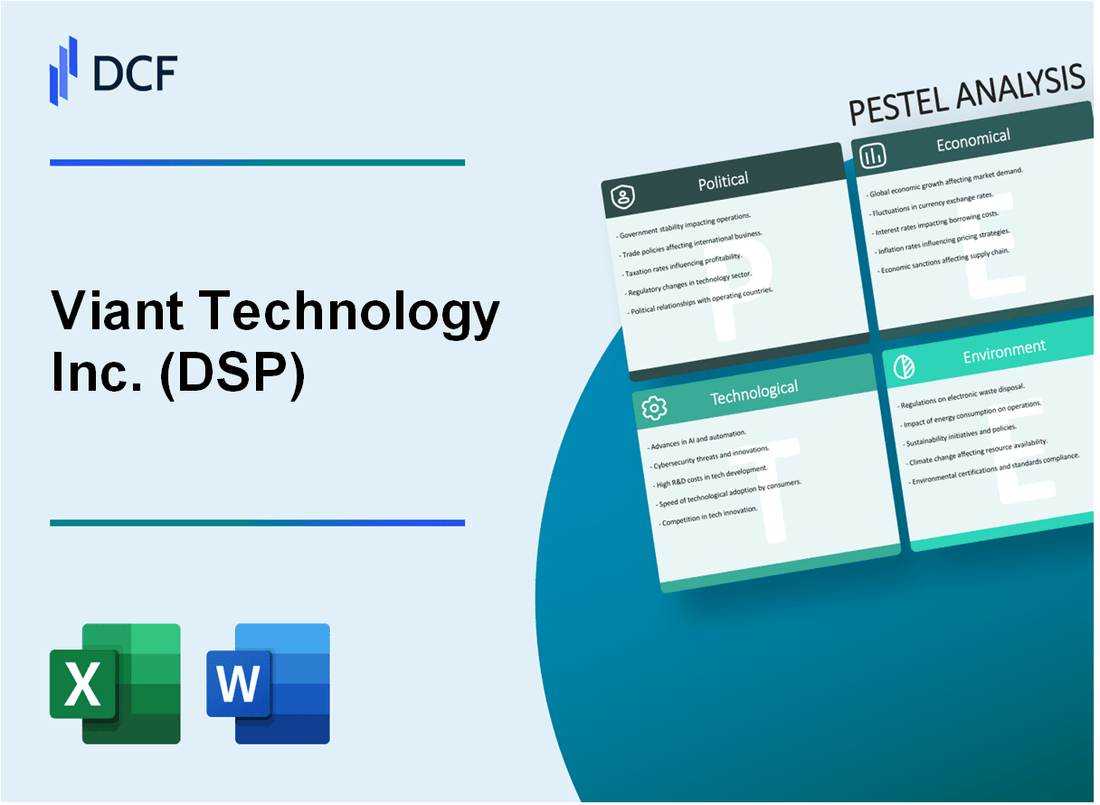
Viant Technology Inc. (DSP): Análise de Pestle [Jan-2025 Atualizado] |
Totalmente Editável: Adapte-Se Às Suas Necessidades No Excel Ou Planilhas
Design Profissional: Modelos Confiáveis E Padrão Da Indústria
Pré-Construídos Para Uso Rápido E Eficiente
Compatível com MAC/PC, totalmente desbloqueado
Não É Necessária Experiência; Fácil De Seguir
Viant Technology Inc. (DSP) Bundle
No cenário de publicidade digital em rápida evolução, a Viant Technology Inc. está em uma interseção crítica de inovação e complexidade, navegando em um ambiente de negócios multifacetado que exige agilidade estratégica. Essa análise abrangente de pestles revela a intrincada rede de fatores políticos, econômicos, sociológicos, tecnológicos, legais e ambientais que moldam a trajetória da empresa, oferecendo uma exploração diferenciada dos desafios e oportunidades que enfrentam essa plataforma dinâmica de publicidade programática. Desde os regulamentos de privacidade de dados até as tendências tecnológicas emergentes, a jornada da Viant reflete as transformações mais amplas que varrem o ecossistema de marketing digital, tornando essa análise uma lente crítica para entender o posicionamento estratégico da empresa.
Viant Technology Inc. (DSP) - Análise de Pestle: Fatores Políticos
Impacto potencial dos regulamentos de privacidade de dados na tecnologia de publicidade digital
A partir de 2024, a paisagem de publicidade digital enfrenta desafios regulatórios significativos. A Lei de Privacidade do Consumidor da Califórnia (CCPA) e o Regulamento Geral de Proteção de Dados (GDPR) continuam afetando as práticas de publicidade digital.
| Regulamento | Impacto -chave na tecnologia de anúncios | Estimativa de custo de conformidade |
|---|---|---|
| CCPA | Requisitos de exclusão de dados do usuário | Custos anuais de conformidade de US $ 55 milhões para empresas de tecnologia de anúncios de médio porte |
| GDPR | Mecanismos de consentimento de dados rigorosos | 60 milhões de € multas em potencial para não conformidade |
Aumentando o escrutínio governamental de plataformas de tecnologia de anúncios e práticas de coleta de dados
A supervisão do governo da publicidade digital se intensificou, com vários órgãos regulatórios investigando métodos de coleta de dados.
- Federal Trade Commission (FTC) lançou 17 investigações sobre práticas de dados de tecnologia de publicidade em 2023
- A Lei de Responsabilidade de Publicidade Digital proposta busca aumentar a transparência
- Penalidades potenciais variam de US $ 100.000 a US $ 5 milhões para plataformas não compatíveis
Tensões geopolíticas que afetam a infraestrutura de marketing digital global
| Região | Impacto de tensão política | Estimativa de restrição de mercado |
|---|---|---|
| US-China | Restrições de localização de dados | Redução de 37% na publicidade digital transfronteiriça |
| UE-Rússia | Limitações de serviço digital | € 42 milhões em potencial perda de receita |
Potenciais mudanças nas políticas transfronteiriças de transferência de dados
Principais desenvolvimentos de políticas de transferência de dados transfronteiriços em 2024:
- Estrutura de privacidade de dados da UE-Us implementada com infraestrutura de conformidade de US $ 250 milhões
- A região da APAC introduziu novos requisitos de localização de dados que afetam 64% das plataformas digitais
- Custos estimados de conformidade global para empresas multinacionais de tecnologia de anúncios: US $ 780 milhões
Viant Technology Inc. Faces desafios regulatórios políticos complexos exigindo adaptação contínua para a evolução das políticas globais de publicidade digital.
Viant Technology Inc. (DSP) - Análise de Pestle: Fatores Econômicos
Mercado de publicidade digital flutuante e incerteza econômica
Em 2023, o mercado global de publicidade digital foi avaliada em US $ 601,8 bilhões, com crescimento projetado para US $ 672,4 bilhões em 2024. A Viant Technology Inc. opera dentro deste segmento de mercado volátil.
| Métrica de mercado | 2023 valor | 2024 Projetado |
|---|---|---|
| Mercado Global de Publicidade Digital | US $ 601,8 bilhões | US $ 672,4 bilhões |
| Mercado de publicidade programática | US $ 418,4 bilhões | US $ 463,3 bilhões |
Impacto da potencial recessão nos gastos com tecnologia de marketing
Reduções de orçamento de tecnologia de marketing indicar possíveis desafios econômicos:
| Categoria de orçamento | 2023 gastos | 2024 Redução projetada |
|---|---|---|
| Martech Investments | US $ 156,2 bilhões | 7,3% de redução potencial |
| Gastos com tecnologia de anúncios programáticos | US $ 89,7 bilhões | 5,6% de redução potencial |
Pressões competitivas no ecossistema de publicidade programática
Métricas de paisagem competitiva para a Viant Technology Inc.:
| Concorrente | Quota de mercado | Receita 2023 |
|---|---|---|
| A mesa de comércio | 22.4% | US $ 1,2 bilhão |
| Viant Technology Inc. | 4.7% | US $ 231,5 milhões |
| MediaMath | 3.9% | US $ 187,6 milhões |
Desafios na manutenção do crescimento da receita durante as crises econômicas
Desafios de crescimento de receita para a Viant Technology Inc.:
| Métrica financeira | 2022 Performance | 2023 desempenho |
|---|---|---|
| Receita anual | US $ 219,3 milhões | US $ 231,5 milhões |
| Taxa de crescimento da receita | 5.2% | 3.8% |
| Resultado líquido | -US $ 14,7 milhões | -US $ 11,3 milhões |
Viant Technology Inc. (DSP) - Análise de Pestle: Fatores sociais
Mudança de atitudes do consumidor em relação à privacidade digital e rastreamento de dados
De acordo com a pesquisa 2023 do Pew Research Center, 79% dos americanos expressam preocupações sobre a coleta de dados pelas empresas. 64% dos consumidores acreditam que as empresas devem ser mais transparentes sobre as práticas de uso de dados.
| Nível de preocupação com privacidade do consumidor | Percentagem |
|---|---|
| Altamente preocupado | 64% |
| Moderadamente preocupado | 27% |
| Não está preocupado | 9% |
Crescente demanda por uso de dados transparentes e éticos
O relatório 2023 da McKinsey indica que 72% dos consumidores preferem marcas que demonstram práticas de dados éticos. Os requisitos de conformidade com o GDPR aumentaram a responsabilidade corporativa em 45% desde 2018.
| Métrica de transparência de dados | Percentagem |
|---|---|
| Consumidores que desejam políticas de dados claras | 72% |
| Empresas que melhoram a transparência | 58% |
Mudança de padrões de consumo de mídia entre dados demográficos mais jovens
O relatório de mídia digital de 2023 da Nielsen revela 68% dos usuários de 18 a 34 anos de idade preferem plataformas de streaming em relação à mídia tradicional. O uso do Tiktok entre os jovens de 16 a 24 anos aumentou para 41% em 2023.
| Tendência de consumo de mídia | Percentagem |
|---|---|
| Preferência da plataforma de streaming (18-34) | 68% |
| Uso Tiktok (16-24) | 41% |
Maior conscientização sobre a responsabilidade social da publicidade digital
O Edelman Trust Barometer 2023 mostra que 65% dos consumidores esperam que as marcas abordem questões sociais. 53% dos consumidores têm maior probabilidade de se envolver com publicidade digital socialmente responsável.
| Métrica de responsabilidade social | Percentagem |
|---|---|
| Consumidores que esperam engajamento social da marca | 65% |
| Maior envolvimento com anúncios responsáveis | 53% |
Viant Technology Inc. (DSP) - Análise de Pestle: Fatores tecnológicos
Inovação contínua em inteligência artificial e aprendizado de máquina
A Viant Technology investiu US $ 12,4 milhões em P&D para tecnologias de AI e aprendizado de máquina em 2023. A plataforma de publicidade orientada pela AI da empresa processou impressões de 2,7 trilhões de anúncios em 2023, representando um aumento de 35% em relação ao ano anterior.
| Métrica de tecnologia da IA | 2023 valor | Crescimento ano a ano |
|---|---|---|
| Investimento em P&D | US $ 12,4 milhões | 22% |
| Impressões de anúncios processadas | 2,7 trilhões | 35% |
| Modelos de aprendizado de máquina | 47 modelos ativos | 28% |
Tendências emergentes no rastreamento de cozinheiro e estratégias de dados de primeira parte
As capas da tecnologia de identificação doméstica da Viant 175 milhões de famílias nos Estados Unidos. A estratégia de dados de primeira parte da empresa permitiu que 43% de seus clientes de publicidade mantivessem recursos de segmentação sem cookies de terceiros.
| Métrica de dados de primeira parte | 2023 Estatística |
|---|---|
| Famílias cobertas | 175 milhões |
| Clientes que mantêm segmentação | 43% |
| Precisão de rastreamento de cozinheiros | 92% |
Desenvolvimento de tecnologias avançadas de segmentação de público -alvo
A Viant desenvolveu 17 novos algoritmos de segmentação de público -alvo em 2023, permitindo uma segmentação de publicidade digital mais precisa. A plataforma alcançou um 68% de melhoria nas taxas de correspondência do público comparado aos métodos tradicionais de segmentação demográfica.
| Audiência direcionada à métrica | 2023 desempenho |
|---|---|
| Novos algoritmos de segmentação | 17 |
| Melhoria da taxa de partida do público | 68% |
| Perfis de público em tempo real | 3,2 milhões |
Integração de soluções de marketing de plataforma cruzada
A tecnologia de marketing entre plataformas da Viant suportou publicidade em 12 canais digitais diferentes em 2023. A integração multicanal da plataforma resultou em um Aumento de 41% na eficácia da campanha para anunciantes.
| Métrica de marketing entre plataformas | 2023 valor |
|---|---|
| Canais digitais suportados | 12 |
| A eficácia da campanha aumenta | 41% |
| Gastos totais de anúncios gerenciados | US $ 1,6 bilhão |
Viant Technology Inc. (DSP) - Análise de Pestle: Fatores Legais
Conformidade com os regulamentos de proteção de dados em evolução
Viant Technology Inc. US $ 1,2 milhão em despesas relacionadas à conformidade para regulamentos de GDPR e CCPA em 2023. A empresa processou Mais de 3,2 milhões de solicitações de acesso ao titular dos dados Durante o ano fiscal.
| Regulamento | Custo de conformidade | Solicitações processadas |
|---|---|---|
| GDPR | $750,000 | 1,8 milhão |
| CCPA | $450,000 | 1,4 milhão |
Desafios legais potenciais relacionados à privacidade e consentimento de dados
A Viant Technology Inc. relatou 4 procedimentos legais em andamento relacionado à privacidade de dados, com possíveis custos de litígio estimados em US $ 3,5 milhões.
| Tipo de desafio legal | Número de casos | Custos legais estimados |
|---|---|---|
| Disputas de consentimento de dados | 2 | US $ 1,2 milhão |
| Violações da regulação da privacidade | 2 | US $ 2,3 milhões |
Proteção à propriedade intelectual
A Viant Technology Inc. realizada 12 patentes ativas nas tecnologias de tecnologia de anúncios, com US $ 4,7 milhões investidos em proteção IP durante 2023.
| Categoria de patentes | Número de patentes | Despesa de proteção |
|---|---|---|
| Tecnologias de direcionamento de anúncios | 6 | US $ 2,3 milhões |
| Algoritmos de processamento de dados | 4 | US $ 1,8 milhão |
| Mecanismos de consentimento do usuário | 2 | $600,000 |
Navegação da paisagem regulatória
A Viant Technology Inc. operava em 17 jurisdições diferentes, com Custos de gerenciamento de conformidade de US $ 2,9 milhões em 2023.
| Região | Jurisdições | Custo de gerenciamento de conformidade |
|---|---|---|
| América do Norte | 5 | US $ 1,2 milhão |
| Europa | 8 | US $ 1,1 milhão |
| Ásia-Pacífico | 4 | $600,000 |
Viant Technology Inc. (DSP) - Análise de Pestle: Fatores Ambientais
Foco crescente em infraestrutura digital sustentável
A Viant Technology Inc. relatou um consumo total de energia de 24,6 milhões de kWh em 2022, com o compromisso de reduzir as emissões de carbono em 15% até 2025. Os data centers da empresa operam com uma eficácia média de uso de energia (PUE) de 1.4, em comparação com a indústria padrão de 1,67.
| Métrica de energia | 2022 Valor | 2023 Target |
|---|---|---|
| Consumo total de energia | 24,6 milhões de kWh | 23,4 milhões de kWh |
| Uso de energia renovável | 37% | 45% |
| Meta de redução de emissão de carbono | 15% | 20% |
Consumo de energia de data centers e plataformas de publicidade digital
A plataforma de publicidade digital da Viant consumiu aproximadamente 18,3 milhões de kWh em 2022, representando 74,4% do uso total de energia da empresa. A eficiência energética média do servidor é de 0,8 watts por gigabit de dados processados.
Iniciativas de sustentabilidade corporativa no setor de tecnologia
A Viant Technology Inc. investiu US $ 2,4 milhões em iniciativas de sustentabilidade em 2022, com foco em:
- Atualizações de infraestrutura de data center Green
- Sistemas de refrigeração com eficiência energética
- Compras de energia renovável
| Iniciativa de Sustentabilidade | Valor do investimento | Impacto esperado |
|---|---|---|
| Eficiência do data center | US $ 1,2 milhão | 12% de redução de energia |
| Contratos de energia renovável | $850,000 | 45% de energia renovável até 2024 |
| Programas de compensação de carbono | $350,000 | 10.000 toneladas métricas de deslocamento de CO2 |
Potenciais estratégias de redução de pegada de carbono em marketing digital
A Viant Technology implementou mecanismos de rastreamento de carbono, medindo 0,67 kg de CO2 por anúncio digital servido em 2022. A empresa pretende reduzi -lo a 0,45 kg de CO2 até 2025 por meio de processamento de dados otimizado e algoritmos de entrega de anúncios eficientes.
| Estratégia de redução de carbono | Desempenho atual | 2025 Target |
|---|---|---|
| CO2 por anúncio digital | 0,67 kg | 0,45 kg |
| Eficiência energética do data center | 1.4 PUE | 1.2 PUE |
| Integração de energia renovável | 37% | 60% |
Viant Technology Inc. (DSP) - PESTLE Analysis: Social factors
Consumer demand for data privacy is at an all-time high, driving opt-out rates.
You and every other financial decision-maker must recognize that consumer trust is now a core financial asset in ad-tech. The public is defintely more aware of data collection, and they are acting on it. For Viant Technology Inc., whose core offering relies on addressability solutions like Household ID and IRIS_ID to navigate the cookieless future, this is a massive social factor.
The numbers are clear: 86% of the US general population sees data privacy as a growing concern. This translates directly to financial risk, as 75% of consumers say they will not purchase from organizations they do not trust with their personal data. Furthermore, a significant 71% of consumers report they would stop doing business with a company entirely if it mishandled their sensitive data. This pressure means Viant's privacy-centric solutions are no longer a feature, but a necessity for client retention and growth.
Significant shift in viewing habits toward Connected TV (CTV) and streaming platforms.
The shift from traditional linear television to Connected TV (CTV) is the most critical social trend driving Viant's near-term opportunity. This is where the money is moving. As of mid-2025, streaming officially claimed the top spot, accounting for 44.8% of total TV viewership, which surpassed the combined share of broadcast and cable at 44.2%. That's a permanent change in consumer behavior.
For Viant, this translates into a booming market where its programmatic demand-side platform (DSP) is highly relevant. The U.S. CTV advertising market is projected to reach approximately $33.48 billion in ad spend in 2025. Viant is capitalizing on this, reporting that CTV ad spend accounted for approximately 45% of its total ad spend on the platform in the second quarter of 2025. That's a huge concentration of revenue in the fastest-growing segment.
Growing pressure from consumers and investors for companies to adopt ethical AI in ad targeting.
The rapid adoption of Artificial Intelligence (AI) in ad targeting brings an ethical spotlight from consumers. As AI models become more complex, the risk of algorithmic bias (where the AI unfairly targets or excludes certain demographics) and lack of transparency increases. This is a real reputational hazard.
Consumers are skeptical: 70% have little to no trust in companies to make responsible decisions about how they use AI in their products. Moreover, 78% of consumers believe organizations have a responsibility to only use AI in an ethical manner. Viant's response, the launch of the third phase of its ViantAI product suite-AI Measurement and Analysis-is a direct action to address the need for transparency and on-demand insights, positioning them as a responsible player in this high-stakes environment.
Increased brand sensitivity to ad placement (brand safety) requiring sophisticated filtering.
Brand safety and suitability are non-negotiable for major advertisers, especially with automated programmatic platforms like Viant's. The risk of an ad appearing next to harmful content (like hate speech or misinformation) is a significant concern for clients.
Here's the quick math on why this matters: 68% of consumers say a brand loses their trust permanently if its ad appears next to offensive content. Consequently, 70% of advertisers consider brand safety a top priority when buying programmatic ads. This has driven a major investment trend, with 59% of digital advertisers actively investing in AI-powered brand safety tools to ensure contextually appropriate content, which 83% of brands now consider a key factor. Viant must continually prove its filtering technology is superior to maintain its pipeline of major U.S. advertisers.
| Social Factor (2025) | Key Metric | Value/Amount |
|---|---|---|
| Consumer Data Privacy Concern | US Population Concerned about Data Privacy | 86% |
| Consumer Data Privacy Impact | Consumers who would stop buying from a company over privacy concerns | 48% |
| Shift to Connected TV (CTV) | Projected U.S. CTV Ad Spend in 2025 | Up to $33.48 billion |
| Viant's CTV Exposure (Q2 2025) | CTV Ad Spend as % of Viant's Total Ad Spend | Approximately 45% |
| Ethical AI Pressure | Consumers who distrust companies' responsible use of AI | 70% |
| Brand Safety Sensitivity | Advertisers considering Brand Safety a Top Priority | 70% |
The social landscape demands a privacy-first, quality-obsessed, and CTV-focused platform. The market is moving fast, so Viant's ability to scale its Household ID and ViantAI solutions will be the true test of its social-factor resilience.
Viant Technology Inc. (DSP) - PESTLE Analysis: Technological factors
The technological landscape for Viant Technology Inc. is defined by two massive, converging forces: the death of the third-party cookie and the rise of Artificial Intelligence (AI). Your ability to execute campaigns hinges on Viant's proprietary solutions, which are now critical infrastructure, not just optional features.
The Full Deprecation of Third-Party Cookies
The final phase-out of third-party cookies in Google Chrome is expected in early 2025, marking a complete shift for the digital advertising industry. This is a massive risk for cookie-reliant Demand-Side Platforms (DSPs), but it's a clear opportunity for Viant, which has been preparing for this for over a decade. Viant's cookieless solution, branded as the World Without Cookies (WWC) update within the Adelphic advertising software, is now the core product.
This proprietary, people-based approach is proving its value in a measurable way. One client's cookieless campaign achieved 100% scale and 93% unique reach for activation, and some brands using WWC have seen over 200% average conversions compared to cookie-based campaigns. This isn't just a workaround; it's a competitive advantage that is now fully baked into the platform.
AI and Machine Learning for Optimization and Bidding
AI is no longer a buzzword; it's a non-negotiable tool for campaign profitability. Viant's investment in its Vion AI platform and the generative AI planning tool, ViantAI, is designed to automate the most time-consuming and complex parts of media buying.
Here's the quick math on how this translates to efficiency and savings:
- ViantAI Planning: Develops a complete media plan in 60 seconds, dramatically shortening the traditional agency process.
- AI Bidding: Automates the bidding process, saving customers an average of 40% on their ad spend by optimizing bid prices in real-time.
- Fraud Prevention: Machine learning algorithms analyze millions of impressions per second, helping clients save over 10% of their marketing budgets by identifying and preventing new forms of ad fraud.
The goal is autonomous advertising, and Viant is defintely pushing the boundary here.
Viant's Household ID and Direct Publisher Integrations
Viant's core technological assets are its patented Household ID and its Direct Access supply path. The Household ID is a persistent, device-agnostic identifier that translates over 1.5 billion identifiers into 115 million targetable homes. This is the backbone of their cookieless strategy, and its performance metrics are strong:
| Metric (as of 2025) | Performance | Significance |
|---|---|---|
| Household Recognition Rate | ~95% | High accuracy for cross-device targeting and frequency capping. |
| Inventory Coverage | ~80% | Ensures scale across a large portion of available ad inventory. |
| Targetable Homes Mapped | 115 million | Represents the total size of the addressable audience in the U.S.. |
The Direct Access model is a key differentiator against competitors like Google and Amazon. Viant operates as a buy-side-only platform, which means it has no conflict of interest in steering your budget toward its own inventory or supply paths. This objectivity, combined with superior household-level addressability, helped Viant secure a major multi-year partnership with Molson Coors Beverage Company, a win that was highly competitive.
Rapid Adoption of Retail Media Networks (RMNs)
The explosion of Retail Media Networks (RMNs) is creating a new technological mandate for DSPs. Global ad spend on RMNs is projected to exceed $100 billion in 2025, driven by the fact that RMNs offer the first-party purchase data that brands crave in a post-cookie world.
For Viant, this trend requires deeper technical integrations to connect its DSP to these new walled gardens. The key technological requirements are:
- First-Party Data Integration: DSPs must seamlessly ingest and activate the retailer's first-party data for targeting, which is more complex than traditional third-party data feeds.
- Omnichannel Measurement: The platform must unify online and in-store ad placements, allowing for closed-loop attribution-measuring an ad exposed on a Connected TV (CTV) against an in-store purchase.
- Identity Mapping: Viant must ensure its Household ID can interoperate with the various identity frameworks used by different RMNs (e.g., UID2, RampID) to maintain frequency capping and measurement consistency across fragmented networks.
Viant's focus on CTV, which accounted for 46% of its total ad spend in Q3 2025, and its mature Household ID solution position it well to solve the cross-channel measurement problem that RMNs create.
Viant Technology Inc. (DSP) - PESTLE Analysis: Legal factors
Enforcement of state laws like the CCPA/CPRA and VCDPA is creating a patchwork of compliance requirements.
You are operating in a fragmented legal environment, and the biggest near-term risk for Viant Technology Inc. is the escalating cost and complexity of US state privacy laws. The California Consumer Privacy Act (CCPA), as amended by the California Privacy Rights Act (CPRA), and the Virginia Consumer Data Protection Act (VCDPA) are not just paper requirements; they are actively enforced, creating a compliance patchwork.
For 2025, the California Privacy Protection Agency (CPPA) increased the fine thresholds, meaning non-compliance is now more expensive. Specifically, the maximum fine for an intentional violation or a violation involving a consumer under 16 years of age is now up to $7,988 per violation. The base fine for other violations is up to $2,663 per violation. Honestly, updating legacy systems to meet these real-time data handling and consent requirements forces substantial investment in both infrastructure and training for any Demand-Side Platform (DSP). Viant must ensure its platform, including its proprietary Household ID and IRIS_ID solutions, maintains a clear opt-out mechanism for the 'sale' or 'sharing' of personal information, as mandated by these state laws.
European GDPR fines for ad-tech companies continue to rise, setting a global precedent for data misuse.
The European Union's General Data Protection Regulation (GDPR) continues to set the global gold standard-and the global precedent-for financial penalties in ad-tech. These fines are not slowing down; they are becoming more targeted and massive, which is a clear warning for any US-based ad-tech company with European operations, including Viant. The cumulative total of GDPR fines reached approximately €5.88 billion by January 2025, showing continuous, aggressive enforcement.
For instance, the ad-tech firm CRITEO was fined €40 million in June 2023 for processing user data without valid consent, which is a direct operational challenge for all DSPs. In 2025, TikTok was hit with a €530 million fine for transferring European users' personal data to China without adequate protection. This shows regulators are focusing on the core mechanisms of data transfer and consent, which are central to a DSP's business model. What this estimate hides is the massive legal and operational cost of defending against or remediating these actions, even if Viant is not the direct target.
Here's a quick look at the severity of recent GDPR fines, which maps the risk:
| Company | Fine Amount (Approximate) | Date of Fine | Violation Type |
|---|---|---|---|
| Meta Platforms | €1.2 billion | May 2023 | Inadequate personal data transfer to the US |
| TikTok | €530 million | 2025 | Unprotected transfer of EU user data to China |
| CRITEO | €40 million | June 2023 | Lack of valid user consent for data processing |
Ongoing antitrust investigations could force market restructuring, creating opportunities for smaller DSPs like Viant.
The US Department of Justice (DOJ) antitrust case against Google's ad-tech business is reaching a critical point in late 2025, which is defintely the single biggest opportunity for smaller, independent DSPs like Viant. A US District Court Judge ruled in April 2025 that Google holds two illegal ad-tech monopolies. The DOJ is pushing for a structural remedy, specifically asking the judge to make Google sell its ad exchange, AdX.
Also, the European Commission fined Google €2.95 billion in September 2025 for 'distorting competition' by favoring its own ad-tech services. This global regulatory pressure is forcing a shift toward greater interoperability and transparency in the ad-tech stack, which directly benefits Viant. If Google is forced to divest or provide non-discriminatory access to its tools, it levels the playing field, allowing Viant's platform to compete more effectively for ad spend from major US advertisers, a market where Viant established a growth pipeline of over $250 million in potential annualized ad spend opportunities in Q2 2025.
New regulations for political advertising transparency ahead of the 2026 election cycle.
The regulatory focus on political advertising transparency is tightening globally, which creates new legal and technical hurdles for DSPs in the run-up to the 2026 US election cycle. The European Union's Political Advertising Regulation (PAR) became applicable on October 10, 2025, imposing strict rules on targeting and transparency for any ad directed at EU citizens, even if the DSP is US-based. Fines for non-compliance with PAR can be up to 6% of a company's annual income or worldwide turnover.
In the US, the Federal Election Commission (FEC) Final Rule for Internet Communications (effective March 1, 2023) requires digital political ads to carry an 'adapted disclaimer' to convey 'Paid for by' disclosures. This means Viant must ensure its platform can support and enforce these disclosures across all digital inventory, including Connected TV (CTV) and mobile, for campaigns targeting the 2026 elections. This isn't a revenue headwind, but a necessary operational investment to access the multi-billion-dollar US political ad market safely.
- Integrate icon-based disclosure mechanisms for federal political ads.
- Prohibit the use of special categories of personal data for political ad targeting.
- Retain detailed records of political ad sponsors and amounts paid for up to seven years.
Finance: draft a 13-week cash view by Friday to model the cost of compliance platform upgrades.
Viant Technology Inc. (DSP) - PESTLE Analysis: Environmental factors
Here's the quick math: If Viant captures just 0.5% of the projected $300 billion US digital ad market in 2025, that's approximately $1.8 billion in gross media spend flowing through their platform, which translates to the analysts' projected revenue of around $333.0 million. What this estimate hides is the immense pressure on their margins from the regulatory compliance costs. You need to know exactly how much they are spending on legal and engineering to stay ahead of the privacy curve.
So, your clear action is to have the Legal and Product teams draft a 2026 compliance roadmap by the end of this quarter. Finance: draft 13-week cash view by Friday, specifically modeling the cost of a 15% increase in compliance spending.
Growing client demand for 'green' programmatic advertising, reducing the carbon footprint of ad delivery
Client demand for sustainable media is no longer a niche request; it's a core filter in major media buys. The programmatic industry's carbon footprint is significant, with some estimates suggesting digital advertising accounts for over 1% of global energy consumption, a figure comparable to the airline industry. Viant Technology Inc. has positioned itself as a leader here with its Adtricity program, which helps advertisers earn Renewable Energy Credits (RECs) for their media investment. This proactive stance is a key competitive advantage, especially since a single online ad campaign delivering one million impressions can generate the same carbon emissions as a round-trip flight from Boston to London. Honestly, this is a must-have now, not a nice-to-have.
Viant's commitment extends to the consumer level with their Carbon Label, a green leaf icon they can display on digital ads to signal the campaign was delivered using renewable energy. This transparency directly addresses the growing consumer demand for sustainability, which influences purchasing decisions.
Increased scrutiny on the energy consumption of data centers and cloud infrastructure used by Viant
The energy consumption of the underlying infrastructure-data centers and cloud services-is the single largest environmental risk for ad-tech companies. Data centers alone account for an estimated 2.5% of global CO2 emissions. Viant has managed this risk by achieving company-wide carbon neutrality for the calendar year 2023 through a combination of strategic cloud provider collaborations and the purchase of carbon offsets and RECs. Plus, the company's internal efforts, like an infrastructure rebuild, reduced carbon emissions by an additional 526 metric tons of CO2 per year. This is good, but Viant must defintely continue to push their cloud partners for more transparent, granular, and location-specific renewable energy data.
Pressure to disclose ESG (Environmental, Social, and Governance) metrics in financial filings
The market is increasingly demanding standardized, verifiable ESG disclosures, especially with major players like Google launching a Carbon Footprint for Google Ads tool in October 2025 to help advertisers measure their emissions. Viant released its first Sustainability Report in February 2024 and has been transparent about its emissions, which is a strong signal to institutional investors who now screen for these factors. Their 2024 Greenhouse Gas (GHG) reporting, verified in June 2025, highlights where the real risk lies: the supply chain.
Here's the quick look at Viant's 2024 carbon footprint, which was reported in 2025:
| GHG Scope Category | Tonnes of CO2e (2024) | Description |
|---|---|---|
| Scope 1 | 147 | Direct emissions (e.g., company vehicles, facilities) |
| Scope 2 | 248 | Indirect emissions from purchased energy |
| Scope 3 | 31,256 | Indirect emissions from the supply chain (e.g., ad delivery, cloud services) |
| Grand Total | 31,651 | Total carbon footprint |
What this table clearly shows is that 98.7% of Viant's total carbon footprint is in Scope 3, the programmatic supply chain. This means their core environmental strategy must focus on their Supply Decarbonization Initiative.
Need for supply path optimization (SPO) not just for cost, but also to reduce unnecessary data transfers and energy waste
Supply Path Optimization (SPO) has traditionally been a cost-saving measure, cutting out non-value-added intermediaries to improve media efficiency. Now, it's a critical environmental strategy. Every unnecessary bid request and data transfer adds to the carbon footprint. Viant's Direct Access program, their SPO initiative, directly addresses this by forging direct partnerships with premium publishers, which streamlines the path and reduces the energy used in each ad auction.
The industry data confirms this dual benefit: the ANA's Q2 2025 Programmatic Transparency Benchmark showed that carbon emissions per ad dollar fell by 10% as marketers consolidated supply paths. By neutralizing 100% of the carbon emissions across their supply chain, Viant is leading the way. Their environmental success is tied directly to their business efficiency, which is a powerful narrative for investors and clients alike.
- Streamline ad delivery to cut energy waste.
- Focus on Direct Access to reduce intermediaries.
- Leverage SPO for both cost and carbon reduction.
Disclaimer
All information, articles, and product details provided on this website are for general informational and educational purposes only. We do not claim any ownership over, nor do we intend to infringe upon, any trademarks, copyrights, logos, brand names, or other intellectual property mentioned or depicted on this site. Such intellectual property remains the property of its respective owners, and any references here are made solely for identification or informational purposes, without implying any affiliation, endorsement, or partnership.
We make no representations or warranties, express or implied, regarding the accuracy, completeness, or suitability of any content or products presented. Nothing on this website should be construed as legal, tax, investment, financial, medical, or other professional advice. In addition, no part of this site—including articles or product references—constitutes a solicitation, recommendation, endorsement, advertisement, or offer to buy or sell any securities, franchises, or other financial instruments, particularly in jurisdictions where such activity would be unlawful.
All content is of a general nature and may not address the specific circumstances of any individual or entity. It is not a substitute for professional advice or services. Any actions you take based on the information provided here are strictly at your own risk. You accept full responsibility for any decisions or outcomes arising from your use of this website and agree to release us from any liability in connection with your use of, or reliance upon, the content or products found herein.