

|
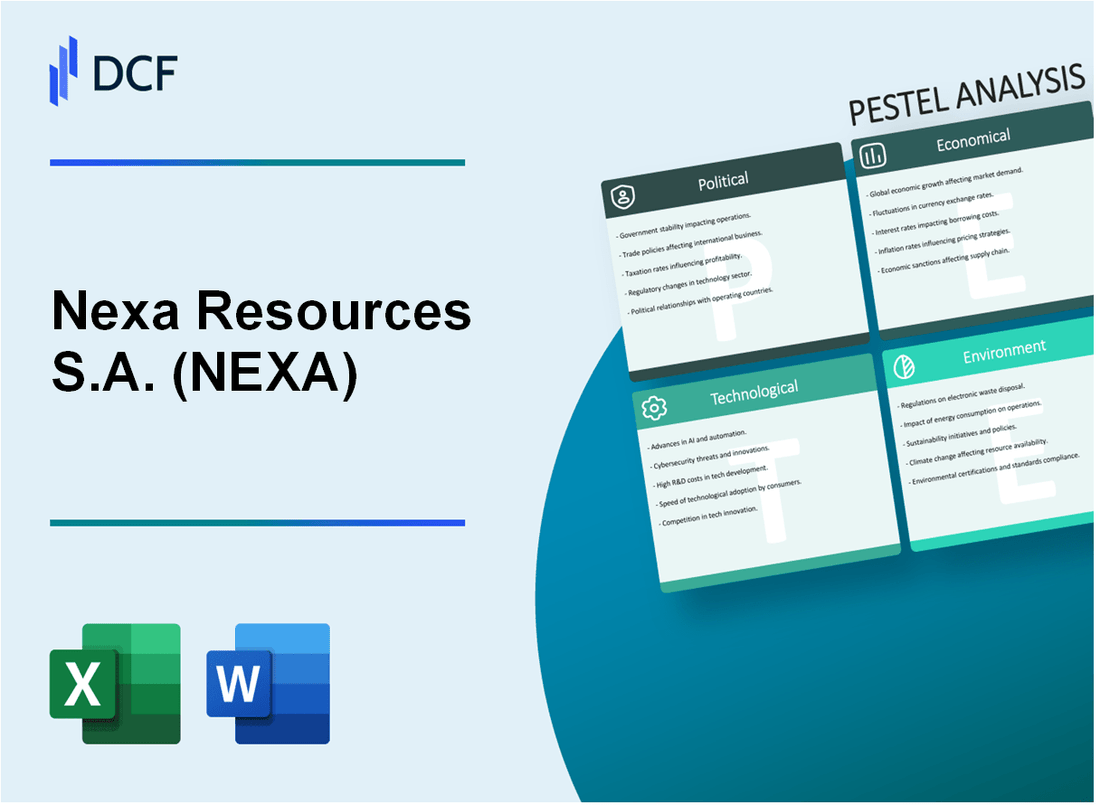
Nexa Resources S.A. (NEXA): PESTLE Analysis [Nov-2025 Updated] |
Fully Editable: Tailor To Your Needs In Excel Or Sheets
Professional Design: Trusted, Industry-Standard Templates
Investor-Approved Valuation Models
MAC/PC Compatible, Fully Unlocked
No Expertise Is Needed; Easy To Follow
Nexa Resources S.A. (NEXA) Bundle
You're looking at Nexa Resources S.A., a major player in the global zinc market, and right now, the map is tricky. While the commodity itself is essential, the real story for 2025 isn't just about the price of zinc; it's about the ground they mine it from-Brazil and Peru. We need to look past the quarterly reports to see how political shifts, community relations, and environmental pressures could defintely derail even the best-laid capital plans. Honestly, understanding these external forces is the difference between a solid investment and a major headache, so let's break down the PESTLE factors shaping their next move.
Nexa Resources S.A. (NEXA) - PESTLE Analysis: Political factors
Resource nationalism risks in Peru and Brazil remain a constant factor.
You need to recognize that resource nationalism in Latin America is not a theoretical risk; it's a structural operating cost. For Nexa Resources, with its core operations in Peru and Brazil, this risk manifests primarily through community conflict and the threat of increased fiscal demands. The mining sector is a prime target for governments looking to increase revenue, and this trend is listed as the third-largest risk for the global mining industry in 2025.
In Peru, social protests can erase planned production gains overnight. Nexa has directly experienced this, such as the road blockades at its Atacocha mine by local communities, which temporarily halted production. While the company engages in dialogue, these disruptions increase operational costs and create volatility. This is a defintely challenge for maintaining consistent output.
The risk isn't just about taxes, but also about the 'license to operate' (LTO). Community demands for local benefits and environmental protection are now political flashpoints that directly impact your bottom line. Nexa's 2025 full-year consolidated CAPEX guidance is set at US$347 million, with US$316 million allocated to sustaining investments, much of which is indirectly protecting this LTO.
Regulatory stability changes with each new administration in Latin America.
The regulatory environment in Nexa's key jurisdictions is highly sensitive to political cycles. New administrations in both Peru and Brazil frequently introduce or propose changes to mining laws, royalties, and environmental standards, creating significant uncertainty for long-term capital planning. This instability directly affects the valuation of long-life assets.
For example, in Peru, the Congress has been involved in a revision process of a law that could prohibit economic activities in the headwaters of basins, a legislative move that could severely restrict future mining development. While Brazil is generally seen as having a more stable, albeit complex, regulatory framework, the risk of intervention, particularly in the energy and environmental sectors, remains present. You have to constantly model for a shifting tax and royalty burden.
Here's a look at the financial scale of Nexa's core operations in these politically volatile regions, based on 2025 guidance and recent performance:
| Metric (2025 Guidance/H1 2025) | Amount/Range | Context |
|---|---|---|
| Full-Year Consolidated CAPEX | US$347 million | Total planned investment, highly sensitive to permitting and political stability. |
| Exploration Investment | US$70 million | Focus on brownfield/greenfield projects, with 51,000 meters of planned drilling in Peru, directly exposed to permitting risk. |
| Adjusted Net Income (H1 2025) | US$72 million | A measure of profitability that social and political disruptions can quickly erode. |
| 2025 Zinc Production Guidance (Peru Mines) | 146,000 - 162,000 tonnes | Production volume directly impacted by blockades and operational halts. |
Bilateral trade agreements impact metal export tariffs and market access.
While Nexa's primary political risk is domestic (resource nationalism and regulation), the company is also exposed to global trade dynamics, which are shaped by bilateral and multilateral agreements. As a major zinc producer, Nexa's sales volumes and costs are sensitive to global tariff policies and trade tensions, particularly between major economies like the U.S. and China.
The uncertainty around evolving global trade dynamics and potential changes in U.S. import tariffs or corporate tax proposals can impact global demand for base metals and increase supply chain costs. Nexa's strategy to navigate this is to maintain its integrated mine-smelter business model, which provides some insulation by processing concentrates into refined metal, but it still relies on global market access for its final products.
- Monitor U.S. tariff proposals, as they affect global metal demand.
- Track foreign exchange rates (BRL/USD: 5.67 and Soles/USD: 3.66 in 2025 guidance) which are influenced by trade balances.
- Factor evolving trade dynamics into the 2025 sales guidance, which anticipates a slight decrease in total metal sales volume.
Government permitting processes for new projects are often slow and complex.
The slow and complex nature of government permitting, especially for Environmental Impact Assessments (EIAs), acts as a significant political hurdle that delays capital deployment and realization of returns. This is a major drag on growth projects.
The most concrete example of this is Nexa's Magistral project in Peru. In May 2024, the National Service for Environmental Certification of Sustainable Investments (SENACE) formally rejected a modification request for the project's EIA. This denial forced Nexa to test the project for impairment, resulting in a substantial loss of US$58 million. That's the cost of a bureaucratic roadblock.
The company is currently addressing this situation with authorities, expecting a resolution in 2025, but the delay has already impacted the project's economic feasibility. This shows that even with a long-term plan, the political-regulatory process can impose massive, non-operational costs. Conversely, the company is advancing its Cerro Pasco Integration Project, with construction permits for Phase I (tailings pumping and piping system) being secured, demonstrating that progress is possible, but never guaranteed.
Nexa Resources S.A. (NEXA) - PESTLE Analysis: Economic factors
You're looking at the core economic levers that directly pull on Nexa Resources' profitability, and frankly, it all comes down to commodity prices and local costs. As a seasoned producer, your fortunes are tied to the global base metal cycle, but the day-to-day margin pressure comes from inflation where you operate.
Zinc price volatility is the single largest driver of revenue and margin risk.
The price of zinc is the main event for Nexa Resources' top line. For instance, in the second quarter of 2025 (2Q25), net revenues hit US$708 million, but this was only up 13% sequentially because lower zinc prices partially offset higher smelting sales volume. When you look year-over-year to 2Q24, net revenues actually dropped 4% because of lower prices for zinc, copper, and lead. By the third quarter of 2025 (3Q25), better metal prices helped push net revenues up to US$764 million. To manage costs, the company's 2025 guidance assumed a zinc price of US$1.24/lb. Still, the market was choppy; on November 28, 2025, the LME price was around 3,028 USD/T.
Here's a quick look at how the market was pricing things around the time of your latest reports:
| Metric | Value (as of late 2025) | Context |
| Zinc Price (Nov 28, 2025) | 3,028 USD/T | Price on the day, up 0.25% from the previous day |
| 2Q25 Net Revenues | US$708 million | Partially offset by lower zinc prices |
| 3Q25 Net Revenues | US$764 million | Supported by favorable metal prices |
| 2025 Zinc Price Assumption (Guidance) | US$1.24/lb | Used for 2025 cash cost guidance |
The market sentiment was cautious, with some analysts predicting a softening to around $2,600/t for the 2025 average due to anticipated supply increases.
High inflation in Brazil and Peru affects local operating costs significantly.
Your operations in Brazil and Peru face local cost inflation that eats into margins, even when metal prices are decent. In Brazil, the annual inflation rate (IPCA) was reported at 4.68% in October 2025, easing slightly from September's 5.17%. By mid-November 2025, the annual mid-month inflation had eased further to 4.50%. These domestic price pressures are real; for example, higher operational costs, especially at the Brazilian assets, were cited as a reason for the year-over-year Adjusted EBITDA decline in 2Q25.
The cost impact shows up in a few ways:
- Mining cash costs for 2025 were expected to increase 16% year-over-year, partly due to higher costs at Vazante, Atacocha, and Cerro Lindo.
- Consolidated smelting cash cost in 1Q25 was $1.17 per pound, up from $0.98 per pound the prior year, driven by higher raw material costs.
- The company had to adopt a prudent approach to cost guidance due to these pressures.
Currency fluctuation (BRL and PEN versus USD) impacts reported earnings.
Since you report in U.S. dollars, the strength or weakness of the Brazilian Real (BRL) and Peruvian Sol (PEN) matters a lot. For cost guidance in 2025, Nexa Resources assumed a rate of BRL/USD at 5.67 and Soles/USD at 3.66. Currency movements can swing reported income. In 1Q25, the appreciation of the BRL against the USD was a positive factor that helped boost operating income. However, this is a double-edged sword; in 3Q25, a 3% appreciation of the Brazilian real actually partially offset the sequential improvement in net income. Conversely, the depreciation of the BRL in 4Q24 actually gave a positive impact of $11 million to the bottom line that year.
Global economic slowdown could reduce industrial demand for base metals.
The health of global industry, particularly in major consumers like China and Europe, directly affects the demand side of your zinc equation. We saw signs of deceleration late in 2025. For example, China's annual industrial production growth slowed to 4.9% in October 2025, missing market expectations. This slowdown translates to weaker downstream demand for your products. In Europe, the struggling steel sector-a primary user of zinc for galvanizing-saw hot-dipped galvanised steel prices drop by nearly 17% from the start of the year. Macquarie was forecasting only 1.7% growth in global refined zinc demand for 2025, reflecting this weaker outlook. This environment is why Nexa Resources' 2025 guidance already factored in a reduction in smelter volume to deal with the volatile market.
Finance: draft 13-week cash view by Friday.
Nexa Resources S.A. (NEXA) - PESTLE Analysis: Social factors
You're managing a mining company in Latin America, so you know that the ground beneath your feet is only as stable as the community support above it. For Nexa Resources S.A., maintaining a strong Social License to Operate (SLO) is defintely crucial for mine continuity, especially given the operational challenges noted in their 2025 guidance. This informal social contract, built on trust and transparency, is a prerequisite for long-term sustainability and securing future capital. If stakeholders feel unheard, the risk of work stoppages, protests, or even license revocation becomes very real. It's not just about compliance; it's about being perceived as a legitimate and accountable partner in the regions of operation, like Peru and Brazil.
Sociological
Community opposition to new or expanded projects can cause costly delays, a risk Nexa explicitly monitors in its 2025 outlook. To proactively manage this, Nexa launched its unified social brand, Nexa Transforma, in September 2025. This initiative consolidates over 50 projects across four strategic areas: Water, Education, Income Generation, and Social Legacy. This is a clear pivot to make their social impact more recognizable and relevant to stakeholders.
The commitment to local development is concrete. In 2024, the company channeled R$ 36 million in social investment across its eight operating locations in Brazil and Peru. This funding supported 65 projects specifically aimed at the SLO, alongside 59 income generation and 50 education projects, directly benefiting around 23,000 people. Furthermore, Nexa is backing its long-term mine life extension plans in Peru with capital; for instance, the integration of the Atacocha and El Porvenir mines involves a US$50 million investment, with specific allocations like US$28.6 million for Atacocha works. This investment strategy is key to demonstrating a commitment that goes beyond the immediate operational horizon.
Focus on local employment and supply chain development is a key expectation that directly feeds into the SLO. Nexa has a stated policy of prioritizing local labor where possible. For example, during the proposed life extension of the Cajamarquilla zinc refinery, the company committed to giving priority to hiring unskilled local personnel from the refinery's areas of social influence. Back in 2021, the company already reported 137 local employees at Cerro Lindo and 407 at the Pasco Complex, showing a historical focus on this area, though the latest 2025 figures would be needed to track progress against current hiring goals.
Labor relations and collective bargaining agreements require continuous management. Nexa officially respects the rights of employees to freely associate and bargain collectively, ensuring fair compensation according to local regulations and agreements. However, labor-related protests remain a recognized risk factor that could affect 2025 production levels, according to the company's guidance commentary. Continuous, open dialogue is the mechanism Nexa uses to prevent and resolve conflicts, aiming for a good relationship with the surrounding society and its workforce.
Here's a snapshot of the social focus areas and recent data points:
| Social Factor Area | Key Metric / Data Point | Year / Context |
|---|---|---|
| Social Investment | R$ 36 million | 2024 Social Investment (Brazil & Peru) |
| SLO Project Focus | 65 projects | 2024 SLO-focused social projects |
| Local Employment (Example) | 407 local employees | 2021 at Pasco Complex |
| Mine Life Extension Capex | US$50 million total | Planned investment for Atacocha and El Porvenir life extension |
| Labor Risk Acknowledged | Labor-related protests | Cited as a risk factor in 2025 guidance |
To be fair, translating social investment into tangible, year-over-year SLO improvement is always the hardest part. The launch of Nexa Transforma in late 2025 should help standardize reporting on these efforts going into 2026.
Finance: draft 13-week cash view by Friday
Nexa Resources S.A. (NEXA) - PESTLE Analysis: Technological factors
You're looking at how Nexa Resources S.A. is using new tech to keep its operations competitive and safe through 2025. Honestly, in this industry, technology isn't a nice-to-have; it's how you manage risk and squeeze out better margins when metal prices are choppy. Nexa is definitely leaning into this, putting capital toward digital tools and process automation to drive efficiency across the board.
Adoption of automation and remote operations improves safety and efficiency
Safety and efficiency go hand-in-hand when you automate tasks, especially underground. Nexa Resources S.A. has earmarked specific funds for this in its 2025 capital plan. They are using technology as a tool to hit productivity goals while keeping safety levels high, which is critical for maintaining operational uptime.
For 2025, the company explicitly guided for US$4 million to be allocated across all units for various automation projects. This isn't just about big robots; it's about smart systems that reduce human exposure to hazards and streamline workflows. If onboarding these systems takes longer than expected, you could see a slight lag in the expected cost improvements, so keep an eye on execution timelines.
Here are some of the technology-related capital and operating expenses planned for 2025:
| Category | 2025 Guidance (US$ million) |
| Technology for Operational Efficiency | 6 |
| Automation Projects (CAPEX) | 4 |
| Mineral Exploration Expenses | 50 |
| Project Evaluation Expenses | 18 |
Advanced geological modeling and exploration technology boost discovery rates
Finding and proving up new reserves is the lifeblood of any mining company, and Nexa Resources S.A. is putting serious money behind its exploration efforts in 2025. They are using advanced modeling to better target drilling, which is paying off by validating their geological assumptions and extending mine life.
The company planned 131,910 meters of drilling for its 2025 exploration program, focusing on near-mine expansion and brownfield projects. This aggressive approach is already showing results; for instance, geological model adjustments at Aripuanã alone contributed to a +81kt increase in contained zinc in Mineral Reserves as of the end of 2024. The total planned spend for mineral exploration in 2025 is US$50 million.
The goal here is clear: use better data science to convert resources into reserves faster. What this estimate hides is the inherent uncertainty in exploration success; drilling might not always hit the high-grade intercepts seen previously, like the 22.14% zinc over 6.3 meters reported at Vazante.
Digitalization of mine-to-mill processes helps optimize zinc recovery
The move from the mine face all the way to the final saleable product-the mine-to-mill chain-is ripe for digital optimization. Nexa Resources S.A. is actively deploying digital solutions to smooth out these handoffs, which directly impacts the final zinc recovery rates and overall throughput at their smelters.
A concrete example is the launch of SmartSupply, a digital solution designed to improve supply chain efficiency. This system is currently being tested in Brazil and is slated for implementation in Peru. Better supply chain visibility helps ensure a more consistent feed grade and volume to the smelters, which is key to maintaining stable conversion costs, like the US$0.30/lb C1 cash cost they achieved in 2024 smelting operations.
- Launch of SmartSupply digital solution.
- Testing in Brazil, rollout planned for Peru.
- Aims to improve supply chain efficiency.
- Supports stable smelting throughput.
Need to invest in cleaner smelting technology to meet future standards
Smelting is energy-intensive and a major source of potential emissions, so investing in cleaner technology is less about future standards and more about current operational necessity and social license to operate. Nexa is integrating environmental technology into its sustaining capital expenditures.
For 2025, sustaining CAPEX is guided at US$316 million, which includes specific environmental and efficiency upgrades. For example, they budgeted US$8 million for the replacement of electro-filters at the Cajamarquilla smelter. Plus, they are putting US$1 million toward a biofuel project at the Três Marias smelter. These targeted investments help manage operational costs and reduce their environmental footprint, which is important as they aim to meet evolving ESG expectations.
Finance: draft 13-week cash view by Friday.
Nexa Resources S.A. (NEXA) - PESTLE Analysis: Legal factors
You're managing a complex, multi-jurisdictional mining portfolio, and the legal landscape in Peru and Brazil is shifting under your feet. Honestly, the biggest headache right now isn't the ore grade; it's the regulatory uncertainty. We need to map these legal landmines to our capital allocation strategy for 2025 and beyond.
Complex and lengthy environmental permitting processes delay capital projects
In Peru, getting new projects or major modifications through the regulatory pipeline remains a significant time sink. For instance, Nexa Resources S.A. had to carry out the Third Modification of the Environmental Impact Assessment for its Atacocha mine from 2024 until now, showing the continuous administrative effort required just to maintain or slightly alter operations. This isn't unique; the entire sector in Peru struggles with this. The current concession system, which has historically allowed an average 40-year timeline from concession grant to production for large-scale mines, is now under political review. While Congress debates reforms, this uncertainty itself creates a legal risk for long-term investment security, potentially causing international investors to pause capital deployment.
Here's a quick look at the scale of the issue in Peru, even outside of Nexa's direct permitting:
- Estimated illegal gold exports in 2025: $12 billion.
- Potential future copper investment stalled due to illegal mining invasions: $7 billion.
- Current concession-to-production timeline: Up to 40 years.
If onboarding a new project takes that long, churn risk rises for capital deployment.
New labor laws in operating countries can increase payroll costs and compliance burden
Brazil is tightening its grip on labor compliance, which directly impacts your payroll structure and administrative overhead in 2025. The enforcement of the Equal Pay Law (Law No. 14.611/2023) is intensifying, requiring companies with over 100 employees to publish detailed transparency reports on gender-based wage disparities or face fines. This means more internal auditing and policy work for your HR and Finance teams this year.
Furthermore, there are ongoing legislative discussions that could increase direct labor costs. For example, proposals in Brazil aim to reduce the standard workweek to 40 or even 36 hours and mandate specific rest periods before overtime, which translates directly into higher labor expenses or reduced effective working hours. In Peru, a proposed amendment to the Safety and Health at Work law could expand the employer's obligation to relocate workers limited by illness, adding another layer of HR management complexity.
Tax regime changes, including potential royalties on mineral extraction, are a risk
Fiscal predictability is eroding, which is a major concern for a company like Nexa Resources S.A. that reports payments to local, regional, and national authorities in both Brazil and Peru as of March 2025. Globally, the trend is toward governments seeking more revenue; in fact, over 60% of mining countries plan to revise royalty rates by 2025.
The most concrete risk is in Brazil, where a Tax reform approved in 2023 is set to begin in 2026, introducing a Selective tax on mineral extraction. While the full impact won't hit until 2026, the debate and uncertainty are happening now, in 2025, affecting long-term financial modeling. The Brazilian mining sector generated revenues of roughly BRL 86 billion from taxes and royalties in 2023, so any change to this base is material.
Here is a snapshot of the fiscal pressure points:
| Jurisdiction | Legal/Fiscal Risk Area | 2025 Context/Impact |
|---|---|---|
| Brazil | New Mineral Extraction Tax | Tax reform scheduled to begin in 2026 is causing concern in 2025 regarding competitiveness. |
| Global/General | Royalty Revisions | Over 60% of mining countries plan to revise royalty rates by 2025 to boost revenue. |
| Peru/Brazil | Transparency & Payments | Nexa publicly discloses all taxes, royalties, and fees paid to authorities as of March 2025. |
Strict anti-corruption laws (FCPA, UK Bribery Act) govern international operations
You absolutely must maintain a zero-tolerance stance on corruption because the legal framework, despite a recent hiccup, remains severe. Nexa Resources S.A. formalized this commitment by publishing its Responsible Mineral Sourcing Policy in March 2025, explicitly covering corruption risks in line with OECD guidance. This is critical because you operate in jurisdictions where corruption risk is historically higher.
The major event in 2025 is the suspension of U.S. FCPA enforcement, effective February 10, 2025, for at least six months. While this was positioned to help U.S. competitiveness, it creates an asymmetric risk: your competitors might feel less deterred, potentially making your teams easier targets for illicit payment demands. The UK Bribery Act, however, remains fully enforced, meaning your international operations are still strictly governed by those rules. Remember the scale of past issues in the region: Brazil's Petrobras paid $853.2 million in penalties in 2018 for a corruption scheme. That historical precedent shows the financial devastation when compliance fails.
Key compliance takeaways for 2025:
- Maintain robust compliance; the UK Bribery Act is fully active.
- The FCPA enforcement pause creates a more tempting environment for bribery.
- Nexa's new policy covers corruption risks as of March 2025.
If onboarding takes 14+ days, churn risk rises.
Finance: draft 13-week cash view by Friday.
Nexa Resources S.A. (NEXA) - PESTLE Analysis: Environmental factors
You're looking at the environmental pressures on Nexa Resources S.A. right now, and honestly, it's where the rubber meets the road for any major miner. The external scrutiny on water, waste, and carbon is intense, driving real, non-negotiable capital allocation decisions.
Water management and scarcity in arid mining regions are critical operational issues.
Operating mines in regions like the Central Andes in Peru means water is a constant, high-stakes operational variable. Investors are watching how Nexa Resources S.A. manages this, especially given the commitments laid out in their strategy. They have a clear 2030 target to tackle this head-on: reduce specific water consumption by 10% across the board.
Here's the quick math on those specific targets: for mining, they aim to drop usage from 1.68 m³/ton of ROM (run-of-mine ore) down to 1.51 m³/ton of ROM. For metallurgy, the goal is to cut consumption from 24.01 m³/ton of metal to 21.61 m³/ton of metal. If onboarding new recirculation tech takes longer than expected, churn risk for community relations rises defintely.
Tailings dam safety and governance require significant, ongoing capital investment.
Dam management is a material topic for Nexa Resources S.A., and rightly so after industry incidents elsewhere. This isn't just about compliance; it's about maintaining your social license to operate and avoiding massive remediation costs down the line. While the 2024 total Capital Expenditure (CAPEX) was US$277 million, a portion of that, and likely ongoing operational spending, must be ring-fenced for governance and safety upgrades to meet international standards.
The company is focused on being recognized as transparent in dam safety, which means more reporting, more third-party audits, and likely, more spending on structural integrity and monitoring systems. You can't skimp here.
Pressure to reduce Scope 1 and 2 carbon emissions is increasing from investors.
The push for decarbonization is translating directly into project spending. Nexa Resources S.A. has already established itself as having one of the lowest carbon footprints in the zinc industry, with a 2021 intensity of about 0.41 tons of CO2 equivalent per ton of commercialized zinc and zinc oxide (Scopes 1 & 2).
The long-term roadmap is aggressive: achieve emissions neutrality by 2040 and Net Zero by 2050. The near-term action is the 2030 commitment to an absolute reduction of Scope 1 emissions by 20% (a 52 thousand ton CO2e reduction from the 2020 baseline). For example, the bio-oil project at the Três Marias unit is set to deliver an annual reduction of 6.44 thousand tons of CO2e starting in 2025. This shift away from fossil fuels is a core part of their strategy.
Biodiversity protection and land reclamation obligations are non-negotiable.
Mining inherently impacts land, so the commitment to reverse that is critical. Nexa Resources S.A. has a 2030 goal to ensure the recovery of 100% of the biodiversity in areas impacted by their operations. This isn't just about filling a hole; it demands a structured, long-term plan for ecological restoration, which requires dedicated budget lines separate from standard mine closure funds.
Here is a snapshot of their stated environmental goals:
| Environmental Focus Area | Target Metric | Target Value | Deadline/Baseline |
| Scope 1 Emissions Reduction | Absolute Reduction | 20% (52,000 tCO2e) | By 2030 (vs. 2020 baseline) |
| Water Consumption (Mining) | Specific Consumption | From 1.68 m³/ton ROM to 1.51 m³/ton ROM | By 2030 |
| Biodiversity | Area Recovery | 100% of impacted areas | By 2030 |
| GHG Intensity (Scopes 1 & 2) | tCO2e per ton of zinc sold | 0.41 | 2021 figure |
Finance: Model a 15% drop in zinc prices against your 2025 cash flow view by next Friday.
Disclaimer
All information, articles, and product details provided on this website are for general informational and educational purposes only. We do not claim any ownership over, nor do we intend to infringe upon, any trademarks, copyrights, logos, brand names, or other intellectual property mentioned or depicted on this site. Such intellectual property remains the property of its respective owners, and any references here are made solely for identification or informational purposes, without implying any affiliation, endorsement, or partnership.
We make no representations or warranties, express or implied, regarding the accuracy, completeness, or suitability of any content or products presented. Nothing on this website should be construed as legal, tax, investment, financial, medical, or other professional advice. In addition, no part of this site—including articles or product references—constitutes a solicitation, recommendation, endorsement, advertisement, or offer to buy or sell any securities, franchises, or other financial instruments, particularly in jurisdictions where such activity would be unlawful.
All content is of a general nature and may not address the specific circumstances of any individual or entity. It is not a substitute for professional advice or services. Any actions you take based on the information provided here are strictly at your own risk. You accept full responsibility for any decisions or outcomes arising from your use of this website and agree to release us from any liability in connection with your use of, or reliance upon, the content or products found herein.