
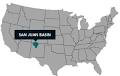
|
San Juan Basin Royalty Trust (SJT): PESTLE Analysis [Nov-2025 Updated] |
Fully Editable: Tailor To Your Needs In Excel Or Sheets
Professional Design: Trusted, Industry-Standard Templates
Investor-Approved Valuation Models
MAC/PC Compatible, Fully Unlocked
No Expertise Is Needed; Easy To Follow
San Juan Basin Royalty Trust (SJT) Bundle
You're staring at San Juan Basin Royalty Trust (SJT) after distributions were suspended, and frankly, the macro picture is what matters now. With Q3 2025 reporting a net loss of $111,000 and the Trust stuck with aging gas reserves, we need to see the external forces at play. This PESTLE analysis cuts through the complexity to show you the political, technological, and environmental hurdles that will dictate when-or if-that $2.0 million cash reserve target gets hit. Keep reading to see the real risks.
San Juan Basin Royalty Trust (SJT) - PESTLE Analysis: Political factors
New Mexico's Energy Transition Act mandates 40% renewable energy for utilities by 2025.
The New Mexico Energy Transition Act (ETA) of 2019 creates a clear, long-term headwind for fossil fuel production in the state, including the San Juan Basin. The Act mandates that investor-owned utilities (IOUs) must source 40% of their electricity from renewable energy by the end of 2025. This is a hard target, not a suggestion. The ETA's ultimate goal is a 100% zero-carbon electricity grid for IOUs by 2045, with an interim target of 80% renewable energy by 2040.
This political shift means less demand for the natural gas produced in the San Juan Basin as utilities like Public Service Company of New Mexico (PNM) transition their power generation portfolio. The state is actively using securitization-low-cost financing-to pay off coal plant costs and fund the transition, which includes directing over $40 million to assist workers and communities impacted by the closure of the San Juan Generating Station.
Here's the quick math: the state is politically committed to replacing fossil fuel generation with renewables, which directly impacts the long-term market for SJT's underlying asset, natural gas. That's a structural risk you can't ignore.
Federal restrictions limit drilling within a 10-mile radius of Chaco Canyon National Historical Park.
Federal policy has created a significant, immediate restriction on new drilling in a key area of the San Juan Basin. The Biden administration, in 2023, finalized a 20-year withdrawal of federal lands from new oil and gas leasing within a 10-mile radius of the Chaco Culture National Historical Park. This ban covers hundreds of thousands of acres of federal land. While the ban doesn't affect existing leases or drilling on private property, it effectively sterilizes a large block of potential new development acreage for the next two decades.
Still, the political risk is now two-sided. As of November 2025, the Trump administration has announced its intention to rescind this 10-mile buffer zone, initiating tribal consultations and an environmental assessment. This move, part of a broader push to increase domestic fossil fuel production, introduces a high degree of regulatory uncertainty. The Bureau of Land Management (BLM) is considering three options: keep the withdrawal, revoke it in full, or opt for a smaller buffer.
Navajo Nation filed a January 2025 lawsuit to revoke the 10-mile drilling limit, citing economic harm.
The political landscape is further complicated by tribal politics and economic interests. In January 2025, the Navajo Nation filed a lawsuit in the U.S. District Court for the District of New Mexico to challenge the 10-mile drilling withdrawal. The core of their argument is that the Interior Department failed to properly consult with the Navajo Nation and its citizens-specifically the allottees-about the devastating economic consequences of the ban.
Many Navajo allottees rely on the oil and gas royalties from their 160-acre trust lands for income. The lawsuit contends the withdrawal could deprive these allottees of millions of dollars in royalty revenue. This creates a unique political dynamic where a major tribal government is aligned with the oil and and gas industry's desire to open up the land for development, directly opposing the environmental and cultural protection stance of other Pueblo tribes.
Regulatory risk from the New Mexico Oil Conservation Division (OCD) governing production.
The New Mexico Oil Conservation Division (OCD) is actively tightening its regulatory grip, increasing both the cost and complexity of operations in the San Juan Basin. This is defintely a near-term risk for operators. The OCD provided advance notice of new policy requirements with staggered effective dates in late 2025:
- November 1, 2025: New requirements for the Hearing Submission Process and the Procedure for Deviation from Orders take effect, aiming to streamline caseloads but adding new filing hurdles for operators.
- December 1, 2025: Clarification of Evidentiary Requirements for Compulsory Pooling Applications becomes effective, adding complexity to the process of pooling working interests.
The most significant financial risk comes from proposed bonding reform. A public hearing was held in late 2025 to consider rule changes (Case No. 24683) that would require oil and gas corporations to post adequate financial assurance to cover the full cost of plugging wells. The state's average cost to plug an abandoned well is $163,000 per well. The OCD's own data from June 2025 identifies 700 wells for state-funded plugging, with an additional 4,400 wells across the state at risk of abandonment. This push for full-cost bonding will increase the operating costs and financial liabilities for all San Juan Basin operators, especially those with older, marginal wells.
| OCD Regulatory Risk Factor (2025) | Impact on SJT Operators | Key Financial/Statistical Data |
|---|---|---|
| Bonding Reform (Case No. 24683) | Increased financial assurance/liability for all wells. | Average state plugging cost: $163,000 per well. |
| Abandoned Well Liability | Potential for forced plugging/higher fees on marginal wells. | 700 wells identified for state-funded plugging (June 2025). |
| New Hearing/Pooling Rules | Increased administrative burden and time for new development. | Effective dates: November 1, 2025 and December 1, 2025. |
San Juan Basin Royalty Trust (SJT) - PESTLE Analysis: Economic factors
The economic reality for the San Juan Basin Royalty Trust (SJT) in 2025 is stark: persistent low natural gas prices combined with significant, unrecovered operational costs have completely choked off cash flow, leading to a total suspension of unit holder distributions.
Distribution Suspension and Commodity Headwinds
You are definitely seeing a complete halt in income from your SJT units throughout 2025. This isn't a temporary pause; it's a direct consequence of the economic environment where the realized price for natural gas simply isn't covering the base operating expenses, let alone the massive cost overruns from prior capital work. For income-focused investors, this is a tough pill to swallow, as the Trust is structured to pass through proceeds, not absorb deficits. The lack of distributions means all net proceeds are being swept directly to pay down liabilities before a single penny goes back to you, the unitholder.
The core economic problem boils down to this:
- Low realized natural gas prices.
- High, unrecovered production costs.
- Zero cash flow available for distribution.
Q3 2025 Financial Distress
The third quarter of fiscal year 2025 paints a grim picture of the Trust's current operational standing. The numbers show just how thin the margin is, or rather, how deep the negative margin runs. For the three months ending September 30, 2025, the Trust posted a net loss of $111,000. To put that into perspective, the reported revenue for that same period was a mere $400. Honestly, that revenue figure is practically noise when weighed against the loss, showing that the Trust is currently operating at a significant negative cash flow before even considering the legacy debt.
The Overhang of Excess Production Costs
The real anchor dragging down the Trust is the cumulative excess production costs (EPCS). This is the total amount by which Hilcorp's incurred production costs and capital expenditures have exceeded the gross proceeds generated by the assets. As of July 2025, the net amount owed back to the operator, which the Trust must clear before distributions resume, stood at approximately $12.87 million net to the Trust.
Here's the quick math on how that deficit impacts your potential return:
| Metric | Value (Net to Trust) | Reporting Period/Context |
|---|---|---|
| Cumulative Excess Production Costs | $12,870,000 | As of July 2025, related to 2024 program |
| Q3 2025 Net Loss | $111,000 | For the quarter ending September 30, 2025 |
| Q3 2025 Revenue | $400 | For the quarter ending September 30, 2025 |
What this estimate hides is the fact that this deficit must be cleared before the Trust can even think about replenishing its $2.0 million cash reserve target or paying down its line of credit.
Operator Capital Allocation Strategy
The economic outlook is heavily influenced by Hilcorp's spending plans, as the Trust has no control over operations. For the full 2025 fiscal year, Hilcorp has estimated capital expenditures for the Subject Interests to be approximately $9.0 million. This is a major shift from the prior year, where capital spending was around $33.6 million in 2024.
This reduced 2025 budget signals a more conservative approach from the operator, focusing on lower-cost projects:
- $4.5 million for recompletions/workovers.
- $4.0 million for seven new vertical drill projects.
- $0.5 million for facilities work.
While the lower 2025 CAPEX is less likely to immediately balloon the deficit like the 2024 program did, it also means production growth-the only thing that can generate the revenue needed to pay down the $12.87 million liability-is not being aggressively pursued through high-cost horizontal drilling this year. If onboarding takes 14+ days, churn risk rises, and in this case, if the revenue doesn't materialize from these lower-cost projects, the deficit reduction stalls.
San Juan Basin Royalty Trust (SJT) - PESTLE Analysis: Social factors
You're looking at the social currents shaping the San Juan Basin Royalty Trust (SJT) landscape, and honestly, it's a mixed bag of long-term headwinds and immediate, localized friction. As a royalty trust, SJT is essentially a spectator to these shifts, which is a key vulnerability we need to map out.
Public and political pressure favors a transition to renewable energy sources over natural gas
The social and political climate in New Mexico, where SJT's assets reside, is definitely leaning away from fossil fuels. State leadership is pushing hard for a cleaner energy mix. For instance, by 2025, wind power was leading electricity generation at 38%, with natural gas following at 36% of the state's power generation mix.
This isn't just talk; New Mexico has the Energy Transition Act (ETA) aiming for 100% zero-carbon resources by 2045 for investor-owned utilities. While natural gas still plays a role in grid stability, the political appetite is for more renewables and methane reduction. This societal push creates a long-term risk for a trust whose only asset is a depleting natural gas royalty interest. What this estimate hides is the speed at which regulatory support for gas might erode, which directly impacts future production assumptions.
Here's a quick snapshot of the energy shift impacting the sector SJT relies on:
- Wind power leads generation at 38% in 2025.
- Natural gas provides 36% of electricity generation.
- State goal is 100% zero-carbon resources by 2045.
The Trust's passive structure limits its ability to respond to changing market and social demands
This is where the structure of SJT becomes a critical limiting factor. Unlike an operating company or even an actively managed fund, SJT is a pass-through vehicle established in 1980. Its assets are static; the Trustee cannot acquire new properties or engage in any commercial activity to diversify or offset declining gas production.
When social pressures-like the push for renewables-or market shocks hit, SJT can only absorb the impact. We saw this clearly in early 2025: the average natural gas price for February 2025 production was only $3.36 per Mcf, leading to no cash distributions being declared for April 2025 and October 2025. The Trust's inability to pivot means it must rely entirely on Hilcorp San Juan, L.P.'s operational decisions and commodity price recovery to generate any distributable income. If onboarding takes 14+ days, churn risk rises-and for SJT, if gas prices stay low, the distribution risk is permanent until the underlying asset is exhausted.
Local community and tribal interests affect drilling permits and operational areas, especially near Chaco Canyon
The social fabric around the San Juan Basin is currently strained by land use conflicts, which directly affect the operator, Hilcorp, and thus SJT's royalty stream. The fight over drilling near Chaco Culture National Historical Park is a prime example of community interests overriding potential energy development.
As of late 2025, the Bureau of Land Management (BLM) was consulting with Native American tribes over a proposal to revoke the 10-mile buffer zone ban on new oil and gas leasing around the park, a ban put in place by the Biden administration. This creates significant regulatory uncertainty. Some Pueblo leaders fear hydraulic fracturing will damage sacred sites, while some Navajo Nation members depend on royalties from existing wells nearby.
This tension is a real, tangible risk to production stability in the basin. The Trust's Q3 2025 report showed a loss of $111,000 on revenue of just $400, illustrating the extreme volatility tied to these operational and regulatory environments. The cumulative excess production costs net to the Trust was still approximately $12,869,691 as of February 2025 production month, meaning any operational hiccup or permit delay directly impacts the timeline for unitholders to see a distribution again.
Here is a comparison of the Chaco Canyon protection status:
| Policy/Entity | Status as of Late 2025 | Impact on San Juan Basin Operations |
|---|---|---|
| Biden-era Buffer Zone | Under formal review for revocation. | Potential for new leasing, but high social/legal opposition. |
| Pueblo Opposition | Strongly against drilling, citing potential damage to sacred sites. | Increases permitting risk and potential for litigation delays. |
| Navajo Nation Members | Some support drilling for vital royalty income. | Creates internal tribal division affecting unified political front. |
| SJT Distribution Status | Suspended since May 2024; no distribution for Oct 2025. | Directly tied to net proceeds after covering operator costs. |
Finance: draft 13-week cash view by Friday.
San Juan Basin Royalty Trust (SJT) - PESTLE Analysis: Technological factors
You're looking at a royalty trust, SJT, which means your fate is entirely tied to the technology and capital decisions made by the operator, Hilcorp. The tech here isn't about software; it's about rock physics and drilling mechanics, specifically how well Hilcorp can execute complex horizontal drilling in the San Juan Basin.
The core issue is that the Trust's asset base is overwhelmingly natural gas-it produces a negligible amount of oil, which means you can't pivot if gas prices tank. This reliance on gas makes the success of advanced drilling techniques absolutely critical for any future value realization.
Operator Execution and Horizontal Drilling Dependency
The Trust's performance hinges on Hilcorp's technical prowess. Future production growth, or even just slowing the decline, is pinned on unlocking value from the deeper Mancos Shale, which requires sophisticated horizontal well technology. For context, Hilcorp spent a hefty $24.6 million in calendar year 2024 on just two new horizontal drilling projects targeting the Mancos formation.
However, the results from that 2024 capital expenditure (CAPEX) have been underwhelming so far. As of August 2025, the average daily natural gas production has actually dropped about 14.5% compared to December 2024 levels, suggesting the initial output from those new wells didn't meet bullish expectations.
Here's a quick look at the production context:
| Metric | Value/Period | Source Context |
| Peak San Juan Gas Production | 4.5 Bcf/d | Early 2000s |
| Estimated San Juan Gas Production | 1.7 Bcf/d | 2025 level mentioned in analysis |
| 2024 Mancos Horizontal CAPEX (Hilcorp) | $24.6 million | Spent on 2 wells |
| 2025 Vertical Drilling CAPEX (Hilcorp) | $4.0 million | For 7 new vertical wells |
Mancos Shale: The Technological Bet for Future Reserves
The industry is betting big on the Mancos Shale as the next major source of gas in the basin, moving beyond the older Fruitland Coal seam. Operators exploring this deeper layer are reporting much higher Initial Production (IP) rates from their horizontal wells compared to older wells. For example, one operator's Mancos horizontal well achieved a peak rate of 24.9 million equivalent cubic feet per day over a 30-day period.
The Trust's future production profile is entirely dependent on Hilcorp's ability to scale this technology successfully across the Trust's acreage. If Hilcorp can consistently replicate those high IP rates with their horizontal drilling program, the Trust's cash flow could stabilize. If not, the slow, steady decline continues.
Commodity Rigidity Due to Gas Dominance
You must remember that SJT is fundamentally a gas play. The Trust is essentially a pass-through vehicle for royalties from properties that produce a negligible amount of oil. This lack of oil exposure means the Trust cannot benefit from the higher margins or different price dynamics that oil-weighted royalty companies enjoy. You are locked into the natural gas market, which is why the performance of gas-focused technology like horizontal drilling in the Mancos is so important.
The basin-wide production decline reflects this rigidity; San Juan gas production has fallen from a peak of 4.5 Bcf/d in the early 2000s to an estimated 1.7 Bcf/d in 2025.
Technological success is the only lever for growth here.
- Horizontal wells access more reserves per pad.
- Mancos Shale development is the key focus area.
- Drilling technology must overcome aging conventional wells.
- The Trust has no ability to shift to oil production.
Finance: draft 13-week cash view by Friday.
San Juan Basin Royalty Trust (SJT) - PESTLE Analysis: Legal factors
You're looking at a structure that is legally rigid, which is a major factor in how SJT navigates the current commodity price environment. The legal framework essentially locks the asset base in place, meaning no growth through acquisition is possible.
Asset Base Restriction and Governing Documents
The Trust's governing documents, specifically the Amended and Restated Royalty Trust Indenture (as amended on February 15, 2024), are quite restrictive. A key legal constraint is that the Trust prohibits acquiring new properties, effectively fixing the asset base to the existing San Juan Basin acreage. This means the only way for the Trust to generate more revenue is through the production performance of the current assets, which are operated entirely by Hilcorp San Juan L.P. The Trustee, Argent Trust Company, is authorized to retain a cash reserve for liabilities, but the primary legal hurdle right now is clearing the massive deficit before any cash flows back to you, the unitholder.
Here are the key legal conditions that must be met before distributions resume:
- Repay the balance of Excess Production Costs (EPC).
- Replenish the cash reserve to $2,000,000.
- Repay the principal and interest on the Line of Credit.
Cash Reserve Mandate and Distribution Suspension
The Trustee has a clear, legally defined path for resuming monthly distributions, and it starts with building up the cash cushion. If onboarding takes 14+ days, churn risk rises, but here, if the reserve isn't topped up, distributions stay suspended. As of the latest filings, the Trust is far from this target. For instance, as of October 2025, the cash reserves stood at a mere $27,243 after using some funds to cover interest on the Line of Credit. This is a long way from the required $2.0 million target.
The current situation is stark, showing zero distributable income for many months in 2025, such as the $0.00 distribution declared for October 2025. The Trust must first clear the EPC overhang, which was approximately $11,630,625 gross as of the August 2025 production month reporting.
Going Concern Qualification
Legally, the preparation of financial statements must assume a going concern, but the reality forces a major caveat. As of September 30, 2025, management explicitly disclosed substantial doubt about the San Juan Basin Royalty Trust's ability to continue as a going concern. This is a direct legal consequence of the cumulative EPC balance, which was over $10.1 million net to the Trust at that time.
Here's a snapshot of the financial pressure points that trigger this legal disclosure:
| Metric | Value as of Sep 30, 2025 (Approximate) | Source of Doubt |
| Cumulative EPC (Net) | $10,195,300 | EPC must be recovered before Net Proceeds yield Royalty Income |
| Cash Reserves | $29,160 | Far below the required $2.0 million replenishment target |
| Line of Credit Outstanding | $274,135 | Must be repaid before distributions resume |
What this estimate hides is that the going concern warning is based on the current inability to cover liabilities and reserves, not a prediction of future operational failure by Hilcorp. Still, it's a red flag for any income-focused investor.
Operational Control and Fiduciary Duty
You definitely need to understand that SJT is a passive entity. The Trust has no operational control whatsoever; it is entirely dependent on Hilcorp's management decisions regarding drilling, production, and cost management. The Trustee's role is primarily oversight and fiduciary duty, not day-to-day management of the gas wells.
The Trustee's legal recourse involves continuous engagement and auditing. Argent Trust Company routinely engages with Hilcorp concerning accounting, reporting, sales revenues, production costs, and capital expenditures. This dependency means that the pace at which the massive EPC balance is paid down is entirely dictated by Hilcorp's operational spending and the resulting net proceeds. If Hilcorp decides to ramp up capital expenditures again, the legal path back to distributions for unitholders gets longer, defintely.
Finance: draft 13-week cash view by Friday
San Juan Basin Royalty Trust (SJT) - PESTLE Analysis: Environmental factors
You're managing a royalty interest in the San Juan Basin, and honestly, the environmental landscape is getting tighter, which directly affects the long-term viability of those aging gas wells your Trust relies on.
The primary concern is the basin's natural decline coupled with increasingly strict state oversight, especially around water and emissions. This isn't just about public perception; it's about compliance costs and operational continuity for the operators who pay you royalties.
New Mexico Regulations for Produced Water Reuse and Disposal
New Mexico took a hard line on produced water (the toxic wastewater from drilling) in 2025. The Water Quality Control Commission voted in May 2025 to completely ban any discharge of treated produced water to ground or surface waters. This is a big deal because New Mexico generates roughly 2 billion barrels of this wastewater annually.
While the ban is in effect, the state is planning Phase 2 rulemaking in 2026 to explore safe reuse pathways. For now, operators must rely on injection wells or closed-loop systems, which adds complexity and cost. To be fair, the state is trying to protect its scarce water, but this regulatory uncertainty impacts future drilling decisions in the basin.
The risk of spills remains a factor; state records showed 938 incidents of produced water spills in 2023.
Declining Production and Aging Well Infrastructure
The Trust's main asset is tied to a basin that has been shrinking since its peak in 2010. Natural gas production has been steadily falling due to competition and the maturity of the coalbed methane (CBM) wells.
Here's a quick look at the trend for the gas that matters to your cash flow:
| Metric | 2010 (Peak/Baseline) | 2024 Estimate | 2025 Forecast |
| San Juan Raw Gas Production (Bcf/d) | 3.372 | 1.701 (Total) | 1.644 (Old Wells Only) |
| Total Annual Gas Production (Tscf) | 0.86 | ~0.47 (in 2024) | N/A |
| Annual Water Production (MMBW) | ~49 (Peak in 2011) | ~20 (in 2024) | N/A |
The older infrastructure inherited by the current smaller operators often means higher potential for leaks and emissions.
Methane Emissions and Compliance Costs
Methane is a potent greenhouse gas, and New Mexico has aggressive rules to control it. Operators are required to capture no less than 98% of their natural gas waste by the end of 2026.
The state's rules appear effective, as 2024-2025 satellite data showed New Mexico's methane intensity in the Permian at 1.2% versus Texas's 3.1% in the Delaware sub-basin. This captured gas is not just an environmental win; it generated an estimated $125 million in additional natural gas production value and $27 million in tax revenue for the state in the measurement period.
For operators, compliance means capital expenditure on new equipment and leak detection. Furthermore, the regulatory expansion under Senate Bill 4 could mean the Environment Department needs 10 more personnel and up to $1.7 million in new funding to enforce these rules.
Water Management and Drilling Viability
Water is the lifeblood of any drilling operation, and in arid New Mexico, it's a constant constraint. Water management-sourcing, transport, treatment, and disposal-is now a central economic factor.
For the San Juan Basin specifically, the petroleum industry holds about 6.3% of the groundwater rights, totaling around 6,674 acre-ft/year. New horizontal wells are water-intensive, averaging 3.13 acre-feet (af) per well.
The cost of moving water is significant, with transport accounting for 43% of total water-related expenses for operators. If operators cannot secure cost-effective water or disposal for produced water due to the new discharge bans, drilling viability for new infill wells in the basin definitely suffers.
- Transport costs drive the push for water reuse.
- U.S. midstream water market projected at $156 billion (2025-2030).
- Reuse is seen as key to reducing freshwater demand.
- New drilling is focused on the Mancos Shale.
Finance: draft 13-week cash view by Friday.
Disclaimer
All information, articles, and product details provided on this website are for general informational and educational purposes only. We do not claim any ownership over, nor do we intend to infringe upon, any trademarks, copyrights, logos, brand names, or other intellectual property mentioned or depicted on this site. Such intellectual property remains the property of its respective owners, and any references here are made solely for identification or informational purposes, without implying any affiliation, endorsement, or partnership.
We make no representations or warranties, express or implied, regarding the accuracy, completeness, or suitability of any content or products presented. Nothing on this website should be construed as legal, tax, investment, financial, medical, or other professional advice. In addition, no part of this site—including articles or product references—constitutes a solicitation, recommendation, endorsement, advertisement, or offer to buy or sell any securities, franchises, or other financial instruments, particularly in jurisdictions where such activity would be unlawful.
All content is of a general nature and may not address the specific circumstances of any individual or entity. It is not a substitute for professional advice or services. Any actions you take based on the information provided here are strictly at your own risk. You accept full responsibility for any decisions or outcomes arising from your use of this website and agree to release us from any liability in connection with your use of, or reliance upon, the content or products found herein.