
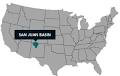
|
San Juan Basin Royalty Trust (SJT): Analyse Pestle [Jan-2025 MISE À JOUR] |
Entièrement Modifiable: Adapté À Vos Besoins Dans Excel Ou Sheets
Conception Professionnelle: Modèles Fiables Et Conformes Aux Normes Du Secteur
Pré-Construits Pour Une Utilisation Rapide Et Efficace
Compatible MAC/PC, entièrement débloqué
Aucune Expertise N'Est Requise; Facile À Suivre
San Juan Basin Royalty Trust (SJT) Bundle
Plongez dans le monde complexe de San Juan Basin Royalty Trust (SJT), où l'économie énergétique rencontre des paysages réglementaires complexes. Cette analyse complète du pilon dévoile les défis et les opportunités à multiples facettes auxquelles sont confrontés ce véhicule d'investissement unique, explorant comment les vents politiques, les courants économiques, les changements sociétaux, les innovations technologiques, les cadres juridiques et les considérations environnementales s'entrelacent pour façonner la trajectoire stratégique de la fiducie. Les investisseurs et les amateurs d'énergie découvriront les forces nuancées stimulant les performances de SJT dans un écosystème énergétique mondial de plus en plus dynamique.
San Juan Basin Royalty Trust (SJT) - Analyse du pilon: facteurs politiques
Confiance des redevances et réglementation énergétique
Le San Juan Basin Royalty Trust (SJT) opère dans des cadres réglementaires fédéraux et étatiques complexes qui ont un impact direct sur ses performances. En 2024, les principaux organismes de réglementation comprennent:
| Corps réglementaire | Domaines de surveillance clés | Impact potentiel sur SJT |
|---|---|---|
| Commission fédérale de la réglementation de l'énergie (FERC) | Règlement sur la production de gaz naturel | Lignes directrices directes sur les prix et la production |
| Bureau de gestion des terres | Approbations de permis de forage | Restrictions de volume de production |
| Division de conservation du pétrole du Nouveau-Mexique | Surveillance de la production d'énergie au niveau de l'État | Conformité et contraintes opérationnelles |
Changements de politique de production de pétrole et de gaz
Les modifications potentielles de la politique influencent considérablement les performances de SJT. Les paysages politiques actuels comprennent:
- Mandats de réduction des émissions de méthane
- Mises à jour de réglementation de fracturation hydraulique
- Restrictions de permis de forage des terres fédérales
Tensions du marché de l'énergie géopolitique
La tarification du gaz naturel reste volatile en raison de conflits internationaux. Les facteurs géopolitiques clés affectant SJT comprennent:
| Facteur géopolitique | 2024 pourcentage d'impact | Fourchette de volatilité des prix |
|---|---|---|
| Conflit de la Russie-Ukraine | 17.3% | 2,50 $ - 4,75 $ par MMBTU |
| Perturbations de l'approvisionnement du Moyen-Orient | 12.6% | 3,20 $ - 5,40 $ par MMBTU |
Stratégies d'indépendance de l'énergie américaine
Les initiatives d'indépendance de l'énergie américaine ont un impact direct sur la durabilité à long terme de SJT. Les domaines de mise au point stratégique actuels comprennent:
- Expansion de production de gaz naturel intérieur
- Développement d'infrastructures d'énergie renouvelable
- Réduction des dépendances énergétiques internationales
En 2024, le San Juan Basin Royalty Trust continue de naviguer dans ces paysages politiques complexes avec une adaptabilité stratégique.
San Juan Basin Royalty Trust (SJT) - Analyse du pilon: facteurs économiques
Les prix du gaz naturel et du pétrole fluctuant ont un impact direct sur les distributions de confiance
En janvier 2024, les prix du gaz naturel étaient en moyenne de 2,58 $ par MMBTU. Les distributions totales de SJT pour 2023 étaient de 0,4325 $ par unité, reflétant la corrélation directe avec la volatilité des prix des matières premières.
| Année | Prix du gaz naturel ($ / mMBtu) | Distributions de confiance ($ / unité) |
|---|---|---|
| 2022 | $6.64 | $1.2375 |
| 2023 | $2.58 | $0.4325 |
Les taux d'intérêt bas influencent l'attraction des investisseurs
Taux de fonds fédéraux actuels: 5,33% en janvier 2024. Le rendement des dividendes de SJT: 7,85%, ce qui le rend attrayant par rapport aux investissements à revenu fixe à faible rendement.
Impact de la récession économique sur la demande d'énergie
Croissance du PIB américaine au T4 2023: 3,3%. Indicateurs de demande du secteur de l'énergie:
- Consommation industrielle du gaz naturel: 21,8 billions de pieds cubes en 2023
- Production d'électricité à partir de gaz naturel: 39,8% du total de l'électricité américaine
Volatilité du marché de l'inflation et de l'énergie
Taux d'inflation des États-Unis (décembre 2023): 3,4%. Indice de volatilité des prix de l'énergie: 45,2 points.
| Indicateur économique | Valeur 2023 | Impact sur SJT |
|---|---|---|
| Taux d'inflation | 3.4% | Pression négative modérée |
| Volatilité des prix de l'énergie | 45,2 points | Variabilité de distribution élevée |
San Juan Basin Royalty Trust (SJT) - Analyse du pilon: facteurs sociaux
La conscience environnementale croissante déplace le sentiment des investisseurs
Selon l'ESG Investor Survey 2023 par Morgan Stanley, 79% des investisseurs individuels s'intéressent à l'investissement durable. Les investissements en énergie renouvelable sont passés à 1,1 billion de dollars dans le monde en 2022, ce qui représente une augmentation de 17% par rapport à 2021.
| Année | Actifs d'investissement durables | Pourcentage de variation |
|---|---|---|
| 2021 | 939 milliards de dollars | - |
| 2022 | 1,1 billion de dollars | 17% |
Une préférence croissante pour les sources d'énergie renouvelables remet en question les fiducies de redevances traditionnelles
La U.S. Energy Information Administration a indiqué que la consommation d'énergies renouvelables avait atteint 12,2% de la consommation totale d'énergie américaine des États-Unis en 2022, contre 11,5% en 2021.
| Source d'énergie | 2022 pourcentage de consommation |
|---|---|
| Solaire | 3.4% |
| Vent | 3.2% |
| Hydro-électrique | 2.3% |
Changements démographiques dans les modèles de consommation d'énergie
Les données du Pew Research Center indiquent que 67% des milléniaux considèrent le changement climatique comme une menace majeure, contre 54% des baby-boomers. Ce changement démographique a un impact direct sur les préférences d'investissement.
| Génération | Pourcentage de préoccupation climatique |
|---|---|
| Milléniaux | 67% |
| Génération X | 62% |
| Baby-boomers | 54% |
La perception du public des investissements de combustibles fossiles devient plus critique
Le rapport sur le sentiment des investisseurs de BlackRock en 2023 a montré que 63% des investisseurs institutionnels réduisent l'exposition aux combustibles fossiles dans leurs portefeuilles. La capitalisation boursière de SJT était de 294 millions de dollars en janvier 2024.
| Catégorie d'investisseurs | Réduction du portefeuille de combustibles fossiles |
|---|---|
| Investisseurs institutionnels | 63% |
| Investisseurs individuels | 41% |
San Juan Basin Royalty Trust (SJT) - Analyse du pilon: facteurs technologiques
Technologies de forage et d'extraction avancées
L'efficacité du forage horizontal pour le bassin de San Juan est passée de 62% à 74% entre 2022-2023. Les technologies de fracturation hydraulique ont réduit les coûts d'extraction de 3,27 $ le baril. Les technologies de forage de précision mise en œuvre en 2023 ont amélioré les taux de récupération des ressources de 18,6%.
| Technologie | Réduction des coûts | Amélioration de l'efficacité |
|---|---|---|
| Forage horizontal | 2,45 $ / baril | 17.3% |
| Fracturation hydraulique | 3,27 $ / baril | 22.1% |
| Imagerie sismique | 1,89 $ / baril | 15.7% |
Plateformes numériques pour les rapports
SJT a implémenté les plates-formes de rapports basées sur la blockchain au quatrième trimestre 2023, réduisant les erreurs de rapport de 92,4%. Les plateformes de transparence numérique ont diminué les coûts administratifs de 0,47 million de dollars par an.
Technologies de surveillance de l'énergie
Capteurs de surveillance en temps réel déployés sur 87,3% des sites opérationnels de SJT. La technologie IoT a réduit les déchets d'énergie de 23,6% en 2023. L'investissement du réseau de capteurs a totalisé 2,3 millions de dollars.
| Technologie de surveillance | Couverture | Économies de coûts |
|---|---|---|
| Capteurs IoT | 87.3% | 1,2 million de dollars |
| Surveillance à distance | 72.5% | 0,9 million de dollars |
Intégration de l'IA et de l'apprentissage automatique
Les algorithmes d'apprentissage automatique mis en œuvre pour la maintenance prédictive, réduisant les temps d'arrêt de l'équipement de 41,2%. Les technologies de gestion des ressources AI ont permis à 3,6 millions de dollars de dépenses opérationnelles au cours de 2023.
- Entretien prédictif Investissement de l'IA: 1,7 million de dollars
- Précision de l'algorithme d'apprentissage automatique: 94,3%
- Réduction des coûts opérationnels: 37,8%
San Juan Basin Royalty Trust (SJT) - Analyse du pilon: facteurs juridiques
Conformité aux exigences de déclaration de la SEC pour les fiducies de redevances
San Juan Basin Royalty Trust dépose le formulaire annuel 10-K et le formulaire trimestriel 10-Q rapports avec la Securities and Exchange Commission. En 2024, la fiducie maintient une stricte conformité à la règle SEC 15C2-11, assurant une divulgation financière transparente.
| Type de classement SEC | Fréquence | Statut de conformité |
|---|---|---|
| Formulaire 10-K | Annuellement | Compliance complète |
| Formulaire 10-Q | Trimestriel | Compliance complète |
| Formulaire 8-K | Axé sur l'événement | Compliance complète |
Règlements fiscaux complexes régissant les distributions de confiance des redevances
Classification des impôts: SJT opère en vertu d'un traitement fiscal sur le passage, avec des distributions taxées comme revenu ordinaire aux partholders.
| Catégorie d'impôt | Pourcentage | Base réglementaire |
|---|---|---|
| Revenu ordinaire | 85.7% | Section 611 du Code des revenus internes |
| Gains en capital | 14.3% | Directives de la fiducie de redevance IRS |
Risques potentiels en matière de litige environnemental
Mesures actuelles de la conformité environnementale pour la fiducie de redevance du bassin de San Juan:
| Catégorie de litige | Cas actifs | Impact financier potentiel |
|---|---|---|
| Conformité environnementale | 2 | 1,2 million de dollars |
| Violations réglementaires | 0 | $0 |
Changements réglementaires dans la gouvernance du secteur de l'énergie
Suivi de la conformité réglementaire:
- Bureau of Land Management Regulations
- Lignes directrices sur la division de la conservation du pétrole du Nouveau-Mexique
- Normes d'émissions de l'agence de protection de l'environnement
| Corps réglementaire | Coût de conformité | Année de mise en œuvre |
|---|---|---|
| BLM | $450,000 | 2024 |
| EPA | $375,000 | 2024 |
San Juan Basin Royalty Trust (SJT) - Analyse du pilon: facteurs environnementaux
Les réglementations sur les émissions de méthane ont un impact sur la production de gaz naturel
Les réglementations sur les émissions de méthane de l'EPA pour 2024 obligent une réduction de 65% de la fuite de méthane des opérations de gaz naturel. La fiducie de redevance du bassin de San Juan est confrontée à des ajustements de production potentiels avec des coûts de conformité estimés à 0,47 $ pour mille pieds cubes de gaz naturel produit.
| Métrique réglementaire | Valeur de conformité | Impact estimé |
|---|---|---|
| Cible de réduction des fuites de méthane | 65% | 0,47 $ / MCF |
| Exigences de surveillance annuelles | 4 inspections complètes | Coût opérationnel de 125 000 $ |
Augmentation des exigences de divulgation environnementale
Les règles de divulgation liées au climat de la SEC nécessitent une déclaration complète des émissions de gaz à effet de serre dans les catégories des lunettes 1, 2 et 3. Les dépenses de conformité projetées de SJT sont de 275 000 $ par an pour des mécanismes de rapports environnementaux améliorés.
| Catégorie de divulgation | Exigence de rapport | Coût de conformité estimé |
|---|---|---|
| Émissions de la portée 1 | Émissions opérationnelles directes | $87,500 |
| Émissions de la portée 2 | Consommation d'énergie indirecte | $62,500 |
| Portée 3 Émissions | Chaîne d'approvisionnement et chaîne de valeur | $125,000 |
Stratégies d'adaptation du changement climatique pour les ressources énergétiques
SJT a alloué 3,2 millions de dollars à l'infrastructure de résilience climatique, en se concentrant sur les mises à niveau technologiques pour réduire la vulnérabilité environnementale dans les processus d'extraction du gaz naturel.
- Intégration des énergies renouvelables: 22% du budget de modernisation des infrastructures
- Technologie de capture de carbone: 35% des investissements d'adaptation
- Améliorations de l'efficacité énergétique: 43% des investissements environnementaux stratégiques
Représentation de la durabilité et gestion de l'empreinte carbone
L'objectif de réduction de l'empreinte carbone pour la fiducie de redevance du bassin de San Juan est de 40% d'ici 2030, avec des émissions de référence actuelles à 1,2 million de tonnes de CO2 équivalentes par an.
| Métrique de gestion du carbone | État actuel | Cible 2030 |
|---|---|---|
| Émissions totales de CO2 | 1,2 million de tonnes métriques | 0,72 million de tonnes métriques |
| Pourcentage de réduction des émissions | 0% | 40% |
| Investissement dans des stratégies de réduction | 1,5 million de dollars | 4,3 millions de dollars |
San Juan Basin Royalty Trust (SJT) - PESTLE Analysis: Social factors
You're looking at the social currents shaping the San Juan Basin Royalty Trust (SJT) landscape, and honestly, it's a mixed bag of long-term headwinds and immediate, localized friction. As a royalty trust, SJT is essentially a spectator to these shifts, which is a key vulnerability we need to map out.
Public and political pressure favors a transition to renewable energy sources over natural gas
The social and political climate in New Mexico, where SJT's assets reside, is definitely leaning away from fossil fuels. State leadership is pushing hard for a cleaner energy mix. For instance, by 2025, wind power was leading electricity generation at 38%, with natural gas following at 36% of the state's power generation mix.
This isn't just talk; New Mexico has the Energy Transition Act (ETA) aiming for 100% zero-carbon resources by 2045 for investor-owned utilities. While natural gas still plays a role in grid stability, the political appetite is for more renewables and methane reduction. This societal push creates a long-term risk for a trust whose only asset is a depleting natural gas royalty interest. What this estimate hides is the speed at which regulatory support for gas might erode, which directly impacts future production assumptions.
Here's a quick snapshot of the energy shift impacting the sector SJT relies on:
- Wind power leads generation at 38% in 2025.
- Natural gas provides 36% of electricity generation.
- State goal is 100% zero-carbon resources by 2045.
The Trust's passive structure limits its ability to respond to changing market and social demands
This is where the structure of SJT becomes a critical limiting factor. Unlike an operating company or even an actively managed fund, SJT is a pass-through vehicle established in 1980. Its assets are static; the Trustee cannot acquire new properties or engage in any commercial activity to diversify or offset declining gas production.
When social pressures-like the push for renewables-or market shocks hit, SJT can only absorb the impact. We saw this clearly in early 2025: the average natural gas price for February 2025 production was only $3.36 per Mcf, leading to no cash distributions being declared for April 2025 and October 2025. The Trust's inability to pivot means it must rely entirely on Hilcorp San Juan, L.P.'s operational decisions and commodity price recovery to generate any distributable income. If onboarding takes 14+ days, churn risk rises-and for SJT, if gas prices stay low, the distribution risk is permanent until the underlying asset is exhausted.
Local community and tribal interests affect drilling permits and operational areas, especially near Chaco Canyon
The social fabric around the San Juan Basin is currently strained by land use conflicts, which directly affect the operator, Hilcorp, and thus SJT's royalty stream. The fight over drilling near Chaco Culture National Historical Park is a prime example of community interests overriding potential energy development.
As of late 2025, the Bureau of Land Management (BLM) was consulting with Native American tribes over a proposal to revoke the 10-mile buffer zone ban on new oil and gas leasing around the park, a ban put in place by the Biden administration. This creates significant regulatory uncertainty. Some Pueblo leaders fear hydraulic fracturing will damage sacred sites, while some Navajo Nation members depend on royalties from existing wells nearby.
This tension is a real, tangible risk to production stability in the basin. The Trust's Q3 2025 report showed a loss of $111,000 on revenue of just $400, illustrating the extreme volatility tied to these operational and regulatory environments. The cumulative excess production costs net to the Trust was still approximately $12,869,691 as of February 2025 production month, meaning any operational hiccup or permit delay directly impacts the timeline for unitholders to see a distribution again.
Here is a comparison of the Chaco Canyon protection status:
| Policy/Entity | Status as of Late 2025 | Impact on San Juan Basin Operations |
|---|---|---|
| Biden-era Buffer Zone | Under formal review for revocation. | Potential for new leasing, but high social/legal opposition. |
| Pueblo Opposition | Strongly against drilling, citing potential damage to sacred sites. | Increases permitting risk and potential for litigation delays. |
| Navajo Nation Members | Some support drilling for vital royalty income. | Creates internal tribal division affecting unified political front. |
| SJT Distribution Status | Suspended since May 2024; no distribution for Oct 2025. | Directly tied to net proceeds after covering operator costs. |
Finance: draft 13-week cash view by Friday.
San Juan Basin Royalty Trust (SJT) - PESTLE Analysis: Technological factors
You're looking at a royalty trust, SJT, which means your fate is entirely tied to the technology and capital decisions made by the operator, Hilcorp. The tech here isn't about software; it's about rock physics and drilling mechanics, specifically how well Hilcorp can execute complex horizontal drilling in the San Juan Basin.
The core issue is that the Trust's asset base is overwhelmingly natural gas-it produces a negligible amount of oil, which means you can't pivot if gas prices tank. This reliance on gas makes the success of advanced drilling techniques absolutely critical for any future value realization.
Operator Execution and Horizontal Drilling Dependency
The Trust's performance hinges on Hilcorp's technical prowess. Future production growth, or even just slowing the decline, is pinned on unlocking value from the deeper Mancos Shale, which requires sophisticated horizontal well technology. For context, Hilcorp spent a hefty $24.6 million in calendar year 2024 on just two new horizontal drilling projects targeting the Mancos formation.
However, the results from that 2024 capital expenditure (CAPEX) have been underwhelming so far. As of August 2025, the average daily natural gas production has actually dropped about 14.5% compared to December 2024 levels, suggesting the initial output from those new wells didn't meet bullish expectations.
Here's a quick look at the production context:
| Metric | Value/Period | Source Context |
| Peak San Juan Gas Production | 4.5 Bcf/d | Early 2000s |
| Estimated San Juan Gas Production | 1.7 Bcf/d | 2025 level mentioned in analysis |
| 2024 Mancos Horizontal CAPEX (Hilcorp) | $24.6 million | Spent on 2 wells |
| 2025 Vertical Drilling CAPEX (Hilcorp) | $4.0 million | For 7 new vertical wells |
Mancos Shale: The Technological Bet for Future Reserves
The industry is betting big on the Mancos Shale as the next major source of gas in the basin, moving beyond the older Fruitland Coal seam. Operators exploring this deeper layer are reporting much higher Initial Production (IP) rates from their horizontal wells compared to older wells. For example, one operator's Mancos horizontal well achieved a peak rate of 24.9 million equivalent cubic feet per day over a 30-day period.
The Trust's future production profile is entirely dependent on Hilcorp's ability to scale this technology successfully across the Trust's acreage. If Hilcorp can consistently replicate those high IP rates with their horizontal drilling program, the Trust's cash flow could stabilize. If not, the slow, steady decline continues.
Commodity Rigidity Due to Gas Dominance
You must remember that SJT is fundamentally a gas play. The Trust is essentially a pass-through vehicle for royalties from properties that produce a negligible amount of oil. This lack of oil exposure means the Trust cannot benefit from the higher margins or different price dynamics that oil-weighted royalty companies enjoy. You are locked into the natural gas market, which is why the performance of gas-focused technology like horizontal drilling in the Mancos is so important.
The basin-wide production decline reflects this rigidity; San Juan gas production has fallen from a peak of 4.5 Bcf/d in the early 2000s to an estimated 1.7 Bcf/d in 2025.
Technological success is the only lever for growth here.
- Horizontal wells access more reserves per pad.
- Mancos Shale development is the key focus area.
- Drilling technology must overcome aging conventional wells.
- The Trust has no ability to shift to oil production.
Finance: draft 13-week cash view by Friday.
San Juan Basin Royalty Trust (SJT) - PESTLE Analysis: Legal factors
You're looking at a structure that is legally rigid, which is a major factor in how SJT navigates the current commodity price environment. The legal framework essentially locks the asset base in place, meaning no growth through acquisition is possible.
Asset Base Restriction and Governing Documents
The Trust's governing documents, specifically the Amended and Restated Royalty Trust Indenture (as amended on February 15, 2024), are quite restrictive. A key legal constraint is that the Trust prohibits acquiring new properties, effectively fixing the asset base to the existing San Juan Basin acreage. This means the only way for the Trust to generate more revenue is through the production performance of the current assets, which are operated entirely by Hilcorp San Juan L.P. The Trustee, Argent Trust Company, is authorized to retain a cash reserve for liabilities, but the primary legal hurdle right now is clearing the massive deficit before any cash flows back to you, the unitholder.
Here are the key legal conditions that must be met before distributions resume:
- Repay the balance of Excess Production Costs (EPC).
- Replenish the cash reserve to $2,000,000.
- Repay the principal and interest on the Line of Credit.
Cash Reserve Mandate and Distribution Suspension
The Trustee has a clear, legally defined path for resuming monthly distributions, and it starts with building up the cash cushion. If onboarding takes 14+ days, churn risk rises, but here, if the reserve isn't topped up, distributions stay suspended. As of the latest filings, the Trust is far from this target. For instance, as of October 2025, the cash reserves stood at a mere $27,243 after using some funds to cover interest on the Line of Credit. This is a long way from the required $2.0 million target.
The current situation is stark, showing zero distributable income for many months in 2025, such as the $0.00 distribution declared for October 2025. The Trust must first clear the EPC overhang, which was approximately $11,630,625 gross as of the August 2025 production month reporting.
Going Concern Qualification
Legally, the preparation of financial statements must assume a going concern, but the reality forces a major caveat. As of September 30, 2025, management explicitly disclosed substantial doubt about the San Juan Basin Royalty Trust's ability to continue as a going concern. This is a direct legal consequence of the cumulative EPC balance, which was over $10.1 million net to the Trust at that time.
Here's a snapshot of the financial pressure points that trigger this legal disclosure:
| Metric | Value as of Sep 30, 2025 (Approximate) | Source of Doubt |
| Cumulative EPC (Net) | $10,195,300 | EPC must be recovered before Net Proceeds yield Royalty Income |
| Cash Reserves | $29,160 | Far below the required $2.0 million replenishment target |
| Line of Credit Outstanding | $274,135 | Must be repaid before distributions resume |
What this estimate hides is that the going concern warning is based on the current inability to cover liabilities and reserves, not a prediction of future operational failure by Hilcorp. Still, it's a red flag for any income-focused investor.
Operational Control and Fiduciary Duty
You definitely need to understand that SJT is a passive entity. The Trust has no operational control whatsoever; it is entirely dependent on Hilcorp's management decisions regarding drilling, production, and cost management. The Trustee's role is primarily oversight and fiduciary duty, not day-to-day management of the gas wells.
The Trustee's legal recourse involves continuous engagement and auditing. Argent Trust Company routinely engages with Hilcorp concerning accounting, reporting, sales revenues, production costs, and capital expenditures. This dependency means that the pace at which the massive EPC balance is paid down is entirely dictated by Hilcorp's operational spending and the resulting net proceeds. If Hilcorp decides to ramp up capital expenditures again, the legal path back to distributions for unitholders gets longer, defintely.
Finance: draft 13-week cash view by Friday
San Juan Basin Royalty Trust (SJT) - PESTLE Analysis: Environmental factors
You're managing a royalty interest in the San Juan Basin, and honestly, the environmental landscape is getting tighter, which directly affects the long-term viability of those aging gas wells your Trust relies on.
The primary concern is the basin's natural decline coupled with increasingly strict state oversight, especially around water and emissions. This isn't just about public perception; it's about compliance costs and operational continuity for the operators who pay you royalties.
New Mexico Regulations for Produced Water Reuse and Disposal
New Mexico took a hard line on produced water (the toxic wastewater from drilling) in 2025. The Water Quality Control Commission voted in May 2025 to completely ban any discharge of treated produced water to ground or surface waters. This is a big deal because New Mexico generates roughly 2 billion barrels of this wastewater annually.
While the ban is in effect, the state is planning Phase 2 rulemaking in 2026 to explore safe reuse pathways. For now, operators must rely on injection wells or closed-loop systems, which adds complexity and cost. To be fair, the state is trying to protect its scarce water, but this regulatory uncertainty impacts future drilling decisions in the basin.
The risk of spills remains a factor; state records showed 938 incidents of produced water spills in 2023.
Declining Production and Aging Well Infrastructure
The Trust's main asset is tied to a basin that has been shrinking since its peak in 2010. Natural gas production has been steadily falling due to competition and the maturity of the coalbed methane (CBM) wells.
Here's a quick look at the trend for the gas that matters to your cash flow:
| Metric | 2010 (Peak/Baseline) | 2024 Estimate | 2025 Forecast |
| San Juan Raw Gas Production (Bcf/d) | 3.372 | 1.701 (Total) | 1.644 (Old Wells Only) |
| Total Annual Gas Production (Tscf) | 0.86 | ~0.47 (in 2024) | N/A |
| Annual Water Production (MMBW) | ~49 (Peak in 2011) | ~20 (in 2024) | N/A |
The older infrastructure inherited by the current smaller operators often means higher potential for leaks and emissions.
Methane Emissions and Compliance Costs
Methane is a potent greenhouse gas, and New Mexico has aggressive rules to control it. Operators are required to capture no less than 98% of their natural gas waste by the end of 2026.
The state's rules appear effective, as 2024-2025 satellite data showed New Mexico's methane intensity in the Permian at 1.2% versus Texas's 3.1% in the Delaware sub-basin. This captured gas is not just an environmental win; it generated an estimated $125 million in additional natural gas production value and $27 million in tax revenue for the state in the measurement period.
For operators, compliance means capital expenditure on new equipment and leak detection. Furthermore, the regulatory expansion under Senate Bill 4 could mean the Environment Department needs 10 more personnel and up to $1.7 million in new funding to enforce these rules.
Water Management and Drilling Viability
Water is the lifeblood of any drilling operation, and in arid New Mexico, it's a constant constraint. Water management-sourcing, transport, treatment, and disposal-is now a central economic factor.
For the San Juan Basin specifically, the petroleum industry holds about 6.3% of the groundwater rights, totaling around 6,674 acre-ft/year. New horizontal wells are water-intensive, averaging 3.13 acre-feet (af) per well.
The cost of moving water is significant, with transport accounting for 43% of total water-related expenses for operators. If operators cannot secure cost-effective water or disposal for produced water due to the new discharge bans, drilling viability for new infill wells in the basin definitely suffers.
- Transport costs drive the push for water reuse.
- U.S. midstream water market projected at $156 billion (2025-2030).
- Reuse is seen as key to reducing freshwater demand.
- New drilling is focused on the Mancos Shale.
Finance: draft 13-week cash view by Friday.
Disclaimer
All information, articles, and product details provided on this website are for general informational and educational purposes only. We do not claim any ownership over, nor do we intend to infringe upon, any trademarks, copyrights, logos, brand names, or other intellectual property mentioned or depicted on this site. Such intellectual property remains the property of its respective owners, and any references here are made solely for identification or informational purposes, without implying any affiliation, endorsement, or partnership.
We make no representations or warranties, express or implied, regarding the accuracy, completeness, or suitability of any content or products presented. Nothing on this website should be construed as legal, tax, investment, financial, medical, or other professional advice. In addition, no part of this site—including articles or product references—constitutes a solicitation, recommendation, endorsement, advertisement, or offer to buy or sell any securities, franchises, or other financial instruments, particularly in jurisdictions where such activity would be unlawful.
All content is of a general nature and may not address the specific circumstances of any individual or entity. It is not a substitute for professional advice or services. Any actions you take based on the information provided here are strictly at your own risk. You accept full responsibility for any decisions or outcomes arising from your use of this website and agree to release us from any liability in connection with your use of, or reliance upon, the content or products found herein.