

|
Verint Systems Inc. (VRNT): 5 FORCES Analysis [Nov-2025 Updated] |
Fully Editable: Tailor To Your Needs In Excel Or Sheets
Professional Design: Trusted, Industry-Standard Templates
Investor-Approved Valuation Models
MAC/PC Compatible, Fully Unlocked
No Expertise Is Needed; Easy To Follow
Verint Systems Inc. (VRNT) Bundle
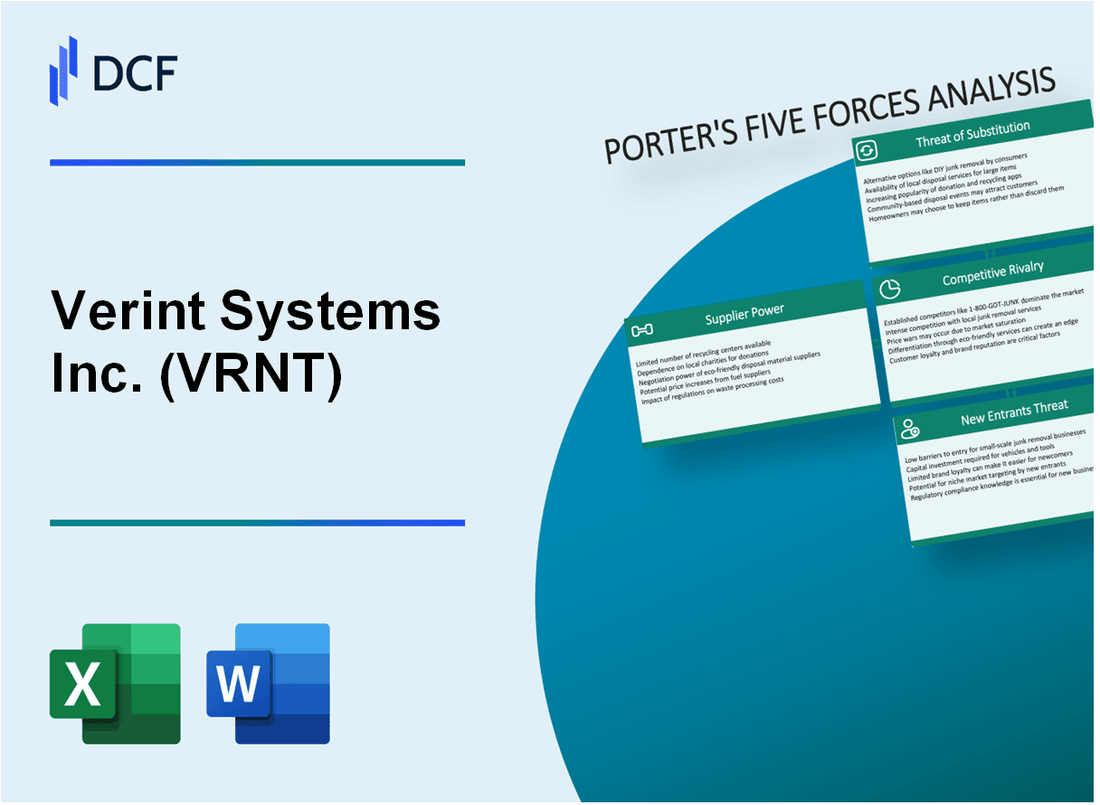
You're looking at Verint Systems Inc. right after the $2 billion acquisition by Thoma Bravo, and honestly, the next chapter hinges entirely on how it navigates the battlefield. With FY25 revenue hitting US$909.2 million, the pressure is on to prove the private equity playbook works in this hyper-competitive Customer Experience Automation space, especially with rivals like Genesys and Five9 pushing hard on AI innovation. We need to map out the near-term risks-where large customers hold the cards, how fast automated substitutes are eroding the moat, and if that established base of 80% of the Fortune 100 is a shield or a target. Dive in below to see the precise pressure points across all five of Porter's forces that will define the company's valuation trajectory.
Verint Systems Inc. (VRNT) - Porter's Five Forces: Bargaining power of suppliers
When you look at the bargaining power of suppliers for Verint Systems Inc., you're really looking at two distinct groups: the foundational cloud infrastructure providers and the specialized talent/technology partners. Honestly, the dynamic here is less about raw material scarcity and more about platform lock-in and specialized human capital.
Suppliers of core cloud infrastructure, like Amazon Web Services, are definitely highly concentrated. That concentration means they hold significant leverage, especially when it comes to pricing and service terms. However, Verint Systems has actively worked to mitigate this risk. Their stated strategy centers on an open platform architecture, which is designed to reduce reliance on any single technology partner. This architectural choice is key; it gives Verint leverage because they can theoretically shift workloads or integrate with alternatives more easily than a vendor deeply embedded in a single proprietary stack.
The large and diverse partner ecosystem further limits individual supplier power. Verint Systems boasts an ecosystem that the outline suggests includes over 123 technology partners. While we don't have a precise, real-time count for late 2025, we know the ecosystem is active, evidenced by the 90 partners present at the 2025 EMEA Partner Summit in May. This breadth means no single partner, outside of the hyperscalers, can dictate terms unilaterally. Also, remember that Verint serves a massive, sticky customer base-more than 80 of the Fortune 100 companies rely on their technology. That scale gives Verint significant pull when negotiating with its smaller technology vendors.
Key components for Verint Systems Inc. are overwhelmingly software and AI talent, not scarce physical resources. This shifts the power dynamic away from traditional manufacturing supply chain issues. The cost structure reflects this, with operating expenses showing significant investment in personnel, as seen in the $93,276 thousand reported for Selling, General and Administrative expenses for the three months ended April 30, 2024, which primarily consists of personnel costs. The value is in the intellectual property and the engineers who build and maintain it.
The August 25, 2025, acquisition by Thoma Bravo for an enterprise value of $2 billion suggests a stable, long-term ownership structure, which can influence supplier relations. Thoma Bravo, managing approximately $184 billion in assets as of March 31, 2025, is a software-focused investor. This private equity backing often means a long-term operational view rather than short-term public market pressures, potentially leading to more deliberate, stable supplier agreements, though it also means Thoma Bravo will look to optimize cost structures post-close.
Here's a quick look at some relevant figures showing the scale and context:
| Metric | Value | Context/Date |
|---|---|---|
| Acquisition Enterprise Value | $2 billion | Agreed upon August 25, 2025 |
| Thoma Bravo AUM | $184 billion | As of March 31, 2025 |
| AI ARR Contribution | 50% | Of total ARR at acquisition announcement |
| Trailing Twelve Month Revenue | $894 million | As of July 31, 2025 |
| Fortune 100 Customers | More than 80 | Customer base size |
You can see the power of Verint Systems Inc. is bolstered by its customer stickiness and its AI traction, which shifts the focus away from simple infrastructure costs. The key actions suppliers must take to gain leverage are centered on deep, proprietary integration with the Verint Open Platform, which is hard to do if the platform is truly open.
The bargaining power of suppliers is kept in check by several structural factors:
- Supplier power is limited by Verint's Open Platform architecture.
- The large partner ecosystem diffuses reliance on any one vendor.
- Key inputs are software and AI talent, not physical commodities.
- Verint's customer base includes 80+ Fortune 100 firms.
- AI ARR is now 50% of total ARR, showing product differentiation.
If onboarding takes 14+ days, churn risk rises, but here, the supplier risk is more about platform compatibility than immediate service delivery.
Finance: draft 13-week cash view by Friday.
Verint Systems Inc. (VRNT) - Porter's Five Forces: Bargaining power of customers
You're analyzing Verint Systems Inc.'s customer power, and the numbers clearly show that the largest buyers hold significant sway. When your customer base includes the biggest names in the economy, negotiation leverage shifts toward them, plain and simple.
The concentration of high-value customers means that while the overall customer count might be manageable, the revenue concentration from the top tier is substantial. Verint Systems Inc. serves a demanding clientele, which directly impacts pricing flexibility and contract terms. For instance, the company serves more than 80 of the Fortune 100 companies.
This dynamic is further emphasized by the geographic concentration of revenue. The United States remains the core market, contributing US$601.7 million in revenue for the fiscal year ended January 31, 2025 (FY25). This single geography represented approximately 66% of the total reported revenue for that period, which was $909.19 million USD.
Here's a quick look at the scale of the key customer segments and revenue drivers:
| Metric | Value/Amount | Context |
|---|---|---|
| Fortune 100 Customer Count | More than 80 | Indicates high-value, enterprise-level customer concentration. |
| United States Revenue (FY25) | US$601.74 million | Largest geographic revenue contributor for the year ended January 31, 2025. |
| Total Revenue (FY25) | $909.19 million USD | Total revenue for the last reported year (FYE 2025). |
| Bundled Software as a Service Revenue (FY25) | $293.25 million USD | A major component of the recurring revenue base subject to renewal negotiations. |
Switching costs are a critical counter-force. Because Verint Systems Inc.'s CX Automation platform is deeply integrated into existing enterprise systems-often forming the backbone of customer interaction workflows-the cost and complexity of migrating to a competitor are inherently high. This integration depth helps lock in customers, even if pricing pressures mount.
Still, customers wield their power by focusing on measurable results. They are not just buying software; they are demanding tangible AI business outcomes. This focus gives leverage to vendors who can prove a strong Return on Investment (ROI). The market demand for these outcomes is clear, as evidenced by the 24% year-over-year growth in AI Annual Recurring Revenue (ARR) reported in Q1 FY25. This shows customers are investing heavily where they see immediate, quantifiable value.
Large customers can negotiate pricing aggressively, especially when it comes to renewals for unbundled Software as a Service (SaaS) components. The company noted that revenue and Non-GAAP Diluted EPS were impacted by unbundled SaaS revenue in its FYE 2025 results, signaling this area is definitely under the microscope during renewal cycles. You need to watch the renewal rates and the pricing realization on these unbundled contracts closely.
The key factors driving customer bargaining power include:
- Power is high as customers include 80+ of the Fortune 100.
- Switching costs are high due to deep platform integration.
- Customers seek tangible AI business outcomes, driving vendor selection.
- Large customers negotiate pricing aggressively on unbundled SaaS renewals.
- The United States segment contributed US$601.7 million (approx. 66% of FY25 revenue).
Finance: draft 13-week cash view by Friday.
Verint Systems Inc. (VRNT) - Porter's Five Forces: Competitive rivalry
You're looking at the competitive fray Verint Systems Inc. operates within, and honestly, it's a dogfight, especially now that AI is the main currency. The rivalry here isn't just about features; it's about who can deploy the smartest automation fastest. This intensity is clearly reflected when you stack Verint's financials against the broader market.
The market for customer engagement automation is defintely not consolidated; it's highly fragmented. Major rivals like Genesys, Five9, Qualtrics, and Medallia are all vying for the same large enterprise wallet share. This fragmentation means Verint Systems Inc. has to fight hard for every point of growth. To put this into perspective, Verint Systems Inc.'s reported revenue for its fiscal year ending January 31, 2025 (FY25) was US$909.2 million. That figure sits well below the $3.6 billion average revenue reported by its top 10 competitors in this space.
Competition is escalating, driven by a clear focus on AI innovation. Verint Systems Inc. is pushing its AI-powered bots, noting that more than 90 of the Fortune 500 are using them to automate workflows. Still, the pressure forces pricing adjustments. The company's reported net margin of 7.1% for FY25 suggests a competitive pricing environment where margins are under constant scrutiny.
The focus has shifted heavily toward Annual Recurring Revenue (ARR) growth as the key metric for valuation, even when top-line revenue gets bumpy. Verint Systems Inc. finished FY25 strong on this front, overachieving its Q4 FYE 2025 ARR guidance by $8 million. This focus on ratable revenue, which management believes is a better view of underlying trends, is a direct response to the competitive need to show consistent, predictable growth over one-time bookings.
Here's a quick look at how Verint Systems Inc.'s performance metrics stack up against the competitive narrative:
| Metric | Verint Systems Inc. (FY25) | Competitive Context |
|---|---|---|
| FY25 Total Revenue | US$909.2 million | Below the $3.6 billion average of top 10 rivals |
| Reported Net Margin (FY25) | 7.1% | Suggests pricing pressure in a competitive market |
| Q4 FY25 ARR Guidance Overachievement | $8 million | Indicates strong customer commitment to recurring AI solutions |
| SaaS ACV Bookings from New Deals Growth (Y-o-Y) | 30% | Reflects success in landing new AI-driven contracts |
| Reported Enterprise Value of Acquisition (Aug 2025) | $2 billion | Market validation despite intense rivalry |
The intensity of rivalry manifests in specific strategic moves and customer outcomes:
- Competition centers on speed of deployment for AI features.
- Rivals are battling over the hybrid cloud adoption model.
- Verint Systems Inc. reported record SaaS ACV bookings from new deals, up 30% year-over-year.
- AI adoption is translating into tangible customer ROI, like a healthcare insurer saving $70 million in agent capacity.
- The August 2025 agreement for Thoma Bravo to acquire the company for $2 billion shows external validation of its category leadership, even amid the rivalry.
If onboarding new AI features takes longer than expected, churn risk rises for Verint Systems Inc. Finance: draft the Q1 FY26 cash flow forecast by next Wednesday, focusing on the impact of the Thoma Bravo transition on operating expenses.
Verint Systems Inc. (VRNT) - Porter's Five Forces: Threat of substitutes
You're looking at the competitive landscape for Verint Systems Inc. (VRNT) and the substitutes for its Customer Experience (CX) automation suite are definitely getting smarter, faster, and cheaper. The threat here isn't just about a competitor; it's about customers solving their own problems or using entirely different technology stacks.
The most significant pressure comes from the rapid advancement of automated AI-powered virtual agents. This technology directly targets the core function of many contact center operations, aiming to replace human labor. Industry projections show this threat is materializing quickly; the global call center AI industry was valued at $1.95 billion in 2024 and is forecast to hit $2.41 billion in 2025, with a projected CAGR of 22.7% through 2032. To be fair, while Gartner projects that 10% of agent interactions will be fully automated by 2026 (up from 1.6% today), the immediate impact is cost displacement. Companies are seeing an average ROI of $3.50 for every $1 invested in AI customer service. Furthermore, 80% of customer service organizations are implementing generative AI by 2025, and Deloitte reports that about 25% of enterprises using generative AI will deploy voice AI agents in their call centers by the end of 2025.
The internal development of CX automation tools by large enterprise customers represents another substitution risk. If a Fortune 100 company decides to build its own proprietary solution, Verint Systems Inc. loses a potential contract or faces scope reduction. Still, the market shows that building in-house is a massive undertaking. A small in-house AI team might cost between $400,000 and $1 million+ annually in salaries and tools alone.
Also, the availability of lower-cost alternatives via open-source AI models and general-purpose cloud platforms provides a viable path for customers to substitute Verint Systems Inc.'s specialized offerings. This choice often boils down to a trade-off between upfront cost/control and ongoing maintenance/support complexity. Here's a quick look at the cost structures you're competing against:
| Solution Type | Upfront Cost Range | Ongoing Cost Structure | Key Advantage |
| Open-Source AI | $0 (for the model) | Internal specialized staff salaries ($400,000 to $1 million+ for a small team) | Flexibility and no licensing fees |
| Commercial Enterprise AI Platforms | Custom Quote/Pilot Fee | $1,000 to $100,000+ per month in subscriptions | Streamlined deployment and dedicated support |
| General-Purpose Cloud AI (e.g., GCP, Azure) | Low entry via Pay-As-You-Go | Usage-based (API calls, compute time) | Deep integration with existing cloud ecosystem |
Verint Systems Inc. counters this substitution threat by demonstrating superior, measurable outcomes, which shifts the focus from mere technology cost to total business value. The company's strategy emphasizes its AI-powered bots within a hybrid cloud model, allowing customers to adopt new AI features without a full platform migration. This strategy appears to be working, as evidenced by the financial results. New SaaS ACV bookings for new deals, excluding cloud conversions, increased a strong 37% year-over-year in Q3 FY25. Furthermore, the success of this hybrid approach is visible in the low migration rate: New SaaS ACV from conversion deals was minimal at $0.7 million in Q3. The momentum is also reflected in core subscription metrics, with Bundled SaaS Revenue accelerating to 19% year-over-year growth in Q3 FY25, and SaaS ARR showing 11% year-over-year growth.
The adoption of Verint Systems Inc.'s AI capabilities is significant among top-tier clients, which acts as a moat against general-purpose substitutes. As of the latest reports, more than 90 of the Fortune 500 are using Verint's AI-powered bots to automate workflows. This high-level adoption suggests that for the largest enterprises, the perceived risk and complexity of building or integrating a general-purpose cloud solution outweigh the benefits of Verint Systems Inc.'s specialized, proven CX outcomes.
- AI-powered bots are being deployed by over 90 Fortune 500 companies.
- Bundled SaaS Revenue growth hit 19% year-over-year in Q3 FY25.
- New deal SaaS ACV bookings grew 37% year-over-year in Q3 FY25.
- FYE25 revenue guidance remains at $933 million, plus or minus 2%.
Finance: draft 13-week cash view by Friday.
Verint Systems Inc. (VRNT) - Porter's Five Forces: Threat of new entrants
You're assessing the competitive landscape for Verint Systems Inc. as new, nimble players emerge, powered by the latest generative AI capabilities. The threat of new entrants here is definitely moderate, but it's accelerating quickly because of AI-first startups like Capacity and Level AI, which can potentially move faster on core technology features.
Still, building a platform that can handle the scale and complexity Verint Systems Inc. manages requires serious backing. A new entrant would need significant capital investment to match Verint Systems Inc.'s global scale and the comprehensive compliance offerings that are non-negotiable for large enterprises. For instance, Verint Systems Inc.'s total assets for Fiscal Year 2025 were reported around $2.29 billion.
The established customer base acts as a powerful moat. Verint Systems Inc. reports that more than 80% of the Fortune 100 relies on their platform, creating major switching costs and relationship barriers for any new player trying to break in. Furthermore, Verint Systems Inc. serves approximately 10,000 clients across more than 175 countries.
New entrants also struggle to replicate the deep, industry-specific expertise Verint Systems Inc. has built, especially in highly regulated areas like financial compliance. This specialized knowledge is embedded in the platform and its service delivery, which takes years to accumulate and validate.
Financially, Verint Systems Inc.'s balance sheet offers a deterrent. The company maintains a low-leverage position, which suggests stability against economic shocks that might sink a less capitalized startup. As of July 2025, Verint Systems Inc.'s total debt was reported at $0.44 Billion USD.
Here's a quick look at the financial scale that new entrants must overcome:
| Metric | Value (As of Late 2025/Early 2026 Data) |
| Total Assets (FY 2025) | Approximately $2.29 billion (or $2,290,049 thousand USD) |
| Total Debt (July 2025) | $0.44 Billion USD |
| Cash & Equivalents (FY 2025) | $215.71 million |
| Fortune 100 Customer Penetration | More than 80% |
The sheer velocity of AI innovation means that while capital barriers are high, the technology gap can close faster than in previous tech cycles. We see this reflected in the broader AI market, which was projected to reach an estimated $244.22 billion by the end of 2025. Even smaller, focused AI startups are attracting significant capital, such as Sierra, which secured $175 million in funding in October 2024.
The primary risks for Verint Systems Inc. from new entrants center on agility and feature velocity, not necessarily immediate scale. You should watch for startups that focus on a single, high-value AI function that can be bolted onto existing enterprise systems, rather than trying to replace the entire platform at once. Key areas of focus for potential disruption include:
- AI-driven agent assist features.
- Automated compliance monitoring modules.
- Generative AI for knowledge base creation.
- Low-cost, cloud-native deployment models.
If onboarding for a new, specialized AI tool takes less than 14 days, churn risk rises for adjacent Verint Systems Inc. features.
Finance: draft 13-week cash view by Friday.
Disclaimer
All information, articles, and product details provided on this website are for general informational and educational purposes only. We do not claim any ownership over, nor do we intend to infringe upon, any trademarks, copyrights, logos, brand names, or other intellectual property mentioned or depicted on this site. Such intellectual property remains the property of its respective owners, and any references here are made solely for identification or informational purposes, without implying any affiliation, endorsement, or partnership.
We make no representations or warranties, express or implied, regarding the accuracy, completeness, or suitability of any content or products presented. Nothing on this website should be construed as legal, tax, investment, financial, medical, or other professional advice. In addition, no part of this site—including articles or product references—constitutes a solicitation, recommendation, endorsement, advertisement, or offer to buy or sell any securities, franchises, or other financial instruments, particularly in jurisdictions where such activity would be unlawful.
All content is of a general nature and may not address the specific circumstances of any individual or entity. It is not a substitute for professional advice or services. Any actions you take based on the information provided here are strictly at your own risk. You accept full responsibility for any decisions or outcomes arising from your use of this website and agree to release us from any liability in connection with your use of, or reliance upon, the content or products found herein.