

|
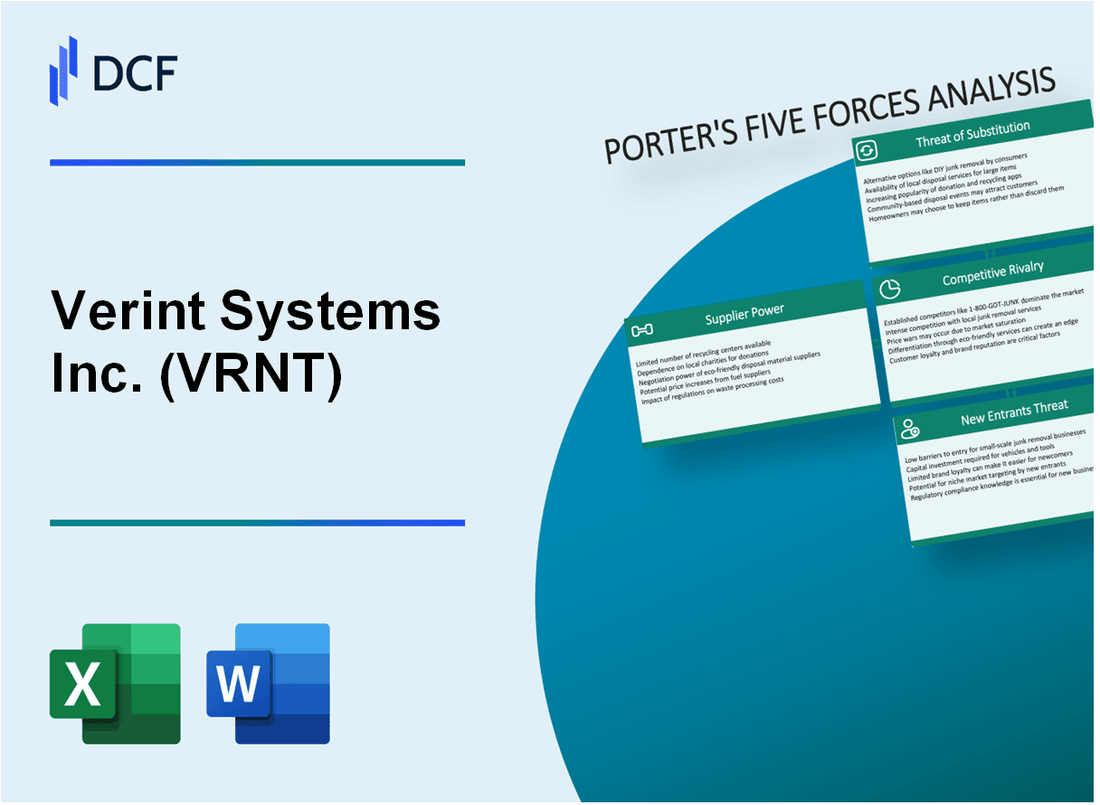
Verint Systems Inc. (VRNT): 5 Analyse des forces [Jan-2025 MISE À JOUR] |
Entièrement Modifiable: Adapté À Vos Besoins Dans Excel Ou Sheets
Conception Professionnelle: Modèles Fiables Et Conformes Aux Normes Du Secteur
Pré-Construits Pour Une Utilisation Rapide Et Efficace
Compatible MAC/PC, entièrement débloqué
Aucune Expertise N'Est Requise; Facile À Suivre
Verint Systems Inc. (VRNT) Bundle
Dans le paysage dynamique des logiciels d'entreprise et des analyses de sécurité, Verint Systems Inc. navigue dans un écosystème complexe de forces concurrentielles qui façonnent son positionnement stratégique. En disséquant le célèbre cadre de cinq forces de Michael Porter, nous dévoilons la dynamique complexe du pouvoir des fournisseurs, les négociations des clients, la rivalité du marché, les substituts potentiels et les obstacles à l'entrée qui définissent le terrain compétitif de Verrint en 2024. Cette analyse en profondeur révèle les défis et opportunités critiques Cela déterminera la capacité de l'entreprise à maintenir son avantage technologique et sa pertinence sur le marché dans une industrie de plus en plus sophistiquée et en évolution rapide.
Verint Systems Inc. (VRNT) - Five Forces de Porter: Poste de négociation des fournisseurs
Paysage des fournisseurs de technologies spécialisées
En 2024, Verint Systems Inc. fait face à un marché des fournisseurs concentrés avec des alternatives limitées:
| Catégorie des fournisseurs | Nombre de fournisseurs clés | Concentration du marché |
|---|---|---|
| Fabricants de semi-conducteurs | 4-5 fournisseurs mondiaux | 82% de part de marché |
| Fournisseurs de micropuces avancés | 3 fabricants principaux | 76% de contrôle du marché |
| Infrastructure de logiciels d'entreprise | 6-7 vendeurs spécialisés | Dominance du marché de 68% |
Dépendances de la chaîne d'approvisionnement
VerInt Systems montre une dépendance importante des fournisseurs:
- Imposition à 90% des fabricants de semi-conducteurs externes
- 85% des composants matériels critiques provenant de 3 fournisseurs principaux
- 72% des microprocesseurs avancés de fabricants mondiaux de haut niveau
Contraintes de chaîne d'approvisionnement
Impacts de pénurie mondiale de semi-conducteurs:
- 2024 Écart d'approvisionnement des micropuces: 15-20%
- Augmentation moyenne des prix des composants: 22-27%
- Délai pour les composants critiques: 28-36 semaines
Exigences d'investissement des fournisseurs
Coûts de développement des fournisseurs alternatifs:
| Catégorie d'investissement | Coût estimé | Chronologie de la mise en œuvre |
|---|---|---|
| Processus de qualification des fournisseurs | 1,2 à 1,5 million de dollars | 12-18 mois |
| Adaptation des infrastructures | 3,5 à 4,2 millions de dollars | 18-24 mois |
| Intégration technologique | 2,7 à 3,1 millions de dollars | 9-15 mois |
Verint Systems Inc. (VRNT) - Five Forces de Porter: Poste de négociation des clients
Effet de levier de négociation des clients d'entreprise
Verint Systems Inc. a généré 1,44 milliard de dollars de revenus pour l'exercice 2023. Les clients d'entreprise ayant des budgets informatiques annuels dépassant 50 millions de dollars ont un pouvoir de négociation important pour les solutions logicielles.
Analyse du marché des solutions d'engagement client
| Segment de marché | Taille du client | Pouvoir de négociation |
|---|---|---|
| Grandes entreprises | Plus de 500 employés | Haut |
| Intermédiaire | 100-499 employés | Moyen |
| Petites entreprises | 1-99 employés | Faible |
Capacités de comparaison des fournisseurs
Selon Gartner, 78% des clients d'entreprise comparent plusieurs fournisseurs avant de prendre une décision d'achat de logiciels.
Facteurs de sensibilité aux prix
- Valeur du contrat logiciel moyen de l'entreprise: 250 000 $
- Attribution annuelle du budget du logiciel: 3 à 5% du total des dépenses informatiques
- Plage de réduction de négociation typique: 15-25%
Considérations de la structure du contrat
La durée moyenne du contrat de Verrint est de 3 à 5 ans, avec des remises de renouvellement potentielles allant jusqu'à 10% pour les engagements à long terme.
Verint Systems Inc. (VRNT) - Five Forces de Porter: Rivalité compétitive
Paysage de concurrence du marché
Depuis 2024, Verint Systems Inc. fait face à une rivalité concurrentielle intense sur les marchés de l'engagement client et de la sécurité.
| Concurrent | Capitalisation boursière | Revenus annuels |
|---|---|---|
| Systèmes Cisco | 246,3 milliards de dollars | 56,6 milliards de dollars |
| Beaux systèmes | 11,2 milliards de dollars | 2,1 milliards de dollars |
| Ibm | 129,7 milliards de dollars | 61,9 milliards de dollars |
Dynamique compétitive
Le paysage concurrentiel de Verrint se caractérise par plusieurs facteurs clés:
- Investissement en R&D: Les concurrents allouent des ressources importantes à l'innovation technologique
- Consolidation du marché: Mergers et acquisitions en cours dans les secteurs de l'expérience client et de l'analyse de la sécurité
- Différenciation technologique: Pression continue pour développer des solutions logicielles uniques
Dépenses de recherche et développement
| Entreprise | Dépenses de R&D | R&D en% des revenus |
|---|---|---|
| Systèmes Verint | 137,4 millions de dollars | 14.2% |
| Beaux systèmes | 182,6 millions de dollars | 16.5% |
| Systèmes Cisco | 6,3 milliards de dollars | 13.7% |
Analyse des parts de marché
Positionnement concurrentiel sur le marché de l'analyse de l'engagement client:
- Systèmes Verint: 18,5% de part de marché
- Beaux systèmes: 22,3% de part de marché
- Cisco Systems: 15,7% de part de marché
Verint Systems Inc. (VRNT) - Five Forces de Porter: menace de substituts
Plateformes de fiançailles clients basées sur le cloud et axées sur l'IA
En 2024, le marché mondial des plateformes d'engagement client basé sur le cloud devrait atteindre 48,7 milliards de dollars, avec un TCAC de 19,3%. Des plateformes comme Salesforce Service Cloud, Zendesk et Microsoft Dynamics 365 sont des substituts directs contestant la position du marché de Verrint.
| Plate-forme | Part de marché 2024 | Revenus annuels |
|---|---|---|
| Salesforce Service Cloud | 23.5% | 8,2 milliards de dollars |
| Zendesk | 12.7% | 1,9 milliard de dollars |
| Microsoft Dynamics 365 | 16.4% | 5,6 milliards de dollars |
Solutions logicielles open-source et alternatives
Les alternatives open source obtiennent une traction du marché importante, avec 35% des entreprises qui envisagent de telles solutions en 2024.
- OpenSource CRM Plateformes capturant 8,2% du marché de l'engagement client
- Source open source de Sugarcrm: revenus annuels de 156 millions de dollars
- Freepbx: 22% de croissance du segment des télécommunications
Transformation numérique et technologies de communication unifiées
Les technologies de communication unifiées devraient atteindre une taille de marché de 96,5 milliards de dollars en 2024, présentant des menaces de substitution substantielles.
| Technologie | Pénétration du marché | Taux de croissance |
|---|---|---|
| Mou | Adoption de 41% des entreprises | 17.3% |
| Microsoft Teams | Adoption de 55% des entreprises | 22.6% |
| Zoom | 38% d'adoption d'entreprise | 15.9% |
Outils avancés d'apprentissage automatique et d'analyse prédictive
Les plateformes d'apprentissage automatique devraient atteindre 164,2 milliards de dollars d'ici 2024, avec un potentiel de substitution important.
- Datarobot: 430 millions de dollars de revenus annuels
- H2O.AI: 277 millions de dollars de revenus annuels
- Rapidmin: 185 millions de dollars d'évaluation du marché
Plates-formes intégrées avec plusieurs fonctionnalités
Les plateformes intégrées offrant des solutions complètes capturent 42% du marché de l'engagement client en 2024.
| Plate-forme | Couverture de fonctionnalité | Revenus annuels |
|---|---|---|
| Expérience client SAP | Couverture de la fonctionnalité de 89% | 4,7 milliards de dollars |
| Oracle CX | Couverture de la fonctionnalité de 85% | 3,9 milliards de dollars |
| Adobe Experience Cloud | Couverture des fonctionnalités de 92% | 5,2 milliards de dollars |
Verint Systems Inc. (VRNT) - Five Forces de Porter: menace de nouveaux entrants
Exigences de capital initial élevées pour le développement de logiciels d'entreprise
Verint Systems Inc. nécessite environ 50 à 75 millions de dollars d'investissement en capital initial pour le développement de logiciels d'entreprise. En 2023, les dépenses de R&D de la société se sont élevées à 199,7 millions de dollars, ce qui représente 17,9% des revenus totaux.
Barrières technologiques à l'entrée
Les obstacles technologiques comprennent des exigences de développement complexes:
- Les coûts de développement de logiciels d'entreprise varient de 500 000 $ à 5 millions de dollars
- Les plateformes d'analyse de l'engagement client nécessitent une expertise spécialisée
- L'infrastructure d'analyse de sécurité exige des capacités techniques importantes
| Catégorie d'investissement technologique | Plage de coûts estimés |
|---|---|
| Infrastructure de développement logiciel | 2,5 à 4,5 millions de dollars |
| Plateforme d'analyse de sécurité | 3 à 6 millions de dollars |
| Systèmes d'engagement client | 1,8 à 3,2 millions de dollars |
Protection de la propriété intellectuelle
VerInt Systems tient 87 brevets actifs En 2023, avec une valeur de portefeuille de brevet estimée de 45 à 60 millions de dollars.
Investissement de la recherche et du développement
Répartition annuelle de l'investissement en R&D de Verrint:
- Dépenses totales de R&D: 199,7 millions de dollars (2023)
- Pourcentage de revenus: 17,9%
- Personnel de développement de logiciels: environ 650-750 ingénieurs
Positionnement du marché et reconnaissance de la marque
| Métrique du marché | Valeur |
|---|---|
| Part de marché dans l'engagement client | 8.5% |
| Revenus annuels | 1,115 milliard de dollars (2023) |
| Clientèle mondiale | Plus de 10 000 clients d'entreprise |
Verint Systems Inc. (VRNT) - Porter's Five Forces: Competitive rivalry
You're looking at the competitive fray Verint Systems Inc. operates within, and honestly, it's a dogfight, especially now that AI is the main currency. The rivalry here isn't just about features; it's about who can deploy the smartest automation fastest. This intensity is clearly reflected when you stack Verint's financials against the broader market.
The market for customer engagement automation is defintely not consolidated; it's highly fragmented. Major rivals like Genesys, Five9, Qualtrics, and Medallia are all vying for the same large enterprise wallet share. This fragmentation means Verint Systems Inc. has to fight hard for every point of growth. To put this into perspective, Verint Systems Inc.'s reported revenue for its fiscal year ending January 31, 2025 (FY25) was US$909.2 million. That figure sits well below the $3.6 billion average revenue reported by its top 10 competitors in this space.
Competition is escalating, driven by a clear focus on AI innovation. Verint Systems Inc. is pushing its AI-powered bots, noting that more than 90 of the Fortune 500 are using them to automate workflows. Still, the pressure forces pricing adjustments. The company's reported net margin of 7.1% for FY25 suggests a competitive pricing environment where margins are under constant scrutiny.
The focus has shifted heavily toward Annual Recurring Revenue (ARR) growth as the key metric for valuation, even when top-line revenue gets bumpy. Verint Systems Inc. finished FY25 strong on this front, overachieving its Q4 FYE 2025 ARR guidance by $8 million. This focus on ratable revenue, which management believes is a better view of underlying trends, is a direct response to the competitive need to show consistent, predictable growth over one-time bookings.
Here's a quick look at how Verint Systems Inc.'s performance metrics stack up against the competitive narrative:
| Metric | Verint Systems Inc. (FY25) | Competitive Context |
|---|---|---|
| FY25 Total Revenue | US$909.2 million | Below the $3.6 billion average of top 10 rivals |
| Reported Net Margin (FY25) | 7.1% | Suggests pricing pressure in a competitive market |
| Q4 FY25 ARR Guidance Overachievement | $8 million | Indicates strong customer commitment to recurring AI solutions |
| SaaS ACV Bookings from New Deals Growth (Y-o-Y) | 30% | Reflects success in landing new AI-driven contracts |
| Reported Enterprise Value of Acquisition (Aug 2025) | $2 billion | Market validation despite intense rivalry |
The intensity of rivalry manifests in specific strategic moves and customer outcomes:
- Competition centers on speed of deployment for AI features.
- Rivals are battling over the hybrid cloud adoption model.
- Verint Systems Inc. reported record SaaS ACV bookings from new deals, up 30% year-over-year.
- AI adoption is translating into tangible customer ROI, like a healthcare insurer saving $70 million in agent capacity.
- The August 2025 agreement for Thoma Bravo to acquire the company for $2 billion shows external validation of its category leadership, even amid the rivalry.
If onboarding new AI features takes longer than expected, churn risk rises for Verint Systems Inc. Finance: draft the Q1 FY26 cash flow forecast by next Wednesday, focusing on the impact of the Thoma Bravo transition on operating expenses.
Verint Systems Inc. (VRNT) - Porter's Five Forces: Threat of substitutes
You're looking at the competitive landscape for Verint Systems Inc. (VRNT) and the substitutes for its Customer Experience (CX) automation suite are definitely getting smarter, faster, and cheaper. The threat here isn't just about a competitor; it's about customers solving their own problems or using entirely different technology stacks.
The most significant pressure comes from the rapid advancement of automated AI-powered virtual agents. This technology directly targets the core function of many contact center operations, aiming to replace human labor. Industry projections show this threat is materializing quickly; the global call center AI industry was valued at $1.95 billion in 2024 and is forecast to hit $2.41 billion in 2025, with a projected CAGR of 22.7% through 2032. To be fair, while Gartner projects that 10% of agent interactions will be fully automated by 2026 (up from 1.6% today), the immediate impact is cost displacement. Companies are seeing an average ROI of $3.50 for every $1 invested in AI customer service. Furthermore, 80% of customer service organizations are implementing generative AI by 2025, and Deloitte reports that about 25% of enterprises using generative AI will deploy voice AI agents in their call centers by the end of 2025.
The internal development of CX automation tools by large enterprise customers represents another substitution risk. If a Fortune 100 company decides to build its own proprietary solution, Verint Systems Inc. loses a potential contract or faces scope reduction. Still, the market shows that building in-house is a massive undertaking. A small in-house AI team might cost between $400,000 and $1 million+ annually in salaries and tools alone.
Also, the availability of lower-cost alternatives via open-source AI models and general-purpose cloud platforms provides a viable path for customers to substitute Verint Systems Inc.'s specialized offerings. This choice often boils down to a trade-off between upfront cost/control and ongoing maintenance/support complexity. Here's a quick look at the cost structures you're competing against:
| Solution Type | Upfront Cost Range | Ongoing Cost Structure | Key Advantage |
| Open-Source AI | $0 (for the model) | Internal specialized staff salaries ($400,000 to $1 million+ for a small team) | Flexibility and no licensing fees |
| Commercial Enterprise AI Platforms | Custom Quote/Pilot Fee | $1,000 to $100,000+ per month in subscriptions | Streamlined deployment and dedicated support |
| General-Purpose Cloud AI (e.g., GCP, Azure) | Low entry via Pay-As-You-Go | Usage-based (API calls, compute time) | Deep integration with existing cloud ecosystem |
Verint Systems Inc. counters this substitution threat by demonstrating superior, measurable outcomes, which shifts the focus from mere technology cost to total business value. The company's strategy emphasizes its AI-powered bots within a hybrid cloud model, allowing customers to adopt new AI features without a full platform migration. This strategy appears to be working, as evidenced by the financial results. New SaaS ACV bookings for new deals, excluding cloud conversions, increased a strong 37% year-over-year in Q3 FY25. Furthermore, the success of this hybrid approach is visible in the low migration rate: New SaaS ACV from conversion deals was minimal at $0.7 million in Q3. The momentum is also reflected in core subscription metrics, with Bundled SaaS Revenue accelerating to 19% year-over-year growth in Q3 FY25, and SaaS ARR showing 11% year-over-year growth.
The adoption of Verint Systems Inc.'s AI capabilities is significant among top-tier clients, which acts as a moat against general-purpose substitutes. As of the latest reports, more than 90 of the Fortune 500 are using Verint's AI-powered bots to automate workflows. This high-level adoption suggests that for the largest enterprises, the perceived risk and complexity of building or integrating a general-purpose cloud solution outweigh the benefits of Verint Systems Inc.'s specialized, proven CX outcomes.
- AI-powered bots are being deployed by over 90 Fortune 500 companies.
- Bundled SaaS Revenue growth hit 19% year-over-year in Q3 FY25.
- New deal SaaS ACV bookings grew 37% year-over-year in Q3 FY25.
- FYE25 revenue guidance remains at $933 million, plus or minus 2%.
Finance: draft 13-week cash view by Friday.
Verint Systems Inc. (VRNT) - Porter's Five Forces: Threat of new entrants
You're assessing the competitive landscape for Verint Systems Inc. as new, nimble players emerge, powered by the latest generative AI capabilities. The threat of new entrants here is definitely moderate, but it's accelerating quickly because of AI-first startups like Capacity and Level AI, which can potentially move faster on core technology features.
Still, building a platform that can handle the scale and complexity Verint Systems Inc. manages requires serious backing. A new entrant would need significant capital investment to match Verint Systems Inc.'s global scale and the comprehensive compliance offerings that are non-negotiable for large enterprises. For instance, Verint Systems Inc.'s total assets for Fiscal Year 2025 were reported around $2.29 billion.
The established customer base acts as a powerful moat. Verint Systems Inc. reports that more than 80% of the Fortune 100 relies on their platform, creating major switching costs and relationship barriers for any new player trying to break in. Furthermore, Verint Systems Inc. serves approximately 10,000 clients across more than 175 countries.
New entrants also struggle to replicate the deep, industry-specific expertise Verint Systems Inc. has built, especially in highly regulated areas like financial compliance. This specialized knowledge is embedded in the platform and its service delivery, which takes years to accumulate and validate.
Financially, Verint Systems Inc.'s balance sheet offers a deterrent. The company maintains a low-leverage position, which suggests stability against economic shocks that might sink a less capitalized startup. As of July 2025, Verint Systems Inc.'s total debt was reported at $0.44 Billion USD.
Here's a quick look at the financial scale that new entrants must overcome:
| Metric | Value (As of Late 2025/Early 2026 Data) |
| Total Assets (FY 2025) | Approximately $2.29 billion (or $2,290,049 thousand USD) |
| Total Debt (July 2025) | $0.44 Billion USD |
| Cash & Equivalents (FY 2025) | $215.71 million |
| Fortune 100 Customer Penetration | More than 80% |
The sheer velocity of AI innovation means that while capital barriers are high, the technology gap can close faster than in previous tech cycles. We see this reflected in the broader AI market, which was projected to reach an estimated $244.22 billion by the end of 2025. Even smaller, focused AI startups are attracting significant capital, such as Sierra, which secured $175 million in funding in October 2024.
The primary risks for Verint Systems Inc. from new entrants center on agility and feature velocity, not necessarily immediate scale. You should watch for startups that focus on a single, high-value AI function that can be bolted onto existing enterprise systems, rather than trying to replace the entire platform at once. Key areas of focus for potential disruption include:
- AI-driven agent assist features.
- Automated compliance monitoring modules.
- Generative AI for knowledge base creation.
- Low-cost, cloud-native deployment models.
If onboarding for a new, specialized AI tool takes less than 14 days, churn risk rises for adjacent Verint Systems Inc. features.
Finance: draft 13-week cash view by Friday.
Disclaimer
All information, articles, and product details provided on this website are for general informational and educational purposes only. We do not claim any ownership over, nor do we intend to infringe upon, any trademarks, copyrights, logos, brand names, or other intellectual property mentioned or depicted on this site. Such intellectual property remains the property of its respective owners, and any references here are made solely for identification or informational purposes, without implying any affiliation, endorsement, or partnership.
We make no representations or warranties, express or implied, regarding the accuracy, completeness, or suitability of any content or products presented. Nothing on this website should be construed as legal, tax, investment, financial, medical, or other professional advice. In addition, no part of this site—including articles or product references—constitutes a solicitation, recommendation, endorsement, advertisement, or offer to buy or sell any securities, franchises, or other financial instruments, particularly in jurisdictions where such activity would be unlawful.
All content is of a general nature and may not address the specific circumstances of any individual or entity. It is not a substitute for professional advice or services. Any actions you take based on the information provided here are strictly at your own risk. You accept full responsibility for any decisions or outcomes arising from your use of this website and agree to release us from any liability in connection with your use of, or reliance upon, the content or products found herein.