

|
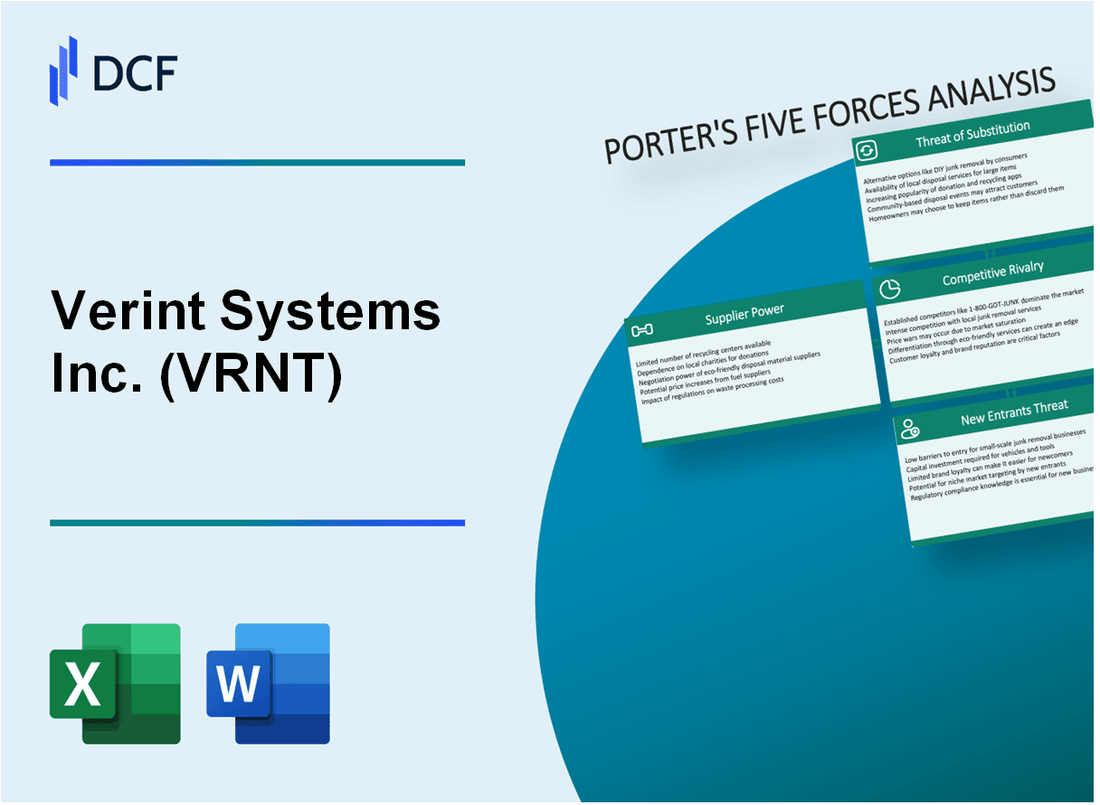
Análisis de 5 Fuerzas de Verint Systems Inc. (VRNT) [Actualizado en Ene-2025] |
Completamente Editable: Adáptelo A Sus Necesidades En Excel O Sheets
Diseño Profesional: Plantillas Confiables Y Estándares De La Industria
Predeterminadas Para Un Uso Rápido Y Eficiente
Compatible con MAC / PC, completamente desbloqueado
No Se Necesita Experiencia; Fáciles De Seguir
Verint Systems Inc. (VRNT) Bundle
En el panorama dinámico del software empresarial y el análisis de seguridad, Verint Systems Inc. navega por un complejo ecosistema de fuerzas competitivas que dan forma a su posicionamiento estratégico. Al diseccionar el famoso marco de cinco fuerzas de Michael Porter, revelamos la intrincada dinámica del poder de los proveedores, las negociaciones de los clientes, la rivalidad del mercado, los posibles sustitutos y las barreras de entrada que definen el terreno competitivo de Verint en 2024. Este análisis de inmersión profunda revela los desafíos críticos y las oportunidades. Eso determinará la capacidad de la compañía para mantener su ventaja tecnológica y relevancia del mercado en una industria cada vez más sofisticada y en rápida evolución.
Verint Systems Inc. (VRNT) - Las cinco fuerzas de Porter: poder de negociación de los proveedores
Paisaje de proveedores de tecnología especializada
A partir de 2024, Verint Systems Inc. enfrenta un mercado de proveedores concentrados con alternativas limitadas:
| Categoría de proveedor | Número de proveedores clave | Concentración de mercado |
|---|---|---|
| Fabricantes de semiconductores | 4-5 proveedores globales | 82% de participación de mercado |
| Proveedores avanzados de microchip | 3 fabricantes principales | 76% de control del mercado |
| Infraestructura de software empresarial | 6-7 vendedores especializados | 68% de dominio del mercado |
Dependencias de la cadena de suministro
Verint Systems demuestra una dependencia significativa de los proveedores:
- El 90% de la dependencia de los fabricantes de semiconductores externos
- El 85% de los componentes críticos de hardware obtenidos de 3 proveedores principales
- 72% de los microprocesadores avanzados de fabricantes globales de primer nivel
Restricciones de la cadena de suministro
Impactos de escasez de semiconductores globales:
- 2024 GABE DE SUMINISTRO DE MICROCHIP: 15-20%
- Aumento promedio del precio del componente: 22-27%
- Tiempo de entrega de componentes críticos: 28-36 semanas
Requisitos de inversión de proveedores
Costos alternativos de desarrollo de proveedores:
| Categoría de inversión | Costo estimado | Línea de tiempo de implementación |
|---|---|---|
| Proceso de calificación del proveedor | $ 1.2-1.5 millones | 12-18 meses |
| Adaptación de infraestructura | $ 3.5-4.2 millones | 18-24 meses |
| Integración tecnológica | $ 2.7-3.1 millones | 9-15 meses |
Verint Systems Inc. (VRNT) - Las cinco fuerzas de Porter: poder de negociación de los clientes
Palancamiento de la negociación del cliente empresarial
Verint Systems Inc. generó $ 1.44 mil millones en ingresos para el año fiscal 2023. Los clientes empresariales con presupuestos de TI anuales superiores a $ 50 millones tienen un poder de negociación significativo para soluciones de software.
Análisis de mercado de la solución de compromiso del cliente
| Segmento de mercado | Tamaño del cliente | Poder de negociación |
|---|---|---|
| Grandes empresas | 500+ empleados | Alto |
| Mercado medio | 100-499 empleados | Medio |
| Pequeñas empresas | 1-99 empleados | Bajo |
Capacidades de comparación de proveedores
Según Gartner, el 78% de los clientes empresariales comparan múltiples proveedores antes de tomar una decisión de compra de software.
Factores de sensibilidad a los precios
- Valor promedio de contrato de software empresarial: $ 250,000
- Asignación anual de presupuesto de software: 3-5% del gasto total de TI
- Rango de descuento de negociación típico: 15-25%
Consideraciones de la estructura del contrato
La duración promedio del contrato de Verint es de 3 a 5 años, con posibles descuentos de renovación de hasta el 10% para compromisos a largo plazo.
Verint Systems Inc. (VRNT) - Las cinco fuerzas de Porter: rivalidad competitiva
Panorama de la competencia del mercado
A partir de 2024, Verint Systems Inc. enfrenta una intensa rivalidad competitiva en los mercados de compromiso y inteligencia de seguridad del cliente.
| Competidor | Capitalización de mercado | Ingresos anuales |
|---|---|---|
| Sistemas de Cisco | $ 246.3 mil millones | $ 56.6 mil millones |
| Bonitos sistemas | $ 11.2 mil millones | $ 2.1 mil millones |
| IBM | $ 129.7 mil millones | $ 61.9 mil millones |
Dinámica competitiva
El panorama competitivo de Verint se caracteriza por varios factores clave:
- Inversión de I + D: Los competidores asignan recursos significativos a la innovación tecnológica
- Consolidación del mercado: Fusiones y adquisiciones en curso en Sectores de Análisis de Seguridad y Experiencia y Seguridad del Cliente
- Diferenciación tecnológica: Presión continua para desarrollar soluciones de software únicas
Gastos de investigación y desarrollo
| Compañía | Gastos de I + D | I + D como % de ingresos |
|---|---|---|
| Sistemas verint | $ 137.4 millones | 14.2% |
| Bonitos sistemas | $ 182.6 millones | 16.5% |
| Sistemas de Cisco | $ 6.3 mil millones | 13.7% |
Análisis de participación de mercado
Posicionamiento competitivo en el mercado de análisis de participación del cliente:
- Sistemas Verint: participación de mercado del 18.5%
- Sistemas buenos: cuota de mercado del 22.3%
- Cisco Systems: 15.7% de participación de mercado
Verint Systems Inc. (VRNT) - Las cinco fuerzas de Porter: amenaza de sustitutos
Plataformas emergentes basadas en la nube y impulsadas por la IA
A partir de 2024, se proyecta que el mercado global de la plataforma de participación del cliente basada en la nube alcance los $ 48.7 mil millones, con una tasa compuesta anual del 19.3%. Plataformas como Salesforce Service Cloud, Zendesk y Microsoft Dynamics 365 son sustitutos directos que desafían la posición de mercado de Verint.
| Plataforma | Cuota de mercado 2024 | Ingresos anuales |
|---|---|---|
| Salesforce Service Cloud | 23.5% | $ 8.2 mil millones |
| Zendesk | 12.7% | $ 1.9 mil millones |
| Microsoft Dynamics 365 | 16.4% | $ 5.6 mil millones |
Soluciones de software de código abierto y alternativa
Las alternativas de código abierto están ganando una tracción de mercado significativa, con el 35% de las empresas considerando tales soluciones en 2024.
- Plataformas CRM de OpenSource que capturan el 8.2% del mercado de participación del cliente
- SugarCrm Open Force: $ 156 millones ingresos anuales
- Freepbx: 22% de crecimiento en el segmento de telecomunicaciones
Transformación digital y tecnologías de comunicación unificada
Se proyecta que las tecnologías de comunicación unificadas alcanzarán el tamaño del mercado de $ 96.5 mil millones en 2024, presentando amenazas sustanciales de sustitución.
| Tecnología | Penetración del mercado | Índice de crecimiento |
|---|---|---|
| Flojo | 41% de adopción empresarial | 17.3% |
| Equipos de Microsoft | 55% de adopción empresarial | 22.6% |
| Zoom | 38% de adopción empresarial | 15.9% |
Herramientas avanzadas de aprendizaje automático y análisis predictivo
Se proyecta que las plataformas de aprendizaje automático alcanzarán los $ 164.2 mil millones para 2024, con un potencial de sustitución significativo.
- Datarobot: ingresos anuales de $ 430 millones
- H2O.AI: ingresos anuales de $ 277 millones
- RapidMiner: valoración del mercado de $ 185 millones
Plataformas integradas con múltiples funcionalidades
Las plataformas integradas que ofrecen soluciones integrales capturan el 42% del mercado de participación del cliente en 2024.
| Plataforma | Cobertura de funcionalidad | Ingresos anuales |
|---|---|---|
| Experiencia del cliente de SAP | 89% de cobertura de funcionalidad | $ 4.7 mil millones |
| Oracle CX | 85% de cobertura de funcionalidad | $ 3.9 mil millones |
| Cloud de Adobe Experience Cloud | Cobertura de funcionalidad del 92% | $ 5.2 mil millones |
Verint Systems Inc. (VRNT) - Las cinco fuerzas de Porter: amenaza de nuevos participantes
Altos requisitos de capital inicial para el desarrollo de software empresarial
Verint Systems Inc. requiere aproximadamente $ 50-75 millones en inversión de capital inicial para el desarrollo de software empresarial. A partir de 2023, los gastos de I + D de la compañía fueron de $ 199.7 millones, lo que representa el 17.9% de los ingresos totales.
Barreras tecnológicas de entrada
Las barreras tecnológicas incluyen requisitos de desarrollo complejos:
- Los costos de desarrollo de software empresarial varían de $ 500,000 a $ 5 millones
- Las plataformas de análisis de participación del cliente requieren experiencia especializada
- La infraestructura de análisis de seguridad exige capacidades técnicas significativas
| Categoría de inversión tecnológica | Rango de costos estimado |
|---|---|
| Infraestructura de desarrollo de software | $ 2.5-4.5 millones |
| Plataforma de análisis de seguridad | $ 3-6 millones |
| Sistemas de participación del cliente | $ 1.8-3.2 millones |
Protección de propiedad intelectual
Verint Systems se mantiene 87 patentes activas A partir de 2023, con un valor estimado de cartera de patentes de $ 45-60 millones.
Investigación de investigación y desarrollo
Desglose anual de inversión de I + D de Verint:
- Gastos totales de I + D: $ 199.7 millones (2023)
- Porcentaje de ingresos: 17.9%
- Personal de desarrollo de software: aproximadamente 650-750 ingenieros
Posicionamiento del mercado y reconocimiento de marca
| Métrico de mercado | Valor |
|---|---|
| Cuota de mercado en la participación del cliente | 8.5% |
| Ingresos anuales | $ 1.115 mil millones (2023) |
| Base de clientes globales | Más de 10,000 clientes empresariales |
Verint Systems Inc. (VRNT) - Porter's Five Forces: Competitive rivalry
You're looking at the competitive fray Verint Systems Inc. operates within, and honestly, it's a dogfight, especially now that AI is the main currency. The rivalry here isn't just about features; it's about who can deploy the smartest automation fastest. This intensity is clearly reflected when you stack Verint's financials against the broader market.
The market for customer engagement automation is defintely not consolidated; it's highly fragmented. Major rivals like Genesys, Five9, Qualtrics, and Medallia are all vying for the same large enterprise wallet share. This fragmentation means Verint Systems Inc. has to fight hard for every point of growth. To put this into perspective, Verint Systems Inc.'s reported revenue for its fiscal year ending January 31, 2025 (FY25) was US$909.2 million. That figure sits well below the $3.6 billion average revenue reported by its top 10 competitors in this space.
Competition is escalating, driven by a clear focus on AI innovation. Verint Systems Inc. is pushing its AI-powered bots, noting that more than 90 of the Fortune 500 are using them to automate workflows. Still, the pressure forces pricing adjustments. The company's reported net margin of 7.1% for FY25 suggests a competitive pricing environment where margins are under constant scrutiny.
The focus has shifted heavily toward Annual Recurring Revenue (ARR) growth as the key metric for valuation, even when top-line revenue gets bumpy. Verint Systems Inc. finished FY25 strong on this front, overachieving its Q4 FYE 2025 ARR guidance by $8 million. This focus on ratable revenue, which management believes is a better view of underlying trends, is a direct response to the competitive need to show consistent, predictable growth over one-time bookings.
Here's a quick look at how Verint Systems Inc.'s performance metrics stack up against the competitive narrative:
| Metric | Verint Systems Inc. (FY25) | Competitive Context |
|---|---|---|
| FY25 Total Revenue | US$909.2 million | Below the $3.6 billion average of top 10 rivals |
| Reported Net Margin (FY25) | 7.1% | Suggests pricing pressure in a competitive market |
| Q4 FY25 ARR Guidance Overachievement | $8 million | Indicates strong customer commitment to recurring AI solutions |
| SaaS ACV Bookings from New Deals Growth (Y-o-Y) | 30% | Reflects success in landing new AI-driven contracts |
| Reported Enterprise Value of Acquisition (Aug 2025) | $2 billion | Market validation despite intense rivalry |
The intensity of rivalry manifests in specific strategic moves and customer outcomes:
- Competition centers on speed of deployment for AI features.
- Rivals are battling over the hybrid cloud adoption model.
- Verint Systems Inc. reported record SaaS ACV bookings from new deals, up 30% year-over-year.
- AI adoption is translating into tangible customer ROI, like a healthcare insurer saving $70 million in agent capacity.
- The August 2025 agreement for Thoma Bravo to acquire the company for $2 billion shows external validation of its category leadership, even amid the rivalry.
If onboarding new AI features takes longer than expected, churn risk rises for Verint Systems Inc. Finance: draft the Q1 FY26 cash flow forecast by next Wednesday, focusing on the impact of the Thoma Bravo transition on operating expenses.
Verint Systems Inc. (VRNT) - Porter's Five Forces: Threat of substitutes
You're looking at the competitive landscape for Verint Systems Inc. (VRNT) and the substitutes for its Customer Experience (CX) automation suite are definitely getting smarter, faster, and cheaper. The threat here isn't just about a competitor; it's about customers solving their own problems or using entirely different technology stacks.
The most significant pressure comes from the rapid advancement of automated AI-powered virtual agents. This technology directly targets the core function of many contact center operations, aiming to replace human labor. Industry projections show this threat is materializing quickly; the global call center AI industry was valued at $1.95 billion in 2024 and is forecast to hit $2.41 billion in 2025, with a projected CAGR of 22.7% through 2032. To be fair, while Gartner projects that 10% of agent interactions will be fully automated by 2026 (up from 1.6% today), the immediate impact is cost displacement. Companies are seeing an average ROI of $3.50 for every $1 invested in AI customer service. Furthermore, 80% of customer service organizations are implementing generative AI by 2025, and Deloitte reports that about 25% of enterprises using generative AI will deploy voice AI agents in their call centers by the end of 2025.
The internal development of CX automation tools by large enterprise customers represents another substitution risk. If a Fortune 100 company decides to build its own proprietary solution, Verint Systems Inc. loses a potential contract or faces scope reduction. Still, the market shows that building in-house is a massive undertaking. A small in-house AI team might cost between $400,000 and $1 million+ annually in salaries and tools alone.
Also, the availability of lower-cost alternatives via open-source AI models and general-purpose cloud platforms provides a viable path for customers to substitute Verint Systems Inc.'s specialized offerings. This choice often boils down to a trade-off between upfront cost/control and ongoing maintenance/support complexity. Here's a quick look at the cost structures you're competing against:
| Solution Type | Upfront Cost Range | Ongoing Cost Structure | Key Advantage |
| Open-Source AI | $0 (for the model) | Internal specialized staff salaries ($400,000 to $1 million+ for a small team) | Flexibility and no licensing fees |
| Commercial Enterprise AI Platforms | Custom Quote/Pilot Fee | $1,000 to $100,000+ per month in subscriptions | Streamlined deployment and dedicated support |
| General-Purpose Cloud AI (e.g., GCP, Azure) | Low entry via Pay-As-You-Go | Usage-based (API calls, compute time) | Deep integration with existing cloud ecosystem |
Verint Systems Inc. counters this substitution threat by demonstrating superior, measurable outcomes, which shifts the focus from mere technology cost to total business value. The company's strategy emphasizes its AI-powered bots within a hybrid cloud model, allowing customers to adopt new AI features without a full platform migration. This strategy appears to be working, as evidenced by the financial results. New SaaS ACV bookings for new deals, excluding cloud conversions, increased a strong 37% year-over-year in Q3 FY25. Furthermore, the success of this hybrid approach is visible in the low migration rate: New SaaS ACV from conversion deals was minimal at $0.7 million in Q3. The momentum is also reflected in core subscription metrics, with Bundled SaaS Revenue accelerating to 19% year-over-year growth in Q3 FY25, and SaaS ARR showing 11% year-over-year growth.
The adoption of Verint Systems Inc.'s AI capabilities is significant among top-tier clients, which acts as a moat against general-purpose substitutes. As of the latest reports, more than 90 of the Fortune 500 are using Verint's AI-powered bots to automate workflows. This high-level adoption suggests that for the largest enterprises, the perceived risk and complexity of building or integrating a general-purpose cloud solution outweigh the benefits of Verint Systems Inc.'s specialized, proven CX outcomes.
- AI-powered bots are being deployed by over 90 Fortune 500 companies.
- Bundled SaaS Revenue growth hit 19% year-over-year in Q3 FY25.
- New deal SaaS ACV bookings grew 37% year-over-year in Q3 FY25.
- FYE25 revenue guidance remains at $933 million, plus or minus 2%.
Finance: draft 13-week cash view by Friday.
Verint Systems Inc. (VRNT) - Porter's Five Forces: Threat of new entrants
You're assessing the competitive landscape for Verint Systems Inc. as new, nimble players emerge, powered by the latest generative AI capabilities. The threat of new entrants here is definitely moderate, but it's accelerating quickly because of AI-first startups like Capacity and Level AI, which can potentially move faster on core technology features.
Still, building a platform that can handle the scale and complexity Verint Systems Inc. manages requires serious backing. A new entrant would need significant capital investment to match Verint Systems Inc.'s global scale and the comprehensive compliance offerings that are non-negotiable for large enterprises. For instance, Verint Systems Inc.'s total assets for Fiscal Year 2025 were reported around $2.29 billion.
The established customer base acts as a powerful moat. Verint Systems Inc. reports that more than 80% of the Fortune 100 relies on their platform, creating major switching costs and relationship barriers for any new player trying to break in. Furthermore, Verint Systems Inc. serves approximately 10,000 clients across more than 175 countries.
New entrants also struggle to replicate the deep, industry-specific expertise Verint Systems Inc. has built, especially in highly regulated areas like financial compliance. This specialized knowledge is embedded in the platform and its service delivery, which takes years to accumulate and validate.
Financially, Verint Systems Inc.'s balance sheet offers a deterrent. The company maintains a low-leverage position, which suggests stability against economic shocks that might sink a less capitalized startup. As of July 2025, Verint Systems Inc.'s total debt was reported at $0.44 Billion USD.
Here's a quick look at the financial scale that new entrants must overcome:
| Metric | Value (As of Late 2025/Early 2026 Data) |
| Total Assets (FY 2025) | Approximately $2.29 billion (or $2,290,049 thousand USD) |
| Total Debt (July 2025) | $0.44 Billion USD |
| Cash & Equivalents (FY 2025) | $215.71 million |
| Fortune 100 Customer Penetration | More than 80% |
The sheer velocity of AI innovation means that while capital barriers are high, the technology gap can close faster than in previous tech cycles. We see this reflected in the broader AI market, which was projected to reach an estimated $244.22 billion by the end of 2025. Even smaller, focused AI startups are attracting significant capital, such as Sierra, which secured $175 million in funding in October 2024.
The primary risks for Verint Systems Inc. from new entrants center on agility and feature velocity, not necessarily immediate scale. You should watch for startups that focus on a single, high-value AI function that can be bolted onto existing enterprise systems, rather than trying to replace the entire platform at once. Key areas of focus for potential disruption include:
- AI-driven agent assist features.
- Automated compliance monitoring modules.
- Generative AI for knowledge base creation.
- Low-cost, cloud-native deployment models.
If onboarding for a new, specialized AI tool takes less than 14 days, churn risk rises for adjacent Verint Systems Inc. features.
Finance: draft 13-week cash view by Friday.
Disclaimer
All information, articles, and product details provided on this website are for general informational and educational purposes only. We do not claim any ownership over, nor do we intend to infringe upon, any trademarks, copyrights, logos, brand names, or other intellectual property mentioned or depicted on this site. Such intellectual property remains the property of its respective owners, and any references here are made solely for identification or informational purposes, without implying any affiliation, endorsement, or partnership.
We make no representations or warranties, express or implied, regarding the accuracy, completeness, or suitability of any content or products presented. Nothing on this website should be construed as legal, tax, investment, financial, medical, or other professional advice. In addition, no part of this site—including articles or product references—constitutes a solicitation, recommendation, endorsement, advertisement, or offer to buy or sell any securities, franchises, or other financial instruments, particularly in jurisdictions where such activity would be unlawful.
All content is of a general nature and may not address the specific circumstances of any individual or entity. It is not a substitute for professional advice or services. Any actions you take based on the information provided here are strictly at your own risk. You accept full responsibility for any decisions or outcomes arising from your use of this website and agree to release us from any liability in connection with your use of, or reliance upon, the content or products found herein.