
|
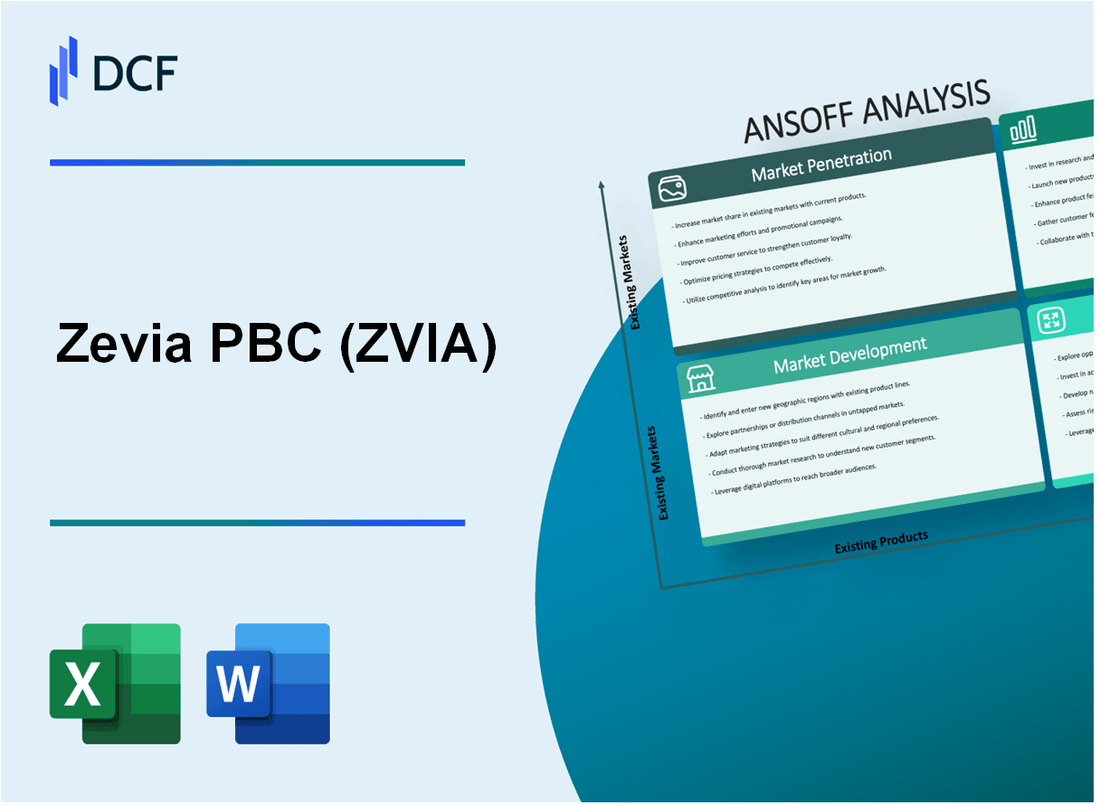
Zevia PBC (ZVIA): ANSOFF MATRIX [Dec-2025 Updated] |
Fully Editable: Tailor To Your Needs In Excel Or Sheets
Professional Design: Trusted, Industry-Standard Templates
Investor-Approved Valuation Models
MAC/PC Compatible, Fully Unlocked
No Expertise Is Needed; Easy To Follow
Zevia PBC (ZVIA) Bundle
Look, you're trying to map out a clear path for this zero-sugar beverage maker's sustainable growth, and honestly, the Ansoff Matrix lays out four distinct, actionable lanes for maximizing returns and market presence. We're not talking vague ideas here; we're looking at concrete targets like securing 20% more US shelf space by Q4 2025, pushing into the European Union via e-commerce, developing a 64-ounce family format, and even earmarking $5 million for a new sweetener R&D project. If you want to see the precise near-term actions-from deep market penetration to that aggressive diversification into snack foods-you need to check out the full breakdown below.
Zevia PBC (ZVIA) - Ansoff Matrix: Market Penetration
Market Penetration focuses on increasing sales of existing products within existing markets, primarily the US beverage sector. This strategy relies heavily on maximizing distribution points, increasing consumer trial, and driving purchase frequency through marketing and promotional levers.
The goal to secure 20% more shelf space in existing US grocery accounts by Q4 2025 is a direct measure of this strategy's success in the core channel. While the exact current shelf space percentage isn't public, the overall retail footprint shows expansion, moving from 31 thousand retail stores in 2021 to 37 thousand in 2024, and further to over 39 thousand retail locations across the U.S. and Canada as of August 2025.
Driving trial through promotional activity remains a key lever, though it has a dual impact. Increased promotional activity at retailers contributed to the 15.6% year-over-year decrease in net sales in Q3 2024 compared to Q3 2023. More recently, in Q2 2025, volume growth of 14.3% was partially offset by increased promotional activity at retailers. This shows the trade-off: promotions drive volume/trial but pressure net sales realization.
Regarding driving trial by sampling Zevia Energy and Zevia Mixers, the strategy has faced product line adjustments. Zevia PBC discontinued its Mixers and Kidz product lines to optimize earnings, which was a factor weighing on the full-year 2025 net sales guidance. This discontinuation directly impacts the ability to execute sampling for those specific SKUs.
Expansion of distribution depth within current channels is evident through specific retailer wins. The expansion at Walmart saw doors grow from approximately 800 to over 4,300 stores by the end of 2024. Furthermore, expanded distribution at Walmart and one customer in the drug channel were largely responsible for the 12.6% volume improvement in Q3 2025, and contributed to the 14.3% volume growth in Q2 2025. The drug channel specifically contributed to this growth.
The digital ad campaign component is supported by the investment in Selling and Marketing expenses, which are critical for converting competitor brand users. The company plans to reinvest cost savings into growth initiatives, including marketing spend.
Here's a quick look at the recent marketing investment relative to sales performance:
| Metric | Q3 2024 | Q3 2025 |
| Net Sales (Millions USD) | $36.4 million | $40.8 million |
| Selling & Marketing Expenses (Millions USD) | $12.0 million | $12.7 million |
| Selling & Marketing as % of Net Sales | 33.0% | 31.0% |
| Marketing Expense Component (Millions USD) | $3.5 million | $4.9 million |
The full year 2024 Selling and marketing expenses totaled $57.1 million, representing 36.8% of the $155.0 million in full-year net sales. The Q4 2024 viral holiday campaign generated 292 million impressions, validating the brand voice and supporting the planned increased marketing investment for 2025.
The overall market penetration efforts are aimed at achieving the full-year 2025 net sales guidance range of $158 million to $163 million.
Zevia PBC (ZVIA) - Ansoff Matrix: Market Development
You're looking at how Zevia PBC expands its existing product line into new geographic areas or new customer segments with its current offerings. This is about taking the zero-sugar, clean-label beverages you know and pushing them into new territories or channels, which requires capital and execution.
Financially, Zevia PBC posted net sales of $40.8 million for the third quarter ended September 30, 2025, marking a 12.3% year-over-year revenue growth. The year-to-date net sales through Q3 2025 reached $123.4 million. The company raised its full-year 2025 net sales guidance to a range of $162 million to $164 million. The adjusted EBITDA loss for Q3 2025 was $1.7 million, with the full-year guidance improving to an expected loss between $5.0 million and $5.5 million.
Enter the European Union market, focusing first on Germany and the UK, via e-commerce.
Specific revenue or investment figures related to the European Union market entry via e-commerce for the 2025 fiscal period are not publicly detailed in the latest reports. The company's current distribution footprint as of the end of 2024 covered more than 37,000 retail locations across the U.S. and Canada through various channels.
Target the Food Service channel by securing a national contract with a fast-casual chain.
While the strategy involves targeting the Food Service channel, concrete 2025 financial contributions or the specific details of any secured national fast-casual contract are not itemized in the reported quarterly results. The Q3 2025 volume growth of 12.6% was largely attributed to expanded distribution in the Club channel and at Walmart.
Establish a dedicated sales team to penetrate the US university and corporate campus vending sector.
Penetration into the US university and corporate campus vending sector through a dedicated sales team is a strategic action point. The company's Q1 2025 net sales of $38.0 million saw selling expenses at 24.1% of net sales, which was a decrease from 31.8% in Q1 2024, reflecting cost-saving measures that could free up resources for new team establishment.
Expand existing Canadian distribution to achieve 15% market share growth in major cities.
Expansion in Canada is an active area of development, with management noting successful distribution expansion there. As of the Q3 2025 earnings call, the company achieved 'just over 400 stores in total' in Canada. This compares to the overall U.S. and Canada distribution base of over 37,000 retail locations at the end of 2024.
| Metric | US/Canada Total Retail Locations (End of 2024) | Canada Store Count (Q3 2025 Update) | Q3 2025 Net Sales |
| Amount | 37,000+ | 400+ | $40.8 million |
Pilot a direct-to-consumer subscription model to reach underserved rural US markets.
The execution of a direct-to-consumer subscription pilot to reach rural markets is a strategic lever for market development. The company's marketing expenses in Q3 2025 were $4.9 million, or 12.1% of net sales, an increase from $3.5 million in Q3 2024, indicating investment in reaching consumers directly, which would include DTC efforts.
The company's overall strategy relies on building distribution, as evidenced by the 12.6% volume increase in Q3 2025.
- Brand consideration and purchase intent showed double-digit gains based on proprietary survey data.
- Household penetration in the overall category is at 20%, versus Zevia PBC's 5%.
- Selling and marketing expenses for Q3 2025 totaled $12.7 million.
- The company has $26.0 million in cash and cash equivalents as of September 30, 2025.
Zevia PBC (ZVIA) - Ansoff Matrix: Product Development
You're looking at how Zevia PBC is pushing new offerings to grow its market share, which is the core of the Product Development quadrant in the Ansoff Matrix. The company's strategy in 2025 clearly centered on flavor innovation to drive consumer engagement and velocity.
Zevia PBC executed on its product innovation pipeline, delivering record-setting new product launches through the third quarter of 2025. Specifically, the company noted the success of Strawberry Lemon Burst, the Amazon-exclusive Peaches & Cream offering, and a new fruity variety pack at Walmart. These launches helped drive Q3 2025 net sales up 12.3% year-over-year to $40.8 million. This success led Zevia PBC to raise its full-year 2025 net sales guidance to a range of $162 million to $164 million.
While the specific launch of a Zevia Hydration line wasn't detailed in the Q3 2025 reports, the focus on flavor trends shows a commitment to expanding beyond core soda. The company's emphasis on innovation is designed to drive consumer excitement and rotation, similar to the concept of launching limited-edition seasonal flavors. The success of the new SKUs is helping to drive velocity in key channels, which is critical for securing and expanding shelf space.
Regarding format expansion, Zevia PBC is focused on distribution depth and breadth. For instance, the company achieved distribution in just over 400 stores in total in Canada, indicating a push for broader accessibility, which often includes format optimization. The company's packaging refresh, a significant product-related investment, is scheduled for a rolling rollout across the rest of the portfolio in early 2026, with some impact already felt in 2025 results.
The financial impact of product and packaging changes is measurable. The third quarter of 2025 gross profit margin was 45.6%, a reduction of 3.5 percentage points year-over-year, primarily due to higher inventory losses associated with the packaging refresh and tariffs. The forecast for the fourth quarter of 2025 specifically includes a $500 thousand charge within cost of goods sold related to this package redesign. This cost is a real-life proxy for the investment required in product evolution, even if a specific R&D dollar amount for a proprietary sweetener blend wasn't disclosed.
The investment in product quality and presentation is a key driver of the company's strategic direction. Here's a quick look at how product-related metrics stacked up through Q3 2025:
| Metric | Q3 2025 Value | Comparison/Context |
| Net Sales (Q3 2025) | $40.8 million | Up 12.3% year-over-year |
| Gross Profit Margin (Q3 2025) | 45.6% | Down 3.5 percentage points from Q3 2024 (49.1%) |
| Package Redesign COGS Charge (Q4 2025 Forecast) | $500 thousand | Charge within cost of goods sold |
| New Product Success Example | Fruity Variety Pack | Best-selling SKU at Walmart in Q1 2025 |
| Distribution Footprint (Canada) | Just over 400 stores | Indicates expansion beyond historical levels |
The focus on product quality is also reflected in the gross margin performance. In the second quarter of 2025, the gross margin was 48.7%, an improvement of 6.8 percentage points year-over-year, driven by lower product costs and improved inventory management before the packaging refresh impact hit later in the year. This shows the underlying profitability potential when product costs are optimized.
The company's strategic pillars guide these development efforts, focusing on elevating marketing, building the product pipeline, and increasing accessibility. The Q2 2025 results showed net sales of $44.5 million, demonstrating the revenue potential when product innovation resonates. The company is definitely making moves in its product portfolio.
You should track the Q4 2025 results closely, as the expected adjusted EBITDA loss is projected to be between $0.25 million and $0.75 million, a significant improvement from prior guidance, partly due to the execution of cost-saving initiatives offsetting ongoing marketing investments and product-related costs like the packaging refresh.
Zevia PBC (ZVIA) - Ansoff Matrix: Diversification
You're looking at Zevia PBC's next big leap beyond its core beverage business, moving into entirely new product/market combinations. This is the riskiest quadrant of the Ansoff Matrix, but the potential reward is entering markets outside the current $270 billion liquid refreshment beverages space where Zevia PBC currently operates.
Consider the financial foundation you'd be building from: As of September 30, 2025, Zevia PBC held $26.0 million in cash and cash equivalents, with no outstanding debt and an available $20 million credit line. The company raised its full-year 2025 net sales guidance to a range of $162 million to $164 million.
Acquire a small, zero-sugar snack food company to enter the CPG food category.
- The Q3 2025 net sales were $40.8 million.
- The full-year 2025 adjusted EBITDA loss guidance is now $5.0 million to $5.5 million.
- The company's household penetration is just over 5%.
- The Q3 2025 gross profit margin was 45.6%.
Launch Zevia-branded, naturally sweetened baking ingredients, like stevia-based sugar substitutes.
| Metric | Value |
| Q3 2025 Net Sales | $40.8 million |
| Year-to-Date Net Sales (9 months) | $123.4 million |
| Q3 2025 Adjusted EBITDA Loss | $1.7 million |
| Productivity Initiative Savings Identified for 2026 | $5 million |
Develop a digital health and wellness platform offering personalized nutrition plans and Zevia product integration.
- Marketing expenses for Q3 2025 were $4.9 million.
- Marketing spend increased from 6% to 12% of revenue year-over-year (as of Q2 2025 presentation).
- The Q3 2025 loss per share was $0.04.
- The company expects to achieve profitability by fiscal 2026.
Partner with a major gym chain to co-develop and sell a zero-sugar, pre-workout powder.
This move targets the performance nutrition segment, leveraging Zevia PBC's zero-sugar positioning. The company's Q2 2025 adjusted EBITDA was $0.2 million, marking its first profitable quarter as a public company. The Q3 2025 net loss was $2.8 million.
Target the pet health market with a line of naturally sweetened, zero-calorie pet hydration supplements.
- Full-year 2025 net sales guidance is $162 million to $164 million.
- The Q3 2025 volume growth was 12.6%.
- The company's Q3 2025 net sales represented a 12.3% increase year-over-year.
- The YTD net loss through Q3 2025 was -$9.9 million.
Disclaimer
All information, articles, and product details provided on this website are for general informational and educational purposes only. We do not claim any ownership over, nor do we intend to infringe upon, any trademarks, copyrights, logos, brand names, or other intellectual property mentioned or depicted on this site. Such intellectual property remains the property of its respective owners, and any references here are made solely for identification or informational purposes, without implying any affiliation, endorsement, or partnership.
We make no representations or warranties, express or implied, regarding the accuracy, completeness, or suitability of any content or products presented. Nothing on this website should be construed as legal, tax, investment, financial, medical, or other professional advice. In addition, no part of this site—including articles or product references—constitutes a solicitation, recommendation, endorsement, advertisement, or offer to buy or sell any securities, franchises, or other financial instruments, particularly in jurisdictions where such activity would be unlawful.
All content is of a general nature and may not address the specific circumstances of any individual or entity. It is not a substitute for professional advice or services. Any actions you take based on the information provided here are strictly at your own risk. You accept full responsibility for any decisions or outcomes arising from your use of this website and agree to release us from any liability in connection with your use of, or reliance upon, the content or products found herein.