

|
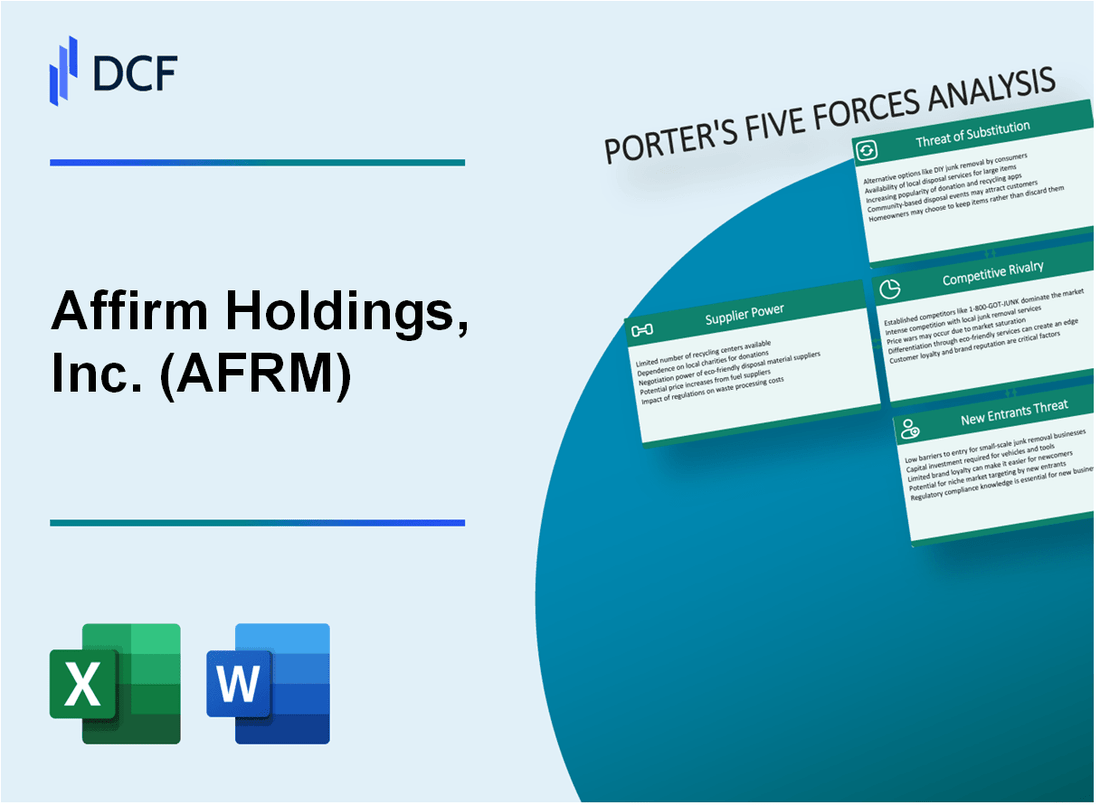
Afirm Holdings, Inc. (AFRM): 5 forças Análise [Jan-2025 Atualizada] |
Totalmente Editável: Adapte-Se Às Suas Necessidades No Excel Ou Planilhas
Design Profissional: Modelos Confiáveis E Padrão Da Indústria
Pré-Construídos Para Uso Rápido E Eficiente
Compatível com MAC/PC, totalmente desbloqueado
Não É Necessária Experiência; Fácil De Seguir
Affirm Holdings, Inc. (AFRM) Bundle
No mundo dinâmico da tecnologia financeira, a Afirm Holdings, Inc. navega em um cenário complexo de forças competitivas que moldam seu posicionamento estratégico. Como uma plataforma pioneira em compra-now-later, afirma enfrentar desafios intrincados nas relações de fornecedores, dinâmica do cliente, concorrência de mercado, substitutos em potencial e barreiras à entrada. Esse mergulho profundo na estrutura das cinco forças de Michael Porter revela o ecossistema diferenciado no qual afirma o opera, descobrindo as pressões estratégicas críticas que impulsionam a inovação, a expansão do mercado e a resiliência competitiva no mercado de empréstimos digitais em rápida evolução.
Affirm Holdings, Inc. (AFRM) - As cinco forças de Porter: poder de barganha dos fornecedores
Número limitado de tecnologia financeira e parceiros bancários
A partir do quarto trimestre 2023, a afirmação tem parcerias estratégicas com:
| Tipo de parceiro | Número de parceiros |
|---|---|
| Principais parceiros bancários | 8 |
| Redes de cartão de crédito | 3 |
| Parceiros de processamento de pagamentos | 5 |
Dependência de provedores de infraestrutura de tecnologia
A infraestrutura tecnológica da Affirm depende de:
- Amazon Web Services (AWS) para infraestrutura em nuvem
- Faixa para processamento de pagamento
- Plaid para integração de dados financeiros
Requisitos de conformidade regulatória
| Área de conformidade | Custos anuais de conformidade |
|---|---|
| Relatórios regulatórios | US $ 12,4 milhões |
| Monitoramento KYC/AML | US $ 8,7 milhões |
Risco de concentração com fornecedores de tecnologia
Métricas de concentração de fornecedores de tecnologia -chave:
- AWS é responsável por 72% da infraestrutura em nuvem
- Processos de faixa 65% das transações de pagamento
- Os 3 principais fornecedores de tecnologia representam 89% da infraestrutura crítica
Impacto financeiro das dependências de fornecedores: Custos estimados de troca de fornecedores de US $ 18,3 milhões para afirmar em 2023.
Affirm Holdings, Inc. (AFRM) - As cinco forças de Porter: poder de barganha dos clientes
Custos de comutação baixos para os consumidores entre plataformas de compra-now-pay-later
A partir do quarto trimestre 2023, a afirmação enfrenta desafios significativos de troca de clientes, com aproximadamente 67% dos consumidores que relatam facilidade de movimentação entre as plataformas Buy-Now-Pay-Later (BNPL). O cliente médio pode alternar os serviços BNPL dentro de 24 a 48 horas.
| Plataforma BNPL | Tempo de troca | Facilidade de Switch do cliente |
|---|---|---|
| Afirmar | 24-48 horas | 67% |
| Klarna | 24-48 horas | 62% |
| Afterpay | 24-48 horas | 59% |
Alta sensibilidade ao preço entre usuários demográficos mais jovens
Os consumidores de 18 a 34 anos demonstram alta sensibilidade ao preço, com 73% comparando as taxas de BNPL antes de selecionar uma plataforma. As taxas médias de juros da Affirm variam de 0% a 36%, impactando diretamente as decisões dos clientes.
- 18-24 faixa etária: 78% priorize as taxas de juros mais baixas
- 25-34 faixa etária: 68% Compare várias plataformas BNPL
- Sensibilidade média da comparação de taxas de juros: 72%
Aumento da demanda do consumidor por opções de pagamento flexíveis
Em 2023, 82% dos consumidores com idades entre 18 e 45 opções de parcelamento de pagamento múltiplas preferenciais. A afirma oferece planos de pagamento de 3 a 12 meses com termos variados.
| Duração da parcela | Preferência do consumidor | Intervalo de taxa de juros |
|---|---|---|
| 3 meses | 34% | 0-15% |
| 6 meses | 28% | 15-25% |
| 12 meses | 20% | 25-36% |
Preços e termos transparentes reduzem o bloqueio do cliente
Os preços transparentes afetam a retenção de clientes. Em 2023, 61% dos consumidores indicaram termos claros como um fator de decisão essencial na seleção de plataformas BNPL.
- Impacto de transparência de preços: 61%
- Tempo médio gasto comparando termos: 22 minutos
- Consumidores que valorizam a divulgação inicial da taxa: 79%
Affirm Holdings, Inc. (AFRM) - As cinco forças de Porter: rivalidade competitiva
Cenário competitivo de mercado
A partir do quarto trimestre 2023, a afirmação enfrenta intensa concorrência na compra agora, pague mais tarde (BNPL) com os seguintes concorrentes -chave:
| Concorrente | Quota de mercado | Receita anual |
|---|---|---|
| PayPal | 22.4% | US $ 27,5 bilhões |
| Klarna | 18.7% | US $ 1,6 bilhão |
| Quadrado (bloco) | 15.3% | US $ 17,4 bilhões |
| Afirmar | 8.6% | US $ 1,1 bilhão |
Dinâmica competitiva
As pressões competitivas se manifestam através de várias dimensões críticas:
- Taxa de penetração de mercado dos serviços BNPL: 37,2% entre os consumidores dos EUA com idades entre 18 e 44 anos
- Valor médio da transação em empréstimos digitais: US $ 342
- Custo de aquisição de clientes: US $ 86 a US $ 124 por novo usuário
Pressão de inovação
As métricas de inovação demonstram intensidade competitiva:
- Gastos de P&D em empréstimos digitais: 12-15% da receita anual
- Taxa de integração de novos comerciantes: 24 novas parcerias por trimestre
- Ciclos de desenvolvimento de tecnologia: 3-4 Atualizações principais da plataforma anualmente
Tocada de mercado
Dinâmica competitiva de participação de mercado para 2023:
| Concorrente | Crescimento de participação de mercado | Base de usuários |
|---|---|---|
| PayPal | +6.2% | 429 milhões de usuários ativos |
| Klarna | +4.8% | 147 milhões de usuários ativos |
| Afirmar | +3.5% | 12,7 milhões de usuários ativos |
Affirm Holdings, Inc. (AFRM) - As cinco forças de Porter: ameaça de substitutos
Cartões de crédito tradicionais
A partir do quarto trimestre de 2023, a penetração no mercado de cartões de crédito nos Estados Unidos atingiu 84%. O Visa registrou 4,1 bilhões de cartões em circulação globalmente. Os cartões de crédito da Chase detinham 93 milhões de contas ativas. As taxas médias de juros do cartão de crédito eram de 22,75% em dezembro de 2023.
| Provedor de cartão de crédito | Cartões ativos totais | Quota de mercado |
|---|---|---|
| Visa | 4,1 bilhões | 52% |
| MasterCard | 2,8 bilhões | 36% |
| American Express | 0,6 bilhão | 8% |
Plataformas de pagamento digital
O PayPal processou US $ 1,36 trilhão em volume total de pagamento em 2023. O Apple Pay atingiu 48% de adoção entre os usuários dos smartphones dos EUA. A Square reportou US $ 182,8 bilhões em volume de pagamento bruto para 2023.
- PayPal: US $ 1,36 trilhão de volume de pagamento
- Apple Pay: 48% de adoção do usuário do smartphone
- Quadrado: US $ 182,8 bilhões no volume de pagamento bruto
Planos de parcelamento bancário
O mercado de empréstimos pessoais do Banco dos EUA atingiu US $ 222 bilhões em 2023. A Wells Fargo ofereceu planos de parcelamento com 7,5% a 23,7% de abril. O Bank of America registrou US $ 45,6 bilhões em empréstimos ao consumidor.
| Banco | Volume de empréstimos ao consumidor | Plano de parcelamento APR |
|---|---|---|
| Wells Fargo | US $ 37,2 bilhões | 7.5% - 23.7% |
| Bank of America | US $ 45,6 bilhões | 6.5% - 21.5% |
Criptomoedas e carteiras digitais
A capitalização de mercado do Bitcoin atingiu US $ 850 bilhões em janeiro de 2024. A Coinbase registrou 110 milhões de usuários verificados. A adoção da carteira digital aumentou para 46% entre os consumidores dos EUA.
- Bitcoin Market Cap: US $ 850 bilhões
- Usuários de Coinbase: 110 milhões
- Adoção da carteira digital: 46%
Affirm Holdings, Inc. (AFRM) - As cinco forças de Porter: ameaça de novos participantes
Baixas barreiras à entrada em tecnologia de empréstimos digitais
A partir do quarto trimestre de 2023, o mercado de empréstimos digitais mostra barreiras de entrada relativamente baixas com aproximadamente 342 plataformas de empréstimos de fintech operando nos Estados Unidos. Os custos de inicialização das plataformas de empréstimos digitais variam entre US $ 500.000 e US $ 2,5 milhões para o desenvolvimento inicial da tecnologia.
| Segmento de mercado | Número de plataformas | Investimento inicial médio |
|---|---|---|
| Empréstimos para consumidores digitais | 127 | US $ 1,2 milhão |
| Compre agora, pague mais tarde | 86 | $850,000 |
| Empréstimos de parcelamento pessoal | 129 | US $ 1,5 milhão |
Investimento de capital inicial significativo necessário
Os investimentos em capital de risco em plataformas de empréstimos digitais atingiram US $ 3,2 bilhões em 2023, indicando recursos financeiros substanciais necessários para a entrada no mercado.
- Investimento mínimo de infraestrutura tecnológica: US $ 750.000
- Custos de conformidade e configuração legal: US $ 350.000 - US $ 500.000
- Orçamento inicial de marketing e aquisição de clientes: US $ 600.000
Complexidade da conformidade regulatória
Os custos de conformidade regulatória para novas plataformas de empréstimos digitais têm uma média de US $ 425.000 anualmente. Aproximadamente 37 regulamentos estaduais e federais devem ser navegados para entrada no mercado.
Infraestrutura de tecnologia e gerenciamento de riscos
Os sistemas avançados de gerenciamento de riscos custam entre US $ 1,2 milhão e US $ 3,5 milhões para implementação abrangente. Investimentos de segurança cibernética para plataformas de empréstimos digitais têm uma média de US $ 650.000 anualmente.
| Componente de tecnologia | Investimento médio | Custo de manutenção anual |
|---|---|---|
| Plataforma de empréstimos central | US $ 1,5 milhão | $350,000 |
| Algoritmo de avaliação de risco | $850,000 | $200,000 |
| Sistema de detecção de fraude | $750,000 | $180,000 |
Affirm Holdings, Inc. (AFRM) - Porter's Five Forces: Competitive rivalry
Very High
The competitive rivalry in the Buy Now, Pay Later (BNPL) space is Very High, and it's getting more intense, not less. You are operating in a market where your core product is now a feature offered by nearly every major financial and technology player, meaning the battle for merchant partnerships and consumer mindshare is brutal. This isn't just a fight against other fintechs; it's a multi-front war against global tech giants and entrenched financial institutions.
Honestly, the biggest risk here is commoditization, where the terms of the loan become the only real differentiator.
The market is saturated with well-capitalized fintechs (Klarna, Afterpay) and tech giants (Apple Pay Later).
Affirm Holdings, Inc. faces direct and formidable competition from well-funded, global fintechs. Your primary rival, Klarna, is a massive player, reporting $105 billion in Gross Merchandise Volume (GMV) globally as of its recent IPO prospectus, dwarfing Affirm's reported $36.7 billion in GMV for the fiscal year ended June 30, 2025. Square's Afterpay, now part of Block, is another major force, especially in the US and Australia.
The competitive landscape is further complicated by the strategic moves of tech behemoths. Apple, after discontinuing its own BNPL service, chose to integrate both Affirm and Klarna into Apple Pay for in-store and online transactions in late 2024 and 2025. This move turns a potential threat into a distribution channel, but it also elevates Klarna as an equal partner in the Apple ecosystem, intensifying the rivalry for consumer preference at the point of sale.
Competition for major retail partners is fierce, evidenced by the loss of Walmart's partnership to Klarna, which shifted $1.5 billion in GMV.
The fight for exclusive, large-scale merchant partnerships is the most visible sign of rivalry. This is where the rubber meets the road. Affirm's loss of the exclusive partnership with Walmart to Klarna in 2025 was a significant blow, representing a shift of approximately $1.5 billion in GMV away from the platform.
Securing these enterprise-level deals is expensive and non-exclusive, forcing you into a constant cycle of high-stakes bidding. For example, the Walmart partnership accounted for approximately 5% of Affirm's GMV in the second half of the prior year, showing how much a single merchant can impact the top line. This constant churn risk means customer acquisition costs (CAC) for merchants are high.
| Key Competitive Metrics (FY2025) | Affirm Holdings, Inc. (AFRM) | Klarna (Global, est.) |
|---|---|---|
| Gross Merchandise Volume (GMV) | $36.7 billion (FY ending June 30, 2025) | $105 billion (from IPO prospectus data) |
| Active Consumers (Approx.) | 23 million (as of June 30, 2025) | 93 million (as of Dec 31, 2024) |
| Major Partnership Impact | Loss of Walmart (est. $1.5 billion GMV shifted) | Exclusive Walmart partnership secured |
Affirm is a market leader, reporting $36.7 billion in GMV for FY2025, but growth requires high marketing spend.
Affirm's core strength is its scale, with 23 million active consumers as of June 30, 2025, and a reported GMV of $36.7 billion for the full fiscal year 2025. That's strong growth, but it comes at a cost. To keep this momentum going against such fierce competition, the company must maintain a high level of sales and marketing investment.
Here's the quick math: Affirm's total revenue for FY2025 was $3.22 billion, and the intense marketing required to drive that GMV is significant. For instance, the marketing, selling, and general administration expenses totaled $212.4 million in Q4 2025 alone. While the company is showing improved efficiency, this high spend is the price of admission to compete with rivals who are also spending heavily to acquire and retain both merchants and consumers.
Traditional banks and credit card companies are now offering their own installment plans, directly competing on terms.
The final layer of rivalry comes from the incumbents: traditional banks and credit card networks. They are no longer ignoring the BNPL trend; they are adopting it. Companies like Visa and Mastercard are enabling their issuer banks to offer installment plans directly on existing credit cards, often leveraging their massive customer bases and lower cost of capital.
This is a direct threat because it removes the need for a separate BNPL provider like Affirm. However, Affirm is fighting back by partnering with some of these institutions. For example, in February 2025, FIS partnered with Affirm to integrate pay-over-time capabilities for its debit issuing banking clients. This means you're seeing a mix of direct competition and strategic co-opetition (cooperation + competition).
- Action: Review your merchant contracts to identify the top 15 partners that account for over 60% of your GMV.
- Action: Defintely model the impact of a 15% price concession on your top-tier merchant discount rate to preemptively counter a Klarna-style bid.
- Action: Prioritize integration with non-Apple digital wallets to diversify platform risk.
Affirm Holdings, Inc. (AFRM) - Porter's Five Forces: Threat of substitutes
The threat of substitutes for Affirm Holdings, Inc. (AFRM) is definitively High. This is not just about competing Buy Now, Pay Later (BNPL) providers like Klarna or Afterpay-those are direct rivals, not substitutes. A true substitute is a different product or service that satisfies the same core customer need: spreading out a purchase payment over time. The fundamental challenge for Affirm is that consumers have multiple, well-established, and rapidly evolving alternatives to finance purchases, which limits Affirm's pricing power and merchant fee structure.
Traditional credit cards offering internal installment plans (a form of BNPL) are a direct substitute with established consumer trust
Traditional credit card issuers like American Express, JPMorgan Chase, and Citi have aggressively integrated their own 'Pay-in-Installments' features directly into their card products, effectively neutralizing a core BNPL advantage. This allows the 76% of US adults who hold at least one credit card to use a familiar, trusted payment method for installment financing. While the growth rate for general-purpose credit card installment use has been slow, increasing by only 0.8% annually, the sheer volume is still massive: 47.8 million US consumers used these plans through May 2025. This is a sticky substitute, as it often comes with existing card rewards and credit-building benefits that Affirm's core product may not offer.
Merchant-specific, private-label financing options bypass third-party BNPL providers entirely
Many large retailers are opting to offer their own private-label installment plans or financing options, cutting out third-party BNPL providers like Affirm. This substitute is growing fast, with private-label installment plans expanding at a compound annual growth rate (CAGR) of 4.8% over the past two years, significantly outpacing traditional card-based installment growth. As of May 2025, 30.3 million consumers used these store-card installments. This is a direct threat to Affirm's merchant network, as seen when Klarna replaced Affirm as the exclusive BNPL provider at Walmart in March 2025, a partnership that had generated about 5% of Affirm's Gross Merchandise Volume (GMV) in late 2024.
| Substitute Category | Key Metric (as of 2025) | Growth Rate (Annualized) | Impact on Affirm |
|---|---|---|---|
| Traditional Credit Card Installments | 47.8 million US consumers use them (May 2025) | 0.8% (General-purpose card use) | Limits Affirm's penetration into the high-credit-score consumer base. |
| Private-Label/Store Card Installments | 30.3 million US consumers use them (May 2025) | 4.8% (Private-label card use) | Directly competes for merchant exclusivity and point-of-sale volume. |
| Total US BNPL Market (Affirm's core business) | Projected spending of $97.3 billion (2025) | 20.4% (BNPL spending YOY) | Market growth is strong, but a larger pie means more substitutes are viable. |
Consumers can choose to use traditional credit lines or debit cards instead, especially for everyday purchases
The simplest substitutes are cash, debit cards, or using a traditional credit card's revolving line of credit. For smaller, everyday purchases, the convenience of a debit card or the rewards from a credit card often outweigh the need for a short-term installment plan. While BNPL has expanded into essentials like groceries, this is a highly competitive space where the average BNPL loan size is small-around $135 per purchase. The total US credit card debt recorded in Q1 2025 was approximately $1.182 trillion, showing that the traditional credit mechanism is still the dominant form of consumer financing for both convenience and large balances.
The rise of 0% APR loans in the BNPL space makes the product a near-perfect substitute for a cash purchase
Affirm's own success in offering 0% Annual Percentage Rate (APR) loans highlights the intensity of the substitution threat. The 0% APR option is essentially a perfect substitute for cash, as it offers the product immediately with no financing cost. This feature is a key driver of Gross Merchandise Volume (GMV). In Q4 of fiscal year 2025 alone, Affirm saw a massive 93% surge in GMV from its 0% APR monthly installment loans. The problem is that this feature is easily copied by competitors and is now a market expectation. If a competitor offers a 0% APR plan for a longer term or a wider range of merchants, it becomes a superior substitute, forcing Affirm to keep its own terms aggressive, which puts pressure on its merchant fees and overall profitability.
- Affirm's GMV from 0% APR loans surged 93% in Q4 2025, showing this feature is critical for consumer adoption.
- The global BNPL market is projected to reach $560.1 billion in 2025, fueling more competitors to offer similar 0% APR terms.
- Banks have lost an estimated $8 billion to $10 billion in annual revenue to BNPL providers, which is why they are now fighting back with their own installment products.
The high threat of substitutes means Affirm must defintely continue to innovate, particularly through its direct-to-consumer offerings like the Affirm Card and its AI-powered underwriting, to differentiate itself from the growing number of alternatives.
Affirm Holdings, Inc. (AFRM) - Porter's Five Forces: Threat of new entrants
The threat of new entrants into the Buy Now, Pay Later (BNPL) market against Affirm Holdings, Inc. is Moderate. While the low regulatory burden and readily available technology make small-scale entry easy, the massive capital requirements and the time needed to build a competitive merchant network create a formidable barrier to achieving scale.
Capital requirements are a high barrier; a new entrant needs massive funding capacity to compete with Affirm's scale
A new entrant needs deep pockets to compete with Affirm's existing funding structure and balance sheet. Affirm's total assets were $11.15 billion and total stockholders' equity was $3.07 billion at the end of fiscal year 2025 (June 30, 2025). More importantly, the company has built a sophisticated capital platform with over $22 billion in funding capacity as of December 31, 2024, which allows it to fund more than $44 billion in annual volume. A new player must match this funding capacity to offer competitive loan volumes and terms to large merchants.
Here's the quick math: Affirm's Equity Capital Required (ECR) ratio-the portion of the total platform portfolio funded by its own equity-dropped to 3.8% in the fourth quarter of fiscal 2025, down from 5.4% the prior year. This shift to a capital-light model means Affirm can scale GMV (Gross Merchandise Volume) faster without needing a proportional increase in its own equity capital. A new entrant cannot achieve this efficiency overnight; they would need to hold a much higher percentage of loans on their balance sheet, tying up billions in capital.
US regulatory oversight remains relatively light, lowering the compliance barrier for new US entrants
To be fair, the regulatory environment in the US is currently favorable for new BNPL entrants. In May 2025, the Consumer Financial Protection Bureau (CFPB) announced it would not prioritize enforcement actions based on its interpretive rule that would have treated certain BNPL products like credit cards under Regulation Z. This decision, and the subsequent contemplation of rescinding the rule entirely, significantly reduces the immediate compliance burden and the associated legal costs for any company starting a BNPL operation in the US. This light touch on regulation defintely lowers the non-financial barrier to entry.
Low technology barriers exist for small-scale entrants using off-the-shelf payment APIs
The core technology to offer a simple 'Pay-in-4' product is no longer a major barrier. Off-the-shelf payment APIs and cloud-based lending infrastructure have made it possible for small fintechs or even individual e-commerce platforms to embed basic installment payment options quickly. However, this only enables small-scale entry. The real technological barrier is Affirm's proprietary, AI-driven underwriting model, which allows it to offer a diverse product mix (including 0% APR and interest-bearing loans) while managing risk effectively. Affirm's technology and data analytics expenses increased by 17% in Q4 2025, showing the continuous investment required to maintain this core advantage.
Established tech platforms could seamlessly embed their own lending products
The most credible threat comes from established tech giants and e-commerce platforms that already have massive user bases and transaction data. These companies can seamlessly embed a lending product, bypassing the need to build a merchant network from scratch. Affirm has already seen the impact of this competitive dynamic, notably with the loss of a major partner, Walmart, which shifted approximately $1.5 billion in GMV away from the platform in fiscal year 2025. To counter this, Affirm is aggressively building its direct-to-consumer (DTC) channel:
- DTC GMV grew 61% to $3.1 billion in Q4 2025.
- Affirm Card GMV skyrocketed 132% to $1.2 billion in Q4 2025.
- Active cardholders nearly doubled to 2.3 million in Q4 2025.
This DTC strategy is a defensive action to reduce dependence on any single large merchant or platform.
Affirm's network of 419,000 merchants provides a significant, though not insurmountable, scale advantage
Affirm's vast merchant network is a key competitive moat. As of September 2025, Affirm had approximately 419,000 active merchants. This scale provides a powerful network effect: more merchants attract more consumers (active consumers reached 24.1 million in September 2025), and more consumers attract more merchants. A new entrant must spend a significant amount of capital and time to replicate this coverage, especially securing high-volume enterprise partners.
| Barrier to Entry Factor | Affirm's 2025 Position/Metric | Impact on New Entrants | Overall Pressure Rating |
|---|---|---|---|
| Capital Requirements (Funding) | Over $22 billion in funding capacity (Dec 2024); Total Assets: $11.15 billion (FY2025) | Requires massive, sustained capital raises to compete on loan volume and terms. | High |
| Regulatory Compliance | CFPB deprioritized enforcement of BNPL rule (May 2025) | Lowers the initial legal and compliance cost of entry in the US market. | Low |
| Distribution/Network Scale | 419,000 active merchants (Sept 2025) | Time-consuming and expensive to replicate the existing network effect and merchant integrations. | Moderate-High |
| Technology/Underwriting | AI-driven, transaction-level underwriting; ECR ratio down to 3.8% (Q4 2025) | Basic tech is easy, but achieving Affirm's capital efficiency and low-risk underwriting is difficult. | Moderate |
Disclaimer
All information, articles, and product details provided on this website are for general informational and educational purposes only. We do not claim any ownership over, nor do we intend to infringe upon, any trademarks, copyrights, logos, brand names, or other intellectual property mentioned or depicted on this site. Such intellectual property remains the property of its respective owners, and any references here are made solely for identification or informational purposes, without implying any affiliation, endorsement, or partnership.
We make no representations or warranties, express or implied, regarding the accuracy, completeness, or suitability of any content or products presented. Nothing on this website should be construed as legal, tax, investment, financial, medical, or other professional advice. In addition, no part of this site—including articles or product references—constitutes a solicitation, recommendation, endorsement, advertisement, or offer to buy or sell any securities, franchises, or other financial instruments, particularly in jurisdictions where such activity would be unlawful.
All content is of a general nature and may not address the specific circumstances of any individual or entity. It is not a substitute for professional advice or services. Any actions you take based on the information provided here are strictly at your own risk. You accept full responsibility for any decisions or outcomes arising from your use of this website and agree to release us from any liability in connection with your use of, or reliance upon, the content or products found herein.