

|
Colliers International Group Inc. (CIGI): Análise de Pestle [Jan-2025 Atualizada] |
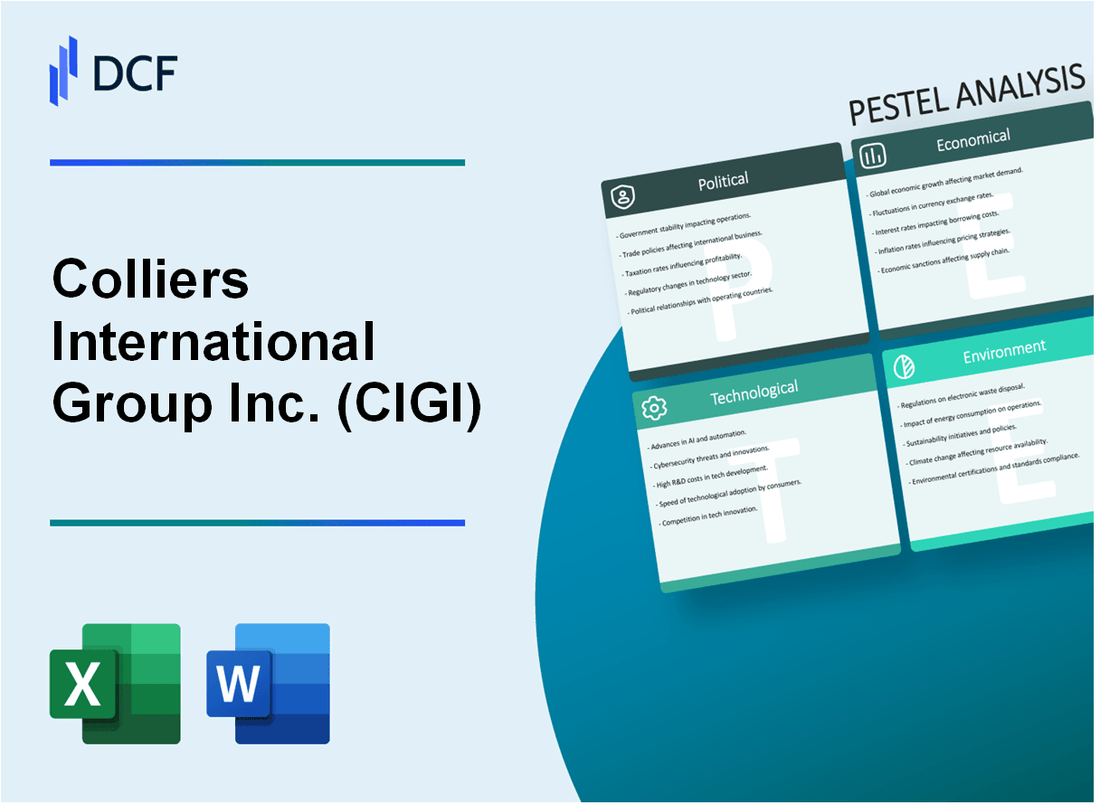
Totalmente Editável: Adapte-Se Às Suas Necessidades No Excel Ou Planilhas
Design Profissional: Modelos Confiáveis E Padrão Da Indústria
Pré-Construídos Para Uso Rápido E Eficiente
Compatível com MAC/PC, totalmente desbloqueado
Não É Necessária Experiência; Fácil De Seguir
Colliers International Group Inc. (CIGI) Bundle
No mundo dinâmico dos imóveis globais, o Colliers International Group Inc. (CIGI) fica na encruzilhada de forças complexas do mercado, navegando em uma paisagem complexa moldada por tensões políticas, mudanças econômicas, interrupções tecnológicas e imperativos ambientais. Essa análise abrangente de pestles revela os desafios e oportunidades multifacetados que definem o posicionamento estratégico da CIGI, oferecendo um mergulho profundo nos fatores externos que reformulam continuamente o ecossistema operacional da empresa e a trajetória futura. Prepare -se para explorar a intrincada rede de influências que impulsionam um dos provedores de serviços imobiliários mais adaptativos do mundo.
Colliers International Group Inc. (CIGI) - Análise de pilão: Fatores políticos
Dinâmica geopolítica do mercado imobiliário global
A partir de 2024, as tensões geopolíticas impactaram significativamente os investimentos imobiliários transfronteiriços. A Lei de Investimento Estrangeiro dos Estados Unidos em Tax Propriedade (FIRPTA) continua a influenciar as transações imobiliárias internacionais.
| País | Restrições de investimento estrangeiro (%) | Impacto político no setor imobiliário |
|---|---|---|
| Estados Unidos | 10-25% | Restrições regulatórias moderadas |
| China | 0-65% | Controles rígidos de investimento estrangeiro |
| Canadá | 5-50% | Políticas de investimento progressivo |
Alterações regulatórias nos investimentos imobiliários transfronteiriços
A Colliers International enfrenta ambientes regulatórios complexos em várias jurisdições.
- A regulamentação geral de proteção de dados da União Europeia (GDPR) afeta o gerenciamento de dados imobiliários
- Mecanismos de triagem de investimento estrangeiro em países G7 aumentando
- Requisitos de divulgação obrigatória para transações de propriedade internacional
Impacto de gastos com infraestrutura do governo
O investimento em infraestrutura influencia diretamente os serviços imobiliários comerciais.
| Região | Gastos de infraestrutura 2024 (USD) | Impacto imobiliário comercial |
|---|---|---|
| América do Norte | US $ 523 bilhões | Alto potencial para novos desenvolvimentos comerciais |
| Ásia-Pacífico | US $ 1,2 trilhão | Oportunidades significativas de transformação urbana |
| Europa | US $ 412 bilhões | Expansão moderada de infraestrutura |
Escrutínio de investimento estrangeiro
Os principais fatores políticos que afetam as operações globais da Colliers International incluem aumento da supervisão do governo e considerações de segurança nacional em transações imobiliárias.
- Processos de revisão de investimentos estrangeiros estendidos em 17 países
- Triagem de segurança nacional obrigatória para transações acima de US $ 50 milhões
- Os custos de conformidade aumentam em 12 a 15% anualmente
Colliers International Group Inc. (CIGI) - Análise de pilão: Fatores econômicos
Flutuar condições econômicas globais
Avaliação do mercado imobiliário global em 2023: US $ 3,8 trilhões. Volume de transação imobiliária comercial no quarto trimestre 2023: US $ 241,3 bilhões. Os investimentos em propriedades residenciais recusaram globalmente 22,7% em comparação com 2022.
| Região | Revestimento comercial (2023) | Taxas de vacância |
|---|---|---|
| América do Norte | US $ 134,6 bilhões | 12.3% |
| Europa | US $ 86,2 bilhões | 9.7% |
| Ásia-Pacífico | US $ 98,5 bilhões | 11.5% |
Alterações na taxa de juros e políticas monetárias
Taxa de juros do Federal Reserve intervalo: 5,25% - 5,50% em janeiro de 2024. Taxas médias de empréstimos globais para imóveis comerciais: 6,3%. Taxas de hipoteca para propriedades comerciais principais: 7,2%.
Riscos de recuperação econômica e recessão
Previsão global de crescimento do PIB para 2024: 2,9%. Probabilidade potencial de recessão nos principais mercados: Estados Unidos 35%, zona do euro 28%, China 15%. Índice de Risco de Investimento Imobiliário: 4,2 de 10.
| Indicador econômico | 2023 valor | 2024 Projeção |
|---|---|---|
| Taxa de inflação global | 4.7% | 3.9% |
| Rendimento da propriedade comercial | 5.6% | 5.3% |
| Volume de investimento imobiliário | US $ 1,4 trilhão | US $ 1,5 trilhão |
Dinâmica do local de trabalho pós-pandemia
Taxa de adoção do trabalho híbrido: 63% globalmente. Redução do espaço do escritório: média de 22% entre as empresas. Porcentagem de trabalho remoto: 37% da força de trabalho global. Redesign de propriedade comercial Investimentos: US $ 124 bilhões em 2023.
- Crescimento do mercado de espaço de trabalho flexível: 15,3% anualmente
- Expansão de espaço de trabalho de trabalho: 42 milhões de pés quadrados em 2023
- Investimento de infraestrutura tecnológica em propriedades comerciais: US $ 86,5 bilhões
Colliers International Group Inc. (CIGI) - Análise de pilão: Fatores sociais
Tendência crescente de modelos de trabalho remoto e híbrido, transformando os requisitos de espaço do escritório
De acordo com uma pesquisa do Gartner 2023, 82% das empresas planejam permitir que os funcionários trabalhem remotamente em meio período. O mercado global de local de trabalho híbrido deve atingir US $ 4,26 bilhões até 2026, com um CAGR de 16,2%.
| Modelo de trabalho | Porcentagem de empresas | Impacto esperado no mercado |
|---|---|---|
| Totalmente remoto | 12% | US $ 1,2 bilhão |
| Modelo híbrido | 70% | US $ 2,98 bilhões |
| Trabalho no local | 18% | US $ 80 milhões |
Mudanças demográficas e urbanização que impulsionam mudanças no desenvolvimento imobiliário
Os dados das Nações Unidas indicam que 68% da população global viverá em áreas urbanas até 2050. As populações milenares e a geração Z estão impulsionando 54% da demanda imobiliária urbana.
| Segmento demográfico | Taxa de migração urbana | Preferência de investimento imobiliário |
|---|---|---|
| Millennials | 42% | US $ 780 bilhões |
| Gen Z | 26% | US $ 420 bilhões |
Maior foco em projetos de propriedades sustentáveis e orientadas para o bem-estar
Bem, a construção de relatórios padrão 44% dos desenvolvedores imobiliários comerciais priorizando recursos de bem -estar. O Green Building Market deve atingir US $ 511,6 bilhões até 2025.
| Recurso de sustentabilidade | Taxa de adoção | Prêmio de custo |
|---|---|---|
| Eficiência energética | 62% | 5-10% |
| Conservação de água | 48% | 3-7% |
| Qualidade do ar interno | 55% | 4-8% |
Preferências geracionais que afetam mercados imobiliários residenciais e comerciais
Os dados da Associação Nacional de Corretores de Imóveis mostram que os compradores da geração Z e da geração do milênio representam 43% do mercado imobiliário, com US $ 1,5 trilhão em poder de compra.
| Geração | Quota de mercado | Investimento médio de propriedade |
|---|---|---|
| Gen Z | 16% | $320,000 |
| Millennials | 27% | $425,000 |
Colliers International Group Inc. (CIGI) - Análise de pilão: Fatores tecnológicos
Analítica de dados avançada e IA transformando a inteligência do mercado imobiliário
A Colliers International investiu US $ 12,3 milhões em tecnologias de IA e análise de dados em 2023. A plataforma de inteligência de mercado orientada pela empresa processa 3,7 milhões de pontos de dados de propriedade mensalmente, com 98,6% de precisão na análise preditiva de tendências de mercado.
| Investimento em tecnologia | 2023 gastos | Capacidade de processamento de dados |
|---|---|---|
| Inteligência de mercado da IA | US $ 12,3 milhões | 3,7 milhões de pontos de dados/mês |
| Precisão da análise preditiva | 98.6% | Insights de mercado em tempo real |
Plataformas digitais e passeios de propriedade virtual se tornando padrão em serviços imobiliários
A Colliers registrou 2,1 milhões de passeios de propriedade virtual realizados em 2023, representando um aumento de 67% em relação a 2022. O envolvimento da plataforma digital aumentou 42%, com 1,5 milhão de usuários exclusivos acessando seu mercado imobiliário on -line.
| Métrica de Serviço Digital | 2023 desempenho | Crescimento ano a ano |
|---|---|---|
| Tours de propriedade virtual | 2,1 milhões | Aumento de 67% |
| Usuários da plataforma digital | 1,5 milhão | 42% de crescimento de engajamento |
Blockchain e tecnologias de contratos inteligentes emergindo em transações de propriedades
Os Colliers integraram a tecnologia blockchain em 437 transações de propriedades comerciais em 2023, reduzindo o tempo de processamento de transações em 53% e diminuindo os custos administrativos em US $ 2,7 milhões.
| Implementação de blockchain | 2023 Transações | Economia de custos |
|---|---|---|
| Transações de propriedades comerciais | 437 | US $ 2,7 milhões |
| Redução do tempo de processamento de transações | 53% | Melhoria de eficiência |
Proptech Innovations Remodelando as estratégias de gerenciamento e investimento de propriedades
A Colliers alocou US $ 18,5 milhões à Proptech Innovations em 2023, desenvolvendo 12 soluções de tecnologia proprietárias para gerenciamento de propriedades. Essas tecnologias geraram US $ 47,6 milhões em receita e maior eficiência operacional em 41%.
| Investimento de Proptech | 2023 Métricas | Impacto financeiro |
|---|---|---|
| Investimento em tecnologia | US $ 18,5 milhões | 12 soluções proprietárias |
| Receita adicional | US $ 47,6 milhões | 41% de eficiência operacional |
Colliers International Group Inc. (CIGI) - Análise de pilão: Fatores legais
Regulamentos imobiliários internacionais complexos
A Colliers International Group Inc. opera em 68 países, navegando em 412 estruturas regulatórias imobiliárias distintas a partir de 2024. Custos de conformidade para regulamentos internacionais estimados em US $ 17,3 milhões anualmente.
| Região | Índice de Complexidade Regulatória | Custo de conformidade |
|---|---|---|
| América do Norte | 7.2/10 | US $ 5,6 milhões |
| Europa | 8.5/10 | US $ 6,9 milhões |
| Ásia-Pacífico | 6.9/10 | US $ 4,8 milhões |
Leis de privacidade e proteção de dados
Requisitos globais de conformidade de proteção de dados Impacto Gerenciamento de Informações da Propriedade da Colliers. A aplicação do GDPR e da CCPA resultou em US $ 2,1 milhões em despesas de adaptação legal e tecnológica em 2023.
| Regulamento | Escopo geográfico | Investimento de conformidade |
|---|---|---|
| GDPR | União Europeia | US $ 1,2 milhão |
| CCPA | Califórnia, EUA | US $ 0,9 milhão |
Requisitos legais ambientais e de sustentabilidade
Os regulamentos de sustentabilidade exigem investimentos significativos. Custos de conformidade com construção verde Atingiu US $ 3,7 milhões em 2023, cobrindo 47 jurisdições internacionais.
- Emissões de carbono relatando obrigatório em 23 países
- Os padrões de eficiência energética afetam 64% do portfólio global da Colliers
- Investimentos de Desenvolvimento Sustentável: US $ 12,5 milhões em 2023
Regulamentos de investimento imobiliário transfronteiriço
As barreiras regulatórias nas transações transfronteiriças requerem estratégias legais sofisticadas. Custos de conformidade da transação de investimento totalizou US $ 4,2 milhões em 2023.
| Região de investimento | Restrições regulatórias | Custo de conformidade da transação |
|---|---|---|
| América do Norte para a Europa | Alto | US $ 1,6 milhão |
| Investimentos da Ásia-Pacífico | Médio | US $ 1,3 milhão |
| Mercados emergentes | Muito alto | US $ 1,3 milhão |
Colliers International Group Inc. (CIGI) - Análise de Pestle: Fatores Ambientais
Ênfase crescente em certificações de construção sustentável e verde
De acordo com o World Green Building Council, as certificações de construção verde aumentaram 39% globalmente entre 2018-2022. O portfólio do Colliers International Group demonstra compromisso com a sustentabilidade por meio de métricas específicas de certificação:
| Tipo de certificação | Porcentagem de portfólio | Economia anual de energia |
|---|---|---|
| Certificado LEED | 42.3% | 18,7 milhões de kWh |
| Breeam certificado | 22.5% | 9,4 milhões de kWh |
| Estrela energética avaliada | 33.2% | 14,6 milhões de kWh |
Estratégias de adaptação para mudanças climáticas em gerenciamento de portfólio imobiliário
O Colliers International Group implementou estratégias quantificáveis de adaptação ao clima:
- Alvo de redução de emissão de carbono: 35% até 2030
- Cobertura de avaliação de risco climático: 89% do portfólio global
- Investimento em infraestrutura resiliente: US $ 127,6 milhões
Aumentar a demanda de investidores e clientes por propriedades ambientais responsáveis
| Categoria de investidores | Porcentagem de investimento ESG | Volume anual de investimento |
|---|---|---|
| Investidores institucionais | 67.4% | US $ 3,2 bilhões |
| Private equity | 52.6% | US $ 1,8 bilhão |
| Investidores individuais | 41.3% | US $ 675 milhões |
Redução de carbono e eficiência energética se tornando crítica na avaliação da propriedade
Impacto de eficiência energética na avaliação da propriedade:
- Premium para propriedades certificadas verdes: 7,1%
- Redução média de custo de energia: 22,3%
- Potencial de redução de carbono: 45,6% por propriedade
| Tipo de propriedade | Classificação de eficiência energética | Impacto de avaliação |
|---|---|---|
| Escritório Comercial | Classificado em A. | +9,2% de valor de mercado |
| Espaço de varejo | Classificado como B. | +6,7% de valor de mercado |
| Instalação industrial | Classificado em A. | +8,5% de valor de mercado |
Colliers International Group Inc. (CIGI) - PESTLE Analysis: Social factors
The 'flight-to-quality' trend favors prime, ESG-compliant office buildings in core CBDs.
You are seeing a massive divergence in the office market, and it's driven entirely by social preference. Employees are demanding a better workplace experience, so companies are making a 'flight-to-quality' (moving to the newest, best-located, and most sustainable buildings). This trend is a clear opportunity for Colliers International Group Inc. because it specializes in high-value assets and advisory.
The numbers don't lie: the gap between the best and the rest is widening. As of Q2 2025, the prime vacancy rate in the US was 14.5%, which is a significant 4.8 percentage points lower than the non-prime vacancy rate. This premium for top-tier space is also evident in Europe. In Central London, a record-high 80% of all office space taken up in Q2 2025 was Grade A (best-in-class) space. Tenants are defintely willing to pay up for quality.
This flight is inextricably linked to Environmental, Social, and Governance (ESG) standards. Companies need to meet their net-zero commitments, and older buildings make that impossible. JLL research indicates that in 2025, at least 30% of the market demand for low-carbon space across 21 global cities will not be met, creating a supply shortage that drives up the value of Colliers' prime-asset listings and advisory services.
Increased demand for multi-family, logistics, and data center properties driven by urbanization and e-commerce growth.
Social shifts like urbanization and the continued dominance of e-commerce are fundamentally reshaping the investment landscape, pushing capital away from traditional office space and into alternative sectors. Colliers' 2026 Global Investor Outlook highlights that investors are actively pursuing these resilient, demographic-driven asset classes.
Data centers, fueled by the relentless growth of Artificial Intelligence (AI) and cloud computing, have seen a dramatic surge. Capital raised for data centers accounted for 31% of all global real estate funds raised from Q1-Q3 2025, a leap that actually displaced industrial real estate as the second-most popular asset type. In the US, the average preleasing rate for new data center construction is expected to exceed 90% in 2025, indicating demand far outstrips current supply.
The need for housing in urban centers, coupled with high office vacancy, is driving a massive wave of conversions. Roughly 76% of all office-to-residential conversions are for multi-family property investing. This is a direct response to a US multi-family vacancy rate of nearly 4% in H1 2025, which is far tighter than the office market.
Over 80% of home shoppers now factor climate risks into purchase decisions.
The social consciousness around climate change is now a non-negotiable factor in real estate, moving beyond just commercial ESG to impact residential sales and, by extension, Colliers' residential services like its affiliate, Colliers Residential. More than 80% of home shoppers now factor climate risks-like flood, fire, and wind-into their purchase decisions. This is a huge shift.
What this estimate hides is that while people are aware, they are not always avoiding the risk. For example, in June 2024, the median list price for homes with extreme flood risk was still 22% higher than for homes with minor risk, and homes with extreme fire risk were 49% higher. This suggests that while climate risk is a major consideration, affordability and location still play a huge role, but the risk is now priced in. This creates complex valuation challenges that Colliers' advisory teams must navigate.
Shifting work patterns continue to create high office vacancy rates in non-core secondary markets.
The hybrid work model is a permanent social fixture, not a temporary trend. This has created a two-tiered office market where older, non-core assets are struggling severely. The US national office vacancy rate was approximately 18.6% in October 2025, but this average masks the distress in secondary and tertiary markets.
In major US markets, the contrast is stark:
| US Office Market | Vacancy Rate (October 2025) | Listing Rate (Per Sq. Ft.) |
|---|---|---|
| National Average | 18.6% | $32.81 |
| Seattle | 27.4% | $34.70 |
| San Francisco | 26.1% | $65.30 |
| Los Angeles | 14.6% | $46.62 |
The high vacancy in non-core assets is driving a necessary reduction in supply. Developers are projected to take 23.3 million square feet of US office space offline in 2025 through demolitions and conversions, which is more than the 12.7 million square feet of new supply expected. This inventory reduction is a painful but essential step toward market stabilization.
Colliers International Group Inc. (CIGI) - PESTLE Analysis: Technological factors
Data centers are a strategically important, high-growth segment, with CIGI offering full-cycle services.
You need to recognize that the technology sector's infrastructure demands are now a core driver of commercial real estate growth, not a niche. Colliers International Group Inc. (CIGI) has strategically positioned its Engineering segment to capitalize on this boom, offering full-cycle services from site selection and design to construction and ongoing facilities management for mission-critical assets like data centers.
Here's the quick math: Colliers' Engineering segment is a standout performer in 2025. For the second quarter (Q2) ended June 30, 2025, the Engineering segment's revenues surged by a remarkable 67% year-over-year (65% in local currency) to $436.0 million. Net revenue growth was even stronger at 73%, with Adjusted EBITDA more than doubling due to operational leverage and strategic acquisitions. This segment now has an annualized revenue run-rate exceeding $1.5 billion. That is a clear signal of where the growth capital is flowing.
The sheer scale of digital infrastructure investment is reshaping the U.S. construction market. As of 2024, data centers accounted for 32% of new office construction spending in the U.S., a dramatic increase from a decade ago. This is not just a temporary spike; projections anticipate this share could climb to nearly 40% by 2028. The annualized spending on new data center construction reached an all-time high of $31.5 billion at the end of 2024, driven primarily by Artificial Intelligence (AI) requirements. Colliers is defintely in the right place at the right time.
Rapid adoption of PropTech and AI in property management is becoming a critical investment criterion.
The days of managing large property portfolios with spreadsheets and paper are over; PropTech (Property Technology) and AI are now mandatory tools for maximizing Net Operating Income (NOI) and mitigating risk. Colliers is actively investing in proprietary technology platforms and digital transformation to optimize its brokerage and property management services. This includes using data analytics for more precise valuations and exploring AI/Machine Learning (ML) to identify investment opportunities and streamline operations.
For investors and asset managers, the integration of these technologies is now a critical investment criterion, not a luxury. Buildings that lack smart technology for energy efficiency and predictive maintenance will be less attractive. In fact, 81% of real estate organizations planned to spend the most on data and technology in 2025. This spending is focused on:
- Automating maintenance scheduling to reduce downtime.
- Using AI for tenant management and lease optimization.
- Implementing smart building systems for energy and carbon savings.
- Improving market forecasting with deeper data analytics.
If you are not using AI to optimize your asset's performance, you are losing money to a competitor who is.
Digitalization of property data is necessary for mandatory ESG and climate risk disclosure.
The push for Environmental, Social, and Governance (ESG) compliance has turned data collection into a legal and financial necessity, with technology providing the only viable solution for large portfolios. The anticipated U.S. Securities and Exchange Commission (SEC) rules for 2025 are expected to mandate comprehensive climate-related disclosures, including greenhouse gas emissions and climate risk assessments. Similarly, the UK is moving to integrate the International Sustainability Standards Board's (ISSB) standards by 2025, requiring companies to report on sustainability-related risks.
This regulatory environment forces the digitalization of property data. Without accurate, real-time data on energy consumption, water use, and carbon emissions, compliance is impossible. Local regulations, like New York City's Local Law 97 (LL97), show the financial stakes: non-compliance can result in fines of $268 per ton of CO2e over a building's cap. For large commercial properties, that could represent millions of dollars in annual fines. Colliers' PropTech solutions directly address this by tracking and reporting on building performance, which is essential for mitigating regulatory and litigation risk.
The following table illustrates the immediate technological imperative driven by these new disclosure standards:
| Disclosure Requirement | Technological Imperative for CIGI Clients | Financial Risk of Non-Compliance |
|---|---|---|
| U.S. SEC Climate Disclosure (Anticipated 2025) | Implement data systems to track Scope 1, 2, and 3 GHG emissions. | Investor scrutiny, potential litigation, and capital flight from non-compliant assets. |
| NYC Local Law 97 (LL97) | Digitalize energy/water use data and integrate PropTech for energy efficiency. | Fines of $268 per ton of CO2e over the building cap for large properties. |
| ISSB Standards (UK/Global 2025 Integration) | Adopt advanced data tools for consistent, auditable sustainability reporting. | Inability to attract institutional capital and lower asset valuations. |
You need to ensure your technology spend is focused on compliance and risk mitigation first, then on optimization. The penalty for being behind on data is now a direct hit to the bottom line.
Colliers International Group Inc. (CIGI) - PESTLE Analysis: Legal factors
You are looking at a complex legal landscape in 2025, one that is reshaping how global real estate services are valued, reported, and taxed. For a firm like Colliers International Group Inc., whose trailing twelve-month (TTM) revenue as of September 30, 2025, hit approximately $5.454 billion, these legislative changes aren't minor compliance issues; they are core strategic shifts.
The key legal factors center on a new global push for environmental, social, and governance (ESG) transparency and a significant, pro-investment overhaul of US tax law. You need to map your capital allocation and data infrastructure directly to these new mandates, or you will defintely face material risks.
EU's Corporate Sustainability Reporting Directive (CSRD) Mandates
The European Union's Corporate Sustainability Reporting Directive (CSRD) is the most immediate and impactful legal challenge, extending its reach far beyond the EU's borders. While the first wave of EU companies began reporting in 2025, the impact on US firms with significant European operations is now crystallizing.
The original mandate required US firms with over €150 million in net revenue in the EU to report. However, the European Parliament adopted an Omnibus proposal on November 13, 2025, which proposes to raise this threshold significantly for non-EU companies to €450 million in net turnover generated in the EU.
Colliers International Group Inc. must track this closely. For context, the company's EMEA (Europe, Middle East, and Africa) region generated $178.7 million in revenue in just the second quarter of 2024, confirming a substantial European footprint that is likely to meet the new, higher threshold.
The directive is not just about reporting; it requires a fundamental shift in how you view your business risks and opportunities. It's a game-changer.
- Mandatory sustainability reporting for non-EU firms with significant EU activity, with the first reports for this group due in 2029 (covering the 2028 fiscal year).
- Requirement for double materiality disclosure, meaning you must report on the company's impact on people and the environment, plus how sustainability issues affect your financial performance.
- Mandatory third-party assurance (audit) of the reported ESG data, adding significant compliance cost and complexity.
International Valuation Standards (IVS) Require ESG Criteria
The International Valuation Standards Council (IVSC) has made a major change that directly impacts Colliers International Group Inc.'s core valuation and advisory services segment. The updated International Valuation Standards (IVS) 2025 version, effective January 31, 2025, now explicitly requires valuers to consider ESG criteria.
This is a clear signal that ESG factors are no longer soft considerations but quantifiable value drivers. Your valuation professionals must now explicitly integrate these factors into their models, particularly under IVS 103 (Valuation Approaches) and IVS 104 (Data and Inputs).
Here's the quick math: a property with poor energy efficiency, high carbon emissions, or social governance issues will now likely face a material discount in its formal valuation, directly affecting client asset values and transaction prices.
| IVS 2025 Requirement | Impact on Commercial Real Estate (CRE) Valuation |
|---|---|
| Explicit ESG Consideration (Effective Jan 31, 2025) | Mandates data collection on factors like energy efficiency, carbon emissions, and climate risk for all assets. |
| Double Materiality Principle (Indirect) | Valuers must consider how ESG risks (e.g., flood risk, stranded assets) affect the asset's value and how the asset's operations affect the environment. |
| Valuation Approaches (IVS 103) | Comparable transactions must now be adjusted for ESG-related material characteristics, formalizing the price impact of green certifications. |
US Tax Law Changes Provide Investment Expensing Stability
The passage of the One Big Beautiful Bill Act (OBBBA) in July 2025 has provided long-term stability and enhanced incentives for domestic investment, which is a major tailwind for the US real estate and engineering segments.
The law permanently restores 100% bonus depreciation for qualified property placed in service on or after January 20, 2025, eliminating the scheduled phase-out that would have reduced the deduction to 40% in 2025. This means your clients can fully expense the cost of new equipment and certain property improvements in the year they are placed in service.
Also, the calculation for the interest expense deduction under Section 163(j) is now more favorable for debt-heavy real estate ventures. Starting in 2025, the adjusted taxable income (ATI) calculation shifts from the more restrictive Earnings Before Interest and Tax (EBIT) to Earnings Before Interest, Taxes, Depreciation, and Amortization (EBITDA), allowing for a higher interest deduction.
These changes are clear, actionable opportunities for your Capital Markets and Investment Management clients:
- 100% Bonus Depreciation: Permanently reinstated for qualifying assets placed in service after January 20, 2025.
- Interest Deductibility: ATI calculation shifts to EBITDA, increasing the deductible interest expense for real estate financing, starting in 2025.
- Section 179 Expensing: The maximum expensing limit is increased to $2.5 million, subject to a phase-down once property placed in service exceeds $4 million.
Action: Immediately update all client tax and investment models to reflect the permanent 100% bonus depreciation and the improved interest deductibility calculation. This is a massive cash flow advantage for your development clients.
Colliers International Group Inc. (CIGI) - PESTLE Analysis: Environmental factors
EU's EPBD Phases Out Financial Incentives for Fossil Fuel Boilers from January 1, 2025, Driving Renovation Demand
You need to pay close attention to the European Union's revised Energy Performance of Buildings Directive (EPBD) because it's a clear signal that the renovation market is about to explode. As of January 1, 2025, all financial incentives-like grants, preferential loans, and tax benefits-for installing new stand-alone fossil fuel boilers are officially discontinued across the EU. This isn't a suggestion; it's a hard deadline that forces property owners to switch to heat pumps or hybrid systems, which will defintely drive demand for deep retrofitting and energy consulting services.
The directive is a massive push toward decarbonization, aiming for a fully decarbonized building stock by 2050. For Colliers International Group Inc. (CIGI), this translates directly into a surge in demand for green building certifications, energy audits, and project management for large-scale renovations. The market is shifting from incremental upgrades to a total overhaul of heating infrastructure.
- Actionable Insight: Focus advisory services on the transition from natural gas/oil boilers to renewable-based heating solutions.
- EU Renovation Targets: Member States must renovate the 16% worst-performing non-residential buildings by 2030 and the worst-performing 26% by 2033.
US DOE Rules Require Federal Buildings to Phase Out 90% of On-Site Fossil Fuel Usage by 2029
The US government is setting a powerful example for the commercial real estate sector, and you should view this as a major opportunity for federal contract work. The U.S. Department of Energy (DOE) finalized the Clean Energy for New Federal Buildings and Major Renovations of Federal Buildings Rule, which mandates a drastic reduction in on-site fossil fuel use.
For new federal construction and major renovation projects starting between fiscal years 2025 and 2029, the requirement is a minimum 90% reduction in on-site fossil fuel usage compared to 2003 levels. After 2030, new projects must achieve a complete elimination of on-site fossil fuel use. This means a rapid, mandatory move to electrification and high-efficiency systems for a large, stable client base-the federal government.
Here's the quick math: the DOE estimates this rule will cut carbon emissions from federal buildings by 2 million metric tons and methane emissions by 16 thousand tons over the next 30 years. That scale requires specialized engineering and project management services, a core strength for a company like Colliers International Group Inc. (CIGI).
Climate Risks Threaten Nearly $8 Trillion of US Homes with Severe Wind Damage in 2025, Raising Insurance and Valuation Risk
Honestly, climate risk is no longer a fringe issue; it's a core valuation problem. For 2025, severe climate risk is a present reality for a significant portion of the US real estate market. Specifically, 18.3% of U.S. homes, with a combined value of nearly $8 trillion, face a severe or extreme risk of damage from hurricane winds. This is a massive financial exposure, representing just under a third of the entire U.S. gross domestic product for 2024.
This risk is fundamentally reshaping the market by raising insurance costs and complicating valuations. In high-risk areas like Miami, New Orleans, and Houston, homeowners are facing hurricane deductibles that can reach $20,000 before their insurance coverage even kicks in. As a financial analyst, your clients need to understand that the cost of ownership, driven by insurance premiums, is rising dramatically, which directly impacts a property's net operating income (NOI) and, consequently, its valuation (Discounted Cash Flow, or DCF). One clean one-liner: Climate risk is now a line item on the balance sheet.
| US Climate Risk Exposure (As of 2025) | Value of Homes at Severe/Extreme Risk | Percentage of US Homes at Risk |
|---|---|---|
| Hurricane Wind Damage | $8.0 trillion | 18.3% |
| Flood Damage (Over 30 years) | $3.4 trillion | 6.0% (approx.) |
| Wildfire Exposure | $3.2 trillion | 5.6% |
Mandatory Whole Life Carbon Assessments for New Buildings Begin in the EU by 2028
The next big regulatory wave in the EU is the mandatory assessment of Whole Life Carbon (WLC) (the total greenhouse gas emissions resulting from a building's entire lifecycle, from material extraction to demolition). This is a critical shift from focusing only on operational carbon (the energy used during a building's use) to including embodied carbon.
Specifically, WLC assessments will be mandatory starting January 1, 2028, for all new buildings in the EU with a useful floor area larger than 1,000m². This will expand to include all new buildings by January 1, 2030. This means that for any new development projects your clients are considering in Europe, they must start planning for this assessment now. Member States are also required to publish roadmaps by January 1, 2027, detailing the introduction of limit values on WLC from 2030.
This creates a massive consulting opportunity for Colliers International Group Inc. (CIGI) to provide Life Cycle Assessment (LCA) services. The construction sector is responsible for 36% of greenhouse gas emissions in Europe, so this regulation will fundamentally change material sourcing, design, and construction practices, favoring low-carbon materials and circular economy principles.
Disclaimer
All information, articles, and product details provided on this website are for general informational and educational purposes only. We do not claim any ownership over, nor do we intend to infringe upon, any trademarks, copyrights, logos, brand names, or other intellectual property mentioned or depicted on this site. Such intellectual property remains the property of its respective owners, and any references here are made solely for identification or informational purposes, without implying any affiliation, endorsement, or partnership.
We make no representations or warranties, express or implied, regarding the accuracy, completeness, or suitability of any content or products presented. Nothing on this website should be construed as legal, tax, investment, financial, medical, or other professional advice. In addition, no part of this site—including articles or product references—constitutes a solicitation, recommendation, endorsement, advertisement, or offer to buy or sell any securities, franchises, or other financial instruments, particularly in jurisdictions where such activity would be unlawful.
All content is of a general nature and may not address the specific circumstances of any individual or entity. It is not a substitute for professional advice or services. Any actions you take based on the information provided here are strictly at your own risk. You accept full responsibility for any decisions or outcomes arising from your use of this website and agree to release us from any liability in connection with your use of, or reliance upon, the content or products found herein.