

|
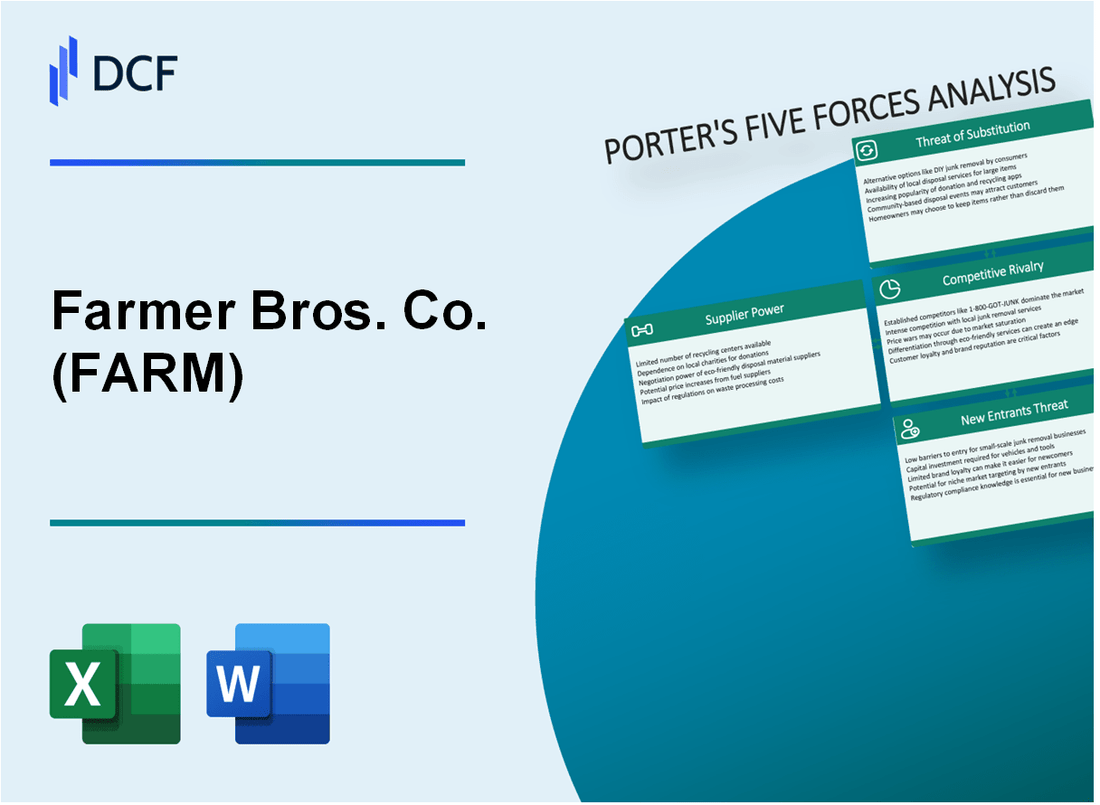
Farmer Bros. Co. (Fazenda): 5 forças Análise [Jan-2025 Atualizada] |
Totalmente Editável: Adapte-Se Às Suas Necessidades No Excel Ou Planilhas
Design Profissional: Modelos Confiáveis E Padrão Da Indústria
Pré-Construídos Para Uso Rápido E Eficiente
Compatível com MAC/PC, totalmente desbloqueado
Não É Necessária Experiência; Fácil De Seguir
Farmer Bros. Co. (FARM) Bundle
No mundo dinâmico da distribuição do café, a Farmer Bros. Co. (fazenda) navega em uma paisagem complexa moldada pelas cinco forças competitivas de Michael Porter. Desde a intrincada cadeia de suprimentos globais de feijão de café até a rivalidade feroz entre os participantes do setor, essa análise revela os desafios e oportunidades estratégicas que definem o posicionamento competitivo da empresa em 2024. Descubra como o agricultor Bros. equilibra restrições de fornecedores, demandas de clientes e pressões de mercado em um Ecossistema de bebidas cada vez mais sofisticadas.
FARMER BROS. Co. (Fazenda) - As cinco forças de Porter: poder de barganha dos fornecedores
Número limitado de fornecedores de feijão de café globalmente
Em 2024, a produção global de feijão de café está concentrada em 10 países primários, com o Brasil produzindo 37% do suprimento mundial de café, seguido pelo Vietnã em 17%. Os principais países produtores de café incluem:
| País | Compartilhamento global de produção de café |
|---|---|
| Brasil | 37% |
| Vietnã | 17% |
| Colômbia | 10% |
| Indonésia | 8% |
| Etiópia | 6% |
Cadeia de suprimentos concentrada para grãos de café verde
As 5 principais empresas globais de comércio de café controlam aproximadamente 50% do mercado internacional de café verde:
- Neumann Gruppe (Alemanha)
- Louis Dreyfus Company (Holanda)
- ECOM Agroindustrial Corp (Suíça)
- Olam International (Cingapura)
- Ed & F Man Holdings (Reino Unido)
Volatilidade potencial de preço em commodities agrícolas
Volatilidade dos preços de commodities de café em 2023:
| Métrica | Valor |
|---|---|
| Preço médio de café da Arábica | US $ 1,80 por libra |
| Flutuação da faixa de preço | ±35% |
| Índice anual de volatilidade de preços | 2.4 |
Dependência de regiões específicas de cultivo de café
Concentração geográfica de riscos de produção de café:
- 80% da produção global de café ocorre dentro de 25 graus ao norte e ao sul do equador
- Impacto das mudanças climáticas em regiões de cultivo de café: redução potencial de 50% nas áreas de cultivo adequadas até 2050
- Escassez de água afetando 47% das principais regiões produtoras de café
FARMER BROS. Co. (Fazenda) - As cinco forças de Porter: poder de barganha dos clientes
Diversificadas Base de Clientes
Farmer Bros. Co. serve vários segmentos de clientes com a seguinte distribuição:
| Segmento de clientes | Porcentagem de receita |
|---|---|
| Restaurantes | 42% |
| Hotéis | 23% |
| Distribuidores de serviço de alimentos | 35% |
Características da demanda do cliente
As tendências especializadas do mercado de café indicam:
- A demanda de café sustentável aumentou 17,3% em 2023
- Taxa de crescimento do mercado de café orgânico: 11,2% anualmente
- Segmento de café especializado que deve atingir US $ 152,8 bilhões até 2027
Análise de sensibilidade ao preço
Dinâmica competitiva de preços do mercado de café:
| Faixa de preço | Sensibilidade ao cliente |
|---|---|
| US $ 8 a US $ 12 por libra | Elasticidade de alto preço |
| US $ 12 a US $ 18 por libra | Sensibilidade moderada ao preço |
| Acima de US $ 18 por libra | Baixa sensibilidade ao preço para segmentos premium |
Potencial de compra em massa
Grandes dados institucionais de aquisição de clientes:
- Aquisição média anual de café: 250.000 libras
- Faixa potencial de desconto de volume: 12-18%
- Os maiores clientes institucionais representam 37% da receita total
Farmer Bros. Co. (fazenda) - Five Forces de Porter: Rivalidade Competitiva
Concorrência intensa na indústria de torrefação e distribuição de café
A partir de 2024, o mercado de café dos EUA está avaliado em US $ 85,16 bilhões, com pressão competitiva significativa. Farmer Bros. Co. enfrenta intensa rivalidade de vários segmentos de mercado.
| Concorrente | Quota de mercado | Receita anual |
|---|---|---|
| Starbucks | 40.2% | US $ 32,3 bilhões |
| Dunkin ' | 25.5% | US $ 14,7 bilhões |
| Farmer Bros. Co. | 3.7% | US $ 541,6 milhões |
Grande presença nacional da marca
As marcas nacionais de café dominam o mercado com vantagens competitivas significativas.
- A Starbucks opera 38.038 lojas globalmente
- Dunkin 'tem 13.381 locais em todo o mundo
- Farmer Bros. Co. mantém 90 centros de distribuição
Estratégias de diferenciação de produtos
Os preços da indústria de café e a qualidade do produto são fatores competitivos críticos.
| Categoria de produto | Preço médio por libra | Taxa de crescimento do mercado |
|---|---|---|
| Café especial | $18.50 | 7.5% |
| Café orgânico | $22.75 | 9.3% |
| Café convencional | $12.25 | 3.2% |
Tendências de consolidação na distribuição de café
O setor de distribuição de café experimenta consolidação em andamento.
- 5 grandes empresas controlam 68% da participação de mercado
- A atividade de fusões e aquisições aumentou 22% em 2023
- Valor médio da transação: US $ 87,5 milhões
FARMER BROS. Co. (Fazenda) - As cinco forças de Porter: ameaça de substitutos
Crescente popularidade de bebidas alternativas
Em 2023, o mercado global de bebidas não alcoólicas atingiu US $ 1.684,2 bilhões. Segmentos alternativos de bebidas mostraram crescimento significativo:
| Categoria de bebida | Valor de mercado 2023 | Taxa de crescimento projetada |
|---|---|---|
| Bebidas energéticas | US $ 86,4 bilhões | 7,2% CAGR |
| Bebidas de chá | US $ 55,3 bilhões | 5,8% CAGR |
| Bebidas à base de plantas | US $ 42,7 bilhões | 11,5% CAGR |
Ascensão de bebidas energéticas e consumo de chá
Insights de mercado de bebidas energéticas:
- Monster Beverage relatou receita de US $ 5,64 bilhões em 2023
- A Red Bull gerou US $ 8,2 bilhões em vendas globais
- O mercado de bebidas energéticas deve atingir US $ 126,8 bilhões até 2028
Surgimento de opções de bebidas baseadas em plantas e funcionais
Estatísticas do mercado de bebidas baseadas em vegetais:
- As vendas de leite de aveia atingiram US $ 4,6 bilhões em 2023
- Mercado de leite de amêndoa avaliado em US $ 7,9 bilhões
- O mercado de bebidas funcionais projetado para atingir US $ 215,8 bilhões até 2025
Aumentando os serviços de assinatura de cerveja e café em casa
| Serviço de assinatura de café | Assinantes 2023 | Receita anual |
|---|---|---|
| Café Blue Bottle | 375,000 | US $ 370 milhões |
| Trocar café | 250,000 | US $ 185 milhões |
| Clube de Café Atlas | 150,000 | US $ 95 milhões |
FARMER BROS. Co. (Fazenda) - As cinco forças de Porter: ameaça de novos participantes
Requisitos de capital inicial para instalações de torrefação de café
Farmer Bros. Co. enfrenta barreiras de entrada significativas com requisitos iniciais de investimento de capital:
| Custo do equipamento | Despesa de configuração da instalação | Investimento em tecnologia |
|---|---|---|
| US $ 2,5 milhões - US $ 7,5 milhões para equipamentos de torrefação de café industrial | US $ 3 milhões - US $ 10 milhões para instalações de fabricação | US $ 500.000 - US $ 1,2 milhão para tecnologia avançada de assar |
Relacionamentos de marca estabelecidos
Relacionamentos da marca da indústria de serviços de alimentação criam barreiras substanciais de entrada:
- Farmer Bros. atende mais de 65.000 clientes comerciais
- Duração média do relacionamento do cliente: 12-15 anos
- Taxa de retenção de contratos: 87,3%
Complexidade da cadeia de suprimentos
| Componente da cadeia de suprimentos | Fator de complexidade |
|---|---|
| Fornecimento de café global | 12 regiões de compras internacionais diferentes |
| Rede de distribuição | 7 centros de distribuição nos Estados Unidos |
| Infraestrutura de logística | US $ 45 milhões de investimento anual de transporte |
Barreiras de conformidade regulatória
Requisitos de conformidade:
- Certificação de segurança alimentar da FDA: US $ 75.000 - US $ 250.000
- Despesas anuais de auditoria de terceiros: US $ 35.000 - US $ 85.000
- Certificação orgânica do USDA: US $ 10.000 - $ 25.000
Farmer Bros. Co. (FARM) - Porter's Five Forces: Competitive rivalry
The competitive rivalry facing Farmer Bros. Co. in the U.S. coffee sector is severe. You're operating in a mature, high-volume industry where differentiation is hard-won.
The U.S. coffee market itself is massive, valued at $85.16 billion as of 2024, according to the framework's baseline data. This scale attracts and sustains numerous, well-capitalized players, which naturally intensifies the fight for every point of market share.
The disparity in scale between Farmer Bros. Co. and the established giants is stark. Consider J.M. Smucker, a major competitor. For the fiscal year ending April 30, 2025, J.M. Smucker reported annual revenue of $8.726 Billion. Farmer Bros. Co.'s net sales for its fiscal year 2025 (ended June 30, 2025) were $342.3 million. This means the competitor generates approximately 2,571% more revenue, which is a clear indicator of the competitive moat held by larger entities in this space.
Industry growth rates do not offer much relief, forcing companies to fight over existing demand rather than riding a wave of expansion. The industry growth is reported as low, between 0.8% to 1.2% annually, which directly translates to aggressive market share battles where any gain by one player is a direct loss for another.
The pressure is so pronounced that Farmer Bros. Co. felt compelled to announce a formal process to evaluate strategic alternatives on July 21, 2025. This action signals management's view that the current competitive environment demands a fundamental shift in structure or ownership to maximize shareholder value, which is a definitive sign of extreme competitive pressure.
Here's a quick look at the financial context of this rivalry:
| Metric | Farmer Bros. Co. (FARM) FY2025 | J.M. Smucker (SJM) FY2025 Est. Annual |
|---|---|---|
| Net Sales/Revenue | $342.3 million | $8.726 Billion |
| Q4 2025 Net Sales | $85.1 million | $2.1 Billion (Q3 2025) |
| Gross Margin | 43.5% | 35.14% |
Despite the lower revenue base, Farmer Bros. Co. has managed to achieve a higher gross margin in the most recent reported fiscal year. For fiscal 2025, Farmer Bros. Co. reported a gross margin of 43.5%, compared to J.M. Smucker's reported operating margin of 15.49% (though J.M. Smucker's gross margin is not explicitly provided for direct comparison, the gross margin for FARM shows operational efficiency in cost of goods sold).
The competitive dynamics also involve the types of products and channels:
- Farmer Bros. Co. focuses on wholesale and foodservice distribution.
- Competitors are strong in retail channels, with J.M. Smucker deriving 73% of its fiscal 2025 revenue from retail pet foods, coffee, and frozen handheld/spreads segments.
- The market shows a strong preference for specialty coffee, which is forecast to expand at a 6.83% CAGR to 2030.
- Off-trade sales (retail) captured 86.43% of the U.S. coffee market revenue share in 2024.
The need for Farmer Bros. Co. to explore alternatives after two years of operational improvements since the 2023 sale of its direct ship business underscores the difficulty of gaining traction against entrenched rivals in this environment. Finance: draft 13-week cash view by Friday.
Farmer Bros. Co. (FARM) - Porter\'s Five Forces: Threat of substitutes
The threat of substitutes for Farmer Bros. Co. remains substantial, rooted in the sheer size and dynamism of the broader non-alcoholic beverage landscape. You are competing not just against other coffee providers, but against every alternative refreshment choice a customer might make.
The non-alcoholic beverage market is massive, reaching $1,223.93 billion in 2023, with projections showing continued expansion, reaching an estimated $1.41 trillion globally in 2025. This scale means that even a small shift in consumer preference away from coffee can represent a significant revenue headwind for Farmer Bros. Co..
| Market Segment | Reported Value/Size | Year/Period | Source Context |
|---|---|---|---|
| Non-Alcoholic Beverages (Global Market Size) | $1,223.93 billion | 2023 | Estimated Market Size |
| Non-Alcoholic Beverages (Global Market Size) | $1.41 trillion | 2025 | Projected Market Size |
| Energy Drinks Market (Global Value) | $69,104.61 million | 2025 | Expected Value |
| Plant-Based Energy Drink Market (Global Value) | $2.5 billion | 2025 | Estimated Market Value |
| Coffee Subscription Market (Global Value) | $934 million | 2025 | Estimated Market Value |
| Farmer Bros. Co. Net Sales | $342.3 million | Fiscal 2025 | Full Year Reported Net Sales |
Strong growth in alternative categories like energy drinks and plant-based beverages directly challenges coffee's dominance as the go-to functional beverage. Consumers are actively seeking different functional benefits or ingredient profiles.
- The general Energy Drinks Market was valued at $66,040.34 million in 2024 and expected to reach $69,104.61 million in 2025.
- The Plant-Based Energy Drink segment is estimated at approximately $2.5 billion in 2025, with a projected 12% Compound Annual Growth Rate through 2033.
- The Kombucha market, a fermented tea, is projected to experience an annual growth rate of 25%.
- Around 35% of consumers are opting for healthier energy drink options like sugar-free or natural variants, which pulls demand from traditional coffee formats.
The rise of specialty coffee subscription services encourages high-quality home consumption, effectively substituting away-from-home purchases that might otherwise go to a foodservice client of Farmer Bros. Co. You see this trend where consumers upgrade their home setup.
The global coffee subscription market is estimated to be valued at $934 million in 2025, with a projected Compound Annual Growth Rate of 11.1% through 2035. Whole bean coffee remains the top choice in this segment, accounting for an estimated 47% of the market share in 2025, indicating a preference for fresh, home-prepared quality.
Farmer Bros. Co.'s diversification into tea and culinary products mitigates some pure coffee substitution risk. The company is a roaster, wholesaler, and distributor of coffee, tea and allied products. This product breadth allows the company to capture spend even when a customer chooses tea over coffee. For fiscal 2025, the company reported total net sales of $342.3 million.
The product lines include:
- Organic, Direct Trade, and sustainably produced coffee.
- Tea, cappuccino mixes, spices, and baking/biscuit mixes.
Finance: draft 13-week cash view by Friday.
Farmer Bros. Co. (FARM) - Porter's Five Forces: Threat of new entrants
The threat of new entrants for Farmer Bros. Co. (FARM) is generally considered moderate to low, primarily due to the significant, sunk costs associated with establishing a national presence in coffee roasting and distribution. A new competitor would face substantial upfront investment hurdles to achieve comparable scale.
The initial capital outlay for production capacity alone is a major deterrent. While the specific figure you mentioned for industrial roasting equipment is high, real-world costs for high-capacity, industrial-grade roasters-those capable of handling bulk production-range from approximately $22,000 for 30 kg batch models up to $60,000+ for fully automated, 200 kg batch machines. For context on Farmer Bros. Co.'s overall investment profile, their capital expenditures for the full fiscal year 2025 were $9.6 million, a decrease from $13.8 million in fiscal 2024, which was driven by a decrease in coffee brewing equipment spend. Still, establishing a new, multi-site roasting footprint requires millions in fixed assets.
The scale of Farmer Bros. Co.'s existing customer base and distribution infrastructure acts as a powerful moat. As of September 30, 2025, the trailing twelve-month revenue for Farmer Bros. Co. stood at $339 million, with full fiscal year 2025 net sales reported at $342.3 million. This revenue base supports an extensive physical network that is costly to duplicate.
The national Direct Store Delivery (DSD) network represents a particularly prohibitive barrier to entry. Replicating this logistical backbone requires massive investment in fleet, warehousing, and local personnel. As of June 2023, when the company focused its operations on this channel, the DSD business utilized a wholly owned national network consisting of:
| Network Component | Quantity |
| Independent Branches | 80 |
| Distribution Centers | 5 |
| DSD Routes | Nearly 240 |
| Annual Delivery Points Reached | 45,000 |
Furthermore, the established nature of customer relationships creates stickiness. While the exact average duration is not publicly specified in recent filings, Farmer Bros. Co. noted positive trends related to customer growth and retention in their first quarter fiscal 2025 results. The challenge for a new entrant is overcoming the inertia of long-term supplier agreements. The company's focus on its DSD channel, which it considers its highest growth potential business, underscores the value of these entrenched relationships.
The barriers to entry can be summarized by the required scale in key operational areas:
- Industrial roasting equipment costs in the tens of thousands of dollars.
- Annual net sales in fiscal 2025 reached $342.3 million.
- Maintaining a national DSD network covering 45,000 delivery points.
- Securing and managing 80 independent branches for local service.
- The implied high cost of acquiring customers with long-term relationships.
Disclaimer
All information, articles, and product details provided on this website are for general informational and educational purposes only. We do not claim any ownership over, nor do we intend to infringe upon, any trademarks, copyrights, logos, brand names, or other intellectual property mentioned or depicted on this site. Such intellectual property remains the property of its respective owners, and any references here are made solely for identification or informational purposes, without implying any affiliation, endorsement, or partnership.
We make no representations or warranties, express or implied, regarding the accuracy, completeness, or suitability of any content or products presented. Nothing on this website should be construed as legal, tax, investment, financial, medical, or other professional advice. In addition, no part of this site—including articles or product references—constitutes a solicitation, recommendation, endorsement, advertisement, or offer to buy or sell any securities, franchises, or other financial instruments, particularly in jurisdictions where such activity would be unlawful.
All content is of a general nature and may not address the specific circumstances of any individual or entity. It is not a substitute for professional advice or services. Any actions you take based on the information provided here are strictly at your own risk. You accept full responsibility for any decisions or outcomes arising from your use of this website and agree to release us from any liability in connection with your use of, or reliance upon, the content or products found herein.