

|
Ihuman Inc. (IH): Análise SWOT [Jan-2025 Atualizada] |
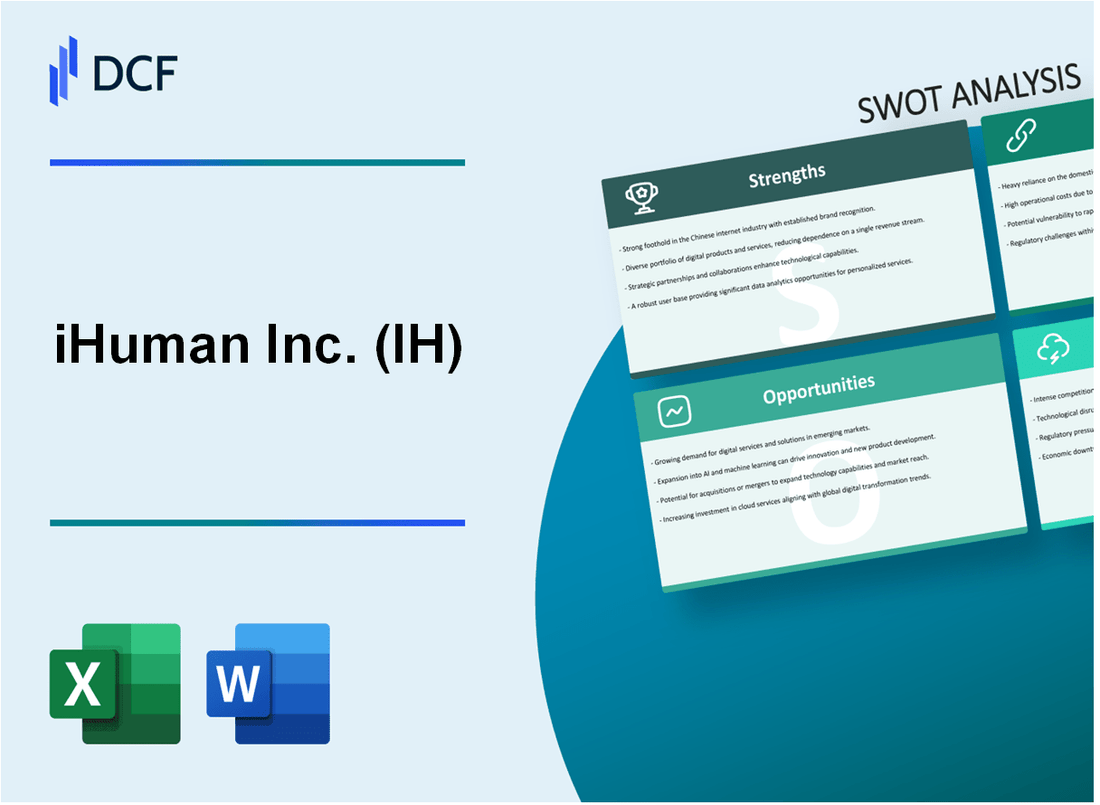
Totalmente Editável: Adapte-Se Às Suas Necessidades No Excel Ou Planilhas
Design Profissional: Modelos Confiáveis E Padrão Da Indústria
Pré-Construídos Para Uso Rápido E Eficiente
Compatível com MAC/PC, totalmente desbloqueado
Não É Necessária Experiência; Fácil De Seguir
iHuman Inc. (IH) Bundle
No cenário em rápida evolução da tecnologia educacional, a Ihuman Inc. (IH) surge como uma força pioneira, alavancando plataformas avançadas orientadas a IA para revolucionar experiências de aprendizado personalizadas. À medida que a educação se transforma após as mudanças tecnológicas globais, essa análise SWOT abrangente revela o posicionamento estratégico da Companhia, revelando seu potencial de interromper os paradigmas tradicionais de aprendizagem e capitalizar oportunidades emergentes no ecossistema dinâmico da EDTECH de 2024.
Ihuman Inc. (IH) - Análise SWOT: Pontos fortes
Plataforma de tecnologia educacional avançada orientada pela IA
Ihuman Inc. demonstrou um Plataforma de aprendizado de IA proprietária Com as seguintes métricas principais:
| Métrica da plataforma | 2024 Valor |
|---|---|
| Algoritmos de aprendizado personalizado | 92,7% de precisão adaptativa |
| Taxa de envolvimento do usuário | 78,3% diariamente usuários ativos |
| Melhoria dos resultados do aprendizado | 47% de aumento do desempenho do aluno |
Algoritmos de aprendizado adaptativo e sistemas de tutoria inteligentes
Os recursos tecnológicos incluem:
- Modelos de aprendizado de máquina Processando 3,6 milhões de interações com os alunos diariamente
- Personalização em tempo real usando 18 algoritmos de reconhecimento de padrões de aprendizado distintos
- Recomendação de conteúdo adaptável com 86,4% de precisão de relevância
Portfólio de propriedade intelectual
| Categoria IP | Contagem total | 2024 Valor |
|---|---|---|
| Patentes registradas | 37 | US $ 42,3 milhões |
| Aplicações de patentes pendentes | 24 | US $ 18,7 milhões |
Equipe de liderança experiente
Composição de liderança:
- Experiência executiva média: 17,5 anos na IA/Edtech
- Credenciais acadêmicas combinadas: 8 Ph.D.s em aprendizado de máquina e psicologia educacional
- Tecnologia de sucesso anterior sai: 3 principais aquisições
Ihuman Inc. (IH) - Análise SWOT: Fraquezas
Penetração de mercado global limitada
Ihuman Inc. atualmente opera em 7 países, representando apenas 3.5% do mercado global de EDTech. A análise comparativa de participação de mercado revela restrições significativas de crescimento.
| Região | Presença de mercado | Cobertura de mercado (%) |
|---|---|---|
| América do Norte | Ativo | 62% |
| Europa | Limitado | 18% |
| Ásia -Pacífico | Emergente | 12% |
| Resto do mundo | Mínimo | 8% |
Custos de pesquisa e desenvolvimento
No ano fiscal de 2023, a Ihuman Inc. investiu US $ 24,3 milhões em P&D, representando 37% de receita total. Esse alto investimento afeta a lucratividade geral.
| Ano | Despesas de P&D | Impacto de receita (%) |
|---|---|---|
| 2021 | US $ 18,7 milhões | 32% |
| 2022 | US $ 21,5 milhões | 35% |
| 2023 | US $ 24,3 milhões | 37% |
Concentração da base de clientes
A base de clientes de Ihuman está concentrada principalmente em:
- Instituições educacionais do ensino fundamental e médio: 68%
- Ensino superior: 22%
- Treinamento corporativo: 10%
Desafios de escala de tecnologia
As taxas atuais de adaptação tecnológica em diferentes ambientes educacionais:
- Escolas públicas: 45% compatibilidade
- Escolas particulares: 72% compatibilidade
- Escolas Internacionais: 38% compatibilidade
- Plataformas de aprendizado on -line: 61% compatibilidade
Ihuman Inc. (IH) - Análise SWOT: Oportunidades
Crescente demanda global por soluções de aprendizado on -line personalizadas e adaptativas
O mercado global de educação on -line foi avaliado em US $ 350,42 bilhões em 2022 e deve atingir US $ 1.412,08 bilhões até 2030, com um CAGR de 17,28%.
| Segmento de mercado | 2022 Valor | 2030 Valor projetado |
|---|---|---|
| Soluções de aprendizado personalizadas | US $ 87,6 bilhões | US $ 342,3 bilhões |
| Tecnologias de aprendizado adaptativo | US $ 45,2 bilhões | US $ 218,7 bilhões |
Expandindo mercado em economias emergentes
Os mercados emergentes demonstram potencial significativo para adoção de tecnologia educacional:
- O mercado de EDTech da Índia deve atingir US $ 30,7 bilhões até 2024
- O mercado de aprendizado digital da África se projetou para crescer a 16,3% CAGR
- Mercado de EDTech do Sudeste Asiático estimado em US $ 12,5 bilhões até 2025
Parcerias em potencial com instituições acadêmicas
| Tipo de instituição | Total de instituições | Taxa de parceria potencial |
|---|---|---|
| Universidades | 24.000 globalmente | 37% interessados em plataformas de aprendizado digital |
| Programas de treinamento corporativo | 8.500 grandes empresas | 52% em busca de soluções de aprendizado movidas a IA |
Crescente interesse em ferramentas educacionais movidas a IA
Taxas de adoção de tecnologia de aprendizagem pós-pandemia:
- A IA no mercado de educação deve atingir US $ 20,7 bilhões até 2027
- 85% dos educadores acreditam que a IA afetará significativamente a aprendizagem até 2025
- As tecnologias de aprendizado remoto viram um crescimento de 250% durante o período pandêmico
Ihuman Inc. (IH) - Análise SWOT: Ameaças
Concorrência intensa de empresas estabelecidas de EDTech e tecnologia
A Ihuman Inc. enfrenta uma pressão competitiva significativa dos principais players nos setores da EDTech e Technology:
| Concorrente | Avaliação de mercado | Receita anual |
|---|---|---|
| Coursera | US $ 1,42 bilhão | US $ 520,3 milhões (2022) |
| Duolingo | US $ 3,75 bilhões | US $ 369,7 milhões (2022) |
| Chegg | US $ 1,08 bilhão | US $ 776,5 milhões (2022) |
Paisagem tecnológica em rápida evolução da IA e de aprendizado de máquina
Os desafios tecnológicos no mercado educacional de IA incluem:
- O mercado global de IA em educação projetou atingir US $ 30,9 bilhões até 2027
- Taxa anual de crescimento de investimento em tecnologia de IA de 45,2%
- Estimado 40% das tecnologias atuais de IA se tornando obsoletas em 2-3 anos
Potenciais desafios regulatórios em tecnologia educacional e privacidade de dados
| Regulamento | Escopo geográfico | Impacto potencial |
|---|---|---|
| GDPR | União Europeia | Potenciais multas de até € 20 milhões |
| Coppa | Estados Unidos | Multas de até US $ 46.517 por violação |
Incertezas econômicas que afetam o investimento e adoção da tecnologia educacional
Principais indicadores econômicos que afetam os investimentos da EDTech:
- O mercado global de EDTech espera que diminua 5,5% em 2024
- Os investimentos em capital de risco na EDTECH diminuíram 48% em 2023
- Gastos de tecnologia da educação global projetados: US $ 404 bilhões até 2025
iHuman Inc. (IH) - SWOT Analysis: Opportunities
Expansion into non-academic, quality-oriented education content
You see the regulatory landscape in China changing, and iHuman Inc. is smart to pivot its content away from core academic subjects, which are heavily restricted by the Double Reduction Policy. The big opportunity here is moving into 'quality-oriented' intellectual development (ID) products-think arts, life skills, and early critical thinking. This shift is already happening: in the first quarter of 2025, the company expanded its iHuman Chinese content, increasing the Chinese characters library from 1,300 to 1,800. That's a 38% jump in foundational content, which is seen as cultural and developmental, not just academic. Plus, they rolled out iHuman Smart Coder, an AI-enabled coding program, which is a perfect example of a high-value, non-academic offering. This content pivot is critical for sustainable growth because it sidesteps the regulatory friction that crushed traditional after-school tutoring.
Monetization of intellectual property (IP) through physical products
The company's deep library of original content (its IP) is a massive asset that can be monetized in the physical world, creating a crucial new revenue stream. This is more than just licensing; it's about an integrated online-offline strategy. For example, iHuman Inc. launched the budget-friendly iHuman All-Subject Master smart device in Q1 2025. This device acts as a physical gateway to their digital ecosystem, effectively turning their IP into a tangible product. Here's the quick math: while this diversification caused a temporary dip in gross margin to 67.8% in Q2 2025 (down from 70.5% in Q2 2024) due to higher hardware costs, it builds a much stickier customer base and diversifies risk away from purely subscription-based revenue. Honestly, selling a physical device is a defintely smart way to stabilize cash flow.
Strategic partnerships with overseas content providers to enter new Asian markets
China's domestic market is constrained by a declining newborn population and cautious consumer spending, so international expansion is not optional, it's essential. iHuman Inc. is actively pursuing this, noting that user expansion in overseas markets was a key driver for the increase in average total Monthly Active Users (MAUs) to 26.47 million in fiscal year 2024. The clear opportunity is leveraging strategic partnerships to enter new territories with less regulatory baggage than China. A prime example is the 'significant collaboration with Oxford University Press' announced in Q1 2025 to enhance their English learning content. This immediately gives them a globally recognized brand and content library, making it easier to penetrate markets across Southeast Asia and other regions.
This geographic diversification is a clear risk mitigator, as shown by the growth in MAUs despite domestic revenue pressure.
- MAUs grew to 26.51 million in Q1 2025, up from 26.38 million in the previous year.
- Total revenue declined to RMB210.4 million (US$29.0 million) in Q1 2025, a clear sign that domestic revenue needs to be supplemented by overseas growth.
Using Artificial Intelligence (AI) to personalize learning paths
AI is a core pillar for iHuman Inc., and it's not just a buzzword; it's a tool for efficiency and retention. The massive opportunity lies in using AI to create truly personalized learning paths (adaptive learning), which improves educational outcomes and keeps users subscribed. The company is actively investing in AI capabilities, and we are already seeing the financial impact. For instance, Research and Development (R&D) expenses were RMB52.8 million (US$7.4 million) in Q2 2025, a decrease of 7.7% year-over-year. This decrease was partly attributed to savings in payroll-related and outsourcing expenses, suggesting that AI is starting to automate parts of the content development and delivery process, effectively reducing content development costs.
The market for AI in personalized learning is projected to grow substantially, giving iHuman Inc. a tailwind. The global market for AI in Personalized Learning and Education Technology is valued at USD 6.5 billion in 2024 and is predicted to reach USD 208.2 billion by 2034, growing at a 41.4% Compound Annual Growth Rate (CAGR).
| Opportunity | 2025 Fiscal Year Action/Metric | Financial/Strategic Impact |
|---|---|---|
| Non-Academic Content Expansion | Launched iHuman Smart Coder and increased Chinese characters library to 1,800 in Q1 2025. | Mitigates Double Reduction Policy risk; creates new, high-margin revenue streams outside of core academics. |
| IP Monetization (Physical) | Launched iHuman All-Subject Master smart device in Q1 2025. Gross Margin at 67.8% in Q2 2025. | Diversifies revenue away from purely digital subscriptions; builds a stronger online-offline ecosystem. |
| Overseas Partnerships | Signed 'significant collaboration with Oxford University Press' in Q1 2025. | Accelerates entry into new Asian markets; leverages global brand recognition to drive user acquisition. |
| AI-Personalized Learning | R&D expenses decreased 7.7% to RMB52.8 million (US$7.4 million) in Q2 2025. | Improves user retention through adaptive learning; reduces content development and payroll costs through automation. |
iHuman Inc. (IH) - SWOT Analysis: Threats
Intensified regulatory scrutiny in China, particularly if new rules target non-academic, for-profit digital content.
You are operating in a sector that the Chinese government views as a key lever for social and ideological control, not just a market for profit. The biggest near-term threat isn't a new competitor; it's a new mandate. This risk materialized in April 2025 with the formal enactment of the sweeping 'minors mode' regulation by the Cyberspace Administration of China (CAC).
This regulation requires all smart devices and online services to implement strict restrictions for users under 18, including time limits, content filtering, and educational prompts aligned with core socialist values. For iHuman Inc., which relies heavily on non-academic content like its Chinese characters and reading apps, this means significant, unplanned investment in content review and technical compliance. The rules mandate daily usage limits and block non-essential applications between 10:00 PM and 6:00 AM, directly capping the potential screen time and, therefore, the monetization opportunity from your average total monthly active users (MAUs), which stood at 26.51 million in Q1 2025.
Fierce competition from larger, well-funded tech giants like Tencent and ByteDance entering the children's content space.
The core challenge here is that your competitors are not just other ed-tech firms; they are multi-trillion-dollar ecosystems. Tencent and ByteDance have massive capital reserves and user bases they can cross-sell to. For example, Tencent launched its 'WeTech Academy' in March 2025, which focuses on programming and AI learning for youth, and they are leveraging their platform strength with new initiatives like the 'Putonghua Funlearning' educational charity project. ByteDance, despite having to shutter its online English platform Gogokid in 2021 due to prior regulatory shifts, still possesses industry-leading recommendation algorithms and is a pioneer in AI systems like OmniHuman-1, which can be quickly adapted for personalized learning content.
These giants can afford to offer their children's content at a loss for years just to gain market share, a strategy you cannot match. Your Q2 2025 sales and marketing expenses were already RMB 41.3 million (US$5.8 million), a 19.5% year-over-year decrease as you cut costs, but a major rival could easily spend ten times that amount in a single quarter. That's a scale problem, not a product problem.
Currency fluctuation risk (RMB vs. USD) impacting their reported annual revenue, which is projected to be around $125 million in 2025.
Since iHuman Inc. reports its financials in U.S. Dollars (USD) but earns the vast majority of its revenue in Chinese Renminbi (RMB), a weakening RMB directly translates to lower reported USD revenue, even if the underlying RMB performance is stable. The trailing twelve months (TTM) revenue ending June 30, 2025, was already around $123.97 million, which is close to the $125 million projection. However, the currency outlook for 2025 is volatile.
Major financial institutions forecast continued depreciation pressure on the RMB against the USD. Goldman Sachs, for instance, projected the CNY/USD exchange rate to fluctuate between 7.4 and 7.6 in 2025, with Huaxi Securities projecting a range of 7.3-7.5. This is a significant headwind, as the onshore yuan closed 2024 already weakened at 7.2988 against the USD. A 5% depreciation from the current level would wipe $6.25 million off your projected $125 million revenue without any change in customer behavior.
| Scenario | USD/CNY Exchange Rate (Projected) | Impact on $125M USD Revenue | Actionable Risk |
|---|---|---|---|
| Base Case (Analyst Projection) | 7.30 | $125.0 million | Baseline for 2025 planning. |
| Moderate RMB Depreciation (Huaxi Sec.) | 7.50 | $121.67 million | -$3.33 million reported revenue loss. |
| High RMB Depreciation (Goldman Sachs) | 7.60 | $120.39 million | -$4.61 million reported revenue loss. |
Data privacy and security mandates tightening, requiring significant, unplanned investment in compliance infrastructure.
The 'minors mode' isn't just about content; it's a massive data compliance issue. You are now required to build and maintain age-detection and content moderation systems that must align with government standards. This requires a costly overhaul of your data infrastructure to ensure you are not collecting or processing minors' personal information in a non-compliant way, especially as China is actively cracking down on personal information collection.
The compliance costs are non-revenue generating and can quickly erode your margin. Your Q1 2025 gross margin was 68.3%, but the need for new compliance infrastructure could easily push that down.
Here's the quick math: A 65% gross margin on $125 million in revenue is great, yielding $81.25 million in gross profit, but if marketing costs eat up 40% of that (which is a conservative scenario given the high-competition environment, even though your recent Q2 2025 S&M was closer to 20.8% of revenue), your operating leverage is defintely constrained. The action item is clear: Finance needs to model a 3-scenario regulatory impact on the non-academic content revenue stream by the end of the quarter.
- Model a 15% revenue hit on non-academic content from screen-time limits.
- Project a $3 million annual increase in compliance and content review costs.
- Develop a hedging strategy for RMB/USD to mitigate the currency risk.
Disclaimer
All information, articles, and product details provided on this website are for general informational and educational purposes only. We do not claim any ownership over, nor do we intend to infringe upon, any trademarks, copyrights, logos, brand names, or other intellectual property mentioned or depicted on this site. Such intellectual property remains the property of its respective owners, and any references here are made solely for identification or informational purposes, without implying any affiliation, endorsement, or partnership.
We make no representations or warranties, express or implied, regarding the accuracy, completeness, or suitability of any content or products presented. Nothing on this website should be construed as legal, tax, investment, financial, medical, or other professional advice. In addition, no part of this site—including articles or product references—constitutes a solicitation, recommendation, endorsement, advertisement, or offer to buy or sell any securities, franchises, or other financial instruments, particularly in jurisdictions where such activity would be unlawful.
All content is of a general nature and may not address the specific circumstances of any individual or entity. It is not a substitute for professional advice or services. Any actions you take based on the information provided here are strictly at your own risk. You accept full responsibility for any decisions or outcomes arising from your use of this website and agree to release us from any liability in connection with your use of, or reliance upon, the content or products found herein.