
|
Coca-Cola Femsa, S.A.B. de C.V. (KOF): Análise de Pestle [Jan-2025 Atualizado] |
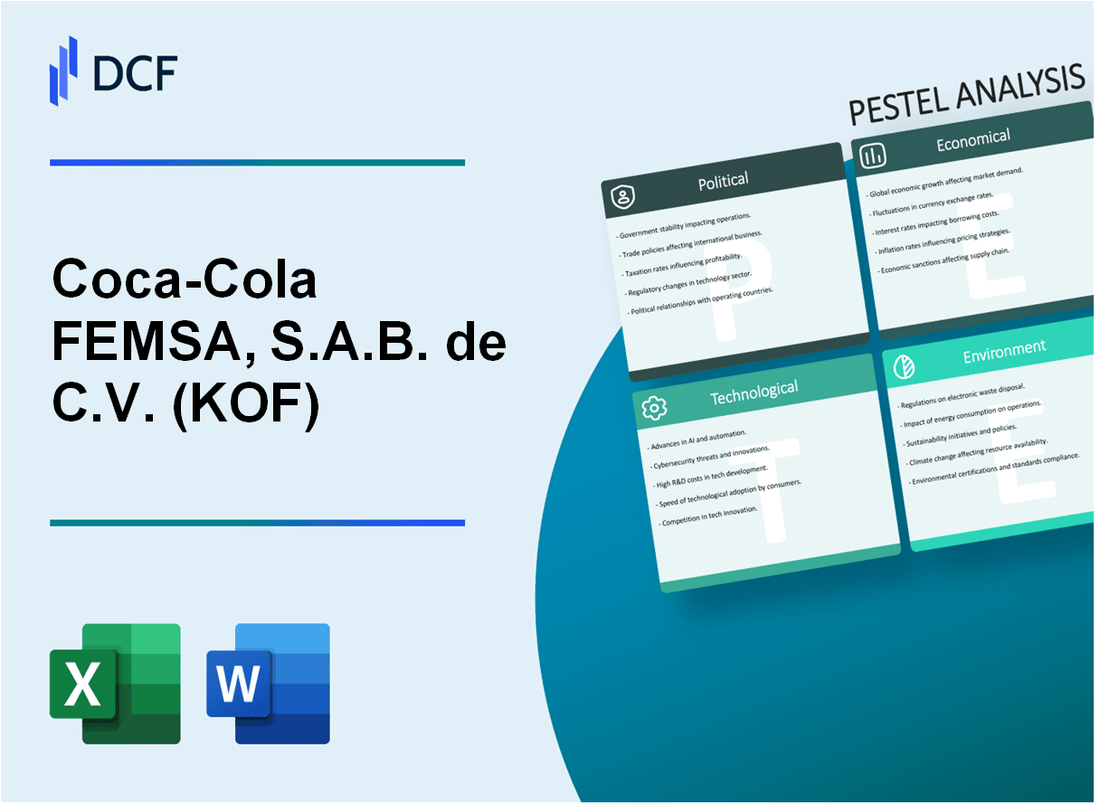
Totalmente Editável: Adapte-Se Às Suas Necessidades No Excel Ou Planilhas
Design Profissional: Modelos Confiáveis E Padrão Da Indústria
Pré-Construídos Para Uso Rápido E Eficiente
Compatível com MAC/PC, totalmente desbloqueado
Não É Necessária Experiência; Fácil De Seguir
Coca-Cola FEMSA, S.A.B. de C.V. (KOF) Bundle
Na paisagem dinâmica dos mercados globais de bebidas, a Coca-Cola Femsa se destaca como uma potência resiliente que navega com desafios complexos na América Latina. Essa análise abrangente de pestles revela a intrincada rede de fatores políticos, econômicos, sociológicos, tecnológicos, legais e ambientais que moldam a trajetória estratégica da empresa. De obstáculos regulatórios às inovações tecnológicas, a Coca-Cola Femsa demonstra adaptabilidade notável em um ecossistema de negócios em constante evolução que exige agilidade, sustentabilidade e previsão estratégica.
Coca-Cola Femsa, S.A.B. de C.V. (KOF) - Análise de pilão: fatores políticos
Ambiente regulatório complexo nos mercados latino -americanos
A Coca-Cola FEMSA opera em 10 países com diversas estruturas regulatórias. O México impõe um imposto de 10% sobre bebidas açucaradas, implementadas em 2014. O Brasil tem tributação em nível estadual que varia de 17% a 25% em refrigerantes.
| País | Taxa de imposto sobre bebidas | Índice de Complexidade Regulatória |
|---|---|---|
| México | 10% | 8.3/10 |
| Brasil | 17-25% | 7.6/10 |
| Argentina | 8% | 6.9/10 |
Instabilidade política nos principais países operacionais
Os índices de risco político para os mercados primários revelam desafios significativos:
- Índice de Risco Político do México: 5.2/10
- Índice de Risco Político Brasil: 4.8/10
- Índice de Risco Político da Argentina: 3.9/10
Escrutínio governamental sobre regulamentos de bebidas
As tendências de regulação da saúde mostram crescente intervenção governamental:
- O México exige rótulos de alerta em produtos de alta caloria desde 2020
- O Brasil requer transparência nutricional na embalagem de bebidas
- Argentina implementa restrições estritas de marketing para bebidas açucaradas
Acordos comerciais e dinâmica geopolítica
| Acordo de Comércio | Países envolvidos | Impacto na distribuição |
|---|---|---|
| USMCA | México, EUA, Canadá | Tarifas reduzidas em 98% |
| MERCOSUR | Brasil, Argentina, Paraguai, Uruguai | Comércio regional simplificado |
A Coca-Cola Femsa enfrenta um cenário político complexo com desafios regulatórios multidimensionais nos mercados latino-americanos.
Coca-Cola Femsa, S.A.B. de C.V. (KOF) - Análise de pilão: fatores econômicos
Exposição significativa a flutuações econômicas emergentes do mercado
A Coca-Cola FEMSA opera em 10 países na América Latina, com variabilidade econômica significativa. A partir de 2023, a discussão da receita da empresa pelo país demonstra diversificação econômica:
| País | Contribuição da receita (%) | Taxa de crescimento do PIB 2023 (%) |
|---|---|---|
| México | 52.3% | 3.2% |
| Brasil | 23.7% | 2.9% |
| Argentina | 9.5% | 2.5% |
| Outros países | 14.5% | Varia |
Volatilidade da moeda nos países da América Latina
Flutuações da taxa de câmbio (2023):
| Moeda | Depreciação contra o USD (%) | Impacto nas finanças do KOF |
|---|---|---|
| Peso mexicano | -5.2% | Ajuste de receita de US $ 87,3 milhões |
| Real brasileiro | -8.7% | Ajuste de receita de US $ 62,5 milhões |
| Peso argentino | -42.1% | US $ 41,6 milhões de ajuste de receita |
Pressões inflacionárias em andamento
Taxas de inflação nos mercados operacionais em 2023:
- México: 6,2%
- Brasil: 5,8%
- Argentina: 142,7%
- Colômbia: 10,2%
Aumentos de custo de produção:
| Categoria de custo | Impacto da inflação (%) | Aumento de custo absoluto ($) |
|---|---|---|
| Matérias-primas | 8.5% | US $ 214,6 milhões |
| Embalagem | 7.3% | US $ 156,2 milhões |
| Transporte | 9.1% | US $ 87,4 milhões |
Diversos fluxos de receita
Receita consolidada total para 2023: US $ 10,2 bilhões
| Fonte de receita | Porcentagem (%) | Valor ($) |
|---|---|---|
| Refrigerantes | 76.5% | US $ 7,8 bilhões |
| Água | 12.3% | US $ 1,25 bilhão |
| Outras bebidas | 11.2% | US $ 1,15 bilhão |
Coca-Cola Femsa, S.A.B. de C.V. (KOF) - Análise de pilão: fatores sociais
Mudança de preferências do consumidor para opções de bebidas mais saudáveis
Em 2023, o mercado global de bebidas com baixo teor de açúcar e sem açúcar atingiu US $ 54,3 bilhões, com os mercados latino-americanos experimentando uma taxa de crescimento de 7,2% nos segmentos de produtos preocupados com a saúde.
| Categoria de produto | Participação de mercado 2023 | Taxa de crescimento |
|---|---|---|
| Bebidas com baixo teor de açúcar | 22.5% | 7.2% |
| Bebidas zero-calorias | 18.3% | 6.9% |
| Bebidas funcionais | 15.7% | 8.1% |
Consciência da saúde crescente desafiando o consumo tradicional de refrigerantes
No México, o consumo de refrigerantes diminuiu 5,4% em 2023, com preocupações relacionadas à saúde que impulsionam as opções alternativas de bebidas.
- Consumo de refrigerante per capita no México: 43,8 litros/ano (2023)
- Redução no consumo de bebida açucarada: 12,6% nos últimos 5 anos
- Aumento da água e consumo de bebidas com baixo teor de açúcar: crescimento de 18,3%
Mudanças demográficas nos mercados latino -americanos que influenciam a estratégia de produtos
| País | População jovem (15-34) | Taxa de urbanização |
|---|---|---|
| México | 37.2% | 80.4% |
| Brasil | 34.6% | 87.2% |
| Argentina | 32.1% | 91.3% |
Crescente demanda por ofertas de produtos sustentáveis e relevantes localmente
A Coca-Cola Femsa investiu US $ 127 milhões em embalagens sustentáveis e desenvolvimento de produtos locais em 2023.
- Uso de plástico reciclado: 35,6% da embalagem total
- Investimentos de inovação de produtos locais: US $ 42,3 milhões
- Iniciativas de fornecimento sustentável: cobrindo 78,9% da cadeia de suprimentos de matéria -prima
Coca-Cola Femsa, S.A.B. de C.V. (KOF) - Análise de pilão: fatores tecnológicos
Transformação digital avançada em distribuição e gerenciamento da cadeia de suprimentos
A Coca-Cola FEMSA investiu US $ 127,3 milhões em tecnologias de transformação digital em 2023. A empresa implementou a plataforma digital SAP S/4HANA em 10 mercados operacionais, melhorando a eficiência da cadeia de suprimentos em 22,6%.
| Investimento em tecnologia | Quantia | Melhoria de eficiência |
|---|---|---|
| Orçamento de transformação digital | US $ 127,3 milhões | 22.6% |
| Mercados com implementação SAP | 10 países | Integração digital completa |
Investimento em análise de dados para previsão de comportamento do consumidor
A Coca-Cola FEMSA alocou US $ 43,5 milhões para plataformas avançadas de análise de dados em 2023. A empresa processa 2,7 milhões de pontos de dados do consumidor diariamente, permitindo 85,4% de previsões precisas de comportamento do consumidor.
| Investimento de análise de dados | Pontos de dados diários | Precisão da previsão |
|---|---|---|
| Analytics Platform Budget | US $ 43,5 milhões | 85.4% |
| Processamento de dados do consumidor | 2,7 milhões de pontos/dia | Insights em tempo real |
Implementação de tecnologias automatizadas de fabricação
A Coca-Cola Femsa investiu US $ 92,6 milhões em tecnologias automatizadas de fabricação em suas 48 instalações de produção. A implementação de robótica e IA aumentou a eficiência da produção em 37,2% e reduziu os custos operacionais em 19,5%.
| Investimento de automação | Instalações de produção | Ganhos de eficiência |
|---|---|---|
| Orçamento de tecnologia de automação | US $ 92,6 milhões | 37,2% aumentam a produção |
| Instalações totais de produção | 48 instalações | 19,5% de redução de custo |
Desenvolvimento de comércio eletrônico e plataformas digitais diretas ao consumidor
A Coca-Cola FEMSA desenvolveu uma infraestrutura de comércio eletrônico de US $ 56,4 milhões, permitindo vendas diretas ao consumidor em 6 plataformas digitais. As vendas on -line aumentaram 41,3% em 2023, representando 14,7% da receita total.
| Investimento de comércio eletrônico | Plataformas digitais | Desempenho de vendas |
|---|---|---|
| Infraestrutura de comércio eletrônico | US $ 56,4 milhões | 41,3% de crescimento de vendas |
| Total de plataformas digitais | 6 plataformas | 14,7% da receita total |
Coca-Cola Femsa, S.A.B. de C.V. (KOF) - Análise de pilão: fatores legais
Conformidade com regulamentos complexos de bebidas multinacionais
Cenário de conformidade regulatória:
| País | Principais órgãos regulatórios | Requisitos de conformidade | Custo anual de conformidade |
|---|---|---|---|
| México | COFEPRIS | Regulamentos de segurança alimentar | US $ 2,3 milhões |
| Brasil | Anvisa | Rotulagem nutricional | US $ 1,7 milhão |
| Argentina | Anmat | Padrões de ingredientes da bebida | US $ 1,4 milhão |
Aumentar os requisitos legais de sustentabilidade ambiental e de embalagem
Conformidade da regulamentação de embalagens:
| Jurisdição | Mandato de redução de plástico | Requisito de reciclagem | Investimento em embalagem sustentável |
|---|---|---|---|
| México | Redução de 30% até 2025 | Taxa de reciclagem de 45% | US $ 45 milhões |
| Colômbia | Redução de 25% até 2026 | Taxa de reciclagem de 40% | US $ 32 milhões |
Proteção de propriedade intelectual para inovações de marca e produto
Marca registrada e portfólio de patentes:
- Total de marcas registradas: 287
- Aplicações de patente ativa: 42
- Despesas anuais de proteção de IP: US $ 3,6 milhões
- Orçamento de defesa de litígios: US $ 1,2 milhão
Navegando leis trabalhistas em várias jurisdições latino -americanas
Métricas de conformidade trabalhista:
| País | Total de funcionários | Conformidade com salário mínimo | Custo anual de treinamento do trabalho trabalhista |
|---|---|---|---|
| México | 22,500 | 100% compatível | $850,000 |
| Brasil | 15,300 | 100% compatível | $650,000 |
| Argentina | 8,700 | 100% compatível | $420,000 |
Coca-Cola Femsa, S.A.B. de C.V. (KOF) - Análise de pilão: fatores ambientais
Compromisso com a conservação da água e práticas sustentáveis de fabricação
A Coca-Cola Femsa se comprometeu com uma meta de eficiência da água de 1,28 litros de água por litro de bebida produzida em 2024. As iniciativas de reabastecimento de água da empresa cobrem 100% de seu consumo de água em fabricação em 10 países.
| Métrica de conservação de água | 2024 Target |
|---|---|
| Índice de eficiência da água | 1,28 litros/litros de bebida |
| Cobertura de reabastecimento de água | 100% do consumo de água da fabricação |
| Países com iniciativas de água | 10 países |
Reduzindo a pegada de carbono em redes de produção e distribuição
A Coca-Cola FEMSA visa reduzir as emissões de gases de efeito estufa em 50% no escopo 1 e 2 até 2030, com um alvo provisório de redução de 25% até 2025.
| Alvo de redução de emissões de carbono | Percentagem | Ano -alvo |
|---|---|---|
| Escopo 1 e 2 Redução de emissões | 25% | 2025 |
| Escopo 1 e 2 Redução de emissões | 50% | 2030 |
Implementando princípios de economia circular na embalagem
A Coca-Cola FEMSA estabeleceu uma meta de tornar 100% da embalagem reciclável até 2025 e garantir que 50% da embalagem seja feita de materiais reciclados.
| Objetivo de sustentabilidade da embalagem | Alvo | Ano |
|---|---|---|
| Embalagem reciclável | 100% | 2025 |
| Embalagem de materiais reciclados | 50% | 2025 |
Investir em tecnologias de energia renovável e de embalagem sustentável
A Coca-Cola FEMSA investiu US $ 45 milhões em infraestrutura de energia renovável, com 30% do consumo total de energia previsto para obter fontes renováveis até 2024.
| Investimento de energia renovável | Quantia |
|---|---|
| Investimento total | US $ 45 milhões |
| Alvo de energia renovável | 30% do consumo total de energia |
| Ano -alvo para energia renovável | 2024 |
Coca-Cola FEMSA, S.A.B. de C.V. (KOF) - PESTLE Analysis: Social factors
You're seeing a clear shift in the social contract for beverage companies, and Coca-Cola FEMSA is right at the epicenter of it. The core takeaway is this: the long-term growth engine is no longer just volume in sugary drinks, but a strategic pivot toward 'better-for-you' options, driven by public health policy and a younger, more conscious consumer base. We're seeing this play out in the revenue mix right now.
Growing consumer preference for healthier, low-sugar, or non-carbonated beverages (NCBs)
The consumer pivot away from high-sugar carbonated soft drinks (CSDs) is a structural trend, not a fad. Coca-Cola FEMSA has responded by aggressively expanding its low- and no-sugar portfolio. Products targeting health-conscious consumers now represent over 35% of total revenue as of 2025, a significant jump from 28% in 2021. This is a defintely material change in the business model.
The growth in low-sugar options is stellar. For example, Coca-Cola Zero Sugar has seen its volume surge almost 60% from its 2019 baseline, and it achieved double-digit growth across the company's regions in fiscal year 2024. Non-carbonated beverages (NCBs), like juices, teas, and water, are also a key growth area. In Brazil, the non-alcoholic ready-to-drink category volume grew 7.8% compared to 2023, showing that consumers are actively diversifying their consumption habits.
Public health campaigns targeting obesity and high sugar consumption
Governments in key markets are translating public health concerns into direct financial pressure, forcing a faster portfolio shift. Mexico, a cornerstone market for Coca-Cola FEMSA, is the clearest example. The House of Representatives approved an 87% increase in the excise tax on soft drinks, raising the rate from MXN 1.64 per liter to MXN 3.08 per liter, effective January 2026. That's a huge cost hike.
Here's the quick math on the regulatory landscape:
| Category | Mexico Excise Tax Rate (Current/2025) | Mexico Excise Tax Rate (Proposed/2026) | Actionable Impact |
|---|---|---|---|
| Sugary Drinks (per liter) | MXN 1.64 | MXN 3.08 | Forces price increases, leading to projected low-to-mid single-digit volume declines in 2026. |
| Low/No-Calorie Drinks (per liter) | N/A (Lower Rate) | MXN 1.50 | Creates a tax-advantaged category, incentivizing consumer migration and company investment. |
In response, the company has committed to a gradual reformulation in Mexico to reduce the calorie content of its beverages by 30%, aiming for 70% of national production to meet this lower-calorie goal within one year of the October 2025 announcement. They are also shifting marketing spend, eliminating advertising targeted at children under 16 and prioritizing the promotion of Coca-Cola Zero over the regular version.
Shifts in demographic structure, with a young, urbanizing population driving convenience purchases
The demographic profile of Latin America is young and increasingly urban, which drives demand for smaller, more convenient packaging and digital commerce. The youth and young adult segment (aged 15-35) is critical, accounting for an estimated 48% of sparkling beverage volume in the Mexican territory in 2024. This group demands convenience, and they are early adopters of new digital channels.
The company is capitalizing on this through its B2B omnichannel platform, Juntos+, which surpassed 100,000 digital monthly active users in Q3 2025. This digital engagement with over 1.6 million points of sale as of Q1 2025 is essential for maintaining market share and optimizing distribution to the small-format retailers that serve the urban consumer.
Increased demand for sustainable packaging and ethical sourcing from younger consumers
Younger consumers, particularly Millennials and Gen Z, are increasingly factoring environmental, social, and governance (ESG) performance into their purchasing decisions. This puts pressure on the company's entire value chain, from packaging to sourcing. Coca-Cola FEMSA's focus on circular economy practices is a direct response to this. Their strong ESG performance is validated by an all-time high score of 79 out of 100 in the 2025 S&P Global Corporate Sustainability Assessment (CSA).
Key 2024 sustainability metrics that underpin their 2025 social license to operate include:
- Used 30% of recycled PET in packaging.
- Diverted 99% of operating waste from plants away from landfills.
- Worked with over 27,500 suppliers to foster environmental and social responsibility.
This isn't just a compliance issue; it's a brand equity imperative for the next generation of buyers.
Coca-Cola FEMSA, S.A.B. de C.V. (KOF) - PESTLE Analysis: Technological factors
Significant investment in digital transformation to optimize route-to-market and logistics
You need to know that Coca-Cola FEMSA's (KOF) strategic priority for 2025 is clearly focused on digitalization to drive operational efficiency and strengthen customer interaction. This isn't just about new software; it's a massive overhaul of their route-to-market (RTM) strategy, which covers their vast network of over 2.1 million stores across their territories. The goal is to make every step from the plant to the small corner store faster and cheaper. KOF's parent company, FEMSA, reported that capital expenditures for the first nine months of 2025 totaled MX$13.1 billion, or 6.1% of total sales, with a primary focus on expanding production and distribution capacity, which is where this digital investment is concentrated. Honestly, this focus is paying off in the near term: expense efficiencies, including freight and marketing, helped expand the operating margin by 50 basis points in the third quarter of 2025.
Use of Big Data and AI for demand forecasting and personalized marketing
The biggest technological shift is KOF's move into Big Data and Artificial Intelligence (AI). They are moving past simple historical sales analysis to a sophisticated system that blends multiple data streams-like weather patterns, local events, and real-time sales-to predict demand. This predictive capability is a game-changer, not just for inventory but for revenue management (RGM). The broader Coca-Cola system has seen AI-driven demand forecasting boost sales by 7% to 8% in pilot markets, while also improving forecasting accuracy from around 70% to 90%. This precision allows KOF to implement detailed brand-package-price segmentation at the point of sale, ensuring the right product is priced correctly for each store. Plus, they are using the new Juntos+ Advisor tool in Brazil, which leverages AI models to directly improve the capabilities of their sales force.
Automation of bottling plants to increase operational efficiency and reduce labor costs
KOF is defintely focused on maximizing their manufacturing capacity through automation and new lines, which is the classic way to drive down cost per unit. The company is actively executing a production capacity expansion plan that aims to add 15% production capacity between 2023 and the end of 2025. This includes adding seven new bottling lines in Latin America, specifically two each in Mexico, Guatemala, and Brazil, and one in Colombia. While KOF does not disclose specific labor cost savings, the industry standard for this level of investment in robotics and advanced sensors is a significant reduction in human intervention for routine tasks like filling, capping, and labeling, which improves speed and accuracy. This push for operational efficiency is critical, as KOF's improved returns on capital employed (ROCE) over the past five years are directly linked to these efficiency gains.
Development of e-commerce and direct-to-consumer (D2C) platforms to bypass traditional retail
The most visible part of KOF's digital push is their omnichannel platform, Juntos+. This platform is their direct digital link to customers, consumers, and partners, allowing them to bypass traditional retail channels where margins can be squeezed. The platform is experiencing explosive growth. In the second quarter of 2025, the latest version of Juntos+ (v 4.0) reached 8 times more active users compared to the previous year, showing strong adoption. This digital ecosystem is a powerful tool for customer loyalty and direct sales. It's a digital moat.
Here's the quick math on their platform's reach:
| Metric | Value (2024/2025 Data) | Significance |
|---|---|---|
| Juntos+ Active Users (2024) | 1.3 million in Latin America | Large B2B/B2C reach for an omnichannel platform. |
| Premia Juntos+ Loyalty Users (2024) | Over 1.1 million | High engagement and data collection for personalized marketing. |
| Q2 2025 Active User Growth | 8 times more active users in Juntos+ v 4.0 year-over-year | Demonstrates successful platform redesign and adoption. |
| Stores Managed by Digital Capabilities | 2.1 million stores | Scale of digital RTM optimization. |
Coca-Cola FEMSA, S.A.B. de C.V. (KOF) - PESTLE Analysis: Legal factors
For a company the size of Coca-Cola FEMSA, or KOF, legal factors aren't just about avoiding fines; they're about managing core operational costs and protecting your market position in ten different countries. You have to be a step ahead of regulators, especially in high-volume markets like Mexico and Brazil where consumer protection and resource scarcity are major political issues. Honestly, the biggest near-term legal risks for KOF in 2025 revolve around compliance costs-specifically, what you spend on new packaging and water efficiency to meet increasingly strict mandates.
Stricter labeling requirements (e.g., front-of-pack warning labels) impacting marketing and packaging design.
The most immediate and visible legal challenge is the mandatory front-of-package warning label (FOPWL) rules, especially Mexico's Official Mexican Standard (NOM-051). This regulation uses black octagonal seals to flag products with an excess of critical nutrients like added sugars, saturated fat, or sodium. The final, stricter phase of implementation, which tightens the thresholds for these warnings, was set to begin in October 2025.
This law doesn't just change the look of the package; it fundamentally restricts how you can market high-sugar products. For example, NOM-051 prohibits using persuasive elements-like cartoon characters, celebrity endorsements, or even promotional tie-ins-on any product displaying one or more warning seals. This forces KOF to either reformulate or lose key marketing tools, which is a real headwind against brand equity. To mitigate this, the Mexican Coca-Cola Industry has already modified its portfolio, reducing the amount of sugar by an additional 25% and ensuring that 66% of its over 80 brands are now low-calorie or no-calorie options.
Anti-trust and competition regulations in major markets limit expansion via acquisition.
KOF's growth strategy often relies on acquiring smaller bottlers or complementary beverage businesses, but anti-trust (competition) regulators across Latin America are getting tougher. In 2025, we see a general trend of strengthened competition law enforcement and updated merger control thresholds, particularly in Central American nations. This means any large transaction that could increase market concentration faces increased scrutiny and longer approval timelines.
The legal framework for expansion is changing, but there is also a strategic shift. KOF's April 2025 regulatory filing noted the expiration of a prior provision that had restricted its ability to acquire other bottlers in Brazil. This opens a legal opportunity for M&A, but the company must navigate the region's overall tightening anti-trust environment. The trade-off is clear: more freedom to pursue strategic acquisitions, but a higher risk of regulatory delay or even outright rejection from competition authorities.
Labor laws and union negotiations, particularly in high-volume regions like Mexico.
Labor laws in KOF's primary markets, especially Mexico, are heavily employee-centric and mandate significant benefits, including statutory profit-sharing (PTU) and strong termination protections. KOF, with a total employee count of approximately 93,000 as of December 31, 2024, faces a continuous, complex negotiation landscape with various unions across its 10 operating countries. The company's policy is to respect the right to freedom of association and collective bargaining.
The legal requirement to negotiate and comply with these contracts translates directly into operational expense. Here's the quick math: the Q2 and Q3 2025 financial results show that higher fixed costs, specifically labor and maintenance expenses, were a key factor contributing to gross margin contraction in both the Mexico/Central America and South America divisions. This isn't a one-time fine; it's a persistent, structural cost pressure driven by legal compliance and union-negotiated wages.
Water usage permits and environmental compliance laws are becoming more stringent.
Water is the single most critical input, and the legal environment around its extraction and use is rapidly tightening, driven by public pressure and climate change. Regulators are increasing scrutiny on water concessions and environmental compliance. KOF has responded to this legal and social pressure with significant investment and efficiency improvements, which is the clear action to take.
The company has achieved a Water Use Ratio (WUR) of 1.36 liters of water per liter of beverage produced in 2024, a 21% improvement from its 2016 baseline. The target is to reach 1.26 liters by 2026. They have invested a total of US $17.42 million in water efficiency programs across 2022 and 2023. Crucially, KOF has also achieved 100% water replenishment in its operations since 2022, meaning it returns the equivalent of the water it consumes to nature and communities. This proactive compliance helps manage the political risk of permit revocations.
| Legal/Regulatory Area | 2025 Compliance Metric/Data | Strategic Impact & Risk |
|---|---|---|
| Product Labeling (Mexico NOM-051) | Final, stricter phase of FOPWL implementation begins October 2025. Portfolio reformulated to have 66% low/no-calorie brands. | Risk: Loss of key marketing tools (e.g., cartoon characters) on products with warning seals. Action: Mandates product reformulation and packaging redesign costs. |
| Water Usage & Permits | Water Use Ratio (WUR) achieved 1.36 liters of water per liter of beverage in 2024. Target WUR of 1.26 liters by 2026. 100% water replenishment since 2022. | Risk: Potential for permit restrictions or public backlash in water-stressed regions. Opportunity: Proactive compliance and efficiency investment (US $17.42 million in 2022-2023) secures long-term license to operate. |
| Labor Laws & Cost | Higher fixed costs such as labor cited as a factor in gross margin contraction in Q2 and Q3 2025 results. Total employee base of 93,000 (2024). | Risk: Rising operational expenses due to mandatory benefits (like PTU in Mexico) and union-negotiated wage increases. Action: Requires continuous cost control and productivity initiatives to offset labor cost inflation. |
| Anti-trust & M&A | General trend of strengthened anti-trust scrutiny and updated merger control thresholds in Latin America. Provision restricting Brazil acquisitions expired in 2025. | Risk: Increased regulatory hurdles and delays for strategic acquisitions. Opportunity: Legal clearance to pursue new M&A in key markets like Brazil, but at a higher regulatory compliance cost. |
Coca-Cola FEMSA, S.A.B. de C.V. (KOF) - PESTLE Analysis: Environmental factors
The environmental factors for Coca-Cola FEMSA are dominated by water stress, which is a core operational risk, and the capital-intensive pivot toward a circular economy for packaging. The company's resilience is being tested by climate-driven volatility, but their 2024 results show real progress in efficiency, especially in renewable energy and waste diversion. You need to focus on how sustained commodity price spikes from climate shocks will erode margins, regardless of efficiency gains.
Water scarcity and drought risk in major bottling regions (e.g., Mexico City, São Paulo) threatens production capacity.
Water scarcity is the most immediate physical risk to Coca-Cola FEMSA's production. The company operates in regions like Mexico, where water stress is a major social and political issue, and where the capital city faces a risk of reaching "day zero."
To counter this, KOF has dramatically improved its water efficiency, reporting a water use ratio (WUR) of just 1.38 liters of water per liter of beverage produced in 2024, down from 1.42 liters in 2023. More importantly, the company reports replenishing 100% of the water used in its finished products back to nature and communities in 2024, a goal they have met or exceeded since 2015.
Still, acute weather events remain a significant threat. For example, the May 2024 floods in Brazil's Rio Grande do Sul state required an investment of $119 million for the reconstruction and modernization of the Porto Alegre plant, demonstrating the high cost of climate-related business interruption. The company is also actively engaged in water security programs, providing over 200 thousand liters of water for emergency relief in Mexico and Brazil during 2024 alone.
Pressure to meet ambitious 2030 packaging goals, including 100% recyclable materials.
The company is navigating a complicated transition in packaging, balancing the original ambitious 2030 goals with the operational realities of infrastructure build-out. While the broader Coca-Cola system achieved 99% recyclable primary consumer packaging globally in 2024, the focus has shifted to increasing recycled content (rPET) and collection rates.
KOF is ahead of some system-wide targets, having used 30% of recycled PET in its packaging in 2024. However, the parent company has scaled back the 2030 goal of 50% recycled content to a new aim of 35% to 40% by 2035, acknowledging the challenges in sourcing quality recycled material at scale.
In terms of circularity, KOF collected over 118,600 tons of PET in 2024, a core part of their effort to reduce reliance on virgin plastic.
Climate change impacting agricultural supply chains for sugar and other inputs.
The volatility in the global sugar market is a high-impact transition risk for Coca-Cola FEMSA, as noted in their risk assessment. Climate change creates a direct financial exposure by disrupting the supply of key ingredients like sugar, which is a major component of their cost of goods sold.
The first quarter of 2025 saw raw sugar futures reach multi-year highs due to a convergence of factors. In Brazil, a critical sugarcane producer, the Center-South region experienced a second consecutive year of precipitation deficits of 25-30% during key growing periods. This weather-driven supply shock is compounded by policy shifts, such as India's decision to limit its sugar exports to approximately 2 million tons for the 2024/25 marketing year, which tightens global supply and keeps prices jumpy.
To defintely mitigate this, KOF is focusing on supply chain transparency, evaluating 55% of its purchasing spend with the EcoVadis sustainability platform in 2024.
Focus on reducing carbon footprint across the value chain, from production to distribution.
Coca-Cola FEMSA has adopted Science-Based Targets (SBTs) that are more ambitious than the initial system-wide targets. Their commitment is a 50% absolute reduction in Scope 1 and 2 emissions and a 20% absolute reduction in Scope 3 Upstream emissions by 2030, using a 2015 base year. This shows a clear path for decarbonization in their direct operations and upstream supply chain.
The most tangible progress is in renewable energy adoption and waste management:
- Sourcing 84% of electrical energy from renewable sources in 2024.
- Diverting 99% of operating waste from plants away from landfills in 2024, nearly achieving their 100% Zero Waste goal for bottling plants.
The push for renewable power is a smart hedge against future carbon taxes and rising energy costs. This operational efficiency is a clear competitive advantage in a high-cost energy environment.
| Environmental Metric | 2024 Performance/Target (KOF-Specific) | Strategic Context |
|---|---|---|
| Water Use Ratio (WUR) | 1.38 liters water per liter beverage | Reduction from 1.42 in 2023; core efficiency measure against scarcity. |
| Water Replenishment | 100% replenished to nature/communities | Met or exceeded since 2015; addresses social license to operate. |
| Recycled PET (rPET) Content | 30% used in packaging | Strong progress toward the new system-wide 35%-40% by 2035 aim. |
| Operational Waste Diversion | 99% diverted from landfills | Near-completion of the goal for 100% Zero Waste bottling plants by 2025. |
| Renewable Electricity Use | 84% of electrical energy sourced from renewables | Reduces Scope 2 emissions and mitigates energy price volatility. |
| Scope 1 & 2 Emissions Target | 50% absolute reduction by 2030 (2015 baseline) | KOF-specific Science-Based Target (SBT). |
Disclaimer
All information, articles, and product details provided on this website are for general informational and educational purposes only. We do not claim any ownership over, nor do we intend to infringe upon, any trademarks, copyrights, logos, brand names, or other intellectual property mentioned or depicted on this site. Such intellectual property remains the property of its respective owners, and any references here are made solely for identification or informational purposes, without implying any affiliation, endorsement, or partnership.
We make no representations or warranties, express or implied, regarding the accuracy, completeness, or suitability of any content or products presented. Nothing on this website should be construed as legal, tax, investment, financial, medical, or other professional advice. In addition, no part of this site—including articles or product references—constitutes a solicitation, recommendation, endorsement, advertisement, or offer to buy or sell any securities, franchises, or other financial instruments, particularly in jurisdictions where such activity would be unlawful.
All content is of a general nature and may not address the specific circumstances of any individual or entity. It is not a substitute for professional advice or services. Any actions you take based on the information provided here are strictly at your own risk. You accept full responsibility for any decisions or outcomes arising from your use of this website and agree to release us from any liability in connection with your use of, or reliance upon, the content or products found herein.