

|
S&P Global Inc. (SPGI): Análise de Pestle [Jan-2025 Atualizada] |
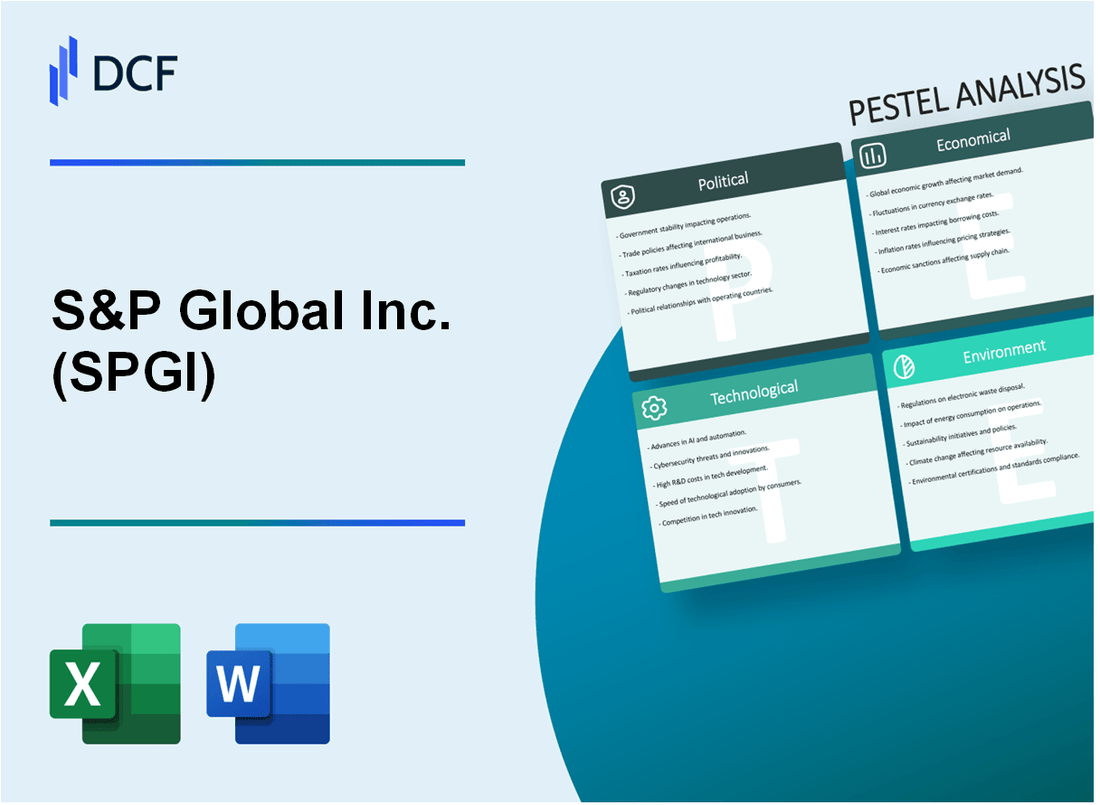
Totalmente Editável: Adapte-Se Às Suas Necessidades No Excel Ou Planilhas
Design Profissional: Modelos Confiáveis E Padrão Da Indústria
Pré-Construídos Para Uso Rápido E Eficiente
Compatível com MAC/PC, totalmente desbloqueado
Não É Necessária Experiência; Fácil De Seguir
S&P Global Inc. (SPGI) Bundle
No cenário dinâmico dos Serviços Financeiros Globais, a S&P Global Inc. (SPGI) permanece como uma força crucial, navegando em desafios interconectados complexos que abrangem domínios políticos, econômicos, sociológicos, tecnológicos, legais e ambientais. Essa análise abrangente de pestles revela as intrincadas considerações estratégicas que impulsionam uma das empresas financeiras e de análise mais influentes do mundo, revelando como o SPGI não apenas se adapta à dinâmica do mercado global, mas também os molda proativamente através de abordagens inovadoras e previsão estratégica. Mergulhe nessa exploração para entender o ecossistema multifacetado que impulsiona a notável resiliência e transformação contínua da S&P Global em um ambiente de negócios global cada vez mais incerto.
S&P Global Inc. (SPGI) - Análise de Pestle: Fatores Políticos
Conformidade regulatória global em vários mercados financeiros e jurisdições
A S&P Global Inc. opera em 31 países e deve cumprir com diversas estruturas regulatórias. A empresa gerencia a conformidade em várias jurisdições, incluindo:
| Região | Órgãos regulatórios | Requisitos de conformidade |
|---|---|---|
| Estados Unidos | Sec, CFTC | Dodd-Frank Lei Compliance |
| União Europeia | Esma, BCE | Regulamentos MiFID II |
| Ásia-Pacífico | ASIC, SEBI | Padrões de relatórios financeiros locais |
Potenciais tensões geopolíticas que afetam operações internacionais
As principais áreas de risco geopolítico da S&P Global incluem:
- Tensões comerciais dos EUA-China
- Sanções econômicas em mercados emergentes
- Alterações regulatórias relacionadas ao Brexit
- Instabilidade política do Oriente Médio
Escrutínio governamental sobre transparência de dados financeiros
A pressão regulatória aumentou com métricas específicas de conformidade:
| Área regulatória | Requisito de conformidade | Faixa de penalidade |
|---|---|---|
| Privacidade de dados | Conformidade do GDPR | € 20 milhões ou 4% da receita global |
| Relatórios financeiros | Conformidade de Sarbanes-Oxley | Até US $ 5 milhões multas individuais |
Regulamentos Internacionais de Comércio e Investimento
A S&P Global Navigats Complex International Regulations através de:
- Mantendo as equipes jurídicas locais em 31 países
- Monitoramento regulatório contínuo
- Estratégias de conformidade adaptativa
- Investimento em tecnologia regulatória
A empresa investiu US $ 127 milhões em tecnologia e tecnologia regulatória em 2023 para gerenciar complexidades operacionais internacionais.
S&P Global Inc. (SPGI) - Análise de Pestle: Fatores Econômicos
Sensibilidade aos ciclos econômicos globais e flutuações do mercado financeiro
A S&P Global reportou receita total de US $ 8,76 bilhões em 2022, com receita líquida de US $ 3,22 bilhões. A quebra de receita da empresa demonstra resiliência em diferentes condições econômicas:
| Segmento de negócios | 2022 Receita | Porcentagem da receita total |
|---|---|---|
| Classificações globais da S&P | US $ 3,1 bilhões | 35.4% |
| S&P Global Market Intelligence | US $ 1,9 bilhão | 21.7% |
| Índices S&P Dow Jones | US $ 1,5 bilhão | 17.1% |
| S&P Global Platts | US $ 1,2 bilhão | 13.7% |
Forte diversificação de receita entre informações financeiras, classificações e setores de análise
Os diversos fluxos de receita da S&P Global fornecem estabilidade econômica:
- Presença global em 35 países
- Serve aproximadamente 75% dos mercados financeiros globais
- Mais de 1,5 milhão de classificações de crédito emitidas anualmente
Impacto potencial das mudanças na taxa de juros no mercado de serviços financeiros
| Cenário de taxa de juros | Impacto potencial na S&P Global |
|---|---|
| Taxas crescentes | Aumento da demanda por avaliação de risco de crédito (+12% de crescimento potencial de receita) |
| Taxas em declínio | Atividades reduzidas de classificação de crédito (-7% potencial redução de receita) |
Investimento contínuo na expansão emergente do mercado e transformação digital
Métricas de investimento para 2022-2023:
- Despesas de P&D: US $ 850 milhões
- Investimento de transformação digital: US $ 320 milhões
- Orçamento emergente de expansão do mercado: US $ 220 milhões
| Foco emergente no mercado | Valor do investimento | Penetração de mercado esperada |
|---|---|---|
| Região da Ásia-Pacífico | US $ 95 milhões | 15% de aumento de participação de mercado |
| América latina | US $ 75 milhões | Aumento de 12% de participação de mercado |
| Médio Oriente & África | US $ 50 milhões | 8% de aumento de participação de mercado |
S&P Global Inc. (SPGI) - Análise de Pestle: Fatores sociais
Crescente demanda por ESG (ambiental, social, governança) de classificação e análise
A partir de 2024, o tamanho do mercado global de ESG deve atingir US $ 45,2 bilhões, com a inteligência S&P Global Sustainable1 cobrindo mais de 12.000 empresas em todo o mundo. As classificações ESG da empresa avaliam mais de 1.300 pontos de dados em 23 indicadores específicos do setor.
| Segmento de mercado ESG | Valor de mercado 2024 | Taxa de crescimento |
|---|---|---|
| Analítica Global ESG | US $ 45,2 bilhões | 22.3% |
| Cobertura de classificação Global de S&P Global | Mais de 12.000 empresas | 15.7% |
Aumentar o foco na privacidade de dados e gerenciamento de informações éticas
A S&P Global investe US $ 187 milhões anualmente em infraestrutura de segurança cibernética, mantendo a conformidade com 42 regulamentos globais de proteção de dados. A empresa processa mais de 3,5 petabytes de dados financeiros mensalmente com 99,98% de conformidade de segurança.
| Métrica de privacidade de dados | 2024 Estatísticas |
|---|---|
| Investimento de segurança cibernética | US $ 187 milhões |
| Compliances regulatórios globais | 42 regulamentos |
| Processamento mensal de dados | 3.5 Petabytes |
Mudar para ambientes de trabalho digitais e remotos em serviços de informação financeira
S&P Global Reports 64% da força de trabalho operando em modelos de trabalho híbrido ou remoto. A empresa reduziu o espaço de escritório físico em 38% e implementou ferramentas de colaboração digital em 35 locais globais.
| Métrica de trabalho remoto | 2024 porcentagem |
|---|---|
| Força de trabalho híbrida/remota | 64% |
| Redução de espaço para escritórios | 38% |
| Locais globais | 35 |
As expectativas crescentes de responsabilidade social corporativa e práticas de negócios sustentáveis
A S&P Global comprometeu US $ 325 milhões a iniciativas de sustentabilidade, com 78% de sua cadeia de suprimentos agora atendendo a rigorosos padrões de governança ambiental e social. A empresa pretende alcançar a neutralidade de carbono até 2030.
| Métrica de responsabilidade social corporativa | 2024 Valor |
|---|---|
| Investimento de sustentabilidade | US $ 325 milhões |
| Conformidade da cadeia de suprimentos | 78% |
| Alvo de neutralidade de carbono | 2030 |
S&P Global Inc. (SPGI) - Análise de Pestle: Fatores tecnológicos
Investimentos significativos em tecnologias de inteligência artificial e aprendizado de máquina
A S&P Global investiu US $ 325 milhões em P&D de AI e aprendizado de máquina em 2023. A empresa implantou 127 modelos algorítmicos orientados pela IA em suas plataformas de inteligência financeira. A capacidade de processamento de tecnologia de aprendizado de máquina atingiu 3,2 petabytes de dados financeiros por dia.
| Categoria de investimento da IA | 2023 Despesas | Taxa de implementação |
|---|---|---|
| Machine Learning R&D | US $ 325 milhões | 87% das iniciativas planejadas |
| Desenvolvimento do algoritmo da AI | US $ 78,6 milhões | 42 novos modelos algorítmicos |
| Infraestrutura de IA | US $ 47,3 milhões | 3.2 Capacidade de processamento de petabytes |
Recursos avançados de análise de dados e modelagem preditiva
As plataformas de análise de dados da S&P Global processaram 4,7 milhões de conjuntos de dados financeiros em 2023. A precisão da modelagem preditiva atingiu 92,4% nas ferramentas de avaliação de risco de mercado. A infraestrutura de análise da empresa suporta processamento em tempo real de 1,3 milhão de transações por segundo.
| Analytics Performance Metric | 2023 valor |
|---|---|
| Conjuntos de dados financeiros processados | 4,7 milhões |
| Precisão de modelagem preditiva | 92.4% |
| Velocidade de processamento da transação | 1,3 milhão/segundo |
Desenvolvimento contínuo de plataforma digital e aprimoramento da segurança cibernética
A S&P Global alocou US $ 214 milhões à segurança da plataforma digital em 2023. A infraestrutura de segurança cibernética detectou e impediu 97,6% das possíveis ameaças digitais. A empresa implementou 63 novos protocolos de segurança em seu ecossistema digital.
| Investimento de segurança cibernética | 2023 desempenho |
|---|---|
| Investimento total de segurança cibernética | US $ 214 milhões |
| Taxa de prevenção de ameaças | 97.6% |
| Novos protocolos de segurança | 63 implementações |
Aquisições tecnológicas estratégicas
A S&P Global concluiu 4 aquisições de tecnologia estratégica em 2023, gastando US $ 742 milhões. Empresas adquiridas especializadas em análises financeiras orientadas pela IA, tecnologias de blockchain e plataformas avançadas de avaliação de risco.
| Foco de aquisição | Número de aquisições | Investimento total |
|---|---|---|
| Análise financeira da IA | 2 aquisições | US $ 356 milhões |
| Blockchain Technologies | 1 Aquisição | US $ 214 milhões |
| Plataformas de avaliação de risco | 1 Aquisição | US $ 172 milhões |
S&P Global Inc. (SPGI) - Análise de Pestle: Fatores Legais
Conformidade com regulamentos rigorosos de relatórios financeiros e agência de classificação
A S&P Global Inc. enfrenta uma rigorosa supervisão regulatória de várias agências, incluindo a Comissão de Valores Mobiliários (SEC) e a Autoridade Reguladora do Indústria Financeira (FINRA).
| Órgão regulatório | Custos anuais de conformidade | Número de auditorias regulatórias (2023) |
|---|---|---|
| Sec | US $ 47,3 milhões | 7 auditorias abrangentes |
| Finra | US $ 31,6 milhões | 5 inspeções detalhadas |
Desafios legais potenciais relacionados a metodologias de classificação de crédito
A empresa enfrenta um escrutínio legal em andamento sobre suas metodologias de classificação de crédito, com 3 casos de litígio ativos em 2024 Precisão desafiador de classificação e possíveis conflitos de interesse.
| Tipo de desafio legal | Número de casos pendentes | Custos estimados de defesa legal |
|---|---|---|
| Disputas de metodologia | 3 | US $ 12,7 milhões |
| Reivindicações de conflito de interesses | 2 | US $ 8,4 milhões |
Navegando estruturas regulatórias financeiras internacionais complexas
A S&P Global opera sob várias estruturas regulatórias internacionais, exigindo investimentos substanciais de conformidade.
| Região geográfica | Número de estruturas regulatórias | Investimento anual de conformidade |
|---|---|---|
| União Europeia | 6 estruturas distintas | US $ 22,5 milhões |
| Ásia-Pacífico | 4 estruturas distintas | US $ 18,3 milhões |
| América do Norte | 3 estruturas distintas | US $ 15,6 milhões |
Gerenciando direitos de propriedade intelectual para plataformas de dados financeiros e análises proprietários
A S&P Global mantém 127 patentes ativas protegendo seus dados financeiros e tecnologias de análise.
| Categoria IP | Número de patentes ativas | Despesas anuais de proteção IP |
|---|---|---|
| Plataformas de análise financeira | 62 | US $ 9,2 milhões |
| Patentes de metodologia de dados | 45 | US $ 6,7 milhões |
| Infraestrutura de tecnologia | 20 | US $ 4,5 milhões |
S&P Global Inc. (SPGI) - Análise de Pestle: Fatores Ambientais
Foco crescente na avaliação de riscos climáticos e relatórios de finanças sustentáveis
A plataforma Trucost da S&P Global avaliou riscos ambientais para 5.060 empresas globalmente em 2023, cobrindo US $ 68,4 trilhões em capitalização de mercado. A plataforma identificada US $ 1,4 trilhão em possíveis custos ambientais em portfólios corporativos.
| Categoria de risco ambiental | Impacto financeiro total | Porcentagem de portfólio |
|---|---|---|
| Risco de emissões de carbono | US $ 742 milhões | 53.2% |
| Risco de escassez de água | US $ 386 milhões | 27.6% |
| Risco de transformação do uso da terra | US $ 272 milhões | 19.2% |
Desenvolvimento de metodologias de classificação ambiental, social e de governança (ESG)
A S&P Global Sustainable1 avaliou 13.700 empresas em 2023, com 4.200 recebendo classificações de ESG abrangentes. A avaliação do ESG abordou mais de 1.000 pontos de dados nas dimensões ambientais.
| Categoria de classificação ESG | Número de empresas | Pontuação ambiental média |
|---|---|---|
| Desempenho ambiental de primeira linha | 680 | 85.6/100 |
| Desempenho ambiental médio | 2,310 | 62.4/100 |
| Baixo desempenho ambiental | 1,210 | 38.7/100 |
Compromisso em reduzir a pegada corporativa de carbono e práticas de negócios sustentáveis
S&P Global comprometido com redução do escopo 1 e 2 emissões em 46,2% até 2030. Em 2023, as emissões diretas de carbono da empresa foram de 42.500 toneladas métricas, com uma estratégia de redução direcionada.
Apoiando financiamento verde e pesquisa e análise de investimento sustentável
A Inteligência de Mercado Global da S&P acompanhou US $ 387,5 bilhões em emissões de títulos verdes durante 2023. A pesquisa financeira sustentável da empresa coberta 62 países e 1.800 instituições financeiras.
| Segmento de finanças verdes | Valor total de investimento | Crescimento ano a ano |
|---|---|---|
| Ligações verdes | US $ 387,5 bilhões | 22.3% |
| Empréstimos ligados à sustentabilidade | US $ 246,7 bilhões | 17.6% |
| Títulos de transição climática | US $ 129,3 bilhões | 31.4% |
S&P Global Inc. (SPGI) - PESTLE Analysis: Social factors
You're looking at the social landscape for S&P Global, and what you see is a powerful tailwind for data and benchmarks, but also a fierce competition for the people who build them. The core takeaway is that cultural and societal shifts-specifically the push for sustainable investing and the relentless march of passive funds-are directly translating into massive revenue growth for the S&P Dow Jones Indices division. This is a defintely a good problem to have, but it's one that requires constant investment in talent and technology.
Growing investor demand for transparency in Environmental, Social, and Governance (ESG) performance
The societal demand for corporate responsibility is no longer a fringe movement; it's a core financial driver. Investors, regulators, and the public are all demanding greater transparency in Environmental, Social, and Governance (ESG) performance. This pressure creates a direct, high-margin revenue opportunity for S&P Global's data and scores.
Consider the institutional side: a 2025 survey found that more than half of institutional investors, specifically 58%, either require or plan to require asset managers to offer portfolio-level exposure to financially material ESG risks. This is not about 'doing good' anymore; it's about risk management and fiduciary duty. Nearly 80% of investors now state that ESG is critical for their investment decisions. This means S&P Global's offerings, like the S&P Global ESG Scores and its Sustainability & Climate Indices, are now essential infrastructure, not just optional add-ons. The fact that 90% of S&P 500 companies already release ESG reports shows the standardization is well underway, and S&P Global is positioned to be the primary arbiter of that data.
Shift to passive investing increasing demand for S&P Dow Jones Indices' benchmark products
The shift from active to passive investing continues to be a monumental social trend that directly benefits S&P Global. When an investor chooses a low-cost index fund, they are choosing a product that licenses an S&P Dow Jones Indices benchmark, like the S&P 500. More than half of all assets under management (AUM) in equity funds are now passively managed. The sheer scale of this trend is staggering.
The S&P Dow Jones Indices division captures revenue through asset-linked fees (a small percentage of the AUM tracking its indices). This is why the division is a powerhouse. In the second quarter of 2025 (Q2 2025), S&P Dow Jones Indices revenue grew by 15% to $446 million, with asset-linked fees specifically growing by 17%. That growth is directly tied to the public's preference for passive products. It's a clean, high-margin business model. For context, as of late 2024, an estimated $13 trillion in indexed (passively managed) assets was tracking the S&P 500® alone.
| S&P Dow Jones Indices Performance (Q2 2025) | Value / Growth Rate |
| Q2 2025 Revenue | $446 million |
| Year-over-Year Revenue Growth | 15% |
| Asset-Linked Fee Growth (Driver) | 17% |
| Indexed AUM (S&P 500® only, end of 2024) | ~$13 trillion |
Talent wars for data scientists and AI specialists in major financial hubs
The biggest internal risk for S&P Global is the 'talent war.' The company is fundamentally a data and analytics business, so its competitive advantage rests entirely on its ability to attract and retain elite data scientists and AI specialists. This talent is scarce and highly sought after by every major financial institution and tech firm in hubs like New York and San Francisco.
S&P Global is actively recruiting for roles like Senior Data Scientist to develop advanced Natural Language Processing (NLP) and Generative AI (Gen AI) solutions for its S&P Capital IQ Pro platform. This shows the company is pushing into cutting-edge AI to maintain its data advantage. The high demand for this talent is also evident in the ESG space, where 55% of UK CEOs, for example, are investing in the tech skills and capabilities of their sustainability teams. This means S&P Global is competing with its own clients for the same specialized employees. They have to pay a premium for this expertise, which puts upward pressure on operating expenses.
Increased focus on financial literacy driving demand for accessible market data
A final, long-term social trend is the growing, but still unmet, need for financial literacy. The global Financial Literacy Education market is projected to be worth $3.8 Billion in 2025 and is expected to grow at a Compound Annual Growth Rate (CAGR) of 10.1% through 2033. This growth is a response to a clear deficit.
The complexity of modern financial products, from digital assets to complex retirement plans, is driving individuals to seek accessible, understandable data. Only 27% of adults globally are considered financially literate in 2025. In the U.S., 35% of Gen Z adults report low confidence in managing day-to-day finances. This huge gap creates a market for S&P Global's data, research, and analytics, particularly through its Market Intelligence and Indices divisions which provide the 'Essential Intelligence' that financial professionals and increasingly, retail investors, rely on. The demand is for tools that simplify complexity, and that's a direct growth opportunity for S&P Global's subscription-based data products.
S&P Global Inc. (SPGI) - PESTLE Analysis: Technological factors
Significant investment in Artificial Intelligence (AI) and Machine Learning (ML) for data processing.
You can't operate a global data and analytics business in 2025 without AI; it's the core engine for efficiency and product enhancement. S&P Global Inc. is defintely prioritizing this, integrating Artificial Intelligence and Machine Learning across its core products and internal processes to drive innovation and efficiency. This isn't just a buzzword strategy; it's a push for margin expansion, targeting low double-digit EPS growth by streamlining operations with technologies like Robotic Process Automation (RPA) and ML.
The company is leveraging its in-house tech incubator, Kensho, and tools like Spark Assist to accelerate productivity and client engagement. For instance, the Enterprise Data Office (EDO) is focused on making data 'AI-ready,' which is critical for closing large deals and increasing data licensing revenues. This technological focus is a direct driver of financial performance: the Market Intelligence division achieved a 7% organic constant currency revenue growth in Q2 2025, showing that these investments are translating into sales.
Competition from FinTech firms offering cheaper, alternative data and analytics platforms.
The competitive landscape is no longer just Bloomberg and Thomson Reuters; it's a swarm of specialized FinTech (financial technology) firms that are highly agile. These smaller players are using technology to undercut traditional data models, either by offering a fraction of the data at a lower cost or by specializing in high-value, non-traditional (alternative) data sets.
Here's the quick map of the competitive pressure points:
- AI-Powered Search: Firms like AlphaSense use generative AI to deliver fully cited, analyst-level insights in seconds, bypassing the tedious aggregation of traditional platforms.
- Private Markets: PitchBook is a dominant force in the high-growth private equity and venture capital data space, an area S&P Global is actively trying to grow into.
- Alternative Data: Competitors like Consumer Edge specialize in non-traditional data-think transaction data, web-scraped insights, and email receipt data-that offer unique, timely signals for investors.
- Affordability: Providers like Exchange Data International focus on delivering high-quality, affordable financial data that is customized to a client's specific operational needs, challenging the high-cost, all-in-one terminal model.
S&P Global must continuously invest in innovation to justify its premium pricing and prevent client churn to these niche, cost-effective alternatives. This is a classic 'innovator's dilemma' situation, but with Q1 2025 revenue at $3.777 billion and an operating margin of 50.8%, the company certainly has the capital to fight back.
Cloud migration strategy enhancing data delivery speed and scalability for clients.
S&P Global has adopted a 'Cloud-first strategy,' recognizing that data delivery speed and scalability are now table stakes for institutional clients. The core of this strategy is migrating away from legacy data centers to public cloud infrastructure, primarily leveraging third-party providers like Amazon Web Services (AWS).
This migration is not just about moving servers; it's about fundamentally changing how clients interact with data. Partnerships with data platforms like Databricks and the adoption of technologies like Snowflake allow for data democratization. This means clients can directly access and query massive datasets, like S&P Capital IQ Pro data, using advanced cloud-sharing technologies without the traditional, cumbersome ingestion process. This shift directly addresses the market demand for integrated, real-time information and scalable analytical capabilities, which is essential for maintaining a competitive edge against the faster, cloud-native FinTech startups.
Cybersecurity risks are paramount due to the vast, sensitive financial data held.
Holding vast amounts of sensitive financial data, credit ratings, and proprietary market intelligence makes S&P Global a prime target for cyber attacks. The sheer scale and systemic importance of the data mean cybersecurity is a top-tier enterprise risk, not just an IT issue.
The threat landscape is intensifying, with evolving cyber threats-including those leveraging AI-posing significant risks to data security and operational integrity. What this estimate hides is the true cost of a breach, which goes far beyond fines and remediation to include a severe blow to the company's reputation as a trusted, institutional source of truth. The number of cyber breaches resulting in confirmed data disclosure has more than doubled in the past five years, according to industry research, making continuous investment non-negotiable. Management is mitigating this by increasing investment in security measures and enhancing its cloud infrastructure, a necessary cost of doing business in this sector.
Here is a breakdown of the technological risk and opportunity:
| Technological Factor | Near-Term Risk (2025) | Near-Term Opportunity (2025) |
|---|---|---|
| AI/ML Integration | High cost of AI talent and infrastructure build-out; failure of proof-of-concept projects. | Drive margin expansion and efficiency; enhance core products (e.g., Ratings) to justify premium pricing. |
| FinTech Competition | Market Intelligence client churn to niche, cheaper, or specialized alternative data providers (e.g., PitchBook, AlphaSense). | Strategic acquisitions of specialized data providers; use AI to create proprietary, differentiated data sets. |
| Cloud Migration | Operational risk from reliance on third-party cloud providers (AWS); data governance and compliance complexity. | Faster data delivery and superior scalability for clients; enable real-time analytics and new product development. |
| Cybersecurity | Reputational damage and regulatory fines from a major breach of sensitive financial data. | Maintain institutional trust; differentiate from competitors with demonstrably superior data protection and compliance. |
Action: Technology leadership must finalize the cloud security audit for all Databricks and Snowflake integrations by the end of the year.
S&P Global Inc. (SPGI) - PESTLE Analysis: Legal factors
Compliance costs rising due to global data privacy laws like GDPR and CCPA
You are defintely seeing the cost of data privacy compliance jump, and S&P Global Inc., as a massive processor of financial and personal data, is no exception. The regulatory landscape is a minefield of non-compliance risk, pushing up both upfront investment and operational spending. For a company of this scale, setting up a fully compliant data protection framework can cost an average of around $1.3 million for initial legal and IT infrastructure upgrades, based on industry benchmarks for large organizations.
But the real cost is in the penalties for failure. In September 2024, S&P Global Ratings agreed to pay a $20 million penalty to the U.S. Securities and Exchange Commission (SEC) to resolve violations of recordkeeping rules, a clear example of the financial hit from compliance failures. This is a recurring operational expenditure now; it's not a one-time fix. The European Union's General Data Protection Regulation (GDPR) and the California Consumer Privacy Act (CCPA) remain major threats, with potential fines reaching up to 4% of global turnover for severe breaches.
The company is actively responding, though. Just in November 2025, S&P Global Market Intelligence launched its WSO Compliance Insights product, a new solution for private credit managers, which is essentially the firm investing in its own infrastructure to manage credit risk and legal compliance for clients-and itself.
Ongoing litigation risk related to credit rating methodologies and accuracy
The core business of S&P Global Ratings is inherently exposed to litigation risk, primarily stemming from the accuracy and independence of its credit rating methodologies. While the massive $1.375 billion settlement related to 2004-2007 conduct is historical, it sets a precedent for the scale of potential liability.
More recently, the focus has shifted to conflicts of interest and internal controls, which directly impact rating accuracy. In November 2022, S&P Global Ratings settled charges with the SEC for $2.5 million over conflict-of-interest violations where sales and marketing teams were found to have influenced a residential mortgage-backed security rating. This shows that the regulatory spotlight is on the internal integrity of the rating process itself, not just the math. The risk is less about the model being wrong and more about the human element compromising the process.
Here's the quick math on recent regulatory penalties:
| Date | Regulator | Violation Type | Penalty Amount (USD) |
| September 2024 | SEC | Recordkeeping Rules | $20 million |
| November 2022 | SEC | Conflict of Interest (Rating Influence) | $2.5 million |
Antitrust review of large-scale financial data provider mergers and acquisitions
The financial data and analytics sector is highly concentrated, making any large-scale merger or acquisition by S&P Global a target for intense global antitrust review. The precedent is clear: the U.S. Department of Justice (DOJ) successfully challenged the 2022 merger with IHS Markit Ltd., forcing a significant divestiture of assets, specifically the Oil Price Information Services (OPIS) business, to News Corp. to satisfy competition concerns [cite: 4, 7, 1st search].
This scrutiny continues into 2025, even for smaller, strategic deals. For instance, the UK's Competition and Markets Authority (CMA) opened and closed a Phase 1 merger inquiry into S&P Global's acquisition of ORBCOMM AIS in November 2025, ultimately granting clearance [cite: 18, 1st search]. The key takeaway is that every M&A transaction, regardless of size, now carries a high execution risk due to mandatory, lengthy, and unpredictable regulatory review across multiple jurisdictions.
This means:
- Anticipate extended regulatory timelines for any deal over $500 million.
- Budget for significant legal and consulting fees for multi-jurisdictional filings.
- Prepare for mandatory divestitures (asset sales) to secure approval.
Stricter regulatory requirements for model validation in their ratings and index businesses
Regulators globally are demanding greater transparency and reliability in the quantitative models used by financial institutions, a trend that directly impacts S&P Global's Ratings and Index divisions. The pressure is on for full 'model validation,' which means independently verifying that the complex algorithms used to generate ratings and indices are accurate, robust, and free from bias.
S&P Global Ratings addresses this through its internal structure, which includes a dedicated Model Validation Group and a Criteria Validation Group [cite: 21, 1st search]. This internal function is critical because external regulatory bodies, like those overseeing derivatives reporting (MiFIR, CSA, HKMA), are raising expectations for data quality and completeness in 2025, making forbearance for inaccurate reporting less likely [cite: 9, 1st search]. The failure to provide high-quality, timely data is now considered a potential impediment to a firm's resolvability.
The regulatory focus points for model and data validation are:
- Data Quality: Ensuring input data for models is complete and accurate.
- Model Governance: Documenting and independently reviewing all model changes.
- Reporting Consistency: Aligning internal data formats with new regulatory reporting regimes.
S&P Global Inc. (SPGI) - PESTLE Analysis: Environmental factors
You are navigating a market where climate is no longer an external issue; it's a core financial risk, and S&P Global Inc. (SPGI) is positioned directly in the data flow of this transition. The environmental factor is a massive tailwind for SPGI's data and analytics segments, driven by both physical threats and regulatory pressure.
Honestly, the demand for high-quality, granular environmental data is exploding, so this is a major growth driver for the company. Their Sustainable1 division is essentially a gold mine of forward-looking risk intelligence.
Accelerating demand for climate risk data and physical asset vulnerability assessments
The immediate and tangible threat of climate change, like the wildfires that struck the Los Angeles region in 2025, is forcing investors and corporations to quantify their physical climate risk. S&P Global's data is a critical tool here, enabling clients to model potential financial losses from extreme weather events (physical climate risks).
Here's the quick math: S&P Global Sustainable1's physical risk datasets cover over 20,000 companies and more than 870,000 asset locations globally. This level of detail is necessary because their research shows 92% of S&P 1200 companies have at least one asset facing high exposure to a physical climate hazard by the 2050s. The utilities, energy, and materials sectors are particularly exposed, with over 70% of companies in those sectors having at least one asset with a physical risk equivalent to 20% or more of that asset's value. This is defintely a high-stakes problem that only data can solve.
SPGI's own commitment to net-zero operations and Scope 3 emissions tracking
As a data provider, S&P Global must practice what it preaches, and its own corporate environmental targets are aggressive and near-term. The company is committed to achieving net-zero emissions by 2040. More immediately, the company has set specific, science-based targets (SBTi-validated) for the 2025 fiscal year, using a 2019 baseline.
What this estimate hides is the operational complexity of meeting these targets, especially the Scope 3 goal, but the commitment itself validates their ESG product line.
- Reduce Scope 1 and 2 GHG emissions intensity (per square foot) by 25% by 2025.
- Reduce absolute Scope 3 GHG emissions from employee business travel by 25% by 2025.
- Source 81% of spend with suppliers who set their own science-based targets by 2025.
Regulatory mandates (e.g., EU's CSRD) driving corporate demand for high-quality ESG scores
The European Union's Corporate Sustainability Reporting Directive (CSRD) is the most significant regulatory catalyst for SPGI's ESG data business in 2025. The first wave of large public-interest entities is required to publish their CSRD-aligned reports this year for the 2024 fiscal year. This is a massive compliance challenge.
The shift is profound: the CSRD mandates reporting on over 1,100 data points, a huge leap from the roughly 200 data points required for traditional financial reporting. This directive is set to impact approximately 50,000 companies globally, including non-EU firms with significant European operations. The sheer volume and complexity of required data-including the concept of double materiality (how environmental issues affect the company, and how the company affects the environment)-makes external, standardized data from providers like S&P Global indispensable for compliance and third-party assurance.
Transition risk analysis becoming a core offering for energy and infrastructure clients
The energy transition-the shift from fossil fuels to low-carbon energy sources-presents a complex set of risks (stranded assets, policy changes) and opportunities for heavy-emitting sectors. S&P Global's 'Climate Transition Assessment (CTA)' is a direct response to this need.
The CTA, which uses a qualitative 'Shades of Green' spectrum, analyzes a company's near-term actions and investments to determine how consistent its planned transition is with a climate-resilient future. This is a core offering for energy, utilities, and infrastructure clients who need to demonstrate their transition readiness to secure sustainability-linked financing or green equity designations on exchanges like Nasdaq or B3. The firm's Q3 2025 research, for example, specifically analyzed the physical climate risks and adaptation efforts of critical infrastructure like airports and data centers, showing where their analytical focus lies for these capital-intensive clients.
| Environmental Growth Driver (2025) | SPGI Product/Service | Key Metric/Data Point |
| Accelerating Physical Climate Risk Demand | Physical Risk Exposure Scores (Sustainable1) | Covers over 870,000 asset locations. |
| Regulatory Mandate (EU CSRD) | S&P Global ESG Scores, Data Solutions | CSRD mandates over 1,100 data points, affecting ~50,000 companies. |
| Corporate Transition Risk Management | Climate Transition Assessment (CTA) | Qualitative opinion used to obtain sustainability financing and green equity designations. |
| Internal Sustainability Commitment | Internal Operations & Supply Chain Goals | Targeting 25% reduction in Scope 3 business travel emissions by 2025. |
Disclaimer
All information, articles, and product details provided on this website are for general informational and educational purposes only. We do not claim any ownership over, nor do we intend to infringe upon, any trademarks, copyrights, logos, brand names, or other intellectual property mentioned or depicted on this site. Such intellectual property remains the property of its respective owners, and any references here are made solely for identification or informational purposes, without implying any affiliation, endorsement, or partnership.
We make no representations or warranties, express or implied, regarding the accuracy, completeness, or suitability of any content or products presented. Nothing on this website should be construed as legal, tax, investment, financial, medical, or other professional advice. In addition, no part of this site—including articles or product references—constitutes a solicitation, recommendation, endorsement, advertisement, or offer to buy or sell any securities, franchises, or other financial instruments, particularly in jurisdictions where such activity would be unlawful.
All content is of a general nature and may not address the specific circumstances of any individual or entity. It is not a substitute for professional advice or services. Any actions you take based on the information provided here are strictly at your own risk. You accept full responsibility for any decisions or outcomes arising from your use of this website and agree to release us from any liability in connection with your use of, or reliance upon, the content or products found herein.