
|
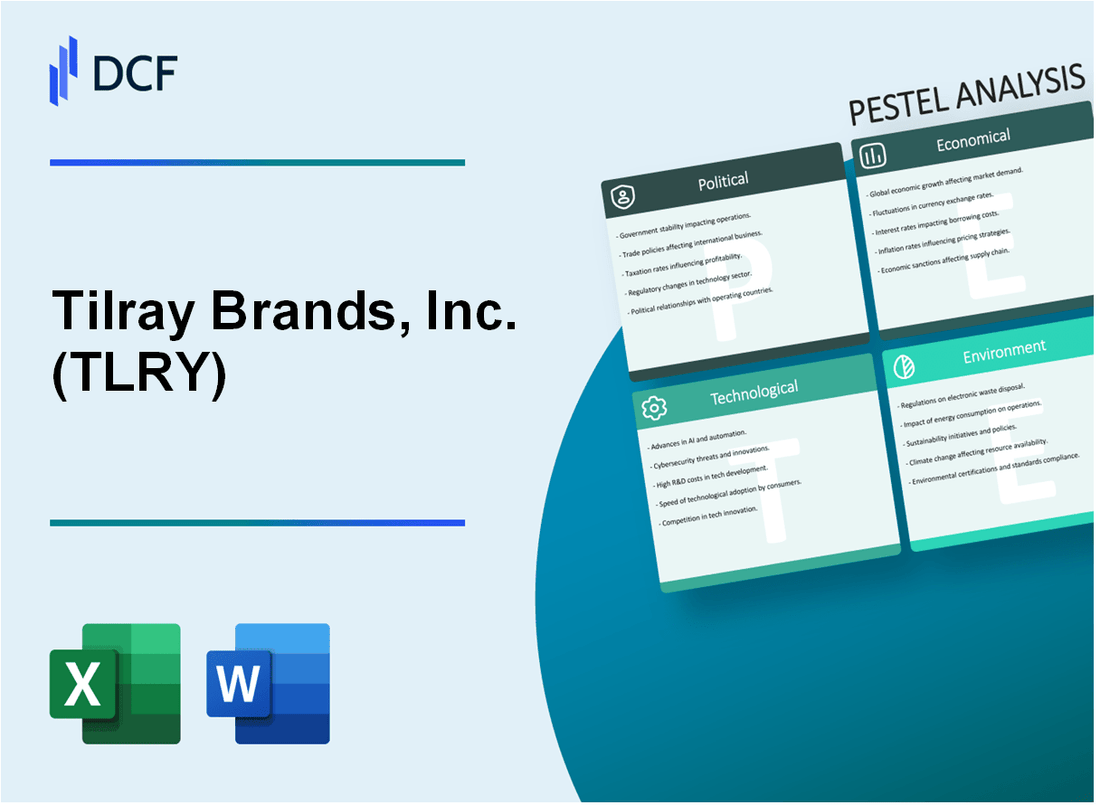
Tilray Brands, Inc. (TLRY): Análise de Pestle [Jan-2025 Atualizado] |
Totalmente Editável: Adapte-Se Às Suas Necessidades No Excel Ou Planilhas
Design Profissional: Modelos Confiáveis E Padrão Da Indústria
Pré-Construídos Para Uso Rápido E Eficiente
Compatível com MAC/PC, totalmente desbloqueado
Não É Necessária Experiência; Fácil De Seguir
Tilray Brands, Inc. (TLRY) Bundle
No cenário em rápida evolução do comércio de cannabis, a Tilray Brands, Inc. fica na encruzilhada de ambientes regulatórios complexos, inovação tecnológica e percepções sociais em mudança. Essa análise abrangente de pestles revela os desafios e oportunidades multifacetados que enfrentam um dos participantes mais dinâmicos da indústria global de cannabis, explorando como os fatores políticos, econômicos, sociais, tecnológicos, legais e ambientais estão reformulando a abordagem estratégica de Tilray para a expansão do mercado e o crescimento sustentável.
Tilray Brands, Inc. (TLRY) - Análise de Pestle: Fatores Políticos
Tendências de legalização de cannabis na América do Norte
A partir de 2024, a cannabis é legal para uso recreativo em 24 estados dos EUA e uso médico em 38 estados. Canadá legalizou a maconha totalmente legalizada em todo o país em outubro de 2018.
| País | Status de cannabis recreativo | Status de cannabis medicinal |
|---|---|---|
| Estados Unidos | 24 estados | 38 estados |
| Canadá | Totalmente legal | Totalmente legal |
Mudanças regulatórias em andamento
Destaques da paisagem regulatória para Tilray:
- A REGRA DE DEA PROPUSEM RECLASSIFICAR A MONABIS DO ANEGO I PARA ANEXO III
- O FDA continua a avaliar a estrutura regulatória de cannabis
- Os regulamentos de cannabis em nível estadual continuam a evoluir
Potenciais reformas de políticas federais de cannabis nos Estados Unidos
As principais reformas de políticas em potencial incluem:
- Lei Bancário Seguro, pendente de aprovação do Congresso
- Potenciais esforços federais de descriminalização
- Legalização potencial da maconha interestadual de cannabis
Regulamentos de Comércio Internacional
| País | Status de importação/exportação | Complexidade regulatória |
|---|---|---|
| Alemanha | Importações de cannabis medicinal permitidos | Alta supervisão regulatória |
| Reino Unido | Importações restritas de cannabis medicinal | Complexidade regulatória moderada |
| Austrália | Importações de cannabis medicinal permitidos | Estrutura regulatória estrita |
Tilray Brands, Inc. (TLRY) - Análise de Pestle: Fatores Econômicos
Desafios voláteis de preços e receita do mercado de cannabis
A Tilray Brands, Inc. relatou receita líquida consolidada de US $ 199,9 milhões para o ano fiscal de 2024, representando uma redução de 5,2% em relação ao trimestre anterior. O mercado de cannabis experimentou pressões significativas de preços, com os preços médios de maconha no atacado caindo para US $ 3,21 por grama em 2023.
| Métrica financeira | Q3 FY2024 Valor | Mudança de ano a ano |
|---|---|---|
| Receita líquida | US $ 199,9 milhões | -5.2% |
| Preço de cannabis por atacado | US $ 3,21 por grama | -22.3% |
Aumento da concorrência em segmentos de maconha e produto CBD
O mercado global de cannabis deve atingir US $ 57,18 bilhões até 2026, com intensa consolidação do mercado de concorrência. A participação de mercado de Tilray enfrenta pressão de grandes concorrentes, como Canopy Growth e Aurora Cannabis.
| Concorrente | Capitalização de mercado | Receita anual |
|---|---|---|
| Tilray Brands | US $ 1,2 bilhão | US $ 631,2 milhões |
| Crescimento do dossel | US $ 1,1 bilhão | US $ 572,5 milhões |
| Aurora Cannabis | US $ 0,8 bilhão | US $ 387,9 milhões |
Potencial para crescimento econômico com a expansão dos mercados legais de cannabis
Potencial de mercado de cannabis dos Estados Unidos: 24 Estados legalizaram a cannabis recreativa, com o tamanho do mercado projetado atingindo US $ 33,6 bilhões até 2025. O posicionamento estratégico de Tilray em vários mercados inclui operações no Canadá, Alemanha e Estados Unidos.
| Mercado | Status legal | Tamanho do mercado projetado (2025) |
|---|---|---|
| Estados Unidos | 24 estados recreativos | US $ 33,6 bilhões |
| Canadá | Totalmente legal | US $ 4,3 bilhões |
| Alemanha | Recreativo médico/limitado | US $ 1,5 bilhão |
Impacto da inflação e incertezas econômicas nos gastos do consumidor
Os gastos do consumidor em produtos de cannabis foram impactados pela inflação, com os preços médios do consumidor diminuindo 15,7% em 2023. A margem bruta de Tilray foi de 22,1% no terceiro trimestre do EF2024, refletindo condições econômicas desafiadoras.
| Indicador econômico | 2023 valor | Impacto no mercado de cannabis |
|---|---|---|
| Declínio dos preços do consumidor de cannabis | 15.7% | Poder de compra reduzido ao consumidor |
| Tilray Margem bruta | 22.1% | Diminuição da lucratividade |
| Taxa de inflação (EUA) | 3.4% | Pressão sobre gastos discricionários |
Tilray Brands, Inc. (TLRY) - Análise de Pestle: Fatores sociais
Aceitação crescente de cannabis para uso médico e recreativo
A partir de 2024, 24 estados dos EUA legalizaram a cannabis recreativa e 38 estados têm programas de cannabis medicinal. De acordo com a pesquisa de 2023 da Gallup, 70% dos americanos apóiam a legalização da cannabis.
| Categoria | Porcentagem de apoio | Ano |
|---|---|---|
| Legalização de cannabis medicinal | 88% | 2023 |
| Legalização de cannabis recreativa | 70% | 2023 |
Mudança de atitudes do consumidor em relação aos produtos de bem -estar de cannabis
O mercado global de cannabis medicinal foi avaliado em US $ 13,4 bilhões em 2022 e deve atingir US $ 59,3 bilhões até 2030, com um CAGR de 20,1%.
| Categoria de produto | Quota de mercado | Taxa de crescimento |
|---|---|---|
| Produtos de bem -estar da CBD | 42% | 18.5% |
| Produtos de cannabis medicinal | 38% | 22.3% |
Tendências demográficas no consumo de cannabis em diferentes faixas etárias
Consumo de cannabis por faixa etária em 2023:
- 18-25 anos: 34% de taxa de uso
- 26-35 anos: 27% de taxa de uso
- 36-50 anos: 19% de taxa de uso
- 51-64 anos: 12% de taxa de uso
Aumentando o foco na saúde e no bem -estar, impulsionando a inovação de produtos de cannabis
O mercado global de bem -estar de cannabis deve atingir US $ 45,6 bilhões até 2025, com um CAGR de 22,8% a partir de 2022.
| Categoria de bem -estar | Valor de mercado 2022 | Valor de mercado projetado 2025 |
|---|---|---|
| Gerenciamento da dor | US $ 8,2 bilhões | US $ 19,5 bilhões |
| Saúde mental | US $ 5,7 bilhões | US $ 14,3 bilhões |
| Ajuda do sono | US $ 3,9 bilhões | US $ 9,6 bilhões |
Tilray Brands, Inc. (TLRY) - Análise de Pestle: Fatores tecnológicos
Tecnologias avançadas de cultivo e extração para produção de cannabis
A Tilray investiu US $ 102,5 milhões em instalações avançadas de cultivo a partir de 2023. A Companhia opera instalações de efeito estufa de última geração, totalizando 227.000 pés quadrados no Canadá e Portugal.
| Tecnologia | Investimento ($) | Melhoria de eficiência |
|---|---|---|
| Sistemas de cultivo automatizados | 42,3 milhões | Aumento de 37% do rendimento da colheita |
| Tecnologia de extração de CO2 | 28,7 milhões | 92% de pureza de extração |
| Sistemas de controle climático | 31,5 milhões | 25% de eficiência energética |
Investimento em plataformas digitais para comércio eletrônico e distribuição de produtos
A Tilray alocou US $ 18,6 milhões ao desenvolvimento de infraestrutura digital em 2023. A plataforma de comércio eletrônico da empresa processou 1,2 milhão de transações on-line com um crescimento de 45% ano a ano.
| Plataforma digital | Investimento ($) | Métricas de desempenho |
|---|---|---|
| Plataforma de comércio eletrônico | 8,9 milhões | 1,2 milhão de transações |
| Aplicativo móvel | 5,7 milhões | 320.000 usuários ativos |
| Gerenciamento de relacionamento com o cliente | 4 milhões | 98% taxa de satisfação do cliente |
Pesquisa e desenvolvimento de tratamentos médicos inovadores baseados em cannabis
A Tilray comprometeu US $ 47,3 milhões a pesquisas médicas e inovação de produtos em 2023. A Companhia possui 12 ensaios clínicos em andamento focados em tratamentos médicos baseados em cannabis.
| Área de pesquisa | Investimento ($) | Ensaios clínicos |
|---|---|---|
| Distúrbios neurológicos | 15,6 milhões | 4 ensaios |
| Gerenciamento da dor | 12,9 milhões | 3 ensaios |
| Tratamentos de saúde mental | 18,8 milhões | 5 ensaios |
Implementação de IA e análise de dados no desenvolvimento de produtos
A Tilray investiu US $ 22,4 milhões em tecnologias de inteligência e análise de dados artificiais em 2023. O processo de desenvolvimento de produtos orientado pela AI da empresa reduziu o tempo de mercado em 35%.
| Tecnologia da IA | Investimento ($) | Melhoria de eficiência |
|---|---|---|
| Análise preditiva | 9,6 milhões | 35% de desenvolvimento de produtos mais rápido |
| Algoritmos de aprendizado de máquina | 7,8 milhões | 28% de formulação melhorada do produto |
| Infraestrutura de processamento de dados | 5 milhões | 42% de insights de dados aprimorados |
Tilray Brands, Inc. (TLRY) - Análise de Pestle: Fatores Legais
Cenário regulatório complexo para empresas de cannabis
Tilray opera em um Mercado de cannabis altamente regulamentado com complexidades legais significativas em várias jurisdições.
| Jurisdição | Status legal | Estrutura regulatória |
|---|---|---|
| Canadá | Totalmente legal | Lei de Cannabis, regulamentada pela Health Canada |
| Estados Unidos | Parcialmente legal | Variação de estado por estado, restrições federais |
| Alemanha | Cannabis Medical Munabis Legal | Lei de Narcóticos, regulamentos médicos rigorosos |
Conformidade com variados regulamentos estaduais e internacionais de cannabis
O Tilray deve navegar nos requisitos complexos de conformidade em vários mercados.
| Área de conformidade | Requisitos regulatórios | Custos anuais de conformidade |
|---|---|---|
| Licenciamento de cannabis medicinal | Múltiplas permissões de jurisdição | US $ 3,2 milhões |
| Controle de qualidade | Certificação GMP | US $ 1,7 milhão |
| Teste de produto | Análise química abrangente | US $ 2,5 milhões |
Desafios legais em andamento nas operações do mercado de cannabis
Tilray enfrenta desafios legais em andamento na expansão dos mercados de cannabis.
- Conflitos federais de cannabis estaduais de cannabis
- Restrições comerciais internacionais
- Estruturas regulatórias em evolução
Proteção de propriedade intelectual para inovações relacionadas à cannabis
A Tilray investe significativamente na proteção da propriedade intelectual relacionada à cannabis.
| Categoria IP | Número de patentes | Despesas anuais de proteção IP |
|---|---|---|
| Técnicas de cultivo | 12 | $750,000 |
| Formulações médicas | 8 | US $ 1,1 milhão |
| Tecnologias de processamento | 6 | $650,000 |
Tilray Brands, Inc. (TLRY) - Análise de Pestle: Fatores Ambientais
Práticas de cultivo sustentáveis na produção de cannabis
A Tilray Brands, Inc. implementou técnicas avançadas de cultivo sustentável em suas instalações de produção. A empresa utiliza métodos de agricultura ambiental controlada (CEA), reduzindo o uso da terra em 90% em comparação com o cultivo tradicional ao ar livre.
| Parâmetro de cultivo | Métrica de eficiência |
|---|---|
| Redução do uso de água | Até 95% menos consumo de água |
| Eficiência energética | A iluminação LED reduz o consumo de energia em 40% |
| Utilização da terra | 90% menos terra necessária em comparação com a agricultura tradicional |
Redução da pegada de carbono na fabricação de cannabis
A Tilray se comprometeu a reduzir suas emissões de carbono por meio de várias iniciativas estratégicas. A empresa investiu US $ 3,2 milhões em infraestrutura de energia renovável e programas de compensação de carbono.
| Métrica de redução de carbono | Dados quantitativos |
|---|---|
| Investimento anual de compensação de carbono | US $ 3,2 milhões |
| Alvo de redução de emissões de CO2 | 35% até 2025 |
| Adoção de energia renovável | 27% da energia total de fontes renováveis |
Conservação de água e técnicas de cultivo com eficiência energética
A Tilray emprega sistemas hidropônicos e aeropônicos avançados que reduzem significativamente o consumo de água e melhoram a eficiência do cultivo.
| Técnica de gerenciamento de água | Métrica de desempenho |
|---|---|
| Reciclagem de água do sistema hidropônico | Taxa de recuperação de água de 92% |
| Eficiência de cultivo aeropônico | 50% de ciclo de crescimento mais rápido |
| Uso de água por quilograma de cannabis | Reduzido para 100 litros |
Iniciativas de embalagem e redução de resíduos ecológicas
A Tilray implementou estratégias abrangentes de sustentabilidade da embalagem para minimizar o impacto ambiental.
| Métrica de sustentabilidade da embalagem | Dados quantitativos |
|---|---|
| Porcentagem de embalagem reciclável | 85% da embalagem do produto |
| Investimento de redução de plástico | US $ 1,5 milhão anualmente |
| Taxa de desvio de resíduos | 72% do resíduo total de fabricação |
Tilray Brands, Inc. (TLRY) - PESTLE Analysis: Social factors
Growing consumer demand for functional, better-for-you wellness products, including hemp-derived Delta-9 THC drinks.
The shift in consumer preferences toward functional, better-for-you products is a major tailwind for Tilray Brands. We're seeing a clear move away from traditional alcohol and towards alternatives that offer a controlled, sessionable experience, especially among younger demographics. Honestly, this is a massive opportunity, and the numbers show it.
The global functional beverage market is expected to hit a staggering $208 billion by the end of 2025, which provides a massive addressable market for the company's Wellness segment. Tilray's Wellness segment revenue for the fiscal year 2025 was $60.5 million, representing a solid 9% increase over the prior year. More specifically, the hemp-derived Delta-9 THC beverage market is exploding; it was valued at $0.5 billion in 2024 and is projected to reach $2.5 billion by 2034, growing at a compound annual growth rate (CAGR) of 17.5%. Tilray is moving fast to capture this, launching its Alternative Beverages line in the U.S. and generating $1.4 million in revenue from hemp-derived THC beverage sales in the fiscal year up to Q3 2025.
Increasing social acceptance of cannabis, particularly medical use, drives international market growth.
Social acceptance of cannabis is the bedrock of international expansion, particularly in medical markets where public opinion and patient demand drive regulatory change. You can defintely see this impact in the company's international performance.
Tilray's strategy to lead the European medical cannabis market is paying off, with total International cannabis revenue increasing by 19% for the full fiscal year 2025. The growth is particularly sharp in Europe, where cannabis revenue grew by an impressive 112% in FY2025, excluding Australia. Germany, for example, saw a 50% increase in medical cannabis flower revenue in Q1 fiscal year 2025 following its legalization moves. This trend confirms that as social stigma fades, the regulated medical market scales quickly. Tilray currently supplies medical cannabis to patients in over 20 countries across five continents.
Tilray is positioned as the fourth-largest U.S. craft beer producer, aligning with the local, craft beverage trend.
Tilray's aggressive move into the U.S. craft beer market is a smart social hedge against slower cannabis legalization. By acquiring a portfolio of established, local craft brands, they tap into the strong consumer preference for local, authentic, and craft beverages.
The company is now the 4th largest craft brewer in the U.S., a position confirmed by the Brewers Association 2024 annual report (based on beer sales volume), up from the #5 spot previously. This beverage segment is a significant growth engine, with net revenue increasing by 19% to $240.6 million for the fiscal year 2025. The momentum is clear: Q1 fiscal year 2025 saw Beverage alcohol net revenue surge by 132% to $56.0 million, primarily due to strategic acquisitions.
The company supports patient advocacy to reduce barriers to medicinal cannabis access globally.
Tilray's commitment to patient advocacy is a crucial social factor, building goodwill and directly influencing market access. When a company actively works to reduce barriers, it secures its long-term position as a trusted provider, not just a seller.
In November 2025, Tilray Medical significantly expanded its Compassionate Pricing program in Canada, increasing the annual income eligibility threshold to $65,000 CAD, up from $32,500 CAD. This expansion directly helps more patients, including seniors, veterans, and first responders, afford their medicine. Internationally, the company is actively expanding access:
- Partnered with the Italian pharmaceutical firm Molteni in August 2025 to broaden the availability of Tilray Medical cannabis extracts across Italy.
- Announced plans in October 2025 to expand medical cannabis operations into Panama, leveraging a joint venture to enhance local patient access.
| Social Factor Metric | Fiscal Year 2025 Value (USD) | YoY Growth / Change | Source/Context |
|---|---|---|---|
| Wellness Segment Net Revenue | $60.5 million | +9% | Reflects demand for better-for-you products. |
| Hemp-Derived THC Beverage Sales (FYTD Q3) | $1.4 million | N/A (New Product Focus) | Early revenue from Delta-9 THC drinks in the U.S. |
| International Cannabis Revenue | N/A (Segment Total: $249.0 million) | +19% | Driven by increasing social acceptance and medical use globally. |
| European Cannabis Revenue (Excl. Australia) | N/A | +112% | Strong growth in markets like Germany following regulatory changes. |
| U.S. Craft Brewer Ranking (Brewers Association) | #4 | Up from #5 | Position in the U.S. craft beverage trend. |
| Beverage Segment Net Revenue | $240.6 million | +19% | Growth fueled by craft brands and acquisitions. |
| Canadian Compassionate Pricing Eligibility | $65,000 CAD | Up from $32,500 CAD | Direct action to reduce barriers to medical access. |
Tilray Brands, Inc. (TLRY) - PESTLE Analysis: Technological factors
Technology for Tilray Brands is not just about growing plants; it's the core engine for product differentiation, quality control, and global scale. You see this most clearly in their aggressive push into innovative product formats and their sophisticated, pharmaceutical-grade production footprint. The near-term opportunity is clear: use automation to drive down cultivation costs while leveraging their #1 market share in high-margin categories like beverages.
Use of AI-driven horticulture automation enhances cultivation efficiency, potency, and yield.
Tilray Brands is actively incorporating Artificial Intelligence (AI) initiatives to boost efficiency and maintain a low-cost structure, a critical factor in a competitive market. This focus on advanced agronomic techniques, often referred to as precision agriculture, is what allows them to produce high-quality products at scale.
The operational efficiency gains are tangible. Through an accelerated growth plan, which included bringing idled sections of the Aphria One facility back online, the company increased its Canadian cannabis cultivation capacity from approximately 150 metric tonnes to a projected 210 metric tonnes per year in 2025. That's a 40% increase in capacity, which directly impacts their ability to meet rising global demand. To be fair, the specific R&D spending on these AI-driven systems is small, with the company reporting only $250 thousand in Research and Development expenses for the first nine months of Fiscal Year 2025, but the capital expenditure on state-of-the-art facilities is where the real investment lies.
Continuous product innovation in formats like THC beverages and infused pre-rolls drives Canadian market share.
Product innovation is how Tilray Brands captures and keeps market share, particularly in the Canadian adult-use market. They use technology to create new, differentiated formats that appeal to a broader consumer base than traditional flower. This innovation pipeline is defintely working.
For Fiscal Year 2025, Tilray Brands holds the #1 market-leading sales position in Canada across several key categories, including pre-rolls and beverages. Their THC beverage brands, XMG and Mollo, are especially dominant, holding over 40% market share in the Canadian cannabis beverage category.
The company's 2025 Summer Cannabis Collection showcased their commitment to new formats, including:
- XMG Atomic Sours Beverages (new THC beverages)
- Redecan's live resin infused pre-rolls
- Good Supply's Double Dutchies (powerful pre-rolls)
Leveraging a scalable, global supply chain and infrastructure to rapidly enter new regulated markets.
Tilray Brands' most significant technological advantage is its global infrastructure, which acts as a platform for rapid market entry. They have a scalable global supply chain that supports a portfolio of over 40 brands across more than 20 countries.
This infrastructure includes EU-GMP (European Union Good Manufacturing Practice) certified cultivation and manufacturing facilities in Portugal and Germany (Neumünster). These facilities are critical for anchoring operations across Europe, Australia, and Latin America. The strategic move to establish Solana Life Group in Panama in late 2025, a joint venture that secured a medical cannabis license, is a perfect example of leveraging this existing global platform to enter the Latin American medical cannabis market.
| Metric | Value (FY 2025 Data) | Strategic Significance |
|---|---|---|
| Total Net Revenue | $821 million | Funding source for continued technology and innovation investment. |
| Canadian Cultivation Capacity | 210 metric tonnes per year | Represents a 40% increase in capacity from late 2024, driven by operational efficiencies. |
| Global Market Reach | Over 20 countries | Scale of the international distribution network and supply chain. |
| Canadian THC Beverage Market Share | Over 40% | Direct result of product innovation in a high-growth format. |
Technology is crucial for product differentiation and maintaining high pharmaceutical-grade standards.
For Tilray Medical, technology is entirely focused on consistency and quality, which is non-negotiable for medical markets. The company's pharmaceutical-grade expertise is demonstrated by its track record of delivering cannabis to patients in over 20 countries.
The EU-GMP certification of their facility in Neumünster, Germany, is a technological and procedural differentiator. It means their production adheres to the rigorous quality control standards required by European medical regulators. They use this advanced facility to continuously introduce new cannabis genetics bred to pharmaceutical standards, ensuring reliable and consistent medical options for physicians and pharmacies. This technological compliance is the key to unlocking the much larger, high-value global medical cannabis market.
Tilray Brands, Inc. (TLRY) - PESTLE Analysis: Legal factors
Potential US Schedule III reclassification would eliminate the punitive IRS Section 280E tax burden, boosting profitability.
The single biggest near-term legal opportunity for Tilray Brands, and the entire cannabis sector, is the potential reclassification of cannabis from Schedule I to Schedule III of the Controlled Substances Act (CSA). This administrative move, currently pending in late 2025, would immediately remove the punitive Internal Revenue Service (IRS) Section 280E tax code.
Section 280E is brutal; it prohibits cannabis companies from deducting ordinary business expenses like salaries, rent, and marketing, forcing them to pay taxes on gross revenue instead of net profit. This results in effective tax rates of 60-70% for many operators. The industry's excess tax burden from 280E was forecasted to be $2.3 billion in 2024, a number that will only grow. Eliminating this tax would immediately and materially lower Tilray's effective tax rate, freeing up significant cash flow from its U.S. operations and investments for expansion or debt reduction. It's a game-changer for the bottom line.
Strict, fragmented state-by-state cannabis laws in the US restrict interstate commerce and market entry.
Despite the promise of a massive U.S. market, projected to exceed $50 billion before the decade's end, Tilray's ability to tap into it is severely hampered by federal prohibition. The federal classification of cannabis as a Schedule I substance means it cannot be transported across state lines; there is no interstate commerce.
This fragmentation forces Tilray to adopt a complex, capital-intensive strategy of establishing separate, costly supply chains-cultivation, processing, and distribution-within each state where it operates. This lack of scale across borders drives up production costs and hinders the efficiency that a global consumer packaged goods company like Tilray is built on. It forces a reliance on expensive, state-specific compliance and automation just to maintain consistency.
EU-GMP certification is a critical competitive advantage for supplying the growing European medical market, like Germany.
In stark contrast to the U.S. legal quagmire, Tilray's international strategy is anchored by its compliance with the European Union's Good Manufacturing Practice (EU-GMP) standards. This certification is the gold standard for pharmaceuticals and medical products, and Tilray leverages its EU-GMP facilities in Portugal and Germany to supply the burgeoning European medical market, which is projected to reach €3.2 billion in 2025.
This compliance is a clear competitive moat. Following German medical cannabis law changes, Tilray's German medical cannabis flower revenue increased by 50% in the first quarter of Fiscal Year 2025. Management is so confident in this market that they expect to triple their German medical cannabis distribution footprint in fiscal 2026. That's a massive, compliant growth engine.
| Regulatory Factor | Impact on Tilray Brands (TLRY) | 2025 Financial/Operational Data |
|---|---|---|
| IRS Section 280E Elimination (US Schedule III) | Massive tax relief, allowing deduction of ordinary business expenses. | Current effective tax rates for industry: 60-70%. US industry excess tax burden (280E): $2.3 billion (2024 forecast). |
| EU-GMP Certification (Germany/Europe) | Establishes a competitive moat in the global medical market. | German medical cannabis flower revenue increased by 50% in Q1 Fiscal Year 2025. European medical market projected to reach €3.2 billion in 2025. |
| US Interstate Commerce Ban | Forces costly, fragmented, state-by-state supply chains. | US state-regulated market projected to exceed $50 billion, a major opportunity currently constrained by state borders. |
The company must navigate complex, varying regulations for its diverse portfolio of cannabis, hemp, and alcohol products.
Tilray is a diversified consumer packaged goods company, but this diversification means navigating three entirely separate and often conflicting regulatory regimes: cannabis, hemp, and alcohol. This is defintely a high compliance burden.
The alcohol business, which generated $63 million in net revenue in Q2 2025, is regulated by the Alcohol and Tobacco Tax and Trade Bureau (TTB). The TTB is proposing new rules in 2025 that mandate more detailed labeling for alcohol content and allergens, with a five-year phase-in period. However, the critical legal challenge is the TTB's firm prohibition on any THC or controlled substances on federally bonded brewery premises, forcing the company to maintain a strict separation of its alcohol and cannabis/hemp production lines.
The hemp-derived Delta-9 THC beverage market, a $1 billion industry in the U.S., presents another layer of legal inconsistency. While Tilray is actively launching products here, it must contend with a patchwork of state laws that are tightening up. For example, some states are changing serving size limits from 8 milligrams to just 5 milligrams of THC and raising the purchase age from 18 to 21, forcing constant product and labeling adjustments. Tilray is lobbying for a federal baseline framework with a 10mg per serving cap to bring some clarity.
- Maintain strict separation of TTB-regulated alcohol and THC production.
- Monitor state-level changes to hemp-derived THC serving sizes (e.g., 8mg to 5mg).
- Adapt product labeling to new TTB mandates on alcohol content and allergens.
Tilray Brands, Inc. (TLRY) - PESTLE Analysis: Environmental factors
You're looking at Tilray Brands, Inc.'s environmental profile, and the core takeaway is that the company is actively addressing immediate, tangible issues like packaging waste, but it still lacks the long-term, public-facing climate commitments that institutional investors now expect from major consumer packaged goods (CPG) players.
They are focusing their efforts where they can show immediate, measurable impact, particularly in their Canadian cannabis and U.S. beverage operations. This approach is practical, but it exposes them to future pressure on Scope 1, 2, and 3 emissions disclosure.
Commitment to monitoring GHG (Greenhouse Gas) emissions and optimizing transportation logistics
Tilray Brands recognizes that climate change presents both risks and opportunities, which is a key part of their Fiscal Year 2025 disclosures. The primary action here is internal monitoring and efficiency, not a public reduction target.
Specifically, the company commits to monitoring its Greenhouse Gas (GHG) emissions by focusing on energy-efficient technologies and optimizing transportation logistics. This is a crucial, foundational step, but it's defintely not the same as setting a Science Based Target (SBTi) for absolute emissions reduction.
The management of climate-related risks-like changing weather patterns affecting cultivation and water scarcity impacting their supply chain-is directly tied to these monitoring efforts. They are using AI-driven horticulture automation in cultivation to manage greenhouse conditions in real-time, which helps reduce costs for resources like water and energy.
Initiative to convert some packaging to hemp, diverting at least 131,000 kilograms of plastic from landfills annually
The company has made a significant, industry-leading move to combat plastic waste in the cannabis sector. This initiative involves converting packaging and product components, such as pre-rolls and vape accessories, to hemp-based materials across key Canadian brands like Good Supply, RIFF, and Broken Coast.
The initial commitment was projected to divert at least 131,000 kilograms (approximately 288,805 pounds) of plastic from landfills each year. However, a more recent update shows the cumulative impact is much larger. Since the initiative's launch in June 2023, the total ongoing efforts have prevented over 925,000 kilograms of plastic from reaching landfills, which is a huge number that demonstrates real progress. They are also using bags made from recycled content for whole-flower products, which alone is expected to divert an additional 38,000 kilograms of plastic waste annually.
Here's a quick look at the packaging impact versus the company's size in FY2025:
| Metric | Fiscal Year 2025 Value | Context |
|---|---|---|
| Total Net Revenue (FY2025) | $821 million | Indicates the scale of operations generating this waste. |
| Plastic Diverted (Cumulative since June 2023) | Over 925,000 kilograms | Shows the overall environmental benefit of the packaging shift. |
| Annual Plastic Diversion (Initial Hemp Commitment) | 131,000 kilograms | The baseline annual impact of the hemp packaging program. |
Sustainability efforts are visible in the beverage segment, such as Terrapin Beer Co.'s solar-powered brewing
The beverage division, which generated $241 million in revenue in Fiscal Year 2025, also features concrete environmental efforts. One of the most visible examples is at Terrapin Beer Co. in Athens, Georgia, which is part of the Tilray Beverages portfolio.
Terrapin Beer Co. operates under a sustainability initiative called Terraprint, which focuses on minimizing waste and conserving water. Crucially, the brewery has over 700 solar panels installed on its roof, which power the brewing of its Sunray Wheat Beer. This demonstrates a tangible commitment to renewable energy within a core operational asset.
- Brewing is powered by over 700 solar panels at the Athens, Georgia facility.
- The Terraprint initiative also includes efforts to minimize waste and conserve water.
- Terrapin also partners with groups like the Chattahoochee Riverkeeper, donating a portion of proceeds from a unique beer to support river preservation.
Tilray has not publicly committed to specific 2030 or 2050 climate goals through major global frameworks
This is the primary gap in Tilray's environmental strategy as of late 2025. While they are implementing practical, operational improvements, they have not yet made a public commitment to a long-term, science-aligned climate goal.
They have not publicly committed to specific 2030 or 2050 climate goals through major global frameworks, such as the Science Based Targets initiative (SBTi) or the Carbon Disclosure Project (CDP). This lack of formal commitment means they do not currently report specific carbon emissions data (in kg CO2e) or documented reduction targets. This is a near-term risk because institutional investors and large asset managers, like BlackRock, are increasingly using these public commitments as a screening tool for ESG compliance. Not having a net-zero roadmap or validated targets can increase the company's perceived ESG risk profile.
Disclaimer
All information, articles, and product details provided on this website are for general informational and educational purposes only. We do not claim any ownership over, nor do we intend to infringe upon, any trademarks, copyrights, logos, brand names, or other intellectual property mentioned or depicted on this site. Such intellectual property remains the property of its respective owners, and any references here are made solely for identification or informational purposes, without implying any affiliation, endorsement, or partnership.
We make no representations or warranties, express or implied, regarding the accuracy, completeness, or suitability of any content or products presented. Nothing on this website should be construed as legal, tax, investment, financial, medical, or other professional advice. In addition, no part of this site—including articles or product references—constitutes a solicitation, recommendation, endorsement, advertisement, or offer to buy or sell any securities, franchises, or other financial instruments, particularly in jurisdictions where such activity would be unlawful.
All content is of a general nature and may not address the specific circumstances of any individual or entity. It is not a substitute for professional advice or services. Any actions you take based on the information provided here are strictly at your own risk. You accept full responsibility for any decisions or outcomes arising from your use of this website and agree to release us from any liability in connection with your use of, or reliance upon, the content or products found herein.