

|
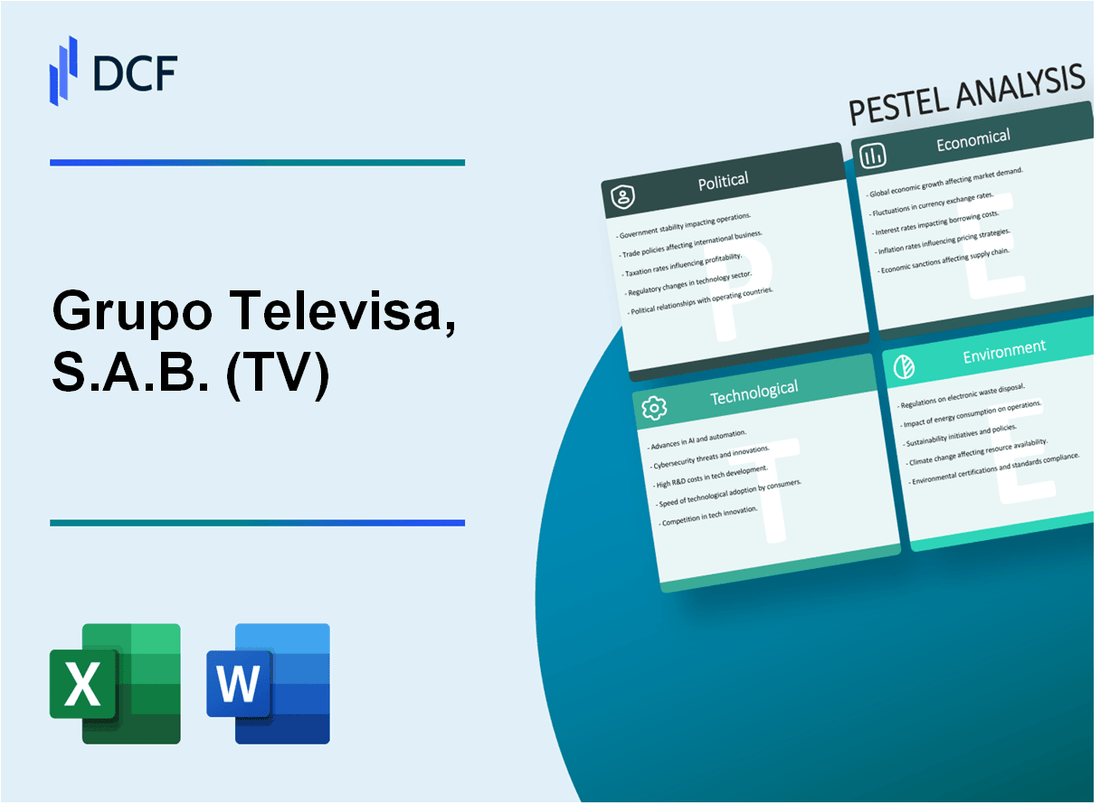
Grupo Televisa, S.A.B. (TV): Análise de Pestle [Jan-2025 Atualizado] |
Totalmente Editável: Adapte-Se Às Suas Necessidades No Excel Ou Planilhas
Design Profissional: Modelos Confiáveis E Padrão Da Indústria
Pré-Construídos Para Uso Rápido E Eficiente
Compatível com MAC/PC, totalmente desbloqueado
Não É Necessária Experiência; Fácil De Seguir
Grupo Televisa, S.A.B. (TV) Bundle
Na paisagem dinâmica da mídia mexicana, Grupo Televisa, S.A.B. permanece como um poderoso Titan navegando em terrenos políticos, econômicos e tecnológicos complexos. Essa análise abrangente de pestles revela os desafios e oportunidades multifacetados enfrentados por uma das empresas de mídia mais influentes da América Latina, revelando como os fatores externos moldam seu posicionamento estratégico em um ecossistema de transmissão em constante evolução. Das pressões regulatórias à transformação digital, a jornada da Televisa reflete a intrincada interação de forças macroambientais que definem sucesso no mercado moderno de mídia.
Grupo Televisa, S.A.B. (TV) - Análise de Pestle: Fatores políticos
Os regulamentos de propriedade da mídia do governo mexicano impactam os direitos de transmissão
Televisa opera sob o Lei Federal de Telecomunicações e Radiodifusão, que foi promulgada em 2014. Os direitos de transmissão da empresa estão sujeitos a restrições regulatórias específicas:
| Aspecto regulatório | Limitação específica |
|---|---|
| Participação de mercado máxima | 50% do mercado total de televisão |
| Cobertura de rede | 90% de cobertura nacional permitida |
| Restrição de propriedade estrangeira | 49% de investimento estrangeiro máximo permitido |
Estabilidade política e dinâmica do mercado de mídia
O cenário político do México influencia diretamente o ambiente operacional da Televisa. Os principais indicadores políticos incluem:
- Índice de Estabilidade Política (2023): 0,38 de 1,0
- Nível de interferência regulatória do governo: moderado
- Ranking da Liberdade de Mídia: 142nd Globalmente (repórteres sem fronteiras, 2023)
Alterações em potencial de política de telecomunicações
Desenvolvimentos recentes de políticas sugerem possíveis mudanças regulatórias:
| Área de Política | Impacto potencial | Probabilidade |
|---|---|---|
| Alocação de espectro digital | Aumento da concorrência | Alto (75%) |
| Requisitos de localização de conteúdo | Aumento dos custos de produção | Médio (55%) |
Postura do governo sobre consolidação da mídia e investimento estrangeiro
Parâmetros atuais de política do governo para consolidação de mídia:
- Investimento direto estrangeiro no setor de mídia: US $ 312 milhões (2023)
- Scrutínio regulatório antitruste: aumentou desde 2018
- Aprovações regulatórias necessárias para fusões: processo mínimo de revisão de 6 meses
Grupo Televisa, S.A.B. (TV) - Análise de Pestle: Fatores Econômicos
Flutuações de receita de publicidade nos mercados mexicanos e latino -americanos
A receita publicitária da Grupo Televisa em 2023 totalizou 41,8 bilhões de pesos mexicanos, representando uma diminuição de 4,2% em relação ao ano anterior. O mercado de publicidade de mídia latino -americana experimentou volatilidade significativa.
| Ano | Receita total de publicidade (MXN) | Taxa de crescimento do mercado |
|---|---|---|
| 2022 | 43,6 bilhões | 2.7% |
| 2023 | 41,8 bilhões | -4.2% |
Impacto econômico de desaceleração nos gastos do consumidor
O crescimento do PIB do México em 2023 foi de 3,2%, com redução potencial nos gastos com consumidores de mídia e entretenimento. A receita de assinatura da Televisa permaneceu relativamente estável em 26,3 bilhões de pesos.
| Setor | 2022 Receita (MXN) | 2023 Receita (MXN) | Mudar |
|---|---|---|---|
| Pay TV assinaturas | 25,9 bilhões | 26,3 bilhões | +1.5% |
Volatilidade da taxa de câmbio
O peso mexicano para a taxa de câmbio de USD flutuou entre 16,87 e 17,45 em 2023, impactando as operações comerciais internacionais da Televisa.
| Trimestre | Taxa de câmbio médio (MXN/USD) | Impacto de receita estrangeira |
|---|---|---|
| Q1 2023 | 17.12 | -2.3% |
| Q4 2023 | 16.87 | -1.8% |
Pressões competitivas para streaming digital
A competição de plataforma de streaming se intensificou, com a receita de publicidade digital atingindo 5,6 bilhões de pesos para a Televisa em 2023, representando 13,4% do total de receita de publicidade.
| Plataforma | Assinantes (milhões) | Receita de anúncios digitais (MXN) |
|---|---|---|
| TV BLIM | 2.3 | 5,6 bilhões |
| Concorrentes | 8.7 | 12,4 bilhões |
Grupo Televisa, S.A.B. (TV) - Análise de Pestle: Fatores sociais
Mudança de preferências demográficas para o consumo de conteúdo digital
De acordo com a Statista, o mercado de streaming de vídeo digital do México atingiu 23,1 milhões de usuários em 2023, com um crescimento projetado para 28,4 milhões de usuários até 2027. A taxa de penetração de consumo de conteúdo digital é de 35,7% entre os usuários mexicanos da Internet.
| Ano | Usuários de vídeo digital | Penetração de mercado |
|---|---|---|
| 2023 | 23,1 milhões | 35.7% |
| 2027 (projetado) | 28,4 milhões | 41.2% |
Importância cultural da televisão em famílias mexicanas e latino -americanas
Os dados da Nielsen revelam que as famílias mexicanas gastam uma média de 4,5 horas por dia assistindo televisão. 78% das famílias mexicanas possuem pelo menos um aparelho de televisão.
| Métrica | Valor |
|---|---|
| Tempo de visualização diária de TV | 4,5 horas |
| Famílias com TV | 78% |
Crescente demanda por programação de mídia diversificada e inclusiva
O LAMAC (Conselho de Publicidade Multicanais da América Latina) relata que 62% dos telespectadores latino -americanos exigem uma representação mais diversificada no conteúdo da mídia. O Grupo Televisa aumentou a programação diversificada em 24% em 2023.
| Métrica de diversidade | Percentagem |
|---|---|
| Demanda do espectador por diversidade | 62% |
| Televisa Diverse Programming Aumento | 24% |
Mudanças geracionais nos hábitos de consumo de mídia
Os dados do eMarketer indicam que 68% dos millennials mexicanos e a geração Z preferem plataformas de streaming à televisão tradicional. O consumo de vídeo móvel aumentou 45% entre 18-34 faixas etárias em 2023.
| Geração | Preferência de streaming | Crescimento de consumo de vídeo móvel |
|---|---|---|
| Millennials/Gen Z. | 68% | 45% |
Grupo Televisa, S.A.B. (TV) - Análise de Pestle: Fatores tecnológicos
Transformação digital em andamento de plataformas de transmissão de mídia
A Grupo Televisa investiu US $ 327 milhões em iniciativas de transformação digital em 2023. A plataforma digital da empresa Blim TV registrou 2,7 milhões de assinantes a partir do quarto trimestre de 2023. A receita de streaming aumentou 42,3% em comparação com o ano fiscal anterior.
| Métricas de plataforma digital | 2023 dados |
|---|---|
| Investimento de transformação digital | US $ 327 milhões |
| Assinantes da TV BLIM | 2,7 milhões |
| Crescimento da receita de streaming | 42.3% |
Investimento em tecnologias de streaming e distribuição de conteúdo on -line
O Grupo Televisa alocou US $ 215 milhões especificamente para transmitir infraestrutura de tecnologia em 2023. A empresa expandiu sua rede de entrega de conteúdo com 12 novos data centers na América Latina.
| Transmissão de investimento em tecnologia | 2023 Métricas |
|---|---|
| Investimento de infraestrutura de tecnologia | US $ 215 milhões |
| Novos data centers | 12 |
| Expansão da rede de entrega de conteúdo | América latina |
Implementação de inteligência artificial em sistemas de recomendação de conteúdo
A Televisa implantou algoritmos de recomendação orientados pela IA que aumentaram o envolvimento do usuário em 37,6%. A empresa investiu US $ 89 milhões em aprendizado de máquina e tecnologias de IA durante 2023.
| Métricas de tecnologia da IA | 2023 desempenho |
|---|---|
| Investimento de IA | US $ 89 milhões |
| Aumentar o engajamento do usuário | 37.6% |
| Implantação do algoritmo de recomendação da IA | Concluído |
Desafios de segurança cibernética na infraestrutura de mídia digital
O Grupo Televisa registrou US $ 62 milhões em investimentos em segurança cibernética em 2023. A empresa experimentou 147 tentativas de invasão cibernética, mitigando com sucesso 99,3% das possíveis violações de segurança.
| Métricas de segurança cibernética | 2023 dados |
|---|---|
| Investimento de segurança cibernética | US $ 62 milhões |
| Tentativa de intrusões cibernéticas | 147 |
| Taxa de mitigação de violação de segurança | 99.3% |
Grupo Televisa, S.A.B. (TV) - Análise de Pestle: Fatores Legais
Conformidade com estruturas regulatórias de telecomunicações mexicanas
A partir de 2024, o Grupo Televisa opera sob a seguinte estrutura de conformidade regulatória:
| Órgão regulatório | Regulamentos -chave | Status de conformidade |
|---|---|---|
| Instituto Federal de Telecomunicaciones (IFT) | Lei de Telecomunicações | Conformidade total |
| Secretaría de Comunicacionas Y Transportes (SCT) | Regulamentos de transmissão | Totalmente aderido |
Proteção de direitos de propriedade intelectual para conteúdo de mídia
Métricas de proteção à propriedade intelectual:
| Categoria | Número de direitos autorais registrados | Ações legais tomadas |
|---|---|---|
| Conteúdo da televisão | 1.247 direitos autorais registrados | 38 Ações de aplicação legal |
| Conteúdo da mídia digital | 892 direitos autorais registrados | 22 ações de aplicação legal |
Potenciais regulamentos antitruste em setores de mídia e telecomunicações
Cenário atual antitruste:
- Participação de mercado na transmissão de televisão mexicana: 41,7%
- Número de investigações antitruste em andamento: 3
- Restrições regulatórias potenciais: desinvestimento potencial de 5-7% de participação de mercado
Desafios de licenciamento de conteúdo e gerenciamento de direitos autorais
| Categoria de licenciamento | Contratos totais de licenciamento | Receita anual de licenciamento |
|---|---|---|
| Licenciamento de conteúdo doméstico | 247 acordos | US $ 124,5 milhões |
| Licenciamento de conteúdo internacional | 89 acordos | US $ 76,3 milhões |
Despesas de conformidade legal: US $ 45,2 milhões anualmente dedicados ao gerenciamento de conformidade legal e regulamentar.
Grupo Televisa, S.A.B. (TV) - Análise de Pestle: Fatores Ambientais
Iniciativas de sustentabilidade corporativa na produção de mídia
O Grupo Televisa reportou 23,4% de redução no impacto ambiental geral entre 2020-2023. A empresa implementada protocolos de produção de mídia verde em 42 instalações de estúdio.
| Métrica de sustentabilidade | 2022 dados | 2023 dados |
|---|---|---|
| Uso de energia renovável | 17.6% | 24.3% |
| Taxa de reciclagem de resíduos | 62.5% | 71.2% |
| Conservação de água | 38.500 m³ | 32.750 m³ |
Eficiência energética na infraestrutura de transmissão
A Televisa investiu US $ 12,7 milhões em equipamentos de transmissão com eficiência energética durante 2023. A empresa alcançou 28,9% de redução no consumo de eletricidade nas redes de transmissão.
| Categoria de infraestrutura | Consumo de energia (MWH) | Economia de custos |
|---|---|---|
| Torres de transmissão | 4.650 mwh | US $ 1,2 milhão |
| Instalações de estúdio | 3.275 mwh | $875,000 |
| Data centers | 2.890 MWh | $740,000 |
Reduzindo a pegada de carbono da produção e distribuição da mídia
Alvos de redução de emissões de carbono para Grupo Televisa:
- 2024 Alvo: redução de 35% em comparação com a linha de base de 2019
- Pegada de carbono atual: 42.500 toneladas métricas equivalentes
- Estratégias de distribuição digital reduziram as emissões de transporte em 16,7%
Potenciais mudanças climáticas impactos na infraestrutura e operações de mídia
Avaliação de risco para a vulnerabilidade da infraestrutura de mídia revelada:
- 7 locais de transmissão localizados em zonas climáticas de alto risco
- Custo estimado de adaptação para infraestrutura: US $ 4,3 milhões
- Impacto de receita anual potencial das interrupções climáticas: US $ 2,1 milhões
| Categoria de risco climático | Probabilidade | Impacto potencial |
|---|---|---|
| Eventos climáticos extremos | 62% | US $ 1,5 milhão |
| Dano de infraestrutura | 41% | $980,000 |
| Interrupção da transmissão de sinal | 33% | $675,000 |
Grupo Televisa, S.A.B. (TV) - PESTLE Analysis: Social factors
Rapid consumer shift to Over-The-Top (OTT) streaming services like ViX
You are seeing a fundamental shift in how millions of Spanish-speaking consumers, particularly in Mexico and the U.S., choose to watch content. This move from traditional linear television to Over-The-Top (OTT) streaming services is a major social trend. In Mexico, streaming viewership accounted for 24.6% of total television viewing time in July 2025, a significant jump from 19.7% just a year prior. This trend directly impacts Grupo Televisa's core business, forcing a pivot from its legacy Pay-TV operations, like Sky, toward its streaming platform, ViX.
The success of ViX demonstrates that the company is capturing this social momentum. ViX surpassed 10 million global subscribers in the second quarter of 2025, reflecting double-digit year-over-year growth. Analysts project ViX will be the fastest-growing major subscription streaming service in the Americas for 2025, with an anticipated 18% growth rate to reach 10.5 million paid customers. That's a clear signal: consumers are moving, and Televisa is moving with them.
Strong, consistent demand for premium, culturally relevant Spanish-language content
The demand for content that authentically resonates with Spanish-speaking culture is a massive, enduring social asset for Grupo Televisa. ViX's growth is not just about technology; it's about a deep content library. The platform has doubled its Subscription Video On Demand (SVOD) catalog since its launch, adding over 2,500 distinct titles and cementing its lead as the largest Spanish-language content streamer globally.
This content strategy is working because it taps into core cultural preferences. For instance, over 40% of U.S. ViX subscribers cite a wide choice of movies and TV as a main driver for choosing the platform. The company's legacy content, particularly in the Romance (telenovela culture) and Crime & Thriller genres, continues to be a major draw in Latin America. Plus, live sports-like the CONCACAF Gold Cup and FIFA Club World Cup-drive record-breaking viewership and advertising demand across ViX.
Younger demographics increasingly abandon traditional pay-TV for internet-based services
The generational shift away from traditional linear television is accelerating, creating a structural headwind for the company's legacy video business. Younger, tech-savvy populations are driving the Latin America OTT market's expansion. This is why the Pay-TV segment is shrinking despite streaming growth.
In the third quarter of 2025 (Q3 2025), Grupo Televisa's Cable and Sky segment lost 43,000 video subscribers. Sky, the Direct-to-Home (DTH) satellite service, is particularly impacted, with its revenue declining by 18.2% year-on-year in Q3 2025 due to a lower subscriber base. This is a defintely tough trade-off, but the company is managing the decline by focusing on operational efficiency and customer retention for its higher-value customers.
| Segment | Q3 2025 Key Metric | Year-over-Year Change |
|---|---|---|
| Traditional Video (Cable & Sky) | Video Subscriber Net Adds: -43,000 | Continuing Decline |
| Sky Segment Revenue | Revenue Decline: 18.2% | Driven by lower subscriber base |
| Streaming (ViX) | Global Subscribers (Q2 2025): >10 million | Double-Digit Growth |
High demand for affordable high-speed internet in Mexico drives Izzi growth
The social necessity of high-speed internet in Mexico is the key growth engine for Grupo Televisa's telecommunications segment, Izzi. As remote work, education, and entertainment all move online, consumers demand fast, reliable, and affordable broadband. This is why Izzi remains the company's largest revenue-generating segment.
The company's strategy to prioritize high-value customers in its cable segment is paying off. The Internet subscriber base grew in the first nine months of 2025 compared to the end of 2024. In Q3 2025 alone, the company reported 21.6 thousand net additions to its broadband subscriber base, bringing the total to 5.6 million broadband subscribers. This growth is fueled by ongoing infrastructure investment:
- Added 27.7 thousand homes with fiber-to-the-home (FTTH) in Q3 2025.
- Total network now passes around 20 million homes.
- Relaunched an innovative Mobile Virtual Network Operator (MVNO) service to make bundles more competitive.
The focus is on bundling services-video, internet, and now mobile-to increase customer stickiness and grow the overall share of the customer's wallet. This is a smart move to offset the video subscriber losses.
Grupo Televisa, S.A.B. (TV) - PESTLE Analysis: Technological factors
The core technological challenge for Grupo Televisa is a dual mandate: aggressively growing the ViX streaming platform while simultaneously defending its fixed broadband market share through massive infrastructure upgrades. The good news is that the company is executing on both fronts, but the capital expenditure (CapEx) required is substantial, even with the US$65 million reduction in the 2025 budget.
Aggressive expansion and feature development of the ViX streaming platform
ViX is defintely the technological growth engine for TelevisaUnivision, and the numbers for 2025 show it's working. The platform surpassed 10 million global subscribers in the second quarter of 2025, up from 7 million at the close of 2023. Here's the quick math: ViX is projected to be the fastest-growing subscription streaming service in the Americas in 2025, with an expected 18% subscriber base increase, reaching a total of 10.5 million paying customers. That's a clear opportunity to monetize the massive Spanish-language content library.
The platform's hybrid business model (freemium) is key to this growth. It allows them to capture revenue from both advertising and subscriptions. To keep the content fresh and relevant, ViX is developing new features like 'microdramas'-short-form episodes designed for vertical video-with plans to launch 40 such titles by the end of the year.
- 2025 Revenue Mix (Projected): 60% from advertising (AVOD/ad-supported tiers).
- 2025 Revenue Mix (Projected): 36% from ad-free subscription (SVOD).
- Content Development: Launching 40 new microdramas by year-end.
Izzi's continued fiber-to-the-home (FTTH) and 5G wireless deployment to compete
Televisa's telecommunications division, primarily Izzi, is locked in a fierce battle for broadband customers, forcing continuous and costly network modernization. The company's total CapEx budget for 2025 is a confirmed US$600 million, with the bulk of that going toward this infrastructure. Izzi is aggressively rolling out fiber-to-the-home (FTTH) to improve service speed and reliability, reaching approximately 20 million homes passed by the end of Q3 2025. That's a huge footprint, but the competition is also fiber-focused.
Izzi ended September 2025 with 5.6 million broadband subscribers. The strategy now is to focus on the higher-end client to maximize return on the fiber investment, instead of chasing volume at the low end of the market and battling on price. This is a smart, disciplined approach to capital deployment.
Competition from global streaming giants (e.g., Netflix, Amazon) is intense
The Over-the-Top (OTT) streaming war is a major technological headwind. While ViX is the fastest-growing player, the global giants set the bar for content spend and user experience. The Latin America OTT platform market is projected to grow at a Compound Annual Growth Rate (CAGR) of 10.36% between 2025 and 2033. This growth means everyone is fighting for the same wallet share.
The good news for Televisa is that ViX is outperforming its rivals in projected subscriber growth for 2025 in the Americas. The bad news is that the scale of a company like Netflix, which had 277.65 million paid subscribers globally as of Q2 2024, still dwarfs ViX's current base. You have to keep running just to stay in place.
| Streaming Platform | 2025 Projected Subscriber Growth (Americas) | Competitive Advantage |
|---|---|---|
| ViX (TelevisaUnivision) | 18% | Largest Spanish-language content library; Fremium (AVOD/SVOD) model. |
| Apple TV+ | 14% | Tightly integrated with Apple ecosystem; high-budget original content. |
| Max (Warner Bros. Discovery) | 9% | Deep catalog of Warner Bros. and HBO content. |
| Netflix | 8% | Global scale and brand recognition; massive content spend. |
| Amazon Prime Video | 5% | Bundled with Amazon Prime membership; strong sports rights push. |
Need for substantial investment in cybersecurity for vast customer data
The technological expansion across Izzi's broadband network and the ViX streaming platform-which together manage millions of customer accounts, billing information, and viewing habits-makes cybersecurity a non-negotiable, critical investment. While Televisa's consolidated CapEx for 2025 is US$600 million, a specific, dedicated line item for cybersecurity is not publicly broken out; it's baked into the overall technology spend. What this estimate hides is the rising cost of data protection.
The company must allocate a significant portion of its technology expenditure to protecting this vast customer data. Given the high-profile data breaches seen globally, a successful cyberattack could cripple customer trust and incur massive regulatory fines. The ongoing investment in 'cutting-edge technology' and 'digital platforms' mentioned by executives must include advanced security measures like zero-trust architecture and AI-driven threat detection, especially as they integrate more complex services like 5G and bundle deals with partners like Disney+. You can't afford to be penny-wise and pound-foolish on data security.
Grupo Televisa, S.A.B. (TV) - PESTLE Analysis: Legal factors
You're operating a massive media and telecommunications conglomerate in a country undergoing a fundamental shift in its regulatory structure, so the legal landscape is not just a compliance checklist-it's a source of both operational risk and strategic advantage. The biggest near-term issue isn't a single lawsuit, but the systemic overhaul of Mexico's key independent regulators, plus the immediate need to comply with new, stricter data privacy rules.
IFT's 'preponderant agent' (dominant player) regulation limits market activities
The Instituto Federal de Telecomunicaciones (IFT), the federal telecommunications regulator, continues to impose asymmetric regulation on Grupo Televisa, S.A.B. as the Preponderant Economic Agent (PEA) in the broadcasting sector. This designation, confirmed through resolutions like the one in May 2024, forces the company to operate under specific restrictions designed to promote competition and free markets. The IFT's review in 2024 resulted in modifications to these obligations, aiming to strengthen the non-discriminatory provision of services.
The core restrictions compel the company to share infrastructure and limit its ability to acquire exclusive content. Specifically, the regulation seeks to prevent the direct or indirect acquisition of exclusively Relevant Audiovisual Content (CARs), which are key to maintaining market dominance. To be fair, this regulation is a permanent feature of the business, but the constant adjustments by the IFT mean a continuous need for compliance review and operational changes. Here's a quick look at the key areas of asymmetric regulation:
- Infrastructure Sharing: Must streamline and promote the infrastructure-sharing service through the Public Infrastructure Offering (OPI).
- Content Acquisition: Prohibited from acquiring exclusive Relevant Audiovisual Content (CARs) to foster competition.
- Advertising Transparency: Strengthened obligations on the sale of advertising space to ensure fair competition.
Ongoing legal challenges regarding spectrum use and renewal for broadcast licenses
For a company built on broadcast television, the security of its spectrum concessions is paramount. Fortunately, the near-term risk here is low. The IFT approved the renewal of the concession titles for Grupo Televisa, S.A.B.'s main broadcast television signals-including Las Estrellas, Canal 5, Canal 9, and Foro TV-for a 20-year term back in November 2018. This secures the core of the company's free-to-air business well past the current decade.
The long-term legal challenge, however, remains the legacy of the so-called 'Televisa Law' and the ongoing political pressure to ensure fair spectrum use. While the concessions are renewed, the company must still navigate the IFT's oversight of its spectrum use, particularly with the push for more efficient utilization and the potential for new entrants. The stability of the 20-year renewal provides a clear runway for the company's content strategy, but any future changes to concession fees or technical standards could impact the company's capital expenditure (CapEx) planning. The company has a confirmed CapEx budget of US$600 million for the 2025 fiscal year, which is already accounting for operational efficiencies.
Antitrust scrutiny over joint ventures, particularly the TelevisaUnivision merger
The major antitrust event, the sale of Grupo Televisa, S.A.B.'s content business to Univision Holdings II, Inc. (resulting in TelevisaUnivision), was approved by the IFT. The regulator concluded that the transaction did not pose a significant risk to competition in the Mexican market, largely because Univision Holdings' presence in Mexico was marginal. This approval removes a major regulatory hurdle from the company's content strategy.
Still, a new, massive legal uncertainty is dominating the 2025 landscape: the constitutional reform that is dissolving the independent regulatory bodies, the IFT and the Federal Economic Competition Commission (Cofece). Their functions are being transferred to new agencies under the Executive Branch. This shift from autonomous to executive-branch oversight introduces significant regulatory risk, plus the new agencies are expected to face a budget reduction of close to 70%. A weakened or politically influenced regulator could lead to unpredictable enforcement, which is defintely a risk for a dominant player like Grupo Televisa, S.A.B.
| Regulatory Body | Status in 2025 | Impact on Grupo Televisa, S.A.B. |
|---|---|---|
| IFT (Federal Telecommunications Institute) | Scheduled for dissolution; functions transferred to new Executive Branch agencies. | Creates high regulatory uncertainty; potential for less technical, more political enforcement of 'preponderant agent' rules. |
| Cofece (Federal Economic Competition Commission) | Scheduled for dissolution; functions transferred. | Uncertainty in merger review and antitrust investigations; new agency faces a budget cut of approximately 70%. |
| Ministry of Anti-Corruption & Good Governance | New oversight authority for data privacy (replacing the autonomous INAI) as of March 21, 2025. | Directly impacts compliance costs for the new LFPDPPP; shifts oversight to a non-autonomous, executive body. |
Compliance with data privacy and protection laws (e.g., GDPR-like rules in Mexico)
The most concrete, immediate compliance action for Grupo Televisa, S.A.B. in 2025 is the overhaul of Mexico's data protection framework. The new Federal Law on Personal Data Protection Held by Private Parties (LFPDPPP of 2025) became effective on March 21, 2025, replacing the 2010 framework. This new law significantly tightens compliance requirements, mirroring key aspects of the European Union's General Data Protection Regulation (GDPR).
For a company with millions of cable, satellite, and digital subscribers across its Izzi and Sky segments, plus the massive user base of TelevisaUnivision's digital platforms, the new law is a huge undertaking. It mandates stricter consent protocols, especially for sensitive personal data like biometric identifiers or health records, and expands the data subject rights (known as 'ARCO' rights: Access, Rectification, Cancellation, and Opposition). The oversight shift to the Ministry of Anti-Corruption & Good Governance also means the enforcement landscape has changed dramatically. Finance: draft a compliance cost estimate for the new LFPDPPP by end of the quarter.
Grupo Televisa, S.A.B. (TV) - PESTLE Analysis: Environmental factors
Increasing pressure for transparent Environmental, Social, and Governance (ESG) reporting
You are defintely seeing the investment community demand more than just talk; they want verifiable data on environmental, social, and governance (ESG) performance. Grupo Televisa is responding to this by aligning its disclosures with major frameworks like the Global Reporting Initiative (GRI), the Task Force on Climate-related Financial Disclosures (TCFD), and the Sustainability Accounting Standards Board (SASB).
The company has set a clear, absolute carbon footprint reduction target: a 20% decrease in total Scope 1, 2, and 3 emissions by 2030, using a 2023 baseline of 835,195.57 Metric Tonnes of CO2 equivalent (mtCO2e). Here's the quick math: as of 2024, they are already ahead of schedule, having achieved 29.9% of the planned reduction, which signals strong internal momentum.
This commitment is crucial because a telecommunications giant's environmental impact is primarily tied to its operations. Their 2023 operational emissions (Scope 1 and 2) totaled 245,021.99 mtCO2e, with Scope 2 (purchased electricity) making up the bulk at 194,267.31 mtCO2e. That's a huge number, so any progress here directly impacts the bottom line and investor confidence.
Energy consumption of extensive cable network infrastructure and data centers is high
The sheer scale of Grupo Televisa's cable network infrastructure, which reached about 20 million homes passed in 2025, means energy consumption is a core environmental and financial risk. The cost of powering and cooling all those data centers and network hubs is immense, so energy efficiency is not just green, it's smart business.
The company has a stated goal to reach 35% clean energy generation by the end of 2024, using a 2017 baseline. They are tackling this with concrete projects, not just offsets. For instance, their San Angel facility uses a power trigeneration plant, which is a renewable energy project that provides 100% clean energy to that site.
The focus is on investing in climate-resilient networks and implementing efficiency initiatives to reduce the overall energy draw, which is a necessary step as network traffic continues to grow. You can't connect 5.6 million broadband subscribers without a massive power draw.
Focus on reducing e-waste from set-top boxes and network equipment
The constant cycle of upgrading technology-from old coaxial cable boxes to new Fiber to the Home (FTTH) equipment and Android TV set-top boxes-creates a significant electronic waste (e-waste) problem. This is a major challenge for any cable operator.
Grupo Televisa is addressing this through a circular economy strategy. They use their service centers to manage the lifecycle of electronic devices, which is a practical way to reduce the number of units that end up as e-waste. This approach prioritizes:
- Promoting reuse and recycling practices with suppliers.
- Reducing operating costs by keeping devices in service longer.
- Minimizing the overall environmental footprint.
The global e-waste crisis is escalating, with worldwide generation on track to reach 82 million tonnes by 2030, so a strong internal recycling and refurbishment program is a critical operational advantage.
Corporate social responsibility (CSR) initiatives focused on media literacy and education
Beyond the hard environmental numbers, the company's corporate social responsibility (CSR) initiatives, primarily run through Fundación Televisa, are a key part of their 'Social' and 'Governance' factors, but also often include environmental awareness. In 2024, the Foundation invested more than Ps. 327 million in its programs.
This investment is directly tied to their purpose of empowering people and creating positive change. The impact is significant, with the Foundation transforming the lives of over 1 million people, specifically 1,001,026 children, youth, and adults in Mexico and the United States in 2024 alone. The programs focus on:
- Education and media literacy for underprivileged communities.
- Fostering culture and entrepreneurship.
- Environmental protection and awareness campaigns.
This table summarizes the core environmental metrics and goals for the company, giving you a clear picture of their near-term commitments.
| Environmental Metric | 2023 Baseline / Target Year | 2024 Performance / Status | Implication |
|---|---|---|---|
| GHG Emissions Reduction Target | 20% reduction by 2030 (2023 Baseline) | Achieved 29.9% of the planned reduction as of 2024 | Ahead of schedule on long-term carbon goal. |
| Total GHG Emissions Baseline | 835,195.57 mtCO2e (2023) | Progressing toward reduction. | Sets the scale of the company's total carbon footprint. |
| Clean Energy Generation Goal | 35% clean energy by 2024 (2017 Baseline) | San Angel facility powered by 100% clean trigeneration. | Focus on direct renewable energy integration for key sites. |
| CSR Investment (Fundación Televisa) | 2024 Fiscal Year | Invested more than Ps. 327 million | Strong commitment to social and environmental programs. |
Disclaimer
All information, articles, and product details provided on this website are for general informational and educational purposes only. We do not claim any ownership over, nor do we intend to infringe upon, any trademarks, copyrights, logos, brand names, or other intellectual property mentioned or depicted on this site. Such intellectual property remains the property of its respective owners, and any references here are made solely for identification or informational purposes, without implying any affiliation, endorsement, or partnership.
We make no representations or warranties, express or implied, regarding the accuracy, completeness, or suitability of any content or products presented. Nothing on this website should be construed as legal, tax, investment, financial, medical, or other professional advice. In addition, no part of this site—including articles or product references—constitutes a solicitation, recommendation, endorsement, advertisement, or offer to buy or sell any securities, franchises, or other financial instruments, particularly in jurisdictions where such activity would be unlawful.
All content is of a general nature and may not address the specific circumstances of any individual or entity. It is not a substitute for professional advice or services. Any actions you take based on the information provided here are strictly at your own risk. You accept full responsibility for any decisions or outcomes arising from your use of this website and agree to release us from any liability in connection with your use of, or reliance upon, the content or products found herein.