

|
Citi Trends, Inc. (CTRN): Análisis FODA [Actualizado en enero de 2025] |
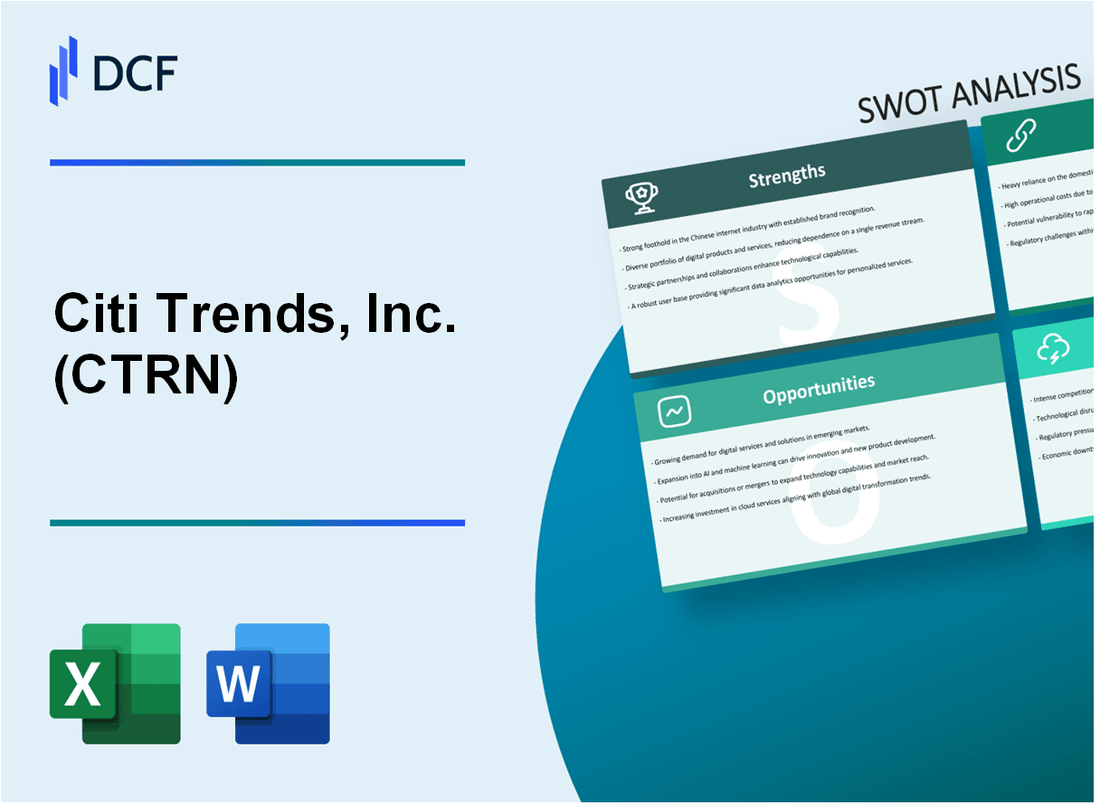
Completamente Editable: Adáptelo A Sus Necesidades En Excel O Sheets
Diseño Profesional: Plantillas Confiables Y Estándares De La Industria
Predeterminadas Para Un Uso Rápido Y Eficiente
Compatible con MAC / PC, completamente desbloqueado
No Se Necesita Experiencia; Fáciles De Seguir
Citi Trends, Inc. (CTRN) Bundle
En el mundo dinámico de la moda minorista, Citi Trends, Inc. (CTRN) se destaca como un jugador único dirigido a la moda urbana asequible para las comunidades afroamericanas. Con una presencia estratégica de Más de 600 tiendas minoristas Principalmente en el sureste de los Estados Unidos, este minorista navega por un panorama complejo de preferencias del consumidor, desafíos económicos y transformación digital. Este análisis FODA completo revela el posicionamiento competitivo de la compañía, las fortalezas estratégicas, las vías potenciales de crecimiento y los desafíos críticos que podrían dar forma a su futuro en el mercado minorista en rápida evolución.
Citi Trends, Inc. (CTRN) - Análisis FODA: fortalezas
Especializado de manera asequible para comunidades afroamericanas y urbanas
Citi Trends se dirige a un segmento de mercado específico con un Estrategia minorista enfocada. A partir de 2024, la compañía mantiene un posicionamiento único en el mercado de moda asequible para las comunidades afroamericanas y urbanas.
| Métricas de segmento de mercado | 2024 datos |
|---|---|
| Demografía de los clientes objetivo | Consumidores afroamericanos y urbanos |
| Precio promedio | $ 12.50 - $ 35 por ropa |
| Ingresos anuales del mercado objetivo | $ 712.3 millones |
Fuerte presencia de tiendas minoristas
Citi Trends mantiene una sólida huella minorista física en el sureste de los Estados Unidos.
- Número total de tiendas minoristas: 607
- Enfoque geográfico primario: el sureste de los Estados Unidos
- Tamaño promedio de la tienda: 4,500 pies cuadrados
Estrategia consistente a precio de valor
| Métricas de estrategia de precios | 2024 cifras |
|---|---|
| Precio promedio de prendas de ropa | $18.75 |
| Accesorios Rango de precios | $5 - $25 |
| Margen bruto de los precios de los valores | 38.6% |
Enfoque minorista omnicanal
- Ingresos de la plataforma de comercio electrónico: $ 89.4 millones
- Tasa de crecimiento de ventas en línea: 22.3%
- Usuarios de aplicaciones móviles: 275,000
- Tasa de conversión digital: 3.7%
La estrategia minorista integrada de la compañía combina la presencia física de la tienda con una plataforma digital robusta, lo que permite una participación integral del cliente.
Citi Trends, Inc. (CTRN) - Análisis FODA: debilidades
Huella geográfica limitada
A partir del cuarto trimestre de 2023, Citi Trends opera 573 tiendas minoristas, concentradas predominantemente en 33 estados en el sureste de los Estados Unidos. La distribución de la tienda de la compañía revela una concentración regional significativa:
| Región | Número de tiendas | Porcentaje de total |
|---|---|---|
| Sureste de EE. UU. | 458 | 80% |
| Otras regiones | 115 | 20% |
Demográfico del mercado objetivo estrecho
Citi Trends se centra principalmente en segmentos de consumo afroamericanos y urbanos, lo que limita su alcance potencial del mercado. Las restricciones demográficas clave incluyen:
- Rango de edad objetivo: 18-45 años
- Ingresos familiares promedio: $ 35,000 - $ 55,000
- Predominantemente mercados urbanos y suburbanos
Vulnerabilidad al gasto discretario del consumidor
Los ingresos de la compañía son altamente sensibles a las fluctuaciones económicas. En 2023, el gasto discrecional del consumidor mostró una volatilidad significativa:
| Métrico | Valor 2023 | Cambio año tras año |
|---|---|---|
| Ingresos totales | $ 918.7 millones | -3.2% |
| Lngresos netos | $ 36.5 millones | -12.7% |
Pequeña capitalización de mercado
En comparación con los competidores minoristas más grandes, Citi Trends tiene una capitalización de mercado relativamente pequeña:
| Compañía | Caut de mercado (a partir de enero de 2024) |
|---|---|
| Tendencias de Citi | $ 393 millones |
| Empresas tjx | $ 86.4 mil millones |
| Tiendas de Ross | $ 44.2 mil millones |
Citi Trends, Inc. (CTRN) - Análisis FODA: oportunidades
Potencial de expansión geográfica en nuevos mercados
A partir del cuarto trimestre de 2023, Citi Trends opera 573 tiendas principalmente en el sureste de los Estados Unidos. La compañía tiene el potencial de expandirse a mercados urbanos adicionales con importantes poblaciones afroamericanas e hispanas.
| Métricas de expansión del mercado | Estado actual | Crecimiento potencial |
|---|---|---|
| Ubicaciones actuales de la tienda | 573 tiendas | Potencial estimado para 200-250 tiendas adicionales |
| Regiones geográficas primarias | Sudeste de los Estados Unidos | Oportunidad en los mercados urbanos del Medio Oeste y Noreste |
Creciente capacidades de comercio electrónico y estrategias de marketing digital
En 2023, Citi Trends reportó $ 59.3 millones en ventas digitales, lo que representa el 8.4% de los ingresos totales.
- Crecimiento de ventas digitales de 15.2% año tras año
- Las descargas de aplicaciones móviles aumentaron en un 22% en 2023
- El tráfico del sitio web aumentó en un 18,3% en comparación con el año anterior
Aumento de la demanda de moda asequible en comunidades urbanas y diversas
El grupo demográfico objetivo representa aproximadamente 42.2 millones de consumidores con un poder adquisitivo anual de $ 1.3 billones.
| Segmento demográfico | Población | Gasto promedio de ropa |
|---|---|---|
| Consumidores afroamericanos | 42.2 millones | $ 904 per cápita anualmente |
| Consumidores hispanos | 62.5 millones | $ 765 per cápita anualmente |
Potencial para asociaciones con plataformas digitales y personas influyentes en las redes sociales
Las métricas de participación en las redes sociales demuestran un potencial significativo para las estrategias de marketing de influencia.
- Seguidores de Instagram: 215,000
- Tiktok seguidores: 87,000
- Tasa de compromiso promedio: 3.6%
Oportunidades clave de asociación: Inflactores de moda emergentes con 50,000-500,000 seguidores dirigidos a la demografía de la moda urbana.
Citi Trends, Inc. (CTRN) - Análisis FODA: amenazas
Competencia intensa de minoristas fuera de precio
El análisis de paisajes competitivos revela una presión significativa en el mercado de los minoristas fuera de precio:
| Competidor | Ingresos anuales (2023) | Cuota de mercado |
|---|---|---|
| Tiendas de Ross | $ 16.8 mil millones | 12.4% |
| TJ Maxx | $ 14.2 mil millones | 10.7% |
| Tendencias de Citi | $ 975.3 millones | 1.8% |
Incertidumbres económicas que afectan el gasto del consumidor
Indicadores económicos que destacan los desafíos del gasto del consumidor:
- Ingresos familiares medios para el grupo demográfico: $ 45,870
- Índice de confianza del consumidor: 61.3 (enero de 2024)
- Reducción de gastos discrecionales: 7.2% año tras año
Alciamiento de la inflación y las interrupciones de la cadena de suministro
| Métrica económica | Valor 2024 |
|---|---|
| Tasa de inflación | 3.4% |
| Aumento del costo de la cadena de suministro | 5.6% |
| Tarifas de contenedor de envío | $ 2,800 por contenedor |
Cambiar las preferencias del consumidor
Desafíos de adaptación de tendencias de moda:
- Crecimiento minorista de moda en línea: 15.2%
- Cuota de mercado de moda sostenible: 6.8%
- Genno de moda Gen Z: $ 143 mil millones anuales
Métricas clave de amenazas competitivas:
| Categoría de amenaza | Nivel de impacto |
|---|---|
| Competencia de precios | Alto |
| Volatilidad del gasto del consumidor | Medio-alto |
| Resiliencia de la cadena de suministro | Medio |
Citi Trends, Inc. (CTRN) - SWOT Analysis: Opportunities
The core opportunity for Citi Trends lies in capitalizing on its value proposition during a period of sustained economic uncertainty, leveraging its recent operational improvements to fuel a disciplined, profitable expansion. You are seeing a clear path to margin expansion and sales growth, driven by external consumer shifts and internal system upgrades.
Expand store footprint into adjacent, underserved markets to reach 1,000+ stores
The long-term vision is clear: Citi Trends plans to nearly double its store count, moving toward the 1,000+ store mark by strategically entering new, underserved markets that align with its core African American customer demographic. This is a massive runway for growth, but it's a multi-year effort.
In fiscal 2025, the focus is on optimizing the existing fleet of 590 locations (as of Q2 2025), not rapid net expansion. The company expects to open only 3 new stores and close 3 locations, while aggressively remodeling approximately 60 stores to enhance the in-store experience and drive higher sales per square foot. Looking ahead, the expansion ramps up significantly, with plans to open approximately 25 to 40 new stores in 2026 and at least 40 new stores per year from 2027 onward, aiming for approximately 650 stores by the end of 2027. That's a solid, disciplined growth path.
| Metric | Q2 Fiscal 2025 End Value | Full-Year Fiscal 2025 Outlook | Long-Term Target (Post-2027) |
|---|---|---|---|
| Total Store Count | 590 locations | Net change of 0 (3 openings, 3 closures) | 1,000+ stores |
| Store Remodels (FY 2025) | 19 stores remodeled (Q2 2025) | Approximately 60 stores | N/A |
| New Store Openings (Annual Rate) | 3 (Planned for FY 2025) | 25 to 40 (Planned for 2026) | At least 40 (From 2027 onward) |
Accelerate digital transformation to capture a larger share of online sales
Digital transformation here is less about a massive e-commerce site and more about using technology to make the physical stores better, which is smart for an off-price model. The company is investing in advanced systems to improve inventory flow and trend capture.
The rollout of a new AI-based allocation system across all categories by mid-September 2025 is a critical step. Test results for this system were 'well above expectations,' which means merchandise should get to the right store at the right time, boosting full-price sell-through. Plus, they are developing a complementary AI-based merchandise planning system for early 2026. This focus on operational technology is what drives the current sales momentum:
- Implement AI to optimize product allocation and inventory efficiency.
- Improve speed from vendor to store for maximum trend relevance.
- Drive higher full-price selling and reduced markdowns.
Leverage consumer trade-down from mid-tier retailers due to persistent inflation
Honestly, persistent inflation is a tailwind for value-focused off-price retailers like Citi Trends. As of September 2025, the annual Consumer Price Index (CPI) rose 3.0%, keeping pressure on household budgets. This financial anxiety is causing consumers to 'trade down' from mid-tier and full-price department stores to value-driven alternatives.
Citi Trends is already benefiting from this shift, reporting a comparable store sales increase of 9.2% in Q2 2025, marking its fourth consecutive quarter of mid- to high-single-digit growth. Year-to-date comparable sales were up 9.6% through Q2 2025, primarily driven by increased customer traffic and transactions. This demonstrates that the company's curated assortment and extreme-value deals are defintely resonating with budget-conscious shoppers, including those trading down from higher-priced competitors.
Optimize supply chain to reduce inbound freight costs, boosting gross margin
The company is in the 'Optimize' phase of its transformation, which is already translating into better financial performance through supply chain efficiency.
The Q2 2025 gross margin rate of 40.0% was the highest for a second quarter since fiscal 2021, representing an 890 basis point expansion versus Q2 2024. A key driver of this massive gain was the lower cost of freight and a faster supply chain. The full-year fiscal 2025 outlook anticipates gross margin to expand by approximately 210 to 230 basis points versus 2024, which is slightly above the previous outlook. This is a direct, measurable benefit of their supply chain focus.
Here's the quick math on inventory: Merchandise inventory was down 12.9% versus Q2 2024, which means they are carrying less risk while supporting strong sales growth. They are simply buying better and moving product faster, which is the heart of a healthy off-price model.
Next step: Operations should finalize the Q4 2025 supply chain metrics to confirm the full-year gross margin expansion hits the high end of the 230 basis point range.
Citi Trends, Inc. (CTRN) - SWOT Analysis: Threats
You're operating in a discount retail space that is incredibly unforgiving, and the primary threats to Citi Trends are all about scale and the consumer's shrinking discretionary wallet. The biggest risk is that your core customer, who is already budget-constrained, gets squeezed by rising costs for essentials, forcing them to prioritize food and fuel over apparel. Plus, the sheer size of your main competitors makes it defintely hard to compete on price and logistics.
Intense competition from larger rivals like TJX Companies and Ross Stores.
The off-price sector is dominated by giants whose operating scale allows them to secure better inventory deals and run more efficient supply chains. Citi Trends' revenue is dwarfed by the market leaders, which translates directly into a structural disadvantage in buying power and overhead absorption.
For the 2025 fiscal year, the revenue disparity is stark. Here's the quick math on the competitive landscape:
| Company | Primary Market Focus | FY 2025 Revenue (Guidance/TTM) | Scale Multiplier (vs. CTRN) |
|---|---|---|---|
| TJX Companies | Broad Off-Price (T.J. Maxx, Marshalls) | ~$59.7 billion | ~76x larger |
| Ross Stores | Off-Price Apparel & Home | ~$22.16 billion | ~28x larger |
| Citi Trends, Inc. (CTRN) | Off-Price Urban/Value Apparel | ~$781.75 million | 1x (Base) |
TJX Companies, with a full-year sales guidance of between $59.7 billion and $59.9 billion, and Ross Stores, with an expected full-year revenue of about $22.16 billion, can absorb cost increases and still offer lower prices than a smaller player like Citi Trends, whose full-year revenue consensus is around $781.75 million. This scale difference is the single largest structural threat you face.
Macroeconomic pressure on core customer base from high food and fuel prices.
Your core customer base-primarily African American families in the United States-is highly sensitive to inflation in non-discretionary categories. When the cost of essentials rises, the first thing cut is apparel spending, which is your entire business.
As of September 2025, the annual inflation rate for all items was 3.0%. What really hits your customer is the cost of living essentials:
- Food prices saw an annual increase of 3.1%.
- Food at home (groceries) was up 2.7% over the last 12 months.
- Energy costs increased 2.8% year-over-year.
- Natural gas, a key utility cost, rose a steep 11.7% over the last year.
When shelter costs are up 3.6% and groceries are up 2.7%, a family's budget for a new outfit simply disappears. This macroeconomic squeeze directly limits the upside potential of your comparable store sales, no matter how good your merchandise is.
Wage inflation and labor shortages impacting store-level operating expenses.
The tight labor market continues to push up the cost of running your 590 locations. As a brick-and-mortar retailer, a significant portion of your Selling, General, and Administrative (SG&A) expenses is labor. While Citi Trends is managing to leverage SG&A by 60 to 90 basis points in FY 2025, the underlying pressure from wage inflation is a persistent threat to margins.
Wage growth for low-wage jobs, which includes much of the retail workforce, was still running at an annual rate of 2.8% as of June 2025. You have to pay more to attract and keep staff, or you face labor shortages that hurt the in-store experience. The cost of labor is not going down anytime soon, so you must find efficiencies elsewhere.
Shifting consumer preferences away from traditional brick-and-mortar apparel.
While the majority of retail sales still happen in physical stores (a projected 80.8% of total retail sales in 2025), the apparel category is a major driver of the shift to online. E-commerce now accounts for about 28% of apparel sales, and non-store/online sales are forecasted to grow between 7% and 9% in 2024.
For a retailer like Citi Trends that relies on a traditional, high-touch brick-and-mortar model, this shift presents two key problems:
- Digital Competition: Fast-fashion giants like Shein and Temu are capturing younger consumers with ultra-low prices and social commerce models.
- High Cost of Online: Moving online is expensive; the online apparel return rate is significantly higher, at 25% to 40%, compared to only 8% to 10% for in-store purchases.
If you don't offer a compelling, seamless online-to-store experience, you risk losing the next generation of shoppers to digital-first competitors. You need to be where the customer is shopping, and that's increasingly on their phone.
Disclaimer
All information, articles, and product details provided on this website are for general informational and educational purposes only. We do not claim any ownership over, nor do we intend to infringe upon, any trademarks, copyrights, logos, brand names, or other intellectual property mentioned or depicted on this site. Such intellectual property remains the property of its respective owners, and any references here are made solely for identification or informational purposes, without implying any affiliation, endorsement, or partnership.
We make no representations or warranties, express or implied, regarding the accuracy, completeness, or suitability of any content or products presented. Nothing on this website should be construed as legal, tax, investment, financial, medical, or other professional advice. In addition, no part of this site—including articles or product references—constitutes a solicitation, recommendation, endorsement, advertisement, or offer to buy or sell any securities, franchises, or other financial instruments, particularly in jurisdictions where such activity would be unlawful.
All content is of a general nature and may not address the specific circumstances of any individual or entity. It is not a substitute for professional advice or services. Any actions you take based on the information provided here are strictly at your own risk. You accept full responsibility for any decisions or outcomes arising from your use of this website and agree to release us from any liability in connection with your use of, or reliance upon, the content or products found herein.