

|
Dell Technologies Inc. (DELL): Lienzo de Modelo de Negocio [Actualizado en Ene-2025] |
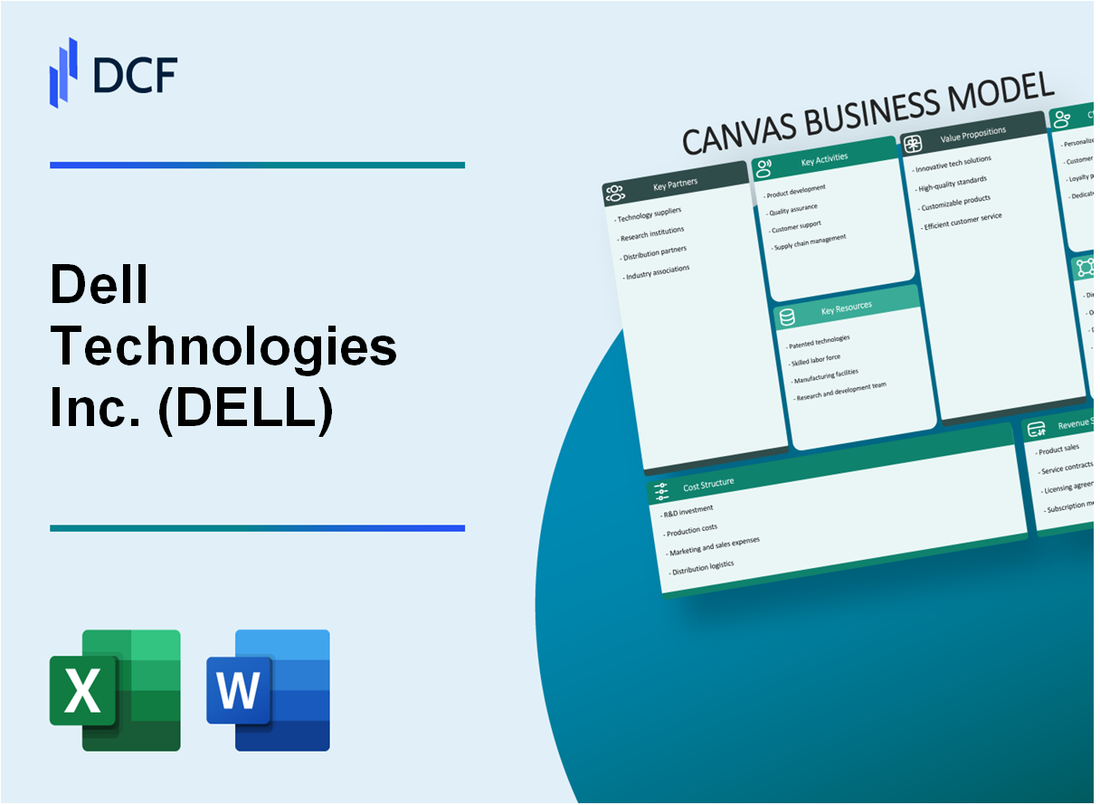
Completamente Editable: Adáptelo A Sus Necesidades En Excel O Sheets
Diseño Profesional: Plantillas Confiables Y Estándares De La Industria
Predeterminadas Para Un Uso Rápido Y Eficiente
Compatible con MAC / PC, completamente desbloqueado
No Se Necesita Experiencia; Fáciles De Seguir
Dell Technologies Inc. (DELL) Bundle
En el panorama dinámico de los gigantes tecnológicos, Dell Technologies Inc. se destaca como una potencia transformadora, navegando estratégicamente el complejo ecosistema de soluciones empresariales y la informática innovadora. Al crear meticulosamente un modelo de negocio que integra perfectamente hardware, software y servicios, Dell se ha posicionado como un socio tecnológico integral para las organizaciones de todo el mundo. Desde asociaciones estratégicas con líderes de la industria como Intel y Microsoft hasta sus robustas capacidades de fabricación global, el modelo de negocio de Dell revela un sofisticado plan de innovación tecnológica y adaptabilidad del mercado que continúa remodelando la forma en que las empresas aprovechan la infraestructura digital y la computación.
Dell Technologies Inc. (Dell) - Modelo de negocios: asociaciones clave
Asociaciones de procesador estratégico
Dell mantiene asociaciones críticas con fabricantes de semiconductores:
| Pareja | Detalles de la asociación | Valor de adquisición anual |
|---|---|---|
| Intel Corporation | Proveedor de procesadores primarios para dispositivos de computación empresarial y de consumo | $ 4.2 mil millones (2023) |
| Micro dispositivos avanzados (AMD) | Proveedor de procesadores secundarios para soluciones informáticas de alto rendimiento | $ 1.8 mil millones (2023) |
Colaboraciones de software empresarial
Las asociaciones de software estratégico de Dell incluyen:
- Microsoft Corporation: integración de software empresarial
- Red Hat: soluciones empresariales de código abierto
- SAP: Sistemas de planificación de recursos empresariales
Asociaciones de proveedores de nubes
| Proveedor de nubes | Alcance de la asociación | Impacto anual de ingresos |
|---|---|---|
| VMware | Virtualización e soluciones de infraestructura en la nube | $ 2.7 mil millones (2023) |
| Servicios web de Amazon (AWS) | Servicios de migración en la nube y híbridos en la nube | $ 1.5 mil millones (2023) |
| Microsoft Azure | Soluciones de nubes híbridas y nubes empresariales | $ 1.3 mil millones (2023) |
Asociaciones de fabricación global
La cadena de suministro de componentes de Dell implica:
- Foxconn: socio de fabricación para la producción de computadoras portátiles y de escritorio
- CUANTA COMPUTADORA: fabricación de cuaderno y servidor
- Compal Electronics: Servicios de fabricación de computadoras portátiles
Asociaciones de integrador de sistemas globales
| Integrador de sistemas | Enfoque de asociación | Valor anual del contrato |
|---|---|---|
| Acentuar | Soluciones de transformación digital empresarial | $ 620 millones (2023) |
| Deloitte | Consultoría e implementación de tecnología | $ 540 millones (2023) |
| Wipro | Infraestructura de TI y servicios administrados | $ 410 millones (2023) |
Dell Technologies Inc. (Dell) - Modelo de negocio: actividades clave
Diseño y fabricación de hardware informático
Salida de fabricación de hardware de Dell en 2023: 57.2 millones de unidades de computadoras personales y servidores empresariales.
| Categoría de productos | Unidades fabricadas (2023) | Ingresos generados |
|---|---|---|
| Computadoras portátiles | 34.6 millones | $ 26.3 mil millones |
| Computadoras de escritorio | 12.4 millones | $ 9.7 mil millones |
| Servidores empresariales | 10.2 millones | $ 15.6 mil millones |
Enterprise TI Solutions and Consulting
Ingresos de soluciones empresariales en 2023: $ 24.8 mil millones
- Volumen de servicios de consultoría: 3.742 contratos empresariales
- Valor promedio del contrato: $ 6.2 millones
- Global Enterprise Clientes atendidos: 10,567
Investigación y desarrollo de tecnologías avanzadas
Inversión en I + D en 2023: $ 5.6 mil millones
| Área de enfoque tecnológico | Asignación de I + D | Solicitudes de patentes |
|---|---|---|
| AI y aprendizaje automático | $ 1.4 mil millones | 287 aplicaciones |
| Tecnologías de ciberseguridad | $ 1.1 mil millones | 214 aplicaciones |
| Computación en la nube | $ 1.3 mil millones | 246 aplicaciones |
Gestión de la cadena de suministro global
Métricas operativas de la cadena de suministro en 2023:
- Total de proveedores: 1,247
- Ubicaciones de fabricación: 32 países
- Cobertura de la red logística: 180 países
- Tasa de eficiencia de la cadena de suministro: 94.3%
Servicios de ciberseguridad y computación en la nube
Ingresos de ciberseguridad y servicios en la nube en 2023: $ 18.9 mil millones
| Categoría de servicio | Ganancia | Base de clientes |
|---|---|---|
| Servicios en la nube | $ 12.6 mil millones | 8.345 clientes empresariales |
| Soluciones de ciberseguridad | $ 6.3 mil millones | 5.672 clientes empresariales |
Dell Technologies Inc. (Dell) - Modelo de negocio: recursos clave
Extensas instalaciones de fabricación global
Dell opera instalaciones de fabricación en:
| Ubicación | Capacidad de fabricación | Volumen de producción anual |
|---|---|---|
| Round Rock, Texas, EE. UU. | 3 plantas de fabricación importantes | 35 millones de unidades/año |
| Limerick, Irlanda | 2 instalaciones de fabricación | 15 millones de unidades/año |
| Penang, Malasia | 4 centros de fabricación | 25 millones de unidades/año |
Centros de investigación y desarrollo avanzados
Dell invierte significativamente en I + D:
- Gastos totales de I + D en 2023: $ 5.3 mil millones
- Número de centros de I + D a nivel mundial: 16
- Ubicaciones primarias de I + D: Austin (Texas), Silicon Valley, Bangalore (India)
Cartera de propiedades intelectuales
| Categoría de patente | Número de patentes | Presentaciones de patentes anuales |
|---|---|---|
| Patentes tecnológicas | 3,750 | 450 |
| Patentes de diseño de hardware | 2,100 | 250 |
| Patentes de innovación de software | 1,650 | 200 |
Ingeniería especializada y fuerza laboral técnica
Composición de la fuerza laboral de Dell:
- Total de empleados: 133,000 (a partir de 2023)
- Fuerza laboral de ingeniería: 38,500
- Personal técnico de I + D: 12,700
Plataformas de infraestructura y tecnología digitales
| Componente de infraestructura | Especificación | Inversión anual |
|---|---|---|
| Infraestructura en la nube | 350 centros de datos globales | $ 1.2 mil millones |
| Infraestructura de red | 99.99% de capacidad de tiempo de actividad | $ 780 millones |
| Sistemas de ciberseguridad | Monitoreo global 24/7 | $ 450 millones |
Dell Technologies Inc. (Dell) - Modelo de negocio: propuestas de valor
Soluciones integrales de tecnología empresarial
Dell Technologies reportó ingresos totales de $ 102.3 mil millones en el año fiscal 2024. Desglose de soluciones de tecnología empresarial:
| Segmento | Ganancia | Cuota de mercado |
|---|---|---|
| Grupo de soluciones de infraestructura | $ 34.6 mil millones | 22.4% |
| Grupo de soluciones de clientes | $ 61.5 mil millones | 35.7% |
| VMware Solutions en la nube | $ 6.2 mil millones | 12.3% |
Configuraciones personalizables de hardware y software
Dell ofrece amplias opciones de personalización en las líneas de productos:
- Más de 500 combinaciones de configuración de hardware únicas
- Configuraciones del servidor empresarial: más de 250 modelos
- Opciones de personalización de la computadora portátil: más de 1,200 variantes
Productos informáticos de alto rendimiento
Especificaciones del segmento de computación de alto rendimiento de Dell:
| Categoría de productos | Ingresos anuales | Métricas de rendimiento |
|---|---|---|
| Servidores PowerEdge | $ 18.7 mil millones | Hasta 3.0 GHz de procesamiento de GHz |
| Estaciones de trabajo de precisión | $ 5.4 mil millones | Hasta 128 GB de RAM |
Soporte de infraestructura de TI de extremo a extremo
Los servicios de apoyo integrales de Dell incluyen:
- Prosupport Enterprise: cubre el 95% del hardware empresarial
- Disponibilidad de soporte técnico 24/7
- Tiempo de respuesta promedio: 30 minutos para problemas críticos
Ofertas de tecnología escalables e innovadoras
Métricas de innovación y escalabilidad:
| Métrica de innovación | Valor |
|---|---|
| Inversión anual de I + D | $ 4.8 mil millones |
| Registros de patentes | 1.250 nuevas patentes |
| Implementaciones de soluciones en la nube | Más de 50,000 clientes empresariales |
Dell Technologies Inc. (Dell) - Modelo de negocios: relaciones con los clientes
Modelo de ventas directo para clientes empresariales
Dell Technologies generó $ 102.3 mil millones en ingresos en el año fiscal 2023, con clientes empresariales que representan el 67% de las ventas totales. El equipo de ventas directas consta de 8.500 representantes de la cuenta empresarial a nivel mundial.
| Segmento de clientes | Ingresos anuales | Tamaño de trato promedio |
|---|---|---|
| Grandes empresas | $ 68.5 mil millones | $ 3.2 millones |
| Compañías del mercado medio | $ 22.7 mil millones | $750,000 |
| Gobierno/Sector Público | $ 11.1 mil millones | $ 1.5 millones |
Soporte en línea y plataformas de autoservicio
La plataforma de soporte en línea de Dell procesa el 72% de las interacciones de servicio al cliente digitalmente. El sitio web recibe 45 millones de visitantes únicos mensualmente.
- Soporte técnico en línea 24/7
- Herramientas de solución de problemas automatizadas
- Base de conocimiento con más de 250,000 artículos
- Foros comunitarios con 2.3 millones de usuarios registrados
Consulta técnica personalizada
Dell emplea 6.200 consultores técnicos especializados en las regiones globales. El tiempo de respuesta promedio para el soporte técnico empresarial es de 17 minutos.
| Tipo de consulta | Interacciones anuales | Tasa de satisfacción del cliente |
|---|---|---|
| Soporte técnico empresarial | 1.2 millones | 94.3% |
| Consultoría de soluciones en la nube | 385,000 | 92.7% |
Gestión del éxito del cliente a largo plazo
La tasa de retención de clientes de Dell es del 88.6% para los clientes empresariales. El ciclo de vida promedio del cliente abarca 7,4 años.
- Revisiones comerciales trimestrales
- Hojas de ruta de tecnología personalizadas
- Recomendaciones de actualización de tecnología proactiva
Gestión de cuentas dedicada para grandes clientes
Dell administra 2.100 cuentas empresariales estratégicas con equipos de cuentas dedicados. Estas cuentas representan el 53% de los ingresos de la empresa total.
| Nivel de cuenta | Número de cuentas | Ingresos anuales por cuenta |
|---|---|---|
| Cuentas estratégicas | 450 | $ 12.5 millones |
| Cuentas clave | 1,650 | $ 3.8 millones |
Dell Technologies Inc. (Dell) - Modelo de negocios: canales
Plataforma directa de ventas en línea
Dell.com generó $ 67.2 mil millones en ingresos directos de ventas en línea en el año fiscal 2023. El canal de ventas directas en línea representaba el 48.3% de las ventas totales de la compañía. El sitio web procesa aproximadamente 35,000 transacciones en línea por día.
| Métrica de ventas en línea | Valor |
|---|---|
| Ingresos anuales en línea | $ 67.2 mil millones |
| Transacciones diarias en línea | 35,000 |
| Porcentaje de ventas en línea | 48.3% |
Equipos de ventas corporativas
Dell emplea a 22,000 representantes de ventas empresariales directas a nivel mundial. El segmento de ventas corporativas generó $ 42.5 mil millones en ingresos durante el año fiscal 2023.
- 22,000 profesionales de ventas empresariales
- Cobertura global en 180 países
- Tamaño promedio de la oferta empresarial: $ 1.3 millones
Redes de revendedor autorizadas
Dell mantiene asociaciones con 105,000 socios de canal global. Las ventas de los socios del canal contribuyeron con $ 31.6 mil millones en ingresos para el año fiscal 2023.
| Métrica de la red de revendedor | Valor |
|---|---|
| Total de canal socios | 105,000 |
| Ingresos de los socios del canal | $ 31.6 mil millones |
Tiendas minoristas físicas
Dell opera 250 ubicaciones minoristas de marca en todo el mundo. Las tiendas minoristas físicas generaron $ 8.7 mil millones en ventas durante el año fiscal 2023.
Canal de marketing digital y comercio electrónico
Dell invirtió $ 1.2 mil millones en iniciativas de marketing digital en 2023. Los canales de marketing digital generaron el 52% de la adquisición total de clientes.
| Métrica de marketing digital | Valor |
|---|---|
| Inversión de marketing digital | $ 1.2 mil millones |
| Adquisición de clientes a través de canales digitales | 52% |
Dell Technologies Inc. (Dell) - Modelo de negocios: segmentos de clientes
Grandes organizaciones empresariales
A partir del cuarto trimestre de 2023, Dell atiende al 99% de las compañías Fortune 500. Los ingresos por segmento empresarial fueron de $ 22.4 mil millones en el año fiscal 2023.
| Categoría de clientes empresariales | Cuota de mercado | Contribución anual de ingresos |
|---|---|---|
| Global 2000 Companies | 95% | $ 15.6 mil millones |
| Corporaciones multinacionales | 92% | $ 6.8 mil millones |
Pequeñas y medianas empresas
Dell atiende a aproximadamente 1,5 millones de clientes de SMB a nivel mundial. El segmento SMB generó $ 8.7 mil millones en ingresos para el año fiscal 2023.
- Tasa de adopción de tecnología: 78%
- Gasto promedio de TI anual: $ 250,000 por negocio
- Categorías de productos primarios: computadoras portátiles, servidores, equipos de redes
Instituciones gubernamentales y del sector público
Dell posee contratos federales en 45 países. Los ingresos del sector público alcanzaron los $ 6.2 mil millones en 2023.
| Segmento gubernamental | Valor de contrato | Penetración del mercado |
|---|---|---|
| Gobierno federal de EE. UU. | $ 3.4 mil millones | 87% |
| Gobiernos estatales/locales | $ 1.8 mil millones | 65% |
Instituciones educativas
Dell sirve a más de 16,000 instituciones educativas en todo el mundo. Los ingresos del segmento de educación fueron de $ 3.5 mil millones en 2023.
- Cuota de mercado de K-12: 42%
- Cuota de mercado de la educación superior: 55%
- Inversión de tecnología institucional promedio: $ 1.2 millones anuales
Consumidores y profesionales individuales
El segmento de consumo generó $ 12.6 mil millones en ingresos para el año fiscal 2023. El total de la base del consumidor excede a 50 millones de usuarios en todo el mundo.
| Categoría de consumidor | Segmento de mercado | Ingresos anuales |
|---|---|---|
| Usuarios caseros | 35 millones | $ 7.4 mil millones |
| Profesional/independiente | 15 millones | $ 5.2 mil millones |
Dell Technologies Inc. (Dell) - Modelo de negocio: Estructura de costos
Inversiones de investigación y desarrollo
Dell Technologies invirtió $ 4.7 mil millones en gastos de I + D para el año fiscal 2024, lo que representa el 4.3% de los ingresos totales.
| Año fiscal | Inversión de I + D | Porcentaje de ingresos |
|---|---|---|
| 2024 | $ 4.7 mil millones | 4.3% |
Gastos de fabricación y cadena de suministro
Los costos totales de fabricación y cadena de suministro para Dell en el año fiscal 2024 fueron de aproximadamente $ 38.2 mil millones.
- Costos de fabricación directa: $ 24.6 mil millones
- Gastos de logística y distribución: $ 8.3 mil millones
- Costos de gestión de inventario: $ 5.3 mil millones
Fuerza laboral global y adquisición de talento
| Categoría de costos | Gasto anual |
|---|---|
| Compensación total de empleados | $ 12.5 mil millones |
| Reclutamiento y capacitación | $ 687 millones |
| Beneficios para empleados | $ 2.3 mil millones |
Operaciones de marketing y ventas
Dell asignó $ 5.9 mil millones a los gastos de marketing y ventas en el año fiscal 2024.
- Marketing digital: $ 1.6 mil millones
- Desarrollo del canal de ventas: $ 2.3 mil millones
- Costos de adquisición de clientes: $ 2 mil millones
Mantenimiento de la infraestructura tecnológica
Los costos de mantenimiento de la infraestructura tecnológica para Dell en 2024 totalizaron $ 3.4 mil millones.
| Componente de infraestructura | Costo de mantenimiento anual |
|---|---|
| Infraestructura del centro de datos | $ 1.8 mil millones |
| Sistemas de computación en la nube | $ 1.2 mil millones |
| Infraestructura de red y de seguridad | $ 400 millones |
Dell Technologies Inc. (Dell) - Modelo de negocios: flujos de ingresos
Venta de productos de hardware
Para el año fiscal 2024, Dell Technologies reportó ingresos por ventas de productos de hardware de $ 54.97 mil millones. El desglose de las ventas de hardware incluye:
| Categoría de productos | Ganancia |
|---|---|
| Venta de computadora personal | $ 35.2 mil millones |
| Servidores empresariales | $ 12.6 mil millones |
| Equipo de redes | $ 4.7 mil millones |
| Sistemas de almacenamiento | $ 2.47 mil millones |
Soluciones y servicios empresariales
Enterprise TI Solutions and Services generó $ 22.3 mil millones en ingresos para Dell en el año fiscal 2024.
- Servicios de consultoría: $ 6.8 mil millones
- Servicios de implementación: $ 5.9 mil millones
- Servicios administrados: $ 4.6 mil millones
- Servicios de TI profesionales: $ 5 mil millones
Servicios de computación en la nube y virtualización
Los ingresos por servicios en la nube y de virtualización totalizaron $ 15.6 mil millones en el año fiscal 2024.
| Tipo de servicio | Ganancia |
|---|---|
| Servicios de nube pública | $ 7.2 mil millones |
| Soluciones de nubes privadas | $ 5.4 mil millones |
| Servicios en la nube híbrida | $ 3 mil millones |
Ofertas de software basadas en suscripción
Los ingresos de software basados en suscripción alcanzaron los $ 8.7 mil millones en el año fiscal 2024.
- Software-as-a-Service (SaaS): $ 4.2 mil millones
- Infraestructura como servicio (IaaS): $ 2.9 mil millones
- Plataforma como servicio (PaaS): $ 1.6 mil millones
Soporte técnico e ingresos por consultoría
El soporte técnico y los ingresos por consultoría ascendieron a $ 12.5 mil millones en el año fiscal 2024.
| Categoría de apoyo | Ganancia |
|---|---|
| Soporte técnico básico | $ 5.6 mil millones |
| Soporte técnico avanzado | $ 3.9 mil millones |
| Consultoría estratégica | $ 3 mil millones |
Dell Technologies Inc. (DELL) - Canvas Business Model: Value Propositions
You're looking at the core promises Dell Technologies Inc. is making to the market as of late 2025, especially as the AI wave reshapes everything. It's all about delivering the infrastructure and endpoints for this new era.
End-to-end AI infrastructure (Dell AI Factory) for enterprise scale
Dell Technologies Inc. is positioning the Dell AI Factory with NVIDIA as the end-to-end solution for enterprise AI deployment. The company is the world's number one provider of AI infrastructure. More than 3,000 global customers are accelerating their AI initiatives with this factory approach. The value proposition here is speed and cost control; the Dell AI Factory approach can be up to 62% more cost effective for inferencing Large Language Models (LLMs) on-premises compared to the public cloud. Furthermore, new PowerEdge servers are designed to deliver AI model training capabilities up to four times faster than their predecessors, supporting up to 192 NVIDIA Blackwell Ultra chips in a single system. This focus is translating directly to financial performance, with AI driving significant growth. For instance, in the first quarter of fiscal 2025, AI-optimized server orders increased sequentially to $2.6 billion, with shipments up more than 100% to $1.7 billion. By the second quarter of fiscal 2026, the Infrastructure Solutions Group (ISG) revenue surged to $16.8 billion (up 44% year over year), fueled by AI servers, where the company shipped $8.2 billion worth of products. Dell Technologies Inc. has increased its full-year fiscal 2026 AI server shipment forecast to $20 billion, and by November 2025, the projection climbed further to $25 billion for fiscal 2026, building on an AI server backlog of roughly $9 billion as of the end of Q4 FY2025. The company targets a $174 billion AI hardware and services market by 2027.
| Metric/Offering | Data Point (Late 2025 Context) | Source Context |
| AI Factory On-Prem LLM Inferencing Cost Advantage | Up to 62% more cost effective than public cloud | Cost Effectiveness |
| AI Model Training Speed Improvement (New Servers) | Up to 4x faster | Performance Metric |
| Max NVIDIA Chips Supported (New Servers) | Up to 192 NVIDIA Blackwell Ultra chips | Hardware Specification |
| Q1 FY2025 AI-Optimized Server Orders | $2.6 billion | Financial Result |
| Q1 FY2025 AI-Optimized Server Shipments | $1.7 billion (up more than 100%) | Financial Result |
| Q2 FY2026 ISG Revenue | $16.8 billion (up 44% YoY) | Financial Result |
| FY2026 AI Server Shipment Forecast (Nov 2025) | $25 billion | Financial Guidance |
| AI Server Backlog (End of Q4 FY2025) | Roughly $9 billion | Financial Metric |
| Targeted AI Hardware & Services Market (by 2027) | $174 billion | Market Target |
Customizable, high-performance client devices (AI PCs)
Dell Technologies Inc. is the number one provider of commercial AI PCs, emphasizing customizable, high-performance devices for on-device AI inference. The Dell Pro Max Plus laptop is cited as the world's first mobile workstation with an enterprise-grade discrete Neural Processing Unit (NPU), capable of running today's 109-billion-parameter model locally. The Dell Pro AI Studio software platform is a key enabler, expected to reduce AI application development and deployment time by as much as 75%, moving from six months down to six weeks. The market trend supports this focus: AI PCs are projected to represent 31% of the total worldwide PC market by the end of 2025. For context on the broader business, the Client Solutions Group (CSG) reported revenue of $12.0 billion in Q1 FY2025, with commercial client revenue at $10.2 billion (up 3% year over year). In Q2 FY2025, commercial client revenue was flat at $10.6 billion. The company shipped 9.5 million PCs in Q1 2025, claiming a 15.1 percent market share overall, with PC sales growing five percent year over year on sales of $12.5 billion in the period leading up to June 2025.
- Dell Pro Max tier offers maximum performance for intensive workloads.
- New thermal technology improves airflow by 20% in commercial laptops.
- AI PCs are expected to make up 64% of the PC market by 2028.
- 74% of consumers reportedly stopped technology purchases due to confusion.
Flexible, consumption-based IT via Dell APEX
Dell Technologies Inc. offers flexible, consumption-based IT through Dell APEX, which is a core offering within the Infrastructure Solutions Group (ISG). While specific, standalone revenue figures for APEX are not explicitly broken out in the latest reports, the overall ISG segment is a primary growth driver. ISG delivered record revenue of $11.6 billion in Q2 FY2025, a 38% increase year-over-year. In Q4 FY2025, ISG revenue grew by 22% year over year to $11.4 billion. The company returned $1.1 billion to shareholders through dividends and repurchases in Q1 FY2025, and later increased its annual cash dividend by 18%, signaling confidence in recurring revenue streams like APEX. Furthermore, PowerStore customers have realized savings of over eight exabytes of capacity through deduplication and compression, a benefit often associated with consumption-based, optimized infrastructure services.
Integrated data protection and cybersecurity solutions
Integrated data protection and cybersecurity are embedded value propositions, particularly within the AI Factory and infrastructure modernization efforts. In May 2025, Dell Technologies Inc. introduced advanced storage, cyber resiliency, and automation innovations to enhance modern disaggregated data centers. The company's focus on zero-trust security is mentioned in the context of simplifying the deployment of AI workloads on the Dell AI Factory. Customers using PowerStore have saved over eight exabytes of capacity via deduplication and compression, which speaks directly to data management and protection efficiency. The company also offers solutions that help organizations securely run scalable AI agents on-premises through collaborations, such as with Glean.
Architectural flexibility to avoid single vendor dependencies
The value proposition of architectural flexibility is delivered through a strategic shift toward a disaggregated data center architecture. This approach is designed to capture the operational excellence of hyperconverged systems while providing the scalability and modularity of traditional architectures, all with cloud-native automation. This directly addresses the need to avoid single vendor dependencies by offering an open stack. The company is collaborating with AI ecosystem players to deliver tailored solutions that integrate into existing IT environments. For example, Dell is delivering Power Switch Ethernet models based on NVIDIA networking, expanding its partnership to include x800 switches in its portfolio. The overall company full-year revenue for fiscal 2025 was $95.6 billion, up 8% year over year, with guidance for fiscal 2026 revenue between $101.0 billion and $105.0 billion, suggesting a strategy built on a broad, flexible portfolio rather than a single technology lock-in.
Dell Technologies Inc. (DELL) - Canvas Business Model: Customer Relationships
You're looking at how Dell Technologies Inc. manages its connections with its massive customer base as of late 2025. It's a multi-pronged approach, really, because the needs of a Fortune 50 company deploying AI factories are worlds apart from someone buying a laptop for college.
Dedicated, high-touch sales teams for large enterprises
For the biggest players, the relationship is direct and deep. This is where the Infrastructure Solutions Group (ISG) shines, especially with the AI boom. The AI server backlog alone hit roughly $9 billion as of the end of fiscal year 2025. That kind of business doesn't happen over a website checkout; it requires dedicated teams working on complex, multi-quarter deployments. The scale of the enterprise relationship is clear when you see the ISG revenue growth, even if the overall FY2025 revenue was $95.6 billion.
Self-service and online configuration for consumers (Dell.com)
On the other end, you have the Client Solutions Group (CSG), which still accounts for a huge chunk of the business, reporting $48.4 billion in revenue for fiscal year 2025. For consumers, the relationship is almost entirely transactional and self-directed via Dell.com, where you configure your own machine. This segment saw its Q4 revenue at $11.9 billion, though the consumer portion specifically was down 12% in that quarter to $1.9 billion. It's a high-volume, low-touch model for this group.
Partner-led engagement for mid-market and SMBs
The middle ground, covering mid-market and small-to-medium businesses (SMBs), relies heavily on the channel. While the exact partner revenue isn't broken out, the Commercial Client revenue in Q4 FY2025 was $10.0 billion, up 5%, suggesting that partner engagement is key to capturing that commercial volume outside the largest direct enterprise deals. This channel strategy helps Dell scale its reach without needing a dedicated, high-touch team for every single smaller account.
Long-term service contracts and premium support (ProSupport)
The move toward recurring revenue and deeper customer lock-in is visible in the service side. These long-term service contracts, like ProSupport, are critical for predictable income. We can see the investment in fulfilling these contracts through the financial reporting: the amortization of deferred costs to fulfill revenue-generating contracts for the fiscal year ended January 31, 2025, was $7.6 billion. Plus, the company signaled confidence in its future earnings by increasing its annual cash dividend by 18%.
Here's a quick look at how the two main customer-facing segments stacked up in FY2025:
| Segment | FY2025 Full-Year Revenue | Year-over-Year Change |
| Client Solutions Group (CSG) | $48.4 billion | Down 1% |
| Infrastructure Solutions Group (ISG) | $43.6 billion | Up 29% |
Community and social media engagement for consumer feedback
For gauging overall sentiment, the company monitors broader customer perception. The Net Promoter Score (NPS) for Dell Technologies was reported at 16, which suggests a healthy, though not industry-leading, level of customer satisfaction and loyalty. This metric is what investors watch to see if the high-touch and self-service models are actually working.
- Net Promoter Score (NPS) as of late 2025: 16.
- Total FY2025 Revenue: $95.6 billion.
- FY2025 Non-GAAP Operating Income: $8.5 billion.
- Q3 2025 Quarterly Revenue: $29.8 billion.
- Annual Cash Dividend Increase: 18%.
Dell Technologies Inc. (DELL) - Canvas Business Model: Channels
You're looking at the pathways Dell Technologies Inc. uses to get its hardware, software, and services to customers as of late 2025. It's a hybrid model, leaning heavily on partners now, which is a big shift from its early days.
The overall financial scale for the last fully reported fiscal year provides context for these channels:
| Metric | Amount (Fiscal Year 2025) | Comparison/Context |
| Full-Year Revenue | $95.6 billion | Up 8% year-over-year from FY2024 |
| Fourth Quarter Revenue | $23.931 billion | Up 7% year-over-year |
| Infrastructure Solutions Group (ISG) Q3 FY2026 Revenue | $14.10 billion | Up 24% year-over-year |
| Client Solutions Group (CSG) Q3 FY2026 Revenue | $12.5 billion | Up 3% year-over-year |
Direct-to-consumer online store (Dell.com)
This channel primarily serves the Consumer segment of the Client Solutions Group. For the fourth quarter of fiscal 2025, Consumer revenue was $1.9 billion, down 12% year-over-year.
Direct sales force for commercial and government accounts
This force targets large enterprises and government entities, often for complex Infrastructure Solutions Group (ISG) deals and high-volume Client Solutions Group (CSG) commercial sales. The company has an estimated 30,000 salespeople.
- Commercial Client revenue for Q4 FY2025 was $10.0 billion, up 5%.
- AI server orders booked in Q3 FY2026 reached $12.3 billion.
- The total AI server backlog stood at a record $18.4 billion at the end of Q3 FY2026.
Global network of value-added resellers (VARs) and distributors
The partner ecosystem is a massive component of Dell Technologies Inc.'s go-to-market engine, especially for storage and enterprise solutions. Partners contributed 50% of net revenues across the four quarters leading up to Q3 2025.
The 2025 Partner Programme included specific incentives:
- Titanium partners received a 2% Storage+ growth incentive upon meeting quarterly targets.
- Titanium partners could receive an incremental 1.5% client growth incentive for meeting quarterly client PC unit targets.
- A 3X AI Networking base rebate multiplier was offered on PowerSwitch Z-series.
Retail partnerships for pre-configured consumer products
This channel moves standardized consumer products through third-party retailers. Consumer revenue for the fourth quarter of fiscal 2025 was $1.9 billion.
Cloud marketplaces for as-a-Service offerings
While specific marketplace revenue figures aren't explicitly broken out, the growth trajectory of the Infrastructure Solutions Group (ISG) suggests strong adoption of as-a-Service models, often transacted via these digital storefronts or through service contracts.
Long-term guidance suggests the ISG segment, which includes storage, software, and servers, is expected to see compounded annual revenue growth between 11% and 14% over the next four years, up from prior expectations of 6% to 8%.
Dell Technologies Inc. (DELL) - Canvas Business Model: Customer Segments
You're looking at the core customers Dell Technologies Inc. serves as of late 2025, which is a mix of massive global entities and individual end-users. The company's reach into the largest corporations is extensive; as of Fiscal Year 2025 (FY25), Dell Technologies served 97% of the Fortune 500.
The Client Solutions Group (CSG) directly addresses individual consumers and students, alongside commercial clients. For the fourth quarter of FY25, the revenue split within this group shows the relative size of the consumer base versus the commercial/enterprise base.
| Customer Type (within CSG) | Revenue Amount (Q4 FY25) | Year-over-Year Change (Q4 FY25) |
| Commercial Client | $10.0 billion | Up 5% |
| Consumer | $1.9 billion | Down 12% |
Public Sector customers, including government, healthcare, and education, are served alongside large enterprises through dedicated account teams globally. This segment is part of the broader enterprise market where Dell maintains deep relationships.
For Cloud Service Providers requiring hyperscale infrastructure, the focus is heavily on AI. Dell Technologies reported that AI server shipments for the full Fiscal Year 2025 reached $9.8 billion, up significantly from $1.5 billion in FY24. Furthermore, the AI server backlog stood at roughly $9 billion as of the end of FY25.
Overall, the company's full-year FY25 revenue hit $95.6 billion, up 8% year over year. The Infrastructure Solutions Group (ISG), which captures much of the hyperscale and large enterprise infrastructure spend, delivered record revenue of $43.6 billion in FY25, marking a 29% increase.
Dell Technologies uses a field sales force to serve its largest customers, which includes both large enterprises and public institutions. The company's total R&D investment for Fiscal 2025 was $3.1 billion.
- Large Enterprises are a core focus, with service provided to 97% of the Fortune 500 as of FY25.
- The Client Solutions Group (CSG) revenue for the full year FY25 was $48.4 billion.
- Dell Financial Services funded $8.4 billion of originations in Fiscal 2025.
Dell Technologies Inc. (DELL) - Canvas Business Model: Cost Structure
You're looking at the major outlays Dell Technologies Inc. makes to keep the lights on and the servers shipping as of late 2025. Honestly, for a company this size, the cost structure is dominated by the physical goods they sell, but the operating expenses tell a story about efficiency efforts.
The biggest chunk, by far, is the Cost of goods sold (COGS) for hardware components and manufacturing. For the full fiscal year ended January 31, 2025, the Total cost of net revenue-which is essentially COGS-came in at $74,317 million. This massive figure covers everything from the raw silicon and memory chips to the assembly and testing of your Latitude laptops and PowerEdge servers. Breaking that down, the cost for Products was $60,162 million, while the cost associated with Services was $14,155 million for the same period.
Next up, we look at the overhead required to run the business, which is captured in Operating Expenses. Total Operating Expenses for fiscal year 2025 were $15,013 million. You'll see that the largest component here is the Sales, General, and Administrative (SG&A) expenses, which totaled $11,952 million for the year. That SG&A line includes everything from the sales commissions you mentioned to the rent on your offices globally; for instance, SG&A expenses decreased 7% during Fiscal 2025, driven by a decrease in employee compensation and benefits expense, principally due to a decline in overall headcount. The third quarter of FY2025 showed this efficiency focus, with operating expenses declining 2% year-over-year to $3.2 billion, which Dell attributed to process efficiencies and the use of AI for higher productivity.
The commitment to future products shows in the Significant R&D expenditure. For the full fiscal year 2025, Research and Development expenses were $3,061 million. This was a 9% increase during Fiscal 2025, showing continued investment in areas like AI infrastructure, even as overall headcount declined. That figure is close to the $3.1 billion mark you referenced.
While specific line items for Global logistics and supply chain operation costs and detailed Marketing and advertising spend aren't cleanly separated from the main COGS and SG&A buckets in the top-line summary, they are embedded within those figures. Logistics costs are a critical part of COGS, especially with the complexity of moving high-value AI server components globally. Marketing spend, covering both enterprise and consumer markets, is a driver within the $11,952 million SG&A total. The company's focus on profitability suggests tight control over these variable costs.
Here's a quick look at the major cost components for the full fiscal year ended January 31, 2025:
| Cost Category | FY2025 Amount (in millions USD) | Year-over-Year Change (FY2024 to FY2025) |
| Total Net Revenue | $95,567 | 8% increase |
| Total Cost of Net Revenue (COGS) | $74,317 | 10% increase |
| - Products COGS | $60,162 | 13% increase |
| - Services COGS | $14,155 | (1)% decrease |
| Gross Profit | $21,250 | 1% increase |
| Total Operating Expenses | $15,013 | (4)% decrease |
| - SG&A Expenses | $11,952 | (7)% decrease |
| - Research and Development (R&D) | $3,061 | 9% increase |
| Operating Income | $6,237 | 15% increase |
You can see the cost discipline in action when you compare the changes:
- Total Cost of Net Revenue grew by 10%, slightly outpacing the 8% total revenue growth.
- Total Operating Expenses actually shrank by 4%, which is a direct result of the 7% drop in SG&A.
- R&D, however, was an area of increased spending, up 9% to support future product development.
Finance: draft 13-week cash view by Friday.
Dell Technologies Inc. (DELL) - Canvas Business Model: Revenue Streams
You're looking at how Dell Technologies Inc. actually brings in the money, which is a mix of selling big-ticket hardware and increasingly, recurring services. Honestly, the hardware sales still drive the bulk of the top line, but the shift to as-a-Service is the strategic focus you need to watch.
Product sales are clearly segmented into two massive buckets. The Infrastructure Solutions Group (ISG) is where the AI-driven growth is showing up, with servers and networking leading the charge. The Client Solutions Group (CSG) is the traditional PC and laptop business, which has seen more fluctuation.
Here are the key revenue figures for the full fiscal year 2025:
| Revenue Stream Category | FY2025 Reported/Target Amount | Context/Notes |
| Infrastructure Solutions Group (ISG) Product Sales | $43.6 billion | Servers, storage, and networking revenue. |
| Client Solutions Group (CSG) Product Sales | $48.4 billion | Client devices, including PCs and laptops. |
| Total Company Revenue (FY2025) | $95.6 billion | Total reported revenue for fiscal year 2025. |
Services and Support are a critical component, designed to provide stability alongside the cyclical hardware sales. You can see this segment contributing approximately 30% of total revenue, which is a significant portion of the overall $95.6 billion top line.
Beyond the direct sales of servers and PCs, Dell Technologies Inc. is building out recurring revenue streams. This is where the future valuation story gets interesting, moving away from pure transactional sales.
The revenue streams from recurring and software elements include:
- Software and licensing fees for proprietary platforms.
- Subscription revenue from Dell APEX as-a-Service offerings.
To be fair, while the hardware numbers are concrete, the specific FY2025 dollar amount for the APEX subscription revenue isn't always broken out separately in the same way as ISG or CSG, but the focus on growing this as-a-Service model is defintely clear in their strategy.
Finance: draft 13-week cash view by Friday.
Disclaimer
All information, articles, and product details provided on this website are for general informational and educational purposes only. We do not claim any ownership over, nor do we intend to infringe upon, any trademarks, copyrights, logos, brand names, or other intellectual property mentioned or depicted on this site. Such intellectual property remains the property of its respective owners, and any references here are made solely for identification or informational purposes, without implying any affiliation, endorsement, or partnership.
We make no representations or warranties, express or implied, regarding the accuracy, completeness, or suitability of any content or products presented. Nothing on this website should be construed as legal, tax, investment, financial, medical, or other professional advice. In addition, no part of this site—including articles or product references—constitutes a solicitation, recommendation, endorsement, advertisement, or offer to buy or sell any securities, franchises, or other financial instruments, particularly in jurisdictions where such activity would be unlawful.
All content is of a general nature and may not address the specific circumstances of any individual or entity. It is not a substitute for professional advice or services. Any actions you take based on the information provided here are strictly at your own risk. You accept full responsibility for any decisions or outcomes arising from your use of this website and agree to release us from any liability in connection with your use of, or reliance upon, the content or products found herein.