

|
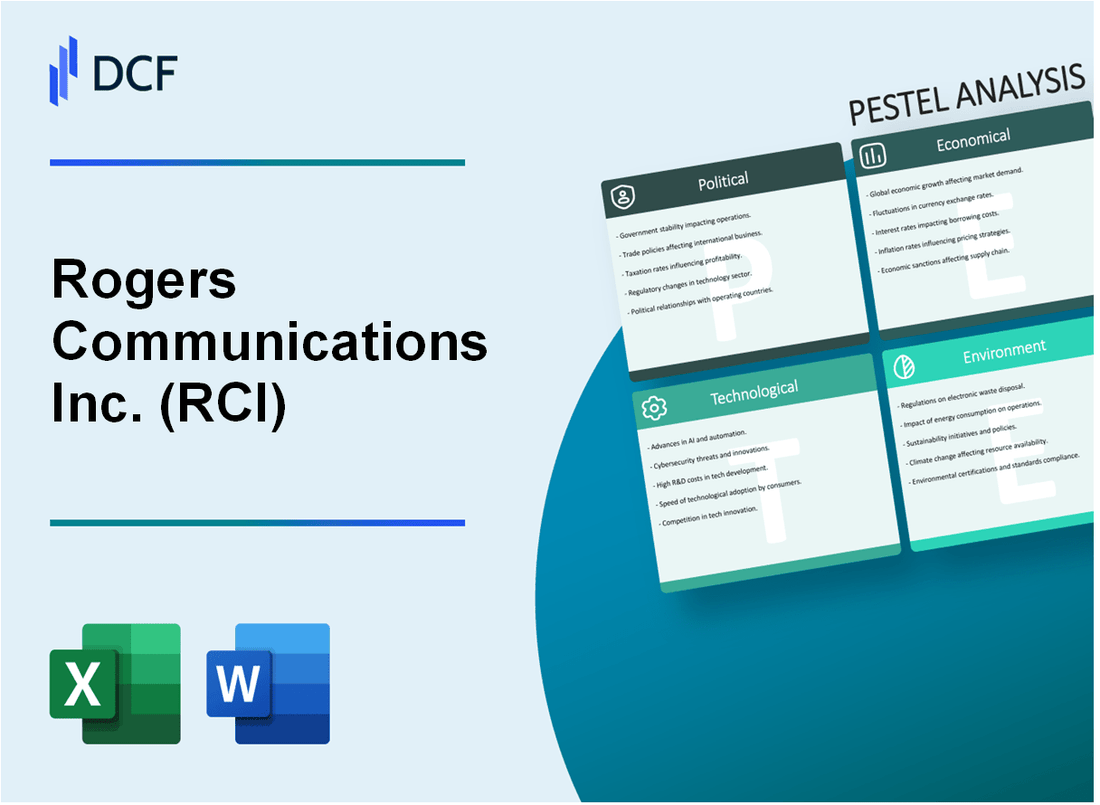
Rogers Communications Inc. (RCI): Análisis PESTLE [Actualizado en enero de 2025] |
Completamente Editable: Adáptelo A Sus Necesidades En Excel O Sheets
Diseño Profesional: Plantillas Confiables Y Estándares De La Industria
Predeterminadas Para Un Uso Rápido Y Eficiente
Compatible con MAC / PC, completamente desbloqueado
No Se Necesita Experiencia; Fáciles De Seguir
Rogers Communications Inc. (RCI) Bundle
En el mundo dinámico de las telecomunicaciones, Rogers Communications Inc. (RCI) se encuentra en la encrucijada de la innovación, la regulación y la transformación social. Este análisis integral de morteros revela el intrincado panorama que da forma a las decisiones estratégicas de RCI, explorando las influencias multifacéticas de los marcos políticos, la dinámica económica, los cambios sociales, los avances tecnológicos, las complejidades legales y las responsabilidades ambientales. Desde la navegación de desafíos regulatorios canadienses hasta invertir en infraestructura 5G de vanguardia, Rogers demuestra un enfoque matizado de los negocios que va mucho más allá de los servicios de comunicación tradicionales, posicionándose como un jugador fundamental en el ecosistema digital de Canadá.
Rogers Communications Inc. (RCI) - Análisis de mortero: factores políticos
El entorno regulatorio canadiense influye en las políticas del sector de las telecomunicaciones
La Comisión Canadiense de Radio-Televisión y Telecomunicaciones (CRTC) mantiene una supervisión estricta del sector de telecomunicaciones. A partir de 2024, Rogers Communications opera dentro de un marco regulado que afecta sus estrategias comerciales.
| Cuerpo regulador | Áreas regulatorias clave | Impacto en las comunicaciones de Rogers |
|---|---|---|
| CRTC | Regulación de servicios de telecomunicaciones | Calidad integral de servicio y supervisión de precios |
| Innovación, ciencia y desarrollo económico Canadá | Gestión del espectro | Controla el desarrollo de infraestructura de redes móviles |
Las reglas de subasta del espectro del gobierno federal impactan la expansión de la red móvil
Las reglas de subasta de espectro influyen directamente en las inversiones de infraestructura de red de Rogers.
- 2023 Subasta de espectro Ingresos totales: CAD 3.4 mil millones
- Inversión del espectro de Rogers en 2023: CAD 1.2 mil millones
- Asignación de espectro 5G: prioridad de la banda de 3500 MHz
Las regulaciones de CRTC rigen los servicios de telecomunicaciones y de radiodifusión
CRTC aplica regulaciones estrictas sobre telecomunicaciones y servicios de transmisión.
| Categoría de regulación | Requisitos específicos | Costo de cumplimiento para Rogers |
|---|---|---|
| Requisitos de contenido canadiense | Mínimo 35% de programación canadiense | CAD 175 millones de inversiones anuales |
| Neutralidad de la red | Reglas de transmisión de datos iguales | Costos de adaptación de infraestructura |
Cambios de política potenciales en la propiedad extranjera de las compañías de telecomunicaciones
Restricciones actuales de propiedad extranjera:
- Límite máximo de propiedad extranjera: 46.7% para las principales compañías de telecomunicaciones
- Rogers Communications Propiedad extranjera actual: 32.5%
- Cambios de política potenciales bajo revisión en curso
Las regulaciones de inversión extranjera continúan dando forma a la planificación estratégica de Rogers Communications y posibles asociaciones internacionales.
Rogers Communications Inc. (RCI) - Análisis de mortero: factores económicos
Inversión continua en infraestructura de red 5G
Rogers Communications Invests $ 2.5 mil millones en gastos de capital para la infraestructura de red en 2023. La implementación de red 5G contabilizó $ 850 millones de gasto total de infraestructura.
| Año | Inversión total de infraestructura | Inversión de red 5G |
|---|---|---|
| 2022 | $ 2.3 mil millones | $ 650 millones |
| 2023 | $ 2.5 mil millones | $ 850 millones |
La fluctuación del dólar canadiense afecta los costos de importación de la tecnología
Tipo de cambio de dólar canadiense frente a USD en 2023: 1 CAD = 0.74 USD. El índice de costos de importación de tecnología aumentó por 7.3% debido a fluctuaciones monetarias.
Estrategias de precios competitivos en el mercado de telecomunicaciones
Precios promedio del plan móvil mensual para Rogers en 2023: $ 65 CAD. La competencia del mercado ha mantenido los precios dentro de ±5% gama de promedio de la industria.
| Competidor | Precio promedio del plan mensual | Cuota de mercado |
|---|---|---|
| Rogers | $ 65 CAD | 31% |
| Telus | $ 63 CAD | 29% |
| Campana | $ 67 CAD | 30% |
Recuperación económica y servicios de comunicación de impacto del gasto del consumidor
Ingresos del servicio de telecomunicaciones en 2023: $ 4.2 mil millones CAD. El gasto del consumidor en servicios de comunicación aumentó por 4.2% en comparación con el año anterior.
Oportunidades potenciales de fusión y adquisición en el sector tecnológico
Rogers Communications completadas 2 adquisiciones estratégicas en 2023, total $ 325 millones CAD. Actividad de M&A del sector tecnológico representada 12.5% de inversiones corporativas totales.
| Objetivo de adquisición | Precio de compra | Enfoque estratégico |
|---|---|---|
| Compañía de tecnología A | $ 200 millones | Servicios en la nube |
| Compañía de tecnología B | $ 125 millones | Ciberseguridad |
Rogers Communications Inc. (RCI) - Análisis de mortero: factores sociales
Aumento de la demanda de Internet de alta velocidad y conectividad móvil
A partir del cuarto trimestre de 2023, Rogers Communications informó 5,9 millones de suscriptores inalámbricos. La tasa de penetración de Internet móvil canadiense alcanzó el 92.3% en 2023. El consumo de datos móviles aumentó en un 38,7% año tras año, con un uso promedio de datos mensuales por suscriptor a 7,2 GB.
| Métricas de conectividad móvil | 2023 datos |
|---|---|
| Suscriptores inalámbricos totales | 5.9 millones |
| Penetración de Internet móvil | 92.3% |
| Crecimiento anual de consumo de datos móviles | 38.7% |
| Uso promedio de datos mensuales por suscriptor | 7.2 GB |
Cambiar las preferencias del consumidor hacia plataformas de comunicación digital
Rogers informó 3,4 millones de suscriptores de Internet de banda ancha en 2023. El uso de la plataforma de comunicación digital aumentó en un 45.2% en comparación con el año anterior. La penetración de teléfonos inteligentes en Canadá alcanzó el 86.5% en 2023.
| Métricas de comunicación digital | 2023 datos |
|---|---|
| Suscriptores de Internet de banda ancha | 3.4 millones |
| Crecimiento del uso de la plataforma digital | 45.2% |
| Penetración de teléfonos inteligentes en Canadá | 86.5% |
Trabajo desde la tendencia del hogar que conduce el consumo de datos de banda ancha y móviles
La adopción de trabajo remoto en Canadá alcanzó el 39,6% en 2023. El uso de Internet de banda ancha durante las horas de trabajo aumentó en un 52,3%. Rogers experimentó un aumento del 41.7% en soluciones de conectividad empresarial.
| Métricas de conectividad de trabajo remoto | 2023 datos |
|---|---|
| Tasa de adopción de trabajo remoto | 39.6% |
| El uso de la banda ancha durante el aumento de las horas de trabajo | 52.3% |
| Crecimiento de soluciones de conectividad empresarial | 41.7% |
Cambios demográficos que influyen en los requisitos del servicio de comunicación
La población canadiense de más de 65 años aumentó a 19.2% en 2023. La demanda de servicios digitales Millennial y Gen Z aumentó un 33,6%. Rogers introdujo Paquetes móviles e de Internet específicos.
| Métricas de conectividad demográfica | 2023 datos |
|---|---|
| Población de más de 65 años | 19.2% |
| Millennial/Gen Z Digital Service Demand Growth | 33.6% |
Creciente énfasis en la inclusión digital y la accesibilidad
Rogers invirtió $ 47.3 millones en tecnologías de accesibilidad en 2023. La cobertura de banda ancha rural se expandió al 89.6% de los territorios canadienses. Los programas de Internet asequibles llegaron a 276,000 hogares de bajos ingresos.
| Métricas de inclusión digital | 2023 datos |
|---|---|
| Inversión en tecnología de accesibilidad | $ 47.3 millones |
| Cobertura de banda ancha rural | 89.6% |
| Programas de Internet para el hogar de bajos ingresos | 276,000 hogares |
Rogers Communications Inc. (RCI) - Análisis de mortero: factores tecnológicos
Inversión continua en tecnologías de red 5G y fibra óptica
Rogers Communications invirtió $ 2.55 mil millones en licencias de espectro para redes 5G en 2022. La compañía desplegó redes 5G en 248 ciudades y ciudades canadienses a partir del cuarto trimestre de 2023. La cobertura de infraestructura de la red de fibra óptica alcanzó 3,1 millones de hogares en Canadá.
| Inversión tecnológica | Monto ($) | Año |
|---|---|---|
| Licencias de espectro 5G | 2,550,000,000 | 2022 |
| Infraestructura de red | 1,350,000,000 | 2023 |
Expansión de soluciones de conectividad de Internet de las cosas (IoT)
Rogers IoT Connections aumentó a 1,4 millones de dispositivos en 2023. Enterprise IoT Solutions generó $ 287 millones en ingresos durante el año fiscal.
| IoT métrica | Valor | Año |
|---|---|---|
| Conexiones totales de IoT | 1,400,000 | 2023 |
| Ingresos de IoT | 287,000,000 | 2023 |
Integración de inteligencia artificial en plataformas de servicio al cliente
Rogers asignó $ 95 millones para el desarrollo de tecnología de IA en 2023. Las plataformas de servicio al cliente con IA redujeron los tiempos de respuesta en un 42% y aumentan las tasas de satisfacción del cliente en un 27%.
Mejora de ciberseguridad y desarrollo de infraestructura digital
Rogers invirtió $ 210 millones en infraestructura de seguridad cibernética en 2023. La compañía informó que bloqueó 3,2 millones de amenazas cibernéticas potenciales en su red durante el año fiscal.
Cloud Computing y inversiones avanzadas de infraestructura de red
Rogers cometió $ 425 millones a la computación en la nube y la infraestructura de red avanzada en 2023. La compañía amplió su ecosistema de asociación múltiple a 87 socios de tecnología de nivel empresarial.
| Categoría de inversión en la nube | Monto de inversión ($) | Año |
|---|---|---|
| Infraestructura de computación en la nube | 425,000,000 | 2023 |
| Ecosistema de asociación en la nube | 87 | 2023 |
Rogers Communications Inc. (RCI) - Análisis de mortero: factores legales
Cumplimiento de las regulaciones de telecomunicaciones canadienses
Rogers Communications Inc. está regulado por la Comisión Canadiense de Radio-Televisión y Telecomunicaciones (CRTC). A partir de 2024, la Compañía debe adherirse a requisitos reglamentarios específicos:
| Área reguladora | Requisito de cumplimiento | Cuerpo regulador |
|---|---|---|
| Ley de Telecomunicaciones | Cumplimiento completo de las regulaciones de servicios de redes de la Sección 27 | CRTC |
| Provisión de servicios inalámbricos | Disponibilidad obligatoria del servicio 911 | CRTC |
| Infraestructura de red | Cumple con las reglas de propiedad de contenido y infraestructura canadienses | Innovación, ciencia y desarrollo económico Canadá |
Requisitos de legislación de privacidad y protección de datos
Rogers debe cumplir con la Ley de Protección de Información Personal y Documentos Electrónicos (PIPEDA):
- Notificación de violación de datos dentro de las 72 horas
- Consentimiento del cliente para la recopilación de datos
- Cifrado obligatorio de información personal del cliente
Derechos de propiedad intelectual en innovaciones tecnológicas
Rogers posee 127 patentes de tecnología activa a partir de 2024, con una inversión de $ 248 millones en I + D para la protección de la propiedad intelectual.
| Categoría de patente | Número de patentes | Inversión de I + D |
|---|---|---|
| Tecnología 5G | 43 patentes | $ 89 millones |
| Seguridad de la red | 37 patentes | $ 72 millones |
| Servicios móviles | 47 patentes | $ 87 millones |
Escrutinio de la Oficina de Competencia de las prácticas de mercado de Telecom
Rogers enfrenta revisiones continuas de práctica del mercado, con investigaciones recientes centradas en:
- Transparencia de precios
- Evaluación de dominio del mercado
- Prácticas de competencia justa
Desafíos legales potenciales en la licencia del espectro y la expansión de la red
Detalles de licencias de espectro para 2024-2026:
| Banda de espectro | Costo de licencia | Cobertura de red |
|---|---|---|
| 3500 MHz | $ 612 millones | 95% de cobertura urbana |
| MMWAVE (26 GHz) | $ 287 millones | Principales áreas metropolitanas |
| De baja banda 600 MHz | $ 423 millones | Expansión rural |
Rogers Communications Inc. (RCI) - Análisis de mortero: factores ambientales
Compromiso de reducir la huella de carbono en las operaciones de red
Rogers Communications se ha comprometido a reducir las emisiones de gases de efecto invernadero en un 50% para 2025 en comparación con los niveles de referencia de 2019. Las emisiones totales de alcance 1 y alcance 2 de la compañía fueron 218,162 toneladas métricas CO2E en 2022.
| Categoría de emisión | 2022 emisiones (toneladas métricas CO2E) |
|---|---|
| Alcance 1 emisiones | 79,423 |
| Alcance 2 emisiones | 138,739 |
| Emisiones totales | 218,162 |
Desarrollo de infraestructura de tecnología sostenible
Rogers invirtió $ 250 millones en infraestructura de energía renovable y tecnologías de red sostenibles en 2022. La compañía ha desplegado 1,287 sitios de células solares en todo Canadá.
Iniciativas de gestión de residuos electrónicos y reciclaje
En 2022, Rogers recolectó y recicló responsablemente 1.456,320 kg de desechos electrónicos a través de su programa de reciclaje corporativo. La compañía logró una tasa de reciclaje de dispositivos del 78% para dispositivos de consumo y comerciales.
| Métricas de reciclaje de residuos electrónicos | Datos 2022 |
|---|---|
| Desechos electrónicos totales recolectados | 1.456,320 kg |
| Tasa de reciclaje de dispositivos | 78% |
Centro de datos de eficiencia energética e inversiones en equipos de red
Rogers gastó $ 42.3 millones en actualizaciones de infraestructura de red de eficiencia energética en 2022. La compañía redujo el consumo de energía del centro de datos en un 23% a través de tecnologías avanzadas de enfriamiento y optimización del servidor.
Informes de sostenibilidad corporativa y responsabilidad ambiental
Rogers publicó su informe de sostenibilidad 2022, que detalla las métricas de desempeño ambiental. La Compañía logró una calificación de 4.2/5 de evaluaciones de sostenibilidad ambiental de terceros.
| Indicador de rendimiento de sostenibilidad | Resultado 2022 |
|---|---|
| Calificación de sostenibilidad de terceros | 4.2/5 |
| Publicación del informe de sostenibilidad | Terminado |
Rogers Communications Inc. (RCI) - PESTLE Analysis: Social factors
Persistent public demand for lower wireless prices and more transparent billing practices
You're a leader in a market where customers are constantly comparing monthly bills, and frankly, they are vocal about what they see. The public sentiment remains highly sensitive to the cost of connectivity, especially for wireless services. While the cost of cellular services in Canada dropped by about 41% between 2020 and 2024, the pressure for further reductions is constant. To be fair, billing transparency is a major sticking point; for instance, Internet-related issues reported to the CCTS in 2024 saw billing issues jump by 84% compared to 2023, making it the number one concern for Internet customers. Rogers Communications has to navigate this while maintaining its financial health, as its Wireless segment remains the most viable business, contributing 57% of revenue and 63% of profit as of the latest reports.
Here's a quick look at how customer perception and regulatory scrutiny are playing out:
- Rogers accounted for 17.4% of all CCTS complaints in a recent mid-year report.
- Billing issues were the top Internet customer concern in 2024.
- The company is focused on personalized customer experience via AI investments in 2025.
Critical need to rebuild customer trust and perception following major network outages
The memory of past service failures, like the massive outage in July 2022 that affected over 12 million customers, definitely lingers in the public consciousness. Rebuilding trust isn't just about saying sorry; it's about demonstrable, sustained reliability. Rogers Communications has publicly stated it completed a full review, implemented all recommendations from the independent report, and now claims its networks are recognized as the most reliable by global benchmarking leaders. This commitment is backed by significant capital; the company announced a C$10 billion investment over three years in AI, testing, and oversight following the disruption. Still, any new, smaller outage, like the one in June 2025 involving SIM card errors that affected thousands, immediately reignites public scrutiny.
Increasing reliance on reliable, high-speed bundled services (internet, TV, wireless) for work-from-home
The social fabric of work in Canada is now fundamentally tied to reliable connectivity. In 2025, flexible work is the norm: a striking 91% of organizations offer hybrid work, and 71% support formal remote arrangements. This means your bundled services-especially high-speed Internet-are mission-critical infrastructure for millions of households, not just entertainment. Around 90% of remote workers report consistent or higher productivity when working from home. What this estimate hides is that for the 55% of remote workers who cite isolation as a challenge, a reliable, fast home connection is their only link to professional collaboration and social interaction. You need to ensure your network capacity supports this heavy, constant load.
Addressing the digital divide by expanding services to underserved communities
There is a clear societal expectation that major carriers like Rogers Communications must actively work to close the gaps in access, often referred to as the digital divide. The company itself noted in its Q2 2025 results that investments will strengthen network resilience and help bridge this divide by expanding the network into rural and underserved areas. This isn't just altruism; it's about market expansion and public license to operate. By 2023, 93.5% of Canadian homes and businesses had broadband internet access, but the focus is now on the last mile. Programs like Connected for Success, which offers low-cost, high-speed Internet to those on income support, are concrete examples of addressing this social need.
Here are some key connectivity benchmarks:
| Metric | Value/Status (Latest Data) | Context |
| Broadband Access (2023) | 93.5% of Canadian homes/businesses | Overall national penetration. |
| First Nations 50/10 Mbps Access | Increased by 85% since 2016 | Progress in underserved communities. |
| Hybrid Work Adoption (2025) | 91% of organizations offer it | Confirms reliance on home internet quality. |
| Reported Billing Issues (2024) | Up 84% from 2023 | Indicates ongoing transparency challenge. |
Finance: draft 13-week cash view by Friday
Rogers Communications Inc. (RCI) - PESTLE Analysis: Technological factors
You're looking at how Rogers Communications Inc. is spending its capital to stay ahead in the hyper-competitive Canadian telecom space as of late 2025. Honestly, the tech race is brutal, and RCI is pouring money into its pipes and airwaves to keep pace with Telus Corporation and Bell.
Aggressive expansion of 5G Standalone (SA) network capabilities and coverage
Rogers was the first operator to launch a nationwide Standalone 5G core network in Canada, a crucial milestone that happened a few years back. As of the latest reports in 2025, the 5G+ network reaches over 32 million Canadians across more than 2,400 communities. While the goal you mentioned of 90% population coverage for SA isn't explicitly confirmed in the very latest data, the commitment is clear: RCI is investing heavily to maintain its lead in wireless performance, which umlaut testing in 2025 confirmed as Canada's most reliable.
This focus on 5G SA technology is about more than just faster downloads; it unlocks advanced features like network slicing and mobile edge computing, which are key for future enterprise services. It's a defintely necessary move to support the next wave of connected devices.
Significant investment in fiber-to-the-home (FTTH) infrastructure to compete with Telus Corporation
When you look at wireline, the competition with Telus is stark. Telus has been aggressively building out its Pure Fibre network, especially in the West, offering symmetrical speeds that Rogers' primarily Fibre-to-the-Node (FTTN) coaxial network can't match on the upload side. So, what is Rogers doing? They are focusing on upgrading their existing hybrid network to DOCSIS 4.0. This evolution is designed to boost resilience and deliver faster speeds over their existing footprint, which covers a very wide share of Canadian households.
The capital allocation shows this priority. For the full 2025 fiscal year, the company guided capital expenditures (CapEx) around $3.8 billion, with earlier projections suggesting approximately $4 billion in capital investments. Here's the quick math: in the first quarter of 2025 alone, RCI invested $978 million, mostly into mobile networks. What this estimate hides is how much of that is pure FTTH versus 5G buildout, but reliability upgrades are clearly a major part of the spend.
Mandated network resiliency upgrades to prevent future widespread service disruptions
Following past major outages, there's a regulatory and customer expectation for rock-solid reliability. Rogers has been making significant, targeted investments here. While a past commitment after a major 2022 event was around $261 million for physical network splitting, the 2025 strategy integrates reliability into core upgrades. The evolution to DOCSIS 4.0 is explicitly tied to offering increased network resilience and stability over their cable plant.
If onboarding new resiliency features takes longer than expected, churn risk rises, especially when rivals like Telus are touting their fibre reliability. The focus is on future-proofing the network to avoid the kind of disruption that costs millions in credits and reputation damage.
- Invested heavily in network reliability in 2025.
- Upgrading HFC network to DOCSIS 4.0.
- Goal: Enhanced customer experience and stability.
Exploring fixed wireless access (FWA) as a cost-effective solution for rural areas
For those rural and remote areas where laying fibre is just too expensive-and it often is, given the geography-Fixed Wireless Access (FWA) is the pragmatic answer. FWA uses the existing 5G mobile network to deliver home broadband wirelessly. This approach bypasses the need for expensive trenching, which can account for over 50% of rural deployment costs.
Rogers has a history of using FWA, partnering with governments to bring service to underserved communities in places like British Columbia. This strategy allows RCI to quickly expand its service footprint and compete in areas where wired infrastructure is lagging, tapping into a market segment expected to see significant growth through 2032. It's a smart way to bridge the digital divide without breaking the bank on every build.
Here's a snapshot of the network-related capital deployment context for Rogers in 2025:
| Metric/Area | Value/Context (2025 Fiscal Year) | Source of Investment | |
| Total Expected CapEx Guidance | Approximately $3.8 billion to $4.0 billion | Wireless leadership, 5G/6G readiness | |
| Q1 2025 CapEx | $978 million | Focus on mobile networks | |
| MLSE Acquisition Cost | $4.7 billion (for 37.5% stake) | Media/Content Strategy (Non-Network) | |
| 5G Infrastructure Spend (Specific) | Estimated $40 billion over 10 years (includes fibre backhaul) | 5G/6G positioning | |
| Network Reliability Upgrade (Past/Context) | $261 million for network splitting post-outage | Mandated resiliency |
Finance: draft 13-week cash view by Friday
Rogers Communications Inc. (RCI) - PESTLE Analysis: Legal factors
You're looking at the legal landscape for Rogers Communications Inc. as of late 2025, and frankly, it's dominated by the fallout from the massive Shaw acquisition and the ever-present shadow of data privacy laws. The legal team is juggling post-merger compliance with ongoing litigation risk.
Adherence to the strict conditions imposed by the Competition Bureau for the Shaw acquisition approval
The major legal hurdle-the CA$26 billion acquisition of Shaw Communications Inc.-was technically cleared by the Competition Tribunal in late 2022, with the Federal Court of Appeal rejecting the Competition Bureau's appeal in early 2024, allowing the deal to close in April 2024. However, adherence to the spirit of the conditions remains a focus. The government had previously mandated that the divested Freedom Mobile unit, sold to Vidéotron Ltd., must be held for at least 10 years. The Bureau continues to monitor pricing, noting that Rogers has not yet offered pricing in Western Canada comparable to the pre-merger, 20% lower average rates Vidéotron offered in Quebec. To manage this, Rogers committed to a five-year price freeze for the approximately 500,000 Shaw Mobile customers it absorbed. This is a critical area where near-term regulatory scrutiny is high.
Here's a quick look at the key post-merger legal/regulatory points:
| Factor | Detail/Value | Status as of 2025 |
| Merger Value | CA$26 billion | Closed April 2024 |
| Freedom Mobile Divestiture Holder | Vidéotron Ltd. | Mandated 10-year holding period |
| Shaw Mobile Customer Price Commitment | Price freeze for 5 years | Active commitment; Bureau monitoring for comparable pricing |
| Recent Regulatory Action | Commissioner of Competition application | Filed October 2025 regarding Infinite plans marketing |
Compliance with new privacy legislation regarding customer data and network security
You defintely need to watch federal privacy reform, as the pace is expected to continue into 2025 with potential new enforcement regimes. The proposed Consumer Privacy Protection Act (CPPA) is the big one, aiming to replace PIPEDA and introduce stricter rules on transparency and data governance. On the provincial side, Québec's updated privacy act, effective September 2024, introduced the first 'data portability' right, which can be operationally challenging to manage. Failure to comply with the Québec Privacy Act exposes organizations to fines up to the greater of $25 million or 4% of worldwide turnover for the preceding fiscal year. Rogers has stated it has robust security safeguards, but the increasing complexity means compliance costs are rising across the board for managing customer data and network security protocols.
Ongoing legal risks related to class-action lawsuits following past service failures
The legal risk from past service failures is very real, centered on the April 19, 2021 network outage affecting Rogers, Fido, and Chatr customers. A national class action was authorized by the Superior Court of Quebec, and the deadline for affected customers to opt out was November 23, 2025. If successful, potential damages include partial reimbursement of service fees, plus compensatory, moral, or punitive damages. Rogers has maintained that it already compensated customers with a one-day service credit, but the lawsuit proceeds regardless. This type of litigation, even if only settling for a fraction of the claim, ties up significant internal resources.
Keep an eye on these potential liabilities:
- 2021 Outage Suit: National class action proceeding in Quebec.
- Potential Damages: Reimbursement, moral, and punitive awards.
- Opt-Out Deadline: November 23, 2025 passed.
Navigating complex municipal permitting for new fiber and cell tower construction
Building out the physical network-fiber and 5G towers-means constant negotiation with local governments. This isn't just about finding land; it's about navigating local bylaws and federal oversight. For instance, Rogers is working to install over 1,000 kilometres of new fibre infrastructure across Prince Edward County by the end of 2025 as part of an Ontario government program. While the final authority for cell tower approval rests with the federal government (ISED), municipal concurrence is a mandatory step in the protocol. We see examples where staff review, public notification (sometimes over a radius three times the tower height), and council authorization are required before construction can start, which in one case was slated for April 1, 2025. Any delay in securing these local sign-offs directly impacts capital deployment timelines and network expansion goals.
Finance: draft 13-week cash view by Friday.
Rogers Communications Inc. (RCI) - PESTLE Analysis: Environmental factors
You're looking at how Rogers Communications Inc. manages its footprint, which is a huge deal for investors and regulators now. Honestly, the pressure is on to hit aggressive climate targets, even if the officially validated long-term goal is a bit further out.
Net-Zero Operational Emissions by 2040 Stakeholder Expectation
While stakeholders are definitely pushing for net-zero operational emissions by 2040, Rogers Communications Inc. has secured Science Based Targets initiative (SBTi) approval for a more comprehensive, long-term goal. This validated ambition is to reduce absolute Scope 1, 2, and 3 greenhouse gas (GHG) emissions to net-zero by 2050, based on a 2019 baseline year. This commitment makes Rogers the first national carrier in Canada with SBTi-approved science-based net-zero targets. The action plan supporting this focuses on four key areas, including increasing energy efficiencies across the network and operations.
Reducing Energy Consumption Through Network Modernization and 5G Efficiency
Network usage is skyrocketing, which naturally drives up energy demand-a major operating cost for any telco. To fight this, Rogers Communications Inc. is leaning hard into network upgrades. In 2024, they continued the rollout of their 5G network and progressed on LTE power savings and 2G/3G modernization projects. This focus on efficiency is showing results, even as the business grows. For instance, energy use intensity has dropped by 55% since 2019, despite absolute energy use increasing by 10% over the same period. Furthermore, using solutions like Ericsson's software, the company realized an annual power saving of 25 GWh, which is about 3,000 metric tonnes of CO2e reduction.
Here's the quick math on their operational efficiency progress:
- Energy use intensity down 55% since 2019.
- Absolute energy use up 10% since 2019.
- 5G technology helps customers transfer data more efficiently, optimizing total energy use.
Implementing Better E-Waste Management and Device Recycling Programs
You have a responsibility to manage product end-of-life, and Rogers Communications Inc. is actively engaging customers in circular economy solutions. For the 2024 reporting period, they diverted a massive amount of electronic waste from landfills. What this estimate hides is the split between recycling and reselling, which is key for maximizing environmental benefit. They achieved a 100% diversion rate from landfill for all collected electronic waste in 2024.
The 2024 performance breakdown is pretty concrete:
| Metric | 2024 Value |
| Total Devices/Materials Diverted from Landfill | 6.6 million (over 9,400 metric tonnes) |
| Devices/Materials Recycled | 49% (or 3.2 million) |
| Devices Resold (Refurbished) | 51% (or 3.4 million) |
| Landfill Diversion Rate Achieved | 100% |
Reporting Scope 1 and Scope 2 Greenhouse Gas Emissions Annually
Meeting investor requirements means transparent, annual reporting on operational emissions, which they do using the GHG Protocol framework. As of their 2024 reporting (based on 2019 baseline), Rogers Communications Inc. has already achieved a 20% reduction in market-based Scope 1 and 2 GHG emissions. To be fair, the integration of the legacy Shaw portfolio required a re-forecast of these emissions in 2024.
Here are the absolute numbers reported for 2024, which you need to track against the 2019 baseline of 228,086 Metric Tonnes of CO2e for Scope 1 and 2 combined:
- Scope 1 GHG Emissions (2024): Approx. 40,777,000 kg CO2e.
- Scope 2 GHG Emissions (Market-based, 2024): Approx. 141,349,000 kg CO2e.
- Total Scope 1 & 2 GHG Emissions Intensity Reduction vs. 2019: 67% (tCO2e/PB).
If onboarding takes 14+ days, churn risk rises, and similarly, if the refreshed 2030 carbon net-zero strategy roadmap, expected to be finalized in 2025, isn't clear, investor confidence in the environmental path could waver.
Finance: draft 13-week cash view by Friday.
Disclaimer
All information, articles, and product details provided on this website are for general informational and educational purposes only. We do not claim any ownership over, nor do we intend to infringe upon, any trademarks, copyrights, logos, brand names, or other intellectual property mentioned or depicted on this site. Such intellectual property remains the property of its respective owners, and any references here are made solely for identification or informational purposes, without implying any affiliation, endorsement, or partnership.
We make no representations or warranties, express or implied, regarding the accuracy, completeness, or suitability of any content or products presented. Nothing on this website should be construed as legal, tax, investment, financial, medical, or other professional advice. In addition, no part of this site—including articles or product references—constitutes a solicitation, recommendation, endorsement, advertisement, or offer to buy or sell any securities, franchises, or other financial instruments, particularly in jurisdictions where such activity would be unlawful.
All content is of a general nature and may not address the specific circumstances of any individual or entity. It is not a substitute for professional advice or services. Any actions you take based on the information provided here are strictly at your own risk. You accept full responsibility for any decisions or outcomes arising from your use of this website and agree to release us from any liability in connection with your use of, or reliance upon, the content or products found herein.