

|
Análisis FODA del Grupo SJW (SJW) [Actualizado en enero de 2025] |
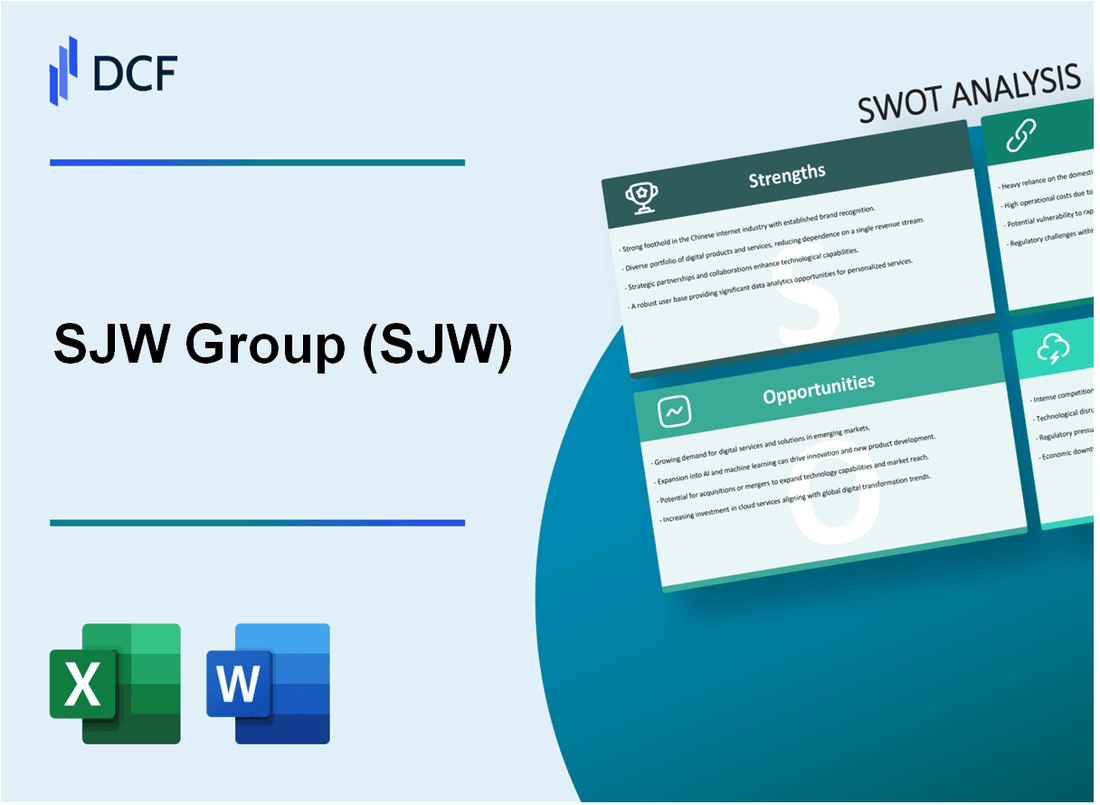
Completamente Editable: Adáptelo A Sus Necesidades En Excel O Sheets
Diseño Profesional: Plantillas Confiables Y Estándares De La Industria
Predeterminadas Para Un Uso Rápido Y Eficiente
Compatible con MAC / PC, completamente desbloqueado
No Se Necesita Experiencia; Fáciles De Seguir
SJW Group (SJW) Bundle
En el panorama dinámico de los servicios de servicios de agua, SJW Group se encuentra en una coyuntura crítica, navegando por desafíos complejos y oportunidades prometedoras en el ecosistema evolutivo de la gestión del agua de California. Este análisis FODA completo revela el posicionamiento estratégico de una empresa profundamente arraigada en la infraestructura de agua sostenible, revelando cómo SJW Group está listo para abordar las necesidades críticas regionales del agua al tiempo que enfrenta los desafíos multifacéticos del cambio climático, los entornos regulatorios y la transformación tecnológica en el sector de utilidad.
SJW Group (SJW) - Análisis FODA: Fortalezas
Servicios de servicios de agua establecidos con fuerte presencia regional en California
SJW Group opera principalmente en California, atendiendo a aproximadamente 1,4 millones de personas en múltiples áreas de servicio. La compañía posee y opera sistemas de agua en San José, California, con territorios de servicio que abarcan aproximadamente 140 millas cuadradas.
| Vía de Servício | Población atendida | Cobertura geográfica |
|---|---|---|
| San José, California | 1.4 millones | 140 millas cuadradas |
Huella constante de ingresos regulados y rendimiento financiero estable
A partir de 2023, el grupo SJW informó:
- Ingresos operativos totales de $ 296.2 millones
- Ingresos netos de $ 54.4 millones
- Base de tasa de utilidad regulada de aproximadamente $ 1.2 mil millones
| Métrica financiera | Valor 2023 |
|---|---|
| Ingresos operativos | $ 296.2 millones |
| Lngresos netos | $ 54.4 millones |
| Base de tasa de servicios públicos | $ 1.2 mil millones |
Infraestructura de agua avanzada y compromiso con la gestión sostenible del agua
SJW Group ha invertido significativamente en Iniciativas de Infraestructura de Agua y Sostenibilidad:
- Más de $ 100 millones invertidos en mejoras de infraestructura anualmente
- Programas de conservación del agua que reducen el consumo en un 20% desde 2010
- Infraestructura de medición avanzada que cubre el 95% de las conexiones de servicio
Equipo de gestión experimentado con profunda experiencia en operaciones de servicios de agua
El equipo de liderazgo aporta una experiencia sustancial de la industria:
- Promedio de tenencia ejecutiva de más de 15 años en gestión de servicios públicos de agua
- Múltiples miembros de la junta con antecedentes en ingeniería y regulación de servicios públicos
- Equipo de liderazgo con más 100 años de experiencia en la industria del agua
| Métrica de experiencia de liderazgo | Valor |
|---|---|
| Tenencia ejecutiva promedio | Más de 15 años |
| Experiencia de la industria combinada | Más de 100 años |
SJW Group (SJW) - Análisis FODA: debilidades
Concentración geográfica en regiones de escasez de agua vulnerables al cambio climático
SJW Group opera principalmente en California, un estado que experimenta graves escasez de agua e impactos del cambio climático. A partir de 2023, California enfrentó el 41% de su territorio en condiciones de sequía extremas.
| Región | Nivel de estrés hídrico | Riesgo climático proyectado |
|---|---|---|
| Valle de Silicon | Estrés hídrico | Extremadamente alto |
| San José | Escasez de agua severa | Alta vulnerabilidad climática |
Diversificación limitada de servicios más allá de las operaciones de servicios de agua
Los flujos de ingresos del Grupo SJW se concentran predominantemente en los servicios de servicios de agua, con el 92.4% de los ingresos totales derivados de las operaciones de agua central en 2022.
- Servicios de servicios de agua: 92.4%
- Otros servicios auxiliares: 7.6%
Altos requisitos de gasto de capital para el mantenimiento y actualizaciones de la infraestructura
En 2023, SJW Group invirtió $ 127.3 millones en mantenimiento de infraestructura y actualizaciones del sistema, lo que representa el 18.6% de los ingresos anuales totales.
| Año | Gasto de capital | Porcentaje de ingresos |
|---|---|---|
| 2022 | $ 114.5 millones | 16.9% |
| 2023 | $ 127.3 millones | 18.6% |
Posibles restricciones regulatorias sobre los aumentos de tasas y el crecimiento de los ingresos
La Comisión de Servicios Públicos de California (CPUC), la tasa de agua limitada aumenta a 5.7% en 2023, lo que limita la posible expansión de los ingresos para SJW Group.
- Aumento de la tasa aprobada: 5.7%
- Aumento de la tasa solicitada: 8.2%
- Impacto de los ingresos: aproximadamente $ 12.3 millones de reducción
SJW Group (SJW) - Análisis FODA: oportunidades
Expansión de la inversión en infraestructura de agua a través de programas de modernización de infraestructura
Se proyecta que el mercado de inversión en infraestructura de agua de EE. UU. Llegará a $ 472.8 mil millones entre 2020-2039, con un significativo apoyo federal. La Ley de Inversión y Empleos de Infraestructura asignó $ 55 mil millones específicamente para mejoras de infraestructura de agua.
| Categoría de inversión de infraestructura | Inversión proyectada (2020-2039) |
|---|---|
| Infraestructura total de agua | $ 472.8 mil millones |
| Financiación federal de infraestructura de agua | $ 55 mil millones |
Creciente demanda de soluciones de agua sostenibles y tecnologías de conservación
Se espera que el mercado de Tecnologías de Conservación del Agua alcance los $ 24.39 mil millones para 2026, con una tasa compuesta anual de 6.5% entre 2021-2026.
- El mercado de medición de agua inteligente proyectado para crecer a $ 12.4 mil millones para 2025
- Las tecnologías de reciclaje y reutilización del agua que se anticipan aumentarán en un 17,3% anual
Adquisiciones estratégicas potenciales en el mercado de servicios públicos de agua
La fragmentación del mercado de servicios de agua presenta oportunidades de consolidación significativas, con aproximadamente 50,000 sistemas de agua comunitaria en los Estados Unidos.
| Característica del mercado | Estadística |
|---|---|
| Sistemas totales de agua comunitaria | 50,000 |
| Objetivos de adquisición potenciales | Utilidades pequeñas a medianas |
Tecnologías emergentes para el tratamiento del agua y las mejoras de eficiencia
Se espera que el mercado de tecnología de tratamiento de agua avanzada alcance los $ 22.8 mil millones para 2025, con innovaciones clave en la filtración de membrana y las tecnologías de desalinización.
- Tasa de crecimiento del mercado de filtración de membrana: 9.2% anual
- Soluciones de gestión del agua habilitadas para IoT proyectadas para alcanzar los $ 15.7 mil millones para 2026
- Se espera que la inteligencia artificial en la gestión del agua crezca a un 35,7% de CAGR
SJW Group (SJW) - Análisis FODA: amenazas
Condiciones de sequía prolongadas en California
California experimentó 9 años de sequía entre 2011-2020, con una reducción del suministro de agua del 31% en algunas regiones. El área de servicio principal de SJW Group en San José enfrentó niveles de escasez de agua Potencial de reducción del 20%.
| Métrica de impacto de sequía | Porcentaje/valor |
|---|---|
| Reducción de suministro de agua | 31% |
| Riesgo de escasez de área de servicio de agua de San José | 20% |
Aumento de los costos de cumplimiento regulatorio
Los gastos de cumplimiento ambiental para los servicios públicos de agua aumentaron en $ 47.3 millones en 2022, con aumentos anuales proyectados de 5.7%.
- Los mandatos de la Junta de Control de Recursos Hídricos del Estado de California: $ 12.5 millones de costos anuales adicionales
- Requisitos de actualización de infraestructura: $ 18.7 millones de gastos proyectados
- Protocolos de prueba de calidad del agua: inversión anual de $ 6.1 millones
Riesgos de interrupción de la infraestructura de agua
La vulnerabilidad de infraestructura relacionada con el cambio climático estimada en $ 2.3 mil millones para California Water Systems para 2030.
| Categoría de riesgo de infraestructura | Daño potencial estimado |
|---|---|
| Vulnerabilidad del terremoto | $ 1.2 mil millones |
| Potencial de daños por inundación | $ 650 millones |
| Deslizamiento de tierra/interrupción del terreno | $ 450 millones |
Presiones competitivas
La competencia de servicios municipales aumentó en un 7,2% en el condado de Santa Clara, con proveedores de agua alternativos que ganan participación en el mercado.
- Penetración del mercado de servicios públicos municipales: crecimiento del 12.3%
- Ingresos alternativos del proveedor de agua: $ 45.6 millones en 2023
- Tasa de cambio de cliente: 3.7% anual
SJW Group (SJW) - SWOT Analysis: Opportunities
The SJW Group's primary opportunities stem directly from its aggressive, regulatorily-backed capital investment program and a clear strategy for external growth. You should see a direct line between the $2.0$ billion five-year capital plan and the projected growth in the rate base, which is the engine for a regulated utility's earnings.
Five-year capital plan (2025-2029) increased 25% to approximately $2.0 billion
SJW Group has significantly ramped up its commitment to infrastructure modernization, increasing its five-year capital spending plan by 25% to approximately $2.0 billion. This massive investment is the most reliable driver for increasing the rate base-the asset value on which a utility is permitted to earn a return-and, consequently, future revenue. This is a clear, long-term growth lever. The plan is heavily focused on three critical areas that address both regulatory compliance and system resilience.
- Infrastructure replacement: Upgrading aging water mains and distribution systems.
- PFAS remediation: Allocating approximately $300 million for Per- and Polyfluoroalkyl Substances treatment to meet new EPA standards.
- Water supply: Securing new sources, especially in high-growth, drought-prone regions like Texas.
Planned 2025 infrastructure investment of $473 million drives future rate base growth
The near-term capital expenditure for the 2025 fiscal year is set at $473 million, which is a significant 34% increase over the $353 million invested in 2024. This substantial, front-loaded investment is defintely a precursor to accelerated rate base growth. The company expects to recover about two-thirds of this investment through timely mechanisms like infrastructure recovery surcharges and forward-looking ratemaking, minimizing regulatory lag and quickly converting capital spending into earnings.
Here's the quick math on the investment-to-recovery pipeline for 2025:
| Metric | Amount (in millions) | Notes |
|---|---|---|
| Planned 2025 Capital Investment | $473 million | 34% increase over 2024. |
| Estimated Recoverable Investment (66%) | $312.18 million | Recovered via surcharges/ratemaking. |
| California GRC Capital Plan (2025-2027) | $450 million | Part of the total five-year plan. |
Long-term diluted EPS growth guidance of 5% to 7% through 2029
The company has affirmed its non-linear long-term diluted Earnings Per Share (EPS) growth guidance of 5% to 7% through 2029, anchored off the 2022 diluted EPS of $2.43. Based on constructive regulatory outcomes and the aggressive capital plan, management is targeting the top half of the range. This is a strong signal to investors, suggesting a compounded annual growth rate that should outpace many peers in the utility sector. For a regulated utility, this kind of predictable, mid-to-high single-digit EPS growth is a core value proposition.
Opportunistic, accretive acquisitions of smaller, non-public water systems are a core strategy
Acquisitions remain a core part of the growth strategy, specifically targeting smaller, non-public water systems that are immediately accretive (add to) earnings per share. This is a classic utility play, consolidating fragmented markets to gain scale and operational efficiencies. A recent example is the agreement to acquire Quadvest, a water and wastewater utility in the rapidly growing Greater Houston, Texas area. This acquisition, expected to close by mid-2026, will significantly expand the Texas footprint, making the combined Texas Water operation the second largest in that metropolitan area. This strategy leverages the company's national platform to drive efficiency into smaller, less-efficient systems.
Investment in Advanced Metering Infrastructure (AMI) is approved for recovery, improving operational efficiency
The regulatory environment in California has proven constructive, notably with the California Public Utilities Commission (CPUC) approving the Advanced Metering Infrastructure (AMI), or smart meter, project for San Jose Water. The total investment is approximately $100 million over four years. Crucially, the CPUC approved a $6.8 million revenue increase, effective July 1, 2025, to recover the capital invested in the first phase of AMI, which totaled $44 million. This swift recovery is key.
The operational benefits of this investment are significant, moving beyond just rate base growth:
- Leak Detection: Real-time data helps detect and stop leaks faster, reducing water loss and operational costs.
- Customer Service: Customers get 24/7 access to usage data, enabling them to better manage consumption and bills.
- Environmental Impact: Expected annual reduction of 103 tons of $\text{CO}_2\text{e}$ from water savings and fewer vehicle trips (truck rolls).
SJW Group (SJW) - SWOT Analysis: Threats
You're looking at a utility with a rock-solid foundation, but even a water company faces significant, near-term headwinds that can impact its cost structure and stock performance. The biggest threats right now are the rising cost of capital for a massive infrastructure build-out and the compounding regulatory burden from emerging contaminants like PFAS.
Exposure to Climate Change and Unpredictable Weather
The core business of a water utility is directly exposed to climate volatility, and this is a threat that's accelerating, not receding. In 2025, the Texas Water operations, for example, have continued to face persistent drought conditions, which necessitated mandatory conservation measures. This hits revenue because lower customer usage, even if offset by regulatory mechanisms, still creates operational and political friction.
Honestly, the long-term picture is worse. A September 2025 study in Nature Communications highlighted that 'Day Zero Drought' (DZD) conditions-where water demands exceed supply-are projected to emerge in 35% of vulnerable regions globally within the next 15 years, with parts of North America identified as robust hotspots. This means the risk of prolonged, multi-year water scarcity is a real capital planning issue, not just a weather event.
Increasing Regulatory and Capital Requirements for Emerging Contaminants
The cost of dealing with per- and polyfluoroalkyl substances (PFAS) is a clear, quantifiable threat to your capital plan. The company's five-year capital plan, totaling $2.0 billion, includes an estimated $300 million specifically for installing PFAS treatment systems, subject to regulatory approvals and funding availability. This is a massive, non-discretionary expenditure.
The regulatory environment is also fragmenting, which adds complexity. As of July 2025, nine states have adopted 17 new PFAS regulations, and Maine, where the company operates, is one of those states. Maine's new law establishes a stringent regulatory framework and sets Maximum Contaminant Levels (MCLs) that are now more stringent than the federal EPA's recently rolled-back regulations, forcing the company to comply with a patchwork of expensive state-level standards. This is a defintely a high-cost, high-urgency threat.
Major Leadership Transition with a New CEO Taking Over on July 1, 2025
A change at the top always introduces execution risk, even when planned. On July 1, 2025, Andrew F. Walters, the former Chief Financial Officer and Treasurer, officially succeeded Eric W. Thornburg as CEO. While Mr. Walters has deep utility sector experience and Mr. Thornburg remains as non-executive Chair, this is still a major transition.
The risk isn't just in the CEO chair; the entire executive team is shifting:
- Andrew F. Walters: New CEO (from CFO/Treasurer)
- Bruce A. Hauk: Promoted to President (from COO)
- Kristen A. Johnson: Promoted to President of the newly formed Shared Services organization
The new team must now execute the ambitious $2.0 billion capital plan and manage the complex regulatory landscape without the day-to-day leadership of the retiring CEO, which can slow down decision-making in the near-term.
Rebranding to H2O America and Ticker Change in May 2025 Creates Short-Term Market Noise and Transition Risk
The rebranding from SJW Group to H2O America, with a new ticker symbol HTO, effective May 6, 2025, is a strategic move, but it creates short-term market confusion. New tickers often lead to temporary volatility as market participants, particularly algorithmic traders and smaller investors, adjust to the change. This can cause a momentary disconnect between the company's fundamental value and its stock price.
Here's the quick math on the change:
| Entity | Old Identifier | New Identifier | Effective Date |
|---|---|---|---|
| Parent Company Name | SJW Group | H2O America | May 6, 2025 |
| Nasdaq Ticker Symbol | SJW | HTO | May 6, 2025 |
The risk is that the market noise distracts from the company's strong Q1 2025 financial results, which saw an adjusted diluted EPS of $0.50, a 39% increase over the prior year quarter. Any volatility could temporarily depress the stock, creating an opportunity for patient investors, but it's still a threat to current shareholder value.
Rising Interest Rates Increase the Cost of Financing the $2.0 Billion Capital Plan
Financing a large capital program in a rising rate environment is a major threat to earnings. The company's five-year capital plan is a massive $2.0 billion, and the planned capital expenditures for 2025 alone are $473 million. This requires significant external financing.
In the first quarter of 2025, the company's average borrowing rate for line of credit advances was already 5.47%. The continued high-rate environment, driven by Federal Reserve policy, directly increases the interest expense on the debt used to fund these infrastructure projects. What this estimate hides is the potential for further rate hikes, which would make the cost of debt for the remaining $1.5 billion+ of the plan even higher, putting pressure on the authorized rate of return and ultimately impacting earnings growth.
To offset this, the company is raising equity, having raised approximately $84 million through its at-the-market (ATM) equity program in the first half of 2025, but this dilutes existing shareholders. The Water Cost of Capital Mechanism (WCCM) in California, which adjusts the return on equity based on the Moody's Aa Utility Bond Index, offers some regulatory relief, but the underlying cost of capital is still rising.
Finance: draft a quarterly debt-to-equity funding model for the $2.0 billion plan by the end of the year.
Disclaimer
All information, articles, and product details provided on this website are for general informational and educational purposes only. We do not claim any ownership over, nor do we intend to infringe upon, any trademarks, copyrights, logos, brand names, or other intellectual property mentioned or depicted on this site. Such intellectual property remains the property of its respective owners, and any references here are made solely for identification or informational purposes, without implying any affiliation, endorsement, or partnership.
We make no representations or warranties, express or implied, regarding the accuracy, completeness, or suitability of any content or products presented. Nothing on this website should be construed as legal, tax, investment, financial, medical, or other professional advice. In addition, no part of this site—including articles or product references—constitutes a solicitation, recommendation, endorsement, advertisement, or offer to buy or sell any securities, franchises, or other financial instruments, particularly in jurisdictions where such activity would be unlawful.
All content is of a general nature and may not address the specific circumstances of any individual or entity. It is not a substitute for professional advice or services. Any actions you take based on the information provided here are strictly at your own risk. You accept full responsibility for any decisions or outcomes arising from your use of this website and agree to release us from any liability in connection with your use of, or reliance upon, the content or products found herein.