

|
Millicom International Cellular S.A. (TIGO): Análisis FODA [Actualizado en Ene-2025] |
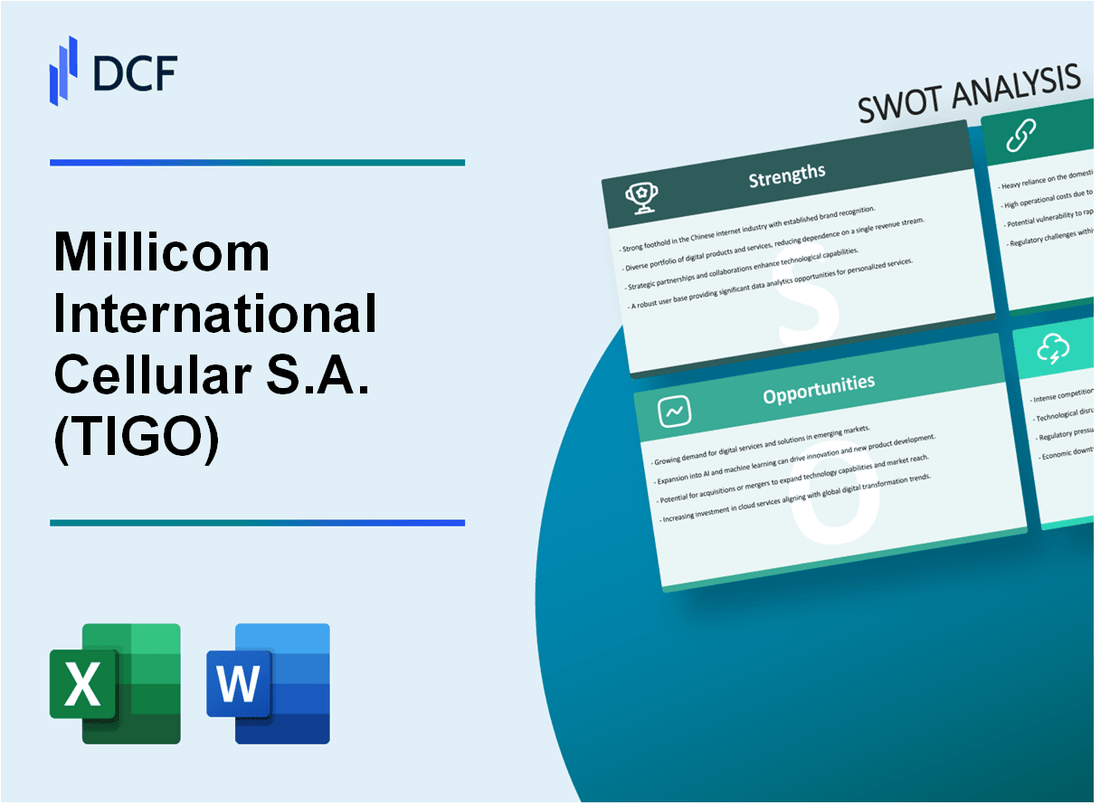
Completamente Editable: Adáptelo A Sus Necesidades En Excel O Sheets
Diseño Profesional: Plantillas Confiables Y Estándares De La Industria
Predeterminadas Para Un Uso Rápido Y Eficiente
Compatible con MAC / PC, completamente desbloqueado
No Se Necesita Experiencia; Fáciles De Seguir
Millicom International Cellular S.A. (TIGO) Bundle
En el panorama dinámico de las telecomunicaciones, Millicom International Cellular S.A. (TIGO) se erige como un jugador fundamental que navega por el complejo ecosistema digital de América Latina. Este análisis FODA completo revela el posicionamiento estratégico de un gigante de telecomunicaciones que ha demostrado constantemente la resiliencia, la innovación y el potencial en un mercado cada vez más competitivo. Al diseccionar sus fortalezas, debilidades, oportunidades y amenazas, proporcionamos una exploración perspicaz en el entorno empresarial actual de Tigo, revelando los intrincados desafíos y las vías prometedoras que darán forma a sus decisiones estratégicas en 2024 y más allá.
Millicom International Cellular S.A. (TIGO) - Análisis FODA: fortalezas
Proveedor líder de telecomunicaciones en América Latina
A partir de 2024, Millicom opera en 10 países latinoamericanos, con una importante presencia del mercado en toda la región. La compañía sirve aproximadamente 49.4 millones de clientes móviles y mantiene una posición competitiva fuerte en los mercados clave.
| País | Suscriptores móviles | Cuota de mercado |
|---|---|---|
| Colombia | 8.2 millones | 15.7% |
| Guatemala | 6.5 millones | 22.3% |
| Paraguay | 4.1 millones | 36.9% |
Extensa cartera de servicios móviles y digitales
Millicom proporciona una gama integral de servicios que incluyen:
- Servicios de voz y datos móviles
- Telecomunicaciones de línea fija
- Internet de banda ancha
- Servicios de televisión digital
Plataformas avanzadas de dinero móvil y tecnología financiera
Plataforma de dinero TIGO procesada $ 2.3 mil millones en transacciones digitales en 2023, con 3.7 millones de usuarios activos de dinero móvil en sus mercados operativos.
| Servicio | Volumen de transacción | Crecimiento de los usuarios |
|---|---|---|
| Pagos móviles | $ 1.6 mil millones | 24% interanual |
| Remesas digitales | $ 470 millones | 18% interanual |
Infraestructura digital robusta
Millicom ha invertido $ 387 millones en infraestructura de red en 2023, con áreas de enfoque clave que incluyen:
- Expansión de la red 4G/5G
- Implementación de red de fibra óptica
- Modernización del centro de datos
Reconocimiento de marca fuerte
TIGO Brand mantiene Reconocimiento de la marca Top 3 Telecommunications en 7 de cada 10 mercados, con una tasa de lealtad de marca promedio de 68.5%.
| Mercado | Clasificación de marca | Lealtad de la marca |
|---|---|---|
| Colombia | Segundo | 72% |
| Guatemala | Primero | 65% |
| Paraguay | Primero | 69% |
Millicom International Cellular S.A. (TIGO) - Análisis FODA: debilidades
Altos costos operativos en los mercados emergentes
Millicom enfrenta importantes desafíos operativos en los mercados emergentes, con los gastos operativos promedio que alcanzan 38.5% de ingresos totales en regiones latinoamericanas y africanas. La estructura de costos operativos de la compañía revela gastos sustanciales:
| Región | Porcentaje de costo operativo | Gastos operativos anuales |
|---|---|---|
| América Latina | 36.7% | $ 487 millones |
| África | 41.3% | $ 312 millones |
Estructura corporativa multinacional compleja
La complejidad corporativa da como resultado un aumento de los gastos generales administrativos y los desafíos de gestión:
- Presencia operativa en 9 países
- Capas de gestión que abarcan múltiples jurisdicciones
- Costos de cumplimiento estimados en $ 42 millones anualmente
Niveles significativos de deuda que afectan la flexibilidad financiera
El apalancamiento financiero de Millicom presenta un riesgo sustancial:
| Métrico de deuda | Valor 2023 |
|---|---|
| Deuda total | $ 2.8 mil millones |
| Relación deuda / capital | 1.65 |
| Gasto de interés | $ 187 millones |
Dependencia de regiones geográficas específicas para la generación de ingresos
Los riesgos de concentración de ingresos son evidentes en la distribución geográfica de Millicom:
- América Latina contribuye 78.3% de ingresos totales
- África representa 15.7% de ingresos totales
- La diversificación limitada aumenta la vulnerabilidad del mercado
Desafíos para mantener actualizaciones tecnológicas consistentes
Los desafíos de la inversión tecnológica y la actualización incluyen:
| Área de inversión tecnológica | Gasto anual | Frecuencia de actualización |
|---|---|---|
| Infraestructura de red | $ 312 millones | Cada 2-3 años |
| Plataforma de servicios digitales | $ 87 millones | Anualmente |
Millicom International Cellular S.A. (TIGO) - Análisis FODA: oportunidades
Ampliar servicios digitales y soluciones financieras móviles en mercados desatendidos
Millicom tiene oportunidades significativas en los mercados latinoamericanos con baja penetración bancaria. A partir de 2023, los servicios de dinero móvil en la región mostraron un crecimiento potencial:
| País | Penetración de dinero móvil | Usuarios potenciales |
|---|---|---|
| Guatemala | 22.3% | 3.8 millones de personas no bancarizadas |
| Honduras | 18.7% | 2.5 millones de usuarios de banca móvil potenciales |
| Paraguay | 16.5% | 1.9 millones de población no bancarizada |
Potencial de crecimiento en Internet móvil y servicios de datos
Las tendencias de consumo de datos móviles indican oportunidades de crecimiento sustanciales:
- Se espera que el tráfico de datos móviles latinoamericanos crezca 24.3% anual hasta 2025
- Consumo promedio de datos móviles por usuario: 4.5 GB por mes en 2023
- Ingresos de datos móviles proyectados: $ 18.2 mil millones para 2025
Posibles asociaciones estratégicas con tecnología y empresas fintech
Oportunidades de asociación en dominios tecnológicos emergentes:
| Sector tecnológico | Valor de asociación potencial | Potencial de mercado |
|---|---|---|
| FinTech Solutions | $ 320 millones | Tasa de crecimiento anual del 37% |
| Servicios en la nube | $ 215 millones | 28% de expansión del mercado |
| Ciberseguridad | $ 180 millones | 22% de crecimiento proyectado |
Aumento de la demanda de transformación digital en telecomunicaciones latinoamericanas
Insights del mercado de transformación digital:
- Telecomunicaciones Tamaño del mercado de transformación digital: $ 4.6 mil millones en 2023
- CAGR esperado de 18.2% hasta 2026
- Gasto de transformación digital empresarial: $ 1.8 billones regionalmente
Posible expansión en ecosistemas digitales emergentes y tecnologías de ciudades inteligentes
Proyecciones del mercado de tecnología de la ciudad inteligente:
| Segmento tecnológico | Valor de mercado 2023 | Proyección de crecimiento |
|---|---|---|
| Infraestructura IoT | $ 620 millones | 26.4% de crecimiento anual |
| Soluciones de ciudad inteligente | $ 480 millones | 22.7% de tasa de expansión |
| Conectividad urbana | $ 350 millones | 19.5% de crecimiento del mercado |
Millicom International Cellular S.A. (TIGO) - Análisis FODA: amenazas
Intensa competencia de proveedores de telecomunicaciones locales e internacionales
En los mercados latinoamericanos, Millicom enfrenta importantes presiones competitivas de las principales compañías de telecomunicaciones:
| Competidor | Cuota de mercado | Ingresos (2023) |
|---|---|---|
| América Móvil | 42.3% | $ 17.6 mil millones |
| Telefónica | 29.7% | $ 13.2 mil millones |
| Millicom (Tigo) | 15.6% | $ 6.8 mil millones |
Incertidumbres regulatorias en los mercados latinoamericanos
Los desafíos regulatorios presentan amenazas significativas para las operaciones de Millicom:
- Costos de subastas de espectro en Colombia: estimado $ 350 millones en 2024
- Regulaciones de privacidad de datos El aumento de los costos de cumplimiento en un 22% anual
- Carga fiscal en países operativos que van desde 30-45%
Inestabilidad económica potencial en las regiones operativas
Indicadores económicos que destacan los desafíos regionales:
| País | Tasa de inflación (2023) | Proyección de crecimiento del PIB |
|---|---|---|
| Bolivia | 3.1% | 2.5% |
| Paraguay | 8.7% | 3.2% |
| Guatemala | 7.3% | 3.8% |
Cambios tecnológicos rápidos que requieren inversiones continuas de infraestructura
Requisitos de inversión tecnológica:
- Costos de implementación de red 5G: estimado de $ 500 millones
- Gasto anual de actualización de infraestructura: $ 250-300 millones
- Tasa de obsolescencia tecnológica esperada: 18-24 meses
Riesgos de ciberseguridad y posibles desafíos de privacidad de datos
Panaje de amenaza de ciberseguridad:
| Tipo de amenaza | Costo anual estimado | Impacto potencial |
|---|---|---|
| Violaciones de datos | $ 4.5 millones | Erosión de la confianza del cliente |
| Ataques de ransomware | $ 2.3 millones | Interrupción operativa |
| Intrusiones de red | $ 3.7 millones | Sanciones regulatorias potenciales |
Millicom International Cellular S.A. (TIGO) - SWOT Analysis: Opportunities
Strategic acquisitions of Telefónica's operations in Ecuador and Uruguay strengthen the regional footprint.
You're seeing Millicom International Cellular S.A. (TIGO) make smart, decisive moves to consolidate its presence in the most attractive Latin American markets. The acquisitions of Telefónica's operations in Ecuador and Uruguay are textbook examples of strengthening a regional footprint through scale, not just simple expansion.
The successful completion of the Telefónica Ecuador acquisition on October 30, 2025, for $380 million, immediately added a new, dollarized economy to the portfolio. This single move brought in 5.2 million mobile customers, giving Millicom a formidable 28.3% market share in Ecuador. Plus, the earlier acquisition of Telefónica Uruguay for $440 million added another 1.5 million mobile lines with a 22% market share. These deals expand Millicom's total operational footprint to 11 countries, deepening its leadership as a pure-play Latin American telecom operator.
Here's the quick math on the customer base expansion from these two deals:
- Ecuador Acquisition: Added 5.2 million mobile customers.
- Uruguay Acquisition: Added 1.5 million mobile lines.
- Total Customer Boost: 6.7 million new mobile customers/lines.
Potential merger with ColTel (Movistar) in Colombia could reshape the market into a strong quasi-duopoly.
The situation in Colombia is the most significant near-term opportunity that could fundamentally change Millicom's value proposition. The definitive agreement signed on March 12, 2025, to acquire Telefónica's 67.5% controlling stake in Colombia Telecomunicaciones (ColTel), which operates as Movistar, is a game-changer. The purchase price is set at $400 million, which was adjusted to $362 million as of September 30, 2024, after accounting for net debt and foreign exchange changes.
If this deal closes, Millicom will double its mobile market share in Colombia. A successful merger with its TigoUne joint venture could propel the combined entity's mobile market share to an unprecedented 43%, directly challenging Claro's long-standing supremacy and creating a strong quasi-duopoly in one of the region's largest markets. This scale allows for massive cost efficiencies and a much stronger position for future 5G and fiber investments.
To be fair, the transaction is still subject to regulatory approvals, but the definitive agreement shows strong intent. Millicom has also reiterated its offer to acquire its partner Empresas Públicas de Medellín's (EPM's) 50% interest in TigoUne, which would give Millicom full control of the combined entity.
Monetizing infrastructure assets provides significant capital (e.g., $975 million from Lati) for debt reduction and shareholder returns.
Millicom's strategy to sell non-core infrastructure assets is a clear, value-unlocking move. The finalization of the Lati tower transaction with SBA Communications, which involves a sale and leaseback of approximately 7,000 towers in Central America, is a huge win. The total consideration for the Lati divestment was approximately $975 million, a massive capital injection.
This cash is being deployed with discipline. It's a defintely a key factor in Millicom's ability to maintain its financial health and return capital to shareholders. The company has a clear 2025 goal of keeping its year-end leverage below 2.5x. More directly, the proceeds supported the Board's approval of a special interim dividend of $2.50 per share on August 6, 2025, demonstrating a direct shareholder return from this asset monetization.
This strategy of separating the passive infrastructure (towers) from the active business (telecom services) is smart; it reduces capital expenditure (CapEx) and allows Millicom to focus its investment dollars on network quality and customer experience, which is what actually drives revenue.
Expansion of high-margin B2B (Tigo Business) and mobile financial services (Tigo Money) platforms.
The high-margin segments of Tigo Business and Tigo Money are proving to be key organic growth engines, insulating the company from some of the volatility in consumer mobile services. The B2B segment, branded Tigo Business, continues to gain momentum, with service revenue reaching $231 million in the third quarter of 2025, representing a strong 5.3% year-on-year growth in constant currency.
This isn't just about big corporate contracts, either. The small business client base grew 10% year-on-year in Q3 2025, now totaling over 400,000 small and medium-sized enterprises (SMEs). This growth is fueled by digital services like cloud, cybersecurity, and Software-Defined Wide Area Network (SD-WAN) solutions, which saw a 10% revenue rise in Q3 2025.
Tigo Money, the mobile financial services platform, is another high-potential area. It provides essential services like remittances and payments to the underbanked population across Millicom's markets. The platform is a crucial component of the company's digital services portfolio, offering a pathway to higher-margin, sticky revenue streams that are less dependent on traditional voice and data competition.
| 2025 Fiscal Year Opportunity Metrics (Q3 2025 Data) | Value / Status | Strategic Impact |
|---|---|---|
| Acquisition of Telefónica Ecuador | Completed (Oct 2025) for $380 million | Adds 5.2 million mobile customers; expands footprint to 11 countries. |
| Acquisition of Telefónica Uruguay | Completed for $440 million | Adds 1.5 million mobile lines; secures 22% market share. |
| Lati Tower Divestment Proceeds | Approximately $975 million | Used for debt reduction and supported $2.50 per share interim dividend. |
| 2025 Equity Free Cash Flow (EFCF) Target | Around $750 million | Shows strong operational efficiency and capacity for internal funding. |
| Tigo Business (B2B) Q3 2025 Service Revenue | $231 million | Grew 5.3% year-on-year in constant currency, driven by high-margin digital services. |
| Tigo Business Small Client Growth (Q3 2025) | Increased 10% year-on-year (over 400,000 clients) | Demonstrates successful penetration into the high-growth SME market. |
| ColTel (Movistar) Colombia Acquisition | Definitive Agreement Signed (Mar 2025) for $362 million (adjusted) | Potential to create a combined entity with a 43% mobile market share, reshaping the competitive landscape. |
Millicom International Cellular S.A. (TIGO) - SWOT Analysis: Threats
You're looking at Millicom International Cellular S.A. (TIGO) and seeing a company on a clear growth path, but you need to map the real threats that could derail the strategy. The biggest risks aren't just operational; they are macroeconomic and regulatory, with significant, quantifiable near-term impacts. We're talking about volatile currencies eating reported profits and regulatory bodies blocking key deals, which are both active threats in late 2025.
Significant exposure to currency volatility in Latin American markets, which can erode reported earnings
Millicom's revenue is denominated in numerous Latin American currencies, but its debt and reported earnings are in US dollars. This structural mismatch creates a persistent, significant risk. For the 2025 fiscal year, management has already noted that its full-year targets are 'exposed to weaker FX' and that the targets are 'partially offset by the impact of weaker projected foreign exchange rates.'
The impact is not theoretical. In the first quarter of 2025, Millicom's reported service revenue was $1.29 billion, which was a decline of 6.6% year-over-year, largely due to adverse foreign exchange rates. A major driver of this was the adoption of a new accounting standard (IAS 21) in Bolivia, which revealed a massive 40% devaluation of the Boliviano relative to the US dollar. This currency headwind is a constant drag on the P&L (Profit and Loss statement), even when organic growth is strong, as seen by the 5.9% revenue decrease to $1.37 billion in Q2 2025 due to currency effects. It's a simple math problem: local revenue growth gets erased on translation.
Execution risk from integrating the multiple 2025 acquisitions while maintaining operational efficiency
The company has made strategic moves to consolidate its footprint, notably completing the acquisition of Telefónica's operations in Uruguay and Ecuador in 2025. While these deals add scale and revenue, integrating two massive, complex operations simultaneously introduces huge execution risk. The risk is not just a delay in realizing synergies (cost savings from combining operations); it includes the potential for 'cultural clash, technology failure, or delay in achieving synergy due to management distraction.'
Here's the quick math on what's at stake with these two integrations:
- Uruguay adds $246 million in annual revenues and $93 million in Adjusted EBITDA.
- Ecuador adds almost $490 million in revenues and $161 million in Adjusted EBITDA.
If the integration falters, Millicom risks missing its synergy targets, which would directly impact its target of around $750 million in Equity Free Cash Flow (EFCF) for 2025. The company is defintely juggling a lot of balls right now.
Potential for adverse legal rulings or increased regulatory scrutiny in key operating countries
Regulatory and legal threats have materialized into concrete financial and reputational damage in late 2025. Millicom's subsidiary, Comunicaciones Celulares S.A. (TIGO Guatemala), recently entered into a Deferred Prosecution Agreement (DPA) with the US Department of Justice (DOJ) on November 10, 2025. The resolution was tied to a 'widespread and systematic bribery scheme' involving payments to Guatemalan legislators. This resulted in a criminal penalty of $118 million. This is a massive, realized legal cost that hits the 2025 financials.
Furthermore, regulatory bodies are actively challenging Millicom's consolidation strategy. In November 2025, the Costa Rican Board of Telecommunications Superintendency (SUTEL) delivered a final resolution denying approval for the proposed merger of Millicom's operations with Liberty Latin America in that country. This sets a negative precedent for other planned consolidation efforts, such as the proposed merger of Tigo and Movistar in Colombia, which is currently pending regulatory approval and could be conditioned on remedies like spectrum divestitures.
Continued dominance of competitor Claro (América Móvil) in the largest market, Colombia, limiting market share gains
Colombia is Millicom's largest market, and it is overwhelmingly dominated by Claro (América Móvil). Even with the proposed merger of Tigo and Movistar, the combined entity would still face an uphill battle against the entrenched market leader. Claro's dominance is not just in subscriber count but also in revenue and next-generation technology rollout.
Claro maintains a significant lead in the overall mobile market, and its dominance is even more pronounced in the high-growth 5G segment. This structural asymmetry makes it incredibly difficult for Millicom to achieve material market share gains or challenge pricing power. The market concentration is stark, as shown in the table below based on recent data:
| Metric | Claro (América Móvil) | Tigo (Millicom) | Tigo/Movistar Combined (Projected) |
|---|---|---|---|
| Mobile Lines (End-2024) | 52.0 million connections | 16.7 million connections | ~37.5 million connections (Tigo + Movistar) |
| Mobile Market Share (2024) | 45% | 18% | 43% |
| Mobile Internet Revenue Share | 61.5% | N/A | ~32% |
| 5G Market Share (End-2024) | 68.7% | 18.7% | N/A |
Claro's control of 61.5% of mobile internet revenue means it has the financial muscle to sustain a price war, which would suppress the profitability of a newly merged Tigo/Movistar entity. The market is already highly concentrated, and Millicom's ability to drive significant change is constrained by this dominant competitor.
Disclaimer
All information, articles, and product details provided on this website are for general informational and educational purposes only. We do not claim any ownership over, nor do we intend to infringe upon, any trademarks, copyrights, logos, brand names, or other intellectual property mentioned or depicted on this site. Such intellectual property remains the property of its respective owners, and any references here are made solely for identification or informational purposes, without implying any affiliation, endorsement, or partnership.
We make no representations or warranties, express or implied, regarding the accuracy, completeness, or suitability of any content or products presented. Nothing on this website should be construed as legal, tax, investment, financial, medical, or other professional advice. In addition, no part of this site—including articles or product references—constitutes a solicitation, recommendation, endorsement, advertisement, or offer to buy or sell any securities, franchises, or other financial instruments, particularly in jurisdictions where such activity would be unlawful.
All content is of a general nature and may not address the specific circumstances of any individual or entity. It is not a substitute for professional advice or services. Any actions you take based on the information provided here are strictly at your own risk. You accept full responsibility for any decisions or outcomes arising from your use of this website and agree to release us from any liability in connection with your use of, or reliance upon, the content or products found herein.