
|
Eni S.P.A. (E): Analyse du Pestle [Jan-2025 MISE À JOUR] |
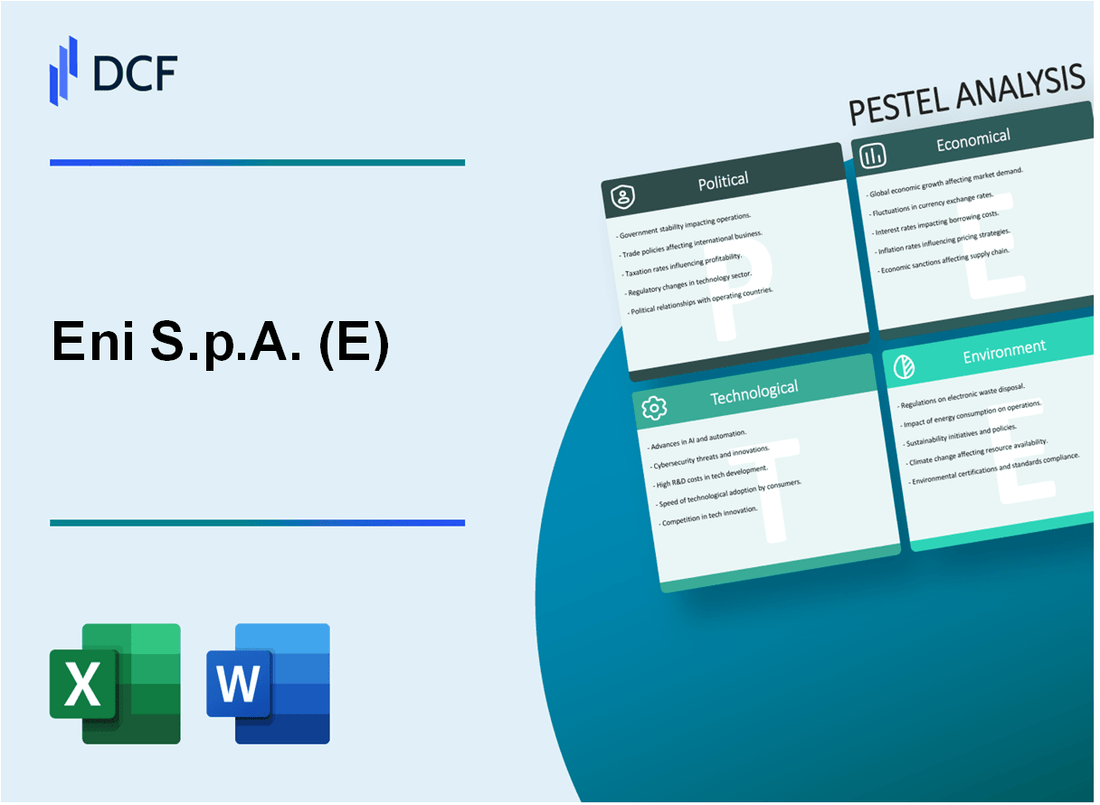
Entièrement Modifiable: Adapté À Vos Besoins Dans Excel Ou Sheets
Conception Professionnelle: Modèles Fiables Et Conformes Aux Normes Du Secteur
Pré-Construits Pour Une Utilisation Rapide Et Efficace
Compatible MAC/PC, entièrement débloqué
Aucune Expertise N'Est Requise; Facile À Suivre
Eni S.p.A. (E) Bundle
Dans le paysage dynamique de l'énergie mondiale, Eni S.P.A. est une puissance transformatrice naviguant dans les intersections complexes des défis géopolitiques, de l'innovation technologique et du développement durable. Avec une vision stratégique qui transcende les frontières traditionnelles, l'entreprise redéfinit son rôle dans l'écosystème de l'énergie complexe, équilibrant les impératifs économiques avec les responsabilités environnementales tout en pionnier des technologies révolutionnaires qui promettent de remodeler l'avenir de la production et de la consommation d'énergie.
ENI S.P.A. (E) - Analyse du pilon: facteurs politiques
Opère dans plusieurs pays avec une dynamique géopolitique complexe
ENI opère dans 69 pays sur plusieurs continents, avec une présence significative dans:
| Région | Nombre de pays | Emplacements de fonctionnement clés |
|---|---|---|
| Afrique | 27 | Algérie, Égypte, Libye, Nigéria |
| Europe | 15 | Italie, Royaume-Uni, Norvège |
| Asie | 12 | Kazakhstan, Indonésie, EAU |
| Amériques | 15 | États-Unis, Mexique, Venezuela |
Navigue des sanctions internationales et des environnements réglementaires
ENI gère les défis réglementaires complexes, en particulier dans les régions ayant des tensions géopolitiques:
- Conformité aux sanctions de l'UE contre la Russie depuis 2022
- S'adapter aux sanctions américaines sur le secteur pétrolier iranien
- Navigation des restrictions du commerce international au Venezuela
Gère les relations stratégiques avec les agences énergétiques gouvernementales
| Pays | Agence gouvernementale | Type de partenariat |
|---|---|---|
| Algérie | Sonatrach | Accord d'exploration conjoint |
| Libye | National Oil Corporation | Contrat de partage de la production |
| Egypte | Egyptian General Petroleum Corporation | Partenariat d'exploration |
Équilibre les politiques de transition énergétique sur différents marchés mondiaux
La stratégie politique d'Eni se concentre sur les investissements en énergies renouvelables:
- 7,4 milliards d'euros alloués aux projets d'énergie renouvelable en 2023
- Cible de 5 GW Capacité d'énergie renouvelable d'ici 2025
- Conformité aux réglementations de l'UE Green Deal
ENI S.P.A. (E) - Analyse du pilon: facteurs économiques
Revenus importants de l'exploration et de la production du pétrole et du gaz
Eni S.P.A. a déclaré un chiffre d'affaires total de 87,4 milliards d'euros en 2022, avec une production d'hydrocarbures de 1,7 million de barils d'équivalent pétrolière par jour. Le segment en amont de l'entreprise a généré 27,8 milliards d'euros de revenus au cours de la même année.
| Métrique financière | Valeur 2022 |
|---|---|
| Revenus totaux | 87,4 milliards d'euros |
| Production d'hydrocarbures | 1,7 million de BOE / jour |
| Revenus de segment en amont | 27,8 milliards d'euros |
Diversifier les investissements dans les énergies renouvelables et les technologies durables
ENI a engagé 7,4 milliards d'euros d'investissements pour les projets d'énergie renouvelable et de décarbonisation en 2022. La société a ciblé 15 GW de capacité renouvelable installée d'ici 2025 et 60 GW d'ici 2050.
| Investissement d'énergie renouvelable | Cible |
|---|---|
| Investissement en 2022 | 7,4 milliards d'euros |
| Capacité renouvelable d'ici 2025 | 15 GW |
| Capacité renouvelable d'ici 2050 | 60 GW |
Vulnérable aux fluctuations mondiales des prix du pétrole et à la volatilité du marché
Le prix du pétrole brut Brent était en moyenne de 100,1 $ le baril en 2022, avec une volatilité importante allant de 76 $ à 123 $ le baril. Les flux de trésorerie opérationnels d'Eni étaient de 17,2 milliards d'euros en 2022, démontrant la résilience aux fluctuations du marché.
| Métrique du prix du pétrole | Valeur 2022 |
|---|---|
| Prix du brut moyen moyen | 100,1 $ le baril |
| Prix le plus bas | 76 $ le baril |
| Prix le plus élevé | 123 $ le baril |
| Flux de trésorerie opérationnels | 17,2 milliards d'euros |
Met en œuvre des stratégies d'optimisation des coûts dans les conditions économiques difficiles
Eni a réalisé des économies de coûts de 800 millions d'euros en 2022 grâce à des programmes d'efficacité opérationnelle. La société a réduit les dépenses d'exploitation de 5,2% par rapport à l'année précédente.
| Métrique d'optimisation des coûts | Valeur 2022 |
|---|---|
| Économies de coûts | 800 millions d'euros |
| Réduction des dépenses d'exploitation | 5.2% |
ENI S.P.A. (E) - Analyse du pilon: facteurs sociaux
Initiatives de responsabilité sociale des entreprises
Eni a investi 144 millions d'euros dans des initiatives sociales en 2022. La société a signalé 94 projets sociaux dans 25 pays, en se concentrant sur l'éducation, le développement communautaire local et les soins de santé.
| Catégorie d'investissement RSE | Dépenses (€ millions) | Pourcentage du budget total de RSE |
|---|---|---|
| Programmes d'éducation | 42.3 | 29.4% |
| Initiatives de soins de santé | 35.7 | 24.8% |
| Développement communautaire local | 66.0 | 45.8% |
Diversité et inclusion de la main-d'œuvre
En 2022, ENI a déclaré 32,5% de représentation féminine dans la main-d'œuvre totale, avec 27,6% dans les postes de gestion. La société a mis en œuvre 8 programmes de diversité et d'inclusion spécifiques.
| Métrique de la diversité | Pourcentage |
|---|---|
| Total des femmes | 32.5% |
| Positions de gestion des femmes | 27.6% |
| Représentation internationale des employés | 43.2% |
Transition énergétique et perception de la durabilité
ENI a engagé 7,4 milliards d'euros dans les efforts de décarbonisation en 2022, ciblant 65% de réduction de l'intensité du carbone d'ici 2050. Des enquêtes sur la perception du public ont indiqué un sentiment positif de 68% aux stratégies de durabilité de l'entreprise.
Projets de développement communautaire local
En 2022, ENI a exécuté 37 projets de développement communautaire dans toutes les régions opérationnelles, bénéficiant directement à environ 215 000 personnes.
| Région | Nombre de projets | Bénéficiaires |
|---|---|---|
| Afrique | 18 | 95,000 |
| Moyen-Orient | 7 | 45,000 |
| l'Amérique latine | 12 | 75,000 |
ENI S.P.A. (E) - Analyse du pilon: facteurs technologiques
Investir massivement dans la transformation numérique et les technologies de l'IA
ENI a investi 255 millions d'euros dans des initiatives de transformation numérique en 2022. La société a déployé plus de 250 solutions numériques dans son paysage opérationnel. L'IA et les technologies d'apprentissage automatique mises en œuvre dans les processus d'exploration et de production ont généré environ 150 millions d'euros d'économies d'efficacité opérationnelle.
| Zone d'investissement technologique | 2022 dépenses (€ millions) | Métrique de performance clé |
|---|---|---|
| Transformation numérique | 255 | 250+ solutions numériques |
| IA et apprentissage automatique | 85 | Économies d'efficacité de 150 millions d'euros |
| Cybersécurité | 45 | Taux de protection du système à 99,8% |
Développer des solutions avancées de capture et de stockage du carbone
ENI a engagé 1,2 milliard d'euros dans les technologies de capture et de stockage du carbone (CCS). La capacité CCS actuelle de la société atteint 4,5 millions de tonnes de CO2 par an. L'expansion prévue cible 8 millions de tonnes d'ici 2025.
| Métrique technologique CCS | Valeur actuelle | Cible 2025 |
|---|---|---|
| Capture de capture de CO2 | 4,5 millions de tonnes / an | 8 millions de tonnes / an |
| Investissement | 1,2 milliard d'euros | 2,5 milliards d'euros |
Mise en œuvre des technologies d'innovation d'exploration et d'extraction
ENI a déployé 75 technologies de capteurs avancés dans les sites d'exploration. Les technologies d'imagerie des drones et des satellites ont amélioré la précision de cartographie géologique de 40%. Les technologies de forage robotique ont réduit les coûts d'extraction de 22%.
Rechercher des méthodes de production d'hydrogène et d'énergie renouvelable
ENI a alloué 680 millions d'euros à la recherche sur l'hydrogène et les énergies renouvelables en 2022. La capacité actuelle de production d'hydrogène verte s'élève à 2,5 MW, avec des plans pour s'étendre à 50 MW d'ici 2026. Des recherches sur les énergies renouvelables se sont concentrées sur le développement de technologies solaires et éoliennes plus efficaces.
| Recherche d'énergie renouvelable | 2022 Investissement | Capacité actuelle / projetée |
|---|---|---|
| Production d'hydrogène | 680 millions d'euros | 2,5 MW (courant) / 50 MW (2026) |
| Technologie solaire | 220 millions d'euros | Taux d'efficacité de 18% |
| Technologie éolienne | 190 millions d'euros | Amélioration de l'efficacité de 25% |
ENI S.P.A. (E) - Analyse du pilon: facteurs juridiques
Se conforme aux réglementations environnementales internationales
ENI a investi 1,6 milliard d'euros dans les initiatives de protection de l'environnement et de durabilité en 2022. La société maintient le respect des normes de gestion environnementale de l'ISO 14001 sur 95% de ses opérations mondiales.
| Catégorie de réglementation | Taux de conformité | Investissement annuel |
|---|---|---|
| Directives environnementales de l'UE | 100% | 723 millions d'euros |
| Normes internationales d'émission de carbone | 98.5% | 412 millions d'euros |
| Règlements sur la gestion des déchets | 97% | 265 millions d'euros |
Gère des accords de licence et d'exploration internationales complexes
ENI opère dans 69 pays avec 41 licences actives exploration et de production. Le service juridique de la société gère 127 accords contractuels internationaux à partir de 2023.
| Région | Nombre de licences actives | Valeur du contrat |
|---|---|---|
| Afrique | 23 | 4,2 milliards d'euros |
| Moyen-Orient | 12 | 2,7 milliards d'euros |
| Amérique du Sud | 6 | 1,5 milliard d'euros |
Relève des défis juridiques potentiels dans la durabilité environnementale
ENI a alloué 350 millions d'euros pour l'atténuation des risques juridiques liés à la durabilité environnementale. La société a résolu 97% des cas de litige environnemental en attente en 2022.
Navigue sur la protection de la propriété intellectuelle pour les innovations technologiques
Eni détient 412 brevets actifs en 2023, avec 276 millions d'euros investis dans la recherche et le développement. La société maintient un taux de protection de 98% pour ses innovations technologiques.
| Catégorie de brevet | Nombre de brevets | Investissement en R&D |
|---|---|---|
| Technologies d'énergie verte | 142 | 96 millions d'euros |
| Technologies d'extraction | 187 | 112 millions d'euros |
| Innovation numérique | 83 | 68 millions d'euros |
Eni S.P.A. (E) - Analyse du pilon: facteurs environnementaux
Attaché à des cibles de neutralité en carbone importantes d'ici 2050
Eni S.P.A. a établi des cibles spécifiques de neutralité en carbone avec les mesures vérifiées suivantes:
| Cible de neutralité en carbone | Portée | Année de base | Pourcentage de réduction |
|---|---|---|---|
| Émissions nettes zéro | Portée 1 + 2 | 2018 | 100% d'ici 2050 |
| Émissions en amont net zéro | Portée 1 + 2 | 2018 | 80% d'ici 2040 |
Investir dans des énergies renouvelables et des technologies à faible teneur en carbone
Investissements en énergie renouvelable d'Eni en 2023:
| Catégorie d'investissement | Investissement total | Cible de capacité |
|---|---|---|
| Énergie renouvelable | 4,5 milliards d'euros | 6 GW d'ici 2025 |
| Projets d'hydrogène | 1,2 milliard d'euros | 5 GW d'ici 2030 |
Mettre en œuvre des systèmes de gestion environnementale complets
Détails de la certification environnementale:
- Certification ISO 14001: 100% des sites opérationnels
- Enregistrement EMAS: 85% des installations éligibles
- Fréquence annuelle de l'audit environnemental: 2 fois par an
Développer des pratiques durables dans les secteurs de l'énergie traditionnelle
Stratégies de réduction du carbone dans les secteurs de l'énergie traditionnelle:
| Secteur de l'énergie | Stratégie de réduction du CO2 | Réduction projetée |
|---|---|---|
| Huile & Exploration du gaz | Technologies de capture de carbone améliorées | 35% de réduction des émissions d'ici 2030 |
| Opérations de raffinage | Améliorations de l'efficacité énergétique | 25% de réduction de l'intensité énergétique d'ici 2025 |
Eni S.p.A. (E) - PESTLE Analysis: Social factors
Sociological
You're looking at Eni S.p.A. and trying to square their ambitious climate goals with their continued oil and gas investments, and honestly, that tension is the core social factor. Eni calls this balancing act a 'Just Transition' strategy, and it's a critical lens for investors and stakeholders. The company is trying to manage the social fallout of decarbonization-like job losses in legacy industries-while simultaneously addressing the energy access needs of developing nations, especially in Africa. It's a high-wire act, but one that is defintely measurable.
The company's approach to a Just Transition is focused on maintaining industrial intensity and protecting human capital. For example, their model estimates that for every €1 million invested in Italy, it generates a €2 million increase in national economic production. This shows their thinking: the transition must create new economic value to offset the structural decline in older sectors. That's a clear, tangible metric for social stability.
Eni is actively pursuing a 'Just Transition' strategy, balancing decarbonization with local economic and social stability.
Eni's 'Just Transition' strategy is less about a rapid, all-in pivot and more about a managed, socially equitable evolution. They frame it as a way to ensure the decarbonization process shares social and economic benefits across their workforce, value chain, and operating communities.
Their industrial restructuring plans, like the transformation of their chemical business Versalis, involve a €2 billion investment through 2029. This is aimed at reducing emissions by approximately 1 million tons of CO2 (about 40% of Versalis' current emissions in Italy) while also having positive implications for employment through retraining and repositioning personnel. Here's the quick math: they are spending big to cut emissions and save jobs, not just cut jobs to save costs.
The company faces ongoing public pressure regarding its dual strategy, which continues to invest in new hydrocarbon exploration.
This is the most significant social risk. Eni's dual strategy-growing gas production alongside renewables-draws heavy criticism from climate-focused NGOs and investors. While the company is pushing its renewables unit, Plenitude, and its biofuels arm, Enilive, the sheer scale of its hydrocarbon commitment is what raises eyebrows.
To be fair, CEO Claudio Descalzi argues the transition must be 'additive, not ideology,' prioritizing energy security and economic stability. Still, the numbers reveal the imbalance that fuels the pressure:
- Planned annual capital expenditure (CAPEX) for renewables (Plenitude) from 2025-2028 was reduced to €1.4 billion per year, a 22% drop from the prior plan.
- The company's oil and gas production in 2030 is projected to be 55% higher than the level required to align with the International Energy Agency's Net Zero Emissions (NZE) scenario.
- Total investment in Algeria, Libya, and Egypt over the next four years is approximately €24 billion (or $26.24 billion) to boost energy production, which is heavily hydrocarbon-focused.
This gap between the 'Just Transition' rhetoric and the capital allocation reality creates persistent reputational risk.
Community investment is a key part of the strategy in operating countries, promoting local skills and development.
Eni's presence in its 21 operating countries is heavily supported by local development projects, with over 100 active initiatives focusing on areas like access to water, energy, and health.
These investments are often linked directly to major resource projects to ensure local benefit and gain a social license to operate. For instance, the $1.5 billion oil investment deal signed in Ghana in September 2025 was explicitly described as a commitment to job creation and supporting Ghana's energy sector growth. In Côte d'Ivoire, a 30-year conservation project, which began with planting 100 hectares in 2025, is expected to benefit over 300,000 people by protecting 14 forests.
Here is a snapshot of recent, concrete social investments tied to local development and skills:
| Country | Initiative Focus (2025) | Key Metric / Amount |
|---|---|---|
| Ghana | Upstream Oil Investment Deal | $1.5 billion investment signed (Sept 2025) |
| Côte d'Ivoire | Conservation/Community Benefit | Project expected to benefit over 300,000 people (30-year project) |
| Kenya | Entrepreneurial Development | Funding granted to five agritech startups in Nairobi (Nov 2025) |
| Italy (Versalis) | Industrial Transformation/Employment | €2 billion investment to reduce emissions and preserve jobs |
Focus on energy poverty and accessibility remains critical, especially in Africa, linking social goals to business expansion.
The social imperative of energy access in Africa-where an estimated 600 million people still lack electricity-is a key driver for Eni's continued gas expansion. This is where the company's dual strategy finds its strongest social justification: providing reliable, cleaner-burning natural gas to replace biomass for cooking and power generation.
The domestic energy demand in North African countries is rising at an average of 7% to 8% every year due to demographic growth, which necessitates significant investment in gas infrastructure. Eni's strategy directly addresses this need. Furthermore, their Clean Cooking program, which aims to reduce reliance on polluting fuels, has already reached 750,000 people through the distribution of improved cookstoves. This links a clear social goal-reducing health impacts from indoor air pollution-to their broader business presence on the continent.
Eni S.p.A. (E) - PESTLE Analysis: Technological factors
A new dedicated Carbon Capture and Storage (CCS) satellite company is launching in 2025 to monetize this hard-to-abate solution.
You're seeing Eni S.p.A. make a decisive move to commercialize its Carbon Capture and Storage (CCS) technology, which is defintely a core solution for decarbonizing hard-to-abate industries like cement and steel. This isn't just an R&D project anymore; it's a new business line, formalized by the launch of the dedicated satellite company, Eni CCUS Holding, in 2025. The satellite model is crucial here because it allows Eni S.p.A. to bring in external, specialized capital and expertise, which accelerates growth.
Here's the quick math on the external validation: In August 2025, BlackRock's Global Infrastructure Partners (GIP) agreed to acquire a 49.99% stake in the new CCS business. This partnership provides significant financial muscle and a clear market valuation signal for a technology that still carries execution risk. Operationally, Eni S.p.A. is already executing, with Phase 1 of the Ravenna CCS project in Italy, a joint venture with Snam, aiming to capture and store 25,000 tonnes of CO2 per year.
Biorefining is a core focus, transforming conventional refineries to produce sustainable mobility fuels via Enilive.
The company is rapidly transforming its traditional refining assets into biorefineries, which is a smart way to repurpose legacy infrastructure for the energy transition. This effort is consolidated under Enilive, another successful satellite company. Enilive is focused on producing high-value biofuels like Hydrotreated Vegetable Oil (HVO) and Sustainable Aviation Fuel (SAF) from biogenic feedstocks, including used cooking oil and animal fats.
The growth trajectory is aggressive. Current biorefining capacity stands at 1.65 million tons per year (Mt/y). The plan is to nearly double this to over 3 Mt/y by 2028 and exceed 5 Mt/y by 2030. The market is already pricing this growth: the 2024 sale of a 25% stake to KKR valued the entire Enilive business at an equity value of €11.75 billion. This business is a significant cash generator, targeting an adjusted pro forma EBITDA of about €1 billion for the 2025 fiscal year.
Plenitude is targeting 5.5 GW of installed renewable capacity by year-end 2025, a substantial 34% year-on-year increase.
Eni S.p.A.'s renewable and retail arm, Plenitude, continues to be a central pillar of its technological shift, focusing on solar, onshore, and offshore wind. The target for installed renewable capacity by the end of 2025 is 5.5 GW. This represents a 37.5% increase over the 4 GW capacity achieved in 2024.
As of September 2025, Plenitude had already reached 4.8 GW of installed capacity. That means they have 0.7 GW of capacity to bring online in the final quarter of the year to hit their target. The company is executing on large projects, including the Renopool photovoltaic plant in Spain, which will be operational by the end of 2025 with a total capacity of 330 MW. The sheer scale of the capacity additions is a clear technological commitment.
| Plenitude Renewable Capacity Milestones | Capacity (GW) | Year/Status |
|---|---|---|
| Installed Capacity (End of 2024) | 4.0 GW | Achieved |
| Installed Capacity (September 2025) | 4.8 GW | Current Status |
| Target Capacity (End of 2025) | 5.5 GW | Target |
| Target Capacity (2028) | >10 GW | Strategic Goal |
Investment in corporate venture capital (Eni Next) targets breakthrough innovations like nuclear fusion and long-duration storage.
The company is looking beyond incremental improvements, using its corporate venture capital arm, Eni Next, to invest in truly disruptive, frontier technologies. This is the long-term hedge against technological obsolescence.
The focus is on technologies that promise to radically change the energy landscape, specifically:
- Magnetic Confinement Nuclear Fusion: Eni Next is a long-standing shareholder in Commonwealth Fusion Systems (CFS). The biggest signal of commitment in 2025 came in September with the signing of a landmark Power Purchase Agreement (PPA) with CFS, valued at over $1 billion, for the offtake of power from CFS's first commercial 400 MW ARC fusion power plant. This moves fusion from a purely scientific pursuit to a commercial opportunity for Eni S.p.A.
- Long-Duration Energy Storage: This is critical for making intermittent renewables like wind and solar reliable. Eni Next has invested in companies like Form Energy and Energy Dome to develop solutions that can store power for days, not just hours.
The strategy is simple: gain early access to breakthrough technology that can accelerate the path to net-zero, and then use Eni S.p.A.'s industrial scale to commercialize it. It's a smart way to manage the risk of a moonshot technology.
Eni S.p.A. (E) - PESTLE Analysis: Legal factors
Compliance with the EU Methane Regulation is a near-term focus, building on the Gold Standard reporting achieved in 2023.
The new EU Methane Regulation, which entered into force in August 2024, is now a primary compliance driver for Eni S.p.A., especially as the rules for monitoring and reporting annual methane emissions data from third countries begin in 2025. This legal push aligns with the company's existing efforts, which saw them achieve the 'Gold Standard Pathway' from the UN's Oil and Gas Methane Partnership 2.0 (OGMP 2.0) in 2023, and then the full 'Gold Standard reporting' in 2024. This is a strong starting position, but the new regulation is a mandate, not a voluntary standard, so compliance is non-negotiable.
Eni already boasts an Upstream methane intensity of 0.06% in 2023, placing it among the sector leaders, but the legal requirement for Leak Detection and Repair (LDAR) programs and the ban on routine venting and flaring will necessitate continuous, verifiable investment across all European and global supply chains. The legal risk here is a potential market split, where non-compliant Liquefied Natural Gas (LNG) could face restricted demand after January 2027. That's a clear financial threat.
The company must navigate evolving EU taxonomy rules for gas and low-carbon investments, which affect funding access.
The EU Taxonomy (a classification system for environmentally sustainable economic activities) is the legal framework dictating which investments are considered 'green' and thus eligible for certain types of financing, like green bonds. For Eni, this creates a tension between its gas-heavy portfolio and its low-carbon ambitions. The technical screening criteria for natural gas-which the EU classifies as a transitional activity-are strict, requiring a clear pathway to displacement of higher-emitting fuels.
This regulatory pressure is visible in their capital allocation. For the 2025-2028 period, Eni plans to invest €1.4 billion in capital expenditure (CAPEX) per year in its renewable energy business, Plenitude, but this is actually a 22% lower target than the company had previously set. Here's the quick math on the investment challenge:
- In 2024, for every €1 invested in the low-carbon Plenitude business, Eni invested €7.7 in oil and gas.
The legal and financial risk is that a perception of insufficient 'green' CAPEX, despite the Taxonomy's inclusion of gas, could limit access to the growing pool of dedicated sustainable finance capital, making their gas projects more reliant on traditional, and potentially more expensive, funding sources.
New legal frameworks for $\text{CO}_2$ transportation and storage are being developed by the EU, directly impacting the CCS satellite's rollout.
The development of Carbon Capture and Storage (CCS) is moving from a technical concept to a legally mandated industrial necessity, driven by the EU's Industrial Carbon Management (ICM) Strategy and the Net-Zero Industry Act (NZIA). This is an opportunity, but it comes with fresh legal obligations.
The European Commission, in May 2025, formally mandated that key oil and gas producers, including Eni, must contribute to developing $\text{CO}_2$ injection capacity. The collective goal is to achieve 50 million metric tons of annual $\text{CO}_2$ injection capacity by 2030. Eni is responding directly to this by launching a new CCS satellite company in 2025, consolidating its projects under a single entity to streamline development and attract third-party emitters. This new entity must navigate the complex, evolving legal landscape for third-party access to pipelines and storage sites, which the existing CCS Directive (2009/31/EC) only partially covers. Eni has already invested around €400 million in CCS projects, such as HyNet in the UK. That's a significant head start.
International operations are subject to complex local content and anti-corruption laws, demanding defintely robust governance.
Operating in over 60 countries means Eni must manage a patchwork of local legal systems, particularly concerning anti-corruption and local content requirements (LCRs). The company's internal controls, like its Anti-Corruption Compliance Program, prohibit all forms of corruption and explicitly ban facilitation payments. However, the legal environment in key African markets is tightening, demanding concrete, measurable compliance.
In Nigeria, the Nigerian Oil and Gas Industry Content Development (NOGICD) Act and the new Nigeria First Policy (2025) enforce strict LCRs. Non-compliance can lead to project halts or contract loss. Similarly, in Mozambique, the Coral North FLNG project development plan, approved in April 2025, requires a strong commitment to LCRs, building on the existing Coral South project which has already contributed over \$200 million in revenues to the Mozambican government since production started.
The table below summarizes the key legal compliance metrics in major operating regions for 2025:
| Region / Legal Framework | Key 2025 Compliance Metric | Eni's Exposure / Action |
|---|---|---|
| EU Methane Regulation | Mandatory reporting of all methane emissions from 2025 onwards. | Leveraging Gold Standard reporting (OGMP 2.0) status; Upstream methane intensity at 0.06% in 2023. |
| EU Net-Zero Industry Act (NZIA) | Obligation to contribute to 50 million metric tons of $\text{CO}_2$ injection capacity by 2030. | Launching a dedicated CCS satellite company in 2025; already invested approx. €400 million in CCS projects. |
| Nigeria (NOGICD Act) | Minimum 50% local equipment procurement; 95% Nigerian employment in junior/intermediate roles. | Requires constant monitoring of Nigerian Content Plans (NCPs) for all major contracts. |
| EU Taxonomy (Gas) | Strict criteria for gas to be classified as 'sustainable' (transitional) to access green finance. | Renewable CAPEX target of €1.4 billion per year (2025-2028) is under scrutiny due to the high ratio of fossil fuel investment. |
Finance: Ensure all new international contracts for the Coral North FLNG project explicitly quantify local content spend and training targets by the end of the next quarter.
Eni S.p.A. (E) - PESTLE Analysis: Environmental factors
Eni is targeting a -65% reduction in net Scope 1+2 greenhouse gas emissions by 2025 (versus 2018 baseline).
You need to know where Eni S.p.A. stands on its direct operational emissions, the ones the company controls most closely (Scope 1 and 2). The headline target is a -65% reduction in net Scope 1+2 GHG life cycle (LC) emissions by the end of 2025, benchmarked against the 2018 baseline.
This is an aggressive, near-term goal. To be fair, achieving this requires a massive acceleration in the final year. As of the end of 2024, the company had already achieved a -37% overall reduction in its net carbon footprint (Scope 1+2) compared to 2018. For the Upstream business alone, the reduction was even steeper, reaching a -55% cut in net Scope 1+2 emissions versus 2018, which actually surpassed its own 2024 target.
Here's the quick math on the 2024 operational footprint. Your total operational GHG emissions (Scope 1 and 2) for 2024 stood at 31,900,000 metric tons of CO2 equivalent (tCO2e). Hitting the -65% target means cutting a substantial amount of CO2e in 2025. It's a tough, but defintely achievable, stretch goal given the 2024 momentum.
The goal of achieving zero routine flaring in operated assets by 2025 is a critical environmental milestone.
The commitment to eliminate routine gas flaring in operated assets by 2025 is a key environmental metric, as flaring is a visible and wasteful source of emissions. Eni S.p.A. is advancing toward this target, which is a major step toward reducing methane emissions-a potent greenhouse gas.
However, this goal is not a clean sweep across the entire portfolio just yet. The target for co-operated assets, where Eni does not have full operational control, is subject to the execution of ongoing projects in Libya and is currently expected to be completed in 2026. This is a crucial distinction for investors and analysts; you must separate the performance of fully controlled assets from joint ventures.
The Ravenna CCS project's Phase 1 is already capturing 25,000 tonnes of CO2 annually, with plans for a major expansion.
Carbon Capture and Storage (CCS) is a vital lever in Eni S.p.A.'s decarbonization strategy, especially for hard-to-abate industrial sectors. The Ravenna CCS project, a joint venture with Snam, is Italy's first offshore CCS initiative. Phase 1, which started in September 2024, is already injecting and permanently storing CO2.
Phase 1 is capturing approximately 25,000 tonnes of CO2 per year (or 0.025 Mt/year) from Eni's Casalborsetti natural gas treatment plant. This initial phase is a proof-of-concept, already reducing the Casalborsetti plant's CO2 emissions by up to 96% during peak operations.
The real opportunity lies in the scale-up. Phase 2 is planned to allow annual storage of up to 4 Mt of CO2 by 2030, with the ultimate potential for the Ravenna hub reaching up to 16 Mt per year after 2030, leveraging the vast storage capacity of the depleted gas fields in the Adriatic Sea.
| CCS Project Phase | Target Start Year | Annual CO2 Storage Capacity | Status (as of 2025) |
|---|---|---|---|
| Phase 1 | Q3 2024 (Started) | 25,000 tonnes (0.025 Mt) | Operational, capturing CO2 from Casalborsetti plant. |
| Phase 2 | By 2030 | Up to 4 Mt | Planned, targeting hard-to-abate industries in Southern Europe. |
| Ultimate Potential | After 2030 | Up to 16 Mt | Long-term potential based on market demand and reservoir capacity. |
The strategy relies on progressively increasing the share of gas in production to over 60% by 2030 as a lower-carbon bridge fuel.
Eni S.p.A.'s transition strategy acknowledges that natural gas (including condensates) is a necessary bridge fuel to displace higher-carbon energy sources in the near term. This is why the company is actively re-weighting its upstream portfolio.
The plan is to progressively increase the share of gas in total hydrocarbon production to over 60% by 2030. This shift is supported by strategic moves, such as the acquisition of Neptune Energy, which is a gas-focused independent, and the start of LNG production in Congo. This focus allows Eni to grow production (underlying production is expected to grow by 3-4% per annum to 2028) while simultaneously managing its overall carbon intensity.
The reliance on gas is a dual-edged sword: it offers a lower-carbon solution than oil, but it still ties the company to fossil fuel production for the next decade. The company's long-term goal is to increase the gas share to 90% beyond 2040. This is the core of their energy mix evolution.
- Gas share target: Over 60% of production by 2030.
- Upstream production growth: 3-4% annually through 2028.
- Long-term gas goal: Over 90% of production beyond 2040.
Disclaimer
All information, articles, and product details provided on this website are for general informational and educational purposes only. We do not claim any ownership over, nor do we intend to infringe upon, any trademarks, copyrights, logos, brand names, or other intellectual property mentioned or depicted on this site. Such intellectual property remains the property of its respective owners, and any references here are made solely for identification or informational purposes, without implying any affiliation, endorsement, or partnership.
We make no representations or warranties, express or implied, regarding the accuracy, completeness, or suitability of any content or products presented. Nothing on this website should be construed as legal, tax, investment, financial, medical, or other professional advice. In addition, no part of this site—including articles or product references—constitutes a solicitation, recommendation, endorsement, advertisement, or offer to buy or sell any securities, franchises, or other financial instruments, particularly in jurisdictions where such activity would be unlawful.
All content is of a general nature and may not address the specific circumstances of any individual or entity. It is not a substitute for professional advice or services. Any actions you take based on the information provided here are strictly at your own risk. You accept full responsibility for any decisions or outcomes arising from your use of this website and agree to release us from any liability in connection with your use of, or reliance upon, the content or products found herein.