
|
Eni S.P.A. (E): Análise de Pestle [Jan-2025 Atualizado] |
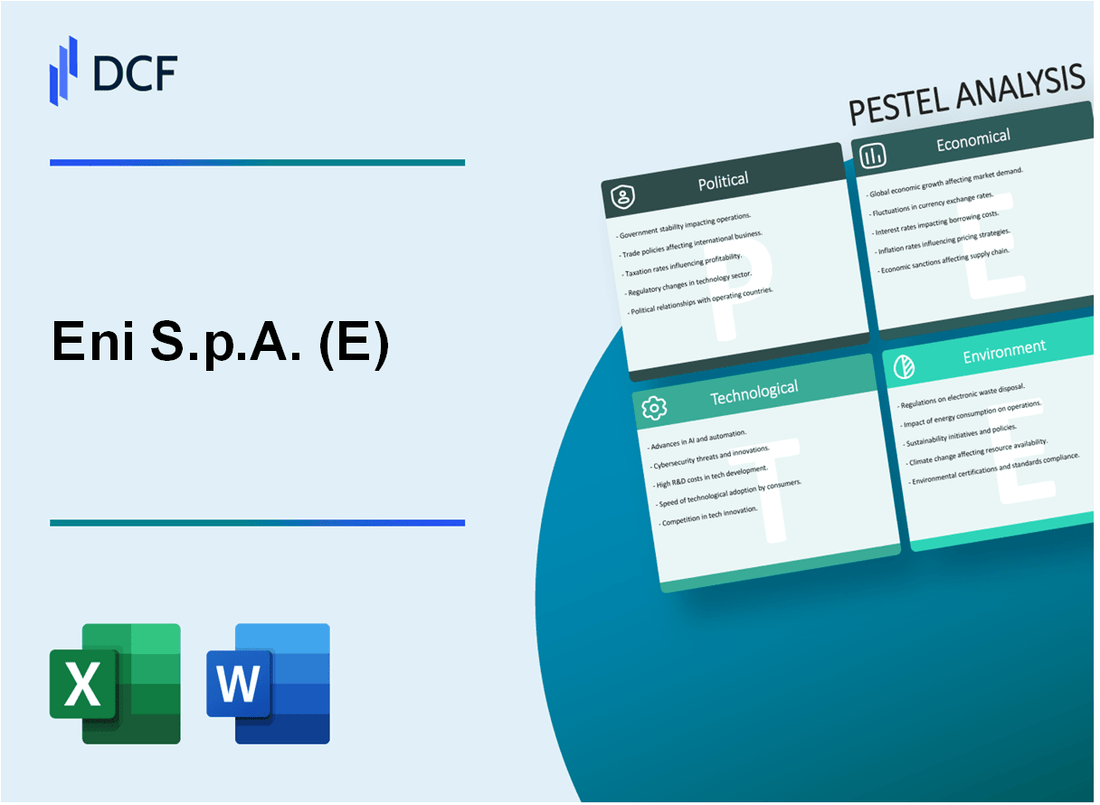
Totalmente Editável: Adapte-Se Às Suas Necessidades No Excel Ou Planilhas
Design Profissional: Modelos Confiáveis E Padrão Da Indústria
Pré-Construídos Para Uso Rápido E Eficiente
Compatível com MAC/PC, totalmente desbloqueado
Não É Necessária Experiência; Fácil De Seguir
Eni S.p.A. (E) Bundle
No cenário dinâmico da energia global, a Eni S.P.A. permanece como uma potência transformadora, navegando nas intrincadas interseções de desafios geopolíticos, inovação tecnológica e desenvolvimento sustentável. Com uma visão estratégica que transcende as fronteiras tradicionais, a empresa está redefinindo seu papel no complexo ecossistema energético, equilibrando os imperativos econômicos com responsabilidades ambientais, enquanto pioneira tecnologias inovadoras que prometem remodelar o futuro da produção e consumo de energia.
Eni S.P.A. (E) - Análise de Pestle: Fatores Políticos
Opera em vários países com dinâmica geopolítica complexa
A ENI opera em 69 países em vários continentes, com presença significativa em:
| Região | Número de países | Principais locais operacionais |
|---|---|---|
| África | 27 | Argélia, Egito, Líbia, Nigéria |
| Europa | 15 | Itália, Reino Unido, Noruega |
| Ásia | 12 | Cazaquistão, Indonésia, Emirados Árabes Unidos |
| Américas | 15 | EUA, México, Venezuela |
Navega sanções internacionais e ambientes regulatórios
A ENI gerencia desafios regulatórios complexos, particularmente em regiões com tensões geopolíticas:
- Conformidade com as sanções da UE contra a Rússia desde 2022
- Adaptando -se às sanções dos EUA ao setor de petróleo iraniano
- Navegando restrições comerciais internacionais na Venezuela
Gerencia relações estratégicas com agências de energia governamental
| País | Agência governamental | Tipo de parceria |
|---|---|---|
| Argélia | Sonatrach | Contrato de exploração conjunta |
| Líbia | Corporação Nacional de Petróleo | Contrato de compartilhamento de produção |
| Egito | Corporação em petróleo geral egípcio | Parceria de Exploração |
Balance políticas de transição energética em diferentes mercados globais
A estratégia política da ENI se concentra em investimentos em energia renovável:
- 7,4 bilhões de euros alocados para projetos de energia renovável em 2023
- Alvo de 5 GW Capacidade de energia renovável até 2025
- Conformidade com os regulamentos de ofertas verdes da UE
Eni S.P.A. (E) - Análise de pilão: Fatores econômicos
Receita significativa da exploração e produção de petróleo e gás
A Eni S.P.A. relatou receita total de € 87,4 bilhões em 2022, com produção de hidrocarbonetos de 1,7 milhão de barris de petróleo equivalente por dia. O segmento a montante da empresa gerou 27,8 bilhões de euros em receita durante o mesmo ano.
| Métrica financeira | 2022 Valor |
|---|---|
| Receita total | € 87,4 bilhões |
| Produção de hidrocarbonetos | 1,7 milhão de boe/dia |
| Receita do segmento upstream | 27,8 bilhões de euros |
Diversificando investimentos sobre energia renovável e tecnologias sustentáveis
A ENI cometeu 7,4 bilhões de euros em investimentos para projetos de energia renovável e descarbonização em 2022. A Companhia direcionou 15 GW de capacidade renovável instalada até 2025 e 60 GW até 2050.
| Investimento de energia renovável | Alvo |
|---|---|
| Investimento em 2022 | € 7,4 bilhões |
| Capacidade renovável até 2025 | 15 GW |
| Capacidade renovável até 2050 | 60 GW |
Vulnerável às flutuações globais dos preços do petróleo e volatilidade do mercado
O preço do petróleo Brent em média de US $ 100,1 por barril em 2022, com volatilidade significativa variando de US $ 76 a US $ 123 por barril. O fluxo de caixa operacional da ENI foi de € 17,2 bilhões em 2022, demonstrando resiliência às flutuações do mercado.
| Métrica do preço do petróleo | 2022 Valor |
|---|---|
| Preço médio de petróleo Brent | $ 100,1 por barril |
| Preço mais baixo | US $ 76 por barril |
| Preço mais alto | US $ 123 por barril |
| Fluxo de caixa operacional | € 17,2 bilhões |
Implementa estratégias de otimização de custos para desafiar condições econômicas
A ENI obteve uma economia de custos de € 800 milhões em 2022 por meio de programas de eficiência operacional. A empresa reduziu as despesas operacionais em 5,2% em comparação com o ano anterior.
| Métrica de otimização de custos | 2022 Valor |
|---|---|
| Economia de custos | € 800 milhões |
| Redução de despesas operacionais | 5.2% |
Eni S.P.A. (E) - Análise de pilão: Fatores sociais
Iniciativas de responsabilidade social corporativa
A ENI investiu 144 milhões de euros em iniciativas sociais em 2022. A Companhia relatou 94 projetos sociais em 25 países, com foco em educação, desenvolvimento comunitário local e saúde.
| Categoria de investimento em RSE | Despesas (milhão de €) | Porcentagem do orçamento total de RSE |
|---|---|---|
| Programas de educação | 42.3 | 29.4% |
| Iniciativas de saúde | 35.7 | 24.8% |
| Desenvolvimento da comunidade local | 66.0 | 45.8% |
Diversidade e inclusão da força de trabalho
A partir de 2022, a ENI relatou 32,5% de representação feminina na força de trabalho total, com 27,6% em cargos de gerenciamento. A empresa implementou 8 programas específicos de diversidade e inclusão.
| Métrica de diversidade | Percentagem |
|---|---|
| Força de trabalho feminina total | 32.5% |
| Posições de gestão feminina | 27.6% |
| Representação internacional de funcionários | 43.2% |
Transição energética e percepção de sustentabilidade
A ENI comprometeu 7,4 bilhões de euros aos esforços de descarbonização em 2022, direcionando a redução de 65% na intensidade do carbono até 2050. Pesquisas de percepção pública indicaram 68% de sentimento positivo em relação às estratégias de sustentabilidade da empresa.
Projetos de desenvolvimento comunitário local
Em 2022, a ENI executou 37 projetos de desenvolvimento comunitário em regiões operacionais, beneficiando aproximadamente 215.000 indivíduos diretamente.
| Região | Número de projetos | Beneficiários |
|---|---|---|
| África | 18 | 95,000 |
| Médio Oriente | 7 | 45,000 |
| América latina | 12 | 75,000 |
Eni S.P.A. (E) - Análise de pilão: Fatores tecnológicos
Investir pesadamente em transformação digital e tecnologias de IA
A ENI investiu 255 milhões de euros em iniciativas de transformação digital em 2022. A Companhia implantou mais de 250 soluções digitais em seu cenário operacional. As tecnologias de IA e aprendizado de máquina implementadas nos processos de exploração e produção geraram cerca de 150 milhões de euros em economia de eficiência operacional.
| Área de investimento em tecnologia | 2022 Despesas (milhões de euros) | Métrica de desempenho principal |
|---|---|---|
| Transformação digital | 255 | 250+ soluções digitais |
| AI e aprendizado de máquina | 85 | Economia de eficiência de € 150 milhões |
| Segurança cibernética | 45 | 99,8% da taxa de proteção do sistema |
Desenvolvimento de soluções avançadas de captura e armazenamento de carbono
A ENI comprometeu 1,2 bilhão de euros às tecnologias de captura e armazenamento de carbono (CCS). A capacidade atual do CCS da empresa atinge 4,5 milhões de toneladas de CO2 anualmente. A expansão planejada tem como alvo 8 milhões de toneladas até 2025.
| Métrica de tecnologia do CCS | Valor atual | 2025 Target |
|---|---|---|
| Capacidade de captura de CO2 | 4,5 milhões de toneladas/ano | 8 milhões de toneladas/ano |
| Investimento | € 1,2 bilhão | 2,5 bilhões de euros |
Implementando tecnologias inovadoras de exploração e extração
A ENI implantou 75 tecnologias de sensores avançados em sites de exploração. As tecnologias de imagens por drone e satélite melhoraram a precisão do mapeamento geológico em 40%. As tecnologias de perfuração robótica reduziram os custos de extração em 22%.
Pesquisando métodos de produção de hidrogênio e energia renovável
A ENI alocou 680 milhões de euros para a pesquisa de hidrogênio e energia renovável em 2022. A atual capacidade de produção de hidrogênio verde é de 2,5 MW, com planos de expandir para 50 MW até 2026. A pesquisa de energia renovável focada no desenvolvimento de tecnologias solares e eólicas mais eficientes.
| Pesquisa de energia renovável | 2022 Investimento | Capacidade atual/projetada |
|---|---|---|
| Produção de hidrogênio | € 680 milhões | 2,5 MW (atual) / 50 MW (2026) |
| Tecnologia solar | € 220 milhões | Taxa de eficiência de 18% |
| Tecnologia eólica | € 190 milhões | 25% de melhoria de eficiência |
Eni S.P.A. (E) - Análise de Pestle: Fatores Legais
Está em conformidade com os regulamentos ambientais internacionais
A ENI investiu 1,6 bilhão de euros em iniciativas de proteção e sustentabilidade ambiental em 2022. A Companhia mantém a conformidade com os padrões de gestão ambiental da ISO 14001 em 95% de suas operações globais.
| Categoria de regulamentação | Taxa de conformidade | Investimento anual |
|---|---|---|
| Diretivas Ambientais da UE | 100% | € 723 milhões |
| Padrões internacionais de emissão de carbono | 98.5% | € 412 milhões |
| Regulamentos de gerenciamento de resíduos | 97% | 265 milhões de euros |
Gerencia acordos complexos de licenciamento e exploração
A ENI opera em 69 países com 41 licenças ativas de exploração e produção. O Departamento Jurídico da Companhia gerencia 127 acordos contratuais internacionais a partir de 2023.
| Região | Número de licenças ativas | Valor do contrato |
|---|---|---|
| África | 23 | € 4,2 bilhões |
| Médio Oriente | 12 | 2,7 bilhões de euros |
| Ámérica do Sul | 6 | € 1,5 bilhão |
Aborda possíveis desafios legais na sustentabilidade ambiental
A ENI alocou 350 milhões de euros para mitigação de riscos legais relacionados à sustentabilidade ambiental. A empresa resolveu 97% dos casos de litígio ambiental pendentes em 2022.
Navega proteção de propriedade intelectual para inovações tecnológicas
A ENI possui 412 patentes ativas a partir de 2023, com 276 milhões de euros investidos em pesquisa e desenvolvimento. A empresa mantém 98% de taxa de proteção para suas inovações tecnológicas.
| Categoria de patentes | Número de patentes | Investimento em P&D |
|---|---|---|
| Tecnologias de energia verde | 142 | € 96 milhões |
| Tecnologias de extração | 187 | € 112 milhões |
| Inovação digital | 83 | € 68 milhões |
Eni S.P.A. (E) - Análise de Pestle: Fatores Ambientais
Comprometido com alvos significativos de neutralidade de carbono até 2050
A Eni S.P.A. estabeleceu metas específicas de neutralidade de carbono com as seguintes métricas verificadas:
| Alvo de neutralidade de carbono | Escopo | Ano de linha de base | Porcentagem de redução |
|---|---|---|---|
| Emissões líquidas zero | Escopo 1 + 2 | 2018 | 100% até 2050 |
| Emissões líquidas zero a montante | Escopo 1 + 2 | 2018 | 80% até 2040 |
Investindo em energia renovável e tecnologias de baixo carbono
Investimentos de energia renovável da Eni a partir de 2023:
| Categoria de investimento | Investimento total | Alvo de capacidade |
|---|---|---|
| Energia renovável | € 4,5 bilhões | 6 GW até 2025 |
| Projetos de hidrogênio | € 1,2 bilhão | 5 GW até 2030 |
Implementando sistemas abrangentes de gestão ambiental
Detalhes da certificação ambiental:
- Certificação ISO 14001: 100% dos sites operacionais
- Registro do EMAS: 85% das instalações elegíveis
- Frequência anual de auditoria ambiental: 2 vezes por ano
Desenvolvendo práticas sustentáveis em setores de energia tradicionais
Estratégias de redução de carbono nos setores tradicionais de energia:
| Setor de energia | Estratégia de redução de CO2 | Redução projetada |
|---|---|---|
| Óleo & Exploração a gás | Tecnologias aprimoradas de captura de carbono | Redução de 35% de emissões até 2030 |
| Operações de refino | Melhorias de eficiência energética | 25% Redução de intensidade energética até 2025 |
Eni S.p.A. (E) - PESTLE Analysis: Social factors
Sociological
You're looking at Eni S.p.A. and trying to square their ambitious climate goals with their continued oil and gas investments, and honestly, that tension is the core social factor. Eni calls this balancing act a 'Just Transition' strategy, and it's a critical lens for investors and stakeholders. The company is trying to manage the social fallout of decarbonization-like job losses in legacy industries-while simultaneously addressing the energy access needs of developing nations, especially in Africa. It's a high-wire act, but one that is defintely measurable.
The company's approach to a Just Transition is focused on maintaining industrial intensity and protecting human capital. For example, their model estimates that for every €1 million invested in Italy, it generates a €2 million increase in national economic production. This shows their thinking: the transition must create new economic value to offset the structural decline in older sectors. That's a clear, tangible metric for social stability.
Eni is actively pursuing a 'Just Transition' strategy, balancing decarbonization with local economic and social stability.
Eni's 'Just Transition' strategy is less about a rapid, all-in pivot and more about a managed, socially equitable evolution. They frame it as a way to ensure the decarbonization process shares social and economic benefits across their workforce, value chain, and operating communities.
Their industrial restructuring plans, like the transformation of their chemical business Versalis, involve a €2 billion investment through 2029. This is aimed at reducing emissions by approximately 1 million tons of CO2 (about 40% of Versalis' current emissions in Italy) while also having positive implications for employment through retraining and repositioning personnel. Here's the quick math: they are spending big to cut emissions and save jobs, not just cut jobs to save costs.
The company faces ongoing public pressure regarding its dual strategy, which continues to invest in new hydrocarbon exploration.
This is the most significant social risk. Eni's dual strategy-growing gas production alongside renewables-draws heavy criticism from climate-focused NGOs and investors. While the company is pushing its renewables unit, Plenitude, and its biofuels arm, Enilive, the sheer scale of its hydrocarbon commitment is what raises eyebrows.
To be fair, CEO Claudio Descalzi argues the transition must be 'additive, not ideology,' prioritizing energy security and economic stability. Still, the numbers reveal the imbalance that fuels the pressure:
- Planned annual capital expenditure (CAPEX) for renewables (Plenitude) from 2025-2028 was reduced to €1.4 billion per year, a 22% drop from the prior plan.
- The company's oil and gas production in 2030 is projected to be 55% higher than the level required to align with the International Energy Agency's Net Zero Emissions (NZE) scenario.
- Total investment in Algeria, Libya, and Egypt over the next four years is approximately €24 billion (or $26.24 billion) to boost energy production, which is heavily hydrocarbon-focused.
This gap between the 'Just Transition' rhetoric and the capital allocation reality creates persistent reputational risk.
Community investment is a key part of the strategy in operating countries, promoting local skills and development.
Eni's presence in its 21 operating countries is heavily supported by local development projects, with over 100 active initiatives focusing on areas like access to water, energy, and health.
These investments are often linked directly to major resource projects to ensure local benefit and gain a social license to operate. For instance, the $1.5 billion oil investment deal signed in Ghana in September 2025 was explicitly described as a commitment to job creation and supporting Ghana's energy sector growth. In Côte d'Ivoire, a 30-year conservation project, which began with planting 100 hectares in 2025, is expected to benefit over 300,000 people by protecting 14 forests.
Here is a snapshot of recent, concrete social investments tied to local development and skills:
| Country | Initiative Focus (2025) | Key Metric / Amount |
|---|---|---|
| Ghana | Upstream Oil Investment Deal | $1.5 billion investment signed (Sept 2025) |
| Côte d'Ivoire | Conservation/Community Benefit | Project expected to benefit over 300,000 people (30-year project) |
| Kenya | Entrepreneurial Development | Funding granted to five agritech startups in Nairobi (Nov 2025) |
| Italy (Versalis) | Industrial Transformation/Employment | €2 billion investment to reduce emissions and preserve jobs |
Focus on energy poverty and accessibility remains critical, especially in Africa, linking social goals to business expansion.
The social imperative of energy access in Africa-where an estimated 600 million people still lack electricity-is a key driver for Eni's continued gas expansion. This is where the company's dual strategy finds its strongest social justification: providing reliable, cleaner-burning natural gas to replace biomass for cooking and power generation.
The domestic energy demand in North African countries is rising at an average of 7% to 8% every year due to demographic growth, which necessitates significant investment in gas infrastructure. Eni's strategy directly addresses this need. Furthermore, their Clean Cooking program, which aims to reduce reliance on polluting fuels, has already reached 750,000 people through the distribution of improved cookstoves. This links a clear social goal-reducing health impacts from indoor air pollution-to their broader business presence on the continent.
Eni S.p.A. (E) - PESTLE Analysis: Technological factors
A new dedicated Carbon Capture and Storage (CCS) satellite company is launching in 2025 to monetize this hard-to-abate solution.
You're seeing Eni S.p.A. make a decisive move to commercialize its Carbon Capture and Storage (CCS) technology, which is defintely a core solution for decarbonizing hard-to-abate industries like cement and steel. This isn't just an R&D project anymore; it's a new business line, formalized by the launch of the dedicated satellite company, Eni CCUS Holding, in 2025. The satellite model is crucial here because it allows Eni S.p.A. to bring in external, specialized capital and expertise, which accelerates growth.
Here's the quick math on the external validation: In August 2025, BlackRock's Global Infrastructure Partners (GIP) agreed to acquire a 49.99% stake in the new CCS business. This partnership provides significant financial muscle and a clear market valuation signal for a technology that still carries execution risk. Operationally, Eni S.p.A. is already executing, with Phase 1 of the Ravenna CCS project in Italy, a joint venture with Snam, aiming to capture and store 25,000 tonnes of CO2 per year.
Biorefining is a core focus, transforming conventional refineries to produce sustainable mobility fuels via Enilive.
The company is rapidly transforming its traditional refining assets into biorefineries, which is a smart way to repurpose legacy infrastructure for the energy transition. This effort is consolidated under Enilive, another successful satellite company. Enilive is focused on producing high-value biofuels like Hydrotreated Vegetable Oil (HVO) and Sustainable Aviation Fuel (SAF) from biogenic feedstocks, including used cooking oil and animal fats.
The growth trajectory is aggressive. Current biorefining capacity stands at 1.65 million tons per year (Mt/y). The plan is to nearly double this to over 3 Mt/y by 2028 and exceed 5 Mt/y by 2030. The market is already pricing this growth: the 2024 sale of a 25% stake to KKR valued the entire Enilive business at an equity value of €11.75 billion. This business is a significant cash generator, targeting an adjusted pro forma EBITDA of about €1 billion for the 2025 fiscal year.
Plenitude is targeting 5.5 GW of installed renewable capacity by year-end 2025, a substantial 34% year-on-year increase.
Eni S.p.A.'s renewable and retail arm, Plenitude, continues to be a central pillar of its technological shift, focusing on solar, onshore, and offshore wind. The target for installed renewable capacity by the end of 2025 is 5.5 GW. This represents a 37.5% increase over the 4 GW capacity achieved in 2024.
As of September 2025, Plenitude had already reached 4.8 GW of installed capacity. That means they have 0.7 GW of capacity to bring online in the final quarter of the year to hit their target. The company is executing on large projects, including the Renopool photovoltaic plant in Spain, which will be operational by the end of 2025 with a total capacity of 330 MW. The sheer scale of the capacity additions is a clear technological commitment.
| Plenitude Renewable Capacity Milestones | Capacity (GW) | Year/Status |
|---|---|---|
| Installed Capacity (End of 2024) | 4.0 GW | Achieved |
| Installed Capacity (September 2025) | 4.8 GW | Current Status |
| Target Capacity (End of 2025) | 5.5 GW | Target |
| Target Capacity (2028) | >10 GW | Strategic Goal |
Investment in corporate venture capital (Eni Next) targets breakthrough innovations like nuclear fusion and long-duration storage.
The company is looking beyond incremental improvements, using its corporate venture capital arm, Eni Next, to invest in truly disruptive, frontier technologies. This is the long-term hedge against technological obsolescence.
The focus is on technologies that promise to radically change the energy landscape, specifically:
- Magnetic Confinement Nuclear Fusion: Eni Next is a long-standing shareholder in Commonwealth Fusion Systems (CFS). The biggest signal of commitment in 2025 came in September with the signing of a landmark Power Purchase Agreement (PPA) with CFS, valued at over $1 billion, for the offtake of power from CFS's first commercial 400 MW ARC fusion power plant. This moves fusion from a purely scientific pursuit to a commercial opportunity for Eni S.p.A.
- Long-Duration Energy Storage: This is critical for making intermittent renewables like wind and solar reliable. Eni Next has invested in companies like Form Energy and Energy Dome to develop solutions that can store power for days, not just hours.
The strategy is simple: gain early access to breakthrough technology that can accelerate the path to net-zero, and then use Eni S.p.A.'s industrial scale to commercialize it. It's a smart way to manage the risk of a moonshot technology.
Eni S.p.A. (E) - PESTLE Analysis: Legal factors
Compliance with the EU Methane Regulation is a near-term focus, building on the Gold Standard reporting achieved in 2023.
The new EU Methane Regulation, which entered into force in August 2024, is now a primary compliance driver for Eni S.p.A., especially as the rules for monitoring and reporting annual methane emissions data from third countries begin in 2025. This legal push aligns with the company's existing efforts, which saw them achieve the 'Gold Standard Pathway' from the UN's Oil and Gas Methane Partnership 2.0 (OGMP 2.0) in 2023, and then the full 'Gold Standard reporting' in 2024. This is a strong starting position, but the new regulation is a mandate, not a voluntary standard, so compliance is non-negotiable.
Eni already boasts an Upstream methane intensity of 0.06% in 2023, placing it among the sector leaders, but the legal requirement for Leak Detection and Repair (LDAR) programs and the ban on routine venting and flaring will necessitate continuous, verifiable investment across all European and global supply chains. The legal risk here is a potential market split, where non-compliant Liquefied Natural Gas (LNG) could face restricted demand after January 2027. That's a clear financial threat.
The company must navigate evolving EU taxonomy rules for gas and low-carbon investments, which affect funding access.
The EU Taxonomy (a classification system for environmentally sustainable economic activities) is the legal framework dictating which investments are considered 'green' and thus eligible for certain types of financing, like green bonds. For Eni, this creates a tension between its gas-heavy portfolio and its low-carbon ambitions. The technical screening criteria for natural gas-which the EU classifies as a transitional activity-are strict, requiring a clear pathway to displacement of higher-emitting fuels.
This regulatory pressure is visible in their capital allocation. For the 2025-2028 period, Eni plans to invest €1.4 billion in capital expenditure (CAPEX) per year in its renewable energy business, Plenitude, but this is actually a 22% lower target than the company had previously set. Here's the quick math on the investment challenge:
- In 2024, for every €1 invested in the low-carbon Plenitude business, Eni invested €7.7 in oil and gas.
The legal and financial risk is that a perception of insufficient 'green' CAPEX, despite the Taxonomy's inclusion of gas, could limit access to the growing pool of dedicated sustainable finance capital, making their gas projects more reliant on traditional, and potentially more expensive, funding sources.
New legal frameworks for $\text{CO}_2$ transportation and storage are being developed by the EU, directly impacting the CCS satellite's rollout.
The development of Carbon Capture and Storage (CCS) is moving from a technical concept to a legally mandated industrial necessity, driven by the EU's Industrial Carbon Management (ICM) Strategy and the Net-Zero Industry Act (NZIA). This is an opportunity, but it comes with fresh legal obligations.
The European Commission, in May 2025, formally mandated that key oil and gas producers, including Eni, must contribute to developing $\text{CO}_2$ injection capacity. The collective goal is to achieve 50 million metric tons of annual $\text{CO}_2$ injection capacity by 2030. Eni is responding directly to this by launching a new CCS satellite company in 2025, consolidating its projects under a single entity to streamline development and attract third-party emitters. This new entity must navigate the complex, evolving legal landscape for third-party access to pipelines and storage sites, which the existing CCS Directive (2009/31/EC) only partially covers. Eni has already invested around €400 million in CCS projects, such as HyNet in the UK. That's a significant head start.
International operations are subject to complex local content and anti-corruption laws, demanding defintely robust governance.
Operating in over 60 countries means Eni must manage a patchwork of local legal systems, particularly concerning anti-corruption and local content requirements (LCRs). The company's internal controls, like its Anti-Corruption Compliance Program, prohibit all forms of corruption and explicitly ban facilitation payments. However, the legal environment in key African markets is tightening, demanding concrete, measurable compliance.
In Nigeria, the Nigerian Oil and Gas Industry Content Development (NOGICD) Act and the new Nigeria First Policy (2025) enforce strict LCRs. Non-compliance can lead to project halts or contract loss. Similarly, in Mozambique, the Coral North FLNG project development plan, approved in April 2025, requires a strong commitment to LCRs, building on the existing Coral South project which has already contributed over \$200 million in revenues to the Mozambican government since production started.
The table below summarizes the key legal compliance metrics in major operating regions for 2025:
| Region / Legal Framework | Key 2025 Compliance Metric | Eni's Exposure / Action |
|---|---|---|
| EU Methane Regulation | Mandatory reporting of all methane emissions from 2025 onwards. | Leveraging Gold Standard reporting (OGMP 2.0) status; Upstream methane intensity at 0.06% in 2023. |
| EU Net-Zero Industry Act (NZIA) | Obligation to contribute to 50 million metric tons of $\text{CO}_2$ injection capacity by 2030. | Launching a dedicated CCS satellite company in 2025; already invested approx. €400 million in CCS projects. |
| Nigeria (NOGICD Act) | Minimum 50% local equipment procurement; 95% Nigerian employment in junior/intermediate roles. | Requires constant monitoring of Nigerian Content Plans (NCPs) for all major contracts. |
| EU Taxonomy (Gas) | Strict criteria for gas to be classified as 'sustainable' (transitional) to access green finance. | Renewable CAPEX target of €1.4 billion per year (2025-2028) is under scrutiny due to the high ratio of fossil fuel investment. |
Finance: Ensure all new international contracts for the Coral North FLNG project explicitly quantify local content spend and training targets by the end of the next quarter.
Eni S.p.A. (E) - PESTLE Analysis: Environmental factors
Eni is targeting a -65% reduction in net Scope 1+2 greenhouse gas emissions by 2025 (versus 2018 baseline).
You need to know where Eni S.p.A. stands on its direct operational emissions, the ones the company controls most closely (Scope 1 and 2). The headline target is a -65% reduction in net Scope 1+2 GHG life cycle (LC) emissions by the end of 2025, benchmarked against the 2018 baseline.
This is an aggressive, near-term goal. To be fair, achieving this requires a massive acceleration in the final year. As of the end of 2024, the company had already achieved a -37% overall reduction in its net carbon footprint (Scope 1+2) compared to 2018. For the Upstream business alone, the reduction was even steeper, reaching a -55% cut in net Scope 1+2 emissions versus 2018, which actually surpassed its own 2024 target.
Here's the quick math on the 2024 operational footprint. Your total operational GHG emissions (Scope 1 and 2) for 2024 stood at 31,900,000 metric tons of CO2 equivalent (tCO2e). Hitting the -65% target means cutting a substantial amount of CO2e in 2025. It's a tough, but defintely achievable, stretch goal given the 2024 momentum.
The goal of achieving zero routine flaring in operated assets by 2025 is a critical environmental milestone.
The commitment to eliminate routine gas flaring in operated assets by 2025 is a key environmental metric, as flaring is a visible and wasteful source of emissions. Eni S.p.A. is advancing toward this target, which is a major step toward reducing methane emissions-a potent greenhouse gas.
However, this goal is not a clean sweep across the entire portfolio just yet. The target for co-operated assets, where Eni does not have full operational control, is subject to the execution of ongoing projects in Libya and is currently expected to be completed in 2026. This is a crucial distinction for investors and analysts; you must separate the performance of fully controlled assets from joint ventures.
The Ravenna CCS project's Phase 1 is already capturing 25,000 tonnes of CO2 annually, with plans for a major expansion.
Carbon Capture and Storage (CCS) is a vital lever in Eni S.p.A.'s decarbonization strategy, especially for hard-to-abate industrial sectors. The Ravenna CCS project, a joint venture with Snam, is Italy's first offshore CCS initiative. Phase 1, which started in September 2024, is already injecting and permanently storing CO2.
Phase 1 is capturing approximately 25,000 tonnes of CO2 per year (or 0.025 Mt/year) from Eni's Casalborsetti natural gas treatment plant. This initial phase is a proof-of-concept, already reducing the Casalborsetti plant's CO2 emissions by up to 96% during peak operations.
The real opportunity lies in the scale-up. Phase 2 is planned to allow annual storage of up to 4 Mt of CO2 by 2030, with the ultimate potential for the Ravenna hub reaching up to 16 Mt per year after 2030, leveraging the vast storage capacity of the depleted gas fields in the Adriatic Sea.
| CCS Project Phase | Target Start Year | Annual CO2 Storage Capacity | Status (as of 2025) |
|---|---|---|---|
| Phase 1 | Q3 2024 (Started) | 25,000 tonnes (0.025 Mt) | Operational, capturing CO2 from Casalborsetti plant. |
| Phase 2 | By 2030 | Up to 4 Mt | Planned, targeting hard-to-abate industries in Southern Europe. |
| Ultimate Potential | After 2030 | Up to 16 Mt | Long-term potential based on market demand and reservoir capacity. |
The strategy relies on progressively increasing the share of gas in production to over 60% by 2030 as a lower-carbon bridge fuel.
Eni S.p.A.'s transition strategy acknowledges that natural gas (including condensates) is a necessary bridge fuel to displace higher-carbon energy sources in the near term. This is why the company is actively re-weighting its upstream portfolio.
The plan is to progressively increase the share of gas in total hydrocarbon production to over 60% by 2030. This shift is supported by strategic moves, such as the acquisition of Neptune Energy, which is a gas-focused independent, and the start of LNG production in Congo. This focus allows Eni to grow production (underlying production is expected to grow by 3-4% per annum to 2028) while simultaneously managing its overall carbon intensity.
The reliance on gas is a dual-edged sword: it offers a lower-carbon solution than oil, but it still ties the company to fossil fuel production for the next decade. The company's long-term goal is to increase the gas share to 90% beyond 2040. This is the core of their energy mix evolution.
- Gas share target: Over 60% of production by 2030.
- Upstream production growth: 3-4% annually through 2028.
- Long-term gas goal: Over 90% of production beyond 2040.
Disclaimer
All information, articles, and product details provided on this website are for general informational and educational purposes only. We do not claim any ownership over, nor do we intend to infringe upon, any trademarks, copyrights, logos, brand names, or other intellectual property mentioned or depicted on this site. Such intellectual property remains the property of its respective owners, and any references here are made solely for identification or informational purposes, without implying any affiliation, endorsement, or partnership.
We make no representations or warranties, express or implied, regarding the accuracy, completeness, or suitability of any content or products presented. Nothing on this website should be construed as legal, tax, investment, financial, medical, or other professional advice. In addition, no part of this site—including articles or product references—constitutes a solicitation, recommendation, endorsement, advertisement, or offer to buy or sell any securities, franchises, or other financial instruments, particularly in jurisdictions where such activity would be unlawful.
All content is of a general nature and may not address the specific circumstances of any individual or entity. It is not a substitute for professional advice or services. Any actions you take based on the information provided here are strictly at your own risk. You accept full responsibility for any decisions or outcomes arising from your use of this website and agree to release us from any liability in connection with your use of, or reliance upon, the content or products found herein.