

|
General Motors Company (GM): Analyse du Pestle [Jan-2025 Mise à jour] |
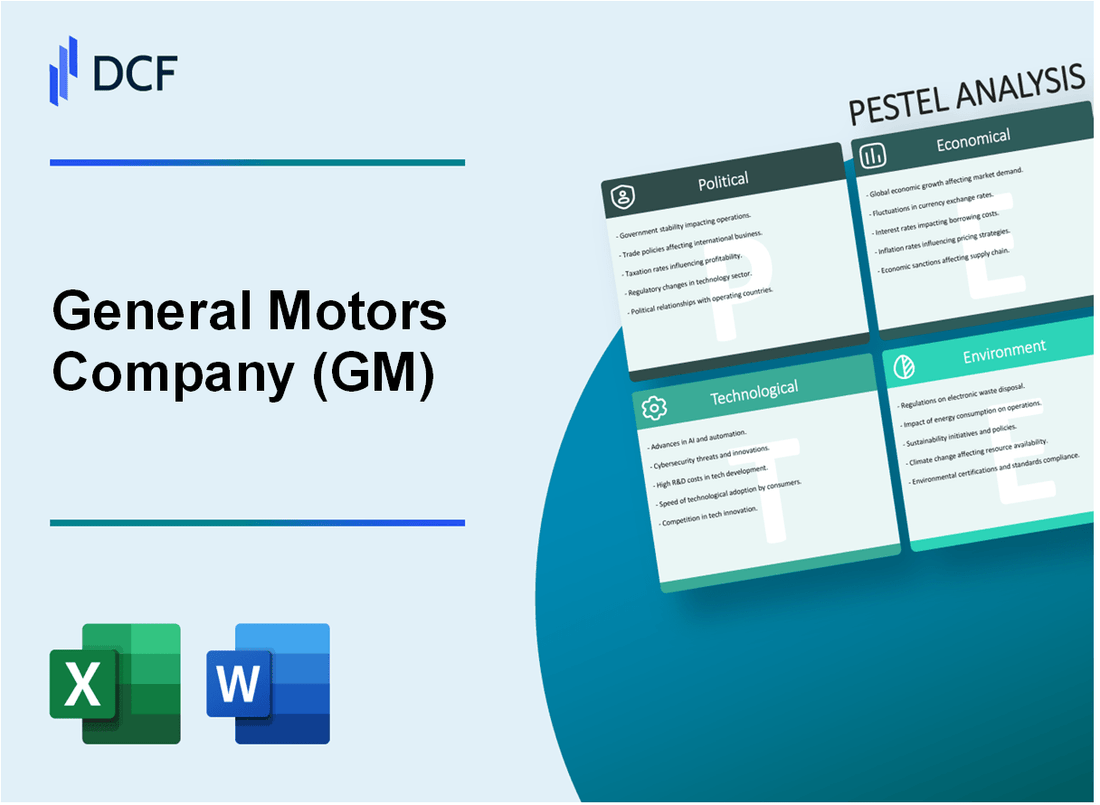
Entièrement Modifiable: Adapté À Vos Besoins Dans Excel Ou Sheets
Conception Professionnelle: Modèles Fiables Et Conformes Aux Normes Du Secteur
Pré-Construits Pour Une Utilisation Rapide Et Efficace
Compatible MAC/PC, entièrement débloqué
Aucune Expertise N'Est Requise; Facile À Suivre
General Motors Company (GM) Bundle
General Motors Company (GM) se dresse à un carrefour pivot de transformation, naviguant dans un paysage complexe où l'innovation, la durabilité et les défis mondiaux se croisent. En tant que l'un des constructeurs automobiles les plus emblématiques du monde, GM se repositionne stratégiquement grâce à une analyse complète des pilotes qui révèle le réseau complexe de facteurs politiques, économiques, sociologiques, technologiques, juridiques et environnementaux qui rehaussent l'industrie automobile. Des investissements révolutionnaires des véhicules électriques à la navigation sur les réglementations mondiales complexes, l'approche stratégique de GM démontre un engagement dynamique en faveur de son modèle commercial à la future à une époque de perturbations technologiques et environnementales sans précédent.
General Motors Company (GM) - Analyse du pilon: facteurs politiques
Incitations du gouvernement américain pour la production de véhicules électriques
La loi sur la réduction de l'inflation de 2022 offre jusqu'à 7 500 $ de crédit d'impôt pour les véhicules électriques éligibles. Les véhicules électriques de GM comme le Bolt Chevrolet et le GMC Hummer EV sont admissibles à ces incitations. En 2023, GM a produit 44 566 véhicules électriques aux États-Unis.
| Catégorie d'incitation EV | Montant du crédit |
|---|---|
| Nouveau crédit d'impôt EV | Jusqu'à 7 500 $ |
| Crédit d'impôt EV Utilisé | Jusqu'à 4 000 $ |
Déplacer les politiques commerciales mondiales
L'Accord américain-Mexico-Canada (USMCA) a un impact sur les stratégies de fabrication de GM. En 2024, 75% du contenu automobile doit provenir de l'Amérique du Nord pour se qualifier pour zéro tarifs.
- GM a investi 7 milliards de dollars dans les installations de fabrication nord-américaines en 2023
- Les taux de tarif pour les véhicules importés varient de 2,5% à 25% selon l'origine
Augmentation de la pression réglementaire sur les émissions et la sécurité des véhicules
L'Agence de protection de l'environnement (EPA) exige Ventes de véhicules à 100% zéro-émissions d'ici 2035.
| Norme d'émissions | Année cible | Exigence de conformité |
|---|---|---|
| Émissions de véhicules légers de l'EPA | 2026 | 161 G CO2 / mile |
Règlements complexes d'entrée sur le marché international
Le marché automobile chinois oblige les fabricants étrangers à former des coentreprises avec des entreprises locales. La coentreprise de GM avec SAIC Motor a généré 14,3 milliards de dollars de revenus en 2023.
- GM opère dans 9 coentreprises dans 5 pays
- Les exigences de propriété locale varient de 25% à 50% sur les marchés émergents
General Motors Company (GM) - Analyse du pilon: facteurs économiques
Marché automobile mondial volatile avec perturbations de la chaîne d'approvisionnement
GM a déclaré un chiffre d'affaires net de 44,8 milliards de dollars au quatrième trimestre 2023, avec des ventes mondiales de véhicules de 555 000 unités. Les perturbations de la chaîne d'approvisionnement ont entraîné 8,3 milliards de dollars de coûts supplémentaires au cours de 2023.
| Métrique économique | Valeur 2023 | Changement d'une année à l'autre |
|---|---|---|
| Ventes de véhicules mondiaux | 555 000 unités | +3.2% |
| Revenus nets | 44,8 milliards de dollars | +5.7% |
| Coûts de perturbation de la chaîne d'approvisionnement | 8,3 milliards de dollars | +12.5% |
Investissement important dans les technologies de véhicules électriques et autonomes
GM engagé 35 milliards de dollars d'investissements pour le développement de véhicules électriques et autonomes jusqu'en 2025. La capacité de production de véhicules électriques prévue atteint 1 million d'unités par an d'ici 2025.
| Catégorie d'investissement | Montant d'investissement | Année cible |
|---|---|---|
| EV et technologies autonomes | 35 milliards de dollars | 2025 |
| Capacité de production EV prévue | 1 million d'unités | 2025 |
Les coûts de matières premières fluctuants ont un impact sur les dépenses de production
Les coûts des matières premières pour GM ont augmenté de 17,6% en 2023, avec une volatilité significative des prix dans les composants semi-conducteurs et de batterie. Les prix du lithium ont eu un impact considérable sur les coûts de production de batteries.
| Matière première | 2023 Augmentation des prix | Impact sur la production |
|---|---|---|
| Semi-conducteurs | +22.3% | Pression des coûts de production élevée |
| Lithium | +15.9% | Augmentation du coût des composants de la batterie |
| Acier | +12.7% | Impact modéré des coûts de production |
Modes de reprise économique et de dépenses de consommation en cours post-pandemiques
La part de marché américaine de GM est restée stable à 16,4% en 2023. Les prix moyens des transactions pour les véhicules GM sont passés à 48 516 $, reflétant la résilience continue des dépenses de consommation.
| Indicateur économique | Valeur 2023 | Comparaison de l'année précédente |
|---|---|---|
| Part de marché américain | 16.4% | Écurie |
| Prix moyen de la transaction du véhicule | $48,516 | +6.3% |
| Indice de confiance des consommateurs | 101.2 | +3,5 points |
General Motors Company (GM) - Analyse du pilon: facteurs sociaux
Préférence croissante des consommateurs pour les véhicules durables et électriques
En 2024, GM a engagé 35 milliards de dollars pour le développement de véhicules électriques et autonomes jusqu'en 2025. % de son portefeuille de véhicules mondiaux à être électrique d'ici 2030.
| Métrique du véhicule électrique | 2024 données |
|---|---|
| Investissement de véhicules électriques GM | 35 milliards de dollars |
| Modèles Global EV planifiés | 30 modèles |
| Part de marché américain EV | 7.6% |
| Cible de portefeuille GM Global EV | 50% d'ici 2030 |
Changer les défis de la démographie de la main-d'œuvre et de l'acquisition de talents
GM emploie 155 000 travailleurs dans le monde, avec 48 000 employés aux États-Unis. La société a mis en œuvre des initiatives de diversité visant 50% de femmes et 25% de minorités sous-représentées dans des postes de direction d'ici 2030.
| Travailleur démographique | 2024 statistiques |
|---|---|
| Total des employés mondiaux | 155,000 |
| Employés américains | 48,000 |
| Objectif de la diversité du leadership - Femmes | 50% d'ici 2030 |
| Objectif de diversité du leadership - minorités sous-représentées | 25% d'ici 2030 |
Demande accrue de véhicules connectés et technologiquement avancés
Les services de véhicules connectés de GM ont atteint 4,5 millions d'abonnés actifs en 2023. La société a investi 2,2 milliards de dollars dans le développement de la technologie des services ONSTAR et des services connectés.
| Métrique du véhicule connecté | 2024 données |
|---|---|
| Abonnés de véhicules connectés | 4,5 millions |
| Investissement technologique | 2,2 milliards de dollars |
Changement de préférences de mobilité urbaine et de tendances de transport
Les initiatives de mobilité urbaine de GM comprennent des investissements dans les services de partage d'automobiles et les technologies de véhicules autonomes. La société a alloué 1,5 milliard de dollars aux solutions de mobilité urbaine et aux recherches de conduite autonomes.
| Métrique de la mobilité urbaine | 2024 données |
|---|---|
| Investissement de mobilité urbaine | 1,5 milliard de dollars |
| Recherche de conduite autonome | Développement continu |
General Motors Company (GM) - Analyse du pilon: facteurs technologiques
Investissements massifs dans la recherche et le développement autonomes de la conduite autonome
GM a engagé 35 milliards de dollars dans les technologies de véhicules autonomes et électriques jusqu'en 2025. Cruise, la filiale autonome de GM, a investi plus de 2,5 milliards de dollars dans le développement de technologies autonomes. Depuis 2024, la plate-forme de véhicules autonomes de GM comprend l'origine du croisière, avec un déploiement prévu sur plusieurs marchés urbains.
| Catégorie d'investissement technologique | Montant d'investissement (2024) | Domaines d'intervention clés |
|---|---|---|
| R&D de conduite autonome | 1,2 milliard de dollars | Lidar, algorithmes AI, intégration du capteur |
| Plateforme autonome de croisière | 2,5 milliards de dollars | Développement de véhicules autonomes |
Innovations de la technologie avancée de la batterie et des véhicules électriques
La plate-forme de batterie Ultium de GM représente un investissement de 35 milliards de dollars dans la technologie des véhicules électriques. La société prévoit de produire 1 million de véhicules électriques par an d'ici 2025. La technologie de batterie actuelle offre jusqu'à 450 miles de portée et prend en charge les capacités de charge rapide.
| EV Technology Metric | Spécification | Cible de performance |
|---|---|---|
| Range de batterie | Jusqu'à 450 miles | Positionnement concurrentiel du marché des véhicules électriques |
| Production annuelle EV | 1 million d'unités | D'ici 2025 |
Intégration de l'intelligence artificielle dans la conception et la fabrication des véhicules
GM utilise l'IA dans les processus de conception, avec 500 millions de dollars alloués aux technologies de l'IA et de l'apprentissage automatique en 2024. La société utilise l'IA pour la maintenance prédictive, le contrôle de la qualité et les systèmes avancés d'assistance à la conduite (ADAS).
| Application d'IA | Investissement | Fonction primaire |
|---|---|---|
| Optimisation de conception | 200 millions de dollars | Algorithmes de conception génératifs |
| Fabrication de l'IA | 300 millions de dollars | Maintenance prédictive, contrôle de la qualité |
Extension des technologies de connectivité numérique et de véhicules intelligents
La plate-forme OnStar de GM relie plus de 18 millions de véhicules. La société a investi 750 millions de dollars dans le développement de la télématique avancée et des technologies de voitures connectées. L'intégration 5G et les capacités de mise à jour des logiciels en direct sont des domaines de concentration technologique clés.
| Technologie des véhicules connectés | Investissement | Recherche de connectivité |
|---|---|---|
| Plate-forme OnStar | 750 millions de dollars | 18 millions de véhicules connectés |
| Intégration 5G | 250 millions de dollars | Systèmes de communication de véhicules améliorés |
General Motors Company (GM) - Analyse du pilon: facteurs juridiques
Conformité réglementaire mondiale complexe pour les émissions de véhicules
Paysage réglementaire des émissions:
| Région | Norme d'émission | Coût de conformité | Plage de pénalité |
|---|---|---|---|
| États-Unis | Normes EPA Tier 3 | 1,2 milliard de dollars d'investissement annuel de conformité | 37 500 $ - 293 527 $ par véhicule |
| Union européenne | Normes Euro 6d | 850 millions de dépenses de conformité annuelles | 95 € par gramme CO2 / km sur la limite |
| Chine | Normes d'émission de Chine 6A | 750 millions de ¥ Coûts d'adaptation réglementaire | 500 000 ¥ - 1,5 million de yens par violation |
Protection de la propriété intellectuelle pour les technologies automobiles émergentes
Métriques du portefeuille de brevets:
- Brevets actifs totaux: 2 387
- Brevets technologiques des véhicules électriques: 612
- Brevets de conduite autonomes: 418
- Dépenses de protection IP annuelles: 127 millions de dollars
Litiges en cours et défis réglementaires sur plusieurs marchés
| Catégorie juridique | Nombre de cas actifs | Dépenses juridiques estimées |
|---|---|---|
| Responsabilité du produit | 47 cas | 215 millions de dollars |
| Litiges réglementaires | 23 cas | 89 millions de dollars |
| Litige de propriété intellectuelle | 16 cas | 62 millions de dollars |
Application stricte de la réglementation de la sécurité et de l'environnement
Métriques de la conformité réglementaire:
- Taux de conformité du rappel de sécurité de la NHTSA: 99,7%
- Investissements annuels de test de sécurité: 142 millions de dollars
- Coûts d'adaptation de la réglementation environnementale: 673 millions de dollars
- Pénalités de violation de la conformité Éviue: 24,5 millions de dollars
General Motors Company (GM) - Analyse du pilon: facteurs environnementaux
Engagement à la neutralité du carbone d'ici 2040
Objectif de neutralité en carbone de GM Les objectifs complètent l'élimination des émissions de carbone d'ici 2040. La société a engagé 35 milliards de dollars d'investissements électriques et autonomes de véhicules jusqu'en 2025.
| Étape de neutralité en carbone | Année cible | Montant d'investissement |
|---|---|---|
| Neutralité totale du carbone | 2040 | 35 milliards de dollars |
Transition vers le portefeuille de véhicules tout électrique
GM prévoit de lancer 30 nouveaux modèles mondiaux de véhicules électriques d'ici 2025. Les objectifs de production de véhicules électriques actuels comprennent:
| Catégorie de modèle EV | Volume de production prévu | Année cible |
|---|---|---|
| Modèles mondiaux EV | 30 modèles | 2025 |
| Capacité de production annuelle EV | 1 million de véhicules | 2025 |
Processus de fabrication durables et réduction de l'empreinte carbone
GM s'est engagé à 100% d'utilisation des énergies renouvelables dans les installations de fabrication mondiales d'ici 2035. Les mesures de durabilité actuelles comprennent:
| Métrique de la durabilité | État actuel | Année cible |
|---|---|---|
| Consommation d'énergie renouvelable | 40% | 2035 |
| Réduction des émissions de CO2 | Réduction de 44% | 2020-2022 |
Investissement dans les initiatives d'énergie renouvelable et d'économie circulaire
GM a alloué des ressources importantes au développement des technologies durables:
| Initiative | Montant d'investissement | Domaine de mise au point |
|---|---|---|
| Programme de recyclage des batteries | 35 millions de dollars | Recyclage de la batterie au lithium-ion |
| Technologie de la batterie ultium | 2,3 milliards de dollars | Développement de la batterie EV |
General Motors Company (GM) - PESTLE Analysis: Social factors
You're watching General Motors Company (GM) navigate two opposing forces right now: a strong, profitable consumer preference for big trucks and SUVs, and a mandated, expensive push toward electric vehicles (EVs) that the public is still hesitant about. This isn't just about product; it's about social trust, labor peace, and ethical sourcing. GM's success in 2025 hinges on how well it manages these social expectations while keeping its core business profitable.
Growing consumer skepticism about EV charging infrastructure reliability.
GM has committed to an all-electric future, investing a massive $35 billion through 2025 in EV and autonomous vehicle development. But honestly, the consumer isn't fully on board yet. A June 2025 AAA survey found that a significant 63% of Americans are skeptical about EVs, with a lack of adequate charging infrastructure being a key concern. This isn't just a perception issue; it's a real-world barrier.
The latest HERE-SBD EV Index from September 2025 reinforces this, showing that access to charging remains the top barrier to adoption, cited by over 53% of U.S. survey respondents. This skepticism puts pressure on GM's aggressive EV rollout, even as their own EV sales surge-up over 100% in Q2 2025, with Q3 2025 deliveries of 144,668 EVs already surpassing their entire 2024 total. That's a defintely a mixed signal.
- Skepticism remains high: 63% of Americans are hesitant about EVs.
- Top concern: Insufficient public charging stations.
- GM's counter-move: Partnerships with EVgo and Pilot Company to expand fast-charging.
Strong preference shift toward SUVs and trucks, driving profitable internal combustion engine (ICE) sales.
For years, the profitable core of GM has been its trucks and SUVs, and while the demand for these high-margin vehicles remains strong, the market narrative is actually showing signs of a shift. Recent 2025 reports suggest the U.S. auto market may have reached 'peak truck,' driven by affordability concerns. The average purchase price for a new pickup is now around $54,600, pushing some buyers toward more affordable options.
Here's the quick math: consumer intent to buy SUVs dropped 1% and trucks fell 2% in 2024, while intent for sedans rose 3% to 29%. Still, GM's strategy is working for now; their Q2 2025 sales growth was primarily driven by new crossovers, SUVs, and pickups, leading to record year-to-date crossover sales. Plus, GM's recent $888 million investment in gas-powered V-8 engines shows they know their high-profit ICE portfolio is the current cash engine funding the EV transition.
Increased focus on corporate social responsibility (CSR) and ethical sourcing.
Stakeholder pressure demands more than just a good product; it requires an ethical supply chain and clear environmental targets. GM has set a goal to source 100% renewable electricity for its U.S. facilities by the end of 2025, which is a major, tangible commitment. This focus extends deep into its supply chain, especially for EV battery materials.
To ensure ethical sourcing, GM requires its Tier I suppliers to meet rigorous standards. This isn't optional; they must achieve a minimum EcoVadis score of 50 by 2025 in key areas like Labor and Human Rights. The company is making progress: by the end of 2023, 88% of its direct and logistics suppliers were enrolled in EcoVadis, achieving an average score of 52 out of 100. Also, 71% of those suppliers had committed to GM's Supplier Pledge, which includes a commitment to carbon neutrality for their own operations serving GM.
| CSR/Ethical Sourcing Metric | GM 2025 Target | 2023 Performance (Baseline) |
|---|---|---|
| U.S. Renewable Electricity Sourcing | 100% | In progress (Goal is 2025) |
| Minimum EcoVadis Score for Tier I Suppliers | 50 | Average score of 52 (for 88% enrolled suppliers) |
| Supplier EcoVadis Enrollment Rate | N/A (Continuous Improvement) | 88% of direct and logistics suppliers |
| Supplier Pledge Commitment Rate | N/A (Continuous Improvement) | 71% of direct and logistics suppliers |
Labor relations remain a critical factor following the contentious 2023 strike.
The six-week United Auto Workers (UAW) strike in 2023 was a clear signal that labor relations are a persistent, high-stakes social factor. The strike cost GM an estimated $1.1 billion in lost production (EBIT-adjusted impact). The resulting contract was historic, granting an immediate 11% wage hike and further increases of at least 14% over the next four years.
While the new agreement provides labor peace until 2028, the higher labor costs are a permanent structural change. GM's leadership, however, has stated they are finalizing a 2024 budget that will 'fully offset' these incremental labor costs through efficiency and cost reduction initiatives. The strong Q3 2024 adjusted profit of $3.4 billion suggests the company is managing the higher cost structure well, but the ongoing relationship with the UAW, especially concerning EV plant jobs, will be a critical social risk to monitor.
General Motors Company (GM) - PESTLE Analysis: Technological factors
Ultium battery platform rollout must hit scale to achieve cost parity with ICE vehicles.
The success of General Motors Company's (GM) electric vehicle (EV) strategy hinges entirely on scaling the Ultium battery platform, which is the defintive technological core of their shift. You need to see this platform reach massive scale quickly, or the economics just won't work against traditional internal combustion engine (ICE) vehicles.
The goal is to achieve an annual North American EV production capacity of 1 million units by 2025, supported by a planned battery cell capacity of 160 GWh across four US joint venture plants. Here's the quick math on cost: GM is targeting a reduction in Ultium cell costs to just $87 per kilowatt-hour (kWh) in 2025, which is a critical step toward making EVs profitable and price-competitive with ICE models. Plus, they expect to reduce the battery pack cost by another $30 per kWh this year alone. They are actively diversifying the chemistry-moving beyond nickel-rich cells to include lower-cost Lithium Iron Phosphate (LFP) cells and planning for Lithium Manganese-Rich (LMR) cells later on-to hit that price point.
Cruise autonomous vehicle unit faces a complex, phased restart under new regulatory conditions.
Honestly, the Cruise autonomous vehicle unit has undergone a total strategic reset following the regulatory and safety issues in late 2023. GM has essentially wound down the original robotaxi business model, which was losing roughly $600 million per quarter in 2023. The company is now realigning its autonomous driving efforts, combining the majority-owned Cruise LLC with GM's technical teams to focus on advanced driver assistance systems (ADAS) for personal vehicles.
This shift is a clear, pragmatic move. It's not a full retreat, but a pivot to a more achievable near-term goal: developing an eyes-off Level 3 automation system that builds on the existing Super Cruise technology. What this estimate hides is the loss of first-mover advantage in the robotaxi space. Still, the financial benefit is clear: GM expects this restructuring to lower spending by more than $1 billion annually, with the plan completing in the first half of 2025. That's a huge boost to the bottom line.
Software-defined vehicle architectures are becoming a major competitive battleground.
Software-Defined Vehicle (SDV) architectures are the new competitive battleground, and GM is fighting hard with its Ultifi platform. This isn't just about a fancy infotainment screen; it's about transforming the vehicle from a hardware product into an updatable, service-generating digital asset. The core strategy is moving to a centralized computing design, which will eventually consolidate dozens of electronic control units (ECUs) into a single core.
GM has committed serious capital to this, allocating approximately $2.3 billion for software-defined architecture development in its 2023-2024 technology budget. This investment is already paying off in customer experience. Already, more than 4.5 million GM vehicles can receive over-the-air (OTA) updates, and 1.6 million vehicles received coordinated software updates just last year. This capability is crucial for generating new, high-margin revenue streams from Features-as-a-Service (FaaS) subscriptions, which is the future of the auto industry.
Need to secure long-term, stable supply of critical battery raw materials.
Securing the supply chain for critical battery raw materials is a non-negotiable risk mitigation strategy. GM has been very aggressive in locking in North American supply to feed its 160 GWh of planned North American battery capacity by 2025.
The biggest move is the Ultium Cathode Active Material (CAM) joint venture with POSCO Future M. They are investing over $1 billion to increase CAM production in Quebec, Canada, which will support batteries for approximately 360,000 EVs annually in the 2025-2030 timeframe. Remember, CAM represents about 40% of the cost of a battery cell, so controlling this stage is vital. They are also moving to secure other materials.
Look at the Element 25 deal, for instance. GM provided an $85 million loan to partially fund a Louisiana facility that will produce 32,500 metric tons of high-purity manganese sulfate over seven years, with operations starting in 2025. This is how you de-risk your supply chain and qualify for US clean energy tax credits. It's smart, proactive finance.
| Technological Focus Area | 2025 Key Metric/Target | Strategic Impact |
|---|---|---|
| Ultium Battery Scale | North American EV production capacity target of 1 million units. | Achieving economies of scale to drive down EV manufacturing costs. |
| Ultium Cell Cost | Target cost of $87/kWh for battery cells. | Critical milestone for reaching EV-ICE cost parity and profitability. |
| Cruise Restructuring | Expected annual spending reduction of more than $1 billion. | Pivot from high-burn robotaxi to lower-risk, Super Cruise-based Level 3 ADAS for personal vehicles. |
| SDV Architecture (Ultifi) | $2.3 billion allocated for SDV development (2023-2024 budget). | Establishes the foundation for new, high-margin software and subscription revenue streams. |
| CAM Supply Chain | Over $1 billion investment with POSCO Future M, supporting batteries for 360,000 EVs annually. | Secures domestic supply of Cathode Active Material, which is 40% of battery cell cost. |
Finance: Track the Ultium cell cost per kWh against the $87/kWh target for Q4 2025 and report on the realized annual savings from the Cruise restructuring.
General Motors Company (GM) - PESTLE Analysis: Legal factors
Stricter US EPA Emissions Standards for 2026 and Beyond Require Immediate Compliance Action
You need to understand that the regulatory floor for internal combustion engines is rapidly dropping, forcing massive capital expenditure toward electrification. The U.S. Environmental Protection Agency (EPA) finalized its Multi-Pollutant Emissions Standards for Model Years 2027 through 2032 in March 2024, creating a clear, long-term compliance pathway. General Motors Company (GM) is already aligning its strategy, having publicly supported goals with the Environmental Defense Fund (EDF) to ensure at least 50% of new vehicles sold by 2030 are zero-emitting, and to achieve a minimum 60% reduction in greenhouse gas (GHG) emissions in Model Year 2030 compared to Model Year 2021 levels. This isn't a distant threat; it's a near-term engineering and manufacturing challenge.
The new rules mean GM must accelerate its Ultium platform rollout and manage the transition of its high-volume, high-margin truck and SUV segments. The company's stated goal is to eliminate tailpipe emissions from new light-duty vehicles by 2035. This is a massive shift, and the legal requirement is now the primary driver for product planning and R&D budgets. You simply cannot sell non-compliant vehicles. The standards phase in starting with Model Year 2027, so the clock is ticking on current platform decisions.
Ongoing Federal and State Investigations into Autonomous Driving Safety Protocols
The legal fallout from autonomous driving incidents has already cost General Motors Company (GM) a significant strategic pivot and substantial financial penalties. The National Highway Traffic Safety Administration (NHTSA) closed its formal probe into GM's Cruise robotaxis in January 2025, but only after GM ceased its robotaxi operations and Cruise agreed to pay a $500,000 criminal fine for submitting a false report to federal investigators. That's a steep price for a single accident's aftermath.
This episode highlights the severe and immediate legal risk associated with Level 4 autonomy. The regulatory environment is highly reactive, and a single safety failure can halt an entire business unit, as it did with Cruise. The subsidiary underwent a significant overhaul, including the layoff of over 24% of its workforce, following the incident. GM also withdrew its request to deploy the driverless Origin vehicle, essentially conceding the near-term legal and regulatory battle for fully driverless commercial deployment. This whole situation was a defintely costly lesson in regulatory compliance.
New Data Privacy and Security Regulations for Connected Vehicles Are Increasing Compliance Costs
The connected car is a legal liability minefield, especially concerning data privacy. General Motors Company (GM) and OnStar faced a significant enforcement action from the Federal Trade Commission (FTC) in January 2025 over allegations of collecting and selling drivers' precise geolocation and driving behavior data without adequate consent. The proposed FTC order is a blueprint for future compliance, banning the disclosure of this data to consumer reporting agencies for five years and requiring affirmative express consent from customers before collection.
The compliance burden is also increasing due to national security concerns. A U.S. Department of Commerce Final Rule, effective March 17, 2025, restricts connected vehicle transactions involving hardware and software linked to foreign adversaries like China and Russia. This forces GM to re-engineer its supply chain for vehicle connectivity systems (VCS) and automated driving software (ADS), with prohibitions phasing in for Model Year 2027 (software) and Model Year 2030 (hardware). Plus, GM is defending a lawsuit in Texas claiming it unlawfully collected and sold the private driving data of 1.5 million people to third parties, who then used it for insurance scoring. This is a multi-front legal war.
- FTC Order: Bans data disclosure to consumer reporting agencies for 5 years.
- Texas Lawsuit: Alleges unlawful data sales on 1.5 million people.
- Commerce Rule: Restricts sourcing of VCS/ADS software (MY 2027) and hardware (MY 2030).
International Trade Agreements and Tariffs Create Complex Sourcing Rules
Geopolitical tensions are translating directly into General Motors Company (GM)'s cost of goods sold. The complexity of international trade agreements and tariffs is forcing a costly, multi-year restructuring of the global supply chain. GM was one of the most exposed U.S. automakers to these tariffs, which were a major headwind in the 2025 fiscal year.
The financial impact is stark: GM warned investors that tariffs would add $4 billion to $5 billion to overall costs in 2025, and reported a $1.2 billion net income reduction attributed to added tariffs in the second quarter of 2025. To mitigate this, GM has instructed thousands of suppliers to phase out Chinese-sourced components by 2027 to enhance supply chain resiliency, a move that requires significant investment and new supplier qualification. The United States-Mexico-Canada Agreement (USMCA) further complicates sourcing, requiring 75% of a vehicle's core components to be North American made to qualify for duty-free treatment.
Here's the quick math on the tariff impact and compliance requirements:
| Legal/Trade Factor | 2025 Financial Impact / Compliance Cost | GM Action / Deadline |
|---|---|---|
| Tariff Cost Warning (2025 FY) | $4 billion to $5 billion in added overall costs | Increase U.S. production by 300,000 vehicles by 2027 |
| Q2-2025 Net Income Reduction (Tariffs) | Reported $1.2 billion reduction | Offset 30% of tariff impact via sourcing changes |
| China Sourcing Exit Directive | High restructuring cost, new supplier qualification | Phase out Chinese-sourced components by 2027 |
| USMCA Core Component Rule | Compliance cost for North American sourcing | 75% of core components must be North American made for duty-free status |
This table shows the clear financial and operational pressure from trade law. GM is shifting production and demanding a supply chain divorce from China, which is expensive and complex, but necessary to manage this legal risk.
General Motors Company (GM) - PESTLE Analysis: Environmental factors
Goal to eliminate tailpipe emissions from new light-duty vehicles by 2035 is driving investment.
You're watching General Motors Company (GM) execute one of the biggest industrial shifts in history, and it's all driven by their commitment to eliminate tailpipe emissions from new light-duty vehicles by 2035. This isn't just a marketing slogan; it's a capital allocation mandate. The company is channeling a massive $35 billion into electric vehicles (EVs) and autonomous vehicles (AVs) through the 2025 fiscal year, a huge bet on the future. Honestly, this is where the real money is moving.
This investment is designed to hit near-term product targets, like having 30 all-electric models globally by mid-decade. Critically, by the end of 2025, GM aims for 40% of its U.S. models offered to be battery-electric vehicles (BEVs). Plus, they're tackling their own operational footprint, securing all the necessary agreements to power all U.S. facilities with 100% renewable energy by 2025, which directly addresses their Scope 1 and Scope 2 emissions.
Pressure to reduce Scope 3 (supply chain) emissions, especially in battery production.
The biggest environmental hurdle isn't the tailpipe; it's the supply chain, specifically what we call Scope 3 emissions (indirect emissions from a company's value chain). For GM, the use of sold products-Category 11-accounts for roughly 75% of their total carbon impact, so the 2035 goal is paramount. But the second major pressure point is the battery itself.
To mitigate this, GM is aggressively localizing its supply chain to reduce the carbon footprint of shipping and the geopolitical risk of sourcing. Here's the quick math on their localization efforts:
- Ultium Cells JV: Building four U.S. battery cell plants with LG Energy Solution.
- North American Capacity: Targeting 160 GWh of total U.S. battery cell capacity.
- Material Production: Investing over $1 billion with POSCO Future M in a joint venture to produce Cathode Active Material (CAM)-a key battery component-in Quebec, Canada.
This localization is a direct CapEx investment to clean up the supply chain and secure materials, which is a defintely smart move.
Significant CapEx on battery recycling and second-life applications is required.
The circular economy for electric vehicle batteries is a strategic necessity, not just a feel-good initiative. The pressure to reduce reliance on newly mined critical minerals like lithium and cobalt requires significant CapEx on recycling and repurposing. The global EV battery recycling market is projected to grow substantially, and GM is positioning itself to capture that value.
GM Ventures, the company's venture capital arm, has already invested in Lithion Recycling, a move to secure access to advanced recycling technology and pursue a circular battery ecosystem. While specific CapEx for GM-owned recycling facilities in 2025 isn't broken out, the federal government is allocating almost $7 billion for strengthening the battery supply chain, including recycling, which lowers the barrier for GM's partnerships and future investment.
This table summarizes the core environmental CapEx and strategic targets for the near-term:
| Environmental Focus Area | 2020-2025 Investment/Commitment | Key 2025 Metric/Target | Primary Environmental Impact |
|---|---|---|---|
| Electrification (EV/AV) | $35 billion (cumulative CapEx) | 40% of U.S. models offered are BEVs | Eliminate Scope 3 (Use of Sold Products) emissions |
| Supply Chain Localization | $1+ billion (CAM JV with POSCO) | 160 GWh North American cell capacity | Reduce Scope 3 (Supply Chain) emissions and risk |
| Operational Energy | N/A (Sourcing Agreements) | 100% U.S. facilities powered by renewables | Eliminate Scope 1 and 2 emissions |
| ICE Production Pivot (Mid-2025) | $4 billion (new CapEx) | Modernize profitable full-size trucks/SUVs | Fund EV transition while meeting current market demand |
Zero-emission vehicle (ZEV) mandates in states like California are non-negotiable sales drivers.
State-level mandates, particularly the Zero-Emission Vehicle (ZEV) program led by California and adopted by 11 other states, are a non-negotiable sales driver that GM must plan for. The rule requires a manufacturer's ZEV sales in California to reach 35% for Model Year 2026, on the way to 100% by 2035. This is a massive regulatory stick.
However, the market reality in 2025 is causing friction. Electric vehicles currently make up only about 20% of new car sales in California, which is well below the mandated benchmark for 2026. This gap between regulation and consumer adoption is why GM, in May 2025, shifted its stance and lobbied against the California ban, arguing that the standards must align with market realities. The company is now advocating for a single, consistent national emissions standard, which would simplify their product planning and CapEx deployment across the country. Still, the underlying mandate to transition remains, forcing GM to prioritize EV production for these key states.
Next step: Finance: draft a detailed sensitivity analysis on the 2025 CapEx budget against a 10% variance in IRA tax credit realization by the end of this quarter.
Disclaimer
All information, articles, and product details provided on this website are for general informational and educational purposes only. We do not claim any ownership over, nor do we intend to infringe upon, any trademarks, copyrights, logos, brand names, or other intellectual property mentioned or depicted on this site. Such intellectual property remains the property of its respective owners, and any references here are made solely for identification or informational purposes, without implying any affiliation, endorsement, or partnership.
We make no representations or warranties, express or implied, regarding the accuracy, completeness, or suitability of any content or products presented. Nothing on this website should be construed as legal, tax, investment, financial, medical, or other professional advice. In addition, no part of this site—including articles or product references—constitutes a solicitation, recommendation, endorsement, advertisement, or offer to buy or sell any securities, franchises, or other financial instruments, particularly in jurisdictions where such activity would be unlawful.
All content is of a general nature and may not address the specific circumstances of any individual or entity. It is not a substitute for professional advice or services. Any actions you take based on the information provided here are strictly at your own risk. You accept full responsibility for any decisions or outcomes arising from your use of this website and agree to release us from any liability in connection with your use of, or reliance upon, the content or products found herein.