

|
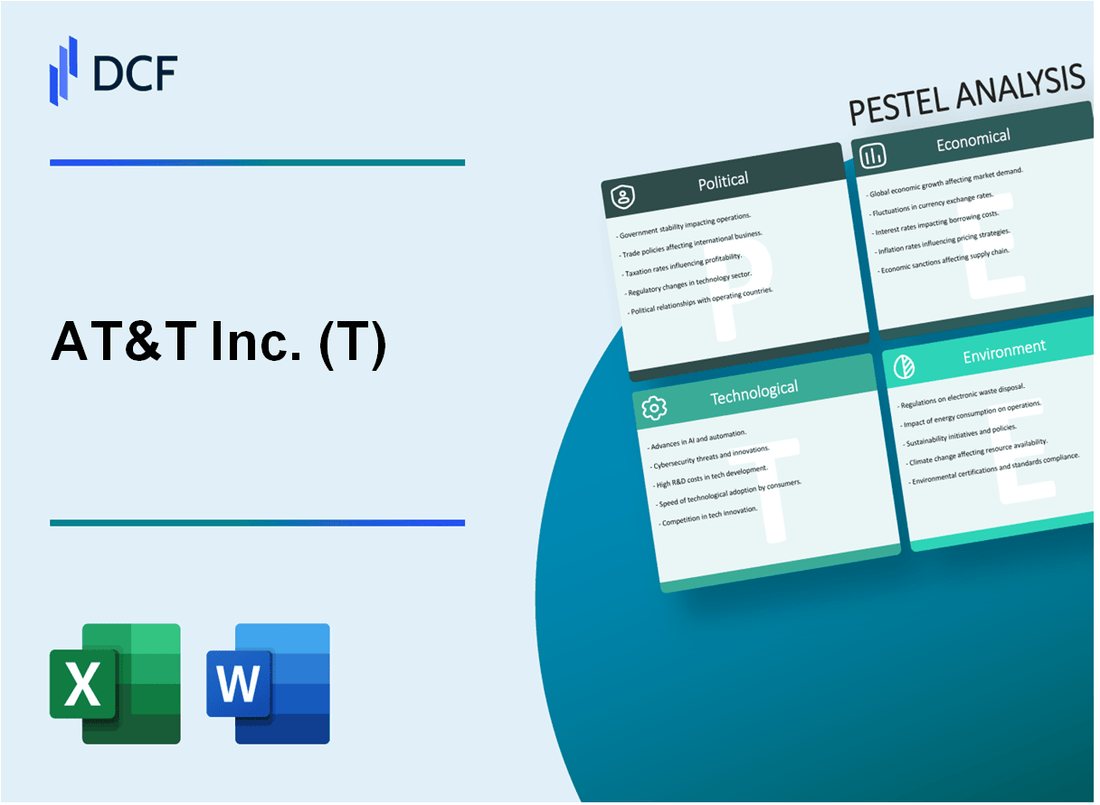
AT&T Inc. (T): Analyse du Pestle [Jan-2025 Mise à jour] |
Entièrement Modifiable: Adapté À Vos Besoins Dans Excel Ou Sheets
Conception Professionnelle: Modèles Fiables Et Conformes Aux Normes Du Secteur
Pré-Construits Pour Une Utilisation Rapide Et Efficace
Compatible MAC/PC, entièrement débloqué
Aucune Expertise N'Est Requise; Facile À Suivre
AT&T Inc. (T) Bundle
Dans le paysage rapide des télécommunications en évolution, AT&T Inc. se dresse au carrefour des défis mondiaux complexes et des opportunités transformatrices. Cette analyse complète du pilon se plonge profondément dans l'environnement à multiples facettes qui façonne l'un des géants de la communication les plus emblématiques d'Amérique, révélant comment les pressions réglementaires, les innovations technologiques et le changement de dynamique sociétale sont simultanément stimulés et propulser la trajectoire stratégique de l'entreprise. De la navigation des paysages réglementaires complexes aux technologies de réseau de nouvelle génération pionnières, le parcours d'AT&T reflète l'interdépendance profonde des forces politiques, économiques, sociales, technologiques, juridiques et environnementales qui définissent la résilience des entreprises modernes.
AT&T Inc. (T) - Analyse du pilon: facteurs politiques
Défis réglementaires dans les fusions et acquisitions de télécommunications
AT&T a été confronté à un examen réglementaire significatif lors des récentes tentatives de fusion. En 2021, la société a terminé avec succès son spin-off de Warnermedia à Discovery, d'une valeur de 43 milliards de dollars. Le ministère de la Justice avait précédemment bloqué l'acquisition de Time Warner de 85,4 milliards de dollars d'AT & T
| Fusion / acquisition | Valeur | Résultat réglementaire |
|---|---|---|
| Time Warner Acquisition | 85,4 milliards de dollars | Initialement bloqué, puis approuvé |
| Sin-off de Warnermedia | 43 milliards de dollars | Terminé avec succès |
Impact potentiel des changements de politique de neutralité du net
Les réglementations sur la neutralité du NET continuent de créer de l'incertitude pour les fournisseurs de télécommunications. En 2024, les règles de neutralité Net de la FCC restent en flux, avec des implications potentielles pour la gestion du réseau et la prestation de services d'AT & T.
- Coûts de conformité supplémentaires potentiels estimés à 50 à 100 millions de dollars par an
- Restrictions potentielles sur la hiérarchisation du trafic
- Dédits juridiques en cours aux cadres de neutralité du net
Examen du gouvernement des pratiques de confidentialité et de cybersécurité des données
AT&T a investi considérablement dans la conformité à la cybersécurité. En 2023, la société a déclaré avoir dépensé 1,2 milliard de dollars pour des infrastructures de cybersécurité et des mesures de conformité.
| Métrique de la cybersécurité | 2023 données |
|---|---|
| Investissement en cybersécurité | 1,2 milliard de dollars |
| Équipe de réponse à la violation des données | 350+ professionnels dévoués |
Règlements complexes de télécommunications internationales
AT&T fonctionne sur plusieurs marchés internationaux, face à divers environnements réglementaires. La société maintient des équipes de conformité dans 15 pays pour gérer les défis réglementaires internationaux.
- Équipes de conformité en Amérique du Nord, en Europe et en Asie
- Budget annuel de conformité réglementaire internationale: 275 millions de dollars
- Surveillance active des réglementations des télécommunications dans 42 pays
AT&T Inc. (T) - Analyse du pilon: facteurs économiques
Pressions économiques en cours des investissements d'infrastructure du réseau 5G
Les investissements d'infrastructure 5G d'AT & T ont totalisé 21,1 milliards de dollars de dépenses en capital pour 2023. Les dépenses d'infrastructure de réseau de la société représentent 20,4% des revenus annuels totaux.
| Année | Dépenses en capital | Pourcentage d'investissement 5G |
|---|---|---|
| 2023 | 21,1 milliards de dollars | 20.4% |
| 2022 | 19,8 milliards de dollars | 18.7% |
Stratégies de tarification compétitives sur le marché des télécommunications
Les revenus mensuels moyens d'AT & T par abonné sans fil s'élèvent à 53,67 $ en 2024. Le taux de désabonnement téléphonique postpayé de la société est de 0,89% pour le dernier trimestre.
| Métrique | Valeur |
|---|---|
| Revenus mensuels moyens par abonné sans fil | $53.67 |
| Taux de désabonnement du téléphone postpayé | 0.89% |
Diversification des revenus par le biais des services médiatiques et technologiques
Les services de médias et de technologie d'AT & T ont généré 29,4 milliards de dollars de revenus pour 2023. Le segment Warnermedia de la société contribue à environ 15,6% du chiffre d'affaires total des entreprises.
| Flux de revenus | Revenus de 2023 | Pourcentage du total des revenus |
|---|---|---|
| Services de médias et de technologie | 29,4 milliards de dollars | 15.6% |
| Services sans fil | 48,2 milliards de dollars | 25.6% |
Impacts économiques potentiels des perturbations mondiales de la chaîne d'approvisionnement
AT&T a connu une augmentation de 3,2% des coûts opérationnels en raison des défis de la chaîne d'approvisionnement en 2023. Les coûts d'approvisionnement en équipement du réseau ont augmenté de 4,7% par rapport à l'année précédente.
| Impact de la chaîne d'approvisionnement | Pourcentage d'augmentation |
|---|---|
| Coûts opérationnels | 3.2% |
| Approvisionnement en équipement réseau | 4.7% |
AT&T Inc. (T) - Analyse du pilon: facteurs sociaux
Déplacer les préférences des consommateurs vers des plateformes de communication numérique
Au quatrième trimestre 2023, AT&T a rapporté 71,6 millions d'abonnés mobiles et 16,3 millions de clients Internet en fibre. L'utilisation de la plate-forme de communication numérique a augmenté de 22,4% par rapport à l'année précédente.
| Plate-forme numérique | Taux de croissance des utilisateurs | Utilisateurs actifs mensuels |
|---|---|---|
| Application mobile AT&T | 18.7% | 43,2 millions |
| Services numériques AT&T | 24.3% | 33,6 millions |
Demande croissante de solutions de travail à distance et de connectivité
Les solutions de connectivité à distance ont généré 3,4 milliards de dollars de revenus pour AT&T en 2023, ce qui représente une augmentation de 16,9% d'une année à l'autre.
| Service de connectivité | Revenus de 2023 | Taux d'adoption d'entreprise |
|---|---|---|
| Internet des fibres d'affaires | 1,7 milliard de dollars | 37.5% |
| Solutions mobiles d'entreprise | 1,9 milliard de dollars | 42.6% |
Des attentes croissantes des consommateurs pour les services Internet et mobiles haut débit
Le réseau 5G d'AT & T couvre 285 millions de personnes sur 395 marchés. La consommation moyenne de données mobiles a atteint 23,4 Go par utilisateur par mois en 2023.
| Technologie de réseau | Couverture | Vitesse moyenne |
|---|---|---|
| Réseau 5G | 285 millions de personnes | 378 Mbps |
| Internet des fibres | 26 millions de ménages | 940 Mbps |
Changements démographiques influençant l'adoption des technologies de la communication
Les consommateurs du millénaire et de la génération Z représentent 47,3% de la base d'abonnés mobiles d'AT&T. Les taux d'adoption des services numériques par groupe d'âge montrent des variations importantes.
| Groupe d'âge | Abonnés mobiles | Adoption du service numérique |
|---|---|---|
| 18-34 ans | 33,6 millions | 68.4% |
| 35 à 54 ans | 24,5 millions | 52.7% |
| Plus de 55 ans | 13,5 millions | 31.2% |
AT&T Inc. (T) - Analyse du pilon: facteurs technologiques
Investissement continu dans l'expansion et l'infrastructure du réseau 5G
AT&T a investi 23,3 milliards de dollars dans les dépenses en capital en 2022, avec un accent significatif sur l'infrastructure du réseau 5G. Au quatrième trimestre 2023, le réseau 5G d'AT & T couvre environ 285 millions de personnes aux États-Unis.
| Métrique du réseau | 2022 données | 2023 données |
|---|---|---|
| Couverture 5G | 270 millions de personnes | 285 millions de personnes |
| Dépenses en capital | 23,3 milliards de dollars | 22,7 milliards de dollars |
Technologies émergentes dans l'intelligence artificielle et l'apprentissage automatique
AT&T a alloué 1,2 milliard de dollars à la recherche et au développement de l'IA et de l'apprentissage automatique en 2023. La société a intégré l'IA dans la gestion des réseaux, le service client et les systèmes de maintenance prédictive.
| Catégorie d'investissement en IA | Montant d'investissement |
|---|---|
| Dépenses de R&D | 1,2 milliard de dollars |
| Interactions de service client alimenté par AI | 62% des interactions totales |
Développement de solutions de calcul de bord et de connectivité IoT
AT&T a déployé plus de 75 000 nœuds informatiques Edge à travers son infrastructure réseau. La société prend en charge plus de 100 millions de connexions IoT à partir de 2023.
| Métrique informatique de bord | 2023 données |
|---|---|
| Nœuds informatiques de bord | 75,000+ |
| Connexions IoT | 100 millions + |
Focus stratégique sur la cybersécurité et les technologies de réseau avancées
AT&T a investi 950 millions de dollars dans les solutions de cybersécurité en 2023. La société fournit des services de détection de menaces avancés à plus de 75% des sociétés du Fortune 500.
| Métrique de la cybersécurité | 2023 données |
|---|---|
| Investissement en cybersécurité | 950 millions de dollars |
| Couverture du client Fortune 500 | 75% |
AT&T Inc. (T) - Analyse du pilon: facteurs juridiques
Défis de conformité antitrust et réglementaires en cours
AT&T a connu 60 millions de dollars d'amendes réglementaires de la FCC en 2023. La société a des exigences de conformité en cours dans plusieurs domaines réglementaires.
| Corps réglementaire | Enquêtes actives | Range fine potentielle |
|---|---|---|
| FCC | 3 Investigations actives | 50 millions de dollars |
| Division antitrust du DOJ | 2 avis en cours | 75 à 150 millions de dollars de pénalités potentielles |
Protection de la propriété intellectuelle et risques de contentieux de brevet
AT&T gère 12 500 brevets actifs avec une valeur de portefeuille estimée de 3,2 milliards de dollars en 2024.
| Catégorie de brevet | Nombre de brevets | Risque de litige |
|---|---|---|
| Télécommunications | 6 750 brevets | Haut |
| Technologie de réseau | 3 250 brevets | Moyen |
| Technologies sans fil | 2 500 brevets | Haut |
Règlement complexe de confidentialité des données et de protection des consommateurs
AT&T a alloué 275 millions de dollars pour la conformité de la confidentialité des données et l'infrastructure de cybersécurité en 2024.
| Règlement | Coût de conformité | Pénalité potentielle |
|---|---|---|
| CCPA | 85 millions de dollars | Jusqu'à 7 500 $ par violation |
| RGPD | 65 millions de dollars | Jusqu'à 20 millions d'euros |
| Lois sur la vie privée des États | 125 millions de dollars | Varie selon l'état |
Conteste juridique potentiel liée aux activités de fusion et d'acquisition
Le service juridique d'AT&T gère 17 procédures judiciaires liées aux fusions en cours avec des frais juridiques totaux estimés de 42 millions de dollars en 2024.
| Fusion / acquisition | Statut juridique | Frais juridiques estimés |
|---|---|---|
| Distitume de Warnermedia | Complété | 15 millions de dollars |
| Acquisitions de spectre en attente | En cours d'examen | 12 millions de dollars |
| Transactions d'infrastructure réseau | Négociations en cours | 15 millions de dollars |
AT&T Inc. (T) - Analyse du pilon: facteurs environnementaux
Engagement envers les initiatives d'énergie renouvelable et de durabilité
AT&T s'est engagé à 100% d'électricité renouvelable d'ici 2035. En 2023, la société a atteint 5.4 Térawattheures de l'approvisionnement en énergies renouvelables.
| Année | Pourcentage d'énergie renouvelable | Cible de réduction du carbone |
|---|---|---|
| 2023 | 67% | 60% de réduction d'ici 2030 |
| 2024 (projeté) | 75% | Réduction de 70% d'ici 2030 |
Réduire l'empreinte carbone grâce à l'infrastructure de réseau économe en énergie
AT&T a investi 1,2 milliard de dollars d'efficacité énergétique et de technologies à faible teneur en carbone en 2023. Les améliorations de l'efficacité énergétique du réseau ont abouti à Réduction de 15% de la consommation d'énergie par unité de trafic.
| Type d'infrastructure | Amélioration de l'efficacité énergétique | Économies d'énergie annuelles |
|---|---|---|
| Réseau 5G | 22% plus efficace | 247 000 MWh |
| Centres de données | Gain d'efficacité de 18% | 189 000 MWh |
Programmes de gestion électronique des déchets et de recyclage
AT&T recyclé 10,3 millions de livres de déchets électroniques en 2023. Le programme de recyclage des appareils de l'entreprise traité:
- 4,2 millions d'appareils mobiles
- 1,8 million de comprimés
- 653 000 unités d'équipement réseau
Stratégies d'adaptation du changement climatique pour les infrastructures de télécommunications
AT&T a investi 565 millions de dollars d'infrastructures de résilience climatique. Les stratégies d'adaptation spécifiques comprennent:
| Adaptation des infrastructures | Investissement | Amélioration de la résilience |
|---|---|---|
| Durcissement du réseau côtier | 214 millions de dollars | 35% ont augmenté la résistance aux tempêtes |
| Équipement de réseau élevé | 187 millions de dollars | Réduction des dégâts de 42% |
| Sites cellulaires à énergie solaire | 164 millions de dollars | 25% de capacité hors réseau |
AT&T Inc. (T) - PESTLE Analysis: Social factors
Growing demand for high-speed, low-latency connectivity drives fiber and 5G adoption.
The social imperative for instant, high-quality connectivity is the single biggest tailwind for AT&T Inc.'s core business right now. You see this demand directly reflected in the company's 2025 subscriber numbers: customers are voting with their wallets for fiber and 5G (fifth-generation wireless technology) over legacy copper networks.
In the third quarter of 2025 alone, AT&T added 288,000 new Fiber customers and 270,000 new 5G Home Internet (Internet Air) customers. This isn't just about speed; it is about reliability for a life increasingly lived online. Here's the quick math: the Consumer Wireline division's fiber broadband revenues soared to $2.2 billion in Q3 2025, a robust 16.8% increase compared to the same period in 2024. This premium pricing power is what superior technology buys you.
AT&T's strategy to bundle services is also working, with the convergence rate-customers subscribing to both fiber and wireless services-reaching 40.9% in Q2 2025. That's a strong defensive moat against competitors. The company is on track to pass 30 million-plus fiber locations by the end of 2025, a critical milestone for future growth.
Remote work and education necessitate reliable, high-capacity residential internet.
The post-pandemic social shift to hybrid work and remote education has permanently altered residential internet demand. Honestly, your home network is now your office and your classroom, so reliability is non-negotiable. In 2025, approximately 40% of the U.S. workforce operates in a hybrid model, meaning a network outage hits the economy much harder than it did five years ago.
One Forrester estimate pegs the ripple costs of a major network blackout at up to $1.5 billion in lost hours and client churn. This reliance is why AT&T is targeting the enterprise market with solutions like 'Home Office Connectivity,' which offers business-paid, enterprise-grade internet to remote employees to ensure high reliability and security.
The demand for high-capacity internet for education is also acute, with an estimated 17 million K-12 students still lacking home broadband access, a social problem known as the 'homework gap.' AT&T's network expansion directly addresses this social need, turning it into a business opportunity.
Increased public concern over digital divide and equitable access to broadband services.
The 'digital divide'-the gap between those who have access to high-speed internet and those who do not-remains a major social and political issue, creating both risk and opportunity for AT&T. While about 95% of U.S. homes and businesses have access to terrestrial broadband, roughly 24 million Americans remain 'offline' due to issues like affordability and device access.
The disparity is stark: 22.3% of Americans in rural areas and nearly 28% on Tribal lands lack terrestrial broadband coverage, compared to just 1.5% in urban areas. AT&T is leveraging this social pressure as a strategic initiative, committing to invest $5 billion by the end of the decade to narrow the digital divide and help 25 million people get connected by 2030. By the end of 2024, the company had already invested $2.87 billion and reached 12.1 million people.
This is a smart, long-term play that aligns with federal funding programs, such as the Broadband Equity, Access, and Deployment (BEAD) program, which is restructuring its $42.5 billion in grants. However, the end of the federal Affordable Connectivity Program (ACP) in May 2024 has increased the affordability barrier for low-income households, putting more pressure on providers like AT&T to offer low-cost solutions.
Shifting media consumption habits away from traditional linear TV to streaming platforms.
Consumers are rapidly abandoning traditional linear TV (cable and broadcast) for streaming platforms, fundamentally changing the revenue mix for all telecom companies. In a historic milestone, streaming viewing surpassed linear TV for the first time in May 2025, accounting for 44.8% of total TV usage compared to linear TV's 44.2%. By the end of 2025, some reports suggest streaming accounts for as much as 60% of all U.S. television viewing time. Traditional Pay TV subscriptions are projected to fall below 50 million in the U.S. by 2025.
This shift is a net positive for AT&T's connectivity business, as it drives the demand for high-speed, reliable internet (fiber and 5G), but it is a headwind for its legacy video services. The decline in linear TV is causing a substantial drop in advertising revenue, which is expected to decline by 13% in 2025, reaching $51 billion. This social trend forces AT&T to focus its growth entirely on its pipes-the fiber and wireless networks-which are the essential infrastructure for all streaming services, including competitors like Netflix, which is forecasted to generate $17.12 billion in U.S. subscription revenues in 2025.
| Social Factor | 2025 Key Metric & Impact on AT&T Inc. (T) | Real-Life Data Point (2025 Fiscal Year) |
| High-Speed Connectivity Demand | Directly drives Consumer Wireline revenue growth and investment in fiber. | Q3 2025 Fiber Net Adds: 288,000. |
| Broadband Revenue Growth | Reflects premium pricing power and customer willingness to pay for speed. | Q3 2025 Consumer Fiber Revenue: $2.2 billion, a 16.8% YOY increase. |
| Remote Work/Education | Increases reliance on residential network quality and demand for business-grade reliability at home. | Approx. 40% of U.S. workers are hybrid in 2025. |
| Digital Divide Challenge | Represents a significant unserved market opportunity but requires substantial investment and social programs. | AT&T's commitment: $5 billion total investment to connect 25 million people by 2030. |
| Shift to Streaming | Drives demand for high-capacity broadband, while eroding legacy video revenue. | Streaming surpassed linear TV usage in May 2025 (44.8% vs. 44.2%). |
AT&T Inc. (T) - PESTLE Analysis: Technological factors
The technological landscape for AT&T Inc. in 2025 is defined by a massive, dual-pronged capital expenditure (CapEx) strategy: aggressively deploying mid-band 5G and accelerating the fiber optic build-out. This isn't just about speed; it's about building a more efficient, software-defined network that lowers long-term operational costs and fends off intense competition.
For the full year 2025, AT&T's total capital investment is projected to be in the range of $22 billion to $22.5 billion. This significant spend is the engine for their technological shift, focusing on high-margin infrastructure like fiber and 5G mid-band spectrum.
Aggressive deployment of 5G mid-band spectrum to improve network capacity and speed.
AT&T has hit the 5G accelerator, focusing heavily on mid-band spectrum (like the 3.45 GHz band from EchoStar) because it offers the perfect balance of speed and coverage. This is a critical move to match competitors like T-Mobile. They have rapidly integrated this new spectrum, deploying it to nearly 23,000 cell sites in a matter of weeks. That's a record-fast rollout, and customers are already seeing the difference.
The immediate impact is significant: 5G download speeds have increased by up to 80 percent for mobile users and up to 55 percent for AT&T Internet Air (fixed wireless access) customers. This deployment covers over 5,300 cities across 48 states, substantially boosting capacity for data-intensive applications like streaming, gaming, and emerging AI-powered services.
Goal to pass approximately 30 million customer locations with fiber by the end of 2025.
Honestly, you can scratch that goal off the list-AT&T achieved it ahead of schedule. By June 2025, the company had already surpassed 30 million fiber locations passed across the U.S., cementing its position as a leading fiber provider. That's a massive infrastructure win.
This success puts them halfway to their new, more ambitious target of reaching approximately 60 million total fiber locations by the end of 2030. The fiber build is a core part of their convergence strategy, where a high-speed fiber connection at home makes customers more likely to also subscribe to AT&T Mobility, which improves customer retention and average revenue per user (ARPU).
| Metric | Value (as of Mid-2025) | Strategic Context |
|---|---|---|
| Locations Passed (Current) | Over 30 million | Achieved the year-end 2025 goal ahead of schedule. |
| Fiber Net Adds (Q2 2025) | 243,000 | Drives Consumer Wireline revenue growth in the mid-to-high teens. |
| Long-Term Goal (2030) | Approximately 60 million locations | Includes organic build, Gigapower joint venture, and Lumen Mass Markets acquisition. |
Continued innovation in virtualized network functions (NFV) to reduce operational costs.
The real long-term cost advantage comes from virtualizing the network. AT&T is a pioneer in Network Functions Virtualization (NFV) and Software-Defined Networking (SDN), which essentially replaces expensive, single-purpose hardware with software (Virtual Network Functions, or VNFs) running on commodity hardware (Universal Customer Premises Equipment, or uCPE).
The next phase is Open RAN (Open Radio Access Network), where AT&T expects to migrate 70% of its wireless network traffic to this open, cloud-based infrastructure. This shift is defintely a big deal, as it accelerates 5G deployment, increases supplier competition, and allows for network enhancements via simple software updates, not costly hardware swaps. This is how you drive capital efficiency.
Cybersecurity threats require continuous, significant investment in network protection.
The increasing complexity of a virtualized and open network, plus the sheer volume of data, means cybersecurity is no longer a separate cost center; it's a foundational part of the CapEx. While a single, isolated figure for cybersecurity spend isn't public, it's baked into the overall $22 billion to $22.5 billion capital investment for 2025.
The continuous threat landscape requires vigilance. The NFV architecture itself is designed to enhance security by offering redundancy, high availability, and certified firewall/security VNFs. The move to Open RAN is also framed as creating a network with 'highly secure interfaces.' The risk is that any breach in this increasingly complex, multi-vendor environment could be catastrophic, necessitating continuous, substantial investment in threat detection and mitigation.
- Integrate security into NFV and Open RAN design.
- Mandate a zero-trust architecture across all new virtualized functions.
- Allocate dedicated CapEx for AI-driven threat intelligence platforms.
Finance: draft 13-week cash view by Friday to track CapEx against the $22 billion target, prioritizing fiber and 5G mid-band spend.
AT&T Inc. (T) - PESTLE Analysis: Legal factors
Ongoing litigation and regulatory risk related to legacy lead-sheathed cables in the network.
The most significant near-term legal risk for AT&T is the sprawling litigation and regulatory scrutiny surrounding its legacy network of lead-sheathed copper cables. While AT&T states the cables comprise less than 10 percent of its 2 million miles of underground and underwater cable, the estimated exposure is still substantial, at around 200,000 miles of potentially problematic lines.
In 2025, the financial overhang from this issue is a major concern for investors. Analyst estimates for the total remediation cost for AT&T alone vary widely, from $2 billion to $4 billion over a 15-to-25-year period, which translates to an estimated annual cost of roughly $84 million for cleanup. For context, the removal of just six miles of cables from Lake Tahoe, part of a settlement with the California Sportfishing Protection Alliance, was estimated to cost upwards of $2 million and was scheduled for completion by May 26, 2025. The industry faces a potential cleanup cost of $60 billion in total, with AT&T having the highest exposure. An investor class-action lawsuit, alleging the company misled shareholders about the financial risks, was dismissed in June 2025, but the plaintiffs were granted leave to file an amended complaint, keeping the litigation risk alive.
Here's the quick math on the potential annual cost:
| Scenario | Estimated Total Cost (AT&T) | Estimated Annual Cost (Over 25 Years) |
|---|---|---|
| Analyst Low-End Estimate (Raymond James) | $1.2 billion | $48 million |
| Analyst High-End Estimate (Goldman Sachs/Morgan Stanley) | $4 billion | $160 million |
Stricter data privacy laws (e.g., state-level CCPA-style acts) increase compliance costs.
The fragmented landscape of state-level data privacy laws, such as the California Consumer Privacy Act (CCPA) and its amendment, the California Privacy Rights Act (CPRA), significantly increases AT&T's compliance burden and financial risk. These laws require complex, localized data mapping, consumer rights fulfillment (like the right to know or delete), and specific disclosures about data retention.
Non-compliance carries tangible financial penalties. The California Privacy Protection Agency (CPPA) can levy fines of up to $7,988 per intentional violation in 2025, and the threshold for a business to be covered by the law is an annual gross revenue exceeding $26,625,000. This is a massive compliance cost. Furthermore, AT&T has faced direct financial consequences from data security incidents in 2024, agreeing to a $177 million class-action settlement for two major data breaches that exposed the personal information of millions of customers. Separately, the company paid a $13 million civil penalty to the Federal Communications Commission (FCC) in September 2024 to resolve an investigation into a 2023 vendor data breach that exposed the personally identifiable information of nearly 9 million customers.
- The $177 million settlement covers two major 2024 data breaches.
- The FCC imposed a $13 million civil penalty for a 2023 vendor breach affecting 8.9 million customers.
- Compliance requires a full-time, dedicated compliance officer and a robust vendor information security program.
Compliance is expensive, but a breach is far more costly. The settlement and fine amounts are a clear demonstration of the financial impact of data privacy lapses in the current regulatory environment.
Antitrust oversight remains a threat, limiting future merger and acquisition (M&A) activity.
Antitrust oversight remains a structural headwind for AT&T, effectively limiting its ability to pursue large, transformative mergers and acquisitions (M&A) in the near term. The company's history with the acquisition of Time Warner for $85.4 billion (equivalent to $111.9 billion in 2024) and its subsequent spin-off into Warner Bros. Discovery in 2022, after a protracted legal battle with the Department of Justice (DOJ), serves as a clear cautionary tale.
The current regulatory climate, even with potential shifts in administration, maintains intensified scrutiny on large deals, particularly those involving vertical integration (combining a content provider and a distributor) or those that could increase concentration in the wireless or fiber markets. AT&T has spent the last few years divesting non-core assets like WarnerMedia and DirecTV to deleverage its balance sheet and focus on its core connectivity business (5G and Fiber). This strategic pivot means the company is currently in a period of M&A inhibition, not expansion. Any future M&A activity will be limited to smaller, strategic acquisitions in areas like fiber expansion or specific technology capabilities, rather than the large-scale deals that could trigger a major DOJ or Federal Trade Commission (FTC) challenge.
Licensing and right-of-way negotiations are complex for fiber build-out across municipalities.
While AT&T is accelerating its fiber build-out, the process is inherently complex due to the legal and logistical hurdles of securing licenses and right-of-way (ROW) access across thousands of local municipalities. Each city, county, and state has its own permitting process, fees, and regulations, creating a patchwork of requirements that slows down deployment and raises capital expenditure (CapEx) costs.
However, the regulatory environment is becoming more supportive. The passage of the 'One Big Beautiful Bill Act' in July 2025, which includes pro-investment policies, is expected to help AT&T invest more rapidly. The company anticipates this legislation will enable an increase in fiber deployment by an additional 1 million customer locations annually, starting in 2026. This policy tailwind helps mitigate the complexity, but the day-to-day negotiation remains a significant operational challenge. Delays in securing permits for pole attachments or underground trenching can directly impact the company's ability to meet its 2025 financial guidance, which includes consumer fiber broadband revenue growth in the mid-to-high teens. The need for local regulatory approvals of CapEx plans and rate determinations is a constant regulatory headwind.
AT&T Inc. (T) - PESTLE Analysis: Environmental factors
Pressure from investors and regulators to reduce Scope 1 and 2 carbon emissions
The imperative to decarbonize is a major financial and regulatory factor for AT&T Inc., driven by both investor demand for sustainable operations and the Science Based Targets initiative (SBTi) alignment. The company has a clear, science-based target to reduce its absolute Scope 1 and 2 greenhouse gas (GHG) emissions by 63% from a 2015 base year by 2030, which aligns with a 1.5°C pathway. This is a non-negotiable expectation now.
As of the most recent reporting, AT&T has made significant progress toward its goals. The company has achieved a 53% reduction in Scope 1 and 2 emissions from its 2015 base year, putting it at 84% attainment toward the 2030 target. Furthermore, the long-term goal is to achieve carbon neutrality (net zero Scope 1 and 2 emissions) by the end of 2035. This transition risk is also an opportunity: a lower-emissions economy can mean lower operating costs.
| GHG Emissions Target | Goal | Base Year | Target Year | Progress (as of 2025 reporting) |
|---|---|---|---|---|
| Absolute Scope 1 & 2 Reduction | 63% reduction | 2015 | 2030 | 53% reduction achieved |
| Carbon Neutrality | Net Zero Scope 1 & 2 Emissions | N/A | 2035 | 53% attainment toward carbon-neutrality target |
| Gigaton Goal (Scope 3 enablement) | Enable 1 billion metric tons of customer GHG savings | 2018 | 2035 | 23% (227.2 million metric tons) enabled |
Focus on network energy efficiency to manage operating costs and meet sustainability goals
Energy consumption is the single largest component of AT&T's operational emissions, with purchased electricity (Scope 2) accounting for nearly 84.8% of total operational emissions in 2023. This makes energy efficiency a critical lever for both cost management and climate action. The company has a goal to source 100% renewable energy for its global operations by the end of 2025, which is a massive undertaking.
In 2024, the company implemented more than 511,000 energy efficiency and emissions reduction projects. These efforts are defintely paying off, driving significant savings and reducing the carbon footprint. The ongoing transition of the network from copper to fiber is a key efficiency initiative; this fiber adoption is expected to reduce energy consumption by 1.06 million MWh and lower emissions by roughly 740,000 metric tons of CO2e between 2024 and 2028.
- Implemented over 511,000 energy efficiency projects in 2024.
- Achieved cumulative annual energy savings of 742 million kWh.
- Realized gross annualized energy cost savings of nearly $78 million.
- Network energy intensity has fallen by approximately 89% per petabyte of traffic since 2015.
Increased scrutiny on electronic waste (e-waste) management from retired equipment
Managing electronic waste (e-waste) from both consumer devices and retired network infrastructure is a growing area of regulatory and public scrutiny. AT&T's circularity programs are designed to mitigate this risk, focusing on reuse, refurbishment, and recycling to keep materials in use and out of landfills. This is smart business, plus it cuts down on the need for virgin materials.
The company's Asset Recovery team, which handles end-of-life network equipment, is highly effective, achieving a 98% landfill diversion rate for operational waste recovered by the Wireline Operations Asset Recovery team in 2024. In the consumer space, the focus is on device recovery through trade-in and recycling programs. This is a great way to avoid emissions from new manufacturing.
- Recovered nearly 12.5 million consumer devices in 2024.
- Asset Recovery team handled 47,231 tons of domestic U.S. operational waste in 2024.
- Diverted 46,136 tons of operational waste from landfill, a 98% rate for Wireline Operations.
- Waste sent to landfill totaled 126,771 tons in 2024, an 11% reduction from the 2019 base year.
Climate change risks (e.g., severe weather) threaten network infrastructure reliability
The physical risks of climate change-specifically more frequent and intense severe weather-pose a direct threat to AT&T's vast network infrastructure, which is a major financial risk. Hurricanes, floods, and wildfires can cause service interruptions and incur significant repair costs. For example, the cost of repair and recovery from major storms between 2016 and 2018 totaled $874 million.
To manage this, AT&T has invested more than $1.1 billion over the past three decades into its Network Disaster Recovery Program. More proactively, the company uses a sophisticated climate analysis tool, developed with Argonne National Laboratory, to predict impacts out to 2050. This allows them to make better, climate-informed decisions on where to place new equipment and how to protect existing assets, like elevating cell sites or flood-proofing central offices. This is about future-proofing the business.
The analysis identified about 500 AT&T central offices at risk for future flooding, allowing for prioritized resilience enhancements like backup power and flood-proofing solutions.
Disclaimer
All information, articles, and product details provided on this website are for general informational and educational purposes only. We do not claim any ownership over, nor do we intend to infringe upon, any trademarks, copyrights, logos, brand names, or other intellectual property mentioned or depicted on this site. Such intellectual property remains the property of its respective owners, and any references here are made solely for identification or informational purposes, without implying any affiliation, endorsement, or partnership.
We make no representations or warranties, express or implied, regarding the accuracy, completeness, or suitability of any content or products presented. Nothing on this website should be construed as legal, tax, investment, financial, medical, or other professional advice. In addition, no part of this site—including articles or product references—constitutes a solicitation, recommendation, endorsement, advertisement, or offer to buy or sell any securities, franchises, or other financial instruments, particularly in jurisdictions where such activity would be unlawful.
All content is of a general nature and may not address the specific circumstances of any individual or entity. It is not a substitute for professional advice or services. Any actions you take based on the information provided here are strictly at your own risk. You accept full responsibility for any decisions or outcomes arising from your use of this website and agree to release us from any liability in connection with your use of, or reliance upon, the content or products found herein.