

|
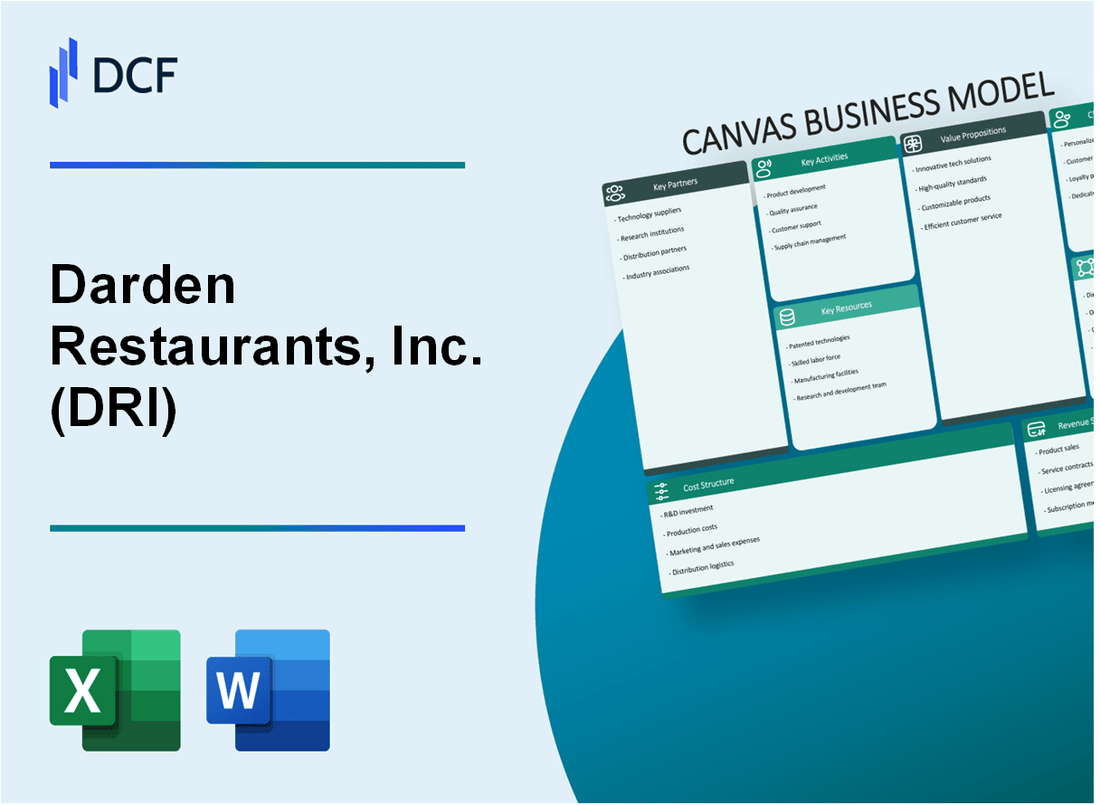
Darden Restaurants, Inc. (DRI): Business Model Canvas [Dec-2025 Updated] |
Fully Editable: Tailor To Your Needs In Excel Or Sheets
Professional Design: Trusted, Industry-Standard Templates
Investor-Approved Valuation Models
MAC/PC Compatible, Fully Unlocked
No Expertise Is Needed; Easy To Follow
Darden Restaurants, Inc. (DRI) Bundle
You're looking to understand the engine behind the restaurant giant that pulled in $12.1 billion in sales for fiscal year 2025, and honestly, it's a masterclass in portfolio management. As someone who spent a decade heading up analysis at a major asset manager, I can tell you their strength isn't just in Olive Garden's $5.21 billion haul, but in how they balance value-focused casual dining with upscale experiences like Ruth's Chris, all while battling food and labor inflation-a key risk you need to watch. This Business Model Canvas breaks down exactly how they manage over 2,100 locations, allocate capital for growth-targeting 50-55 new units in FY2025-and structure their key activities to keep that massive machine running smoothly. Dive in below to see the nine blocks that define their strategy right now.
Darden Restaurants, Inc. (DRI) - Canvas Business Model: Key Partnerships
You're analyzing Darden Restaurants, Inc. (DRI)'s strategic alliances that underpin its massive scale and growth trajectory as of late 2025. These partnerships are critical for managing capital, expanding reach, and controlling supply costs across its portfolio of brands like Olive Garden and LongHorn Steakhouse.
Strategic Third-Party Delivery with Uber Direct Delivery
Darden Restaurants, Inc. formalized an exclusive, multi-year delivery partnership with Uber Technologies, leveraging Uber Direct for on-demand logistics. This strategy directly addresses consumer demand for convenience, allowing Darden to maintain control over guest data and in-restaurant pricing for delivery orders. The rollout began with Olive Garden, with national expansion across its over 900 company-owned locations expected by May 2025.
This partnership has since expanded beyond the flagship brand. As of March 20, 2025, Cheddar's Scratch Kitchen began piloting the same first-party delivery integration, initially testing the system in 10 restaurants before broader deployment.
Global Franchise Partners for International Expansion
Franchising is a key lever for Darden Restaurants, Inc.'s international footprint expansion, focusing on high-potential markets for brands like Olive Garden and The Capital Grille. The company actively seeks well-capitalized partners with established operational experience in the restaurant, retail, or hospitality sectors.
Recent development agreements highlight this focus:
- New development agreement in India for 40 Olive Garden locations.
- New development agreement in Spain for 40 Olive Garden locations.
- New agreement in Asia for six The Capital Grille locations.
- Transitioning Canadian Olive Garden locations to franchise ownership, with an agreement to open 30 additional restaurants over the next decade in that market.
Here are the key metrics related to Darden Restaurants, Inc.'s financial and franchise structure as of fiscal year 2025:
| Partnership/Facility Type | Partner/Brand Focus | Key Metric/Amount (As of late 2025 or latest filing) |
| Revolving Credit Facility | Bank of America, N.A. (BOA) | $1.25 billion Revolving Credit Agreement commitment. |
| Revolving Credit Facility Availability | Liquidity Management | $1.19 billion of credit available as of February 23, 2025. |
| Delivery Logistics | Uber Direct Delivery (Olive Garden) | National expansion targeted for May 2025 across over 900 locations. |
| Delivery Logistics Pilot | Uber Direct Delivery (Cheddar's) | Pilot initiated in 10 restaurants as of March 2025. |
| International Franchise Development | Olive Garden (India/Spain) | Agreements for 40 locations in India and 40 locations in Spain. |
| International Franchise Development | The Capital Grille (Asia) | Agreement for six locations in Asia. |
Large-Scale, National Food and Beverage Suppliers
Darden Restaurants, Inc. emphasizes cost-effective sourcing by engaging directly with producers, avoiding brokers or intermediaries where possible. The company actively monitors and audits its key suppliers, maintaining excellent long-term relationships. Furthermore, Darden supports national minority supplier organizations to ensure diverse sourcing decisions. While specific supplier names and contract values aren't public, this direct engagement is crucial for managing commodity costs across its portfolio, which generated consolidated revenue of $12.1 billion in fiscal 2025.
Financial Institutions for Credit Facility
The company secures its liquidity and financing flexibility through major financial institutions. Darden maintains a $1.25 billion Revolving Credit Agreement with Bank of America, N.A. serving as the administrative agent. This agreement, which replaced a prior $1.0 billion facility, had no outstanding balances as of May 25, 2025, demonstrating strong internal cash generation to support operations and capital expenditures planned between $700 million and $750 million for fiscal 2026.
Real Estate Developers for New Restaurant Construction
Site selection and new construction rely on established relationships with real estate professionals. For its corporate headquarters consolidation, Darden partnered with firms like Trammell Crow Company for project coordination and Hardin Construction. Architects such as Perkins & Will were involved in the design of the new LEED gold certified campus. On the ground level, Darden uses brokers like Baker Katz to secure new sites. For example, Baker Katz handled leasing for a 7,805-SF Olive Garden in Portland, Texas, slated for a Q2 2025 opening, and a 6,142-SF Cheddar's Scratch Kitchen in Donna, Texas, scheduled for Q3 2025.
If you're looking at site criteria, Darden directs developers and brokers to mail information to their Real Estate Department in Orlando, FL.
Darden Restaurants, Inc. (DRI) - Canvas Business Model: Key Activities
You're looking at the core engine of Darden Restaurants, Inc., the activities that keep over 2,000 restaurants running and growing. It's a massive logistical and strategic undertaking, honestly.
Managing Operations for Company-Owned Restaurants
The sheer scale of daily operations is a primary key activity. As of the end of Fiscal Year 2025, on May 25, 2025, Darden Restaurants, Inc. owned and operated exactly 2,159 restaurants across the United States and Canada. This activity involves managing the day-to-day execution across all ten distinct brands, ensuring consistency in service and quality across that massive footprint.
Here's a quick breakdown of the owned restaurant count by major brand at the end of that fiscal year:
| Brand Segment | Company-Owned Restaurants (as of 5/25/2025) |
| Olive Garden | 935 |
| LongHorn Steakhouse | 591 |
| Cheddar's Scratch Kitchen | 181 |
| Chuy's (Post-Acquisition) | 106 (as of 2/23/25, integrated in FY25) |
| Ruth's Chris Steak House (Post-Acquisition) | 82 (as of 2/23/25, integrated in FY25) |
The operational focus is on leveraging scale while protecting the uniqueness of each concept. That's the tightrope walk here.
Strategic Brand Acquisitions and Integration
A critical, high-impact activity is the strategic addition and integration of new brands. The acquisition of Chuy's Holdings, Inc. is the most recent major example. Darden completed this all-cash transaction on October 11, 2024. The enterprise value for the deal was approximately $605 million, or about $660 million including payments for vested RSUs. The integration activity included managing expected pre-tax transaction and integration-related costs of approximately $50 to $55 million. Management projects achieving pre-tax net synergies of $15 million by the end of fiscal 2026.
Culinary Innovation and Menu Management
Darden Restaurants, Inc. must constantly innovate menus across its portfolio to drive same-restaurant sales growth. This activity is brand-specific yet centrally informed by data insights. For example, in the Fine Dining segment, Ruth's Chris Steakhouse introduced a five-week limited time offer (LTO) featuring a three-course menu to address softness in business travel traffic during Q1 Fiscal 2026. Furthermore, the company leverages its scale to implement technology-driven customer relationship marketing across its brands.
Key innovation and execution points for the major brands in FY2025 included:
- Olive Garden completing the rollout of Uber Direct delivery across nearly all locations.
- LongHorn Steakhouse achieving an all-time high for steaks grilled correctly, signaling operational execution excellence.
- Introducing smaller restaurant prototypes for Yard House and Cheddar's Scratch Kitchen, reducing construction costs by approximately 15%.
Disciplined Capital Allocation for New Unit Growth
Allocating capital effectively to build new restaurants is a core driver of long-term growth. For Fiscal Year 2025, Darden Restaurants, Inc. planned to open between 50 and 55 new restaurants. The projected capital spending to support this, along with maintenance and technology, was approximately $650 million for FY2025. The actual net result for FY2025 included the addition of 103 net company-owned Chuy's restaurants and 25 other net new restaurants, contributing to total sales growth.
Centralized Supply Chain and Procurement to Manage Food Inflation
Managing the cost of goods sold through a centralized supply chain is vital, especially when facing external pressures. For Fiscal Year 2025, Darden Restaurants, Inc. had to raise its total inflation projection to between 3 percent and 5 percent, up from an initial estimate of 2.5 percent. This adjustment was partly due to tariff impacts. Specifically, the company expected high single-digit inflation for categories like seafood and beef, while other categories like dairy and wheat were projected for low single-digit inflation. The procurement activity centers on mitigating these specific cost pressures through the centralized system.
Darden Restaurants, Inc. (DRI) - Canvas Business Model: Key Resources
You're looking at the core assets that power Darden Restaurants, Inc.'s market position as of late 2025. These aren't just line items; they are the engines driving their financial results.
The scale of their brand portfolio is a primary resource. As of the end of fiscal 2025, Darden Restaurants, Inc. operated a diversified portfolio of 11 distinct, company-owned brands, designed to capture a wide range of consumer dining preferences. This scale is defintely what allows them to generate the reported total sales of approximately $12.1 billion in fiscal year 2025.
The physical footprint is massive, representing a significant barrier to entry for competitors. As of May 25, 2025, Darden owned and operated 2,159 restaurants across the United States and Canada. This real estate base supports their high-volume traffic strategy.
The human capital is substantial, underpinning the service model. The dedicated workforce supporting these operations stood at 197,924 employees in fiscal 2025, a 3.57% increase from the prior year.
Darden Restaurants, Inc. relies on proprietary systems to manage the complexity of this scale. They use technology to maintain operational efficiency, especially as they integrate new volume from off-premise dining channels.
Financially, the company maintains a robust position to fund growth and return capital. Operating cash flow from continuing operations was reported as a strong $1.71 billion in fiscal 2025.
Here is a breakdown of the key physical and human resource metrics as of the end of fiscal 2025:
| Resource Metric | Value as of May 25, 2025 |
| Total Company-Owned Restaurants | 2,159 |
| Total Employees | 197,924 |
| Operating Cash Flow (FY2025) | $1.71 billion |
| Revolving Credit Agreement Capacity | $1.25 billion |
The brand portfolio is segmented to maximize market coverage. The key components include:
- Olive Garden: 935 company-owned locations as of 5/25/25.
- LongHorn Steakhouse: 591 company-owned locations as of 5/25/25.
- Fine Dining Segment: Includes Ruth\'s Chris Steak House, The Capital Grille, and Eddie V\'s.
- Other Business Segment: Includes Cheddar\'s Scratch Kitchen (181 locations), Yard House, Bahama Breeze, The Capital Burger, and the newly acquired Chuy\'s (108 company-owned locations as of 5/25/25).
Regarding technology and capital access, the following points detail the operational assets:
- Proprietary capacity management tool used to manage order volume and minimize disruption to dine-in operations.
- Focus on quickening the checkout process for guests who order and pay for meals online.
- Maintained a $1.25 billion Revolving Credit Agreement with no outstanding balances as of May 25, 2025, ensuring immediate access to capital.
- Authorized a new $1 billion share repurchase program, signaling confidence in future cash generation.
Finance: draft 13-week cash view by Friday.
Darden Restaurants, Inc. (DRI) - Canvas Business Model: Value Propositions
You're looking at the core reasons why Darden Restaurants, Inc. keeps winning in a tough market, right around the end of fiscal year 2025. It's about delivering specific value to different diners, which you can see clearly in the numbers.
Value-focused casual dining with unlimited offerings (Olive Garden).
Olive Garden continues to be the engine, showing strong demand even when consumers are cautious. For the fourth quarter of fiscal 2025, Olive Garden same-restaurant sales grew by an impressive 6.9%. For the full fiscal year 2025, the brand delivered 1.7% same-restaurant sales growth, contributing significantly to the total. The brand operates 935 locations as of May 25, 2025. The value proposition is reinforced by its off-premise success; delivery made up about 3.5% of Olive Garden's total sales in the fourth quarter of fiscal 2025, and overall off-premise sales grew nearly 20% over the prior year.
High-quality, consistent steakhouse experience at a casual price point (LongHorn Steakhouse).
LongHorn Steakhouse shows strong execution on its value promise, often leading the segment growth. In the fourth quarter of fiscal 2025, LongHorn Steakhouse same-restaurant sales were up 6.7%. For the full fiscal year 2025, this brand achieved 5.1% same-restaurant sales growth. Darden operated 591 LongHorn Steakhouse locations as of May 25, 2025. This brand's performance suggests consumers see it as a reliable, affordable indulgence.
Here's a quick look at how the major segments performed in same-restaurant sales for the last reported quarter of fiscal 2025:
| Brand Segment | Q4 Fiscal 2025 Same-Restaurant Sales Change |
| Olive Garden | 6.9% |
| LongHorn Steakhouse | 6.7% |
| Consolidated Darden | 4.6% |
Upscale, experiential fine dining for affluent consumers (The Capital Grille, Ruth's Chris).
The Fine Dining segment, which includes The Capital Grille and Ruth's Chris Steak House, faced headwinds in the latter part of fiscal 2025, indicating that even affluent consumers pulled back slightly on experiential spending. The segment posted a same-restaurant sales decline of (3.3)% in the fourth quarter of fiscal 2025. For the full fiscal year 2025, the segment saw a (3.0)% decline in same-restaurant sales. Still, the company is committed to this portfolio, having authorized a new share repurchase program of up to $1 billion, signaling confidence in its overall cash flow generation.
Portfolio diversity that hedges against economic and consumer taste shifts.
Darden Restaurants, Inc.'s portfolio diversity is a key value driver, evident in the varied segment performances. Total sales for the full fiscal year 2025 reached $12.1 billion, a 6.0% increase over fiscal 2024, despite the Fine Dining softness. The company operated 2,159 restaurants as of May 25, 2025, spanning multiple price points and cuisines, including 181 Cheddar's Scratch Kitchen locations and the recently acquired Chuy's Tex Mex restaurants. This diversity helps stabilize overall results. The commitment to shareholder returns, a reflection of this stable model, is seen in the quarterly cash dividend being increased by 7.1% to $1.50 per share.
Seamless off-premise experience via ToGo and delivery.
The focus on making the experience portable is a clear value-add. Olive Garden's delivery check size is currently 20% higher than traditional small order takeout, which helps lift average transaction value. The company is actively investing in this area, with Olive Garden achieving a nearly 20% increase in takeout sales year-over-year in the last quarter. The rollout of delivery, such as the Uber Direct partnership, is a tangible step in meeting modern consumer convenience demands.
Finance: draft 13-week cash view by Friday.
Darden Restaurants, Inc. (DRI) - Canvas Business Model: Customer Relationships
You're looking at how Darden Restaurants, Inc. (DRI) keeps its guests coming back, which is really the engine for their $12,076.7 million in total sales for fiscal year 2025. The relationship strategy hinges on balancing that classic, high-touch dining experience with modern convenience.
High-touch, in-restaurant service model focused on guest satisfaction.
The core relationship is built on the floor of the restaurant. When you look at the operational execution, it translates directly into guest perception. For instance, LongHorn Steakhouse achieved an all-time high for steaks grilled correctly, which is a concrete measure of in-restaurant execution that builds trust. This focus supports the overall portfolio, which saw consolidated same-restaurant sales growth of 4.6% in the fourth quarter of fiscal 2025. Even with economic shifts, the major brands show consistent strength:
- Olive Garden same-restaurant sales (FY2025 Q4): 6.9%
- LongHorn Steakhouse same-restaurant sales (FY2025 Q4): 6.7%
- Fine Dining same-restaurant sales (FY2025 Q4): 6.7%
The sheer scale of the in-restaurant presence is significant, with 2,159 restaurants owned and operated in the United States and Canada as of May 25, 2025, including 935 Olive Garden locations and 591 LongHorn Steakhouse locations.
Digital and mobile ordering for convenient ToGo and delivery orders.
Convenience is now table stakes, and Darden Restaurants has pushed hard on off-premises channels. Olive Garden's off-premises sales surged 20% year-over-year in a recent period. The digital relationship is being cemented through delivery partnerships; Olive Garden completed the rollout of Uber Direct delivery across nearly all its locations. This focus on digital access is paying off, as delivery orders generally carry higher average checks than curbside pickup orders. The investment in this channel is clear, with adjusted diluted net earnings per share from continuing operations hitting $1.97 in the first quarter of fiscal 2026.
Brand-specific value promotions to drive traffic and perceived value.
Darden Restaurants, Inc. uses targeted promotions to manage traffic flow and perceived value, especially with its largest brand. Olive Garden, which contributes approximately 40% of quarterly revenue, successfully reintroduced its 'Buy One Take One' promotion, priced at $14.99 for a second meal to take home. This specific value play boosted Olive Garden sales by 6.9% and widened its sales advantage over the broader casual dining industry by 450 basis points. The focus on value is a recurring theme, as seen in LongHorn Steakhouse's continued outperformance, driven by the promise of reasonably priced quality meat.
You can see how these relationship drivers impact sales momentum across quarters:
| Metric (Same-Restaurant Sales) | FY2025 Q2 | FY2025 Q3 | FY2025 Q4 | FY2026 Q1 |
| Consolidated Darden | 2.4% | 0.7% | 4.6% | 4.7% |
| Olive Garden | 2.0% | 0.6% | 6.9% | 5.9% |
| LongHorn Steakhouse | 7.5% | 2.6% | 6.7% | 5.5% |
Standardized operational excellence across all brands (brilliant with the basics).
Operational consistency underpins the entire relationship structure. This commitment to the basics allows for efficient execution, even when integrating new concepts. For example, the introduction of smaller restaurant prototypes for Yard House and Cheddar's Scratch Kitchen has successfully reduced construction costs by approximately 15% while maintaining brand essence. This efficiency helps maintain margin health, which was 18.9% for the restaurant-level EBITDA margin in the first quarter of fiscal 2026. The company's full-year fiscal 2025 diluted net earnings per share was $8.86.
- Total capital spending planned for fiscal 2026: $700 million to $750 million.
- New restaurant openings planned for fiscal 2026: 60 to 65.
- FY2025 total dividends declared per share: $5.60.
The focus on disciplined execution across the portfolio of 10 major brands is what keeps the guest relationship strong enough to support a new share repurchase authorization of up to $1 billion. Finance: draft 13-week cash view by Friday.
Darden Restaurants, Inc. (DRI) - Canvas Business Model: Channels
You're looking at how Darden Restaurants, Inc. gets its food and experiences to the customer, which is a mix of old-school real estate and modern digital reach. It's a multi-pronged approach, really.
The core channel remains the company-owned physical restaurant locations. As of the end of fiscal year 2025, which concluded on May 25, 2025, Darden Restaurants, Inc. owned and operated 2,159 restaurants across the United States and Canada. This massive footprint is the primary way they serve nearly 360 million guests annually.
The unit count breaks down across their key brands, showing where the volume is:
- Olive Garden: 935 locations.
- LongHorn Steakhouse: 591 locations.
- Cheddar's Scratch Kitchen: 181 locations.
Growth in this channel for fiscal 2025 included the addition of 103 net company-owned Chuy's restaurants and 25 other net new restaurants, totaling 128 net company-owned additions for the year.
For the fiscal 2026 outlook, Darden planned for continued physical expansion, guiding for new restaurant openings between 60 and 65 units.
Darden uses direct digital platforms-their websites and apps-to handle ToGo and catering orders. While specific digital sales percentages aren't broken out for every channel, the overall digital engagement is clearly important for driving incremental revenue. For instance, in the fourth quarter of fiscal 2025, delivery fees themselves contributed a small boost of about 4% to their average check size for that quarter. This shows the direct transactional value of their digital ordering capabilities, whether fulfilled in-house or via partners.
The use of third-party delivery services is integrated into their digital strategy. The data point showing that delivery fees added about 4% to the average check size in Q4 2025 suggests a measurable financial impact from these off-premise channels. You can see the scale of the company's owned vs. franchised operations in this table as of May 25, 2025:
| Channel Type | Unit Count (as of May 25, 2025) | Geographic Scope |
| Company-Owned Restaurants | 2,159 | United States and Canada |
| Franchised Restaurants | 154 | International (Latin America, Asia, Middle East, Caribbean) and US Airports |
| Total Restaurants (Owned + Franchise) | 2,313 (Approximate) | Global |
The international franchise network is a key growth lever outside of the core U.S. and Canada operations. As of May 25, 2025, Darden had 154 franchised restaurants. The company is actively expanding this channel, announcing new development agreements for 40 Olive Garden locations in India and another 40 Olive Garden locations in Spain, plus 6 Capital Grille locations in Asia. Furthermore, Darden is repositioning its Canadian Olive Garden market by transitioning locations to franchise ownership under a new agreement to open 30 additional restaurants there over the next decade. This focus on franchising allows Darden to scale its recognizable brands into new territories with local partners who have established operational experience.
Darden Restaurants, Inc. (DRI) - Canvas Business Model: Customer Segments
You're looking at how Darden Restaurants, Inc. (DRI) divides up its dining public across its portfolio, which is key to understanding their $12.1 billion in total sales for fiscal year 2025. The company serves a broad base, but the segments break down by income level and dining occasion.
Core Casual Diners: Middle-income families seeking value (Olive Garden, LongHorn)
This group forms the volume backbone of Darden Restaurants, Inc. Olive Garden, the largest chain, is the primary draw for this segment, contributing an estimated 43% of total revenue in fiscal year 2025, which equates to $5.21 billion. LongHorn Steakhouse is the second pillar, with sales reaching $3.03 billion in fiscal 2025. These brands target trade areas with a median household income around $69.0K to $70.1K. Still, executives noted that lower-income consumers, specifically those earning below $75,000 annually, showed reduced spending habits across the portfolio in early 2025.
Here's a look at the scale of these core brands as of May 25, 2025:
| Brand | FY2025 Q4 Sales (Millions USD) | FY2025 Full Year Same-Restaurant Sales Growth | Company-Owned Locations (as of May 25, 2025) |
| Olive Garden | $1,381 | 1.7% | 935 |
| LongHorn Steakhouse | $834 | 5.1% | 591 |
The focus here is on delivering perceived value; for example, Olive Garden ran a 'buy one, take one' pasta promotion starting at $14.99 during Q4 2025.
Affluent Consumers: High-income individuals for fine dining (Ruth\'s Chris, The Capital Grille)
This segment seeks premium experiences, primarily through the Fine Dining segment, which includes The Capital Grille and Ruth's Chris Steak House. While this group is generally less sensitive to minor economic shifts than lower-income diners, the segment did experience headwinds, reporting a 5.8% decline in same-restaurant performance in Q2 of fiscal 2025. However, the full fiscal year 2025 same-restaurant sales for the entire Fine Dining segment finished positive at 5.1%. The Q4 2025 sales for the combined Fine Dining segment were $335 million.
The company noted that lower-income households earning below $75,000 annually showed a particularly pronounced decrease in transactions within this fine-dining category.
Specialty/Experiential Diners: Younger, higher-income groups (Yard House, Chuy\'s)
Darden Restaurants, Inc. targets younger, often higher-income diners through brands like Yard House and the recently acquired Tex-Mex chain, Chuy's. Yard House demonstrates strong appeal to this demographic, boasting a trade area median household income of $82.6K, which is notably higher than the core casual brands. This group showed strong momentum in Q2 2025, with Yard House posting a 6.2% increase in overall visits and a 4.3% gain in same-store visits. Chuy's results are folded into the Other Business segment, which saw a substantial 22.5% surge in sales in Q3 2025, largely due to its inclusion.
- Yard House Same-Store Visits (Q2 2025): 4.3% increase.
- Yard House Trade Area Median HH Income: $82.6K.
- Chuy\'s acquisition added 103 new restaurants in fiscal 2025.
Corporate and Group Customers: Catering and private dining events
This segment is served through private dining rooms and catering options available across the portfolio, most prominently at the Fine Dining concepts and larger casual locations like Olive Garden and LongHorn Steakhouse. While Darden Restaurants, Inc. does not typically report a specific revenue line item for catering or private dining events separate from total segment sales, the high average check and business-focused atmosphere of brands like The Capital Grille and Ruth's Chris are designed to capture corporate expense accounts and celebrations. The total number of Darden-operated restaurants across all brands stood at 2,159 as of May 25, 2025, providing a wide physical footprint to service group needs.
Here's a summary of the segment structure that serves these customers:
| Segment Name | Key Brands Representing Segment | FY2025 Q4 Sales (Millions USD) |
| Fine Dining | Ruth\'s Chris, The Capital Grille, Eddie V\'s | $335 |
| Other Business | Yard House, Chuy\'s (includes group/catering potential) | $722 |
Darden Restaurants, Inc. (DRI) - Canvas Business Model: Cost Structure
You're looking at the major drains on Darden Restaurants, Inc.'s bottom line, which is what cost structure is all about. It's a mix of variable costs that move with sales and big fixed investments in the business.
Dominant Variable Costs: Food, Beverage, and Labor
The biggest recurring costs are what you'd expect: the ingredients and the people serving them. For the fiscal year ending May 25, 2025, Darden Restaurants, Inc. reported that Food and beverage costs actually decreased as a percent of sales, thanks to pricing leverage and cost savings, though inflation was a headwind. Similarly, Restaurant labor costs also decreased as a percent of sales for that same period, driven by sales leverage and productivity, despite inflation. However, the near-term pressure is clear; comparing Q1 2026 to Q1 2025, Food and beverage costs jumped 9.7% and labor costs rose 11.1% year-over-year, showing inflation is definitely biting now.
The way Darden measures profitability at the restaurant level (Segment Profit) excludes non-cash real estate related expenses, meaning rent and depreciation aren't in that core operating metric.
Capital Expenditures for Growth
Darden Restaurants, Inc. commits significant capital to expanding its footprint. The plan for capital expenditures to build new restaurants, remodel existing ones, and fund technology initiatives for fiscal 2025 was approximately $650 million. For fiscal 2026, the total capital spending outlook is set between $700 million and $750 million.
Centralized Corporate Overhead
Centralized corporate functions drive General and Administrative (G&A) expenses. Darden Restaurants, Inc.'s annual SG&A expenses for the full fiscal year 2025 were reported as $0.69 billion. Looking at a specific period, for the second quarter of fiscal 2025 (ended November 24, 2024), General and administrative expenses were $25.0 million.
Acquisition and Integration Costs
Strategic moves, like the acquisition of Chuy's Holdings, Inc., introduce one-time, non-recurring costs. For fiscal 2025, Darden Restaurants, Inc. expected approximately $47 million, pre-tax, in transaction and integration related costs associated with the Chuy's acquisition. The total enterprise value for the Chuy's acquisition itself was approximately $605 million.
Occupancy Costs and Real Estate Portfolio
The cost of the extensive real estate portfolio is a major fixed component. While a specific total occupancy cost isn't explicitly stated, the impact of the real estate base is reflected in depreciation. For the six months ended November 24, 2024, Depreciation and amortization expenses increased as a percent of sales, largely due to the Chuy's acquisition and incremental depreciation on new restaurant assets.
Here's a quick look at how some of these major cost categories compare:
| Cost Category | FY2025 Financial Data Point | Amount/Value |
| Capital Expenditures (New Units/Remodels/Tech) | Fiscal 2025 Total Capital Spending | $650 million |
| Acquisition & Integration Costs (Chuy's) | Expected Pre-Tax Costs for FY2025 | $47 million |
| General & Administrative (G&A) | Annual SG&A Expense for 2025 | $0.69 billion |
| Food & Beverage Costs | Year-over-Year Inflationary Jump (Q1 2026 vs Q1 2025) | 9.7% |
| Restaurant Labor Costs | Year-over-Year Inflationary Jump (Q1 2026 vs Q1 2025) | 11.1% |
You can see the pressure points clearly: the fixed investment in growth via CapEx, the one-time hit from acquisitions, and the variable cost inflation in labor and ingredients.
Finance: draft 13-week cash view by Friday
Darden Restaurants, Inc. (DRI) - Canvas Business Model: Revenue Streams
The core of Darden Restaurants, Inc. (DRI) revenue generation comes from the direct sale of food and beverages consumed within its restaurants. This represents the primary revenue stream across its portfolio of iconic brands. However, the company has seen significant growth in its off-premise channels, which include ToGo (takeout), catering, and delivery services across all brands. For instance, during the fourth quarter of fiscal 2025, Olive Garden saw a nearly 20% increase in takeout sales, and its delivery order volumes nearly doubled in the last two weeks of that quarter, showing strong momentum in these ancillary channels.
Total sales reached $12.1 billion for fiscal year 2025. This figure is the aggregate of all company-operated restaurant sales for the period ended May 25, 2025. To give you a clearer picture of the composition of that total revenue, here is a breakdown of the major segment sales for the full fiscal year 2025:
| Revenue Source / Segment | Fiscal Year 2025 Sales (in millions) | Percentage of Total Sales (Approximate) |
|---|---|---|
| Consolidated Darden Total Sales | $12,076.7 | 100% |
| Olive Garden Sales | $5,212.9 | 43.17% |
| LongHorn Steakhouse Sales | $3,025.5 | 25.05% |
| Fine Dining Sales | $1,304.8 | 10.81% |
| Other Business Sales (including Chuy's) | $2,533.5 | 20.98% |
Olive Garden contributed $5.21 billion, which accounts for approximately 43% of the total sales in FY2025. The Other Business segment, which includes Cheddar's Scratch Kitchen, Yard House, and the recently acquired Chuy's, accounted for $2,533.5 million in sales for the full year.
A secondary, though less significant, revenue stream involves franchise fees and royalties derived from international operations and domestic franchise agreements. Darden Restaurants, Inc. has area development, franchise, and license agreements for brands like Olive Garden and LongHorn Steakhouse in regions spanning the United States, Canada, Mexico, Central and South America, Asia, the Caribbean, Europe, and the Middle East as of May 25, 2025. However, the income derived from these franchise arrangements, including royalty income, is explicitly stated as not material to the consolidated financial statements.
You can see the key drivers of the revenue base here:
- Primary revenue source is in-restaurant food and beverage sales.
- Total FY2025 sales reached $12,076.7 million.
- Olive Garden accounted for $5,212.9 million in FY2025 sales.
- Off-premise sales channels, like delivery, showed accelerated growth in Q4 FY2025.
- Franchise fees and royalties are generated internationally but are not material to total revenue.
Disclaimer
All information, articles, and product details provided on this website are for general informational and educational purposes only. We do not claim any ownership over, nor do we intend to infringe upon, any trademarks, copyrights, logos, brand names, or other intellectual property mentioned or depicted on this site. Such intellectual property remains the property of its respective owners, and any references here are made solely for identification or informational purposes, without implying any affiliation, endorsement, or partnership.
We make no representations or warranties, express or implied, regarding the accuracy, completeness, or suitability of any content or products presented. Nothing on this website should be construed as legal, tax, investment, financial, medical, or other professional advice. In addition, no part of this site—including articles or product references—constitutes a solicitation, recommendation, endorsement, advertisement, or offer to buy or sell any securities, franchises, or other financial instruments, particularly in jurisdictions where such activity would be unlawful.
All content is of a general nature and may not address the specific circumstances of any individual or entity. It is not a substitute for professional advice or services. Any actions you take based on the information provided here are strictly at your own risk. You accept full responsibility for any decisions or outcomes arising from your use of this website and agree to release us from any liability in connection with your use of, or reliance upon, the content or products found herein.