
|
Zillow Group, Inc. (ZG): PESTLE Analysis [Nov-2025 Updated] |
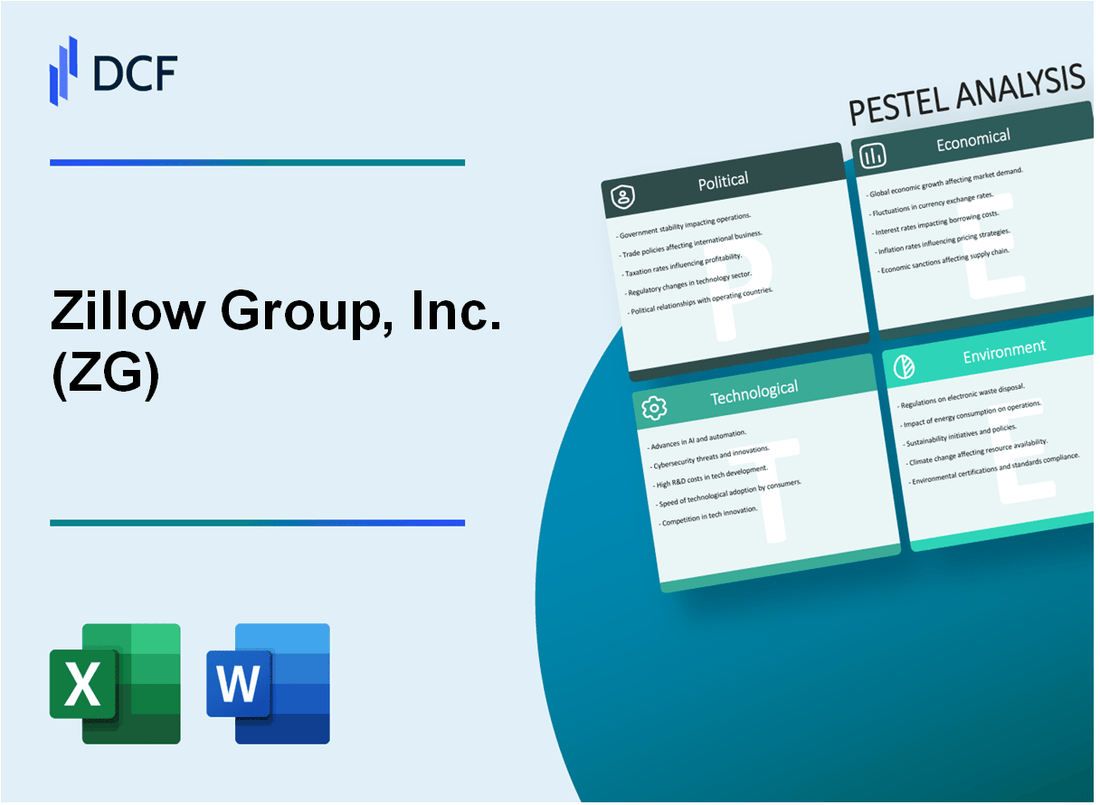
Fully Editable: Tailor To Your Needs In Excel Or Sheets
Professional Design: Trusted, Industry-Standard Templates
Investor-Approved Valuation Models
MAC/PC Compatible, Fully Unlocked
No Expertise Is Needed; Easy To Follow
Zillow Group, Inc. (ZG) Bundle
You're looking for a clear, no-nonsense breakdown of the forces shaping Zillow Group, Inc. (ZG) right now. As a seasoned analyst, I see a company navigating a tough, high-rate economic environment while fighting a critical legal battle for its core data. The near-term is about managing listing access and high-intent customer conversion, but the long-term opportunity hinges on their super app tech and the shift toward climate-aware real estate.
Political
The political landscape for Zillow Group, Inc. is a mix of regulatory risk and potential tailwinds. Right now, the biggest headwind is the antitrust litigation which challenges Zillow's listing access standards and market power. This forces them to spend capital on legal defense instead of product development.
But there's a potential upside: local government pressure to relax zoning laws could increase housing supply significantly. More homes for sale means more listings for Zillow, plain and simple. Also, keep an eye on new federal tax policies or housing affordability programs; these could shift buyer demand overnight, creating volatility Zillow has to quickly adapt to.
Political One-Liner: Mortgage rate forecasts are a political football.
Economic
Honest look: the economy is tough, but Zillow Group, Inc.'s model is proving resilient. The company reported Q3 2025 Total Revenue of $676 million and Net Income of $10 million. That net income is thin, but it shows they can still turn a profit in a high-rate environment.
The high mortgage rate environment is actually a huge boost for their Rentals segment, which saw Q2 2025 revenue surge 36% year-over-year. People are renting longer, so Zillow Group, Inc. is capitalizing on that shift. Still, the core sales market is slow; existing home sales are only projected to reach 4.09 million in 2025, which is up a measly 0.6% from 2024.
Here's the quick math: Zillow forecasts modest US home price appreciation of only 1.5% between October 2025 and 2026. Low appreciation and high costs (property taxes, insurance) will continue to dampen demand for their Zillow Home Loans business.
Economic One-Liner: Rentals are the new growth engine.
Sociological
The way people live and what they value is changing the market Zillow Group, Inc. serves. We're seeing a growing consumer demand for affordability, which is driving interest in smaller, 'cozy' homes-mentions are up 35% in listings. This isn't just a trend; it's a financial necessity for many buyers.
Plus, climate is now a must-have feature. A massive 86% of recent homebuyers prioritize at least one climate-resilient feature in a home. Zillow Group, Inc. has to make sure its search filters and listing data capture this shift.
To be fair, shifting demographics and the lasting effects of remote work continue to drive migration into secondary markets. Zillow Group, Inc. is well-positioned to capture this movement, but they also face increased focus on fair housing and equity, especially concerning private listing networks.
Sociological One-Liner: Buyers want small and sustainable.
Technological
Technology is Zillow Group, Inc.'s long-term moat. They are making heavy investment in Artificial Intelligence (AI) to personalize the home search experience. This is crucial for converting casual browsers into high-intent buyers for their agents and loan officers.
The core strategy is the 'housing super app'-integrating everything from search to Zillow Home Loans transactions. This is how they capture the entire value chain. Also, they rolled out climate risk data (flood, wildfire) on property listings, available to all users in 2025. This is a smart move that aligns with consumer values.
We're also seeing surging buyer interest in electric features; mentions of whole-home batteries are up 62% since 2023. Zillow Group, Inc. needs to keep its platform ahead of these fast-moving product trends.
Technological One-Liner: AI is the new Zestimate.
Legal
Legal risk is front and center for Zillow Group, Inc. right now. They are in active antitrust litigation with Compass over access to listing data and Zillow's market dominance. Losing this could fragment their core data asset.
Also, the National Association of Realtors (NAR) policy changes in 2025, specifically the Clear Cooperation Policy rollback, are already fragmenting listing data access. This forces Zillow Group, Inc. to work harder to maintain comprehensive inventory.
What this estimate hides is the rising tide of scrutiny on data privacy and ethical AI use in personalized home recommendations. As Zillow Group, Inc. leans harder into AI, that legal risk only grows. They must maintain strict listing access standards to protect their platform's inventory.
Legal One-Liner: Listing access is under attack.
Environmental
Environmental factors are moving from a nice-to-have to a core financial risk for Zillow Group, Inc. They are adding climate risk scores to listings, covering flood, wildfire, and heat risks. This helps buyers, but it also exposes the risk in their own mortgage portfolio.
Consumer preference for sustainable features is driving up listings mentioning solar panels (18% increase) and EV chargers (34% increase). This is a clear market signal for builders and agents.
The big financial risk is the increased insurance costs in high-risk areas (e.g., Florida, Louisiana), which will affect affordability and Zillow Group, Inc.'s mortgage business. Demand for climate resiliency features like flood barriers (up 22%) and seismic retrofitting (up 20%) is a defintely growing trend.
Environmental One-Liner: Climate risk is now mortgage risk.
Zillow Group, Inc. (ZG) - PESTLE Analysis: Political factors
Antitrust litigation challenges Zillow's listing access standards and market power
The most immediate political risk for Zillow Group is the intensifying antitrust scrutiny over its market dominance in the digital real estate space. Regulators and competitors are challenging Zillow's control over the essential commodity: home listing data.
In June 2025, real estate brokerage Compass filed a lawsuit alleging Zillow's new Listing Access Standard-which bans listings marketed off Zillow for more than one day-is an anticompetitive move to suppress rivals. The Federal Trade Commission (FTC) escalated this in September 2025, filing an antitrust lawsuit that specifically targets Zillow's rental market. The FTC alleges Zillow engaged in an unlawful agreement with Redfin, paying them $100 million to exit the multifamily rental advertising market and consolidate Zillow's position. Honestly, these lawsuits are about more than just money; they challenge Zillow's core business model of being the gatekeeper to the nation's housing data. A federal judge in New York even stated in November 2025 that internal Zillow documents showed the company aimed to 'regulate' the conduct of brokerages, which speaks directly to its perceived market power.
Here is a quick look at the major antitrust fronts as of late 2025:
- Compass Lawsuit: Challenges Zillow's Listing Access Standard, claiming it harms seller choice and competition.
- FTC Lawsuit: Filed September 30, 2025, alleging an anti-competitive deal with Redfin in the rental market.
- Market Power Claim: Internal Zillow communications allegedly referenced using a 'hammer' and 'stick plan' to 'stomp' out private listing networks.
Local government pressure to relax zoning laws could increase housing supply
A major bipartisan political trend is the push to increase housing supply by reforming restrictive local zoning laws (rules that dictate what can be built where). This is a huge opportunity for Zillow, as more housing inventory means more transactions and more Premier Agent revenue.
The bipartisan Renewing Opportunity in the American Dream (ROAD) to Housing Act of 2025, which unanimously cleared the Senate Banking Committee, is the most ambitious federal housing legislation in a decade. This law doesn't force changes, but it uses financial incentives to encourage local governments to adopt pro-housing policies like by-right zoning (automatic approval for certain housing types) and eliminating parking minimums. The bill includes a proposed $1 billion Innovation Fund to support infrastructure in housing-growth areas, plus a separate $200 million Housing Innovation Fund to directly support local land-use changes. If this legislation passes, it will defintely accelerate the supply of 'missing middle' housing (duplexes, triplexes, ADUs), which is a new market segment for Zillow's platform. More supply means more leads.
New federal tax policies or housing affordability programs could shift buyer demand
The political focus on housing affordability is translating into tangible, demand-side policy proposals that could inject capital into the market, particularly for first-time buyers.
The Bipartisan American Homeownership Opportunity Act of 2025, introduced in May 2025, proposes a significant first-time homebuyer tax credit. This credit would be equal to the down payment, up to a maximum of $50,000. A refundable credit of that size could unlock a massive wave of middle-income buyers currently priced out by high down payment requirements, directly boosting Zillow's core transaction volume. Also, on the supply side, the Federal Housing Finance Agency (FHFA) announced in August 2025 that Fannie Mae and Freddie Mac would double their investment in Low-Income Housing Tax Credits (LIHTC) properties from $1 billion to $2 billion each, totaling $4 billion per year. This investment aims to expand the supply of affordable rental and for-sale housing, which will increase activity on Zillow's rental and sales platforms.
Political volatility impacts mortgage rate forecasts, creating market uncertainty
Political and geopolitical volatility is a key driver of market uncertainty, which directly impacts the 30-year fixed mortgage rate-the single most important factor for Zillow's transaction-based revenue.
Uncertainty around federal policy, trade tariffs, and the overall economic outlook causes bond yields (which inform mortgage rates) to fluctuate. For 2025, the rates are expected to remain elevated, largely due to a 'higher-for-longer' interest rate backdrop. Fannie Mae's January 2025 forecast projected the 30-year fixed mortgage rate to average 6.6 percent in 2025, while J.P. Morgan Research expected it to ease only slightly to 6.7% by year-end 2025. This persistent rate environment means the 'lock-in effect' will continue, keeping existing home sales low and pressuring Zillow's core business.
Here's the quick math: higher rates mean fewer transactions, so Zillow's pool of potential Premier Agent revenue shrinks. Fannie Mae trimmed its total home sales forecast for 2025 to 4.89 million (a downgrade from a prior forecast of 5.00 million), driven by the upward revision in mortgage rates.
| Political Factor | 2025 Status/Value | Impact on Zillow Group (ZG) |
|---|---|---|
| Antitrust Litigation (FTC/Compass) | FTC lawsuit filed Sept 2025; Compass preliminary injunction hearing Nov 2025. | High Risk: Threatens Zillow's control over listing data and rental market dominance. Potential for forced changes to listing access standards. |
| Federal Housing Supply Legislation | ROAD to Housing Act of 2025 (Senate-approved) includes a $1 billion Innovation Fund. | High Opportunity: Incentivizes local zoning reform, which increases housing supply, ultimately boosting Zillow's transaction volume. |
| Mortgage Rate Forecast (30-Year Fixed) | Projected to average 6.6 percent in 2025 (Fannie Mae). | Near-Term Risk: High rates sustain the 'lock-in effect,' keeping existing home sales low (forecasted at 4.89 million for 2025), which suppresses Premier Agent revenue. |
| First-Time Homebuyer Tax Credit | Proposed credit up to $50,000 (Bipartisan American Homeownership Opportunity Act of 2025). | High Opportunity: A direct cash injection that could unlock significant demand from first-time buyers, increasing Zillow's user base and sales leads. |
Finance: Monitor the Compass preliminary injunction decision and model the revenue impact of a 6.6 percent average mortgage rate versus a 5.5% rate by year-end.
Zillow Group, Inc. (ZG) - PESTLE Analysis: Economic factors
Zillow forecasts modest US home price appreciation of 1.5% between October 2025 and 2026
The core economic environment for Zillow Group, Inc. (ZG) is defined by a slow-growth housing market, which directly impacts its primary revenue stream: the For Sale segment. Zillow's latest 12-month forecast, published in November 2025, projects that U.S. home prices, as measured by the Zillow Home Value Index, will grow by just 1.5% between October 2025 and October 2026. This modest appreciation signals a sideways grind for home values, far from the rapid growth seen in prior years.
This conservative outlook is a direct result of affordability constraints, mainly high mortgage rates and accumulating inventory, which give buyers more negotiating power. For Zillow, this means lower overall transaction values in the market, making growth in its Residential revenue-which was up only 7% year-over-year in Q3 2025-more challenging.
Existing home sales are projected to reach 4.09 million in 2025, up only 0.6% from 2024
The sheer volume of transactions remains suppressed, a key headwind for Zillow's Premier Agent business, which relies on closed sales. Zillow projects that existing home sales will reach 4.09 million in 2025, representing a minimal increase of only 0.6% from 2024. This stagnation is largely due to the 'lock-in effect,' where homeowners with low, pre-2022 mortgage rates are hesitant to sell and trade up to a much higher rate.
Here's the quick math on the market's current state versus a more robust year:
| Metric | 2025 Projection | Pre-Pandemic (2019) | Change |
| Existing Home Sales (Units) | 4.09 million | 5.3 million | -22.8% |
| Projected Home Price Appreciation (Oct 2025-2026) | 1.5% | Higher (Pre-2022) | Significant Slowdown |
This low sales volume means Zillow must work harder to capture revenue from a smaller pool of transactions, pushing the company to focus on higher-value services like its New Construction marketplace and Mortgages segment.
High mortgage rates are boosting the Rentals segment, which saw Q2 2025 revenue surge 36% year-over-year
High mortgage rates, which dampen home sales, create a positive counterbalance for Zillow's Rentals segment. When buying a home becomes too expensive or unaffordable, prospective buyers are forced to remain renters for longer, increasing demand for rental listings.
This dynamic has fueled explosive growth in Zillow's Rentals segment:
- Q2 2025 Rentals revenue: $159 million
- Year-over-year Q2 2025 revenue growth: 36%
- Q3 2025 Rentals revenue: $174 million
- Year-over-year Q3 2025 revenue growth: 41%
The Rentals segment is defintely a bright spot, showing that Zillow's diversified model helps mitigate risks in the For Sale market. The company is actively scaling this business, with multifamily revenue leading the charge, up 62% year-over-year in Q3 2025.
The company reported Q3 2025 Total Revenue of $676 million and Net Income of $10 million
Despite the sluggish home sales environment, Zillow Group's overall financial performance in the third quarter of 2025 demonstrated resilience. The company reported Total Revenue of $676 million, a 16% year-over-year increase, and achieved a GAAP net income of $10 million. This marks the third consecutive profitable quarter for Zillow, showing effective cost management alongside revenue growth.
The combination of strong Rentals and Mortgages growth, plus stable Residential revenue, allowed Zillow to surpass its internal outlook. The company is managing to grow even when the broader housing market is essentially flat.
Rising property taxes and insurance costs increase the total cost of homeownership, dampening demand
Beyond the mortgage rate, the total cost of homeownership (TCHO) is rising sharply, which acts as another economic barrier, especially for first-time buyers. The average U.S. homeowner now spends an estimated $15,979 to over $21,000 annually on 'hidden costs' like maintenance, property taxes, and insurance. This rising unpredictability erodes the long-standing value proposition of homeownership-that a fixed-rate mortgage locks in housing costs.
Property insurance is a major pain point, with annual payments for single-family mortgage holders averaging nearly $2,370 in 2025, and property insurance payments rising 4.9% in the first half of 2025. This increase in TCHO pushes more households toward the rental market, further reinforcing the strength of Zillow's Rentals business.
Zillow Group, Inc. (ZG) - PESTLE Analysis: Social factors
Growing consumer demand for affordability is driving interest in smaller, 'cozy' homes
The relentless pressure of housing affordability is fundamentally reshaping what the American buyer wants in 2025, and Zillow Group's platform activity shows this clearly.
Buyers are moving past the pandemic-era demand for cavernous, open-plan spaces and are instead prioritizing smaller, more contained, and ultimately cheaper homes. This shift is best captured by the term 'cozy,' which is appearing in listing descriptions a remarkable 35% more compared to last year, signaling a clear market preference for character and comfort over sheer square footage.
This isn't just a design trend; it's an economic reaction. With the typical mortgage payment in March 2025 requiring about 35.3% of median household income (assuming a 20% down payment), buyers are forced to seek value, and smaller homes deliver that. You can't ignore a market where the cost of entry is this high.
86% of recent homebuyers prioritize at least one climate-resilient feature in a home
Climate risk is no longer a niche concern; it is a core financial consideration for the majority of buyers, creating a powerful new social mandate for the real estate industry.
Our data shows that 86% of recent homebuyers consider it very important that a home has at least one climate-resilient feature, a number that defintely changes the conversation around property value. This is about mitigating risk-not just environmental, but financial risk from rising insurance and maintenance costs.
The demand for specific features is surging, creating a new premium market for homes that can withstand extreme weather or offer energy independence. Here's a quick look at how mentions of these features have grown in Zillow listings recently, showing where the market is headed:
| Climate-Resilient Feature | Increase in Listing Mentions (Year-over-Year) |
|---|---|
| Whole-Home Batteries | 62% |
| Flood Barriers | 22% |
| Seismic Retrofitting | 20% |
| Water Catchment Systems | 19% |
This trend means Zillow Group must continue to enhance its climate risk data tools (like the Zillow Climate Risk Index) to remain the authoritative source for these critical buyer decisions.
Shifting demographics and remote work continue to drive migration and demand in secondary markets
The 'Great Reshuffling' isn't over; it's simply matured, with remote work continuing to unlock new markets far from the traditional coastal hubs.
The median age of a U.S. buyer in the 2025 Consumer Housing Trends Report is 42, with Millennials (ages 31-45) comprising the largest buyer cohort at 35%. This generation, often burdened by student debt and high primary market costs, is leveraging flexible work policies to seek out affordability and space in secondary, or 'Zoomtown,' markets.
This migration is creating intense competition and rapid appreciation in specific mid-sized cities. For example, Zillow data shows that two of the hottest markets in 2025, Hartford, CT, and Richmond, VA, are seeing significant gains:
- Hartford, CT: Median home price up 24% in four years, with homes going pending in just 7 days.
- Richmond, VA: Median home price around $385,000 in 2025, a 24% increase in three years, driven by the surge in remote workers.
For Zillow Group, this means the focus must be on hyper-local data and agent networks in these rapidly appreciating secondary and tertiary markets. Remote work is a strategic tailwind for Zillow's national reach.
Increased focus on fair housing and equity, as highlighted by Zillow's own reports on private listing networks
The industry faces growing scrutiny on equity, and Zillow Group is both reporting on and actively engaging with the structural issues that limit access for diverse populations.
The core issue is that the homeownership rate is not equitable. The 2025 Zillow Consumer Housing Trends Report reveals that while 18% of U.S. adults identify as non-Hispanic Black or African American, only 9% of buyers are Black, highlighting a significant disparity in market participation.
Furthermore, Zillow's own November 2025 analysis of private listing networks-listings kept off public sites-shows how these practices can reinforce segregation.
Here's the quick math on the Chicago market: homes in majority-white neighborhoods were found to be 2.2 times more likely to be listed privately than those in majority non-white areas.
- Majority-White Neighborhoods: 7.9% of homes listed privately.
- Majority Non-White Neighborhoods: 3.4% of homes listed privately.
This is a major social risk for the entire real estate ecosystem, as it directly contradicts the spirit of the Fair Housing Act and limits opportunity.
Zillow's decision to publish this data positions the company as a leader in transparency, but it also increases the expectation for the platform to actively champion inclusive and open listing practices across all its services.
Zillow Group, Inc. (ZG) - PESTLE Analysis: Technological factors
Heavy investment in Artificial Intelligence (AI) for personalizing the home search experience
Zillow Group is making substantial, targeted investments in Artificial Intelligence (AI) to transform the home search from a simple data query into a hyper-personalized, conversational experience. This isn't just a filter; it's about predicting what you need before you even type it. The company's collaboration with ChatGPT, announced in October 2025, allows the Zillow app to provide AI-driven insights, including photos, maps, and pricing, directly within the conversational interface.
This AI focus extends to their professional tools, which is defintely a smart move. The October 2025 launch of Zillow Pro, a suite of products for agents, unifies tools like Follow Up Boss and My Agent, all powered by AI. The system uses real-time consumer insights, showing agents what a connected contact is viewing and saving, and then providing AI-personalized outreach suggestions. This means the AI is directly helping to streamline the agent's workflow and increase the quality of consumer connections.
Here's the quick math on their AI-driven personalization:
- AI-Personalization: Recommends homes based on past search activity and preferences.
- Generative AI: Used to craft customized user experiences, moving beyond simple data analysis to automated creativity.
- Agent Workflow: Zillow Pro provides AI-powered follow-up alerts to agents when contacts re-engage.
Rollout of climate risk data (flood, wildfire) on property listings, available to all users in 2025
The full rollout of climate risk data on all for-sale listings in early 2025 marks a major technological step that fundamentally changes how buyers assess long-term home value and risk. This data, sourced from First Street Foundation, assigns a risk score from 1 to 10 for five key categories: flood, wildfire, wind, heat, and air quality.
This transparency is critical because over 80% of home shoppers now consider climate risks when looking for a new home. The data is available on the Zillow website and iOS app and was fully rolled out to the Android app in early 2025, providing risk estimates for 15 and 30 years into the future-matching common fixed-rate mortgage terms. This is a huge risk-mitigation tool for the consumer.
What this estimate hides is the sheer scale of the financial risk Zillow is now quantifying for the market. As of March 2025, the total value of U.S. residential real estate exposed to major climate risk is staggering:
| Climate Risk Category (Score 5+) | Total Value of U.S. Homes at Major Risk (March 2025) |
|---|---|
| Extreme Wind Risk | $17 \text{ trillion} (More than half of U.S. GDP) |
| Major Fire Risk | $9.1 \text{ trillion} |
| Major Flood Risk | $7 \text{ trillion} |
Focus on the 'housing super app' strategy to fully integrate transactions, including Zillow Home Loans
Zillow's 'housing super app' strategy is the core technological and business model pivot for 2025, aiming to integrate every step of the move-from search to financing to closing-into one seamless platform. The goal is to capture a greater share of the transaction revenue, not just the advertising dollars. The company is aggressively expanding its 'enhanced markets' where this full integration is available.
The key performance indicators for 2025 show this strategy is gaining traction. Zillow is targeting to increase its share of customer transactions from 3% to 6% by the end of 2025. They are also aiming for 35% of connections to flow through these enhanced markets by year-end 2025, a significant jump from the 21% adoption rate seen in 2024.
The integration of Zillow Home Loans is a major driver here. In the last reported quarter of 2025, mortgage revenue grew 41% year-over-year, with loan originations increasing by 48%. This shows that users are increasingly financing their home purchase within the Zillow ecosystem, which is the whole point of the super app. The technology is successfully rewiring the transaction process.
Surging buyer interest in electric features; mentions of whole-home batteries are up 62% since 2023
Technological trends in home features are shifting rapidly toward sustainability and climate resilience, which Zillow's platform is capturing and amplifying. The most significant surge is in whole-home batteries, with mentions in for-sale listings rising by a massive 62% since 2023.
This isn't just an eco-friendly fad; it's a response to climate volatility and rising energy costs. The technology-batteries paired with solar panels-offers energy stability, which is a critical selling point in regions prone to power outages. This trend is creating a clear market premium for tech-enabled homes. In 2024, homes with solar panels sold for 6.8% more nationally than comparable non-solar homes, which is up from a 4.1% premium in 2019.
Other electric features are also seeing strong growth in 2025 listings, indicating a broader shift in buyer priorities:
- Electric Vehicle (EV) Chargers: Appearing in 34% more for-sale listings.
- Solar Panels: Appearing in 18% more for-sale listings.
- Induction Cooktops: Mentions are up 5%.
Zillow Group, Inc. (ZG) - PESTLE Analysis: Legal factors
Active antitrust litigation with Compass over access to listing data and Zillow's market dominance
The most pressing legal risk for Zillow Group in the 2025 fiscal year is the active antitrust lawsuit filed by Compass, Inc. on June 23, 2025, in Manhattan federal court. Compass alleges that Zillow is leveraging its dominant market position to create a monopoly in the online home search platform market, primarily through its stringent Listing Access Standards, which Compass calls the "Zillow ban."
The core of the complaint is Zillow's rule requiring that a property be listed on its platform within one business day of being marketed publicly, or risk being banned from Zillow entirely. Compass argues this rule is an anticompetitive tactic designed to suppress its own innovative 'three-phase marketing strategy,' which often involves a period of pre-marketing before a full public listing. This is a high-stakes battle because the outcome could redefine how real estate portals and brokerages interact, especially concerning data sharing and listing control. The judge's ruling on Compass's motion for a preliminary injunction to halt the ban was pending following closing arguments in late November 2025.
Here's the quick math on the competitive dynamic: Compass internal analysis from April 2025 showed that off-market deals were 'double-ended' (the same agent represented both buyer and seller) 31 percent of the time, compared to 18 percent for publicly listed properties. Zillow's ban directly targets this practice, aiming to force all inventory onto their platform for maximum consumer transparency and, crucially, to protect their own monetizable stock.
National Association of Realtors (NAR) policy changes in 2025 are fragmenting listing data access (Clear Cooperation Policy rollback)
The National Association of Realtors (NAR) policy adjustments in 2025 have created a fragmented data landscape, which Zillow is actively trying to counteract. In March 2025, NAR amended its Clear Cooperation Policy (CCP), which previously required listings to be submitted to a Multiple Listing Service (MLS) within 24 hours of public marketing.
The revision introduced a new category called 'delayed marketing exempt listings,' allowing sellers to temporarily withhold listings from public platforms like Zillow while still entering them into the MLS. This policy shift, effective immediately with a September 30, 2025, implementation deadline for MLSs, was a partial rollback that increased the risk of listing inventory being withheld from Zillow's site.
Zillow's response was to implement its own strict policy, essentially saying, 'If you delay syndicating the listing to the Internet Data Exchange (IDX) feed, you're out.' This move, which goes beyond NAR's new flexibility, is a clear attempt to maintain the integrity of its listing inventory, but it also directly contributes to the antitrust claims against them.
Increased scrutiny on data privacy and ethical AI use in personalized home recommendations
As Zillow Group deepens its reliance on Artificial Intelligence (AI) for core products like the Zestimate and personalized home recommendations, the legal scrutiny around data privacy and ethical AI use has intensified.
Zillow publicly supports a national consumer privacy law to provide clear, consistent guidelines, as compliance with a patchwork of state laws is complex. The company's use of AI for personalized recommendations, which leverages user search activity and preferences, must be transparent to meet consumer trust and regulatory standards.
The ethical risk is not just about data collection, but the output of the algorithms themselves. AI-driven valuations, while fast, can miss the mark on unique properties, which can lead to litigation risk from sellers who feel their home was undervalued. A 2025 survey of real estate professionals found that 87 percent believe AI undervalues homes with unique features or upgrades. This potential for algorithmic bias or inaccuracy creates a liability exposure that Zillow must manage through adherence to frameworks like the National Institute of Standards and Technology's (NIST) AI Risk Management Framework (RMF).
| Legal Risk Area (2025 Focus) | Specific Legal Action/Policy | Potential Impact on Zillow Group | Status/Timing |
|---|---|---|---|
| Antitrust/Market Dominance | Compass Antitrust Lawsuit (Filed June 23, 2025) | Risk of court-ordered suspension of Listing Access Standards; potential for significant fines and mandatory business practice changes. | Preliminary injunction hearing held in November 2025; decision pending. |
| Listing Inventory Control | NAR's 'Delayed Marketing Exempt Listings' Policy (March 2025) | Increased fragmentation of listing data, requiring Zillow to aggressively enforce its own standards to maintain comprehensive inventory. | NAR policy effective immediately; MLS implementation deadline September 30, 2025. |
| Data Privacy & Ethical AI | Increased scrutiny on personalized recommendations and Zestimate accuracy. | Risk of consumer protection lawsuits or regulatory action if AI is perceived to be biased or non-transparent in data usage. | Ongoing; Zillow supports a national consumer privacy law to mitigate state-level regulatory risk. |
Risk of litigation regarding Zillow's listing access standards to maintain inventory on its platform
The risk of litigation over Zillow's listing access standards is not theoretical; it is the central issue in the Compass lawsuit. Zillow implemented these standards to combat the rise of 'private listings' and 'office exclusives' that bypass the public Multiple Listing Service (MLS) and, consequently, Zillow's platform.
Zillow's internal strategy, outlined in a December 2024 confidential document, was to ensure they kept 90 percent of listings on their portal following anticipated NAR policy changes. The 'sticks' in this strategy included the listing ban itself, while 'carrots' involved preferential treatment for compliant brokerages. This documentation provides direct evidence for Compass's claim that the standards are not about consumer transparency, but about gatekeeping and protecting Zillow's inventory moat.
The financial risk here is substantial, as Zillow's revenue model is fundamentally tied to having the most comprehensive listing data. If the court rules against Zillow, their competitive advantage in listing inventory could defintely erode quickly, impacting their entire Premier Agent revenue stream.
- Monitor the Compass case ruling, as it will set a legal precedent for platform-brokerage listing requirements.
- Review AI algorithms to ensure compliance with emerging ethical standards and to minimize the 87% risk of undervaluing unique homes.
- Prepare a legal and operational contingency plan for a fragmented listing data environment post-September 2025 NAR policy implementation.
Zillow Group, Inc. (ZG) - PESTLE Analysis: Environmental factors
Zillow is adding climate risk scores to listings, covering flood, wildfire, and heat risks
You can no longer ignore the physical risks of climate change when buying a home, and Zillow Group is responding by integrating critical environmental data directly into its platform. This is a smart move because more than 80% of home shoppers now consider climate risks when looking for a new property.
By early 2025, Zillow will have fully rolled out climate risk scores-powered by First Street Foundation data-to nearly every for-sale listing. This score covers five key perils: flood, wildfire, wind, heat, and air quality. The platform doesn't just show the current threat; it also provides risk estimates for 15 and 30 years into the future, aligning with common fixed-rate mortgage terms. This transparency is a game-changer for buyers and a defintely necessary evolution for the platform.
The numbers show the scale of the problem Zillow is addressing. A March 2025 analysis found that U.S. homes with major flood risk are worth a cumulative $7 trillion, and those with major fire risk are valued at $9.1 trillion. For Zillow, this feature is a way to maintain its position as the most trusted source of housing information, but it also highlights the growing exposure of its core market.
Consumer preference for sustainable features is driving up listings mentioning solar panels and EV chargers
Homebuyers are actively seeking properties that offer both environmental benefits and lower operating costs. This is no longer a niche market; it's a major demand driver. We see this shift clearly in the keywords agents are using in their listings.
Mentions of solar panels in Zillow listings are up 18% compared to last year, and listings touting electric vehicle (EV) chargers have seen a 34% increase. Even more telling is the surge in mentions of whole-home batteries, which are up a whopping 62%, making them the fastest-growing amenity in Zillow's 2025 home trends data. This is about energy independence and resilience, not just being green.
Here's the quick math on the value proposition: Homes with solar panels are now selling for an average of 6.9% more than comparable non-solar homes in 2025. For a median-priced home, that translates to roughly $29,000 in additional value. This consumer drive for sustainability is a clear opportunity for Zillow to grow its New Construction marketplace, which saw Residential revenue growth in Q3 2025.
Increased insurance costs in high-risk areas (e.g., Florida, Louisiana) will affect affordability and Zillow's mortgage business
The rising cost of property insurance in climate-vulnerable states is creating a huge headwind for housing affordability, which directly impacts Zillow's Mortgages segment. In Florida, the average homeowners insurance premium in 2025 has soared to over $6,000 annually, nearly triple the national average of about $1,700. This year alone, homeowners are seeing premium hikes of 40-60%.
This financial shock is already causing buyers to pull back. In early 2025, approximately 15% of Florida buyers backed out of contracts after receiving insurance quotes that exceeded their budget. For Zillow's mortgage business, which saw a 57% increase in purchase loan origination volume to $1.3 billion in Q3 2025, this is a major risk. Higher insurance costs increase the total debt-to-income ratio, making it harder for potential buyers to qualify for a loan and ultimately shrinking the pool of eligible homebuyers.
The long-term outlook is even more challenging for these markets, as shown by First Street Foundation's projected insurance premium increases by 2055:
| High-Risk County | State | Projected Insurance Premium Increase (2025-2055) |
|---|---|---|
| Orleans Parish | Louisiana | +634% |
| Miami-Dade County | Florida | +590% |
| Pinellas County | Florida | +451% |
| St. Tammany Parish | Louisiana | +351% |
Demand for climate resiliency features like flood barriers and seismic retrofitting is a defintely growing trend
The market is quickly placing a premium on home features that offer protection from disaster. Buyers are looking for tangible ways to mitigate the risks Zillow is now highlighting with its climate scores. This is a clear opportunity for Zillow to connect users with contractors and financing for these upgrades.
The demand for these climate-resilient features is significant:
- Mentions of flood barriers in Zillow listings are up 22% compared with last year.
- Listings touting seismic retrofitting-making a building earthquake-resistant-are up 20% compared to last year.
- Water catchment systems were mentioned 19% more frequently.
These features are not just buzzwords; they are becoming non-negotiable for a large segment of the market. This trend creates a new revenue stream opportunity for Zillow to integrate services that help homeowners finance and install these resiliency upgrades, essentially closing the loop between identifying a risk and offering a solution.
Disclaimer
All information, articles, and product details provided on this website are for general informational and educational purposes only. We do not claim any ownership over, nor do we intend to infringe upon, any trademarks, copyrights, logos, brand names, or other intellectual property mentioned or depicted on this site. Such intellectual property remains the property of its respective owners, and any references here are made solely for identification or informational purposes, without implying any affiliation, endorsement, or partnership.
We make no representations or warranties, express or implied, regarding the accuracy, completeness, or suitability of any content or products presented. Nothing on this website should be construed as legal, tax, investment, financial, medical, or other professional advice. In addition, no part of this site—including articles or product references—constitutes a solicitation, recommendation, endorsement, advertisement, or offer to buy or sell any securities, franchises, or other financial instruments, particularly in jurisdictions where such activity would be unlawful.
All content is of a general nature and may not address the specific circumstances of any individual or entity. It is not a substitute for professional advice or services. Any actions you take based on the information provided here are strictly at your own risk. You accept full responsibility for any decisions or outcomes arising from your use of this website and agree to release us from any liability in connection with your use of, or reliance upon, the content or products found herein.