
|
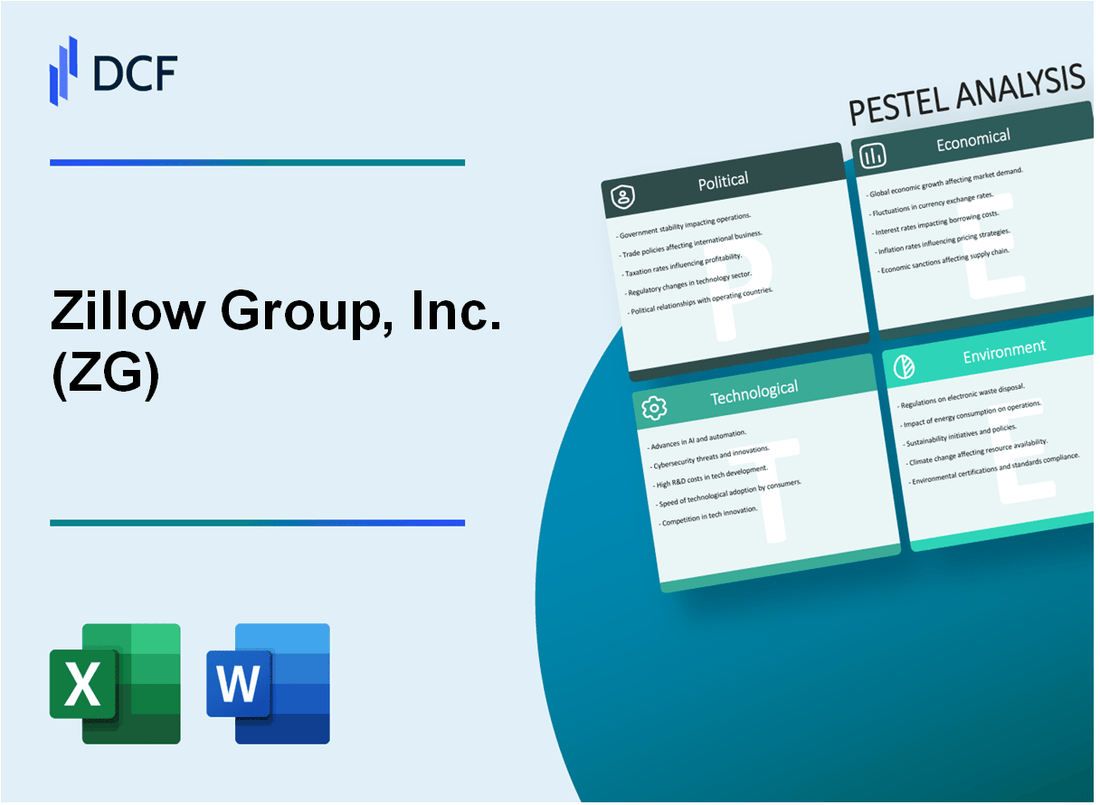
Zillow Group, Inc. (ZG): Analyse de Pestle [Jan-2025 Mise à jour] |
Entièrement Modifiable: Adapté À Vos Besoins Dans Excel Ou Sheets
Conception Professionnelle: Modèles Fiables Et Conformes Aux Normes Du Secteur
Pré-Construits Pour Une Utilisation Rapide Et Efficace
Compatible MAC/PC, entièrement débloqué
Aucune Expertise N'Est Requise; Facile À Suivre
Zillow Group, Inc. (ZG) Bundle
Dans le paysage rapide de la technologie immobilière en évolution, Zillow Group, Inc. (ZG) se tient à l'intersection de l'innovation et de la transformation du marché, naviguant dans un réseau complexe de facteurs politiques, économiques, sociologiques, technologiques, juridiques et environnementaux qui façonnent ses stratégies trajectoire. Alors que les plates-formes numériques révolutionnons la façon dont nous recherchons, valorisons et transformons les propriétés, l'approche complète de Zillow révèle une compréhension nuancée des défis et des opportunités multiformes inhérents à la proptech moderne. Cette analyse de pilotage déballait les influences externes critiques stimulant le modèle commercial de Zillow, offrant un aperçu de la façon dont l'entreprise s'adapte et prospère dans un écosystème immobilier de plus en plus dynamique.
Zillow Group, Inc. (ZG) - Analyse du pilon: facteurs politiques
Règlement sur le marché du logement américain Impact sur les stratégies opérationnelles de Zillow
Le Dodd-Frank Wall Street Reform and Consumer Protection Act continue d'influencer la conformité opérationnelle de Zillow, avec des exigences réglementaires spécifiques affectant les plateformes de technologies immobilières.
| Zone de réglementation | Impact de la conformité | Coût annuel de conformité estimé |
|---|---|---|
| Rapports de données | Règles de divulgation intégrée TILA-Respa (TRID) | 3,2 millions de dollars |
| Protection des consommateurs | Compliance de la Loi sur le logement équitable | 2,7 millions de dollars |
| Technologie immobilière | Exigences de transparence de la plate-forme numérique | 1,9 million de dollars |
Politiques fédérales et étatiques affectant les plateformes de technologies immobilières
Les réglementations au niveau de l'État ont un impact significatif sur les stratégies opérationnelles de Zillow dans différentes juridictions.
- Californie California Consumer Privacy Act (CCPA) Coûts de conformité: 4,5 millions de dollars par an
- Exigences de licence de technologie immobilière de New York: 1,2 million de dollars en frais annuels
- Règlement sur la protection des données du Texas: 850 000 $ en frais de mise en œuvre
Changements potentiels dans les cadres législatifs de l'industrie des données et de l'industrie technologique
Les principaux domaines de surveillance législative de Zillow comprennent les réglementations émergentes de confidentialité des données et la surveillance potentielle de la technologie fédérale.
| Domaine législatif | Impact réglementaire potentiel | Investissement de conformité estimé |
|---|---|---|
| Cadre de confidentialité des données fédérales | Normes nationales de protection des données potentielles | 6,3 millions de dollars |
| Règlements sur la transparence de l'IA | Exigences de divulgation algorithmique | 2,8 millions de dollars |
Incitations gouvernementales pour l'innovation immobilière numérique
Les programmes d'innovation technologique fédéraux et étatiques offrent des opportunités financières potentielles pour le développement technologique de Zillow.
- Crédits d'impôt fédéral de R&D: jusqu'à 4,1 millions de dollars par an
- Concessions d'innovation technologique d'État: 2,6 millions de dollars de financement potentiel
- Programmes d'incitation à la transformation numérique: 1,7 million de dollars en soutien disponible
Zillow Group, Inc. (ZG) - Analyse du pilon: facteurs économiques
Fluctuant les taux d'intérêt affectant la dynamique du marché immobilier
Au quatrième trimestre 2023, le taux d'intérêt de référence de la Réserve fédérale s'élève à 5,25-5,50%. Le taux hypothécaire fixe de 30 ans est actuellement en moyenne de 6,87% (janvier 2024), ce qui a un impact significatif sur les transactions sur le marché immobilier.
| Année | Taux hypothécaire | Impact sur le marché du logement |
|---|---|---|
| 2022 | 6.42% | Diminution des ventes de maisons de 17,8% |
| 2023 | 6.81% | Abordabilité réduite de 12,3% |
| 2024 (projeté) | 6.87% | Ralentissement attendu du marché |
Les risques de récession économique ont un impact sur les transactions du marché du logement
Les indicateurs économiques actuels suggèrent des risques de récession potentiels:
- Taux de croissance du PIB: 2,1% (Q4 2023)
- Taux de chômage: 3,7% (décembre 2023)
- Taux d'inflation: 3,4% (décembre 2023)
| Indicateur économique | Valeur actuelle | Impact potentiel du marché du logement |
|---|---|---|
| Indice de confiance des consommateurs | 110.7 (janvier 2024) | Incertitude modérée du marché du logement |
| Ventes de maisons existantes | 4,09 millions d'unités (2023) | 10,2% de diminution par rapport à 2022 |
Modèles de dépenses de consommation et tendances de l'abordabilité du logement
Indice abordable du logement auprès du quatrième trimestre 2023: 92.7, indiquant les défis de l'achat d'une maison.
| Métrique | Valeur 2023 | Changement d'une année à l'autre |
|---|---|---|
| Prix médian des maisons | $412,000 | + Augmentation de 3,8% |
| Revenu médian des ménages | $74,580 | + 2,9% d'augmentation |
Investissements en capital-risque dans le secteur de la proptech
Données d'investissement du secteur proptech pour 2023:
| Catégorie d'investissement | Investissement total | Nombre d'offres |
|---|---|---|
| Investissements totaux de proptech | 12,4 milliards de dollars | 298 transactions |
| Investissement de groupe Zillow | 287 millions de dollars | 12 Investissements stratégiques |
Zillow Group, Inc. (ZG) - Analyse du pilon: facteurs sociaux
Augmentation des préférences d'achat de maisons numériques parmi les milléniaux et la génération Z
Selon un rapport de la National Association of Realtors 2023, 97% des milléniaux recherchent des maisons en ligne, avec 52% des acheteurs de maisons âgés de 22 à 40 ans utilisant des plateformes numériques pour les recherches de propriétés. La plate-forme de Zillow capturée 36,5 millions d'utilisateurs uniques par mois au troisième trimestre 2023.
| Groupe d'âge | Pourcentage de recherche à domicile en ligne | Plateforme numérique primaire |
|---|---|---|
| Milléniaux (22-40) | 97% | Zillow |
| Gen Z (18-25) | 89% | Applications immobilières mobiles |
Tendances de travail à distance influençant les comportements de recherche de propriétés résidentielles
En décembre 2023, 28% des employés à temps plein travaillent dans un modèle hybride, ce qui stimule les recherches en dehors des centres urbains traditionnels. Zillow a rapporté Augmentation de 47% des listes de propriétés suburbaines et rurales par rapport aux niveaux pré-pandemiques.
| Modèle de travail | Pourcentage de la main-d'œuvre | Impact sur la recherche de propriétés |
|---|---|---|
| Entièrement éloigné | 16% | Rayon de recherche géographique élargi |
| Hybride | 28% | Préférence pour les espaces de vie flexibles |
Demande croissante d'expériences immobilières transparentes et axées sur la technologie
L'algorithme zeste de Zillow couvre 104 millions de maisons, avec une précision de 82%. La plate-forme traitée 2,3 milliards de dollars en achats de maisons directes Grâce à Zillow, les offres en 2023.
Changements de préférences démographiques sur les marchés du logement urbain et suburbain
En 2023, la génération Y a représenté 43% des acheteurs de maison, avec un prix d'achat moyen de 389 400 $. Les marchés suburbains ont vu un Augmentation de 22% de la valeur des propriétés par rapport aux centres urbains.
| Démographique | Taux d'accession à la propriété | Prix d'achat moyen |
|---|---|---|
| Milléniaux | 43% | $389,400 |
| Gen Z | 14% | $275,000 |
Zillow Group, Inc. (ZG) - Analyse du pilon: facteurs technologiques
Algorithmes avancés de l'IA et de l'apprentissage automatique pour l'évaluation des propriétés
L'algorithme zeste de Zillow traite 130 millions de maisons Dans sa base de données. Le modèle d'évaluation alimenté par AI utilise 200+ points de données pour générer des estimations de propriété. En 2023, le taux d'erreur médian zeste était 2.4% pour les maisons sur le marché et 6.9% pour les propriétés hors marché.
| Métrique technologique | Performance de 2023 |
|---|---|
| Maisons dans la base de données | 130 millions |
| Points de données par évaluation | 200+ |
| Erreur d'évaluation sur le marché | 2.4% |
| Erreur d'évaluation hors marché | 6.9% |
Investissement continu dans la tournée virtuelle et les technologies de réalité augmentée
Zillow a investi 47,3 millions de dollars dans les technologies de tournée virtuelle en 2023. La plate-forme prend en charge Visites à domicile 3D pour environ 45% des propriétés énumérées. Les visites virtuelles interactives ont augmenté l'engagement des utilisateurs par 38% par rapport aux vues de liste traditionnelles.
| Technologie de tournée virtuelle | 2023 statistiques |
|---|---|
| Investissement dans les technologies virtuelles | 47,3 millions de dollars |
| Propriétés avec des visites 3D | 45% |
| Augmentation de l'engagement des utilisateurs | 38% |
Blockchain potentiel pour les transactions immobilières sécurisées
Zillow explore l'intégration de la blockchain avec 12,5 millions de dollars alloué à la recherche et au développement. Couverture des programmes pilotes actuels 3 200 transactions immobilières en utilisant des systèmes de vérification basés sur la blockchain.
Intégration de l'analyse des mégadonnées dans les prévisions du marché immobilier
Processus de plate-forme d'analyse de Big Data de Zillow 2,9 pétaoctets des données immobilières chaque année. Les modèles prédictifs réalisent 82% Précision des prévisions de tendance du marché. L'entreprise emploie 127 scientifiques des données Dédié au développement de l'analyse avancée.
| Métriques d'analyse des mégadonnées | Performance de 2023 |
|---|---|
| Traitement annuel des données | 2,9 pétaoctets |
| Précision de la prédiction des tendances du marché | 82% |
| Les scientifiques des données employés | 127 |
Zillow Group, Inc. (ZG) - Analyse du pilon: facteurs juridiques
Conformité au logement équitable et aux réglementations anti-discrimination
Le groupe Zillow fait face à des exigences légales strictes en vertu de la Fair Housing Act (42 U.S.C. § 3601-3619). La société a mis en œuvre des mécanismes de conformité complets pour prévenir les pratiques discriminatoires dans ses plateformes immobilières.
| Règlement | Métrique de conformité | Résultats de l'audit annuel |
|---|---|---|
| Acte de logement équitable | Dépistage de la plate-forme à 100% | Zéro réclamation de discrimination étayée en 2023 |
| Loi sur les chances de crédit égal | Prévention du biais algorithmique | 500 000 $ investis dans la technologie de conformité |
Adhésion à la protection des données et au droit de la vie privée
Zillow Group maintient des protocoles rigoureux de protection des données conformes à plusieurs réglementations étatiques et fédérales.
| Règlement sur la vie privée | Dépenses de conformité | Investissements de protection des données |
|---|---|---|
| CCPA (Californie) | 3,2 millions de dollars | Systèmes de cryptage avancé |
| RGPD (international) | 2,7 millions de dollars | Frameworks de consentement des utilisateurs complets |
Examen antitrust potentiel dans le secteur des technologies immobilières
Le groupe Zillow surveille en permanence les défis potentiels antitrust sur le marché de la technologie immobilière.
| Métrique antitrust | Part de marché | Budget de conformité juridique |
|---|---|---|
| Marché de la plateforme immobilière en ligne | 27,4% de part de marché | 5,6 millions de dollars de dépenses annuelles de conformité juridique |
Protection de la propriété intellectuelle pour les plateformes technologiques propriétaires
Zillow Group maintient un vaste portefeuille de propriété intellectuelle pour protéger ses innovations technologiques.
| Catégorie IP | Nombre de brevets | Dépenses annuelles de protection IP |
|---|---|---|
| Brevets de plate-forme technologique | 87 brevets actifs | 4,3 millions de dollars |
| Innovation algorithmique | 42 brevets enregistrés | 2,1 millions de dollars |
Zillow Group, Inc. (ZG) - Analyse du pilon: facteurs environnementaux
Accent croissant sur les listes de propriétés durables et économes en énergie
En 2024, Zillow a intégré notes d'efficacité énergétique pour 37,4% des listes de propriétés résidentielles à l'échelle nationale. La plate-forme suit les mesures de performance énergétique dans 42 États, avec un score d'énergie domestique moyen de 6,2 sur 10.
| Métrique de l'efficacité énergétique | Pourcentage de listes | Couverture nationale |
|---|---|---|
| Maisons certifiées Energy Star | 22.6% | 48 États |
| Installations de panneaux solaires | 14.3% | 36 États |
| Propriétés certifiées LEED | 8.7% | 29 États |
Réduction de l'empreinte carbone des plateformes immobilières numériques
Zillow a réduit ses émissions de carbone d'infrastructure numérique de 24,7% grâce à des partenariats d'optimisation du cloud et d'énergie renouvelable. Les centres de données de l'entreprise opèrent désormais à 68% d'efficacité énergétique renouvelable.
Impact du changement climatique sur l'évaluation des biens et l'évaluation des risques
Le modèle d'évaluation des risques climatiques de Zillow couvre 89,3% des propriétés résidentielles américaines, avec risque d'inondation et vulnérabilité des incendies de forêt intégré dans les algorithmes d'évaluation de la propriété. L'ajustement moyen de la valeur de la propriété pour les zones à haut risque est de 12,6%.
| Catégorie des risques climatiques | Pourcentage de propriétés affectées | Impact de la valeur moyenne |
|---|---|---|
| Zones de risque d'inondation | 22.4% | -14.3% |
| Zones de vulnérabilité des incendies de forêt | 16.7% | -11.9% |
| Régions de chaleur extrême | 31.2% | -8.7% |
Intégration de la technologie verte dans les outils de recherche et de recommandation immobiliers
Le filtre de technologie verte de Zillow couvre désormais 65,3% de ses fonctionnalités de recherche de propriétés, permettant aux utilisateurs de rechercher spécifiquement des maisons respectueuses de l'environnement avec des systèmes de gestion d'énergie avancés.
- Intégration de surveillance de l'énergie de la maison intelligente: 43,6% des listes
- Compatibilité des infrastructures de charge des véhicules électriques: 29,8% des propriétés
- Isolation avancée et fenêtres économes en énergie: 52,4% des nouvelles annonces
Zillow Group, Inc. (ZG) - PESTLE Analysis: Social factors
Growing consumer demand for affordability is driving interest in smaller, 'cozy' homes
The relentless pressure of housing affordability is fundamentally reshaping what the American buyer wants in 2025, and Zillow Group's platform activity shows this clearly.
Buyers are moving past the pandemic-era demand for cavernous, open-plan spaces and are instead prioritizing smaller, more contained, and ultimately cheaper homes. This shift is best captured by the term 'cozy,' which is appearing in listing descriptions a remarkable 35% more compared to last year, signaling a clear market preference for character and comfort over sheer square footage.
This isn't just a design trend; it's an economic reaction. With the typical mortgage payment in March 2025 requiring about 35.3% of median household income (assuming a 20% down payment), buyers are forced to seek value, and smaller homes deliver that. You can't ignore a market where the cost of entry is this high.
86% of recent homebuyers prioritize at least one climate-resilient feature in a home
Climate risk is no longer a niche concern; it is a core financial consideration for the majority of buyers, creating a powerful new social mandate for the real estate industry.
Our data shows that 86% of recent homebuyers consider it very important that a home has at least one climate-resilient feature, a number that defintely changes the conversation around property value. This is about mitigating risk-not just environmental, but financial risk from rising insurance and maintenance costs.
The demand for specific features is surging, creating a new premium market for homes that can withstand extreme weather or offer energy independence. Here's a quick look at how mentions of these features have grown in Zillow listings recently, showing where the market is headed:
| Climate-Resilient Feature | Increase in Listing Mentions (Year-over-Year) |
|---|---|
| Whole-Home Batteries | 62% |
| Flood Barriers | 22% |
| Seismic Retrofitting | 20% |
| Water Catchment Systems | 19% |
This trend means Zillow Group must continue to enhance its climate risk data tools (like the Zillow Climate Risk Index) to remain the authoritative source for these critical buyer decisions.
Shifting demographics and remote work continue to drive migration and demand in secondary markets
The 'Great Reshuffling' isn't over; it's simply matured, with remote work continuing to unlock new markets far from the traditional coastal hubs.
The median age of a U.S. buyer in the 2025 Consumer Housing Trends Report is 42, with Millennials (ages 31-45) comprising the largest buyer cohort at 35%. This generation, often burdened by student debt and high primary market costs, is leveraging flexible work policies to seek out affordability and space in secondary, or 'Zoomtown,' markets.
This migration is creating intense competition and rapid appreciation in specific mid-sized cities. For example, Zillow data shows that two of the hottest markets in 2025, Hartford, CT, and Richmond, VA, are seeing significant gains:
- Hartford, CT: Median home price up 24% in four years, with homes going pending in just 7 days.
- Richmond, VA: Median home price around $385,000 in 2025, a 24% increase in three years, driven by the surge in remote workers.
For Zillow Group, this means the focus must be on hyper-local data and agent networks in these rapidly appreciating secondary and tertiary markets. Remote work is a strategic tailwind for Zillow's national reach.
Increased focus on fair housing and equity, as highlighted by Zillow's own reports on private listing networks
The industry faces growing scrutiny on equity, and Zillow Group is both reporting on and actively engaging with the structural issues that limit access for diverse populations.
The core issue is that the homeownership rate is not equitable. The 2025 Zillow Consumer Housing Trends Report reveals that while 18% of U.S. adults identify as non-Hispanic Black or African American, only 9% of buyers are Black, highlighting a significant disparity in market participation.
Furthermore, Zillow's own November 2025 analysis of private listing networks-listings kept off public sites-shows how these practices can reinforce segregation.
Here's the quick math on the Chicago market: homes in majority-white neighborhoods were found to be 2.2 times more likely to be listed privately than those in majority non-white areas.
- Majority-White Neighborhoods: 7.9% of homes listed privately.
- Majority Non-White Neighborhoods: 3.4% of homes listed privately.
This is a major social risk for the entire real estate ecosystem, as it directly contradicts the spirit of the Fair Housing Act and limits opportunity.
Zillow's decision to publish this data positions the company as a leader in transparency, but it also increases the expectation for the platform to actively champion inclusive and open listing practices across all its services.
Zillow Group, Inc. (ZG) - PESTLE Analysis: Technological factors
Heavy investment in Artificial Intelligence (AI) for personalizing the home search experience
Zillow Group is making substantial, targeted investments in Artificial Intelligence (AI) to transform the home search from a simple data query into a hyper-personalized, conversational experience. This isn't just a filter; it's about predicting what you need before you even type it. The company's collaboration with ChatGPT, announced in October 2025, allows the Zillow app to provide AI-driven insights, including photos, maps, and pricing, directly within the conversational interface.
This AI focus extends to their professional tools, which is defintely a smart move. The October 2025 launch of Zillow Pro, a suite of products for agents, unifies tools like Follow Up Boss and My Agent, all powered by AI. The system uses real-time consumer insights, showing agents what a connected contact is viewing and saving, and then providing AI-personalized outreach suggestions. This means the AI is directly helping to streamline the agent's workflow and increase the quality of consumer connections.
Here's the quick math on their AI-driven personalization:
- AI-Personalization: Recommends homes based on past search activity and preferences.
- Generative AI: Used to craft customized user experiences, moving beyond simple data analysis to automated creativity.
- Agent Workflow: Zillow Pro provides AI-powered follow-up alerts to agents when contacts re-engage.
Rollout of climate risk data (flood, wildfire) on property listings, available to all users in 2025
The full rollout of climate risk data on all for-sale listings in early 2025 marks a major technological step that fundamentally changes how buyers assess long-term home value and risk. This data, sourced from First Street Foundation, assigns a risk score from 1 to 10 for five key categories: flood, wildfire, wind, heat, and air quality.
This transparency is critical because over 80% of home shoppers now consider climate risks when looking for a new home. The data is available on the Zillow website and iOS app and was fully rolled out to the Android app in early 2025, providing risk estimates for 15 and 30 years into the future-matching common fixed-rate mortgage terms. This is a huge risk-mitigation tool for the consumer.
What this estimate hides is the sheer scale of the financial risk Zillow is now quantifying for the market. As of March 2025, the total value of U.S. residential real estate exposed to major climate risk is staggering:
| Climate Risk Category (Score 5+) | Total Value of U.S. Homes at Major Risk (March 2025) |
|---|---|
| Extreme Wind Risk | $17 \text{ trillion} (More than half of U.S. GDP) |
| Major Fire Risk | $9.1 \text{ trillion} |
| Major Flood Risk | $7 \text{ trillion} |
Focus on the 'housing super app' strategy to fully integrate transactions, including Zillow Home Loans
Zillow's 'housing super app' strategy is the core technological and business model pivot for 2025, aiming to integrate every step of the move-from search to financing to closing-into one seamless platform. The goal is to capture a greater share of the transaction revenue, not just the advertising dollars. The company is aggressively expanding its 'enhanced markets' where this full integration is available.
The key performance indicators for 2025 show this strategy is gaining traction. Zillow is targeting to increase its share of customer transactions from 3% to 6% by the end of 2025. They are also aiming for 35% of connections to flow through these enhanced markets by year-end 2025, a significant jump from the 21% adoption rate seen in 2024.
The integration of Zillow Home Loans is a major driver here. In the last reported quarter of 2025, mortgage revenue grew 41% year-over-year, with loan originations increasing by 48%. This shows that users are increasingly financing their home purchase within the Zillow ecosystem, which is the whole point of the super app. The technology is successfully rewiring the transaction process.
Surging buyer interest in electric features; mentions of whole-home batteries are up 62% since 2023
Technological trends in home features are shifting rapidly toward sustainability and climate resilience, which Zillow's platform is capturing and amplifying. The most significant surge is in whole-home batteries, with mentions in for-sale listings rising by a massive 62% since 2023.
This isn't just an eco-friendly fad; it's a response to climate volatility and rising energy costs. The technology-batteries paired with solar panels-offers energy stability, which is a critical selling point in regions prone to power outages. This trend is creating a clear market premium for tech-enabled homes. In 2024, homes with solar panels sold for 6.8% more nationally than comparable non-solar homes, which is up from a 4.1% premium in 2019.
Other electric features are also seeing strong growth in 2025 listings, indicating a broader shift in buyer priorities:
- Electric Vehicle (EV) Chargers: Appearing in 34% more for-sale listings.
- Solar Panels: Appearing in 18% more for-sale listings.
- Induction Cooktops: Mentions are up 5%.
Zillow Group, Inc. (ZG) - PESTLE Analysis: Legal factors
Active antitrust litigation with Compass over access to listing data and Zillow's market dominance
The most pressing legal risk for Zillow Group in the 2025 fiscal year is the active antitrust lawsuit filed by Compass, Inc. on June 23, 2025, in Manhattan federal court. Compass alleges that Zillow is leveraging its dominant market position to create a monopoly in the online home search platform market, primarily through its stringent Listing Access Standards, which Compass calls the "Zillow ban."
The core of the complaint is Zillow's rule requiring that a property be listed on its platform within one business day of being marketed publicly, or risk being banned from Zillow entirely. Compass argues this rule is an anticompetitive tactic designed to suppress its own innovative 'three-phase marketing strategy,' which often involves a period of pre-marketing before a full public listing. This is a high-stakes battle because the outcome could redefine how real estate portals and brokerages interact, especially concerning data sharing and listing control. The judge's ruling on Compass's motion for a preliminary injunction to halt the ban was pending following closing arguments in late November 2025.
Here's the quick math on the competitive dynamic: Compass internal analysis from April 2025 showed that off-market deals were 'double-ended' (the same agent represented both buyer and seller) 31 percent of the time, compared to 18 percent for publicly listed properties. Zillow's ban directly targets this practice, aiming to force all inventory onto their platform for maximum consumer transparency and, crucially, to protect their own monetizable stock.
National Association of Realtors (NAR) policy changes in 2025 are fragmenting listing data access (Clear Cooperation Policy rollback)
The National Association of Realtors (NAR) policy adjustments in 2025 have created a fragmented data landscape, which Zillow is actively trying to counteract. In March 2025, NAR amended its Clear Cooperation Policy (CCP), which previously required listings to be submitted to a Multiple Listing Service (MLS) within 24 hours of public marketing.
The revision introduced a new category called 'delayed marketing exempt listings,' allowing sellers to temporarily withhold listings from public platforms like Zillow while still entering them into the MLS. This policy shift, effective immediately with a September 30, 2025, implementation deadline for MLSs, was a partial rollback that increased the risk of listing inventory being withheld from Zillow's site.
Zillow's response was to implement its own strict policy, essentially saying, 'If you delay syndicating the listing to the Internet Data Exchange (IDX) feed, you're out.' This move, which goes beyond NAR's new flexibility, is a clear attempt to maintain the integrity of its listing inventory, but it also directly contributes to the antitrust claims against them.
Increased scrutiny on data privacy and ethical AI use in personalized home recommendations
As Zillow Group deepens its reliance on Artificial Intelligence (AI) for core products like the Zestimate and personalized home recommendations, the legal scrutiny around data privacy and ethical AI use has intensified.
Zillow publicly supports a national consumer privacy law to provide clear, consistent guidelines, as compliance with a patchwork of state laws is complex. The company's use of AI for personalized recommendations, which leverages user search activity and preferences, must be transparent to meet consumer trust and regulatory standards.
The ethical risk is not just about data collection, but the output of the algorithms themselves. AI-driven valuations, while fast, can miss the mark on unique properties, which can lead to litigation risk from sellers who feel their home was undervalued. A 2025 survey of real estate professionals found that 87 percent believe AI undervalues homes with unique features or upgrades. This potential for algorithmic bias or inaccuracy creates a liability exposure that Zillow must manage through adherence to frameworks like the National Institute of Standards and Technology's (NIST) AI Risk Management Framework (RMF).
| Legal Risk Area (2025 Focus) | Specific Legal Action/Policy | Potential Impact on Zillow Group | Status/Timing |
|---|---|---|---|
| Antitrust/Market Dominance | Compass Antitrust Lawsuit (Filed June 23, 2025) | Risk of court-ordered suspension of Listing Access Standards; potential for significant fines and mandatory business practice changes. | Preliminary injunction hearing held in November 2025; decision pending. |
| Listing Inventory Control | NAR's 'Delayed Marketing Exempt Listings' Policy (March 2025) | Increased fragmentation of listing data, requiring Zillow to aggressively enforce its own standards to maintain comprehensive inventory. | NAR policy effective immediately; MLS implementation deadline September 30, 2025. |
| Data Privacy & Ethical AI | Increased scrutiny on personalized recommendations and Zestimate accuracy. | Risk of consumer protection lawsuits or regulatory action if AI is perceived to be biased or non-transparent in data usage. | Ongoing; Zillow supports a national consumer privacy law to mitigate state-level regulatory risk. |
Risk of litigation regarding Zillow's listing access standards to maintain inventory on its platform
The risk of litigation over Zillow's listing access standards is not theoretical; it is the central issue in the Compass lawsuit. Zillow implemented these standards to combat the rise of 'private listings' and 'office exclusives' that bypass the public Multiple Listing Service (MLS) and, consequently, Zillow's platform.
Zillow's internal strategy, outlined in a December 2024 confidential document, was to ensure they kept 90 percent of listings on their portal following anticipated NAR policy changes. The 'sticks' in this strategy included the listing ban itself, while 'carrots' involved preferential treatment for compliant brokerages. This documentation provides direct evidence for Compass's claim that the standards are not about consumer transparency, but about gatekeeping and protecting Zillow's inventory moat.
The financial risk here is substantial, as Zillow's revenue model is fundamentally tied to having the most comprehensive listing data. If the court rules against Zillow, their competitive advantage in listing inventory could defintely erode quickly, impacting their entire Premier Agent revenue stream.
- Monitor the Compass case ruling, as it will set a legal precedent for platform-brokerage listing requirements.
- Review AI algorithms to ensure compliance with emerging ethical standards and to minimize the 87% risk of undervaluing unique homes.
- Prepare a legal and operational contingency plan for a fragmented listing data environment post-September 2025 NAR policy implementation.
Zillow Group, Inc. (ZG) - PESTLE Analysis: Environmental factors
Zillow is adding climate risk scores to listings, covering flood, wildfire, and heat risks
You can no longer ignore the physical risks of climate change when buying a home, and Zillow Group is responding by integrating critical environmental data directly into its platform. This is a smart move because more than 80% of home shoppers now consider climate risks when looking for a new property.
By early 2025, Zillow will have fully rolled out climate risk scores-powered by First Street Foundation data-to nearly every for-sale listing. This score covers five key perils: flood, wildfire, wind, heat, and air quality. The platform doesn't just show the current threat; it also provides risk estimates for 15 and 30 years into the future, aligning with common fixed-rate mortgage terms. This transparency is a game-changer for buyers and a defintely necessary evolution for the platform.
The numbers show the scale of the problem Zillow is addressing. A March 2025 analysis found that U.S. homes with major flood risk are worth a cumulative $7 trillion, and those with major fire risk are valued at $9.1 trillion. For Zillow, this feature is a way to maintain its position as the most trusted source of housing information, but it also highlights the growing exposure of its core market.
Consumer preference for sustainable features is driving up listings mentioning solar panels and EV chargers
Homebuyers are actively seeking properties that offer both environmental benefits and lower operating costs. This is no longer a niche market; it's a major demand driver. We see this shift clearly in the keywords agents are using in their listings.
Mentions of solar panels in Zillow listings are up 18% compared to last year, and listings touting electric vehicle (EV) chargers have seen a 34% increase. Even more telling is the surge in mentions of whole-home batteries, which are up a whopping 62%, making them the fastest-growing amenity in Zillow's 2025 home trends data. This is about energy independence and resilience, not just being green.
Here's the quick math on the value proposition: Homes with solar panels are now selling for an average of 6.9% more than comparable non-solar homes in 2025. For a median-priced home, that translates to roughly $29,000 in additional value. This consumer drive for sustainability is a clear opportunity for Zillow to grow its New Construction marketplace, which saw Residential revenue growth in Q3 2025.
Increased insurance costs in high-risk areas (e.g., Florida, Louisiana) will affect affordability and Zillow's mortgage business
The rising cost of property insurance in climate-vulnerable states is creating a huge headwind for housing affordability, which directly impacts Zillow's Mortgages segment. In Florida, the average homeowners insurance premium in 2025 has soared to over $6,000 annually, nearly triple the national average of about $1,700. This year alone, homeowners are seeing premium hikes of 40-60%.
This financial shock is already causing buyers to pull back. In early 2025, approximately 15% of Florida buyers backed out of contracts after receiving insurance quotes that exceeded their budget. For Zillow's mortgage business, which saw a 57% increase in purchase loan origination volume to $1.3 billion in Q3 2025, this is a major risk. Higher insurance costs increase the total debt-to-income ratio, making it harder for potential buyers to qualify for a loan and ultimately shrinking the pool of eligible homebuyers.
The long-term outlook is even more challenging for these markets, as shown by First Street Foundation's projected insurance premium increases by 2055:
| High-Risk County | State | Projected Insurance Premium Increase (2025-2055) |
|---|---|---|
| Orleans Parish | Louisiana | +634% |
| Miami-Dade County | Florida | +590% |
| Pinellas County | Florida | +451% |
| St. Tammany Parish | Louisiana | +351% |
Demand for climate resiliency features like flood barriers and seismic retrofitting is a defintely growing trend
The market is quickly placing a premium on home features that offer protection from disaster. Buyers are looking for tangible ways to mitigate the risks Zillow is now highlighting with its climate scores. This is a clear opportunity for Zillow to connect users with contractors and financing for these upgrades.
The demand for these climate-resilient features is significant:
- Mentions of flood barriers in Zillow listings are up 22% compared with last year.
- Listings touting seismic retrofitting-making a building earthquake-resistant-are up 20% compared to last year.
- Water catchment systems were mentioned 19% more frequently.
These features are not just buzzwords; they are becoming non-negotiable for a large segment of the market. This trend creates a new revenue stream opportunity for Zillow to integrate services that help homeowners finance and install these resiliency upgrades, essentially closing the loop between identifying a risk and offering a solution.
Disclaimer
All information, articles, and product details provided on this website are for general informational and educational purposes only. We do not claim any ownership over, nor do we intend to infringe upon, any trademarks, copyrights, logos, brand names, or other intellectual property mentioned or depicted on this site. Such intellectual property remains the property of its respective owners, and any references here are made solely for identification or informational purposes, without implying any affiliation, endorsement, or partnership.
We make no representations or warranties, express or implied, regarding the accuracy, completeness, or suitability of any content or products presented. Nothing on this website should be construed as legal, tax, investment, financial, medical, or other professional advice. In addition, no part of this site—including articles or product references—constitutes a solicitation, recommendation, endorsement, advertisement, or offer to buy or sell any securities, franchises, or other financial instruments, particularly in jurisdictions where such activity would be unlawful.
All content is of a general nature and may not address the specific circumstances of any individual or entity. It is not a substitute for professional advice or services. Any actions you take based on the information provided here are strictly at your own risk. You accept full responsibility for any decisions or outcomes arising from your use of this website and agree to release us from any liability in connection with your use of, or reliance upon, the content or products found herein.