

|
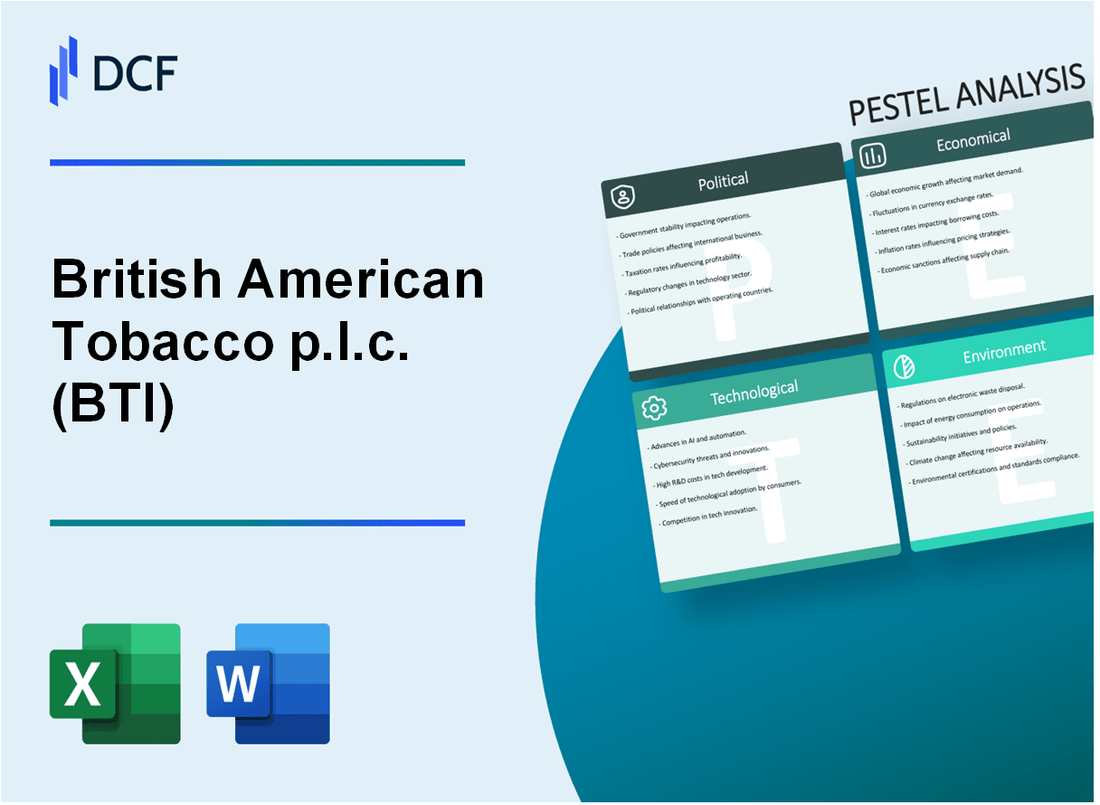
British American Tobacco P.L.C. (BTI): Análise de Pestle [Jan-2025 Atualizado] |
Totalmente Editável: Adapte-Se Às Suas Necessidades No Excel Ou Planilhas
Design Profissional: Modelos Confiáveis E Padrão Da Indústria
Pré-Construídos Para Uso Rápido E Eficiente
Compatível com MAC/PC, totalmente desbloqueado
Não É Necessária Experiência; Fácil De Seguir
British American Tobacco p.l.c. (BTI) Bundle
No complexo mundo da indústria global de tabaco, o British American Tobacco P.L.C. (BTI) Navega um cenário desafiador de regulamentos em evolução, mudanças de atitudes do consumidor e interrupção tecnológica. Essa análise abrangente de pestles revela os fatores externos multifacetados que moldam as decisões estratégicas da BTI, revelando como a empresa se adapta às pressões do mercado sem precedentes, ao mesmo tempo em que exploram caminhos inovadores no consumo de nicotina. De políticas governamentais rigorosas a desenvolvimentos tecnológicos inovadores, a jornada da BTI reflete as profundas transformações que desafiavam os modelos tradicionais de negócios de tabaco no século XXI.
British American Tobacco P.L.C. (BTI) - Análise de pilão: fatores políticos
Aumentando os regulamentos globais sobre publicidade e embalagem de tabaco
A partir de 2024, 90 países implementaram proibições abrangentes de publicidade de tabaco. A Convenção -Quadro da Organização Mundial da Saúde sobre Controle de Tabaco (OMS FCTC) foi ratificada por 182 países.
| Região | Nível de restrição de publicidade | Gravidade da regulação da embalagem |
|---|---|---|
| União Europeia | Proibição completa | Avisos de saúde gráfica obrigatória cobrindo 65% da embalagem |
| Austrália | Proibição total de marketing | Embalagem simples obrigatória desde 2012 |
| Estados Unidos | Restrições parciais | Avisos gráficos necessários |
Políticas governamentais direcionadas ao consumo reduzido de tabaco
As estratégias tributárias impactaram significativamente o consumo de tabaco:
- Taxa média de imposto sobre tabaco médio: 48.5% de preço de varejo
- Receita média tributária de tabaco globalmente: US $ 269 bilhões anualmente
- Gastos globais de controle de tabaco projetado: US $ 7,4 bilhões até 2025
Tensões comerciais internacionais que afetam o acesso ao mercado do tabaco
Barreiras e restrições comerciais criaram desafios significativos no mercado:
| País | Tarifas de importação | Restrições de acesso ao mercado |
|---|---|---|
| China | Tarifa de importação de 50% | Controle de monopólio estatal estrito |
| Índia | 40% de imposto de importação | Leis abrangentes de controle de tabaco |
| Brasil | Tarifa de importação de 35% | Barreiras significativas de entrada de mercado |
Medidas estritas de controle de tabaco em vários países
Cenário global de controle de tabaco:
- 168 países implementaram leis livres de fumo
- Idade média do fumo legal médio: 18 anos
- Países com legislação abrangente de controle de tabaco: 53% globalmente
As tendências regulatórias emergentes incluem aumento da tributação, restrições de marketing e iniciativas de saúde pública direcionadas à redução do consumo de tabaco.
British American Tobacco P.L.C. (BTI) - Análise de pilão: fatores econômicos
Demanda global de mercado global de tabaco
O tamanho do mercado global de tabaco foi de US $ 849,2 bilhões em 2022, projetado para atingir US $ 951,6 bilhões até 2030, com um CAGR de 1,4%. O volume global de cigarros da British American Tobacco em 2022 foi de 553 bilhões de paus, representando uma participação de mercado de 10,2%.
| Segmento de mercado | 2022 Receita | Quota de mercado |
|---|---|---|
| Tabaco combustível | US $ 25,4 bilhões | 10.2% |
| Novos produtos de categoria | US $ 3,8 bilhões | 5.7% |
Volatilidade da taxa de câmbio
A receita de 2022 da BTI impactada pelas flutuações da moeda: £ 25,7 bilhões reportaram receita, com £ 2,3 bilhões no efeito de tradução de moeda negativa.
| Par de moeda | 2022 Volatilidade | Impacto na receita |
|---|---|---|
| GBP/USD | -11.2% | £ 1,1 bilhão |
| EUR/GBP | -5.7% | £ 0,6 bilhão |
Custos de produção crescentes
Os custos de produção da BTI aumentaram 7,3% em 2022, atingindo £ 18,5 bilhões. Os principais drivers de custo incluídos:
- Preços brutos de tabaco: +12,4%
- Mercancada de fabricação: +6,2%
- Logística e transporte: +9,1%
Diversificação em produtos alternativos de nicotina
A nova receita de produtos de categoria atingiu £ 3,8 bilhões em 2022, representando 13,5% da receita total do grupo.
| Categoria de produto | 2022 Receita | Taxa de crescimento |
|---|---|---|
| Produtos de vapor | £ 1,6 bilhão | 18.3% |
| Tabaco aquecido | £ 1,2 bilhão | 22.7% |
| Oral moderno | £ 0,9 bilhão | 15.6% |
British American Tobacco P.L.C. (BTI) - Análise de pilão: Fatores sociais
Declínio aceitação social do tabagismo tradicional
De acordo com a Organização Mundial da Saúde, a prevalência global do tabagismo diminuiu de 22,7% em 2007 para 17,5% em 2019. No Reino Unido, as taxas de tabagismo de adultos caíram de 20,2% em 2011 para 12,9% em 2021.
| País | Prevalência de fumar 2019 | Prevalência de fumar 2021 |
|---|---|---|
| Reino Unido | 14.1% | 12.9% |
| Estados Unidos | 14.0% | 12.5% |
| União Europeia | 19.8% | 18.2% |
Crescente consciência da saúde entre a demografia mais jovem
Uma pesquisa de 2022 revelou que 73% dos indivíduos com idades entre 18 e 24 anos priorizam a saúde e o bem-estar em suas escolhas de estilo de vida. O mercado global de bem-estar foi avaliado em US $ 4,4 trilhões em 2022, indicando tendências significativas de consumidores focadas na saúde.
Mudança de preferências do consumidor para produtos de risco reduzido
O British American Tobacco relatou que seus novos produtos de categoria (incluindo tabaco aquecida e produtos de vapor) geraram £ 2,1 bilhões em receita em 2022, representando um aumento de 40,5% em relação a 2021.
| Categoria de produto | 2021 Receita | 2022 Receita | Porcentagem de crescimento |
|---|---|---|---|
| Tabaco aquecido | £ 1,2 bilhão | £ 1,7 bilhão | 41.7% |
| Produtos de vapor | £ 0,8 bilhão | £ 1,1 bilhão | 37.5% |
Aumentando a conscientização sobre os riscos à saúde relacionados ao tabaco
Os Centros de Controle e Prevenção de Doenças relataram que o uso de tabaco causa aproximadamente 480.000 mortes anualmente nos Estados Unidos. As despesas globais de saúde relacionadas a doenças induzidas por tabaco atingiram US $ 1,4 trilhão em 2020.
| Impacto na saúde | Estatísticas anuais |
|---|---|
| Mortes globais relacionadas ao tabaco | 8,2 milhões |
| Custos diretos de saúde | US $ 1,4 trilhão |
| Perdas de produtividade | US $ 0,9 trilhão |
British American Tobacco P.L.C. (BTI) - Análise de pilão: fatores tecnológicos
Investimento em tecnologias aquecidas de tabaco e cigarro eletrônico
O British American Tobacco investiu £ 695 milhões em novas tecnologias em 2023. A nova receita de categoria da empresa atingiu 2,1 bilhões de libras em 2022, representando um aumento de 40,4% em relação ao ano anterior.
| Categoria de tecnologia | Valor do investimento (£) | Quota de mercado |
|---|---|---|
| Tabaco aquecido | 422 milhões | 35.6% |
| Cigarros eletrônicos | 273 milhões | 24.8% |
Desenvolvimento de marketing digital e plataformas diretas ao consumidor
A BAT lançou 15 plataformas de engajamento de consumidores digitais em 45 mercados em 2023. As vendas on-line por meio de canais diretos ao consumidor aumentaram 27,3% em comparação com 2022.
| Plataforma digital | Número de mercados | Taxa de envolvimento do usuário |
|---|---|---|
| Plataforma digital de vuse | 38 | 22.5% |
| plataforma digital GLO | 22 | 18.7% |
Tecnologias avançadas de fabricação para inovação de produtos
O BAT implementou 7 tecnologias avançadas de fabricação em 12 instalações de produção em 2023. Os investimentos em automação e precisão de fabricação totalizaram £ 348 milhões.
| Tecnologia de fabricação | Investimento (£) | Melhoria de eficiência |
|---|---|---|
| Moldagem por precisão | 127 milhões | 18.3% |
| Montagem automatizada | 221 milhões | 22.6% |
Pesquisa sobre redução de danos e sistemas alternativos de entrega de nicotina
O BAT alocou £ 524 milhões à pesquisa e desenvolvimento em tecnologias de redução de danos em 2023. A Companhia apresentou 351 novas patentes relacionadas a sistemas alternativos de entrega de nicotina.
| Área de pesquisa | Investimento (£) | Número de patentes |
|---|---|---|
| Tecnologias de redução de danos | 524 milhões | 351 |
| Entrega alternativa de nicotina | 276 milhões | 187 |
British American Tobacco P.L.C. (BTI) - Análise de pilão: fatores legais
Conformidade complexa da regulamentação internacional do tabaco
Paisagem regulatória Overview:
| Região | Principais órgãos regulatórios | Requisitos de conformidade |
|---|---|---|
| União Europeia | Diretiva Europeia de Produtos de Tabaco | Rendimento máximo de alcatrão: 10 mg por cigarro |
| Estados Unidos | Lei de Controle de Tabaco FDA | Divulgação obrigatória para ingredientes |
| Reino Unido | Tabaco e regulamentos de produtos relacionados | Limite de teor de nicotina: 20 mg/ml |
Riscos de litígios em andamento relacionados a reivindicações de saúde
Estatísticas de litígios:
| Ano | Número de ações ativas | Despesas legais estimadas |
|---|---|---|
| 2022 | 387 | US $ 412 milhões |
| 2023 | 423 | US $ 489 milhões |
Requisitos rigorosos de embalagem de produtos e alerta
Regulamentos de embalagens globais:
- Austrália: embalagem simples obrigatória desde 2012
- Canadá: avisos de saúde gráfica cobrindo 75% do pacote
- Reino Unido: embalagem padronizada implementada em 2017
Aumentando restrições nas vendas e distribuição de produtos do tabaco
Métricas de restrição de vendas:
| País | Idade mínima de compra | Restrições de publicidade |
|---|---|---|
| Estados Unidos | 21 anos | Proibição completa da publicidade de TV/rádio |
| Austrália | 18 anos | Proibição abrangente de marketing |
| Reino Unido | 18 anos | A publicidade no ponto de venda proibiu |
British American Tobacco P.L.C. (BTI) - Análise de Pestle: Fatores Ambientais
Compromisso com práticas agrícolas sustentáveis
Métricas do Programa de Sustentabilidade Agrícola:
| Métrica | 2023 dados |
|---|---|
| Agricultores matriculados no Programa de Sustentabilidade | 86,000 |
| Hectares sob agricultura sustentável | 200,000 |
| Melhoria da eficiência da água | 22.4% |
| Práticas de conservação do solo implementadas | 47 países |
Reduzindo a pegada de carbono nos processos de fabricação
Realizações de redução de carbono:
| Métrica de carbono | 2023 desempenho |
|---|---|
| Redução total de emissões de CO2 | 59% (desde 2017) |
| Uso de energia renovável | 43% da energia total |
| Melhoria da eficiência energética | 26.7% |
| Locais de fabricação com zero desperdício no aterro | 74% |
Iniciativas de gerenciamento e reciclagem de resíduos
Desempenho de gerenciamento de resíduos:
| Métrica de gerenciamento de resíduos | 2023 dados |
|---|---|
| Resíduos totais gerados | 129.000 toneladas |
| Taxa de reciclagem de resíduos | 86% |
| Redução de embalagens de plástico | 33% |
| Investimentos em economia circular | £ 37,5 milhões |
Fornecimento sustentável de tabaco e materiais de embalagem
Métricas de fornecimento sustentável:
| Métrica de fornecimento | 2023 desempenho |
|---|---|
| Folha de tabaco sustentável certificada | 62% |
| Fornecedores auditados para sustentabilidade | 1,250 |
| Materiais de embalagem de fontes recicladas | 48% |
| Investimento de embalagem sustentável | £ 22,3 milhões |
British American Tobacco p.l.c. (BTI) - PESTLE Analysis: Social factors
Accelerating Shift from Traditional Cigarettes to New Categories
You're watching a fundamental, irreversible shift in consumer behavior, and it's the main social driver for British American Tobacco. Adult nicotine users are moving away from traditional, combustible cigarettes at a quickening pace, so BTI's entire strategy is built on capturing this transition with its New Categories portfolio (vapor, heated tobacco, and modern oral products).
The numbers from the first half of 2025 make this clear. While the global tobacco industry volume is expected to decline by approximately 2% for the full year 2025, BTI's smokeless portfolio grew to account for 18.2% of Group revenue in H1 2025, an increase of 70 basis points from the end of 2024. The New Categories segment delivered a revenue increase of 2.4% at constant exchange rates in H1 2025. That's real momentum.
Health and Wellness Trends Pressure the Entire Nicotine Industry
The universal focus on health and wellness puts continuous pressure on the entire nicotine industry, not just BTI. Consumers are actively seeking alternatives they perceive as having reduced risk, which is why BTI's 'A Better Tomorrow' strategy, aiming to build a smokeless world, is a social necessity as much as a business strategy. The company is defintely trying to meet the public where they are.
This trend is forcing BTI to commit massive resources to the transition. The long-term ambition is to become a predominantly smokeless business, targeting at least 50% of total revenue from non-combustibles by 2035. More immediately, the company is focused on converting adult smokers, with an ambitious goal of reaching 50 million consumers of its smokeless products by 2030.
New Categories Performance: H1 2025 Snapshot
Here's the quick math on where the consumer shift is hitting hardest in BTI's portfolio, based on H1 2025 performance at constant rates. This shows you exactly which products are resonating with the new social trends and which are struggling with market realities like illicit trade.
| New Category Segment | H1 2025 Revenue Growth (Constant Rates) | Key Driver / Trend |
|---|---|---|
| Modern Oral (Velo) | Up 40.6% | Discreet, smoke-free, and socially acceptable alternative. |
| Heated Products (glo) | Up 3.1% | Reduced-risk perception, strong in markets like Japan and Europe. |
| Vapour (Vuse) | Declined 13.0% | Significant drag from proliferation of illicit, unregulated products in the U.S. and Canada. |
Increased Demand for Discreet, Smoke-Free Alternatives
The social acceptance of nicotine has fundamentally changed. Younger adults, in particular, are demanding discreet, smoke-free nicotine alternatives that align with a less visible, more on-the-go lifestyle. This is a huge tailwind for Modern Oral products like Velo.
In the U.S., the successful launch of Velo Plus in the first half of 2025 drove a remarkable +550 basis point increase in BTI's Modern Oral volume share, pushing it to 11.9%. Plus, social media influence is a major factor, with over 65% of nicotine pouch sales growth in the 2023-2024 period linked to viral content on platforms like TikTok. This is a new marketing battleground.
- Focus on discreet use drives Modern Oral growth.
- Social media accelerates product discovery and sales.
- Flavor variety appeals strongly to younger consumers.
Action: Marketing must continue to prioritize digital channels and lifestyle branding for Velo to capitalize on this social trend.
British American Tobacco p.l.c. (BTI) - PESTLE Analysis: Technological factors
You're looking at British American Tobacco p.l.c. (BTI) and its technology platform, and the core takeaway is simple: the company is in a high-stakes, high-cost technology race where innovation is the only way to protect its future cash flow. The shift to New Categories (Vapour, Heated Tobacco, Modern Oral) means BAT is now a consumer electronics company that also sells nicotine, and that requires massive, sustained investment.
Here's the quick math: New Categories revenue hit £1,651 million in the first half of 2025, up 2.4% at constant foreign exchange, and the total gross capital expenditure for 2025 is expected to be around £650 million. That money is going straight into the technology that drives the business transformation.
Rapid innovation in Vapour products (e.g., Vuse) requires massive R&D spending.
The pace of development in Vapour products is relentless, forcing BAT to pour capital into R&D to stay ahead of illicit markets and competitors. This isn't just about new flavors; it's about core chemistry and hardware. For example, the 2025 launch of Vuse One focuses on synthetic nicotine, which allows for more precise concentration standardization and consistent production, breaking away from traditional tobacco cultivation constraints.
This innovation drive is central to the goal of becoming a predominantly smokeless business, aiming for >50% of revenue from Smokeless products by 2035. The company's New Category contribution margin improved to 10.6% at constant foreign exchange in H1 2025, up 2.8 percentage points year-on-year, showing that the investment is starting to generate better returns.
Patent litigation is a constant, high-cost factor in the heated tobacco space.
While the threat of patent litigation is a constant risk in this space, a major recent development has offered a period of stability. In February 2024, British American Tobacco and Philip Morris International (PMI) reached a global settlement resolving all ongoing patent infringement litigation related to heated tobacco and vapor products. This agreement, which is valid for eight years, prevents future claims against the companies' current heated tobacco and vapor product portfolios, including BAT's glo and PMI's IQOS.
This settlement drastically reduces the near-term legal and financial uncertainty that had been a multi-year, multi-jurisdiction drain on resources. Still, the underlying need to protect intellectual property (IP) remains, and the cost of defending new patents against smaller, non-settling competitors or future product iterations is a structural cost of doing business in New Categories.
Digital marketing and direct-to-consumer (DTC) platforms are crucial for New Categories.
Regulatory restrictions on traditional advertising for nicotine products mean that a digital-first ecosystem and direct-to-consumer (DTC) platforms are not just a preference, but a necessity. BAT uses these channels to manage compliance, gather consumer data, and build brand loyalty. This is a significant shift from the old tobacco model.
The digital strategy is underpinned by a data and analytics-led approach and a dedicated Digital Confidence Unit (DCU) that monitors social media content 24/7 for compliance and reputational management. This integrated data ecosystem is what allows them to adapt quickly to changing consumer preferences. The launch of the MyVuse app in 2025 is a perfect example of this in action, turning the device into a connected platform.
- Use e-commerce and DTC for direct consumer feedback.
- Ensure all digital marketing is age-restricted and adult-focused.
- Leverage data and analytics to power product innovation.
- Monitor social media 24/7 via the Digital Confidence Unit (DCU).
Device technology improvements are focused on battery life and flavor consistency.
The technology race boils down to delivering a superior, reliable consumer experience. The focus is on small, incremental improvements that drive conversion from combustible cigarettes. The 2025 launch of Vuse Ultra in the UK, for instance, is a premium closed-system device that connects to the MyVuse app, allowing adult consumers to track flavor and performance parameters like auto-tune and puff tracking. That's a defintely a tech-driven value-add.
In the heated tobacco segment, the rollout of the glo Hilo platform in H2 2025 is a key move. Early trials in Serbia showed a doubled trial-to-conversion rate, indicating that the new device technology is significantly more effective at getting smokers to switch. The focus on flavor consistency is also a compliance and quality measure, with BAT emphasizing that its Vuse products use the best materials and flavors, with no sucralose added and no vitamin E acetate.
| New Category Product | 2025 Technological Focus | Key Metric/Data Point (2025) |
|---|---|---|
| Vuse One (Vapour) | Synthetic Nicotine Use | Standardized concentrations, consistent production. |
| Vuse Ultra (Vapour) | App-Connected Device (MyVuse app) | Features like auto-tune and puff tracking; £30 device price point. |
| glo Hilo (Heated Tobacco) | Improved Heating Platform | Doubled trial-to-conversion rates in early trials. |
| New Categories (Overall) | R&D and Capital Investment | FY 2025 Gross Capital Expenditure of approx. £650 million. |
British American Tobacco p.l.c. (BTI) - PESTLE Analysis: Legal factors
You are operating in a legal environment that is not just restrictive but is rapidly evolving, forcing a constant, costly pivot in your product and marketing strategy. The core legal challenge for British American Tobacco p.l.c. (BTI) in 2025 is the regulatory bifurcation: a high-stakes, all-or-nothing approval process for New Categories in the US, coupled with a defintely rising tide of flavor and marketing bans globally.
US FDA Pre-Market Tobacco Product Application (PMTA) process dictates Vapour and THP market access.
The US Food and Drug Administration (FDA) PMTA process remains the single most critical legal gatekeeper for your next-generation products, especially Vapour and Tobacco Heating Products (THP). This isn't a simple registration; it's a multi-year, multi-million-dollar scientific gauntlet that determines market viability. While your Vuse Alto device and its Golden Tobacco and Rich Tobacco flavor pods received Marketing Granted Orders (MGOs) in 2024, securing your legal footing in the US vapor market, the fight continues.
The FDA's Marketing Denial Orders (MDOs) for Vuse Alto's Menthol and Mixed Berry flavors are still being challenged in the courts, and the Menthol product remains on the market under a court-ordered stay. This legal limbo is expensive. More recently, in October 2025, your unit, Reynolds American, paused the planned pilot launch of the Vuse One disposable vape, a product acquired specifically because its previous owner had a PMTA application pending since 2022. This pause came amid an FDA crackdown, underscoring the risk of marketing products without final authorization, even with a pending application.
Defintely rising global legal challenges against flavored nicotine products.
The regulatory pressure on flavors is intensifying globally, threatening the growth engine of your New Categories. While the US menthol cigarette ban proposed by the FDA was withdrawn in January 2025, a short-term reprieve for your highly profitable Newport brand, the risk has simply shifted to state and local levels. We estimate that US menthol sales account for approximately 18% of your total revenue, making this a massive, recurring legal vulnerability.
Internationally, the World Health Organization (WHO) called for an urgent, comprehensive ban on all flavored tobacco and nicotine products in May 2025. In Europe, key markets are moving ahead with their own restrictions.
- Ireland and Spain are considering or implementing bills in 2025 that would limit e-liquid flavors to tobacco only.
- Slovakia is proposing an amendment to ban all e-liquid flavors except menthol, mint, and tobacco.
- In the US, at least 20 states are considering PMTA registry bills in 2025, which, while supported by major tobacco companies to stabilize the market, still rely on a restrictive federal approval process.
Stricter marketing and advertising restrictions across key European and Asian markets.
The legal framework for advertising, promotion, and sponsorship (TAPS) is tightening, particularly for New Categories, as regulators seek to curb youth uptake. The current directives in the European Union (EU) are considered insufficient, and the European Commission is actively revising the Tobacco Products Directive and the Tobacco Advertisement Directive in 2025.
Here's the quick map of what's coming:
| Region/Market | Regulatory Action (2025 Focus) | Potential Impact on BTI |
|---|---|---|
| European Union (EU) | Revision of TPD/TAD to address youth use, cross-border online sales, and social media marketing. Calls for plain packaging, internet sales bans, and point-of-sale display bans. | Significantly increases cost of customer acquisition for Vuse and glo. Forces a complete overhaul of digital and retail marketing strategies. |
| Asia Pacific, Middle East & Africa (APMEA) | Increased excise duties and regulatory challenges in markets like Bangladesh and Australia. | Contributed to a reported 12.3% revenue decline in the APMEA region in H1 2025, demonstrating immediate financial impact. |
| Global (WHO Influence) | WHO's 2025 report highlights that only 13 out of 53 European Region countries ban all forms of TAPS, signaling a major regulatory gap that will likely close in the near term. | Accelerates the global shift towards plain packaging and total media blackout, eroding brand equity for both combustible and New Category products. |
The key takeaway is that the days of broad, unconstrained marketing for New Categories are ending. You will need to rely more on product innovation and retail execution, not just advertising spend.
Ongoing legacy litigation risk related to combustible products is still a major balance sheet item.
While the focus is on New Categories, the legacy litigation from combustible products remains a material balance sheet factor. The good news is that BTI has made significant progress in resolving long-standing issues, which immediately improved your reported operating profit in the first half of 2025.
Specifically, the update to the provision for the Canadian litigation settlement, which now fully resolves all past, present, and future tobacco claims in Canada, resulted in a net credit of £575 million in H1 2025. This compares favorably to the much larger adjusting item of £1,306 million in the prior year (2024), which included impairment charges. This one-time credit is a clear win, but it doesn't eliminate the underlying risk. You still face ongoing litigation in the US and other jurisdictions, which requires a consistent, substantial legal defense budget and continuous monitoring of balance sheet provisions. It's a managed risk, but a risk still.
British American Tobacco p.l.c. (BTI) - PESTLE Analysis: Environmental factors
ESG (Environmental, Social, and Governance) investor pressure on supply chain sustainability
You are defintely seeing the heat from ESG investors, and it's focused sharply on the value chain, which is where most of British American Tobacco's (BTI) environmental impact sits. Scope 3 emissions-the indirect ones from the supply chain-account for over 90% of the company's total carbon footprint, so this is not a minor issue. It's the main event.
To address this, BTI is pushing its suppliers to set their own Science Based Targets (SBTs), which is a clear, actionable metric. The good news is that BTI hit its 2025 target early: by the end of 2024, 23.5% of suppliers of purchased goods and services, by spend, had set SBTs. That's an 8.5 percentage point jump from 2023. They've also expanded their Supplier Climate Enablement Programme to engage with 150 of their top carbon-emitting suppliers, up from 60 the year before. This is a smart move because, honestly, you can't hit Net Zero without getting your suppliers on board.
Focus on reducing the environmental impact of tobacco farming (water, pesticides)
The environmental footprint of tobacco farming, particularly around water use and curing, is a major risk area. BTI has been aggressive here and actually achieved its 2025 water reduction target two years ahead of schedule. As of 2024, the company reported a 47.4% reduction in water withdrawn against its 2017 baseline, which is well past the original 2025 goal of a 35% reduction. That's a strong performance metric.
On the farming side, the focus is on regenerative agriculture (practices that improve soil health). In 2025, BTI is piloting a new regenerative agriculture framework. Also, they've made significant progress in tobacco curing, the energy-intensive process of drying the leaf. More than 87% of the leaf volume is now cured using renewable fuels and methods, and the use of coal across the entire supply chain for curing dropped from 3.3% in 2023 to 2.3% in 2024. That's a real-world reduction that matters.
Significant challenge in managing waste from disposable Vapour products globally
This is where the rubber meets the road on the 'E' in ESG for the New Categories business. The convenience of disposable Vapour products creates a massive electronic waste (e-waste) problem, mainly due to the lithium batteries and plastic components. In the US alone, at least 150 million disposable devices are thrown away annually. In the UK, the scale is staggering, with about 5 million vapes discarded weekly, which contributed around 40 tonnes of lithium to waste streams in 2022.
BTI's response is two-fold: product design and collection. Their Vuse brand is certified as the first global carbon-neutral vaping brand. Critically, BTI has a 2025 target to eliminate unnecessary single-use plastic and make all plastic packaging 100% reusable, recyclable, or compostable. To tackle the end-of-life problem, they run collection programs, like the 'Drop the Pod' campaign in South Africa, which collected 1.5 million pods in its first eight months. This is a clear action, but the sheer volume of global disposable waste means the challenge is still immense and will require regulatory changes, like the disposable vape ban set for June 2025 in England and Wales.
BTI aims for carbon neutrality in its operations by 2030
BTI's climate ambition is centered on achieving carbon neutrality in its operations (Scope 1 and 2 emissions) by 2030, with a broader goal of Net-Zero across the entire value chain (Scope 1, 2, and 3) by 2050. Here's the quick math on their progress as of 2024:
| Metric | 2030 Target (vs. 2020 Baseline) | 2024 Progress (vs. 2020 Baseline) |
|---|---|---|
| Scope 1 & 2 GHG Emissions Reduction | 50% absolute reduction | 42.6% absolute reduction |
| Scope 3 GHG Emissions Reduction (Total) | N/A (Broken down below) | 11% reduction year-on-year (2023-2024) |
| Renewable Energy Use in Operations | 50% | N/A (Target of 30% for 2025 was achieved early) |
The company is investing heavily in this transition. In 2024, they invested a further £19 million in energy reduction initiatives across 63% of their operational sites. This is expected to reduce absolute Scope 1 and 2 emissions by about 27,000 tonnes of CO2e per year once completed. They have also re-submitted their near-term targets to the Science Based Targets initiative (SBTi) to align with a 1.5°C warming pathway. The biggest hurdle remains Scope 3 emissions, which they are tackling through supplier engagement and design for end-of-life.
Disclaimer
All information, articles, and product details provided on this website are for general informational and educational purposes only. We do not claim any ownership over, nor do we intend to infringe upon, any trademarks, copyrights, logos, brand names, or other intellectual property mentioned or depicted on this site. Such intellectual property remains the property of its respective owners, and any references here are made solely for identification or informational purposes, without implying any affiliation, endorsement, or partnership.
We make no representations or warranties, express or implied, regarding the accuracy, completeness, or suitability of any content or products presented. Nothing on this website should be construed as legal, tax, investment, financial, medical, or other professional advice. In addition, no part of this site—including articles or product references—constitutes a solicitation, recommendation, endorsement, advertisement, or offer to buy or sell any securities, franchises, or other financial instruments, particularly in jurisdictions where such activity would be unlawful.
All content is of a general nature and may not address the specific circumstances of any individual or entity. It is not a substitute for professional advice or services. Any actions you take based on the information provided here are strictly at your own risk. You accept full responsibility for any decisions or outcomes arising from your use of this website and agree to release us from any liability in connection with your use of, or reliance upon, the content or products found herein.